REVIEW 5 major objections 5 minor 54 references
CogDDN: A Cognitive Demand-Driven Navigation with Decision Optimization and Dual-Process Thinking
T0 review · 5 major / 5 minor · reviewed 2026-08-06 · deepseek-v4-flash
Pith's one-line read A dual-process, knowledge-augmented VLM system lets a camera-only robot turn vague demands like "I'm thirsty" into successful navigation, more than doubling the prior best single-view method's success on unseen scenes and instructions.
desk verdict A plausible framework with big reported gains, but the abstract overstates the margin and the scene-split ambiguity makes the central generalization claim unverifiable as written. read the letter →
The pith
A machine-rendered reading of the paper's core claim, the machinery that carries it, and where it could break.
The reading
What carries the argument
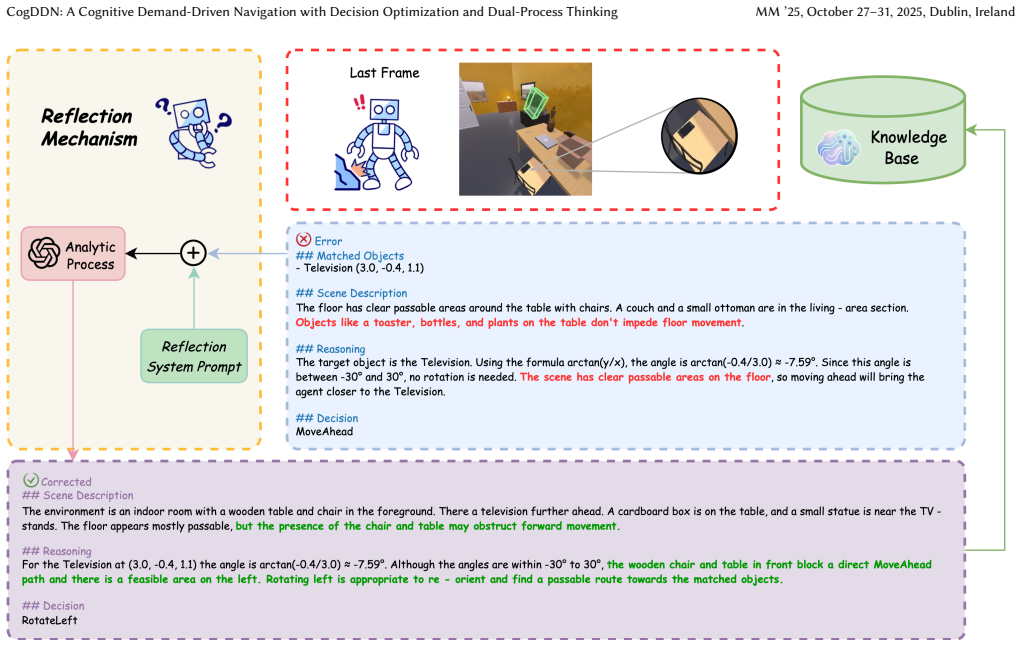
The central object is the dual-process decision module: a Heuristic Process (System I) that acts quickly, either exploring via a VLM-generated action sequence or exploiting via a fine-tuned VLM that emits a single action toward a matched target, and an Analytic Process (System II) that, upon detecting a hindrance, inspects the previous frame, produces a corrected reasoning trace, and deposits it into a knowledge base. The knowledge base is built offline from A* optimal trajectories annotated with scene descriptions and chain-of-thought rationales, and it transfers experience into the heuristic through supervised fine-tuning. Chain-of-thought prompting runs through both processes, and a demand-matching LLM maps each instruction to a set of plausible target object categories. Together these components close the loop that lets the agent improve with experience.
What would settle it
Check the scene IDs in the 55K-frame training set for the 3D Robot Perception module against the 200 closed-loop evaluation scenes; if even one evaluation scene appears in the training frames, retrain the detector on a strict scene-exclusive split and re-run the closed-loop evaluation to see whether the unseen-scene NSR/SPL/SSR gaps shrink.
Extended reading notes
Core claim
CogDDN's central claim is that demand-driven navigation—locating an object that satisfies an implicit human need such as "I'm thirsty" without being told the object or its location—can be cast as a closed cognitive loop: a monocular 3D detector identifies candidate objects, a fine-tuned vision-language model matches them to the instruction, a fast Heuristic Process chooses actions (an Explore module for searching, an Exploit module for approaching), and a slow Analytic Process reviews failures and appends corrected reasoning to a knowledge base that is periodically fine-tuned back into the heuristic. In closed-loop evaluation on ProcThor scenes, the system achieves a navigation success rate (NSR) of 34.5%, a path-length-weighted success (SPL) of 17.1%, and a selection success rate (SSR) of 27.5% on unseen scenes with unseen instructions, against 16.1%, 8.4%, and 6.0% respectively for the strongest camera-only baseline (DDN). On the same setup it also edges above InstructNav, a depth-enabled method, on NSR (34.5 vs 30.0). The authors interpret these margins as evidence that explicit reasoning and accumulating experience can compensate for the absence of depth sensing and large pre-collected navigation datasets.
Load-bearing premise
The unseen-scene results assume that none of the 55,000 frames used to train the 3D object detector came from the 200 scenes used for closed-loop evaluation, and the paper reports only a frame-level split, so a scene-level overlap would inflate the reported gains.
Editorial extensions
If this is right
- A single front-facing RGB camera plus VLM reasoning can outperform the best camera-only demand-driven navigation baseline on unseen scenes and instructions (NSR 34.5 vs 16.1; SSR 27.5 vs 6.0).
- The reflection mechanism's main measurable benefit is navigation efficiency: after four rounds of accumulating corrected experiences, SPL rises substantially while NSR and SSR improve only marginally.
- CogDDN's navigation success rate (34.5) exceeds that of InstructNav (30.0), which uses depth maps in addition to RGB, indicating that reasoning can partially substitute for geometric sensing in this task.
- Removing the fine-tuned Exploit module or the chain-of-thought prompting degrades NSR (to 29.1/24.2 and 27.3 respectively), showing both are load-bearing components of the reported performance.
- The performance gap between seen and unseen scenes is attributed mainly to the 3D perception module, not to demand matching or the decision process.
Reading between the lines
- The abstract's '15%' figure understates the paper's own tables: on unseen scenes with unseen instructions, NSR more than doubles (34.5 vs 16.1) and SSR roughly quintuples (27.5 vs 6.0), so the practical effect is far larger than the headline percentage suggests.
- Because the Explore and Analytic processes rely on a proprietary model (GPT-4) while only Exploit and Demand Matching use the open Qwen2-VL, a natural stress test is to swap in a weaker or open-weight VLM; results that collapse would indicate the gains are tied to the proprietary model's reasoning depth rather than the dual-process architecture.
- The reflection loop's largest measured benefit is path efficiency (SPL) rather than goal completion, suggesting the design could be extended to learn to anticipate obstacles explicitly from visual cues, a capability the current system acquires only implicitly through fine-tuning on corrected examples.
Editorial analysis
A structured set of objections, weighed in public.
Referee Report
Summary. The paper proposes CogDDN, a monocular RGB-only VLM framework for demand-driven navigation in the AI2Thor simulator with the ProcThor dataset. The system combines a 3D object perception module, an LLM-based demand-matching module, a dual-process decision module (Heuristic Explore/Exploit and Analytic reflection), and a knowledge base of scene descriptions and reasoning generated from A* trajectories. Closed-loop experiments report large gains over prior DDN baselines, e.g., NSR 34.5 versus DDN's 16.1 on unseen scenes with unseen instructions, and NSR/SPL of 34.5/17.1 versus InstructNav's 30.0/14.2. The abstract claims that CogDDN outperforms single-view camera-only methods by 15%.
Significance. If the quantitative claims hold with clean dataset separation, the contribution is potentially significant: it demonstrates that a dual-process, knowledge-base-augmented VLM policy can beat prior DDN baselines and a depth-based SOTA while using only front-facing RGB, and the reflection loop with supervised fine-tuning is a concrete continuous-learning mechanism. The paper is clearly structured and includes ablations for the Exploit module, CoT, and Reflection. However, the load-bearing generalization claim currently rests on unverified scene-level splits, and the headline improvement figure is internally inconsistent; both issues must be resolved before the results can be relied upon.
major comments (5)
- [§4.1, §4.3, Table 2] The 'Unseen Scene' columns in Table 2 are the central generalization evidence, but the manuscript never states that the 55K perception frames and 72K Heuristic Process trajectories are drawn from scenes that exclude the test scenes used in evaluation. Section 4.1 reports only percentage splits (70/10/20 and 80/20), and Section 4.3 says evaluation is on '400 scenes' while Section 4.1 says '600 scenes,' adding ambiguity. If any training frame or trajectory comes from the evaluation scenes, the reported gains (e.g., NSR 34.5 vs. DDN 16.1) reflect detector and policy memorization rather than cognitive generalization. The authors must provide scene-level split statistics, scene IDs, or a data/code release that establishes disjointness; without this, the unseen-scene claim is unsupported.
- [Abstract, Table 2, Table 3] The abstract's claim of a '15%' improvement over single-view camera-only methods is inconsistent with the reported numbers. In Table 2, the relative gain over the best single-view baseline DDN exceeds 100% (NSR 34.5 vs. 16.1 is a 114% relative increase), while the 15% figure matches the relative margin over depth-based InstructNav in Table 3 (34.5 vs. 30.0 is a 15% increase). Please clarify which baseline the headline number refers to and correct the abstract accordingly; if 15% refers to InstructNav, the descriptor 'single-view camera-only' is inaccurate, and if it refers to DDN, the number is wrong.
- [Tables 2–4, Figure 7] No error bars, number of runs, or significance tests are reported for any of the main quantitative results or ablations. The abstract and ablation discussion use the word 'significant,' and the closed-loop simulator has stochasticity in both environment and policy. The authors should report mean and standard deviation over at least three seeds for the main results and ablations, or otherwise justify why single-run numbers are sufficient for the claims made.
- [§4.1, Appendix A.2, Appendix A.3] The Demand Matching attributes and the Knowledge Base rationales are generated by LLMs/VLMs and then used to supervised-fine-tune the Qwen2-VL Heuristic Process, with the paper claiming this is a 'self-supervised mechanism' requiring no human intervention. No validation of the correctness of these generated labels is reported. Since the final evaluation uses an external simulator, the loop is not fully circular, but the risk remains that SFT teaches the model to imitate the generator's biases. Please provide a human-verified sample, an automatic consistency check, or a comparison against human-annotated data, and clarify which model generated each dataset component.
- [§4.1 vs. §4.3] The evaluation protocol is internally inconsistent: Section 4.1 says the model is evaluated on 600 scenes (200 each from ProcThor's train, validation, and test splits), while Section 4.3 says evaluation is performed on 400 scenes. This discrepancy affects the interpretation of Table 2's column labels and the comparability with prior work. Please reconcile the numbers and state exactly how many scenes are used for each reported condition.
minor comments (5)
- [Table 4] The 'Single Action' column in Table 4 is not defined in the caption or text; the ablation description mentions two settings for the w/o Exploit case (single action per step and full action sequence), but the check/cross symbols are not explained.
- [Author affiliations] In the author list, the email for Hao Su contains a typo ('haosu@@zju.edu.com'), which should be corrected.
- [Throughout] The simulator name is written inconsistently as 'AI2THOR' in some places and 'AI2Thor' in others; please standardize the spelling.
- [Algorithm 1] Algorithm 1 uses the variable 'B' for the knowledge base without defining it, and the helper functions 'detect_hindrance()' and 'explore_impede_check' are not specified; please define these or add explanatory text.
- [Figure 7] Figure 7 presents the Reflection ablation over four rounds without numerical values, axis labels, or error bars; please add these so the claimed SPL improvement can be quantitatively assessed.
Circularity Check
No circularity found: CogDDN's central claims are grounded in external closed-loop simulator evaluation, and the self-referential data-generation loop does not define the reported metrics.
full rationale
No step in CogDDN's derivation reduces by construction to its own inputs. The headline result (Table 2, NSR 34.5 vs DDN 16.1 on unseen scenes and unseen instructions) is an externally measured closed-loop outcome in AI2Thor; NSR, SPL, and SSR are defined by the simulator and by the DDN [32] task setup, not by any quantity fitted in this paper. The Heuristic Process is fine-tuned on knowledge-base samples built from A* trajectories and simulator ground-truth target objects, so the training labels are anchored to the simulator rather than to the evaluation metric. The Demand Matching and reflection data are LLM-generated, but this is a bootstrap data-construction choice, not a definitional equivalence: selection success is later judged against the simulator's demand-object task, so the model is not being evaluated on its own generated labels. Citations to LeapVAD [23] and the authors' prior dual-process driving work [24] are inspirational and architectural references, not load-bearing uniqueness theorems or ansatz-forcing citations; the dual-process framing is independently grounded in external cognitive-science references [8,13,38]. The self-referential loop noted by the reader therefore does not make the central claim circular. I do flag three correctness, not circularity, caveats: (1) Section 4.1 reports only percentage splits for the 55K perception frames and 72K heuristic trajectories, with no scene-level split, so the 'Unseen Scene' columns in Table 2 are only as strong as the unstated guarantee that no evaluation scenes contributed training frames; if that guarantee fails, the gains would reflect detector leakage rather than the cognitive framework. (2) Section 4.1 states 600 evaluation scenes while Section 4.3 states 400 scenes, an inconsistency that should be corrected. (3) The reflection ablation in Section 4.4 and Figure 7 fine-tunes on experiences generated by the reflection mechanism and then re-measures the same closed-loop task family; if the same test episodes are reused across rounds, the reported SPL improvement would partly reflect test-time adaptation rather than held-out generalization, but the paper does not state this and the main Table 2 comparison does not depend on that ablation.
Assumptions & free parameters
assumptions (5)
- domain assumption The monocular 3D detector UniMODE provides accurate object category and 3D position on AI2Thor frames.
- domain assumption Qwen2-VL-7B and GPT-4 produce reliable scene descriptions, reasoning, and corrected decisions in the simulator.
- domain assumption VLM-generated knowledge base entries from A* expert trajectories are high-quality and improve the fine-tuned policy.
- domain assumption The 1.5-meter distance-to-target completion criterion is a valid proxy for fulfilling the user demand.
- domain assumption The ProcThor/AI2Thor simulator is an adequate testbed for demand-driven navigation claims.
Cite this review
Pith. "Pith review of CogDDN: A Cognitive Demand-Driven Navigation with Decision Optimization and Dual-Process Thinking." pith.science (2026). https://pith.science/paper/LXHWYP7J
@misc{pith2026250711334,
  author       = {Pith},
  title        = {Pith review of: CogDDN: A Cognitive Demand-Driven Navigation with Decision Optimization and Dual-Process Thinking},
  year         = {2026},
  howpublished = {\url{https://pith.science/paper/LXHWYP7J}},
  note         = {Machine review of arXiv:2507.11334}
}
read the original abstract
Mobile robots are increasingly required to navigate and interact within unknown and unstructured environments to meet human demands. Demand-driven navigation (DDN) enables robots to identify and locate objects based on implicit human intent, even when object locations are unknown. However, traditional data-driven DDN methods rely on pre-collected data for model training and decision-making, limiting their generalization capability in unseen scenarios. In this paper, we propose CogDDN, a VLM-based framework that emulates the human cognitive and learning mechanisms by integrating fast and slow thinking systems and selectively identifying key objects essential to fulfilling user demands. CogDDN identifies appropriate target objects by semantically aligning detected objects with the given instructions. Furthermore, it incorporates a dual-process decision-making module, comprising a Heuristic Process for rapid, efficient decisions and an Analytic Process that analyzes past errors, accumulates them in a knowledge base, and continuously improves performance. Chain of Thought (CoT) reasoning strengthens the decision-making process. Extensive closed-loop evaluations on the AI2Thor simulator with the ProcThor dataset show that CogDDN outperforms single-view camera-only methods by 15\%, demonstrating significant improvements in navigation accuracy and adaptability. The project page is available at https://yuehaohuang.github.io/CogDDN/.
Figures


Figures from the paper (12 more)




Reference graph
Works this paper leans on
-
[1]
Peter Anderson, Angel Chang, Devendra Singh Chaplot, Alexey Dosovitskiy, Saurabh Gupta, Vladlen Koltun, Jana Kosecka, Jitendra Malik, Roozbeh Mottaghi, Manolis Savva, et al. 2018. On evaluation of embodied navigation agents. arXiv preprint arXiv:1807.06757 (2018)
arXiv 2018
-
[2]
Lei Han Hamidreza Kasaei Tingguang Li Bangguo Yu, Yuzhen Liu and Ming Cao
-
[3]
Wenzhe Cai, Siyuan Huang, Guangran Cheng, Yuxing Long, Peng Gao, Changyin Sun, and Hao Dong. 2024. Bridging zero-shot object navigation and founda- tion models through pixel-guided navigation skill. In 2024 IEEE International Conference on Robotics and Automation (ICRA) . IEEE, 5228–5234
work page 2024
-
[4]
Yuxin Cai, Xiangkun He, Maonan Wang, Hongliang Guo, Wei-Yun Yau, and Chen Lv. 2025. CL-CoTNav: Closed-Loop Hierarchical Chain-of-Thought for Zero-Shot Object-Goal Navigation with Vision-Language Models. arXiv preprint arXiv:2504.09000 (2025)
arXiv 2025
-
[5]
Devendra Singh Chaplot, Dhiraj Prakashchand Gandhi, Abhinav Gupta, and Russ R Salakhutdinov. 2020. Object goal navigation using goal-oriented semantic exploration. Advances in Neural Information Processing Systems 33 (2020), 4247– 4258
work page 2020
-
[6]
Jinyu Chen, Chen Gao, Erli Meng, Qiong Zhang, and Si Liu. 2022. Reinforced structured state-evolution for vision-language navigation. In Proceedings of the IEEE/CVF Conference on Computer Vision and Pattern Recognition . 15450–15459
work page 2022
-
[7]
Matt Deitke, Eli VanderBilt, Alvaro Herrasti, Luca Weihs, Kiana Ehsani, Jordi Salvador, Winson Han, Eric Kolve, Aniruddha Kembhavi, and Roozbeh Mot- taghi. 2022. ProcTHOR: Large-Scale Embodied AI Using Procedural Generation. Advances in Neural Information Processing Systems 35 (2022), 5982–5994
work page 2022
-
[8]
Jonathan St BT Evans and Keith E Stanovich. 2013. Dual-process theories of higher cognition: Advancing the debate. Perspectives on psychological science 8, 3 (2013), 223–241
work page 2013
Show all 54 references
-
[9]
Samir Yitzhak Gadre, Mitchell Wortsman, Gabriel Ilharco, Ludwig Schmidt, and Shuran Song. 2022. Clip on wheels: Zero-shot object navigation as object local- ization and exploration. arXiv preprint arXiv:2203.10421 3, 4 (2022), 7
2022 arXiv
-
[10]
Dylan Goetting, Himanshu Gaurav Singh, and Antonio Loquercio. 2024. End-to- End Navigation with Vision Language Models: Transforming Spatial Reasoning into Question-Answering. arXiv preprint arXiv:2411.05755 (2024)
2024 arXiv
-
[11]
Peter E Hart, Nils J Nilsson, and Bertram Raphael. 1968. A formal basis for the heuristic determination of minimum cost paths. IEEE transactions on Systems Science and Cybernetics 4, 2 (1968), 100–107
1968
-
[12]
Haodong Hong, Yanyuan Qiao, Sen Wang, Jiajun Liu, and Qi Wu. 2025. Gen- eral Scene Adaptation for Vision-and-Language Navigation. arXiv preprint arXiv:2501.17403 (2025)
2025 arXiv
-
[13]
Daniel Kahneman. 2011. Fast and slow thinking. Allen Lane and Penguin Books, New York (2011)
2011
-
[14]
Aishwarya Kamath, Peter Anderson, Su Wang, Jing Yu Koh, Alexander Ku, Austin Waters, Yinfei Yang, Jason Baldridge, and Zarana Parekh. 2023. A new path: Scaling vision-and-language navigation with synthetic instructions and imitation learning. In Proceedings of the IEEE/CVF Con...
2023
-
[15]
DA Sasi Kiran, Kritika Anand, Chaitanya Kharyal, Gulshan Kumar, Nandiraju Gireesh, Snehasis Banerjee, Ruddra Dev Roychoudhury, Mohan Sridharan, Bro- jeshwar Bhowmick, and Madhava Krishna. 2022. Spatial relation graph and graph convolutional network for object goal navigation. ...
2022
-
[16]
Eric Kolve, Roozbeh Mottaghi, Winson Han, Eli VanderBilt, Luca Weihs, Alvaro Herrasti, Matt Deitke, Kiana Ehsani, Daniel Gordon, Yuke Zhu, et al. 2017. Ai2- thor: An interactive 3d environment for visual ai. arXiv preprint arXiv:1712.05474 (2017)
2017 arXiv
-
[17]
Zhuoling Li, Xiaogang Xu, SerNam Lim, and Hengshuang Zhao. 2024. UniMODE: Unified monocular 3D object detection. In Proceedings of the IEEE/CVF Conference on Computer Vision and Pattern Recognition . 16561–16570
2024
-
[18]
Guangyi Liu, Pengxiang Zhao, Liang Liu, Zhiming Chen, Yuxiang Chai, Shuai Ren, Hao Wang, Shibo He, and Wenchao Meng. 2025. Learnact: Few-shot mobile gui agent with a unified demonstration benchmark. arXiv preprint arXiv:2504.13805 (2025)
2025 arXiv
-
[19]
Guangyi Liu, Pengxiang Zhao, Liang Liu, Yaxuan Guo, Han Xiao, Weifeng Lin, Yuxiang Chai, Yue Han, Shuai Ren, Hao Wang, et al . 2025. Llm-powered gui agents in phone automation: Surveying progress and prospects. arXiv preprint arXiv:2504.19838 (2025)
2025
-
[20]
Yuxing Long, Wenzhe Cai, Hongcheng Wang, Guanqi Zhan, and Hao Dong. 2024. Instructnav: Zero-shot system for generic instruction navigation in unexplored environment. arXiv preprint arXiv:2406.04882 (2024)
2024 arXiv
-
[21]
Zhengxi Lu, Yuxiang Chai, Yaxuan Guo, Xi Yin, Liang Liu, Hao Wang, Han Xiao, Shuai Ren, Guanjing Xiong, and Hongsheng Li. 2025. UI-R1: Enhancing Efficient Action Prediction of GUI Agents by Reinforcement Learning. arXiv preprint arXiv:2503.21620 (2025)
2025 arXiv
-
[22]
Yukai Ma, Jianbiao Mei, Xuemeng Yang, Licheng Wen, Weihua Xu, Jiangning Zhang, Xingxing Zuo, Botian Shi, and Yong Liu. 2024. Licrocc: Teach radar for accurate semantic occupancy prediction using lidar and camera. IEEE Robotics and Automation Letters (2024)
2024
-
[23]
Yukai Ma, Tiantian Wei, Naiting Zhong, Jianbiao Mei, Tao Hu, Licheng Wen, Xuemeng Yang, Botian Shi, and Yong Liu. 2025. LeapVAD: A Leap in Autonomous Driving via Cognitive Perception and Dual-Process Thinking. arXiv preprint arXiv:2501.08168 (2025)
2025 arXiv
-
[24]
Jianbiao Mei, Yukai Ma, Xuemeng Yang, Licheng Wen, Xinyu Cai, Xin Li, Daocheng Fu, Bo Zhang, Pinlong Cai, Min Dou, et al. 2024. Continuously learning, adapting, and improving: A dual-process approach to autonomous driving. arXiv preprint arXiv:2405.15324 (2024)
2024 arXiv
-
[25]
Reihaneh Mirjalili, Michael Krawez, Florian Walter, and Wolfram Burgard. 2024. VLM-Vac: Enhancing Smart Vacuums through VLM Knowledge Distillation and Language-Guided Experience Replay. ArXiv abs/2409.14096 (2024). https://api. semanticscholar.org/CorpusID:272826708
2024 arXiv
-
[26]
Khanh Nguyen, Debadeepta Dey, Chris Brockett, and Bill Dolan. 2019. Vision- based navigation with language-based assistance via imitation learning with indirect intervention. In Proceedings of the IEEE/CVF Conference on Computer Vision and Pattern Recognition . 12527–12537
2019
-
[27]
Dujun Nie, Xianda Guo, Yiqun Duan, Ruijun Zhang, and Long Chen. 2025. WM- Nav: Integrating Vision-Language Models into World Models for Object Goal Navigation. https://api.semanticscholar.org/CorpusID:276776282
2025
-
[28]
Anwesan Pal, Yiding Qiu, and Henrik Christensen. 2021. Learning hierarchical relationships for object-goal navigation. In Conference on Robot Learning . PMLR, 517–528
2021
-
[29]
Santhosh Kumar Ramakrishnan, Devendra Singh Chaplot, Ziad Al-Halah, Jiten- dra Malik, and Kristen Grauman. 2022. Poni: Potential functions for objectgoal navigation with interaction-free learning. In Proceedings of the IEEE/CVF Confer- ence on Computer Vision and Pattern Recog...
2022
-
[30]
Dhruv Shah, Blazej Osinski, Brian Ichter, and Sergey Levine. 2022. LM-Nav: Robotic Navigation with Large Pre-Trained Models of Language, Vision, and Action. In 6th Annual Conference on Robot Learning . https://openreview.net/ forum?id=UW5A3SweAH
2022
-
[31]
Daeun Song, Jing Liang, Amirreza Payandeh, Amir Hossain Raj, Xuesu Xiao, and Dinesh Manocha. 2025. VLM-Social-Nav: Socially Aware Robot Navigation Through Scoring Using Vision-Language Models. IEEE Robotics and Automation Letters 10, 1 (2025), 508–515. doi:10.1109/LRA.2024.3511409
2025
-
[32]
Hongcheng Wang, Andy Guan Hong Chen, Xiaoqi Li, Mingdong Wu, and Hao Dong. 2023. Find what you want: Learning demand-conditioned object attribute space for demand-driven navigation. Advances in Neural Information Processing Systems 36 (2023), 16353–16366
2023
-
[33]
Hongcheng Wang, Peiqi Liu, Wenzhe Cai, Mingdong Wu, Zhengyu Qian, and Hao Dong. 2024. MO-DDN: A Coarse-to-Fine Attribute-based Exploration Agent for Multi-object Demand-driven Navigation. In The Thirty-eighth Annual Conference on Neural Information Processing Systems
2024
-
[34]
Peng Wang, Shuai Bai, Sinan Tan, Shijie Wang, Zhihao Fan, Jinze Bai, Keqin Chen, Xuejing Liu, Jialin Wang, Wenbin Ge, et al. 2024. Qwen2-vl: Enhancing vision-language model’s perception of the world at any resolution.arXiv preprint arXiv:2409.12191 (2024)
2024 arXiv
-
[35]
Tian Wang, Junming Fan, and Pai Zheng. 2024. An LLM-based vision and language cobot navigation approach for Human-centric Smart Manufacturing. Journal of Manufacturing Systems 75 (Aug. 2024), 299–305. doi:10.1016/j.jmsy. 2024.04.020 Publisher Copyright: © 2024 The Society of M...
2024 doi
-
[36]
Xudong Wang, Weihong Ren, Xi’ai Chen, Huijie Fan, Yandong Tang, and Zhi Han. 2024. Uni-YOLO: Vision-Language Model-Guided YOLO for Robust and Fast Universal Detection in the Open World. In Proceedings of the 32nd ACM International Conference on Multimedia . 1991–2000
2024
-
[37]
Xin Wang, Wenhan Xiong, Hongmin Wang, and William Yang Wang. 2018. Look before you leap: Bridging model-free and model-based reinforcement learning for planned-ahead vision-and-language navigation. In Proceedings of the European Conference on Computer Vision (ECCV) . 37–53
2018
-
[38]
Peter C Wason and J St BT Evans. 1974. Dual processes in reasoning? Cognition 3, 2 (1974), 141–154
1974
-
[39]
Jiateng Wei, Quan Lu, Ning Jiang, Siqi Li, Jingyang Xiang, Jun Chen, and Yong Liu. 2024. Structured Optimal Brain Pruning for Large Language Models. In Proceedings of the 2024 Conference on Empirical Methods in Natural Language Processing. 13991–14007
2024
-
[40]
Jason Wei, Xuezhi Wang, Dale Schuurmans, Maarten Bosma, Fei Xia, Ed Chi, Quoc V Le, Denny Zhou, et al. 2022. Chain-of-thought prompting elicits reasoning in large language models. Advances in neural information processing systems 35 (2022), 24824–24837. MM ’25, October 27–31, ...
2022
-
[41]
Pengying Wu, Yao Mu, Bingxian Wu, Yi Hou, Ji Ma, Shanghang Zhang, and Chang Liu. 2024. Voronav: Voronoi-based zero-shot object navigation with large language model. arXiv preprint arXiv:2401.02695 (2024)
2024 arXiv
-
[42]
Jingyang Xiang and Sai Qian Zhang. 2024. DFRot: Achieving Outlier-Free and Massive Activation-Free for Rotated LLMs with Refined Rotation. arXiv preprint arXiv:2412.00648 (2024)
2024 arXiv
-
[43]
Zecheng Yin, † ChonghaoCheng, Yinghong Liao, Zhihao Yuan, Shuguang Cui, and Zhen Li. 2024. Navigation with VLM framework: Go to Any Language.ArXiv abs/2410.02787 (2024). https://api.semanticscholar.org/CorpusID:273163041
2024
-
[44]
Lu Yue, Dongliang Zhou, Liang Xie, Feitian Zhang, Ye Yan, and Erwei Yin. 2024. Safe-vln: Collision avoidance for vision-and-language navigation of autonomous robots operating in continuous environments. IEEE Robotics and Automation Letters (2024)
2024
-
[45]
Zhaohuan Zhan, Lisha Yu, Sijie Yu, and Guang Tan. 2024. Mc-gpt: Empowering vision-and-language navigation with memory map and reasoning chains. arXiv preprint arXiv:2405.10620 (2024)
2024 arXiv
-
[46]
Jiazhao Zhang, Kunyu Wang, Rongtao Xu, Gengze Zhou, Yicong Hong, Xiaomeng Fang, Qi Wu, Zhizheng Zhang, and He Wang. 2024. Navid: Video-based vlm plans the next step for vision-and-language navigation. arXiv preprint arXiv:2402.15852 (2024)
2024 arXiv
-
[47]
Lingfeng Zhang, Xiaoshuai Hao, Qinwen Xu, Qiang Zhang, Xinyao Zhang, Peng- wei Wang, Jing Zhang, Zhongyuan Wang, Shanghang Zhang, and Renjing Xu
-
[48]
Yue Zhang, Ziqiao Ma, Jialu Li, Yanyuan Qiao, Zun Wang, Joyce Chai, Qi Wu, Mohit Bansal, and Parisa Kordjamshidi. 2024. Vision-and-Language Naviga- tion Today and Tomorrow: A Survey in the Era of Foundation Models. ArXiv abs/2407.07035 (2024). https://api.semanticscholar.org/C...
2024 arXiv
-
[49]
Ying Zhang, Peng Zhang, Mincong Huang, Jingyang Xiang, Yujie Wang, Chao Wang, Yineng Zhang, Lei Yu, Chuan Liu, and Wei Lin. 2024. Qqq: Quality quattuor- bit quantization for large language models.arXiv preprint arXiv:2406.09904 (2024)
2024 arXiv
-
[50]
Qianfan Zhao, Lu Zhang, Bin He, Hong Qiao, and Zhiyong Liu. 2023. Zero-shot object goal visual navigation. In 2023 IEEE International Conference on Robotics and Automation (ICRA). IEEE, 2025–2031
2023
-
[51]
Gengze Zhou, Yicong Hong, Zun Wang, Xin Eric Wang, and Qi Wu. 2024. Navgpt- 2: Unleashing navigational reasoning capability for large vision-language models. In European Conference on Computer Vision . Springer, 260–278
2024
-
[52]
question
Gengze Zhou, Yicong Hong, and Qi Wu. 2024. Navgpt: Explicit reasoning in vision-and-language navigation with large language models. In Proceedings of the AAAI Conference on Artificial Intelligence , Vol. 38. 7641–7649. CogDDN: A Cognitive Demand-Driven Navigation with Decision...
2024
-
[2024]
arXiv:2411.11609 (2024)
VLN-Game: Vision-Language Equilibrium Search for Zero-Shot Semantic Navigation. arXiv:2411.11609 (2024)
2024 arXiv
-
[2025]
ArXiv abs/2502.13451 (2025)
MapNav: A Novel Memory Representation via Annotated Semantic Maps for VLM-based Vision-and-Language Navigation. ArXiv abs/2502.13451 (2025). https://api.semanticscholar.org/CorpusID:276449634
2025 arXiv
Reviewed August 6, 2026 · model on record in the stance chip above.
Discussion (0). Sign in to comment.