REVIEW 2 major objections 4 minor 28 references
Neurosymbolic Reasoning Shortcuts under the Independence Assumption
T0 review · 2 major / 4 minor · reviewed 2026-08-06 · deepseek-v4-flash
Pith's one-line read The paper proves that neurosymbolic predictors using the conditional-independence assumption can only be aware of reasoning shortcuts in rare cases, and shows that expressive models with the right loss and architecture can hedge…
desk verdict Solid formal characterization of when conditionally independent NeSy models can be RS-aware, but the 'extremely rare' claim only holds for the full set of remappings, which the paper never fixes. read the letter →
The pith
A machine-rendered reading of the paper's core claim, the machinery that carries it, and where it could break.
The reading
What carries the argument
The load-bearing objects are concept remappings, confusion sets, and implicant covers. A concept remapping $\alpha$ is a non-identity function on ground-truth concepts that preserves the label under the program $\beta$; each such remapping is a reasoning shortcut, and a mixture over several remappings is how a predictor would express uncertainty between correct and shortcut explanations. The confusion set $V_{c^*}$ collects all concepts reachable from a ground-truth world $c^*$ under the available remappings. Theorem 7 says an independent, factorised model class can represent such a mixture only when $V_{c^*}$ is the cover of an implicant of the label constraint — in other words, when the ambiguity is confined to variables that the program does not constrain. This turns the independence assumption itself into the mechanism doing the work: a factorised distribution over $k$ boolean concepts has only $k$ free parameters, so it cannot spread probability across arbitrary subsets of the concept cube, and overconfidence in one reasoning shortcut is the inevitable result.
What would settle it
Train a conditionally independent NeSy predictor on XORMNIST, or any parity-style program with two-concept ambiguity, using the KL-to-uniform objective: if any run reaches perfect label accuracy while assigning 0.5/0.5 posterior mass to the two valid concept combinations on ambiguous inputs, Theorem 7 is refuted. The paper's own appendix predicts instead that independent models collapse to uniform, input-independent marginals; a brute-force search over $k=3$ boolean programs and remappings for a weakly reasoning-shortcut-aware independent model whose confusion set is not an implicant cover would settle the theorem directly.
Extended reading notes
Core claim
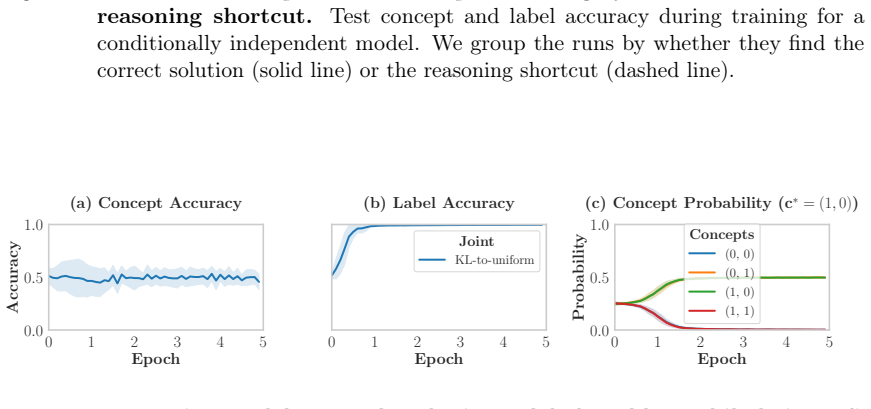
The central claim is that conditionally independent NeSy predictors are almost never reasoning-shortcut aware. Theorem 7 proves a necessary condition: if the universal class of conditionally independent models can weakly represent a mixture over a set of concept remappings, then for every ground-truth concept $c^*$, the confusion set $V_{c^*}$ — the set of concepts that the remappings can produce from $c^*$ — must be exactly the cover of an implicant of the label constraint $\varphi_y$. Theorem 8 sharpens this for complete awareness: each confusion set must be a singleton or a pair of concepts differing in exactly one coordinate. The XORMNIST parity problem fails this test, because its confusion sets are $\{(1,0),(0,1)\}$ and $\{(0,0),(1,1)\}$, neither of which is an implicant cover, so an independent model cannot simultaneously solve the label task and express 0.5/0.5 uncertainty over the two valid concepts; the experiments show 11 of 20 runs committing to the reasoning shortcut. On the positive side, the paper demonstrates that a joint or autoregressive model with a KL-to-uniform loss can be reasoning-shortcut aware, with the autoregressive model also succeeding on a shortcut-free task where a plain joint model loses concept accuracy.
Load-bearing premise
The theorems presuppose that each input fully determines the true concepts through an invertible oracle and that the program deterministically maps concepts to labels; when inputs are only partial observations, the formal impossibility result no longer applies and the paper falls back on a looser expressivity argument.
Editorial extensions
If this is right
- In any NeSy problem whose ambiguity spans two or more free concept variables, an independent-factor predictor that reaches perfect label accuracy has silently selected one reasoning shortcut and will report high confidence in it.
- Changing the training loss cannot rescue independent models: the KL-to-uniform objective that makes expressive models reasoning-shortcut aware drives an independent model toward input-independent uniform marginals, so it stops learning the task at all.
- Expressive concept distributions are necessary but not sufficient for reasoning-shortcut awareness; the paper's experiments show architecture choice matters, with the autoregressive model achieving both label accuracy and calibrated concept uncertainty on XORMNIST and Traffic Lights MNIST.
- Concept-quality evaluation, such as expected calibration error on concepts, is what exposes reasoning-shortcut awareness; label accuracy alone is nearly identical between models that commit to the shortcut and models that hedge.
Reading between the lines
- A practical design rule follows: if you keep independent concept factors, every concept variable the program does not pin down should either be marginalised out or modelled jointly, because independence can hedge at most one free variable.
- The confusion-set-versus-implicant-cover criterion could be turned into a benchmark diagnostic: compute the maximum number of free variables in any confusion set of a program, and use it to predict which benchmarks will exhibit overconfident independent predictors.
- The paper's result is restricted to full observability; under partial observability the ground-truth posterior is not factorised, which makes independence even less adequate, so an empirical study with occluded inputs would likely show larger reliability gaps.
- The same criterion can serve as a post-hoc warning sign: a trained independent model that is highly confident on inputs whose ground truth has a non-implicant confusion set is probably exhibiting a reasoning shortcut, so its confidence should be discounted.
Editorial analysis
A structured set of objections, weighed in public.
Referee Report
Summary. The paper studies conditionally independent neurosymbolic predictors and their ability to be aware of reasoning shortcuts. It formalizes RS-awareness through sets of concept remappings A and mixtures p_{A,π} (Definitions 2 and 3), defines the universal conditionally independent (UCI) model class (Definition 4), and proves a necessary condition for weak RS-awareness (Theorem 7): all confusion sets must be covers of implicants of the label constraint. It also proves a necessary and sufficient condition for complete RS-awareness (Theorem 8). Experimentally, the paper compares independent, joint, and autoregressive models on XORMNIST and Traffic Lights MNIST, showing that independent models cannot represent the RS-aware distribution, while suitably designed expressive models can.
Significance. The formal criterion in Theorem 7 is clean and useful: for a fixed set of remappings, weak RS-awareness requires every confusion set to be an implicant cover, which is the same as having partial supervision over some concept variables. The proofs in Appendix A are clear, and the paper provides code and a careful empirical study with multiple seeds and architectures. The main caveat is that the headline claim that independence makes RS-awareness possible only in 'extremely rare cases' is stronger than the theorem as stated; the theorem quantifies over an arbitrary set A and does not establish genericity. This gap is fixable and does not undermine the correctness of the formal results.
major comments (2)
- [Section 4, Theorem 7; Abstract] The statement of Theorem 7 quantifies over an arbitrary set A of concept remappings, and the proof never uses exhaustiveness of A. The abstract and Contribution C2 claim that UCI models can be RS-aware only in 'extremely rare cases'. This conclusion does not follow from the theorem as stated. For example, for β(c)=c1∧c2, take A={id,α} with α(0,0)=(0,1), α(0,1)=(0,0), α(1,0)=(0,0), α(1,1)=(1,1). Every map in A satisfies Eq. (6), yet the confusion sets are V_(0,0)=V_(0,1)={(0,0),(0,1)} (cover of the implicant c1=0), V_(1,0)={(1,0),(0,0)} (cover of c2=0), and V_(1,1)={(1,1)}, so Theorem 7's condition holds for this A. Thus the paper should either formalize the 'rare' claim by defining a natural set of remappings (e.g., all label-preserving maps) and proving that the condition generically fails, or weaken the abstract and Section 4 wording to match the theorem.
- [Section 5, Definition 1] In Section 5, the paper states that Traffic Lights MNIST 'does not contain RSs for independent models.' This is not consistent with Definition 1, under which any non-identity α satisfying Eq. (6) is an RS. For β(c)=¬c1∨¬c2, the map α that swaps (0,1) and (1,0) and fixes (0,0) and (1,1) is label-preserving, so RSs exist under Definition 1. The claim is only true if A is restricted to remappings realizable by the shared per-digit architecture used for the independent model (cf. Footnote 3). This restriction should be stated explicitly in Definition 1 or the claim should be revised; otherwise the empirical comparison is framed around an architecture-specific notion while the formal results use a broader one.
minor comments (4)
- [Definition 3] The simplex is written as Δ^{k-1}, but the mixture is over m remappings; it should be Δ^{m-1}. Also, when m=1, the condition 0<π_i<1 for all i has no solution, so the definition of weak RS-awareness should either exclude this degenerate case or be clarified.
- [Appendix A, proof of Theorem 7] The argument invokes Theorem 4.3 of van Krieken et al. (2024) without stating it. Since this theorem is load-bearing for the proof, please include its statement (or at least its precise assumptions) so the proof is self-contained.
- [Appendix A, Definition 9] The phrase 'which give the probability that an RS mixture (Theorem 2 remapsc∗ toc' appears to be a typo or extraction error; it should refer to Definition 2 and to p_{A,π}(c|c*).
- [Table 1] Reporting only mean±std for XORMNIST concept accuracy is uninformative because the results are bimodal (0% or 100%); please also report the fraction of seeds that found the reasoning shortcut.
Circularity Check
No significant circularity: the formal derivation is supported by an independently-stated structural lemma about factorized distributions, not by the paper's own conclusions.
full rationale
The paper's central claim—that conditionally independent NeSy predictors cannot be RS-aware except under restrictive conditions—is not an input to its definitions. The proof of Theorem 7 invokes Theorem 4.3 of van Krieken et al. (2024) as a lemma: a factorized distribution whose support lies inside a constraint set has support equal to the cover of an implicant of that constraint. That cited result is parameter-free, has stated assumptions that do not include RS-awareness or the target theorem, and is applied only after the paper proves Lemma 10, which connects RS mixtures to factorized distributions. The same-author citation therefore functions as independent support under the audit rules, not as a self-citation chain forcing the conclusion. Theorem 8's characterization of complete RS-awareness is proved in the appendix from Definitions 2-4 and Lemma 10. The empirical sections train models on MNIST-derived tasks and report test accuracy and calibration; no fitted parameter is renamed as a prediction, and no equation is defined in terms of the quantity it is claimed to predict. Concerns that the 'extremely rare' wording is stronger than Theorem 7's quantification over an arbitrary set A, or that Section 5's 'no RS' claim depends on a disentangled-architecture reading of Definition 1, are scope/correctness objections, not circularity; under the hard rules they cannot raise the circularity score. No circular step can be exhibited with a specific equation-to-equation reduction, so the honest finding is no significant circularity.
Assumptions & free parameters
assumptions (5)
- domain assumption Ground-truth generative process p*(s,c,x,y) = p*(s)p*(c)p*(x|s,c)p*(y|c) (Eq. 3).
- domain assumption Assumption A1: there exists an oracle f with f(c,s)=x, smooth in s and invertible in c, so p*(c|x) is deterministic.
- domain assumption Assumption A2: each ground-truth world c has a unique label y = β(c), so p*(y|c) is deterministic.
- domain assumption The learner knows the program β and thus p*(y|c) exactly.
- domain assumption Theorem 4.3 of van Krieken et al. (2024): for a conditionally independent distribution consistent with φ_y, its deterministic component is an implicant of φ_y and its support equals the cover of that implicant.
Cite this review
Pith. "Pith review of Neurosymbolic Reasoning Shortcuts under the Independence Assumption." pith.science (2026). https://pith.science/paper/AJ2FYWPJ
@misc{pith2026250711357,
  author       = {Pith},
  title        = {Pith review of: Neurosymbolic Reasoning Shortcuts under the Independence Assumption},
  year         = {2026},
  howpublished = {\url{https://pith.science/paper/AJ2FYWPJ}},
  note         = {Machine review of arXiv:2507.11357}
}
read the original abstract
The ubiquitous independence assumption among symbolic concepts in neurosymbolic (NeSy) predictors is a convenient simplification: NeSy predictors use it to speed up probabilistic reasoning. Recent works like van Krieken et al. (2024) and Marconato et al. (2024) argued that the independence assumption can hinder learning of NeSy predictors and, more crucially, prevent them from correctly modelling uncertainty. There is, however, scepticism in the NeSy community around the scenarios in which the independence assumption actually limits NeSy systems (Faronius and Dos Martires, 2025). In this work, we settle this question by formally showing that assuming independence among symbolic concepts entails that a model can never represent uncertainty over certain concept combinations. Thus, the model fails to be aware of reasoning shortcuts, i.e., the pathological behaviour of NeSy predictors that predict correct downstream tasks but for the wrong reasons.
Figures


Figures from the paper (1 more)

Reference graph
Works this paper leans on
-
[1]
Semantic probabilistic layers for neuro-symbolic learning
Kareem Ahmed, Stefano Teso, Kai-Wei Chang, Guy Van den Broeck, and Antonio Vergari. Semantic probabilistic layers for neuro-symbolic learning. 35: 0 29944--29959, 2022
work page 2022
-
[2]
Samy Badreddine, Artur d'Avila Garcez , Luciano Serafini, and Michael Spranger. Logic Tensor Networks . Artificial Intelligence, 303: 0 103649, February 2022. ISSN 0004-3702. doi:10.1016/j.artint.2021.103649
arXiv 2022
-
[3]
A neuro-symbolic benchmark suite for concept quality and reasoning shortcuts
Samuele Bortolotti, Emanuele Marconato, Tommaso Carraro, Paolo Morettin, Emile van Krieken, Antonio Vergari, Stefano Teso, and Andrea Passerini. A neuro-symbolic benchmark suite for concept quality and reasoning shortcuts. In The Thirty-eight Conference on Neural Information Processing Systems Datasets and Benchmarks Track, 2024
work page 2024
-
[4]
On probabilistic inference by weighted model counting
Mark Chavira and Adnan Darwiche. On probabilistic inference by weighted model counting. Artificial Intelligence, 172 0 (6-7): 0 772--799, 2008
2008
-
[5]
A knowledge compilation map
Adnan Darwiche and Pierre Marquis. A knowledge compilation map. Journal of Artificial Intelligence Research, 17: 0 229--264, 2002
2002
-
[6]
Neuro-symbolic= neural+ logical+ probabilistic
Luc De Raedt, Robin Manhaeve, Sebastijan Dumancic, Thomas Demeester, and Angelika Kimmig. Neuro-symbolic= neural+ logical+ probabilistic. In NeSy@ IJCAI, 2019
work page 2019
-
[7]
Independence Is Not an Issue in Neurosymbolic AI
Håkan Karlsson Faronius and Pedro Zuidberg Dos Martires . Independence is not an issue in neurosymbolic ai, 2025. URL https://arxiv.org/abs/2504.07851
work page Pith review arXiv 2025
-
[8]
Jonathan Feldstein, Paulius Dilkas, Vaishak Belle, and Efthymia Tsamoura. Mapping the neuro-symbolic ai landscape by architectures: A handbook on augmenting deep learning through symbolic reasoning. arXiv preprint arXiv:2410.22077, 2024
Show all 28 references
-
[9]
Neurosymbolic ai: The 3 rd wave
Artur d’Avila Garcez and Luis C Lamb. Neurosymbolic ai: The 3 rd wave. Artificial Intelligence Review, 56 0 (11): 0 12387--12406, 2023
2023
-
[10]
Road-r: the autonomous driving dataset with logical requirements
Eleonora Giunchiglia, Mihaela C a t a lina Stoian, Salman Khan, Fabio Cuzzolin, and Thomas Lukasiewicz. Road-r: the autonomous driving dataset with logical requirements. Machine Learning, 112 0 (9): 0 3261--3291, 2023
2023
-
[11]
On calibration of modern neural networks
Chuan Guo, Geoff Pleiss, Yu Sun, and Kilian Q Weinberger. On calibration of modern neural networks. In International conference on machine learning, pages 1321--1330. PMLR, 2017
2017
-
[12]
Neuro-symbolic approaches in artificial intelligence
Pascal Hitzler, Aaron Eberhart, Monireh Ebrahimi, Md Kamruzzaman Sarker, and Lu Zhou. Neuro-symbolic approaches in artificial intelligence. National Science Review, 9 0 (6): 0 nwac035, 2022
2022
-
[13]
Scallop: A language for neurosymbolic programming
Ziyang Li, Jiani Huang, and Mayur Naik. Scallop: A language for neurosymbolic programming. Proceedings of the ACM on Programming Languages, 7 0 (PLDI): 0 1463--1487, 2023
2023
-
[14]
DeepProbLog : Neural probabilistic logic programming
Robin Manhaeve, Sebastijan Duman c i \'c , Angelika Kimmig, Thomas Demeester, and Luc De Raedt. DeepProbLog : Neural probabilistic logic programming. In Samy Bengio, Hanna M Wallach, Hugo Larochelle, Kristen Grauman, Nicol \`o Cesa-Bianchi , and Roman Garnett, editors, Advance...
2018
-
[15]
Neural probabilistic logic programming in DeepProbLog
Robin Manhaeve, Sebastijan Duman c i \'c , Angelika Kimmig, Thomas Demeester, and Luc De Raedt. Neural probabilistic logic programming in DeepProbLog . Artificial Intelligence, 298: 0 103504, 2021. ISSN 0004-3702. doi:10.1016/j.artint.2021.103504
2021
-
[16]
Not All Neuro-Symbolic Concepts Are Created Equal : Analysis and Mitigation of Reasoning Shortcuts
Emanuele Marconato, Stefano Teso, Antonio Vergari, and Andrea Passerini. Not All Neuro-Symbolic Concepts Are Created Equal : Analysis and Mitigation of Reasoning Shortcuts . In Thirty-Seventh Conference on Neural Information Processing Systems, May 2023
2023
-
[17]
BEARS Make Neuro-Symbolic Models Aware of their Reasoning Shortcuts
Emanuele Marconato, Samuele Bortolotti, Emile van Krieken , Antonio Vergari, Andrea Passerini, and Stefano Teso. BEARS Make Neuro-Symbolic Models Aware of their Reasoning Shortcuts . In Uncertainty in Artificial Intelligenc , February 2024
2024
-
[18]
Semantic objective functions: A distribution-aware method for adding logical constraints in deep learning
Miguel Angel Mendez-Lucero, Enrique Bojorquez Gallardo, and Vaishak Belle. Semantic objective functions: A distribution-aware method for adding logical constraints in deep learning. arXiv preprint arXiv:2405.15789, 2024
2024 arXiv
-
[19]
Probabilistic programming languages: Independent choices and deterministic systems
David Poole and Frank Wood. Probabilistic programming languages: Independent choices and deterministic systems. In Probabilistic and Causal Inference: The Works of Judea Pearl, pages 691--712, 2022
2022
-
[20]
A statistical learning method for logic programs with distribution semantics
SATO Taisuke. A statistical learning method for logic programs with distribution semantics. In Proceedings of ICLP, pages 715--729. Citeseer, 1995
1995
-
[21]
A-nesi: A scalable approximate method for probabilistic neurosymbolic inference
Emile van Krieken, Thiviyan Thanapalasingam, Jakub Tomczak, Frank Van Harmelen, and Annette Ten Teije. A-nesi: A scalable approximate method for probabilistic neurosymbolic inference. Advances in Neural Information Processing Systems, 36: 0 24586--24609, 2023
2023
-
[22]
On the independence assumption in neurosymbolic learning
Emile van Krieken, Pasquale Minervini, Edoardo M Ponti, and Antonio Vergari. On the independence assumption in neurosymbolic learning. In Proceedings of the 41st International Conference on Machine Learning, pages 49078--49097, 2024
2024
-
[23]
Neurosymbolic diffusion models, 2025
Emile van Krieken, Pasquale Minervini, Edoardo Ponti, and Antonio Vergari. Neurosymbolic diffusion models, 2025. URL https://arxiv.org/abs/2505.13138
2025
-
[24]
A compositional atlas of tractable circuit operations for probabilistic inference
Antonio Vergari, YooJung Choi, Anji Liu, Stefano Teso, and Guy Van den Broeck. A compositional atlas of tractable circuit operations for probabilistic inference. Advances in Neural Information Processing Systems, 34: 0 13189--13201, 2021
2021
-
[25]
On learning latent models with multi-instance weak supervision
Kaifu Wang, Efthymia Tsamoura, and Dan Roth. On learning latent models with multi-instance weak supervision. In A. Oh, T. Naumann, A. Globerson, K. Saenko, M. Hardt, and S. Levine, editors, Advances in Neural Information Processing Systems, volume 36, pages 9661--9694. Curran ...
2023
-
[26]
A semantic loss function for deep learning with symbolic knowledge
Jingyi Xu, Zilu Zhang, Tal Friedman, Yitao Liang, and Guy den Broeck . A semantic loss function for deep learning with symbolic knowledge. In Jennifer Dy and Andreas Krause, editors, Proceedings of the 35th International Conference on Machine Learning , volume 80, pages 5502--...
2018
-
[27]
Neurasp: Embracing neural networks into answer set programming
Zhun Yang, Adam Ishay, and Joohyung Lee. Neurasp: Embracing neural networks into answer set programming. In 29th International Joint Conference on Artificial Intelligence, IJCAI 2020, pages 1755--1762. International Joint Conferences on Artificial Intelligence, 2020
2020
-
[28]
Towards unbiased exploration in partial label learning
Zsolt Zombori, Agapi Rissaki, Krist \'o f Szab \'o , Wolfgang Gatterbauer, and Michael Benedikt. Towards unbiased exploration in partial label learning. Journal of Machine Learning Research, 25 0 (412): 0 1--56, 2024
2024
Reviewed August 6, 2026 · model on record in the stance chip above.
Discussion (0). Continue with ORCID to comment.