REVIEW 2 major objections 5 minor 36 references
Magnetic ground state and persistent spin fluctuations in triangular-lattice antiferromagnet NdZnAl$_{11}$O$_{19}$
T0 review · 2 major / 5 minor · reviewed 2026-08-06 · deepseek-v4-flash
Pith's one-line read NdZnAl11O19 is a candidate quantum spin liquid: its effective spin-1/2 moments keep fluctuating to 0.28 K, with no magnetic order or freezing down to 50 mK.
desk verdict Solid first characterization of a new rare-earth QSL candidate, but the muSR plateau—the main evidence—does not cleanly separate the 2d triangular sublattice from ~20% 6h Nd disorder. read the letter →
The pith
A machine-rendered reading of the paper's core claim, the machinery that carries it, and where it could break.
The reading
What carries the argument
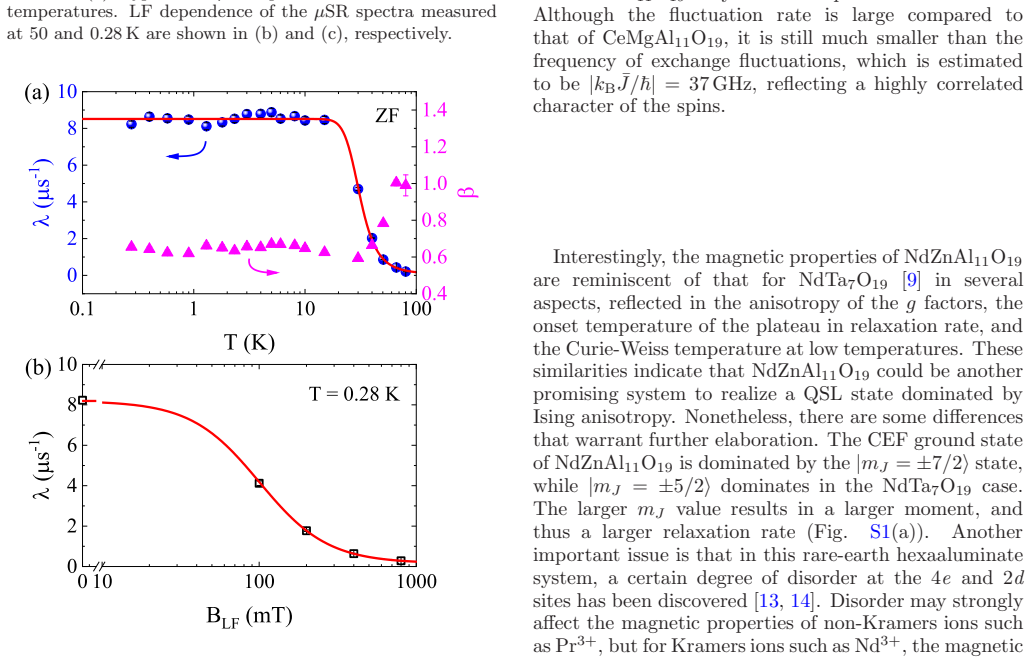
The central object is the crystal-electric-field Hamiltonian $H_{\mathrm{CEF}} = \sum B_l^m O_l^m$ acting on the $|J, m_J\rangle$ basis of the Nd$^{3+}$ $^4I_{9/2}$ multiplet, with only $B_2^0$, $B_4^0$, $B_6^0$, and $B_6^6$ nonzero under the $\bar{6}$ site symmetry. This Hamiltonian produces the effective $J_{\mathrm{eff}}=1/2$ ground doublet and the measured $g$-factor anisotropy, and the same fit is constrained by the inelastic neutron scattering intensities, the powder magnetization, and the specific-heat excitation at 9.5 meV. The argument for persistent spin fluctuations is carried by the stretched-exponential muon relaxation analysis and by the modified Redfield formula $\lambda(B_{\mathrm{LF}}) = 2(\gamma_\mu \Delta)^2 \nu / [\nu^2 + (\gamma_\mu B_{\mathrm{LF}})^2] + \lambda_0$, which separates the dynamic electron-spin contribution from static nuclear and disorder contributions.
What would settle it
A decisive test would be single-crystal neutron diffraction and inelastic scattering at millikelvin temperatures: finding long-range magnetic order, a spin-freezing transition, or a conventional gapped spin-wave spectrum would falsify the quantum spin liquid claim, as would a muon experiment showing that the low-temperature relaxation is static in origin rather than dynamically fluctuating.
Extended reading notes
Core claim
The paper establishes that NdZnAl11O19 hosts a magnetic ground state that resists order and never freezes, and interprets this as quantum spin liquid behavior. The inelastic neutron scattering data, fit with a Stevens-operator crystal-electric-field Hamiltonian, put the first CEF excitation at about 9.5 meV and yield a ground doublet dominated by $|m_J = \pm 7/2\rangle$ with a small $|m_J = \mp 5/2\rangle$ admixture, giving $g_c = 4.54$, $g_{\mathrm{ab}} = 1.42$. Zero-field muon spin relaxation spectra are described by stretched exponentials whose rate $\lambda$ saturates near $8.5\,\mu\mathrm{s}^{-1}$ below about 15 K; longitudinal-field data at 0.28 K give a spin fluctuation rate $\nu = 85.3$ MHz and an internal field width $\Delta = 21.76$ mT, with $\nu/(\gamma_\mu \Delta) = 4.5$, consistent with fast fluctuations in the motional-narrowing regime. AC susceptibility shows no transition and no frequency dependence down to 50 mK, while the low-temperature Curie-Weiss temperature is $-0.42$ K, giving a frustration index above 8.4. The paper concludes that NdZnAl11O19 may host a quantum spin liquid state with dominant Ising anisotropy.
Load-bearing premise
The load-bearing premise is that the persistent muon relaxation below 15 K comes from fast intrinsic electronic spin fluctuations rather than from the material's known Nd-site disorder, orphan spins, or nuclear moments; if disorder is the true source, the quantum spin liquid candidacy loses its footing.
Editorial extensions
If this is right
- The material becomes a concrete testing ground for the $J_{\mathrm{eff}}=1/2$ triangular-lattice quantum spin liquid scenario with Ising-type anisotropy, comparable to NdTa7O19 and CeMgAl11O19.
- Because NdZnAl11O19 has moderate anisotropy ($g_c/g_{\mathrm{ab}}\approx 3.2$) while CeMgAl11O19 has strong Ising anisotropy ($g_c/g_{\mathrm{ab}}\approx 9.5$), the hexaaluminate family offers a natural comparison series for how anisotropy controls the stability of quantum spin liquid phases.
- The large first CEF gap ($\sim 110$ K) justifies modelling the low-temperature physics with an effective spin-1/2 Hamiltonian, so theoretical predictions for such a model become directly testable on this material.
- Persistent muon fluctuations down to at least 0.28 K together with the absence of spin freezing down to 50 mK set an upper bound on any ordering or glassy transition energy scale, directing future searches for a spin excitation continuum.
- The paper's suggestion that future single-crystal synthesis and neutron scattering could look for an excitation continuum identifies the next experimental step that would confirm or refute the quantum spin liquid interpretation.
Reading between the lines
- If the quantum spin liquid interpretation holds, the moderate Ising anisotropy of NdZnAl11O19 relative to CeMgAl11O19 may place it closer to an XY-like regime where quantum fluctuations are more effective; comparing the two systems could reveal whether the U(1) Dirac state survives over a range of anisotropy.
- A testable extension is to dilute the Nd sublattice with nonmagnetic ions: if the low-temperature muon relaxation plateau is intrinsic to the spin liquid, it should be robust against moderate dilution, whereas a plateau driven by orphan spins or disorder should change markedly.
- The mismatch between the muSR plateau onset near 15 K and the ac-susceptibility flattening near 0.1 K may reflect the difference between a local probe summing over all wavevectors and a bulk $Q=0$ probe; a wavevector-resolved neutron study below 1 K could directly test this.
- Single-crystal growth would allow a direct search for the spin excitation continuum, the sharpest experimental fingerprint of quantum spin liquid behavior, and would also allow quantifying the role of the known 2d/6h site disorder that the powder study cannot fully resolve.
Signed reviews
Editorial analysis
A structured set of objections, weighed in public.
Referee Report
Summary. The manuscript reports a combined ac-susceptibility, powder inelastic neutron scattering (INS), and zero/longitudinal-field muon spin relaxation (muSR) study of the triangular-lattice compound NdZnAl11O19. The authors extract a crystal-electric-field (CEF) scheme with a J_eff = 1/2 ground doublet dominated by |m_J = ±7/2>, with g_c = 4.54 and g_ab = 1.42, separated by about 9.5 meV from the first excited doublet. They observe no magnetic ordering or spin freezing down to 50 mK, a low-temperature Curie-Weiss temperature of -0.42 K, and a temperature-independent muSR relaxation rate lambda = 8.5 microsecond^-1 below about 15 K, which they interpret as persistent quantum spin fluctuations. The paper concludes that NdZnAl11O19 is a good candidate quantum spin liquid with moderate Ising anisotropy, analogous to recently proposed rare-earth triangular-lattice spin-liquid candidates.
Significance. If the persistent muSR relaxation is intrinsic to the triangular 2d Nd sublattice, this paper would add a useful new member to the small family of rare-earth triangular-lattice quantum spin liquid candidates, with a different anisotropy ratio from CeMgAl11O19 and NdTa7O19. The strengths of the paper are its combination of three complementary probes, the clear reporting of fit parameters with error bars, and the explicit acknowledgment of some ambiguities (e.g., only two of four CEF transitions observed). The central phenomenon, however, is not yet uniquely established because the muSR signal likely contains contributions from the minority Nd 6h sites, and the CEF model used to characterize the ground state is underdetermined. The paper is therefore of interest but requires additional analysis before the QSL candidacy claim is load-bearing.
major comments (2)
- [III, Fig. 5, Eq. (4); SM Table S1] The central claim that the persistent muSR relaxation is intrinsic to the triangular 2d Nd sublattice is not established, because the sample contains a substantial Nd population on the 6h site. With Nd1(2d) occupation 0.780 and Nd2(6h) occupation 0.072, the 6h sites carry roughly 22% of the total Nd content, and the manuscript itself assigns the broad 3.5 and 9 meV INS peaks to those 6h ions. The ZF plateau (lambda = 8.5 microsecond^-1) and the LF data at 0.28 K are fitted with a single-component Redfield form (Eq. 4), but a slow or static distribution of 6h spins would produce the same plateau, the same LF decoupling, and the stretched exponent beta = 0.6 observed below 15 K. The counterarguments given in Section III, namely resolution-limited CEF widths on the 2d site, absence of precession, and no ac spin-glass signature, are not site-selective and cannot exclude a separate magnetic population on 6h. The supplement itself concedes that a single-crystal study is required to better quantify the disorder. I ask for a two-component analysis of the ZF/LF spectra (for example, one dynamic Redfield component plus one static Kubo-Toyabe component) and an assessment of how the fast relaxation rate scales with the 2d-site fraction, ideally using an isostructural compound with a different 6h occupancy. Without this, the persistent-fluctuation plateau is ambiguous evidence for a quantum spin liquid on the triangular lattice.
- [III, Fig. 3 and Table I; SM Eqs. (5)-(6)] The CEF determination is underdetermined and partly circular. Only two of the four expected ground-state transitions are observed, and the supplementary specific-heat analysis (Eq. 6) assigns the 3.5 and 9 meV peaks to the 6h site and then fixes E1 = 9.5(1) meV for the 2d site; that value is then used as an input to the simultaneous INS/magnetization fit in the main text. Thus E1 is not an independent constraint, and the reported agreement of the calculated 100 K susceptibility is a consistency check of the same fitted model rather than an out-of-sample prediction. Because the quoted g factors (g_c = 4.54, g_ab = 1.42) are derived from the fitted CEF parameters, the 'moderate Ising anisotropy' characterization inherits the model ambiguity. Please report parameter uncertainties from the covariance matrix or bootstrap, and show that the conclusions are stable when the positions and intensities of the two unobserved doublets are varied over ranges consistent with the INS data.
minor comments (5)
- [Title and Abstract] The title contains 'tr iangular' and the abstract contains 'temprature'; the paper would benefit from a careful proofread.
- [III, Fig. 3(c)] Please specify the magnetic field and temperature used in the magnetization fit and the number of data points, and state clearly whether the 100 K data shown in Fig. 3(b),(c) are included in the fit or only used as a consistency check.
- [III, Fig. 5 and text] The claim that delta = 14.7(3) meV 'agrees reasonably well' with the first CEF excitation E1 = 9.5(1) meV is difficult to follow, since the values differ by a factor of about 1.5; please justify this statement or provide an alternative interpretation (e.g., a distribution of gaps or a different relaxation mechanism).
- [Reference [17]] Reference [17] is given as 'see the supplementary materials'; it should be replaced with a proper citation or a DOI for the supplementary data.
- [Fig. 2(d) and Section III] The text and figure caption should be reconciled: the weak features near 7.5 and 12.5 meV mentioned in Fig. 2(d) are not the same as the 3.5 and 9 meV excitations discussed in the text, and the reader should not have to infer which features are phonon remnants and which are assigned to the 6h site.
Circularity Check
No definitional circularity: the QSL candidacy rests on independent muSR and ac data, but the 'INS-established' g-factors and J_eff = 1/2 scheme import their first-excitation gap (9.5 meV) from the paper's own specific-heat fit; the 100 K susceptibility is an in-model consistency check, not a prediction.
-
fitted input called prediction
[Supplementary Materials (Fig. S3, Eq. 6); main text Section III CEF analysis and Table I; Abstract]
"The best fit yields f = 0.86(1), and E1 for the 2d site is 9.5(1) meV, which is used to fit the INS spectrum in the main text. ... Inelastic neutron scattering measurements establish a well-defined J_eff = 1/2 ground state with moderate Ising anisotropy (g_c = 4.54, g_ab = 1.42)."
The first-excitation eigenvalue ES1 = 9.4 meV in Table I is not determined by the INS data: no 2d-site transition below 23.8 meV is observed, and the GS to ES1 matrix element is said to be small. Instead, ES1 is pinned by this paper's own specific-heat fit (E1 = 9.5(1) meV), whose site weighting already assumes the 3.5/9.0 meV INS peaks belong to the 6h-site Nd. The abstract's claim that INS measurements 'establish' the J_eff = 1/2 ground state therefore presents as an INS output a level scheme whose first-excitation gap, the stated basis for the J_eff = 1/2 reduction, is by construction an input from the same authors' specific-heat analysis, not an independent measurement.
full rationale
The central claim, that NdZnAl11O19 is a good QSL candidate, rests on three mutually independent observations: (i) ZF/LF muSR shows no precession and a relaxation plateau of about 8.5 per microsecond below about 15 K down to 0.28 K, analyzed only phenomenologically via the stretched exponential (Eq. 3) and the Redfield form (Eq. 4); (ii) ac susceptibility shows no ordering or spin freezing down to 50 mK with frequency-independent chi-prime; (iii) the low-temperature Curie-Weiss theta of -0.42 K gives a frustration index above 8.4. None of these reduce to the CEF model, so the QSL candidacy has independent content. The CEF analysis is a conventional joint fit to INS peak energies, 2 K magnetization, and specific heat, and the paper is transparent that only two of four expected transitions are observed and that E1 = 9.5 meV comes from its own specific-heat fit in the SI (Eq. 6). The limited circularity is a presentation issue: the abstract attributes joint-fit outputs (g_c = 4.54, g_ab = 1.42, J_eff = 1/2) to INS alone, while the first-excitation gap that justifies J_eff = 1/2 is an input from the same authors' specific-heat analysis, whose site weighting assumes the 3.5 and 9.0 meV INS peaks are 6h-site in origin. The 100 K susceptibility agreement is a genuine out-of-sample extrapolation in temperature, but it is weak support because the CEF Hamiltonian fixes chi(T) once parameters are set at 2 K, and the paper calls it 'calculated ... agree well,' not a prediction, while acknowledging the 6h-site omission. The delta = 14.7 meV value fitted to muSR versus E1 = 9.5 meV from specific heat is an intramural consistency check with a 55 percent discrepancy glossed as 'reasonably well,' so it does not independently confirm the level scheme. The muSR plateau itself stands in the raw data regardless of the fitting form, so the persistent-fluctuation claim is not manufactured by the fit ansatz; concerns about the 22 percent 6h-site Nd occupancy contributing to the relaxation and the stretched exponent beta about 0.6 indicating a rate distribution are correctness or robustness risks, not circular reductions. Self-citations to references 13 and 14 supply only context for the CeMgAl11O19 comparison and are not load-bearing for this paper's conclusion. The score of 2 reflects one mild fitted-input-presented-as-result issue that does not drive the main conclusion.
Assumptions & free parameters
free parameters (12)
- B20 =
-0.20(4) meV
- B40 =
-0.0033(2) meV
- B60 =
0.00056(2) meV
- B66 =
0.0034(4) meV
- E1 (first 2d-site excitation) =
9.5(1) meV
- f (2d-site Nd fraction) =
0.86(1)
- theta_CW_LT =
-0.42(3) K
- lambda0 (muSR plateau) =
8.5(1) µs^-1
- delta (activation energy) =
14.7(3) meV
- Delta (field distribution width) =
21.76(8) mT
- nu (spin fluctuation rate) =
85.3(8) MHz
- lambda0_static (LF background) =
0.160(4) µs^-1
assumptions (9)
- domain assumption Nd3+ at the 2d site has D3h point symmetry, so only B20, B40, B60, and B66 are nonzero in the Stevens operator expansion.
- domain assumption The CEF can be treated in a weak-coupling |J,mJ> basis for the 4I9/2 Hund's rule multiplet, with a Zeeman term added for magnetization.
- standard math Powder magnetization is averaged as M = 2/3 Mx + 1/3 Mz.
- standard math Neutron magnetic scattering is modeled with the dipole approximation, Eq. (2), using only Jx, Jy, and Jz matrix elements.
- domain assumption Phonon background can be removed by scaling LaZnAl11O19 data to the high-Q Nd data.
- ad hoc to paper Weak broad excitations at 3.5 and 9 meV originate from Nd3+ ions on the 6h site, not the main 2d site.
- domain assumption muSR spectra are described by a stretched exponential and, in the fast-fluctuation limit, by the modified Redfield formula Eq. (4).
- domain assumption The low-temperature muSR relaxation comes from dynamic electron-spin fluctuations, with nuclear and static contributions separated by LF measurements.
- domain assumption Structural disorder on 4e and 2d sites has only a minor effect on the magnetic ground state because CEF peaks are resolution-limited and no spin-glass transition is seen.
Cite this review
Pith. "Pith review of Magnetic ground state and persistent spin fluctuations in triangular-lattice antiferromagnet NdZnAl$_{11}$O$_{19}$." pith.science (2026). https://pith.science/paper/GSA3KVIS
@misc{pith2026250711391,
  author       = {Pith},
  title        = {Pith review of: Magnetic ground state and persistent spin fluctuations in triangular-lattice antiferromagnet NdZnAl$_11$O$_19$},
  year         = {2026},
  howpublished = {\url{https://pith.science/paper/GSA3KVIS}},
  note         = {Machine review of arXiv:2507.11391}
}
abstract
Rare-earth triangular-lattice magnets serve as an excellent platform for investigating exotic quantum magnetic phenomena. Recently, the hexaaluminate \cmao\ has been proposed to host a $U(1)$ Dirac quantum spin liquid state with dominant Ising anisotropy. Here, we report a systematic study of its analogue, \nzao, employing ac susceptibility, inelastic neutron scattering, and muon spin relaxation measurements. Inelastic neutron scattering measurements establish a well-defined $J_\mathrm{eff}$ = 1/2 ground state with moderate Ising anisotropy ($g_c$ = 4.54, $g_\mathrm{ab}$ = 1.42). Muon spin relaxation measurements reveal persistent fluctuations emerging below $\sim$15\,K, and extending down to at least 0.28 K. AC susceptibility data further indicate an absence of magnetic ordering or spin freezing down to 50\,mK, despite an overall antiferromagnetic interaction with the Curie-Weiss temprature of $-0.42$\,K. These results suggest that \nzao\ is a good candidate material for realizing a quantum spin liquid state.
Figures


Figures from the paper (2 more)

Reference graph
Works this paper leans on
-
[1]
Balents, Spin liquids in frustrated magnets, Nature 464, 199 (2010)
L. Balents, Spin liquids in frustrated magnets, Nature 464, 199 (2010)
2010
-
[2]
Savary and L
L. Savary and L. Balents, Quantum spin liquids: a review, Rep. Prog. Phys. 80, 016502 (2016)
2016
-
[3]
C. Broholm, R. J. Cava, S. Kivelson, D. Nocera, M. Norman, and T. Senthil, Quantum spin liquids, Science 367, eaay0668 (2020)
work page 2020
-
[4]
P. W. Anderson, The resonating valence bond state in la2cuo4 and superconductivity, Science 235, 1196 (1987)
1987
-
[5]
P. W. Anderson, Resonating valence bonds: A new kind of insulator?, Mater. Res. Bull. 8, 153 (1973)
1973
-
[6]
L. Capriotti, A. E. Trumper, and S. Sorella, Long- range n´ eel order in the triangular heisenberg model, Phys. Rev. Lett. 82, 3899 (1999)
work page 1999
-
[7]
Y. Iqbal, W.-J. Hu, R. Thomale, D. Poilblanc, and F. Becca, Spin liquid nature in the heisenberg J1 − J2 triangular antiferromagnet, Phys. Rev. B 93, 144411 (2016)
work page 2016
-
[8]
may still give rise to a spin liquid state. Recent studies on neodymium heptatantalate NdTa 7O19 [9] reveal Ising- like anisotropy and a possible QSL state. However, only polycrystals or small single crystals [ 10] were available for this system, hindering further studies using techniques such as inelastic neutron scattering. Another promising system with...
work page Pith review arXiv 2025
Show all 36 references
-
[9]
G. H. Wannier, Antiferromagnetism. the triangular isin g net, Phys. Rev. 79, 357 (1950)
1950
-
[10]
T. Arh, B. Sana, M. Pregelj, P. Khuntia, Z. Jagliˇ ci´ c, M. D. Le, P. K. Biswas, P. Manuel, L. Mangin-Thro, A. Ozarowski, and A. Zorko, The ising triangular-lattice antiferromagnet neodymium heptatantalate as a quan- tum spin liquid candidate, Nat. Mater. 21, 416 (2022)
2022
-
[11]
˘Sibav, M
L. ˘Sibav, M. Lozin˘ sek, Z. Jagli˘ ci´ c, T. Arh, P. Khuntia, A. Zorko, and M. Dragomir, Optimized flux single- crystal growth of the quantum spin liquid candidate ndta7o19 and other rare-earth heptatantalates, erta 7o19 and gdta 7o19, Cryst. Growth Des. 25, 4646 (2025)
2025
-
[12]
Ashtar, M
M. Ashtar, M. Marwat, Y. Gao, Z. Zhang, L. Pi, S. Yuan, and Z. Tian, Reznal 11o19 (re= pr, nd, sm–tb): a new family of ideal 2d triangular lattice frustrated magnets, J. Mater. Chem. C 7, 10073 (2019)
2019
-
[13]
H. Bu, M. Ashtar, T. Shiroka, H. C. Walker, Z. Fu, J. Zhao, J. S. Gardner, G. Chen, Z. Tian, and H. Guo, Gapless triangular-lattice spin-liquid candidate prznal11o19, Phys. Rev. B 106, 134428 (2022)
2022
-
[14]
Y. Cao, A. Koda, M. Le, V. Pomjakushin, B. Liu, Z. Fu, Z. Li, J. Zhao, Z. Tian, and H. Guo, U(1) dirac quantum spin liquid candidate in triangular-lattice antiferromagnet cemgal11o19, Sci. China: Phys. Mech. Astron 68, 1 (2025)
2025
-
[15]
Y. Cao, H. Bu, Z. Fu, J. Zhao, J. S. Gardner, Z. Ouyang, Z. Tian, Z. Li, and H. Guo, Synthesis, disorder and ising anisotropy in a new spin liquid candidate prmgal11o19, Materials Futures 3, 035201 (2024)
2024
-
[16]
N. Li, A. Rutherford, Y. Y. Wang, H. Liang, Q. J. Li, Z. J. Zhang, H. Wang, W. Xie, H. D. Zhou, and X. F. Sun, Ising-type quantum spin liquid state in prmgal 11o19, Phys. Rev. B 110, 134401 (2024)
2024
-
[17]
Z. Ma, S. Zheng, Y. Chen, R. Xu, Z.-Y. Dong, J. Wang, H. Du, J. P. Embs, S. Li, Y. Li, Y. Zhang, M. Liu, R. Zhong, J.-M. Liu, and J. Wen, Pos- sible gapless quantum spin liquid behavior in the triangular-lattice ising antiferromagnet prmgal 11o19, Phys. Rev. B 109, 165143 (2024)
2024
-
[18]
Y. T. Cao, H. P. Bu, T. Shiroka, H. C. Walker, Z. Fu, Z. Tian, J. Zhao, and H. Guo, see the supplementary materials,
-
[19]
H. G. et al., CEF ground state of quantum spin liquid candidates REZnAl 11O19 (RE = Pr, Nd) https://doi.org/10.5286/ISIS.E.RB1990296-1 (2020)
2020 doi
-
[20]
H. G. et al., Phonon measurement on the quantum spin liquid candidates REZnAl 11O19 (RE = Pr, Nd) https://doi.org/10.5286/ISIS.E.RB2190071-1 (2021)
2021 doi
-
[21]
Arnold, J
O. Arnold, J. Bilheux, J. Borreguero, A. Buts, S. Campbell, L. Chapon, M. Doucet, N. Draper, R. F. Leal, M. Gigg, V. Lynch, A. Markvardsen, D. Mikkelson, R. Mikkelson, R. Miller, K. Palmen, P. Parker, G. Passos, T. Perring, P. Peterson, S. Ren, M. Reuter, A. Savici, J. Taylor,...
2014
-
[22]
Suter and B
A. Suter and B. Wojek, Musrfit: a free platform- independent framework for µsr data analysis, Phys. Proc. 30, 69 (2012)
2012
-
[23]
Scheie, PyCrystalField: software for calculation, anal- ysis and fitting of crystal electric field Hamiltonians, J
A. Scheie, PyCrystalField: software for calculation, anal- ysis and fitting of crystal electric field Hamiltonians, J. Appl. Cryst. 54, 356 (2021)
2021
-
[24]
A. T. Boothroyd, Principles of Neutron Scattering from Condensed Matter (Oxford University Press, Oxford, 2020)
2020
-
[25]
J. Xu, V. K. Anand, A. K. Bera, M. Frontzek, D. L. Abernathy, N. Casati, K. Siemensmeyer, and B. Lake, Magnetic structure and crystal-field states of the pyrochlore antiferromagnet nd 2zr2o7, 7 Phys. Rev. B 92, 224430 (2015)
2015
-
[26]
V. K. Anand, D. L. Abernathy, D. T. Adroja, A. D. Hillier, P. K. Biswas, and B. Lake, Muon spin re- laxation and inelastic neutron scattering investiga- tions of the all-in/all-out antiferromagnet nd 2hf 2o7, Phys. Rev. B 95, 224420 (2017)
2017
-
[27]
Scheie, M
A. Scheie, M. Sanders, J. Krizan, A. D. Christianson, V. O. Garlea, R. J. Cava, and C. Broholm, Crystal field levels and magnetic anisotropy in the kagome com- pounds nd 3sb3mg2o14, nd 3sb3zn2o14, and pr 3sb3mg2o14, Phys. Rev. B 98, 134401 (2018)
2018
-
[28]
Orbach, Spin-lattice relaxation in rare-earth salt s, Proc
R. Orbach, Spin-lattice relaxation in rare-earth salt s, Proc. R. Soc. A 264, 458 (1961)
1961
-
[29]
J. Lago, S. J. Blundell, and C. Baines, µsr investiga- tion of spin dynamics in the spin-ice material dy 2ti2o7, J. Phys.: Condens. Matter 19, 326210 (2007)
2007
-
[30]
Khasanov, H
R. Khasanov, H. Luetkens, A. Amato, H.-H. Klauss, Z.- A. Ren, J. Yang, W. Lu, and Z.-X. Zhao, Muon spin rotation studies of smfeaso 0.85 and ndfeaso 0.85 supercon- ductors, Phys. Rev. B 78, 092506 (2008)
2008
-
[31]
H. C. H. Wu, F. L. Pratt, B. M. Huddart, D. Chatterjee, P. A. Goddard, J. Single- ton, D. Prabhakaran, and S. J. Blundell, Spin dynamics in the dirac u(1) spin liquid ybzn 2gao5 (2025), arXiv:2502.00130 [cond-mat.str-el]
2025 arXiv
-
[32]
Y. J. Uemura, A. Keren, K. Kojima, L. P. Le, G. M. Luke, W. D. Wu, Y. Ajiro, T. Asano, Y. Kuriyama, M. Mekata, H. Kikuchi, and K. Kakurai, Spin fluctuations in frus- trated kagom´ e lattice system srcr 8ga4o19 studied by muon spin relaxation, Phys. Rev. Lett. 73, 3306 (1994)
1994
-
[33]
Khuntia, F
P. Khuntia, F. Bert, P. Mendels, B. Koteswararao, A. V. Mahajan, M. Baenitz, F. C. Chou, C. Baines, A. Amato, and Y. Furukawa, Spin liquid state in the 3d frustrated antiferromagnet pbcute 2o6: Nmr and muon spin relax- ation studies, Phys. Rev. Lett. 116, 107203 (2016)
2016
-
[34]
Yang, C.-Y
Y.-X. Yang, C.-Y. Jiang, L.-L. Huang, Z.-H. Zhu, C.-S. Chen, Q. Wu, Z.-F. Ding, C. Tan, K.-W. Chen, P. K. Biswas, A. D. Hillier, Y.-G. Shi, C. Liu, L. Wang, F. Ye, J.-W. Mei, and L. Shu, Muon spin relaxation study of spin dynamics on a kitaev honeycomb material h3liir2o6, npj ...
2024
-
[35]
H. Guo, H. Xing, J. Tong, Q. Tao, I. Watanabe, and Z.-a. Xu, Possible spin frustration in nd2ti2o7 probed by muon spin relaxation, J. Phys. Condens. Matter 26, 436002 (2014)
2014
-
[36]
E. S. R. Gopal, SPECIFIC HEATSAT LOW TEMPER- ATURES (Plenum Press, New York, 1966). SUPPLEMENTAR Y MATERIALS X-ray diffraction (XRD) measurements were per- formed on a Rigaku Miniflex with Cu Kα radiation at room temperature. The refined pattern is shown in Fig. S1. The refined cr...
1966
Reviewed August 6, 2026 · model on record in the stance chip above.
Discussion (0). Continue with ORCID to comment.