REVIEW 3 major objections 5 minor 65 references
Exploring the robustness of TractOracle methods in RL-based tractography
T0 review · 3 major / 5 minor · reviewed 2026-08-06 · deepseek-v4-flash
Pith's one-line read This paper claims that a transformer oracle scoring streamline plausibility makes RL tractography consistently produce many more anatomically valid streamlines across algorithms and datasets, and that retraining the oracle on the agent's…
desk verdict The oracle-guided RL robustness result is credible, but the 'accuracy' and 'anatomical validity' claims are weakened by circular evaluation and poor overlap metrics. read the letter →
The pith
A machine-rendered reading of the paper's core claim, the machinery that carries it, and where it could break.
The reading
What carries the argument
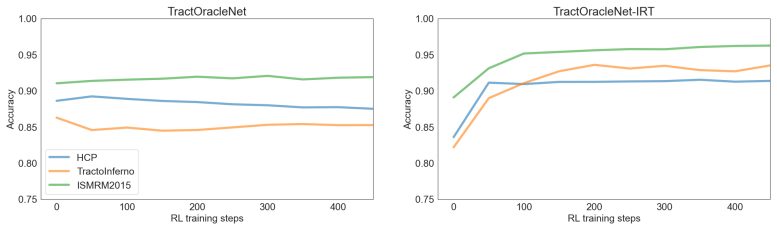
The load-bearing object is TractOracle-Net, a transformer of about 550K parameters (4 encoder blocks, 4 heads) that takes a streamline resampled to 32 points, converts it to 31 direction vectors, and outputs a plausibility score in $[0,1]$. This score enters training through a reward term: at termination, if the oracle's score is $\geq 0.5$, the agent receives an added bonus (weighted by $\alpha=10$), on top of the local fODF alignment reward; during inference the same oracle is polled at every step as a stopping criterion, terminating implausible growing paths. The new Iterative Reward Training (IRT) loop is the second mechanism: train the agent for a warmup (150–200 episodes), track about 250K streamlines from 5 training subjects, annotate them with a filter (RecobundlesX, extractor_flow, or Verifyber), append them to a balanced 4M-streamline dataset, fine-tune the oracle for a few epochs, and repeat for 60 iterations within a 3000-episode budget. IRT's job is to keep the oracle aligned with the distribution of streamlines the agent actually produces, which the authors show is needed for the oracle's accuracy to remain high.
What would settle it
Run the trained oracle-guided agents on a dataset with an independent anatomical gold standard (for example, manually curated expert tracts, or a phantom with known ground-truth bundles) and count how many oracle-accepted streamlines match it; if the 3x–30x gains in plausible streamlines shrink or disappear under that gold standard, the central claim collapses to filter agreement, not anatomical truth.
Extended reading notes
Core claim
The paper's central claim is that a trained oracle, embedded as a reward and as a stopping criterion, is what makes RL-based tractography accurate and anatomically valid, and that this holds regardless of which RL algorithm (Soft Actor-Critic, DroQ, or CrossQ), dataset, or silver-standard filter is used. In the authors' experiments, every oracle-based agent produces between 3x and 20x more filter-accepted streamlines on in vivo data than sd_stream, ifod2, Parallel Transport Tractography (PTT), and Track-to-Learn; the proposed Iterative Reward Training (IRT) raises this to up to 30x over traditional baselines and up to 1.5x over the same RL agent without IRT. The authors attribute the gains to closing a distribution shift: the oracle is initially trained on streamlines from classical algorithms, while IRT re-trains it on filtered streamlines generated by the agent itself, keeping the oracle's accuracy high as the agent's behavior changes.
Load-bearing premise
The same silver-standard filter methods that label the oracle's training streamlines are also used as the scoreboard for anatomical validity in the in vivo evaluations; if those filters are biased, noisy, or gameable, the reported gains measure agreement with the filters rather than with anatomy.
Editorial extensions
If this is right
- Any RL tractography agent can likely be upgraded by adding an oracle: SAC, DroQ, and CrossQ all outperformed the oracle-free Track-to-Learn and classical baselines when given oracle feedback, on every dataset tested.
- Oracle-guided agents transfer across datasets without fine-tuning: agents trained on TractoInferno produced 2–7x more filter-accepted streamlines than baselines when applied to HCP and Penthera-3T.
- Streamlines can be compressed to 32 points with no accuracy loss, cutting oracle inference time from 21 seconds to 6 seconds, making the oracle cheap enough for per-step use during tracking.
- Training for 3000 episodes instead of 1000 caused no divergence or reward-hacking symptoms; oracle-guided training appears stable under extended training.
- IRT is the strongest variant in vivo: it raises filter-accepted streamlines by up to 1.5x over the same agent without IRT and by up to 30x over traditional baselines.
Reading between the lines
- Beyond the paper: if the silver-standard filters really are the bottleneck, the framework's self-reinforcing loop means a filter's blind spot (for example, a rare but valid tract) would be amplified by IRT over iterations, not corrected; a testable safeguard is to hold out one filter per IRT iteration and monitor the unseen filter's acceptance.
- Beyond the paper: the 32-point result suggests oracle inference cost could drop further with even shorter resampling, freeing compute to enlarge the oracle or increase seeding density; the authors hint at this direction when discussing how hard extractor_flow is to learn from geometry alone.
- Beyond the paper: the recipe of rewarding a sequential reconstruction process with an iteratively refreshed plausibility scorer is a general pattern for any reconstruction task with a pretrained judge, such as neuron tracing, vessel extraction, or road tracing from images.
- Beyond the paper: replacing the single-filter oracle with a committee of filters, or training an oracle on filter disagreement, would test whether the gains are anatomical or filter-specific; the paper notes individual filters have different biases but does not try aggregation.
Editorial analysis
A structured set of objections, weighed in public.
Referee Report
Summary. This paper investigates four extensions of the TractOracle-RL framework for reinforcement-learning-based tractography: integrating the DroQ and CrossQ RL algorithms, widening the agent's local neighborhood input with a pretrained autoencoder, and introducing Iterative Reward Training (IRT), which periodically fine-tunes the oracle on agent-generated streamlines labeled by filtering methods. The authors evaluate on ISMRM2015 (with Tractometer ground-truth metrics) and on HCP, TractoInferno, and Penthera-3T in vivo datasets, using the number of streamlines accepted by RecobundlesX, extractor_flow, and Verifyber as the success metric. The paper claims that oracle-based RL methods are robust across algorithms and datasets and significantly outperform classical and oracle-free RL baselines in accuracy and anatomical validity.
Significance. The paper provides a useful empirical exploration of how modern off-policy RL algorithms interact with an oracle reward in tractography, and the IRT scheme is a plausible method for adapting a reward model to the agent's changing streamline distribution. The ISMRM2015 Tractometer results, the public code release, and the detailed hyperparameter tables are strengths. However, the significance is currently limited by two problems: the in vivo evaluation metric is entangled with the oracle's training signal, and the in silico results show that oracle-based methods trade overlap/F1 for lower no-connection rates, which is a narrower claim than the abstract states. With appropriate revisions, the paper could be a valuable robustness study, but the current formulation overstates the anatomical-validity gains.
major comments (3)
- [Section 3.1 vs Section 4.4 (Tables 3 and 4)] The in vivo evaluation of anatomical validity is not independent of the oracle's training signal. Section 3.1 trains TractOracle-Net on streamlines annotated by RecobundlesX, extractor_flow, and Verifyber, and Section 4.4 counts streamlines accepted by those same filters as the measure of success (Tables 3 and 4). An RL agent rewarded on filter-based annotations and stopped by a filter-trained oracle will produce streamlines tailored to satisfy that filter, so the reported gains in 'true positive streamlines' may reflect better filter agreement rather than better anatomy. The abstract's claim that oracle-based methods 'significantly outperform ... in terms of ... anatomical validity' therefore goes beyond what the evaluation demonstrates. Please either soften the wording to 'filter agreement' or add an independent validation (e.g., expert dissection or a filter not used in training).
- [Table 2, Section 4.6.2] The in silico results do not support the claim of consistently superior accuracy. On ISMRM2015, ptt achieves OL=75.32 and F1=65.75, while SAC-3K achieves OL=35.43 and F1=45.87, and CrossQ-3K achieves OL=33.20 and F1=43.27; the best oracle-based F1 is below the classical baseline. Oracle-based methods do improve VC, IB, and NC, but at the cost of overlap and F1. Furthermore, IRT does not improve these metrics over non-IRT training (SAC-IRT F1=45.85 vs SAC-3K 45.87; CrossQ-IRT 44.22 vs CrossQ-3K 43.27). The abstract and conclusion should be revised to state a bias-precision trade-off rather than overall superiority in accuracy.
- [Tables 3 and 4, Section 4.4] The in vivo comparisons use raw numbers of filter-accepted streamlines without controlling for the total number of streamlines generated. Machine-learning methods are tracked with 20 seeds per voxel (Section 4.4), while the classical baselines are run with their default seeding; hence a method that simply produces more streamlines will report more accepted streamlines even at identical precision. Without reporting the fraction of accepted streamlines (precision) or matching the seeding budget, the statements '3× to 20× more valid streamlines' and 'up to 30× more true positive streamlines' (Section 5) are not interpretable. Please report precision or normalized counts.
minor comments (5)
- [Section 3.6] The final sentence of Section 3.6 is incomplete: 'Since in vivo datasets do not provide ground truth streamlines or tract annotations, for all methods' should be completed, e.g., '... we use the filter-based counts described in Section 4.4'.
- [Section 3.4] The text contains typos: 'by an convolutional encoder' should be 'by a convolutional encoder', and 'The sheer reason' should be 'The main reason'.
- [Table 3] In Table 3, 'SAC-IR T' should be 'SAC-IRT' to match the method names used elsewhere.
- [Section 3.1] The word 'mutiple' in 'on mutiple datasets' is a typo for 'multiple'.
- [References] The spelling of the first author of [29] is inconsistent: 'Theberge' in the text vs 'Théberge' in the reference entry; please unify.
Circularity Check
In vivo 'anatomical validity' gains are measured by the same filter family that labels the oracle's training data, so the central claim partially reduces to filter agreement.
-
fitted input called prediction
[Section 3.1 (Oracle training) and Section 3.6 / Tables 3-4 (in vivo evaluation)]
"On the in vivo HCP dataset ... we again use local and PFT [35] tracking but instead use Verifyber, extractor_flow and RecobundlesX to provide three annotations per streamline, which are then used to train three oracles. ... However, since the in vivo datasets do not provide ground truth tract annotations, we leverage RecobundlesX [45, 38], extractor_flow [16] and Verifyber [17] to quantify the number of streamlines recognized by each method."
The oracle is trained to reproduce the labels of RecobundlesX, extractor_flow, and Verifyber, and the in vivo success metric counts streamlines accepted by those same filters. An RL agent rewarded by the filter-trained oracle and stopped by it at inference is therefore optimized to produce streamlines that the filter family accepts. The reported 'true positive streamlines' in Tables 3 and 4 are thus a measure of agreement with the training-label generator, not an independent anatomical measurement; the claimed gains in anatomical validity are partly forced by construction.
-
self definitional
[Section 3.5 (IRT) and Section 4.4 / Tables 3-4]
"The tractograms are then filtered by RecobundlesX [45], extractor_flow [16] or Verifyber [17] so their streamlines are annotated as plausible or implausible, similar to the workflow described in section 3.1. ... Then, the oracle is trained for a few epochs. Then, the RL training loop goes back to step 1..."
IRT closes the loop: agent-generated streamlines are labeled by the filters, the oracle is fine-tuned on those labels, the agent is trained against the oracle, and the final evaluation counts streamlines accepted by the same filters. 'Anatomically valid' is thereby operationally defined by the filter annotations at every stage of the loop. The improvement attributed to IRT on in vivo data is an improvement in matching the filters' criteria; any claim that this equals improved anatomy rests on the unverified assumption that the filters are unbiased, an assumption that is not tested independently.
full rationale
The central circularity is evaluative rather than derivational. The oracle is trained on streamlines annotated by RecobundlesX, extractor_flow, and Verifyber (Section 3.1), and the in vivo evaluation in Section 4.4 and Tables 3-4 counts streamlines recovered by those same filters. Because the RL agent's reward and stopping criterion come from the filter-trained oracle, the reported 'true positive streamlines' measure filter agreement, not independent anatomical truth. This is a genuine benchmark-alignment loop, and it directly supports the abstract's claim of improved 'anatomical validity.' However, the paper is not entirely circular: the ISMRM2015 Tractometer evaluation is an external scoring system not identical to the in vivo filters; cross-dataset transfer experiments (Table 4) show the trained agents generalize to new datasets while still being scored by the same filter family; and qualitative visualizations provide some independent evidence. Self-citation of TractOracle [29] is not load-bearing because the present paper re-runs and extends those experiments rather than relying on the cited result as proof. Overall, the robustness claim across RL algorithms and datasets stands on more than the filter loop, but the headline claim of in vivo anatomical validity is partially defined by the very filters used to create the training labels, warranting a score of 6.
Assumptions & free parameters
free parameters (2)
- Oracle reward bonus alpha_1 =
10
- Oracle acceptance threshold =
0.5
assumptions (4)
- domain assumption RecobundlesX, extractor_flow, and Verifyber labels are an acceptable proxy for anatomical plausibility in vivo.
- ad hoc to paper The oracle trained on complete streamlines can also assess partial in-progress streamlines.
- ad hoc to paper IRT fine-tuning preserves or improves oracle accuracy while the RL policy changes.
- standard math Standard SAC, DroQ, and CrossQ update rules are correct as presented in Appendix A.
Cite this review
Pith. "Pith review of Exploring the robustness of TractOracle methods in RL-based tractography." pith.science (2026). https://pith.science/paper/ROQ5MFGA
@misc{pith2026250711486,
  author       = {Pith},
  title        = {Pith review of: Exploring the robustness of TractOracle methods in RL-based tractography},
  year         = {2026},
  howpublished = {\url{https://pith.science/paper/ROQ5MFGA}},
  note         = {Machine review of arXiv:2507.11486}
}
read the original abstract
Tractography algorithms leverage diffusion MRI to reconstruct the fibrous architecture of the brain's white matter. Among machine learning approaches, reinforcement learning (RL) has emerged as a promising framework for tractography, outperforming traditional methods in several key aspects. TractOracle-RL, a recent RL-based approach, reduces false positives by incorporating anatomical priors into the training process via a reward-based mechanism. In this paper, we investigate four extensions of the original TractOracle-RL framework by integrating recent advances in RL, and we evaluate their performance across five diverse diffusion MRI datasets. Results demonstrate that combining an oracle with the RL framework consistently leads to robust and reliable tractography, regardless of the specific method or dataset used. We also introduce a novel RL training scheme called Iterative Reward Training (IRT), inspired by the Reinforcement Learning from Human Feedback (RLHF) paradigm. Instead of relying on human input, IRT leverages bundle filtering methods to iteratively refine the oracle's guidance throughout training. Experimental results show that RL methods trained with oracle feedback significantly outperform widely used tractography techniques in terms of accuracy and anatomical validity.
Figures


Figures from the paper (3 more)


Reference graph
Works this paper leans on
-
[1]
P. J. Basser, S. Pajevic, C. Pierpaoli, J. Duda, A. Aldroubi, In vivo fiber tractography using dt-mri data, Magnetic resonance in medicine 44 (4) (2000) 625–632
work page 2000
-
[2]
W. I. Essayed, F. Zhang, P. Unadkat, G. R. Cosgrove, A. J. Golby, L. J. O’Donnell, White matter tractography for neurosurgical planning: A topography-based review of the current state of the art, NeuroImage: Clinical 15 (2017) 659–672
work page 2017
-
[3]
N. Soni, A. Mehrotra, S. Behari, S. Kumar, N. Gupta, Diffusion-tensor imaging and tractography application in pre-operative planning of intra-axial brain lesions, Cureus 9 (10) (2017)
work page 2017
-
[4]
H. Takemura, J. Kruper, T. Miyata, A. Rokem, Tractometry of human visual white matter pathways in health and disease, Magn Reson Med Sci. 23 (3) (2024) 316–340
work page 2024
-
[5]
F. Henderson, K. Abdullah, R. Verma, S. Brem, Tractography and the connectome in neurosurgical treatment of gliomas: the premise, the progress, and the potential., Neurosurg Focus. 48 (2) (2020). 26
work page 2020
- [6]
- [7]
-
[8]
K. H. Maier-Hein, P. F. Neher, J.-C. Houde, M.-A. Côté, E. Garyfallidis, J. Zhong, M. Chamberland, F.-C. Yeh, Y.-C. Lin, Q. Ji, et al., The challenge of mapping the human connectome based on diffusion tractography, Nature communications 8 (1) (2017) 1349
work page 2017
Show all 65 references
-
[9]
B.Jeurissen, A.Leemans, J.-D.Tournier, D.Jones, J.Sijbers, Investigatingthepreva- lence of complex fiber configurations in white matter tissue with diffusion magnetic resonance imaging, Hum Brain Mapp 34 (11) (2013) 2747–2766
2013
-
[10]
Mangin, P
J.-F. Mangin, P. Fillard, Y. Cointepas, D. Le Bihan, V. Frouin, C. Poupon, Toward global tractography, Neuroimage 80 (2013) 290–296
2013
-
[11]
Christiaens, M
D. Christiaens, M. Reisert, T. Dhollander, S. Sunaert, P. Suetens, F. Maes, Global tractography of multi-shell diffusion-weighted imaging data using a multi-tissue model, Neuroimage 123 (2015) 89–101
2015
-
[12]
B. W. Kreher, I. Mader, V. G. Kiselev, Gibbs tracking: a novel approach for the reconstruction of neuronal pathways, Magnetic Resonance in Medicine: An Official Journal of the International Society for Magnetic Resonance in Medicine 60 (4) (2008) 953–963
2008
-
[13]
Smith, J
R. Smith, J. Tournier, F. Calamante, A. Connelly, Sift: Spherical-deconvolution in- formed filtering of tractograms., Neuroimage 67 (2013) 298–312
2013
-
[14]
Smith, J
R. Smith, J. Tournier, F. Calamante, A. Connelly, Sift2: Enabling dense quantita- tive assessment of brain white matter connectivity using streamlines tractography, Neuroimage 119 (2015) 338–351
2015
-
[15]
Daducci, A
A. Daducci, A. Dal Palu, A. Lemkaddem, J. Thiran, Commit: Convex optimization modeling for microstructure informed tractography., IEEE Trans Med Imaging 34 (1) (2015) 246–257
2015
-
[16]
Petit, L
K. Petit, L. amd Ali, F. Rheault, A. Bore, S. Cremona, F. Corsini, A. De Benedic- tis, M. Descoteaux, S. Sarubbo, The structural connectivity of the human angular gyrus as revealed by microdissection and diffusion tractography., Brain Structure and Function 228 (1) (2023) 103–120
2023
-
[17]
Astolfi, R
P. Astolfi, R. Verhagen, L. Petit, E. Olivetti, S. Sarubbo, J. Masci, D. Boscaini, P. Avesani, Supervised tractogram filtering using geometric deep learning, Medical Image Analysis 90 (2023) 102893. 27
2023
-
[19]
P. F. Neher, M.-A. Côté, J.-C. Houde, M. Descoteaux, K. H. Maier-Hein, Fiber tractography using machine learning, Neuroimage 158 (2017) 417–429
2017
-
[20]
Poulin, M.-A
P. Poulin, M.-A. Côté, J.-C. Houde, L. Petit, Neher, P. F, K. H. Maier-Hein, H. Larochelle, M. Descoteaux, Learn to track: Deep learning for tractography, in: proc of MICCAI, Springer, 2017, p. 540–547
2017
-
[21]
L. Y. Cai, H. H. Lee, N. R. Newlin, C. I. Kerley, P. Kanakaraj, Q. Yang, G. W. Johnson, D. Moyer, K. G. Schilling, F. Rheault, B. A. Landman, Convolutional- recurrent neural networks approximate diffusion tractography from t1-weighted mri and associated anatomical context, in:...
2024
-
[22]
Poulin, D
P. Poulin, D. Jorgens, P.-M. Jodoin, M. Descoteaux, Tractography and machine learning: Current state and open challenges, Magnetic Resonance Imaging 24 (2019) 37–48
2019
-
[23]
Wasserthal, P
J. Wasserthal, P. Neher, K. H. Maier-Hein, Tractseg-fast and accurate white matter tract segmentation, NeuroImage 183 (2018) 239–253
2018
-
[24]
Rheault, A
F. Rheault, A. De Benedictis, A. Daducci, C. Maffei, C. M. W. Tax, D. Romas- cano, E. Caverzasi, F. C. Morency, F. Corrivetti, F. Pestilli, G. Girard, G. Theaud, I. Zemmoura, J. Hau, K. Glavin, K. M. Jordan, K. Pomiecko, M. Chamberland, M. Barakovic, N. Goyette, P. Poulin, Q. ...
2020
-
[25]
M.-A. Côté, G. Girard, A. Boré, E. Garyfallidis, J.-C. Houde, M. Descoteaux, Trac- tometer: Towards validation of tractography pipelines, Medical Image Analysis 17 (7) (2013) 844–857
2013
-
[26]
Poulin, G
P. Poulin, G. Theaud, F. Rheault, E. St-Onge, A. Bore, E. Renauld, L. de Beau- mont, S. Guay, P.-M. Jodoin, M. Descoteaux, Tractoinferno-a large-scale, open- source, multi-site database for machine learning dmri tractography, Scientific Data 9 (1) (2022) 725
2022
-
[27]
Théberge, C
A. Théberge, C. Desrosiers, M. Descoteaux, P.-M. Jodoin, Track-to-learn: A general frameworkfortractographywithdeepreinforcementlearning, MedicalImageAnalysis 72 (2021) 102093
2021
-
[28]
Théberge, C
A. Théberge, C. Desrosiers, A. Boré, M. Descoteaux, P.-M. Jodoin, What matters in reinforcement learning for tractography, Medical Image Analysis 93 (2024) 103085. 28
2024
-
[29]
Théberge, M
A. Théberge, M. Descoteaux, P.-M. Jodoin, Tractoracle: towards an anatomically- informed reward function for rl-based tractography, in: International Conference on Medical Image Computing and Computer-Assisted Intervention, Springer, 2024, pp. 476–486
2024
-
[30]
Skalse, N
J. Skalse, N. Howe, D. Krasheninnikov, K. D., Defining and characterizing reward hacking, in: in proc of NeurIPS, 2022, pp. 9460 – 9471
2022
-
[31]
Tournier, F
J. Tournier, F. Calamante, D. Gadian, A. Connelly, Direct estimation of the fiber orientation density function from diffusion-weighted mri data using spherical decon- volution, NeuroImage 23 (3) (2004) 1176–1185
2004
-
[32]
Descoteaux, R
M. Descoteaux, R. Deriche, T. Knösche, A. Anwander, Deterministic and probabilis- tic tractography based on complex fibre orientation distributions, IEEE Trans Med Imaging 28 (2) (2009) 269–286
2009
-
[33]
Haarnoja, A
T. Haarnoja, A. Zhou, P. Abbeel, S. Levine, Soft actor-critic: Off-policy maximum entropy deep reinforcement learning with a stochastic actor, in: in proc of ICML, Pmlr, 2018, pp. 1861–1870
2018
-
[34]
Vaswani, N
A. Vaswani, N. Shazeer, N. Parmar, J. Uszkoreit, L. Jones, A. N. Gomez, Ł. Kaiser, I. Polosukhin, Attention is all you need, Advances in neural information processing systems 30 (2017)
2017
-
[35]
Girard, K
G. Girard, K. Whittingstall, R. Deriche, M. Descoteaux, Towards quantitative con- nectivity analysis: reducing tractography biases, Neuroimage 98 (2014) 266–278
2014
-
[36]
Renauld, A
E. Renauld, A. Théberge, L. Petit, J.-C. Houde, M. Descoteaux, Validate your white matter tractography algorithms with a reappraised ismrm 2015 tractography chal- lenge scoring system, Scientific Reports 13 (1) (2023) 2347
2023
-
[37]
Garyfallidis, M
E. Garyfallidis, M. Brett, M. M. Correia, G. B. Williams, I. Nimmo-Smith, Quick- bundles, a method for tractography simplification, Frontiers in neuroscience 6 (2012) 175
2012
-
[38]
F.Rheault, Analyseetreconstructiondefaisceauxdelamatièreblanche, Ph.D.thesis, Université de Sherbrooke Computer Science (2020)
2020
-
[39]
Janner, J
M. Janner, J. Fu, M. Zhang, S. Levine, When to trust your model: Model-based policy optimization, Advances in neural information processing systems 32 (2019)
2019
-
[40]
X. Chen, C. Wang, Z. Zhou, K. Ross, Randomized ensembled double q-learning: Learning fast without a model, arXiv preprint arXiv:2101.05982 (2021)
2021 arXiv
-
[41]
Hiraoka, T
T. Hiraoka, T. Imagawa, T. Hashimoto, T. Onishi, Y. Tsuruoka, Dropout q-functions for doubly efficient reinforcement learning, in: International Conference on Learning Representations, 2022. 29
2022
-
[42]
Bhatt, D
A. Bhatt, D. Palenicek, B. Belousov, M. Argus, A. Amiranashvili, T. Brox, J. Pe- ters, Crossq: Batch normalization in deep reinforcement learning for greater sample efficiency and simplicity, in: in proc of ICLR, 2024
2024
-
[43]
F. L. Sinzinger, R. Moreno, Reinforcement learning based tractography with so (3) equivariant agents, in: Geometric Deep Learning in Medical Image Analysis (Ex- tended abstracts), 2022
2022
-
[44]
P. P. Ray, Chatgpt: A comprehensive review on background, applications, key chal- lenges, bias, ethics, limitations and future scope, Internet of Things and Cyber- Physical Systems 3 (2023) 121–154
2023
-
[45]
Garyfallidis, M.-A
E. Garyfallidis, M.-A. Côté, F. Rheault, J. Sidhu, J. Hau, L. Petit, D. Fortin, S. Cu- nanne, M. Descoteaux, Recognition of white matter bundles using local and global streamline-based registration and clustering, NeuroImage 170 (2018) 283–295
2018
-
[46]
Maier-Hein, P
K. Maier-Hein, P. Neher, J.-C. Houde, E. Caruyer, A. Daducci, T. Dyrby, B. Stieltjes, M. Descoteaux, Tractography challenge ISMRM 2015 data, 10.5281/zenodo.572345 (2015)
2015 doi
-
[47]
P. F. Neher, F. B. Laun, B. Stieltjes, K. H. Maier-Hein, Fiberfox: facilitating the creation of realistic white matter software phantoms, Magnetic resonance in medicine 72 (5) (2014) 1460–1470
2014
-
[48]
Jeurissen, C.-H
J.-D.Tournier, R.Smith, D.Raffelt, R.Tabbara, T.Dhollander, M.Pietsch, D.Chris- tiaens, B. Jeurissen, C.-H. Yeh, A. Connelly, Mrtrix3: A fast, flexible and open software framework for medical image processing and visualisation, Neuroimage 202 (2019) 116137
2019
-
[49]
St-Onge, A
E. St-Onge, A. Daducci, G. Girard, M. Descoteaux, Surface-enhanced tractography (set), NeuroImage 169 (2018) 524–539
2018
-
[50]
Mazoyer, E
B. Mazoyer, E. Mellet, G. Perchey, L. Zago, F. Crivello, G. Jobard, N. Delcroix, M. Vigneau, G. Leroux, L. Petit, et al., Bil&gin: A neuroimaging, cognitive, behav- ioral, and genetic database for the study of human brain lateralization, Neuroimage 124 (2016) 1225–1231
2016
-
[51]
S. N. Sotiropoulos, S. Jbabdi, J. Xu, J. L. Andersson, S. Moeller, E. J. Auerbach, et al., Advances in diffusion mri acquisition and processing in the human connectome project, Neuroimage 80 (2013) 125–143
2013
-
[52]
Theaud, J.-C
G. Theaud, J.-C. Houde, A. Boré, F. Rheault, F. Morency, M. Descoteaux, Tractoflow: A robust, efficient and reproducible diffusion mri pipeline leveraging nextflow & singularity, Neuroimage 218 (2020) 116889
2020
-
[53]
Paquette, G
M. Paquette, G. Gilbert, M. Descoteaux, Penthera 3t, https://doi.org/10.5281/zenodo.2602049, [Data set] (2019). doi:10.5281/zenodo.2602049. 30
2019 doi
-
[54]
D. B. Aydogan, Y. Shi, Parallel transport tractography, IEEE transactions on medical imaging 40 (2) (2020) 635–647
2020
-
[55]
J. H. Legarreta, L. Petit, F. Rheault, G. Theaud, C. Lemaire, M. Descoteaux, P.-M. Jodoin, Filtering in tractography using autoencoders (finta), Medical Image Analysis 72 (2021) 102126
2021
-
[56]
Silver, G
D. Silver, G. Lever, N. Heess, T. Degris, D. Wierstra, M. Riedmiller, Deterministic policy gradient algorithms, in: International conference on machine learning, Pmlr, 2014, pp. 387–395
2014
-
[57]
Hasselt, Double q-learning, in: J
H. Hasselt, Double q-learning, in: J. Lafferty, C. Williams, J. Shawe-Taylor, R. Zemel, A. Culotta (Eds.), in proc of NeuRIPS, Vol. 23, 2010
2010
-
[58]
1352–1361
T.Haarnoja, H.Tang, P.Abbeel, S.Levine, Reinforcementlearningwithdeepenergy- based policies, in: International conference on machine learning, PMLR, 2017, pp. 1352–1361
2017
-
[59]
Haarnoja, A
T. Haarnoja, A. Zhou, K. Hartikainen, G. Tucker, S. Ha, J. Tan, V. Kumar, H. Zhu, A. Gupta, P. Abbeel, et al., Soft actor-critic algorithms and applications, arXiv preprint arXiv:1812.05905 (2018)
2018 arXiv
-
[60]
Srivastava, G
N. Srivastava, G. Hinton, A. Krizhevsky, I. Sutskever, R. Salakhutdinov, Dropout: a simple way to prevent neural networks from overfitting, The journal of machine learning research 15 (1) (2014) 1929–1958
2014
-
[61]
J. L. Ba, J. R. Kiros, G. E. Hinton, Layer normalization, arXiv preprint arXiv:1607.06450 (2016)
2016 arXiv
-
[62]
Ioffe, C
S. Ioffe, C. Szegedy, Batch normalization: Accelerating deep network training by reducing internal covariate shift, in: International conference on machine learning, pmlr, 2015, pp. 448–456
2015
-
[63]
T. P. Lillicrap, J. J. Hunt, A. Pritzel, N. Heess, T. Erez, Y. Tassa, D. Silver, D. Wierstra, Continuous control with deep reinforcement learning, arXiv preprint arXiv:1509.02971 (2015)
2015 arXiv
-
[64]
K. Ota, D. K. Jha, A. Kanezaki, Training larger networks for deep reinforcement learning, arXiv preprint arXiv:2102.07920 (2021)
2021 arXiv
-
[65]
K. Ota, T. Oiki, D. Jha, T. Mariyama, D. Nikovski, Can increasing input dimension- ality improve deep reinforcement learning?, in: International conference on machine learning, PMLR, 2020, pp. 7424–7433
2020
-
[66]
input channels, 3d filter size, output channels
K. He, X. Zhang, S. Ren, J. Sun, Deep residual learning for image recognition, in: ProceedingsoftheIEEEconferenceoncomputervisionandpatternrecognition, 2016, pp. 770–778. 31 Appendix A. Details of reinforcement learning algorithms Appendix A.1. Soft Actor-Critic Algorithm 1Sof...
2016
Reviewed August 6, 2026 · model on record in the stance chip above.
Discussion (0). Sign in to comment.