REVIEW 5 major objections 5 minor 36 references
CharaConsist: Fine-Grained Consistent Character Generation
T0 review · 5 major / 5 minor · reviewed 2026-08-06 · deepseek-v4-flash
Pith's one-line read Point tracking pins a character's identity across generated scenes.
desk verdict A well-executed training-free consistency method for DiT models, with a load-bearing point-matching step that needs stronger external validation. read the letter →
The pith
A machine-rendered reading of the paper's core claim, the machinery that carries it, and where it could break.
The reading
What carries the argument
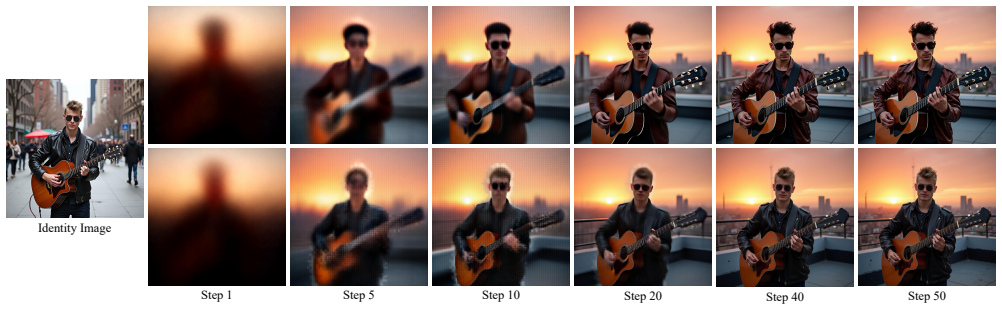
The load-bearing mechanism is point-tracking attention combined with adaptive token merge. Point-tracking attention stores the identity image's keys without positional embedding, computes a dense semantic matching map $\mathrm{map}^*(j)=k$ by layer-averaged cosine similarity of attention outputs, and re-encodes each matched key with the query's Rotary Position Embedding, so shared information is transferred to the correct location despite layout changes. Adaptive token merge then blends the frame's attention output with the identity's re-arranged output, using the averaged similarity $S^*_{\max}$ as a confidence weight, and a foreground-background mask $M$ (from text-attention differences) decides which regions share identity versus background content. Each piece counters a specific failure: RoPE re-encoding addresses positional shift, token merge repairs local geometry and imperfect matches, and the mask gives controllable scene persistence.
What would settle it
Run the point-matching module on a public semantic-correspondence benchmark such as SPair-71k using FLUX.1 features at the 11th sampling step; if matching accuracy is near chance despite the claims of stability, or if replacing the learned correspondences with random ones yields equal consistency in the generation pipeline, the central mechanism is falsified.
Extended reading notes
Core claim
The paper claims that inter-image attention fails at consistent generation because both UNet and DiT models allocate attention by spatial proximity rather than semantic correspondence, a locality bias that grows with positional shift. CharaConsist overcomes this by storing the identity image's keys and attention outputs from FLUX.1, recovering a per-pixel matching map by averaging the cosine similarity of attention outputs across layers at the 11th sampling step, and then re-encoding the matched keys with the query's rotary position embedding during frame generation. An adaptive token merge interpolates the frame's attention output toward the identity's aligned output, weighted by matching confidence, so that low-confidence matches cannot inject wrong features. Decoupled foreground/background masks, derived from attention differences between image tokens and foreground versus background text tokens, allow users to keep a static scene fixed or let it change. The result is claimed to be the largest consistency improvement among training-free methods on consistency metrics, with the method needing only one identity image.
Load-bearing premise
The method rests on the assumption that reliable semantic point correspondences between the frame and identity images can be obtained by averaging cosine similarities of attention outputs at the 11th sampling step; if this matching is inaccurate, the re-encoded attention and token merge both inject mismatched features.
Editorial extensions
If this is right
- Generating an image series for visual storytelling or keyframe-based video can keep both the character's face, clothing, and scene details stable without retraining, which removes a bottleneck in long-format content production.
- Because the method needs just one identity image and no parallel batch generation, the extra GPU memory cost over normal generation is small, so it can be used in interactive or resource-limited settings.
- The point-tracking and mask-extraction controls plug into FLUX.1-style multimodal transformers, meaning they can be ported to other DiT-based editors and generators once the same attention outputs are available.
- The decoupled foreground/background masks let a user freeze a static scene across shots while characters act, or switch scenes entirely, giving direct control over the trade-off between scene persistence and narrative change.
Reading between the lines
- Inference: the layer-averaged cosine correspondence could be repurposed as a general semantic-correspondence prior for DiT feature spaces, e.g., for image editing and style transfer, independent of character generation.
- Inference: the 11th-step heuristic suggests attention maps at mid-sampling encode stable semantics; a timestep-adaptive selection or fine-tuning of the matching step could further improve matching on unusual prompts or styles.
- Inference: since the method declines input identity, combining CharaConsist's point-tracking with a face-reference adapter would likely yield both identity fidelity from the reference and detail/background consistency from the tracking – the paper itself hints at this as future direction.
- Inference: the locality bias finding is model-agnostic; the same diagnosis likely applies to other generative transformers, so the re-encode-and-merge recipe may transfer to video diffusion or multi-image editing tasks.
Editorial analysis
A structured set of objections, weighed in public.
Referee Report
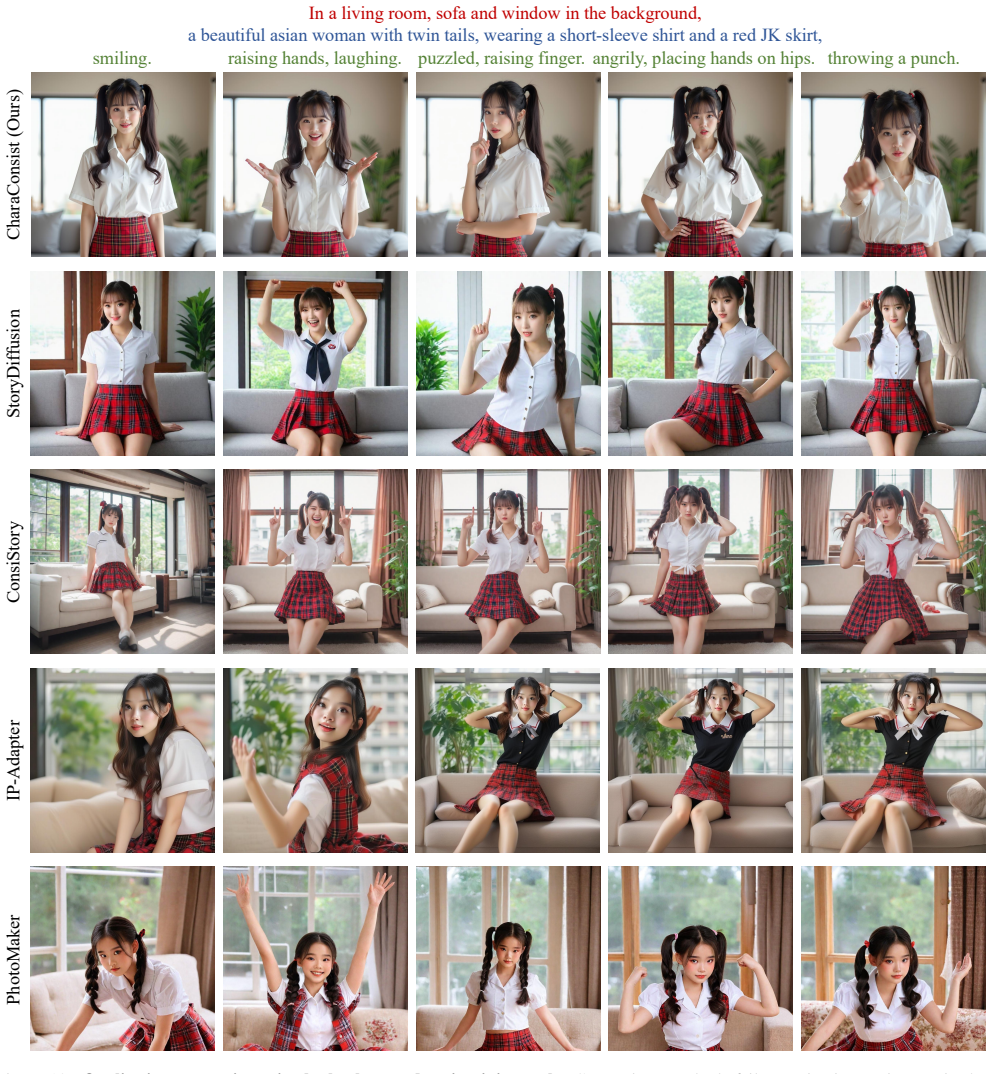
Summary. The paper proposes CharaConsist, a training-free consistent text-to-image generation method built on FLUX.1. It introduces three components: point-tracking attention, which establishes semantic correspondences between a generated identity image and each frame image and re-encodes positional embeddings; adaptive token merge, which interpolates attention outputs according to matching confidence; and foreground/background masks, which allow decoupled control of background consistency. The method is evaluated against ConsiStory, StoryDiffusion, IP-Adapter, and PhotoMaker on a GPT-4-generated benchmark, with additional ablations and a user study. The main claims are that CharaConsist achieves fine-grained foreground and background consistency, supports large motion variation, and is the first consistent generation method tailored to a DiT text-to-image model.
Significance. If the claims hold, CharaConsist addresses a real limitation of existing training-free consistency methods: they are built on UNet models and cannot preserve fine-grained background details or handle large pose changes. The proposed mechanism is plausible, memory-efficient (it requires only a single identity image rather than parallel batch generation), and the qualitative results are visually consistent with the claims. The paper also ships source code, which is a positive contribution to reproducibility. The main weakness is that the quantitative evidence is not yet convincing: the evaluation relies on a self-created prompt set and CLIP-based proxy metrics without error bars or significance tests, and the load-bearing point-matching component is validated only on a small, manually annotated set of the method's own outputs rather than on an external correspondence benchmark.
major comments (5)
- [§3.2, Eqs. (4)–(5), Appendix A] The point-matching map is the load-bearing component of the method: it is used both to re-encode identity keys with frame positions (Eq. (13)) and to weight the interpolation of identity attention outputs (Eq. (20)). However, its accuracy is validated only on a small, manually annotated set of the method's own generated images (Fig. 7), with no external correspondence benchmark and no breakdown by pose change, occlusion, or texture ambiguity. Because the map is computed from a first frame-image pass generated without any consistency constraint, failures in exactly the large-motion regime the paper targets are plausible. The authors should validate point matching on an external semantic-correspondence benchmark using the same FLUX feature extraction, or at minimum compare with DIFT and a no-matching baseline, and report failure cases.
- [Tables 1–3, Table 4] All quantitative tables report point estimates without error bars, confidence intervals, or significance tests. Many differences are small (e.g., CLIP-I-fg 0.883 vs 0.876/0.881/0.882 in Table 1, and increments 0.036 vs 0.041 in Table 2), so the claim that CharaConsist 'significantly outperforms' the baselines is not statistically supported. The user study in Table 4 also lacks inter-annotator agreement or per-item vote counts. The authors should report results over repeated seeds with paired significance tests (e.g., bootstrap or Wilcoxon) for all metrics, and provide more detailed user-study statistics.
- [§4.1] The evaluation benchmark is self-created using GPT-4 prompts and is not released, which limits reproducibility and makes the comparison sensitive to prompt-selection bias. The authors should release the full prompt set, evaluation scripts, and generated images, and ideally also evaluate on at least one existing benchmark, such as the ConsiStory evaluation set or a video-frame consistency set, to demonstrate that the improvements are not an artifact of the chosen prompts.
- [Table 2] The consistency 'increments' in Table 2 are computed relative to different base models (SDXL, RealVisXL4.0, FLUX.1), so the claim that CharaConsist achieves the largest increment is not well-defined because the baselines and scales differ. To support the conclusion that the improvements are not due to the stronger FLUX.1 base model, the authors should report absolute scores with variance for each base model, and where possible compare all methods on the same base model or provide a normalized increment measure.
- [Appendix A, Fig. 7] The critical hyperparameters — the point-matching timestep (step 11), the stopping step for the proposed modules (step 40), the interpolation weight alpha, and the morphological kernel sizes (3x3 erosion, 5x5 dilation) — are selected by manual inspection on a small set of generated outputs, and no sensitivity analysis is reported. The paper should include ablations over these choices (e.g., matching at steps 8/11/15, stopping at steps 35/40/45, different alpha schedules) to show that the method is not brittle to these settings.
minor comments (5)
- [Abstract and §4.2] The claim that CharaConsist is 'the first consistent generation method tailored for text-to-image DiT model' is strong; since the related-work section covers only three prior methods, the claim should be softened to 'to the best of our knowledge' and should be checked against more recent DiT-based consistency works.
- [Eq. (20)] The interpolation weight alpha is described as decaying with timestep, but the decay schedule is never specified. The paper should give the exact schedule (e.g., linear, cosine, or stepwise) and its hyperparameter values.
- [Eq. (6)] The notation Wmm[l:, : lbg + lfg] is unclear: the row index 'l:' should be explicitly defined as the image-token rows of the multimodal attention matrix, and the column range should be described as the text-token columns.
- [Appendix A, Fig. 9] The manual evaluation of point matching and masks uses 'manually selected points in the first image,' but the number of annotated points, number of images, and number of annotators are not reported. Please add these details to make the validation reproducible.
- [§4.1] For the identity-reference baselines IP-Adapter and PhotoMaker, the comparison may be unfair since these methods optimize for facial identity and are not designed for background or clothing consistency. The paper acknowledges this in the discussion, but the experimental section should more clearly state that these baselines are provided for reference rather than as direct competitors.
Circularity Check
No significant circularity: the point-tracking attention and adaptive token merge are self-contained modules evaluated against external baselines; the few self-citations appear only in related work and are not load-bearing.
full rationale
CharaConsist's derivation chain is self-contained. Point matching (Eqs. 4-5) is defined directly from averaged cosine similarity of attention outputs; point-tracking attention (Eqs. 12-17) and adaptive token merge (Eqs. 18-20) consume that matching as input rather than fitting a target metric. The consistency improvements are measured with external CLIP, ID-Sim, and user-study metrics against ConsiStory, StoryDiffusion, IP-Adapter, and PhotoMaker, not against quantities derived from the method's own fitted values. Hyperparameters such as the 11th timestep, step 40 cutoff, alpha, and morphological kernel sizes are selected via manual point/mask accuracy checks, which is standard hyperparameter selection, not a fitted parameter renamed as a prediction. The self-citations in the reference list (AnyI2V, a survey, Free-form motion control) are confined to related-work contexts and do not support the central claim. The paper's limitation that it cannot take an input identity as reference is an acknowledged scope restriction, not a circular step. The only notable evidence concern is that point-matching quality is validated on the method's own generated images rather than an external correspondence benchmark; that is a limitation in evaluation robustness, not a circularity, because the matching is not an output that is then fed back as its own validation target. Accordingly, no circular step meeting the required evidentiary standard is present.
Assumptions & free parameters
free parameters (4)
- Alpha interpolation weight =
not fully specified; decays with timestep
- Timestep for point matching and mask extraction =
11
- Sampling steps for module application =
1 to 40
- Morphological kernel sizes =
3x3 erosion, 5x5 dilation
assumptions (6)
- domain assumption Cosine similarity of diffusion attention outputs averaged across layers yields accurate semantic point correspondences between images.
- domain assumption Foreground and background can be separated by comparing image-token attention to text tokens, given prompts formatted with background before foreground.
- domain assumption Re-encoding positional embeddings with RoPE for matched keys preserves semantic content while correcting viewpoint.
- domain assumption Inter-image attention in FLUX.1 exhibits a locality bias similar to SDXL.
- ad hoc to paper The last 10 sampling steps contribute only low-level texture, not consistency, so modules can be stopped at step 40.
- domain assumption FLUX.1-dev is a valid base model for training-free consistency and its original CLIP-T domain gap carries over to the method.
Cite this review
Pith. "Pith review of CharaConsist: Fine-Grained Consistent Character Generation." pith.science (2026). https://pith.science/paper/D6P7JWXM
@misc{pith2026250711533,
  author       = {Pith},
  title        = {Pith review of: CharaConsist: Fine-Grained Consistent Character Generation},
  year         = {2026},
  howpublished = {\url{https://pith.science/paper/D6P7JWXM}},
  note         = {Machine review of arXiv:2507.11533}
}
read the original abstract
In text-to-image generation, producing a series of consistent contents that preserve the same identity is highly valuable for real-world applications. Although a few works have explored training-free methods to enhance the consistency of generated subjects, we observe that they suffer from the following problems. First, they fail to maintain consistent background details, which limits their applicability. Furthermore, when the foreground character undergoes large motion variations, inconsistencies in identity and clothing details become evident. To address these problems, we propose CharaConsist, which employs point-tracking attention and adaptive token merge along with decoupled control of the foreground and background. CharaConsist enables fine-grained consistency for both foreground and background, supporting the generation of one character in continuous shots within a fixed scene or in discrete shots across different scenes. Moreover, CharaConsist is the first consistent generation method tailored for text-to-image DiT model. Its ability to maintain fine-grained consistency, combined with the larger capacity of latest base model, enables it to produce high-quality visual outputs, broadening its applicability to a wider range of real-world scenarios. The source code has been released at https://github.com/Murray-Wang/CharaConsist
Figures


Figures from the paper (10 more)





Reference graph
Works this paper leans on
-
[1]
Retinaface: Single-shot multi-level face localisation in the wild
Jiankang Deng, Jia Guo, Evangelos Ververas, Irene Kotsia, and Stefanos Zafeiriou. Retinaface: Single-shot multi-level face localisation in the wild. In CVPR, pages 5203–5212,
-
[2]
Taming transformers for high-resolution image synthesis
Patrick Esser, Robin Rombach, and Bj ¨orn Ommer. Taming transformers for high-resolution image synthesis. In CVPR, pages 12873–12883. Computer Vision Foundation / IEEE,
-
[3]
Scaling rec- tified flow transformers for high-resolution image synthesis
Patrick Esser, Sumith Kulal, Andreas Blattmann, Rahim Entezari, Jonas M ¨uller, Harry Saini, Yam Levi, Dominik Lorenz, Axel Sauer, Frederic Boesel, Dustin Podell, Tim Dockhorn, Zion English, and Robin Rombach. Scaling rec- tified flow transformers for high-resolution image synthesis. In ICML. OpenReview.net, 2024. 1, 2, 3
work page 2024
-
[4]
An image is worth one word: Personalizing text- to-image generation using textual inversion
Rinon Gal, Yuval Alaluf, Yuval Atzmon, Or Patashnik, Amit Haim Bermano, Gal Chechik, and Daniel Cohen- Or. An image is worth one word: Personalizing text- to-image generation using textual inversion. In ICLR. OpenReview.net, 2023. 4
work page 2023
-
[5]
Generative adversarial networks
Ian Goodfellow, Jean Pouget-Abadie, Mehdi Mirza, Bing Xu, David Warde-Farley, Sherjil Ozair, Aaron Courville, and Yoshua Bengio. Generative adversarial networks. Communications of the ACM, 63(11):139–144, 2020. 3
work page 2020
-
[6]
Deep residual learning for image recognition
Kaiming He, Xiangyu Zhang, Shaoqing Ren, and Jian Sun. Deep residual learning for image recognition. In CVPR, pages 770–778. IEEE Computer Society, 2016. 3
work page 2016
-
[7]
Denoising diffusion probabilistic models
Jonathan Ho, Ajay Jain, and Pieter Abbeel. Denoising diffusion probabilistic models. In NeurIPS, 2020. 3
work page 2020
-
[8]
Diederik P. Kingma and Max Welling. Auto-encoding variational bayes. In ICLR, 2014. 3
work page 2014
Show all 36 references
-
[9]
Segment anything
Alexander Kirillov, Eric Mintun, Nikhila Ravi, Hanzi Mao, Chloe Rolland, Laura Gustafson, Tete Xiao, Spencer Whitehead, Alexander C Berg, Wan-Yen Lo, et al. Segment anything. In ICCV, pages 4015–4026, 2023. 7
2023
-
[10]
Hunyuanvideo: A systematic framework for large video generative models
Weijie Kong, Qi Tian, Zijian Zhang, Rox Min, Zuozhuo Dai, Jin Zhou, Jiangfeng Xiong, Xin Li, Bo Wu, Jianwei Zhang, et al. Hunyuanvideo: A systematic framework for large video generative models. arXiv preprint arXiv:2412.03603, 2024. 3
2024 arXiv
-
[11]
Multi-concept customization of text-to-image diffusion
Nupur Kumari, Bingliang Zhang, Richard Zhang, Eli Shechtman, and Jun-Yan Zhu. Multi-concept customization of text-to-image diffusion. In CVPR, pages 1931–1941,
1931
-
[12]
Black Forest Labs. Flux. https://github.com/ black-forest-labs/flux, 2024. 1, 2, 3, 4, 11
2024
-
[13]
Photomaker: Customizing realistic human photos via stacked id embedding
Zhen Li, Mingdeng Cao, Xintao Wang, Zhongang Qi, Ming- Ming Cheng, and Ying Shan. Photomaker: Customizing realistic human photos via stacked id embedding. In CVPR, pages 8640–8650, 2024. 3, 4, 7, 8, 12
2024
-
[14]
Hunyuan-dit: A powerful multi-resolution diffusion transformer with fine-grained chinese understanding
Zhimin Li, Jianwei Zhang, Qin Lin, Jiangfeng Xiong, Yanxin Long, Xinchi Deng, Yingfang Zhang, Xingchao Liu, Minbin Huang, Zedong Xiao, et al. Hunyuan-dit: A powerful multi-resolution diffusion transformer with fine-grained chinese understanding. arXiv preprint arXiv:2405.08748 ,
-
[15]
AnyI2V: Animating any conditional image with motion control generation
Ziye Li, Hao Luo, Xincheng Shuai, and Henghui Ding. AnyI2V: Animating any conditional image with motion control generation. In ICCV, 2025. 3
2025
-
[16]
One-prompt-one-story: Free-lunch consistent text- to-image generation using a single prompt
Tao Liu, Kai Wang, Senmao Li, Joost van de Weijer, Fhad Khan, Shiqi Yang, Yaxing Wang, Jian Yang, and Mingming Cheng. One-prompt-one-story: Free-lunch consistent text- to-image generation using a single prompt. In ICLR, 2025. 2, 3
2025
-
[17]
Flow straight and fast: Learning to generate and transfer data with rectified flow
Xingchao Liu, Chengyue Gong, and Qiang Liu. Flow straight and fast: Learning to generate and transfer data with rectified flow. In ICLR. OpenReview.net, 2023. 11
2023
-
[18]
Scalable diffusion models with transformers
William Peebles and Saining Xie. Scalable diffusion models with transformers. In ICCV, pages 4172–4182. IEEE, 2023. 1, 2, 3
2023
-
[19]
SDXL: improving latent diffusion models for high-resolution image synthesis
Dustin Podell, Zion English, Kyle Lacey, Andreas Blattmann, Tim Dockhorn, Jonas M ¨uller, Joe Penna, and Robin Rombach. SDXL: improving latent diffusion models for high-resolution image synthesis. In ICLR. OpenReview.net, 2024. 1, 2, 3, 4
2024
-
[20]
Learning transferable visual models from natural language supervision
Alec Radford, Jong Wook Kim, Chris Hallacy, Aditya Ramesh, Gabriel Goh, Sandhini Agarwal, Girish Sastry, Amanda Askell, Pamela Mishkin, Jack Clark, et al. Learning transferable visual models from natural language supervision. In International conference on machine learning, pa...
2021
-
[21]
Exploring the limits of transfer learning with a unified text-to-text transformer
Colin Raffel, Noam Shazeer, Adam Roberts, Katherine Lee, Sharan Narang, Michael Matena, Yanqi Zhou, Wei Li, and Peter J Liu. Exploring the limits of transfer learning with a unified text-to-text transformer. Journal of machine learning research, 21(140):1–67, 2020. 3
2020
-
[22]
High-resolution image synthesis with latent diffusion models
Robin Rombach, Andreas Blattmann, Dominik Lorenz, Patrick Esser, and Bj ¨orn Ommer. High-resolution image synthesis with latent diffusion models. In CVPR, pages 10684–10695, 2022. 1, 3
2022
-
[23]
U- net: Convolutional networks for biomedical image segmen- tation
Olaf Ronneberger, Philipp Fischer, and Thomas Brox. U- net: Convolutional networks for biomedical image segmen- tation. In Medical image computing and computer-assisted intervention–MICCAI 2015: 18th international conference, Munich, Germany, October 5-9, 2015, proceedings, pa...
2015
-
[24]
Dreambooth: Fine tuning text-to-image diffusion models for subject-driven generation
Nataniel Ruiz, Yuanzhen Li, Varun Jampani, Yael Pritch, Michael Rubinstein, and Kfir Aberman. Dreambooth: Fine tuning text-to-image diffusion models for subject-driven generation. In CVPR, pages 22500–22510, 2023. 4
2023
-
[25]
Facenet: A unified embedding for face recognition and clustering
Florian Schroff, Dmitry Kalenichenko, and James Philbin. Facenet: A unified embedding for face recognition and clustering. In CVPR, pages 815–823, 2015. 7
2015
-
[26]
A survey of multimodal-guided image editing with text-to-image diffu- sion models
Xincheng Shuai, Henghui Ding, Xingjun Ma, Rongcheng Tu, Yu-Gang Jiang, and Dacheng Tao. A survey of multimodal-guided image editing with text-to-image diffu- sion models. arXiv preprint arXiv:2406.14555, 2024. 3
2024 arXiv
-
[27]
Free-form motion control: A synthetic video generation dataset with controllable camera and object motions
Xincheng Shuai, Henghui Ding, Zhenyuan Qin, Hao Luo, Xingjun Ma, and Dacheng Tao. Free-form motion control: A synthetic video generation dataset with controllable camera and object motions. In ICCV, 2025. 3
2025
-
[28]
Deep unsupervised learning using nonequilibrium thermodynamics
Jascha Sohl-Dickstein, Eric Weiss, Niru Maheswaranathan, and Surya Ganguli. Deep unsupervised learning using nonequilibrium thermodynamics. In ICML, pages 2256–
-
[29]
Roformer: Enhanced transformer with rotary position embedding
Jianlin Su, Murtadha Ahmed, Yu Lu, Shengfeng Pan, Wen Bo, and Yunfeng Liu. Roformer: Enhanced transformer with rotary position embedding. Neurocomputing, 568:127063,
-
[30]
Emergent correspondence from image diffusion
Luming Tang, Menglin Jia, Qianqian Wang, Cheng Perng Phoo, and Bharath Hariharan. Emergent correspondence from image diffusion. NeurIPS, 36:1363–1389, 2023. 3, 5
2023
-
[31]
Training-free consistent text-to-image generation
Yoad Tewel, Omri Kaduri, Rinon Gal, Yoni Kasten, Lior Wolf, Gal Chechik, and Yuval Atzmon. Training-free consistent text-to-image generation. ACM TOG, 43(4):1–18,
-
[32]
Attention is all you need
Ashish Vaswani, Noam Shazeer, Niki Parmar, Jakob Uszkoreit, Llion Jones, Aidan N Gomez, Łukasz Kaiser, and Illia Polosukhin. Attention is all you need. Advances in neural information processing systems, 30, 2017. 3
2017
-
[33]
Q-align: teaching lmms for visual scoring via discrete text-defined levels
Haoning Wu, Zicheng Zhang, Weixia Zhang, Chaofeng Chen, Liang Liao, Chunyi Li, Yixuan Gao, Annan Wang, Erli Zhang, Wenxiu Sun, et al. Q-align: teaching lmms for visual scoring via discrete text-defined levels. InProceedings of the 41st International Conference on Machine Learn...
2024
-
[34]
Cogvideox: Text-to-video diffusion models with an expert transformer
Zhuoyi Yang, Jiayan Teng, Wendi Zheng, Ming Ding, Shiyu Huang, Jiazheng Xu, Yuanming Yang, Wenyi Hong, Xiaohan Zhang, Guanyu Feng, et al. Cogvideox: Text-to-video diffusion models with an expert transformer. arXiv preprint arXiv:2408.06072, 2024. 3
2024 arXiv
-
[35]
Ip- adapter: Text compatible image prompt adapter for text-to- image diffusion models
Hu Ye, Jun Zhang, Sibo Liu, Xiao Han, and Wei Yang. Ip- adapter: Text compatible image prompt adapter for text-to- image diffusion models. arXiv preprint arXiv:2308.06721,
-
[36]
Storydiffusion: Consistent self- attention for long-range image and video generation
Yupeng Zhou, Daquan Zhou, Ming-Ming Cheng, Jiashi Feng, and Qibin Hou. Storydiffusion: Consistent self- attention for long-range image and video generation. NeurIPS, 2024. 2, 3, 7, 8, 12 Appendix A. Implementation Details Our CharaConsist is built on the FLUX.1-dev [12] and ma...
2024
Reviewed August 6, 2026 · model on record in the stance chip above.
Discussion (0). Continue with ORCID to comment.