REVIEW 2 major objections 5 minor 44 references
Can Moons Exist around the Habitable-zone Planet K2-18b?
T0 review · 2 major / 5 minor · reviewed 2026-08-06 · deepseek-v4-flash
Pith's one-line read Tidal forces would push any moon around K2-18b past its stability limit within ~10 million years, far under the system's 3-billion-year age, so the habitable-zone planet is moonless today.
desk verdict A solid, well-documented simulation that shows K2-18b likely has no moons if it formed as a rapid rotator, but the abstract oversells the result by dropping that caveat. read the letter →
The pith
A machine-rendered reading of the paper's core claim, the machinery that carries it, and where it could break.
The reading
What carries the argument
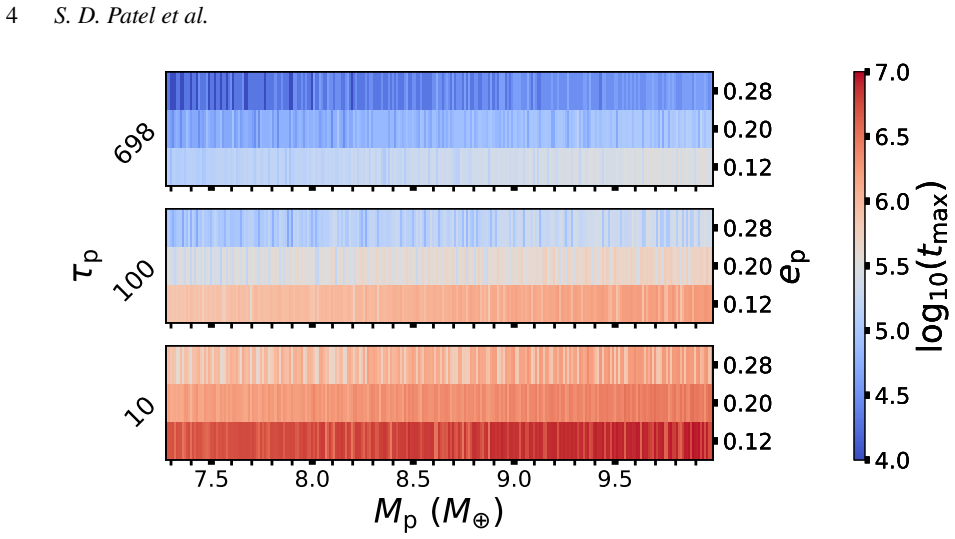
The argument rides on two mechanisms working together. The first is the constant time-lag model of tides, implemented as the tides_spin module: the planet's tidal bulge lags the moon by a fixed time $\tau_p$, transferring angular momentum and steadily evolving the moon's semi-major axis and eccentricity. The second is the critical semi-major axis $a_{\rm crit} = 0.4031(1 - 1.123\,e_p)\,R_H$, with $R_H$ the planet's Hill radius, which defines the stability boundary beyond which a moon counts as lost; each simulation is scored by the moon's maximum lifetime $t_{\max}$, the time to cross $a_{\rm crit}$. The assumed rapid initial spin of the planet (5-hour period) sets the sign of the tidal torque so that the moon always migrates outward, and the relatively small Hill radius of this close-in planet makes the outward journey short.
What would settle it
Two concrete tests would decide the matter: a transit-timing or transit-duration search that detects a moon signal around K2-18b would directly contradict the null prediction, and a re-run of the same simulations with a slow or retrograde initial planetary spin that yields lifetimes above 3 Gyr would show the conclusion depends on the spin assumption rather than on the system itself.
Extended reading notes
Core claim
The paper's central claim is that exomoons are extremely unlikely to survive around K2-18b because planetary tides drive a moon's orbit outward on a timescale far shorter than the system age. In the full grid of simulations, the longest moon lifetime is about 9.1 Myr, achieved only with the most favorable parameters tested: a Neptune-like tidal response (Love number $k_2 = 0.120$), the smallest tidal time-lag $\tau_p = 10$ s, and the lowest observed planetary eccentricity $e_p = 0.12$. Faster dissipation (larger $\tau_p$) and higher eccentricities shorten lifetimes, and even the circular-orbit limit only extends the maximum to roughly 22–24 Myr. Since the K2-18 system is about 3 Gyr old, the authors conclude that no moon can be observed there now, and they extend the result to short-period M-dwarf planets generally: rapid tidal-driven migration removes moons before they can play any climate-stabilizing role, so moon-based habitability scenarios for such systems are doubtful.
Load-bearing premise
The whole conclusion assumes K2-18b began as a rapid rotator with a 5-hour spin period, so tides always push a moon outward; if the planet instead started with a slow or retrograde spin, the tides could pull a moon inward and let it survive much longer.
Editorial extensions
If this is right
- No moon is observable around K2-18b today: the ~10 Myr migration timescale is shorter than the 3 Gyr system age by a factor of about 300.
- Because even the circular-planet limit gives lifetimes of only ~22–24 Myr, the null prediction is robust across the observed eccentricity range.
- The result acts as a predictive filter for exomoon surveys, flagging K2-18b as a false-positive-prone target and helping prioritize other systems.
- Moon-based habitability scenarios for short-period M-dwarf planets are doubtful in general, since tides remove moons before they can stabilize planetary obliquity or host subsurface oceans.
- Changing the moon's mass changes the lifetime by at most a factor of a few, so the conclusion does not hinge on the assumed Luna-mass satellite.
Reading between the lines
- The assumed 5-hour initial spin is load-bearing: if K2-18b instead formed with a slow or retrograde spin, the tidal torque would reverse and could pull a moon inward, letting it survive far beyond 10 Myr. The paper states this assumption but does not vary it, so the result is a statement about rapidly rotating young planets.
- The ~10 Myr removal timescale is so short that even a moon formed in situ after the planet's birth would have to appear within an extremely narrow window to be observable now; this strengthens the null prediction but also means the simulations assume the moon existed at all.
- The same simulation machinery could be turned into a quick screening catalog for other habitable-zone M-dwarf planets: any planet with a short period and small Hill radius is a poor exomoon target, no matter how promising its atmosphere.
- If future JWST-style observations confirm biosignature gases while independent data rule out a moon, the habitability discussion for K2-18b would have to lean entirely on the planet itself rather than on moon-supported environments.
Editorial analysis
A structured set of objections, weighed in public.
Referee Report
Summary. The paper investigates whether K2-18b could host a detectable exomoon by integrating star–planet–moon systems with rebound and reboundx's tides_spin module under the constant time-lag tidal model. The authors vary planetary mass (271 values), initial planetary eccentricity (three values), planetary tidal time-lag (three values), and two interior parameter sets (Earth-like and Neptune-like k2 and C). Each simulation places a Luna-mass moon at 3 R_Roche and defines instability as crossing the a_crit stability boundary of Eq. (3). Across 2,439 simulations, the maximum moon lifetime is found to be about 9.1 Myr, with an extrapolated circular-orbit limit of roughly 22–24 Myr, far shorter than the ~3 Gyr system age. The paper concludes that observable moons are unlikely around K2-18b and questions moon-based habitability scenarios for short-period M-dwarf planets in general.
Significance. If the result holds, it provides a concrete dynamical constraint on exomoon survivability in a high-profile habitable-zone M-dwarf system and offers a template for using N-body tidal simulations to filter exomoon survey targets. The main strengths are the broad parameter sweep (2,439 integrations, three eccentricities, three time-lags, two interior models), the use of a well-documented tidal evolution module that includes spin evolution, and the fact that the lifetimes are outputs of direct integration rather than assumed inputs. The principal weakness is that the fixed 5-hour initial spin period controls the sign of tidal migration and is not varied, so the headline conclusion is conditional on an unconstrained assumption. The absence of public code or data and the neglect of the known companion K2-18c further limit the strength of the broadest generalizations.
major comments (2)
- [Section 2, Table 1; Section 4] The fixed initial planetary spin period of 5 h (Table 1) places the planet in a super-synchronous state relative to the moon's initial orbit, which forces the tidal torque to push the moon outward. This single assumption controls the sign of the tidal migration that drives the headline result. If K2-18b instead began with a slower, near-synchronous, or retrograde spin, the tidal torque could draw the moon inward, keep it near a synchronous state, or otherwise allow substantially longer survival; the migration-reversal mechanism cited from Sasaki et al. (2012) is dismissed rather than simulated. Section 4 explicitly concedes that the conclusion assumes a rapid rotator, but the abstract and title present the result without this caveat. I request additional simulations with a range of initial spin periods (e.g., near the synchronous period, longer periods, and retrograde spin), or at least an analytic sign criterion for the tidal migration, and a revised abstract and title that state the conditional nature of the claim.
- [Abstract; Section 4] The generalization that the result "cast[s] doubt on moon-based habitability scenarios for short-period M-dwarf planets in general" goes beyond what the simulations establish. The study varies M_p, e_p, tau_p, k2, and C, but it holds the moon mass at a single lunar mass, fixes the initial moon semi-major axis at 3 R_Roche, fixes the initial planetary spin at 5 h, and omits the known companion K2-18c. Any of these choices could alter the tidal migration rate or the effective stability boundary. The broad statement should either be removed or supported by simulations that explore at least the moon-mass and initial-spin dimensions.
minor comments (5)
- [Table 1] The column header for a_m lists units of au, but the entry is "3 R_Roche"; please specify the corresponding au value or change the header so the units are consistent.
- [Section 3, Fig. 3, Table 2] The MCMC linear fits use only three eccentricity values per time-lag value, and the error bars are described as "not statistically significant." The slopes and y-intercepts in Table 2 should be presented as descriptive linear interpolations rather than robust statistical inferences, and the circular-orbit extrapolation should be labeled as such.
- [Section 2] The simulations treat the star and moon as point masses and the planet with a constant radius of 2.61 R_E. The tidal response of the star is not modeled; a brief justification or citation for neglecting stellar tides on the 10 Myr integration timescale would improve the completeness of the methods.
- [Data Availability] The statement that "the data underlying this article will be shared on reasonable request" is insufficient for a study with 2,439 simulations; please deposit the rebound/reboundx scripts, initial-condition files, and summary outputs in a public repository to enable reproducibility.
- [Section 1] K2-18c is mentioned as a companion but is not included in the N-body model. A sentence quantifying the expected perturbation from K2-18c (for example, the ratio of its semi-major axis to K2-18b's Hill radius) would make the Payne et al. (2013) assumption of negligible planetary perturbations more transparent.
Circularity Check
No significant circularity: lifetimes are direct N-body outputs; disclosed spin assumption is a limitation, not a circular step.
full rationale
The claimed prediction—moon lifetimes of ~10^4–10^7 yr and instability within ~9.1 Myr—is the output of direct rebound/reboundx integrations under the constant time-lag tidal model, with planetary mass, eccentricity, and time-lag varied over the stated ranges. No equation in the paper injects the lifetime as an input; the simulations determine when the moon crosses the adopted stability boundary a_crit (Eq. 3). That boundary is cited from Rosario-Franco et al. (2020), a same-group publication, but it is a parameter-free stability criterion from prior simulations used only to stop the clock, and the tidal migration times to reach it are computed, not fitted. The MCMC lines in Fig. 3 and Table 2 merely interpolate/extrapolate the simulated median lifetimes to e_p=0 and are not the central claim. The 5 h initial spin is an unvaried assumption (Kokubo & Genda 2010; Takaoka et al. 2023) that sets the direction of migration; Section 4 explicitly discloses the conclusion is conditional on K2-18b beginning as a rapid rotator and notes the migration-reversal scenario is not possible under that assumption. This is a model limitation and a correctness risk for the general 'M-dwarf moons' claim, not a circular reduction of the result to its inputs. Accordingly, no circular step is identified.
Assumptions & free parameters
free parameters (7)
- Planetary mass M_p =
7.28 to 9.98 M_Earth (scan, step 0.01)
- Initial planetary eccentricity e_p =
0.12, 0.20, 0.28
- Planetary tidal time-lag tau_p =
10, 100, 698 s
- Love number k2 and moment of inertia C =
k2=0.298/C=0.3308 (Earth-like); k2=0.120/C=0.2200 (Neptune-like)
- Initial planetary spin period P_s =
5 hours
- Initial moon semi-major axis a_m =
3 R_Roche
- Moon mass M_m =
0.0123 M_Earth (Luna mass)
assumptions (5)
- domain assumption Constant time-lag tidal model (Eggleton et al. 1998)
- domain assumption Stability criterion a_crit (Eq. 3)
- domain assumption Negligible perturbations from other planets
- domain assumption Rapid initial spin P_s=5 h
- domain assumption Constant planetary radius
Cite this review
Pith. "Pith review of Can Moons Exist around the Habitable-zone Planet K2-18b?." pith.science (2026). https://pith.science/paper/2W4HB5PI
@misc{pith2026250711594,
  author       = {Pith},
  title        = {Pith review of: Can Moons Exist around the Habitable-zone Planet K2-18b?},
  year         = {2026},
  howpublished = {\url{https://pith.science/paper/2W4HB5PI}},
  note         = {Machine review of arXiv:2507.11594}
}
read the original abstract
K2-18b closely orbits a nearby M3 dwarf within its habitable zone, where this planet could be either a super-Earth or a mini-Neptune. Recent studies using transit spectroscopy suggest that it is Hycean in nature, but this classification is currently controversial. We use the N-body integrator rebound and its extension library reboundx to investigate the possibility of exomoons around K2-18b. Due to tidal interactions that induce outward migration, we find that any moons would be extremely unlikely. If formed, their lifetimes would be relatively short, not exceeding 10 Myr assuming Earth-like or Neptune-like tidal parameters for K2-18b. Recent studies estimate the stellar (and system) lifetime as 3 Gyr, which is significantly longer than the tidal migration timescale. We show that exomoons are unlikely to survive around K2-18b due to rapid tidal-driven migration, casting doubt on moon-based habitability scenarios for short-period M-dwarf planets in general.
Figures


Reference graph
Works this paper leans on
-
[1]
Barnes R., 2017, @doi [Celest. Mech. Dyn. Astron.] 10.1007/s10569-017-9783-7 , https://ui.adsabs.harvard.edu/abs/2017CeMDA.129..509B 129, 509
-
[2]
Barnes J. W., O’Brien D. P., 2002, @doi [ ] 10.1086/341477 , 575, 1087
doi:10.1086/341477 2002
-
[3]
Benneke B., et al., 2019, @doi [ ] 10.3847/2041-8213/ab59dc , https://ui.adsabs.harvard.edu/abs/2019ApJ...887L..14B 887, L14
-
[4]
N., Leconte J., Hersant F., Correia A
Bolmont E., Raymond S. N., Leconte J., Hersant F., Correia A. C. M., 2015, @doi [A&A] 10.1051/0004-6361/201525909 , 583, A116
-
[5]
Cloutier R., et al., 2019, @doi [ ] 10.1051/0004-6361/201833995 , https://ui.adsabs.harvard.edu/abs/2019A&A...621A..49C 621, A49
-
[6]
Cuntz M., Guinan E. F., 2016, @doi [ ] 10.3847/0004-637X/827/1/79 , https://ui.adsabs.harvard.edu/abs/2016ApJ...827...79C 827, 79
-
[7]
Eggleton P. P., Kiseleva L. G., Hut P., 1998, @doi [ ] 10.1086/305670 , https://ui.adsabs.harvard.edu/abs/1998ApJ...499..853E 499, 853
doi:10.1086/305670 1998
-
[8]
Foreman-Mackey D., Hogg D. W., Lang D., Goodman J., 2013, @doi [ ] 10.1086/670067 , https://ui.adsabs.harvard.edu/abs/2013PASP..125..306F 125, 306
doi:10.1086/670067 2013
Show all 44 references
-
[9]
France K., et al., 2013, @doi [ ] 10.1088/0004-637X/763/2/149 , https://ui.adsabs.harvard.edu/abs/2013ApJ...763..149F 763, 149
2013 doi
-
[10]
Gaia Collaboration et al., 2023, @doi [ ] 10.1051/0004-6361/202243940 , https://ui.adsabs.harvard.edu/abs/2023A&A...674A...1G 674, A1
2023 doi
-
[11]
Goodman J., Weare J., 2010, @doi [Comm. App. Math. Com. Sc.] 10.2140/camcos.2010.5.65 , https://ui.adsabs.harvard.edu/abs/2010CAMCS...5...65G 5, 65
2010 doi
-
[12]
Heller R., et al., 2014, @doi [Astrobiology] 10.1089/ast.2014.1147 , https://ui.adsabs.harvard.edu/abs/2014AsBio..14..798H 14, 798
2014
-
[13]
Hut P., 1981, , https://ui.adsabs.harvard.edu/abs/1981A&A....99..126H 99, 126
1981
-
[14]
Jagtap O., Quarles B., Cuntz M., 2021, @doi [ ] 10.1017/pasa.2021.52 , https://ui.adsabs.harvard.edu/abs/2021PASA...38...59J 38, e059
2021 doi
-
[15]
Kaltenegger L., 2010, @doi [ ] 10.1088/2041-8205/712/2/L125 , https://ui.adsabs.harvard.edu/abs/2010ApJ...712L.125K 712, L125
2010 doi
-
[16]
M., Nesvorn \'y D., Buchhave L
Kipping D. M., Nesvorn \'y D., Buchhave L. A., Hartman J., Bakos G. \'A ., Schmitt A. R., 2014, @doi [ ] 10.1088/0004-637X/784/1/28 , https://ui.adsabs.harvard.edu/abs/2014ApJ...784...28K 784, 28
2014 doi
-
[17]
Kokubo E., Genda H., 2010, @doi [ ] 10.1088/2041-8205/714/1/L21 , https://ui.adsabs.harvard.edu/abs/2010ApJ...714L..21K 714, L21
2010 doi
-
[18]
J., Barnes J
Lissauer J. J., Barnes J. W., Chambers J. E., 2012, @doi [ ] 10.1016/j.icarus.2011.10.013 , https://ui.adsabs.harvard.edu/abs/2012Icar..217...77L 217, 77
2012 doi
-
[19]
C., Laughlin G., 2023, @doi [ ] 10.3847/1538-4357/acc06d , https://ui.adsabs.harvard.edu/abs/2023ApJ...948...41L 948, 41
Lu T., Rein H., Tamayo D., Hadden S., Mardling R., Millholland S. C., Laughlin G., 2023, @doi [ ] 10.3847/1538-4357/acc06d , https://ui.adsabs.harvard.edu/abs/2023ApJ...948...41L 948, 41
2023 doi
-
[20]
M., Rein H., 2024, @doi [ ] 10.1093/mnras/stae1982 , https://ui.adsabs.harvard.edu/abs/2024MNRAS.533.3708L 533, 3708
Lu T., Hernandez D. M., Rein H., 2024, @doi [ ] 10.1093/mnras/stae1982 , https://ui.adsabs.harvard.edu/abs/2024MNRAS.533.3708L 533, 3708
2024 doi
- [21]
-
[22]
Madhusudhan N., Sarkar S., Constantinou S., Holmberg M., Piette A. A. A., Moses J. I., 2023, @doi [ ] 10.3847/2041-8213/acf577 , https://ui.adsabs.harvard.edu/abs/2023ApJ...956L..13M 956, L13
2023 doi
-
[23]
Madhusudhan N., Constantinou S., Holmberg M., Sarkar S., Piette A. A. A., Moses J. I., 2025, @doi [ ] 10.3847/2041-8213/adc1c8 , https://ui.adsabs.harvard.edu/abs/2025ApJ...983L..40M 983, L40
2025 doi
-
[24]
T., et al., 2015, @doi [ ] 10.1088/0004-637X/809/1/25 , https://ui.adsabs.harvard.edu/abs/2015ApJ...809...25M 809, 25
Montet B. T., et al., 2015, @doi [ ] 10.1088/0004-637X/809/1/25 , https://ui.adsabs.harvard.edu/abs/2015ApJ...809...25M 809, 25
2015 doi
-
[25]
D., Dermott S
Murray C. D., Dermott S. F., 1999, Solar System Dynamics , @doi 10.1017/CBO9781139174817
1999 doi
-
[26]
Neron de Surgy O., Laskar J., 1997, , https://ui.adsabs.harvard.edu/abs/1997A&A...318..975N 318, 975
1997
-
[27]
L., Charbonneau D., Cherubim C., Garcia-Mejia J., 2024, A Search for Exoplanet Satellites that are the Same Size as the Earth's Moon , JWST Proposal
Pass E., Bean J. L., Charbonneau D., Cherubim C., Garcia-Mejia J., 2024, A Search for Exoplanet Satellites that are the Same Size as the Earth's Moon , JWST Proposal. Cycle 3, ID. \#6193
2024
-
[28]
D., Quarles B., Cuntz M., 2025, @doi [ ] 10.1093/mnras/staf131 , https://ui.adsabs.harvard.edu/abs/2025MNRAS.537.2291P 537, 2291
Patel S. D., Quarles B., Cuntz M., 2025, @doi [ ] 10.1093/mnras/staf131 , https://ui.adsabs.harvard.edu/abs/2025MNRAS.537.2291P 537, 2291
2025 doi
-
[29]
J., Deck K
Payne M. J., Deck K. M., Holman M. J., Perets H. B., 2013, @doi [ ] 10.1088/2041-8205/775/2/L44 , https://ui.adsabs.harvard.edu/abs/2013ApJ...775L..44P 775, L44
2013 doi
-
[30]
L., 2018, @doi [ ] 10.3847/1538-3881/aaca38 , https://ui.adsabs.harvard.edu/abs/2018AJ....156...54P 156, 54
Piro A. L., 2018, @doi [ ] 10.3847/1538-3881/aaca38 , https://ui.adsabs.harvard.edu/abs/2018AJ....156...54P 156, 54
2018 doi
-
[31]
E., Cuntz M., 2012, @doi [ ] 10.1088/0004-637X/750/1/14 , https://ui.adsabs.harvard.edu/abs/2012ApJ...750...14Q 750, 14
Quarles B., Musielak Z. E., Cuntz M., 2012, @doi [ ] 10.1088/0004-637X/750/1/14 , https://ui.adsabs.harvard.edu/abs/2012ApJ...750...14Q 750, 14
2012 doi
-
[32]
J., 2019, @doi [ ] 10.3847/1538-4357/ab46b5 , https://ui.adsabs.harvard.edu/abs/2019ApJ...886...56Q 886, 56
Quarles B., Li G., Lissauer J. J., 2019, @doi [ ] 10.3847/1538-4357/ab46b5 , https://ui.adsabs.harvard.edu/abs/2019ApJ...886...56Q 886, 56
2019 doi
-
[33]
J., 2022, @doi [ ] 10.1093/mnras/stab3179 , https://ui.adsabs.harvard.edu/abs/2022MNRAS.509.2736Q 509, 2736
Quarles B., Li G., Lissauer J. J., 2022, @doi [ ] 10.1093/mnras/stab3179 , https://ui.adsabs.harvard.edu/abs/2022MNRAS.509.2736Q 509, 2736
2022 doi
-
[34]
F., 2012, @doi [ ] 10.1051/0004-6361/201118085 , https://ui.adsabs.harvard.edu/abs/2012A&A...537A.128R 537, A128
Rein H., Liu S. F., 2012, @doi [ ] 10.1051/0004-6361/201118085 , https://ui.adsabs.harvard.edu/abs/2012A&A...537A.128R 537, A128
2012 doi
-
[35]
S., 2015, @doi [ ] 10.1093/mnras/stu2164 , https://ui.adsabs.harvard.edu/abs/2015MNRAS.446.1424R 446, 1424
Rein H., Spiegel D. S., 2015, @doi [ ] 10.1093/mnras/stu2164 , https://ui.adsabs.harvard.edu/abs/2015MNRAS.446.1424R 446, 1424
2015 doi
-
[36]
E., Cuntz M., 2020, @doi [ ] 10.3847/1538-3881/ab89a7 , https://ui.adsabs.harvard.edu/abs/2020AJ....159..260R 159, 260
Rosario-Franco M., Quarles B., Musielak Z. E., Cuntz M., 2020, @doi [ ] 10.3847/1538-3881/ab89a7 , https://ui.adsabs.harvard.edu/abs/2020AJ....159..260R 159, 260
2020 doi
-
[37]
Sairam L., Madhusudhan N., 2025, @doi [MNRAS] 10.1093/mnras/staf528 , 539, 1299
2025 doi
-
[38]
Sarkis P., et al., 2018, @doi [ ] 10.3847/1538-3881/aac108 , https://ui.adsabs.harvard.edu/abs/2018AJ....155..257S 155, 257
2018 doi
-
[39]
W., O'Brien D
Sasaki T., Barnes J. W., O'Brien D. P., 2012, @doi [ ] 10.1088/0004-637X/754/1/51 , https://ui.adsabs.harvard.edu/abs/2012ApJ...754...51S 754, 51
2012 doi
-
[40]
Takaoka K., Kuwahara A., Ida S., Kurokawa H., 2023, @doi [ ] 10.1051/0004-6361/202345915 , https://ui.adsabs.harvard.edu/abs/2023A&A...674A.193T 674, A193
2023 doi
-
[41]
M., 2020, @doi [ ] 10.1093/mnras/stz2870 , https://ui.adsabs.harvard.edu/abs/2020MNRAS.491.2885T 491, 2885
Tamayo D., Rein H., Shi P., Hernandez D. M., 2020, @doi [ ] 10.1093/mnras/stz2870 , https://ui.adsabs.harvard.edu/abs/2020MNRAS.491.2885T 491, 2885
2020 doi
-
[42]
arXiv:2504.21788
Welbanks L., et al., 2025, @doi [arXiv e-prints] 10.48550/arXiv.2504.21788 , https://ui.adsabs.harvard.edu/abs/2025arXiv250421788W p. arXiv:2504.21788
2025 doi
-
[43]
Youngblood A., et al., 2017, @doi [ ] 10.3847/1538-4357/aa76dd , https://ui.adsabs.harvard.edu/abs/2017ApJ...843...31Y 843, 31
2017 doi
-
[44]
write newline
" write newline "" before.all 'output.state := FUNCTION fin.entry write newline FUNCTION new.block output.state before.all = 'skip after.block 'output.state := if FUNCTION new.sentence output.state after.block = 'skip output.state before.all = 'skip after.sentence 'output.stat...
Reviewed August 6, 2026 · model on record in the stance chip above.
Discussion (0). Continue with ORCID to comment.