REVIEW 3 major objections 4 minor 72 references
Decision Models for Selecting Architecture Patterns and Strategies in Quantum Software Systems
T0 review · 3 major / 4 minor · reviewed 2026-08-06 · deepseek-v4-flash
Pith's one-line read The paper proposes six decision models for choosing architecture patterns and strategies in quantum software systems, grounded in mined practitioner data and a systematic literature review, and reports practitioner ratings suggesting the…
desk verdict A systematic, useful catalog of quantum architecture patterns—worth refereeing, but the 'can aid practitioners' claim rests on thin subjective evidence and needs revision. read the letter →
The pith
A machine-rendered reading of the paper's core claim, the machinery that carries it, and where it could break.
The reading
What carries the argument
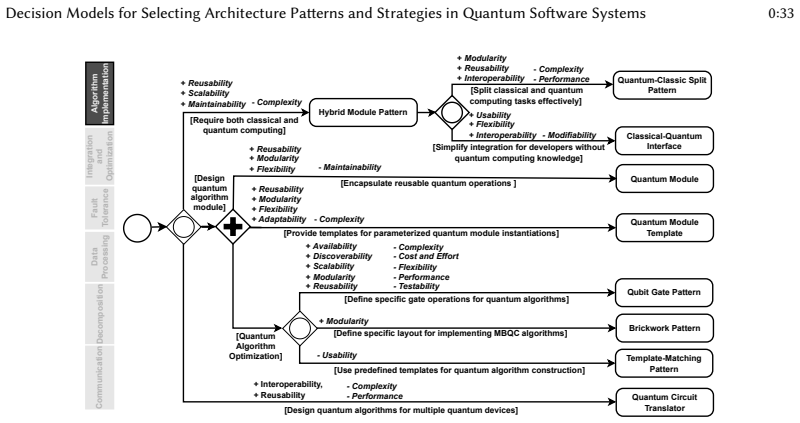
The central artifact is the decision model itself, rendered as a BPMN-style flow that maps a design area's required quality attributes (the problem space) to candidate architecture patterns and strategies (the solution space). Inclusive, exclusive, and parallel gateways represent decision flows; patterns appear as rounded rectangles labeled with the quality attributes they positively and negatively affect, and constraints appear as octagons attached by dashed arrows. For example, the Communication model routes a practitioner needing a unified quantum-classical interface to Quantum API Gateway, showing its positive effects on flexibility, modularity, interoperability, security, and scalability alongside its negative effects on availability, performance, and cost. The models were built from patterns identified in mined project data and developer Q&A posts plus patterns from a systematic literature review of 92 studies, then de-duplicated into 63 unique patterns and strategies across the six design areas.
What would settle it
A controlled experiment where matched teams design the same quantum software system with and without the decision models, judged blind on quality-attribute satisfaction by independent experts; if the model-using teams show no measurable advantage over a simple pattern list, the central claim fails.
Extended reading notes
Core claim
The central claim is that six proposed decision models can aid practitioners in selecting suitable architecture patterns and strategies for quantum software systems. The models organize a consolidated set of 63 unique patterns and strategies into six design areas, connect each pattern to the quality attributes it improves and degrades, and use BPMN-style gateways to route decisions based on conditions such as whether communication is point-to-point or collective, whether fault detection or correction is needed, or whether data should be encoded with basis, amplitude, or angle encoding. Evaluation by 16 practitioners produced high ratings for familiarity, understandability, and sufficiency across all six models, with Communication and Fault Tolerance rated most familiar and all six models judged sufficient by most participants. The paper concludes that the models offer a structured way to select reusable patterns and strategies in the complexity of hybrid quantum-classical environments.
Load-bearing premise
The claim rests on the assumption that 16 practitioners' self-reported familiarity, understandability, and completeness ratings are a reliable proxy for actual improvement in architecture decisions; no baseline or behavioural test shows the models outperform unaided judgment.
Editorial extensions
If this is right
- Using the Communication model, a practitioner who needs a unified entry point to quantum backends is routed to Quantum API Gateway, with its positive and negative quality-attribute impacts shown side by side.
- Using the Decomposition model, a team building a hybrid system can decide between Quantum-Classic Split and Quantum Microservices by checking which quality attributes matter more for their hardware and integration constraints.
- Using the Fault Tolerance model, an architect can separate fault detection (Comparison, Voting, Sparing) from fault correction (Error Correction, Readout Error Mitigation, Gate Error Mitigation) rather than choosing one pattern in isolation.
- Because the models and their underlying dataset are public, the mapping from quality attributes to patterns can be inspected, reproduced, and extended with new patterns as quantum technology evolves.
- Following the paper's own plans, the models could be embedded in tool support that recommends patterns during architecture design.
Reading between the lines
- The most decisive next test would be a controlled comparison: teams with and without the decision models designing the same system, with independent experts scoring the resulting architectures; the interview ratings alone cannot show that the models beat unaided judgment or a plain list of patterns.
- Because the models encode today's pattern vocabulary, they will need ongoing updates as quantum hardware and hybrid integration practices change; the paper's static models do not yet include such a maintenance mechanism.
- Tying the models to measurable quality-attribute outcomes, such as decoherence rates, gate counts, or integration latency, would let future users validate a pattern choice numerically instead of by familiarity.
Editorial analysis
A structured set of objections, weighed in public.
Referee Report
Summary. The paper proposes six decision models that map architectural patterns and strategies to quality attributes in six design areas of quantum software systems: Communication, Decomposition, Data Processing, Fault Tolerance, Integration and Optimization, and Algorithm Implementation. The models are constructed from a mining study of GitHub issues/pull requests and Stack Exchange posts, combined with a systematic literature review, then condensed and de-duplicated into 63 unique patterns/strategies organized as BPMN-style decision flows. The evaluation consists of semi-structured interviews with 16 quantum software practitioners, who rated their familiarity with the patterns, the models' understandability, and the models' completeness/sufficiency for architecture decision-making. The paper concludes that the decision models can aid practitioners in selecting suitable architecture patterns and strategies.
Significance. If the central claim were supported by the evidence, this would be a useful contribution: the quantum software engineering community currently lacks structured, quality-attribute-driven selection guidance for architecture patterns and strategies. The paper has clear strengths: the construction process is transparent, combining a mining study and an SLR; the decision model notation is carefully documented; the interview protocol and materials are included; and a replication package is provided. The study also explicitly acknowledges several validity threats and reports the demographic diversity of its small participant sample. However, the significance is currently limited by the evaluation design: the only evidence for the load-bearing claim that the models 'can aid practitioners in selecting' is self-reported familiarity, understandability, and completeness, with no behavioral test, baseline comparison, or objective measure of decision quality. The paper is therefore a solid model-proposal study whose central claim needs either additional validation or a more modest wording.
major comments (3)
- [Section 5.2 and Figure 10] The central claim in the Abstract and Section 8 is that the decision models 'can aid practitioners in selecting suitable patterns and strategies.' The evaluation in Section 5.2, however, measures only self-reported familiarity with patterns, perceived ease of understanding, and perceived completeness/sufficiency. None of these metrics operationalizes 'aid in selecting': a practitioner can find a model understandable and complete and still make the same architecture decision as without it. The interview questions quoted in Section 5.2 ask about ease of understanding and sufficiency, but not about whether the models changed or improved a real selection decision. Section 7.3 explicitly concedes that 'the reliance on subjective evaluations introduces potential bias' and that further validation across real-world scenarios is needed, so the Section 8 conclusion that the models 'can effectively support' practitioners goes beyond the reported evidence. This issue is load-bearing for the paper's main claim; it should be addressed either by adding a behavioral evaluation (e.g., a decision task with and without the models, scored by independent experts) or by substantially tempering the conclusion to claim perceived usefulness rather than demonstrated selection support.
- [Section 3.1.3 and Section 3.1.1, Phase 4] The reported pattern counts are internally inconsistent. Section 3.1.1, Phase 4 states that 164 patterns/strategies were identified, with 145 from 121 GitHub issues and 19 from 13 Stack Exchange posts. Section 3.1.3 states that the mining study yielded 162 patterns/strategies, comprising 145 from GitHub and 17 from Stack Exchange, and then lists 210 patterns from the SLR in a way that appears to make the 'comprising' clause sum to 145+17+210=372. The totals 164 versus 162, and 19 versus 17, are contradictory. The per-site breakdown is also inconsistent: Table 2 lists 13 related Stack Exchange posts (2+0+0+5+3+2+0+1+0 = 13), but Phase 4 reports 19 patterns from '5 from Stack Overflow, 13 from Quantum Computing Stack Exchange, and 1 from Computer Science Stack Exchange,' which does not match the related-post counts in Table 2. These inconsistencies weaken confidence in the traceability of the model construction and should be corrected and explained before the paper can be accepted.
- [Section 4.4 and Figure 6/Figure 7] The Fault Tolerance decision model section refers to 'Figure 7,' but the displayed figure for that model is numbered Fig. 6, while Fig. 7 is the Integration and Optimization model. Similarly, Section 4.1 states that 'Table 3 lists the patterns and strategies covered by the Communication Decision Model,' but the table actually appears as Table 9. These cross-reference errors, while not technical, make the paper difficult to verify and suggest the final manuscript needs a careful pass over figure and table numbering.
minor comments (4)
- [Section 7.1] A paragraph beginning 'To mitigate bias that may arise from relying on a single data source or method...' is duplicated verbatim within Section 7.1; the duplicate should be removed.
- [Section 7.3] The sentence 'Despite the modest number of participants, their qualitative feedback played a crucial role in refining the decision models...' appears twice in the same paragraph; one occurrence should be deleted.
- [Section 3.1.3] The sentence 'Specifically, from the mining study, we identified 162 patterns/strategies, comprising 145 from 121 GitHub issues & PRs, 17 from 13 Stack Exchange posts, and 210 patterns from 92 reviewed studies' is grammatically ambiguous about whether the 210 SLR patterns are part of the mining-study total or the overall total; the intended grouping should be restated clearly.
- [Section 3.1.1, Phase 4] The text reports '87.8% of participants' as familiar with most or all patterns in the Algorithm Implementation model, but Figure 10 shows 56.3% + 31.3% = 87.6%, and the individual response counts (9 and 5 of 16) give 87.5%; the percentage should be corrected to match the data.
Circularity Check
No significant circularity: the decision models are induced from external mining and SLR data, and the interview evaluation, while subjective, is not definitionally tied to the model content.
full rationale
The derivation chain is: collect patterns, strategies, and quality attributes from GitHub, Stack Exchange, and a systematic literature review (Sections 3.1.1 and 3.1.2); integrate and deduplicate them into six decision models (Section 3.1.3 and Section 4); and evaluate the models through semi-structured interviews with 16 practitioners (Section 5). No step defines a model output in terms of the evaluation outcome, and no fitted parameter is renamed as a prediction. The six design areas are said to originate from recurring architectural challenges reported in the literature [10, 30], and the authors' prior empirical study [7] is used only to motivate the focus rather than to force the model contents; the models themselves are populated from the current mining study and SLR. The evaluation asks practitioners for familiarity, understandability, completeness, and usefulness, which are self-reports about the presented artifacts rather than a behavioral test of decision quality, and Section 7.3 concedes that 'the reliance on subjective evaluations introduces potential bias.' That is a validity limitation, not a circularity: the claim that the models can aid practitioners is not equivalent by construction to the input data, and there are no equations or fitted parameters into which the conclusion collapses. Numerical inconsistencies (e.g., 164 versus 162 patterns, and 19 versus 17 Stack Exchange patterns) bear on data quality but do not establish circularity. Accordingly, no circular step is identified.
Assumptions & free parameters
assumptions (4)
- domain assumption The six design areas (Communication, Decomposition, Data Processing, Fault Tolerance, Integration and Optimization, Algorithm Implementation) are the critical architectural concerns for quantum software systems.
- domain assumption GitHub issues and pull requests, Stack Exchange posts, and SLR primary studies are representative of real quantum software architecture decisions.
- domain assumption The authors' thematic coding and naming unification correctly identify, consolidate, and attribute quality attributes to patterns and strategies.
- domain assumption Practitioners' self-reported familiarity, understandability, and sufficiency are valid evidence that the models aid selection.
Cite this review
Pith. "Pith review of Decision Models for Selecting Architecture Patterns and Strategies in Quantum Software Systems." pith.science (2026). https://pith.science/paper/2OKFWKMO
@misc{pith2026250711671,
  author       = {Pith},
  title        = {Pith review of: Decision Models for Selecting Architecture Patterns and Strategies in Quantum Software Systems},
  year         = {2026},
  howpublished = {\url{https://pith.science/paper/2OKFWKMO}},
  note         = {Machine review of arXiv:2507.11671}
}
read the original abstract
Quantum software represents disruptive technologies in terms of quantum-specific software systems, services, and applications - leverage the principles of quantum mechanics via programmable quantum bits (Qubits) that manipulate quantum gates (QuGates) - to achieve quantum supremacy in computing. Quantum software architecture enables quantum software developers to abstract away implementation-specific details (i.e., mapping of Qubits and QuGates to high-level architectural components and connectors). Architectural patterns and strategies can provide reusable knowledge and best practices to engineer quantum software systems effectively and efficiently. However, quantum software practitioners face significant challenges in selecting and implementing appropriate patterns and strategies due to the complexity of quantum software systems and the lack of guidelines. To address these challenges, this study proposes decision models for selecting patterns and strategies in six critical design areas in quantum software systems: Communication, Decomposition, Data Processing, Fault Tolerance, Integration and Optimization, and Algorithm Implementation. These decision models are constructed based on data collected from both a mining study (i.e., GitHub and Stack Exchange) and a Systematic Literature Review, which were used to identify relevant patterns and strategies with their involved Quality Attributes (QAs). We then conducted semi-structured interviews with 16 quantum software practitioners to evaluate the familiarity, understandability, completeness, and usefulness of the proposed decision models. The results show that the proposed decision models can aid practitioners in selecting suitable patterns and strategies to address the challenges related to the architecture design of quantum software systems. The dataset is available at [6], allowing the community to reproduce and build upon our findings.
Figures


Figures from the paper (7 more)




Reference graph
Works this paper leans on
-
[7]
Mst Shamima Aktar, Peng Liang, Muhammad Waseem, Amjed Tahir, Aakash Ahmad, Beiqi Zhang, and Zengyang Li. 2025. Architecture Decisions in Quantum Software Systems: An Empirical Study on Stack Exchange and GitHub. Information and Software Technology 177 (2025), 107587
work page 2025
-
[1]
Aakash Ahmad and Muhammad Ali Babar. 2016. Software Architectures for Robotic Systems: A Systematic Mapping Study. Journal of Systems and Software 122 (2016), 16–39
work page 2016
-
[2]
Aakash Ahmad, Arif Ali Khan, Muhammad Waseem, Mahdi Fahmideh, and Tommi Mikkonen. 2022. Towards Process Centered Architecting for Quantum Software Systems. In Proceedings of the 1st IEEE International Conference on Quantum Software (QSW). IEEE, Barcelona, Spain, 26–31
work page 2022
-
[3]
Aakash Ahmad, Muhammad Waseem, Peng Liang, Mahdi Fehmideh, Arif Ali Khan, David Georg Reichelt, and Tommi Mikkonen. 2023. Engineering Software Systems for Quantum Computing as a Service: A Mapping Study.arXiv preprint arXiv:2303.14713 (2023)
arXiv 2023
-
[4]
Muhammad Azeem Akbar, Arif Ali Khan, and Saima Rafi. 2023. A Systematic Decision-Making Framework for Tackling Quantum Software Engineering Challenges. Automated Software Engineering 30, 2 (2023), 22
work page 2023
-
[5]
Muhammad Azeem Akbar, Arif Ali Khan, Mohammad Shameem, and Mohammad Nadeem. 2024. Genetic Model-Based Success Probability Prediction of Quantum Software Development Projects. Information and Software Technology 165 (2024), 107352
work page 2024
-
[6]
Mst Shamima Aktar, Peng Liang, and Muhammad Waseem. 2025. Replication Package for the Study: Decision Models for Selecting Patterns and Strategies in Quantum Software Systems. https://github.com/shamimaaktar1/DMQSA
work page 2025
-
[8]
Álvaro M Aparicio-Morales, Enrique Moguel, Luis Mariano Bibbo, Alejandro Fernandez, Jose Garcia-Alonso, and Juan M Murillo. 2024. An Overview of Quantum Software Engineering in Latin America. Quantum Information Processing 23 (2024), Article No.: 380
work page 2024
Show all 72 references
-
[9]
Frank Arute, Kunal Arya, Ryan Babbush, Dave Bacon, Joseph C Bardin, Rami Barends, Rupak Biswas, Sergio Boixo, Fernando GSL Brandao, David A Buell, et al . 2019. Quantum Supremacy using a Programmable Superconducting Processor. Nature 574, 7779 (2019), 505–510
2019
-
[10]
Michal Baczyk, Ricardo Pérez-Castillo, and Mario Piattini. 2024. Patterns for Quantum Software Engineering. In Proceedings of 1st Recent Advances in Quantum Computing and Technology (ReAQCT) . ACM, Budapest, Hungary, 1–6
2024
-
[11]
Michal Baczyk, Ricardo Pérez-Castillo, and Mario Piattini. 2024. Towards a Framework of Architectural Patterns for Quantum Software Engineering. In Proceedings of the 5th IEEE International Conference on Quantum Computing and Engineering (QCE). IEEE, Montreal, QC, Canada, 228–233
2024
-
[12]
Martin Beisel, Johanna Barzen, Frank Leymann, Felix Truger, Benjamin Weder, and Vladimir Yussupov. 2022. Patterns for Quantum Error Handling. In Proceedings of the 14th International Conference on Pervasive Patterns and Applications (PATTERNS). XPS, Barcelona, Spain, 22–30
2022
-
[13]
Tingting Bi, Peng Liang, and Antony Tang. 2018. Architecture Patterns, Quality Attributes, and Design Contexts: How Developers Design with Them. In Proceedings of the 25th Asia-Pacific Software Engineering Conference (APSEC) . IEEE, Nara, Japan, 49–58
2018
-
[14]
Virginia Braun and Victoria Clarke. 2006. Using Thematic Analysis in Psychology. Qualitative Research in Psychology 3, 2 (2006), 77–101
2006
-
[15]
Pearl Brereton, Barbara A Kitchenham, David Budgen, Mark Turner, and Mohamed Khalil. 2007. Lessons from Applying the Systematic Literature Review Process within the Software Engineering Domain. Journal of Systems and Software 80, 4 (2007), 571–583
2007
-
[16]
Fabian Bühler, Johanna Barzen, Martin Beisel, Daniel Georg, Frank Leymann, and Karoline Wild. 2023. Patterns for Quantum Software Development. In Proceedings of the 15th International Conference on Pervasive Patterns and Applications (PATTERNS). XPS, Nice, France, 30–39
2023
-
[17]
John L Campbell, Charles Quincy, Jordan Osserman, and Ove K Pedersen. 2013. Coding in-Depth Semistructured Interviews: Problems of Unitization and Intercoder Reliability and Agreement. Sociological Methods & Research 42, 3 (2013), 294–320
2013
-
[18]
Cloves Carneiro and Tim Schmelmer. 2016. Microservices from Day One . Springer
2016
-
[19]
Lianping Chen, Muhammad Ali Babar, and He Zhang. 2010. Towards an Evidence-Based Understanding of Electronic Data Sources. In Proceedings of the 14th International Conference on Evaluation and Assessment in Software Engineering (EASE). BCS Learning & Development, Swindon, UK, 1–4
2010
-
[20]
Kai Ding, Andrey Morozov, and Klaus Janschek. 2017. Classification of Hierarchical Fault-Tolerant Design Patterns. In Proceedings of the 15th International Conference on Dependable, Autonomic and Secure Computing (DASC) . IEEE, Orlando, FL, USA, 612–619
2017
-
[21]
Hrishikesh Dutta and Amit Kumar Bhuyan. 2024. Quantum Communication: From Fundamentals to Recent Trends, challenges and open problems. arXiv preprint arXiv:2406.04492 (2024). ACM Trans. Softw. Eng. Methodol., Vol. 0, No. 0, Article 0. Publication date: 2025. Decision Models fo...
2024 arXiv
-
[22]
Steve Easterbrook, Janice Singer, Margaret-Anne Storey, and Daniela Damian. 2008. Selecting Empirical Methods for Software Engineering Research. Guide to Advanced Empirical Software Engineering (2008), 285–311
2008
-
[23]
Mark Endrei, Jenny Ang, Ali Arsanjani, Sook Chua, Philippe Comte, Pål Krogdahl, Min Luo, and Tony Newling. 2004. Patterns: Service-Oriented Architecture and Web Services . IBM Corporation
2004
-
[24]
Richard P Feynman. 2018. Simulating Physics with Computers. In Feynman and Computation. CRC Press, 133–153
2018
-
[25]
Jose Garcia-Alonso, Javier Rojo, David Valencia, Enrique Moguel, Javier Berrocal, and Juan Manuel Murillo. 2021. Quantum Software as a Service Through a Quantum API Gateway. IEEE Internet Computing 26, 1 (2021), 34–41
2021
-
[26]
Richard W Grove. 1988. An Analysis of the Constant Comparative Method. Internation Journal of Qualitative Studies in Education 1, 3 (1988), 273–279
1988
-
[27]
Thomas Grurl, Jürgen Fuß, and Robert Wille. 2020. Considering Decoherence Errors in the Simulation of Quantum Circuits Using Decision Diagrams. In Proceedings of the 39th International Conference on Computer-Aided Design (ICCAD). IEEE, Thoothukudi, India, 1–7
2020
-
[28]
Travis S Humble and Erik P DeBenedictis. 2019. Quantum Realism. IEEE Computer 52, 6 (2019), 13–17
2019
-
[29]
Pramod Mathew Jacob and Prasanna Mani. 2018. Software Architecture Pattern Selection Model for Internet of Things Based Systems. IET Software 12, 5 (2018), 390–396
2018
-
[30]
Arif Ali Khan, Aakash Ahmad, Muhammad Waseem, Peng Liang, Mahdi Fahmideh, Tommi Mikkonen, and Pekka Abrahamsson. 2023. Software Architecture for Quantum Computing Systems—A Systematic Review.Journal of Systems and Software 201 (2023), 111682
2023
-
[31]
Arif Ali Khan, Davide Taibi, Cécile M Perrault, and Asif Ali Khan. 2024. Advancing Quantum Software Engineering: A Vision of Hybrid Full-Stack Iterative Model. In Proceedings of the 40th ACM/SIGAPP Symposium on Applied Computing (SAC). ACM, Catania, Italy, 1444–1448
2024
-
[32]
Arif Ali Khan, Boshuai Ye, Muhammad Azeem Akbar, Javed Ali Khan, Davoud Mougouei, and Xinyuan Ma. 2025. Mining Q&A Platforms for Empirical Evidence on Quantum Software Programming. arXiv preprint arXiv:2503.05240 (2025)
2025 arXiv
-
[33]
Barbara Kitchenham, Stuart Charters, et al. 2007. Guidelines for Performing Systematic Literature Reviews in Software Engineering. Technical Report. EBSE Technical Report EBSE-2007-01 ver. 2.3
2007
-
[34]
Pearl Brereton, David Budgen, Mark Turner, John Bailey, and Stephen Linkman
Barbara Kitchenham, O. Pearl Brereton, David Budgen, Mark Turner, John Bailey, and Stephen Linkman. 2009. Systematic literature reviews in software engineering – A systematic literature review. Information and Software Technology 51, 1 (2009), 7–15
2009
-
[35]
Mykhailo Klymenko, Thong Hoang, Xiwei Xu, Zhenchang Xing, Muhammad Usman, Qinghua Lu, and Liming Zhu
-
[36]
Grace A Lewis, Patricia Lago, and Paris Avgeriou. 2016. A Decision Model for Cyber-Foraging Systems. In Proceedings of the 13th Working IEEE/IFIP Conference on Software Architecture (WICSA) . IEEE, Venice, Italy, 51–60
2016
-
[37]
Yue Liu, Qinghua Lu, Hye-Young Paik, Guangsheng Yu, and Liming Zhu. 2023. Decision Models for Selecting Patterns in Governance-driven Blockchain Systems. In Proceedings of the 6th IEEE International Conference on Blockchain (ICBC) . IEEE, Hainan, China, 307–314
2023
-
[38]
Juan M Murillo, Jose Garcia-Alonso, Enrique Moguel, Johanna Barzen, Frank Leymann, Shaukat Ali, Tao Yue, Paolo Arcaini, Ricardo Pérez Castillo, Ignacio García Rodríguez de Guzmán, et al. 2025. Quantum Software Engineering: Roadmap and Challenges Ahead. ACM Transactions on Soft...
2025
-
[39]
Lalitha Nallamothula. 2020. Selection of Quantum Computing Architecture Using a Decision Tree Approach. In Proceedings of the 3rd International Conference on Intelligent Sustainable Systems (ICISS) . IEEE, Coimbatore, India, 644–649
2020
-
[40]
Michael A Nielsen and Isaac L Chuang. 2010. Quantum Computation and Quantum Information . Cambridge University Press
2010
-
[41]
Moses Openja, Mohammad Mehdi Morovati, Le An, Foutse Khomh, and Mouna Abidi. 2022. Technical Debts and Faults in Open-Source Quantum Software Systems: An Empirical Study. Journal of Systems and Software 193 (2022), 111458
2022
-
[42]
Ricardo Pérez-Castillo, Miriam Fernández-Osuna, José A Cruz-Lemus, and Mario Piattini. 2024. A Preliminary Study of the Usage of Design Patterns in Quantum Software. In Proceedings of the 5th ACM/IEEE International Workshop on Quantum Software Engineering (Q-SE) . ACM, Lisbon,...
2024
-
[43]
Ricardo Pérez-Castillo, Luis Jiménez-Navajas, Iván Cantalejo, and Mario Piattini. 2023. Generation of Classical- Quantum Code from UML models. In Proceedings of the 4th IEEE International Conference on Quantum Computing and Engineering (QCE). IEEE, Bellevue, WA, USA, 165–168
2023
-
[44]
Ricardo Pérez-Castillo, Luis Jiménez-Navajas, and Mario Piattini. 2021. Modelling Quantum Circuits with UML. In Proceedings of the IEEE/ACM 2nd International Workshop on Quantum Software Engineering (Q-SE) . IEEE, Madrid, Spain, ACM Trans. Softw. Eng. Methodol., Vol. 0, No. 0,...
2021
-
[45]
Mario Piattini, Manuel Serrano, Ricardo Perez-Castillo, Guido Petersen, and Jose Luis Hevia. 2021. Toward a Quantum Software Engineering. IT Professional 23, 1 (2021), 62–66
2021
-
[46]
Mark Richards. 2015. Software Architecture Patterns. Vol. 4. O’Reilly Media
2015
-
[47]
Chris Richardson. 2018. Microservices Patterns: With Examples in Java . Simon and Schuster
2018
-
[48]
Javier Rojo, David Valencia, Javier Berrocal, Enrique Moguel, Jose Garcia-Alonso, and Juan Manuel Murillo Rodriguez
-
[49]
Hadi Salloum, Hamza Shafee Aldaghstany, Osama Orabi, Ahmad Haidar, Mohammad Reza Bahrami, and Manuel Mazzara. 2024. Integration of Machine Learning with Quantum Annealing. In Proceedings of the 38th International Conference on Advanced Information Networking and Applications (...
2024
-
[50]
Carolyn B. Seaman. 1999. Qualitative Methods in Empirical Studies of Software Engineering. IEEE Transactions on Software Engineering 25, 4 (1999), 557–572
1999
-
[51]
Peter W Shor. 1994. Algorithms for Quantum Computation: Discrete Logarithms and Factoring. In Proceedings of the 35th Annual Symposium on Foundations of Computer Science (FOCS) . IEEE, Santa Fe, New Mexico, USA, 124–134
1994
-
[52]
Klaas-Jan Stol, Paul Ralph, and Brian Fitzgerald. 2016. Grounded Theory in Software Engineering Research: a Critical Review and Guidelines. In Proceedings of the 38th International Conference on Software Engineering (ICSE) . Austin, TX, USA, 120–131
2016
-
[53]
Pedro Henrique Dias Valle, Lina Garcés, and Elisa Yumi Nakagawa. 2021. Architectural strategies for interoperability of software-intensive systems: practitioners’ perspective. In Proceedings of the 36th Annual ACM Symposium on Applied Computing (SAC). ACM, Virtual Event, Repub...
2021
-
[54]
Raymon Van Dinter, Bedir Tekinerdogan, and Cagatay Catal. 2021. Automation of Systematic Literature Reviews: A Systematic Literature Review. Information and Software Technology 136 (2021), 106589
2021
-
[55]
Daniel Vietz, Johanna Barzen, Frank Leymann, and Karoline Wild. 2021. On Decision Support for Quantum Application Developers: Categorization, Comparison, and Analysis of Existing Technologies. InProceedings of the 21st International Conference on Computational Science (ICCS) ....
2021
-
[56]
Yanze Wang, Yiling Huang, Jingyue Li, Shanshan Li, He Zhang, Chenxing Zhong, Xiaodong Liu, Bohan Liu, Yue Liu, Qinghua Lu, et al. 2025. Decision Support for Selecting Blockchain-Based Application Design Patterns with Layered Taxonomy and Quality Attributes. IEEE Transactions o...
2025
-
[57]
Muhammad Waseem, Peng Liang, Aakash Ahmad, Mojtaba Shahin, Arif Ali Khan, and Gastón Márquez. 2022. Decision Models for Selecting Patterns and Strategies in Microservices Systems and Their Evaluation by Practitioners. In Proceedings of the 44th IEEE/ACM International Conferenc...
2022
-
[58]
Muhammad Waseem, Peng Liang, and Mojtaba Shahin. 2020. A Systematic Mapping study on Microservices Architec- ture in DevOps. Journal of Systems and Software 170 (2020), 110798
2020
-
[59]
Muhammad Waseem, Peng Liang, Mojtaba Shahin, Aakash Ahmad, and Ali Rezaei Nassab. 2021. On the Nature of Issues in Five Open Source Microservices Systems: An Empirical Study. In Proceedings of the 25th International Conference on Evaluation and Assessment in Software Engineeri...
2021
-
[60]
Muhammad Waseem, Tommi Mikkonen, Aakash Ahmad, Muhammad Taimoor Khan, Majid Haghparast, Vlad Stirbu, and Peng Liang. 2025. QADL: Prototype of Quantum Architecture Description Language. In Proceedings of the 29th International Conference on Evaluation and Assessment in Software...
2025
-
[61]
Benjamin Weder, Johanna Barzen, Frank Leymann, and Michael Zimmermann. 2021. Hybrid Quantum Applications Need Two Orchestrations in Superposition: A Software Architecture Perspective. InProceedings of the 28th International Conference on Web Services (ICWS) . IEEE, Chicago, IL...
2021
-
[62]
Benjamin Weder, Uwe Breitenbücher, Frank Leymann, and Karoline Wild. 2020. Integrating Quantum Computing into Workflow Modeling and Execution. In Proceedings of the IEEE/ACM 13th International Conference on Utility and Cloud Computing (UCC). IEEE, Leicester, United Kingdom, 279–291
2020
-
[63]
Manuela Weigold, Johanna Barzen, Frank Leymann, and Marie Salm. 2021. Expanding Data Encoding Patterns For Quantum Algorithms. In Proceedings of the 18th IEEE International Conference on Software Architecture Companion (ICSA-C). IEEE, Stuttgart, Germany, 95–101
2021
-
[64]
Manuela Weigold, Johanna Barzen, Frank Leymann, and Daniel Vietz. 2021. Patterns for Hybrid Quantum Algorithms. In Proceedings of the 15th Symposium and Summer School on Service-Oriented Computing (SummerSOC) . Springer, Virtual Event, 34–51
2021
-
[65]
Claes Wohlin. 2014. Guidelines for Snowballing in Systematic Literature Studies and a Replication in Software Engineering. In Proceedings of the 18th International Conference on Evaluation and Assessment in Software Engineering (EASE). ACM, London, England, UK, 1–10. ACM Trans...
2014
-
[66]
Xiwei Xu, HMN Dilum Bandara, Qinghua Lu, Ingo Weber, Len Bass, and Liming Zhu. 2021. A Decision Model for Choosing Patterns in Blockchain-Based Applications. In Proceedings of the 18th IEEE International Conference on Software Architecture (ICSA). IEEE, Stuttgart, Germany, 47–57
2021
-
[67]
Tao Yue, Wolfgang Mauerer, Shaukat Ali, and Davide Taibi. 2023. Challenges and Opportunities in Quantum Software Architecture. In Software Architecture: Recent Trends in Software Architecture . Springer, 45–52
2023
-
[68]
He Zhang, Muhammad Ali Babar, Xu Bai, Juan Li, and Liguo Huang. 2011. An Empirical Assessment of A Systematic Search Process for Systematic Reviews. In Proceedings of the 15th Annual Conference on Evaluation and Assessment in Software Engineering (EASE). IEEE, Durham, UK, 56–65
2011
-
[69]
Jianjun Zhao. 2024. Towards An Architecture Description Language for Hybrid Quantum-Classical Systems. In 2024 IEEE International Conference on Quantum Software (QSW) . IEEE, Shenzhen, China, 19–23
2024
-
[70]
Olaf Zimmermann, Uwe Zdun, Thomas Gschwind, et al. 2008. Combining Pattern Languages and Reusable Architectural Decision Models into a Comprehensive and Comprehensible Design Method. InProceedings of the 7th Working IEEE/IFIP Conference on Software Architecture (WICSA). IEEE, ...
2008
-
[2021]
arXiv preprint arXiv:2105.04421 (2021)
Trials and Tribulations of Developing Hybrid Quantum-Classical microservices systems. arXiv preprint arXiv:2105.04421 (2021)
2021 arXiv
-
[2025]
Journal of Systems and Software 227 (2025), 112456
Architectural Patterns for Designing Quantum Artificial Intelligence Systems. Journal of Systems and Software 227 (2025), 112456
2025
Reviewed August 6, 2026 · model on record in the stance chip above.
Discussion (0). Continue with ORCID to comment.