REVIEW 5 major objections 5 minor 27 references
Volatile enrichment in low-mass planets: Signatures of past planetary disruption?
T0 review · 5 major / 5 minor · reviewed 2026-08-06 · deepseek-v4-flash
Pith's one-line read Tidal disruption of a close-in giant planet can deliver enough hydrogen and helium to a surviving low-mass planet to form a detectable secondary atmosphere lasting up to 100 million years.
desk verdict A genuinely new capture mechanism with numbers that need a binding-check before you quote them. read the letter →
The pith
A machine-rendered reading of the paper's core claim, the machinery that carries it, and where it could break.
The reading
What carries the argument
The load-bearing mechanism is a two-stage capture-and-survival chain. First, tidal stripping of a close-in giant leaves a debris ring whose gas spreads outward by viscous diffusion; the paper treats gas as captured by the outer planet if it enters a circle of radius R_cap = 0.2 R_Hill, an empirical scale from energy-balance considerations. Second, the captured envelope contracts on a Kelvin-Helmholtz timescale, with dust opacity setting the rate, and this contraction regulates further gas accretion. The surviving atmosphere is then eroded by XUV-driven escape and stellar wind, and its transit signal is estimated from the effective height of an isothermal hydrostatic envelope.
What would settle it
Run a 3D hydrodynamical simulation that tracks whether gas entering the 0.2-Hill-radius zone remains gravitationally bound to the planet after the viscous disk disperses, or take a high-sensitivity transmission spectrum of a 1 to 10 Earth-mass planet at 0.04 to 0.07 au in a system with a recent giant disruption and check whether the predicted tens-to-hundreds of parts per million H/He signal is present.
Extended reading notes
Core claim
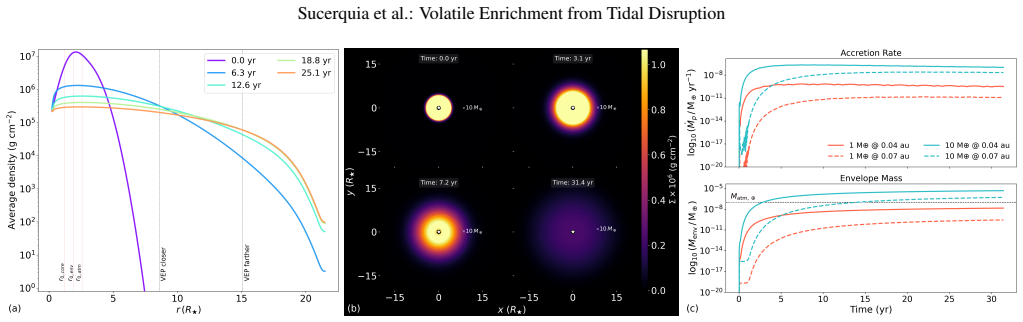
The paper's central claim is that volatile-rich gas expelled when a close-in giant planet is tidally stripped can be re-accreted by a lower-mass outer planet, creating a 'volatile-enriched planet' (VEP) with a transient H/He envelope. In their 2D hydrodynamical simulations, a Jupiter-like planet disrupted near the Roche limit produces a viscous gas ring that spreads outward over a few years; a 1 or 10 Earth-mass planet placed at 0.04 or 0.07 au captures gas within 0.2 Hill radii. The captured envelope masses range from about 2.75 x $10^{-10}$ to 4.58 x $10^{-6}$ Earth masses, with the more massive planet capturing more gas and the less massive planet holding a more extended envelope. These envelopes yield transit depths of roughly 24 to 293 ppm and, under XUV-driven escape, persist for $10^{6}$ to $10^{8}$ years. The paper presents this as a viable pathway for the formation of volatile-rich, inflated low-mass planets, especially when accompanied by dynamical signatures such as eccentric orbits.
Load-bearing premise
The entire inventory of captured gas rests on treating every particle inside 0.2 Hill radii as accreted atmosphere, so if gas there is not actually bound to the planet, the quoted envelope masses and transit depths shrink dramatically.
Editorial extensions
If this is right
- Surviving low-mass planets in systems that host or hosted a close-in giant can acquire H/He atmospheres without forming in a gas-rich protoplanetary disk, extending atmosphere formation to evolved systems.
- The captured envelopes outlast the debris disk by orders of magnitude: the gas disk disperses on a viscous timescale of about 160 years, while the atmospheres survive for 1 to 100 million years.
- Transit depth depends strongly on planetary mass: 1 Earth-mass VEPs give roughly 180 to 293 ppm, while 10 Earth-mass VEPs give 24 to 35 ppm, making low-mass planets the best targets for detection.
- Systems combining a metal-enriched star, an eccentric low-density planet, and an H/He-rich atmosphere, such as WASP-107b, HAT-P-11b, and TOI-421b, are consistent with a past disruption event.
- An extended, asymmetric, or optically thick captured envelope can produce transit shapes that mimic rings or disks, potentially biasing radius and atmosphere measurements if ignored.
Reading between the lines
- The 0.2-Hill-radius capture prescription is the assumption to test next; if the region from which gas truly remains bound is smaller, the quoted envelope masses and transit depths scale as the square of the radius ratio and could drop by orders of magnitude.
- The scenario predicts that VEP atmospheres should be nearly pure hydrogen and helium even when the host star is metal-rich, so atmospheric metallicity measurements of warm sub-Neptunes could distinguish this pathway from other atmosphere origins.
- A statistical correlation between moderate orbital eccentricity and H/He-rich, low-density envelopes among warm Neptune-mass planets would strengthen the case that these are remnants of disruptions.
Editorial analysis
A structured set of objections, weighed in public.
Referee Report
Summary. This Letter proposes that the tidal disruption of a close-in giant planet produces a volatile-rich gas ring that spreads outward and can be gravitationally captured by a low-mass outer planet, forming a transient H/He-rich envelope: a 'volatile-enriched planet' (VEP). The authors use 2D FARGO3D hydrodynamical simulations of the gas ring, N-body simulations with REBOUND to assess orbital stability, and analytical models for envelope contraction, XUV-driven escape, and transit spectroscopy. They report captured envelope masses of 10^-10 to 10^-6 Earth masses, transit depths of tens to hundreds of parts per million, and persistence timescales of 10^6 to 10^8 years, and they suggest that systems such as TOI-421b and WASP-107b may be explained by this mechanism. The central quantitative claims, however, rest on an empirical capture radius, a 2D-to-3D extrapolation, and a Hill-radius arithmetic error that materially affects the 10 Earth-mass cases.
Significance. If the proposed mechanism is physically correct, it offers a novel and falsifiable pathway for the formation of H/He-rich secondary atmospheres on low-mass planets, with clear observational predictions (transit depth, He I 10830 Angstrom absorption, and eccentric orbits) that connect tidal disruption events to the population of inflated sub-Neptunes. The hydrodynamic demonstration that disrupted gas spreads outward on a short timescale is a genuine strength, and the paper is clearly written with a well-defined question. However, the quantitative envelope masses and transit depths are not yet supported: they depend on an empirically calibrated capture radius, on counting all gas inside that radius without demonstrating gravitational binding, and on a spherical-atmosphere model applied to a 2D surface-density flow. These issues are load-bearing for the paper's central claim, so the result is plausible but not yet established.
major comments (5)
- [Section 2, Eq. (1)] The envelope mass is defined as the total gas mass inside Rcap = 0.2 RH, where the factor 0.2 is an empirical scale taken from Montesinos et al. (2025) without derivation or sensitivity analysis. Because all quantitative results in Table 1 and Section 3 scale with this radius, the paper needs either an independent physical justification for Rcap/RH or a sensitivity study (e.g., varying Rcap from 0.05 to 0.5 RH). More importantly, the manuscript does not demonstrate that the gas counted inside Rcap is gravitationally bound to the planet rather than transient shear flow or horseshoe material; a bound-mass criterion (e.g., bound-energy or particle-trajectory analysis) should be applied to the simulation output before the quoted masses can be interpreted as atmospheric masses.
- [Table A.2] The Hill radius quoted for the 10 Earth-mass planet at a = 0.04 au is 1.5e-4 au, but the stated formula RH = a(Mp/3Mstar)^(1/3) gives approximately 8.6e-4 au; the tabulated value is too small by a factor of about 5.7. This error propagates directly into Rcap = 0.2 RH and hence into the 10 Earth-mass captured masses and transit depths in Table 1. The 10 Earth-mass calculations must be redone with the correct Hill radius, and the revised numbers should be reported.
- [Section 3.2 and Appendix C] The transit-depth estimate uses a spherical, hydrostatic, isothermal atmosphere with a base density rho0 and atmospheric mass Matm (Eqs. C.1-C.5). The simulation, however, provides a 2D surface-density distribution in a disc-like flow with no vertical structure, and Eq. (1) counts surface density inside Rcap. No mapping is given from the simulated 2D mass to the spherical atmospheric mass used in Eq. (C.3), so the effective height AH and transit depth DeltaF are not derivable from the simulation as presented. The authors should either perform a 3D model or provide an explicit, justified conversion that accounts for the vertical structure, temperature, and opacity.
- [Section 3.3] The persistence timescales of 10^6 to 10^8 years are obtained from mass-loss rates taken from Eq. (12) of Alvarado-Montes et al. (2025), a companion paper. The applicability of that formalism to the specific parameter space considered here (1-10 Earth-mass planets at 0.04-0.07 au around a solar-type star) is not demonstrated in this manuscript. Since the observability claim depends on these long persistence timescales, the essential mass-loss equations and the adopted input values should be reproduced in an appendix, or a clear validity argument for this parameter range should be provided.
- [Section 2, Eqs. (2)-(3)] The accretion prescription Mdot = Menv(t)/tKH is used with tKH ~ 10^8 yr for a 1 Earth-mass core, while the gas disc disperses on t_nu ~ 163 yr (Section 3.4). Integrating Mdot over the disc lifetime gives an accreted mass of order Menv * 163/10^8, which is negligible compared with the instantaneous Menv values quoted in Table 1. The paper does not specify at which time the 'captured mass' in Table 1 is evaluated, nor how the instantaneous count of gas inside Rcap becomes the final, persistently bound envelope mass. This logical gap should be addressed, either by revising the accretion model or by clarifying that the quoted masses are instantaneous hydrodynamical gas counts, not necessarily retained atmospheres.
minor comments (5)
- [Section 3.1] The text says 'the accretion rate peak of Fig. 2.b', but Fig. 2.b is the density evolution panel; the accretion rate and envelope mass are shown in Fig. 2.c. The cross-reference should be corrected.
- [Section 3.5] The text refers to 'Fig. B' for eccentricity excitation; the relevant figure is Fig. B.2 (and the MEGNO maps are Fig. B.1). The cross-references should be made precise.
- [Appendix C] In Eq. (C.2), the term 'p2πRpH' is a typographical rendering of sqrt(2π R_p H); the typeset version should use a proper square-root symbol to avoid confusion.
- [Throughout] Several superscripts are lost in the text version (e.g., '10−10–10−6, M⊕' and '106–108 years'); the published version must format these as 10^-10-10^-6 and 10^6-10^8 years.
- [Throughout] Minor typographical issues: 'W ASP-107b' should read 'WASP-107b', and 'HAT-P-11b' has an extra space in the Introduction. These should be corrected during production.
Circularity Check
No circular reduction found: envelope masses come from simulated surface densities and observability is analytic post-processing, with a self-citation caveat on the capture radius.
full rationale
The derivation chain is not circular in the sense of this review. The closest candidate is Eq. (1), where the envelope mass is defined as the integral of the simulated surface density inside Rcap = 0.2 RH, but Rcap is not derived from Menv and is not fitted to the reported envelope masses or transit depths. The nontrivial content is the FARGO3D surface-density evolution, which follows from the Roche-disruption ring setup, and the analytic post-processing in Appendix C (Eqs. C.1-C.5) and Section 3.3 (mass loss from Alvarado-Montes et al. 2025) that converts that mass into transit depth and persistence. No claimed prediction equals a fitted parameter by construction. The main caveat is that the adopted capture radius is an 'empirical scale' from Montesinos et al. (2025), a paper sharing one author, and all quantitative claims scale with Rcap; a boundness/retention test would strengthen the physical interpretation. This is a parameter-justification and self-citation concern, not a circular reduction of the result to its inputs.
Assumptions & free parameters
free parameters (3)
- kinematic viscosity nu =
7e13 cm2/s
- capture radius fraction Rcap/RH =
0.2
- envelope opacity kappa_R =
1 cm2/g
assumptions (5)
- domain assumption Tidal disruption of a close-in giant produces a circularised, viscously spreading gas ring with Gaussian surface-density profiles (Eq. A.2).
- domain assumption Gas inside Rcap = 0.2 RH is accreted and retained as an envelope.
- domain assumption Kelvin-Helmholtz contraction formula (Eq. 3) from Ikoma et al. 2000 applies to low-mass cores with tKH up to 1e8 yr.
- domain assumption Mass-loss rates follow Eq. (12) of Alvarado-Montes et al. 2025.
- domain assumption Locally isothermal equation of state with constant viscosity adequately represents the gas thermodynamics.
Cite this review
Pith. "Pith review of Volatile enrichment in low-mass planets: Signatures of past planetary disruption?." pith.science (2026). https://pith.science/paper/MLXN74AF
@misc{pith2026250711693,
  author       = {Pith},
  title        = {Pith review of: Volatile enrichment in low-mass planets: Signatures of past planetary disruption?},
  year         = {2026},
  howpublished = {\url{https://pith.science/paper/MLXN74AF}},
  note         = {Machine review of arXiv:2507.11693}
}
read the original abstract
Tidal disruption and engulfment events around main-sequence stars -- such as the luminous red nova ZTF SLRN-2020, a candidate planetary-engulfment event -- reveal the destruction of close-in giant planets. While current observations focus on stellar accretion and inner dust emission, the fate of the volatile-rich material expelled during disruption remains poorly understood. We investigate whether the hydrogen- and helium-rich gas expelled from the disrupted planet's envelope and atmosphere can escape the inner system and be gravitationally captured by a low-mass outer planet, potentially forming a transient atmosphere and producing detectable volatile contamination. We model the outward diffusion of gas from a tidally stripped giant using 2D hydrodynamical simulations, complemented by analytical estimates of volatile observability and atmospheric escape. We assess the efficiency of gas capture by outer planets and the survival timescales of the resulting secondary atmospheres under high-energy stellar irradiation. Our results show that volatile-rich gas can form a "volatile-enriched planet" (VEP). The resulting envelopes can contain up to 10^-6 Earth masses -- comparable to Earth's atmosphere -- for Earth-like planets, yielding transit depths of tens to hundreds of parts per million. Such signatures may persist for 1 to 100 million years, depending on planetary mass, orbit, and stellar activity. This scenario offers a viable pathway for the formation of volatile-rich atmospheres in evolved low-mass planets and may help explain the properties of systems such as TOI-421b and WASP-107b.
Figures
Reference graph
Works this paper leans on
-
[1]
2018, Science, 362, 1384
Allart, R., Bourrier, V ., Lovis, C., et al. 2018, Science, 362, 1384
2018
-
[2]
Alvarado-Montes, J. A., Sucerquia, M., Zuluaga, J. I., & Schwab, C. 2025, The Astrophysical Journal, 988, 66
work page 2025
-
[3]
Becker, J. C., Vanderburg, A., Adams, F. C., Rappaport, S. A., & Schwengeler, H. M. 2015, ApJ, 812, L18 Benítez-Llambay, P. & Masset, F. S. 2016, ApJS, 223, 11
work page 2015
- [4]
-
[5]
Cincotta, P. M. & Simó, C. 2000, A&AS, 147, 205
work page 2000
- [6]
-
[7]
Davenport, B., Kempton, E. M. R., Nixon, M. C., et al. 2025, ApJ, 984, L44 de Wit, J. & Seager, S. 2013, Science, 342, 1473
work page 2025
-
[8]
Harre, J. V ., Smith, A. M. S., Barros, S. C. C., et al. 2024, A&A, 692, A254
work page 2024
Show all 27 references
-
[9]
2025, ApJL, 984, L3
Hon, M., Rappaport, S., Shporer, A., Vanderburg, A., et al. 2025, ApJL, 984, L3
2025
-
[10]
X., Quinn, S
Huang, C. X., Quinn, S. N., Vanderburg, A., et al. 2020, ApJ, 892, L7
2020
-
[11]
2000, ApJ, 537, 1013
Ikoma, M., Nakazawa, K., & Emori, H. 2000, ApJ, 537, 1013
2000
-
[12]
2016, Celestial Me- chanics and Dynamical Astronomy, 126, 227
Jackson, B., Jensen, E., Peacock, S., Arras, P., & Penev, K. 2016, Celestial Me- chanics and Dynamical Astronomy, 126, 227
2016
-
[13]
Y .-K., & Changeat, Q
Kafle, J., Cho, J. Y .-K., & Changeat, Q. 2025, arXiv e-prints [arXiv:2504.11679]
2025 arXiv
-
[14]
2025, submitted to Nature Astronomy [arXiv:2505.20588]
Krishnamurthy, V ., Carteret, Y ., Piaulet-Ghorayeb, C., et al. 2025, submitted to Nature Astronomy [arXiv:2505.20588]
2025 arXiv
-
[15]
M., Jencson, J
Lau, R. M., Jencson, J. E., Salyk, C., et al. 2025, ApJ, 983, 87
2025
-
[16]
E., Bello-Arufe, A., Berta-Thompson, Z
Libby-Roberts, J. E., Bello-Arufe, A., Berta-Thompson, Z. K., et al. 2025, sub- mitted to AJ [arXiv:2505.21358]
2025 arXiv
-
[17]
D., Giannios, D., & Spiegel, D
Metzger, B. D., Giannios, D., & Spiegel, D. S. 2012, MNRAS, 425, 2778
2012
-
[18]
2022, A&A, 662, A18
Miguel, Y ., Bazot, M., Guillot, T., et al. 2022, A&A, 662, A18
2022
-
[19]
2025, ApJ, 985, 36
Montesinos, M., Garrido-Deutelmoser, J., Cuadra, J., et al. 2025, ApJ, 985, 36
2025
-
[20]
M., Brewer., et al
Oh, S., Price-Whelan, A. M., Brewer., et al. 2018, ApJ, 854, 138
2018
-
[21]
& Liu, S.-F
Rein, H. & Liu, S.-F. 2012, A&A, 537, A128
2012
-
[22]
2003, A&A, 410, 611
Semenov, D., Henning, T., Helling, C., Ilgner, M., & Sedlmayr, E. 2003, A&A, 410, 611
2003
-
[23]
2024, to appear in: Handbook of Exoplanets, 2nd Edition, eds
Spina, L. 2024, to appear in: Handbook of Exoplanets, 2nd Edition, eds. H. Deeg & J.A. Belmonte, Springer [arXiv:2401.12296]
2024 arXiv
-
[24]
A., Ramírez, V ., & Zuluaga, J
Sucerquia, M., Alvarado-Montes, J. A., Ramírez, V ., & Zuluaga, J. I. 2017, MN- RAS, 472, L120
2017
-
[25]
2022, in European Planetary Sci- ence Congress, EPSC2022–1114
Tinetti, G., Eccleston, P., Lueftinger, T., et al. 2022, in European Planetary Sci- ence Congress, EPSC2022–1114
2022
-
[26]
2023, AJ, 165, 171
Wu, D.-H., Rice, M., & Wang, S. 2023, AJ, 165, 171
2023
-
[27]
I., Bustamante, S., Cuartas, P
Zuluaga, J. I., Bustamante, S., Cuartas, P. A., & Hoyos, J. H. 2013, ApJ, 770, 23 Article number, page 4 of 7 Sucerquia et al.: V olatile Enrichment from Tidal Disruption Appendix A: Gas ring parameters and numerical set-up To determine the gas distribution in the debris ring,...
2013
Reviewed August 6, 2026 · model on record in the stance chip above.
Discussion (0). Sign in to comment.