Implicit representations of codimension-2 submanifolds and their prequantum structure
Pith reviewed 2026-05-19 03:51 UTC · model grok-4.3
The pith
Complex-valued functions implicitly represent codimension-2 submanifolds and induce a prequantum bundle with the Marsden-Weinstein form as curvature.
A machine-rendered reading of the paper's core claim, the machinery that carries it, and where it could break.
Core claim
Implicit representations of codimension-2 submanifolds by complex-valued functions yield a prequantum bundle over the space of submanifolds. The Marsden-Weinstein symplectic structure on this space is recovered as the curvature of the connection on the bundle, where this curvature measures the average volume swept by the deformation of the family of hypersurfaces given by the phase level sets of the complex function.
What carries the argument
The prequantum bundle structure on the space of implicit complex representations, whose connection curvature equals the Marsden-Weinstein symplectic form on the base space of submanifolds.
If this is right
- The Marsden-Weinstein symplectic structure admits an interpretation as curvature of a connection.
- The phase level sets of the complex function provide an S^1-family of hypersurfaces associated to each submanifold.
- Averaging the volumes swept during deformations gives the connection form.
- This structure equips the space of submanifolds with a prequantum line bundle.
Where Pith is reading between the lines
- This approach could be used to study quantization of the space of submanifolds in symplectic geometry.
- Similar implicit representations might apply to submanifolds of other codimensions.
- Explicit low-dimensional examples could verify the volume averaging construction.
- Connections to other geometric quantization procedures may emerge from this bundle.
Load-bearing premise
There exists a suitable class of complex-valued functions that implicitly represents every codimension-2 submanifold so that the phase level sets form an S^1-family of hypersurfaces and the average swept volumes define a connection whose curvature is the Marsden-Weinstein form.
What would settle it
Direct calculation of the connection curvature on a specific space of codimension-2 submanifolds and comparison to the Marsden-Weinstein symplectic form.
Figures


read the original abstract
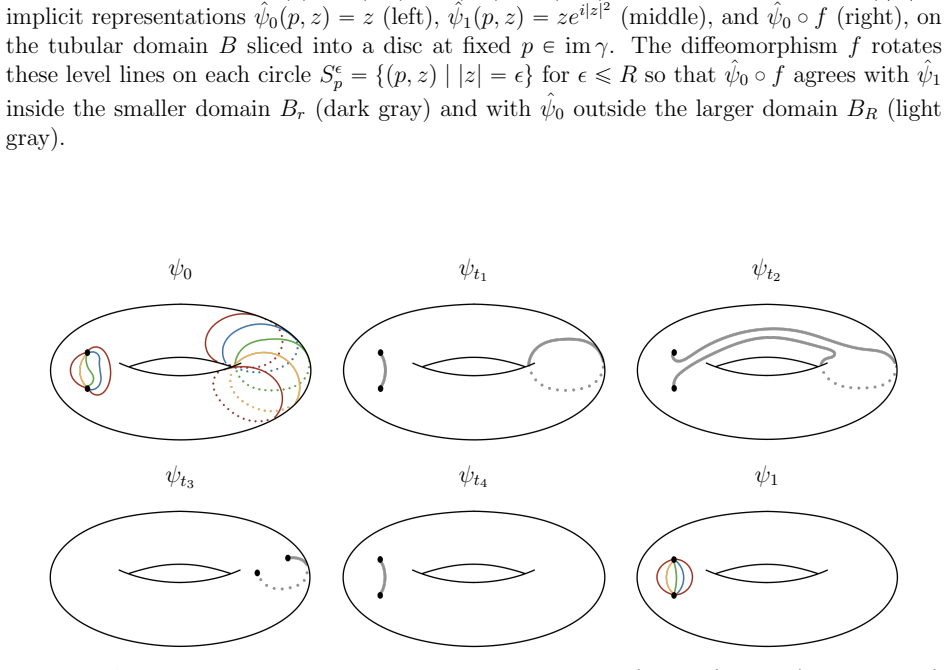
This paper explores the geometry of the space of codimension-2 submanifolds. We implicitly represent these submanifolds by a class of complex-valued functions. We show that the space of all these implicit representations admits a prequantum bundle structure over the space of submanifolds, equipped with the well-known Marsden-Weinstein symplectic structure. This bundle allows a new geometric interpretation of the Marsden-Weinstein structure as the curvature of a connection form, which measures the average of volumes swept by the deformation of the S^1-family of hypersurfaces, defined as the phase level sets of the complex function implicitly representing a submanifold.
Editorial analysis
A structured set of objections, weighed in public.
Referee Report
Summary. The paper claims that codimension-2 submanifolds admit implicit representations by a suitable class of complex-valued functions whose argument level sets form an S¹-family of hypersurfaces. The space of all such representations is asserted to carry a prequantum bundle structure over the space of submanifolds equipped with the Marsden-Weinstein symplectic form; the curvature of the induced connection is interpreted geometrically as the average of the symplectic volumes swept by infinitesimal deformations of this S¹-family.
Significance. If the stated construction and curvature identification hold, the work would supply a new prequantum interpretation of the Marsden-Weinstein structure on the space of codimension-2 submanifolds, linking implicit function representations to geometric quantization in infinite-dimensional symplectic geometry. Such an interpretation could be useful for studying deformations and quantization questions in this setting.
major comments (3)
- The abstract asserts the existence of a class of complex-valued functions that implicitly represent every codimension-2 submanifold with well-defined S¹ phase level sets, yet the manuscript supplies neither an explicit construction of this class nor a proof that every such submanifold arises in this way.
- No definition of the connection 1-form is given, nor is there a derivation showing that the curvature of the averaged volume-swept form coincides with the Marsden-Weinstein 2-form; the equality is stated but not verified even for a dense set of submanifolds or in local coordinates.
- The independence of the resulting curvature from the choice of representing function f is claimed but not demonstrated; without this, the prequantum bundle structure is not shown to be well-defined on the base space of submanifolds.
minor comments (1)
- Notation for the space of submanifolds and the implicit functions should be introduced with greater precision at the outset to aid readability.
Simulated Author's Rebuttal
We thank the referee for their thorough review and valuable feedback on our manuscript. We address each of the major comments below and outline the revisions we intend to make to strengthen the presentation and rigor of the results.
read point-by-point responses
-
Referee: The abstract asserts the existence of a class of complex-valued functions that implicitly represent every codimension-2 submanifold with well-defined S¹ phase level sets, yet the manuscript supplies neither an explicit construction of this class nor a proof that every such submanifold arises in this way.
Authors: We agree that an explicit construction and a complete existence proof would enhance the clarity and completeness of the paper. In the revised manuscript, we will provide a detailed construction of the class of complex-valued functions using local coordinates and tubular neighborhood arguments, and include a proof that every codimension-2 submanifold can be represented in this manner with well-defined S¹ phase level sets. revision: yes
-
Referee: No definition of the connection 1-form is given, nor is there a derivation showing that the curvature of the averaged volume-swept form coincides with the Marsden-Weinstein 2-form; the equality is stated but not verified even for a dense set of submanifolds or in local coordinates.
Authors: We acknowledge this omission. The revised version will include an explicit definition of the connection 1-form on the space of implicit representations. We will also provide a detailed derivation of the curvature, verifying that it coincides with the Marsden-Weinstein 2-form, including computations in local coordinates and for a dense subset of submanifolds. revision: yes
-
Referee: The independence of the resulting curvature from the choice of representing function f is claimed but not demonstrated; without this, the prequantum bundle structure is not shown to be well-defined on the base space of submanifolds.
Authors: We recognize the importance of demonstrating this independence to ensure the structure descends to the space of submanifolds. In the revision, we will add a proof that the curvature is independent of the choice of representing function f, thereby establishing that the prequantum bundle is well-defined on the base. revision: yes
Circularity Check
No circularity: independent construction of prequantum bundle yields MW curvature via explicit averaging
full rationale
The paper defines a class of complex-valued functions whose common zero sets represent codim-2 submanifolds and whose argument level sets form an S¹-family of hypersurfaces. It then constructs a connection 1-form on the space of these representations by averaging the symplectic volumes swept by infinitesimal deformations of this family. The curvature of this connection is computed directly from the averaging operation and shown to coincide with the Marsden-Weinstein 2-form on the base space of submanifolds. No step equates the target curvature to the input by definition, renames a fitted quantity, or relies on a self-citation chain whose prior result is itself unverified. The existence of the representing functions and the equality of the curvature are established by explicit construction and direct calculation rather than by presupposing the desired geometric interpretation.
Axiom & Free-Parameter Ledger
axioms (1)
- domain assumption Existence of a class of complex-valued functions whose phase level sets implicitly represent codimension-2 submanifolds and admit an S^1-family of hypersurfaces.
Lean theorems connected to this paper
-
IndisputableMonolith/Foundation/AlexanderDuality.leanalexander_duality_circle_linking unclear?
unclearRelation between the paper passage and the cited Recognition theorem.
the curvature of the connection Θ_P agrees with the MW symplectic form... measures the average of volumes swept by the deformation of the S¹-family of hypersurfaces, defined as the phase level sets
-
IndisputableMonolith/Cost/FunctionalEquation.leanwashburn_uniqueness_aczel unclear?
unclearRelation between the paper passage and the cited Recognition theorem.
We implicitly represent these submanifolds by a class of complex-valued functions... prequantum G-bundle where ω is the MW symplectic form
What do these tags mean?
- matches
- The paper's claim is directly supported by a theorem in the formal canon.
- supports
- The theorem supports part of the paper's argument, but the paper may add assumptions or extra steps.
- extends
- The paper goes beyond the formal theorem; the theorem is a base layer rather than the whole result.
- uses
- The paper appears to rely on the theorem as machinery.
- contradicts
- The paper's claim conflicts with a theorem or certificate in the canon.
- unclear
- Pith found a possible connection, but the passage is too broad, indirect, or ambiguous to say the theorem truly supports the claim.
Reference graph
Works this paper leans on
-
[1]
Vladimir I. Arnold and Boris A. Khesin, Topological methods in hydrodynamics, Springer-Verlag, Berlin, Heidelberg, 1998
work page 1998
-
[2]
G. Alberti, Geometric measure theory, Encyclopedia of Mathematical Physics, Academic Press, Oxford, 2006, pp. 520--528
work page 2006
-
[3]
Martin Bauer, Martins Bruveris, and Peter W Michor, Overview of the geometries of shape spaces and diffeomorphism groups, Journal of Mathematical Imaging and Vision 50 (2014), 60--97
work page 2014
-
[4]
Maciej Borodzik, Supredee Dangskul, and Andrew Ranicki, Solid angles and seifert hypersurfaces, Annals of Global Analysis and Geometry 57 (2020), no. 3, 415--454
work page 2020
-
[5]
Symplectic structures on the space of space curves
Martin Bauer, Sadashige Ishida, and Peter W. Michor, Symplectic structures on the space of space curves, https://arxiv.org/abs/2407.19908
work page internal anchor Pith review Pith/arXiv arXiv
-
[6]
J.L. Brylinski, Loop spaces, characteristic classes and geometric quantization, Modern Birkh \"a user Classics, Birkh \"a user Boston, 2009
work page 2009
-
[7]
Albert Chern and Sadashige Ishida, Area formula for spherical polygons via prequantization, SIAM Journal on Applied Algebra and Geometry 8 (2024), no. 3, 782--796
work page 2024
-
[8]
Albert Chern, Felix Kn^^c3^^b6ppel, Franz Pedit, and Ulrich Pinkall, Commuting hamiltonian flows of curves in real space forms, London Mathematical Society Lecture Note Series, vol. 1, p. 291^^e2^^80^^93328, Cambridge University Press, 2020
work page 2020
-
[9]
S.S. Chern, F.R. Smith, and G. de Rham, Differentiable manifolds: Forms, currents, harmonic forms, Grundlehren der mathematischen Wissenschaften, Springer Berlin Heidelberg, 2012
work page 2012
-
[10]
Demailly, Complex analytic and differential geometry, Universit \'e de Grenoble I, 1997
J.P. Demailly, Complex analytic and differential geometry, Universit \'e de Grenoble I, 1997
work page 1997
-
[11]
Tobias Diez, Bas Janssens, Karl-Hermann Neeb, and Cornelia Vizman, Induced differential characters on nonlinear G ra mannians , Annales de l'Institut Fourier (2020)
work page 2020
-
[12]
G. de Rham, Differentiable manifolds: Forms, currents, harmonic forms, Die Grundlehren der mathematischen Wissenschaften in Einzeldarstellungen mit besonderer Ber \"u cksichtigung der Anwendungsgebiete, Springer-Verlag, 1984
work page 1984
-
[13]
Lectures on open book decompositions and contact structures
John B. Etnyre, Lectures on open book decompositions and contact structures, https://arxiv.org/abs/math/0409402
work page internal anchor Pith review Pith/arXiv arXiv
-
[14]
Federer, Geometric measure theory, Classics in Mathematics, Springer Berlin Heidelberg, 2014
H. Federer, Geometric measure theory, Classics in Mathematics, Springer Berlin Heidelberg, 2014
work page 2014
-
[15]
Hansj^^c3^^b6rg Geiges, A n introduction to contact topology , Cambridge studies in advanced mathematics, vol. 109, Cambridge University Press, Cambridge, 2008, Includes unchanged reprints with later publication date
work page 2008
-
[16]
Falk-Florian Henrich, Loop spaces of riemannian manifolds, Doctor thesis, Technische Universit \"a t Berlin, 2009
work page 2009
-
[17]
Hirsch, Differential topology, Graduate Texts in Mathematics, Springer New York, 2012
M.W. Hirsch, Differential topology, Graduate Texts in Mathematics, Springer New York, 2012
work page 2012
-
[18]
Stefan Haller and Cornelia Vizman, Non-linear grassmannians as coadjoint orbits, Mathematische Annalen 329 (2003), 771--785
work page 2003
-
[19]
Sadashige Ishida, Chris Wojtan, and Albert Chern, Hidden degrees of freedom in implicit vortex filaments, ACM Transactions on Graphics 41 (2022), no. 6, 241:1--241:14
work page 2022
-
[20]
Robert L Jerrard and Didier Smets, Leapfrogging vortex rings for the three dimensional gross-pitaevskii equation, Annals of PDE 4 (2018), 1--48
work page 2018
-
[21]
Boris Khesin, Symplectic structures and dynamics on vortex membranes, Moscow Mathematical Journal 12 (2012)
work page 2012
-
[22]
Lee, Introduction to smooth manifolds, Graduate Texts in Mathematics, Springer New York, 2012
J. Lee, Introduction to smooth manifolds, Graduate Texts in Mathematics, Springer New York, 2012
work page 2012
-
[23]
L \'a szl \'o Lempert, Loop spaces as complex manifolds, Journal of Differential Geometry 38 (1993), 519--543
work page 1993
-
[24]
Peter Michor, A convenient setting for differential geometry and global analysis ii, Cahiers de Topologie et G^^c3^^a9om^^c3^^a9trie Diff^^c3^^a9rentielle Cat^^c3^^a9goriques 25 (1984), no. 2, 113--178 (eng)
work page 1984
-
[25]
Michor, Manifolds of mappings for continuum mechanics, Advances in Mechanics and Mathematics (2019)
Peter W. Michor, Manifolds of mappings for continuum mechanics, Advances in Mechanics and Mathematics (2019)
work page 2019
-
[26]
Morgan, Geometric measure theory: A beginner's guide, Academic Press, 2008
F. Morgan, Geometric measure theory: A beginner's guide, Academic Press, 2008
work page 2008
-
[27]
Jerrold Marsden and Alan Weinstein, Coadjoint orbits, vortices, and clebsch variables for incompressible fluids, Physica D: Nonlinear Phenomena 7 (1983), no. 1, 305--323
work page 1983
-
[28]
John J. Millson and Brett Zombro, A k\"ahler structure on moduli space of isometric maps of a circle into euclidean space., Inventiones mathematicae 123 (1996), no. 1, 35--60
work page 1996
- [29]
-
[30]
Shin-ichiro Ogawa, Makoto Tsubota, and Yuji Hattori, Study of reconnection and acoustic emission of quantized vortices in superfluid by the numerical analysis of the gross-pitaevskii equation, Journal of the Physical Society of Japan 71 (2002), no. 3, 813--821
work page 2002
-
[31]
Joel Oakley and Michael Usher, On certain lagrangian submanifolds of S^2 S^2 and C P^n , Algebraic & Geometric Topology 16 (2013), 149--209
work page 2013
-
[32]
o ppel, Ulrich Pinkall, and Peter Schr\
Marcel Padilla, Albert Chern, Felix Kn\" o ppel, Ulrich Pinkall, and Peter Schr\" o der, On bubble rings and ink chandeliers, ACM Trans. Graph. 38 (2019), no. 4
work page 2019
-
[33]
Steven J Ruuth, Barry Merriman, Jack Xin, and Stanley Osher, Diffusion-generated motion by mean curvature for filaments, Journal of Nonlinear Science 11 (2001), 473--493
work page 2001
-
[34]
Serge Tabachnikov, On the bicycle transformation and the filament equation: Results and conjectures, Journal of Geometry and Physics 115 (2017), 116--123, FDIS 2015: Finite Dimensional Integrable Systems in Geometry and Mathematical Physics
work page 2017
-
[35]
Cornelia Vizman, Induced differential forms on manifolds of functions, Archivum Mathematicum 047 (2011), no. 3, 201--215 (eng)
work page 2011
-
[36]
Alberto Villois, Giorgio Krstulovic, Davide Proment, and Hayder Salman, A vortex filament tracking method for the gross--pitaevskii model of a superfluid, Journal of Physics A: Mathematical and Theoretical 49 (2016), no. 41, 415502
work page 2016
discussion (0)
Sign in with ORCID, Apple, or X to comment. Anyone can read and Pith papers without signing in.