REVIEW 3 major objections 6 minor 25 references
Torsional-GFN: a conditional conformation generator for small molecules
T0 review · 3 major / 6 minor · reviewed 2026-08-06 · deepseek-v4-flash
Pith's one-line read A single conditional GFlowNet can sample small-molecule conformations approximately proportional to the Boltzmann distribution and adapt to unseen bond lengths and angles without retraining.
desk verdict Conditional GFlowNet over torsions with a new VectorGNN is a real step forward, but the det(g)=1 simplification and self-referential grid metrics mean the Boltzmann claim is not yet supported. read the letter →
The pith
A machine-rendered reading of the paper's core claim, the machinery that carries it, and where it could break.
The reading
What carries the argument
The central object is the conditional GFlowNet on the hypertorus [0,2π]^m, where each coordinate is a torsion angle. The reward is the Boltzmann weight exp(-E(c(Φ,L))/k_BT), and the training objective is the VarGrad loss, which lets the model learn off-policy without importance-sampling variance. The policy is a mixture of von Mises distributions, and its parameters are emitted by VectorGNN, a message-passing network that predicts interatomic forces, computes torques about each rotatable bond, and maps pseudo-scalar torque magnitudes through a reflection-equivariant layer to mixture weights, locations, and concentrations. The change of variables from Cartesian to torsion coordinates formally introduces a metric-tensor factor $\sqrt$(det(g)), which the paper sets to 1 in the reward.
What would settle it
Compute the metric tensor g(Φ) from Equation (5)-(6) for the torsion angles sampled on the training grid and compare the resulting sqrt(det(g)) values with 1 over the high-reward modes; if the relative variation exceeds a few percent, the reward used in training omits a material volume factor and the model's output distribution cannot be Boltzmann-proportional in Cartesian space. A second check is to compare Torsional-GFN's energy histograms against MD for a held-out molecule that shares the training scaffold but has three rotatable bonds, since the paper's two-rotatable-bond test set cannot separate generalization from memorization.
Extended reading notes
Core claim
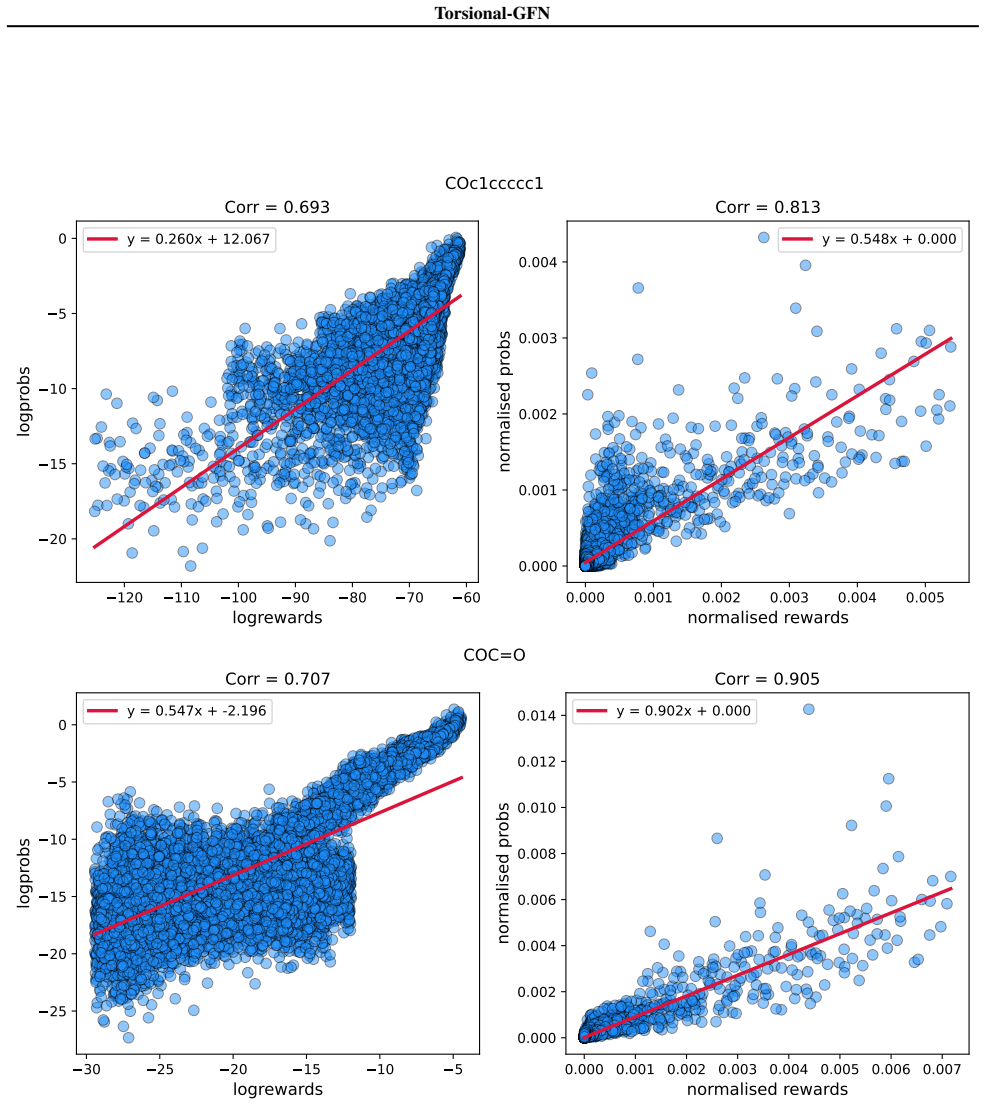
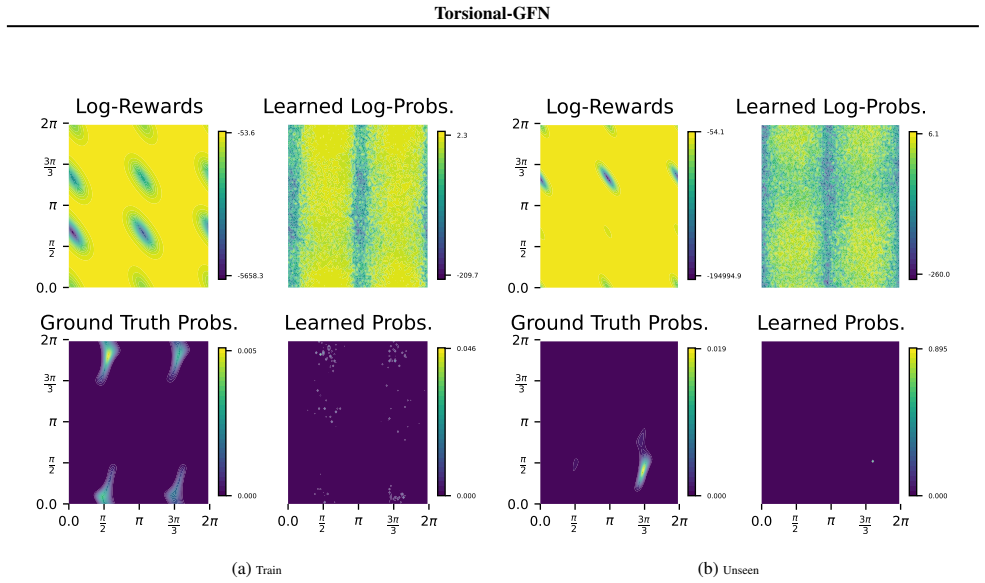
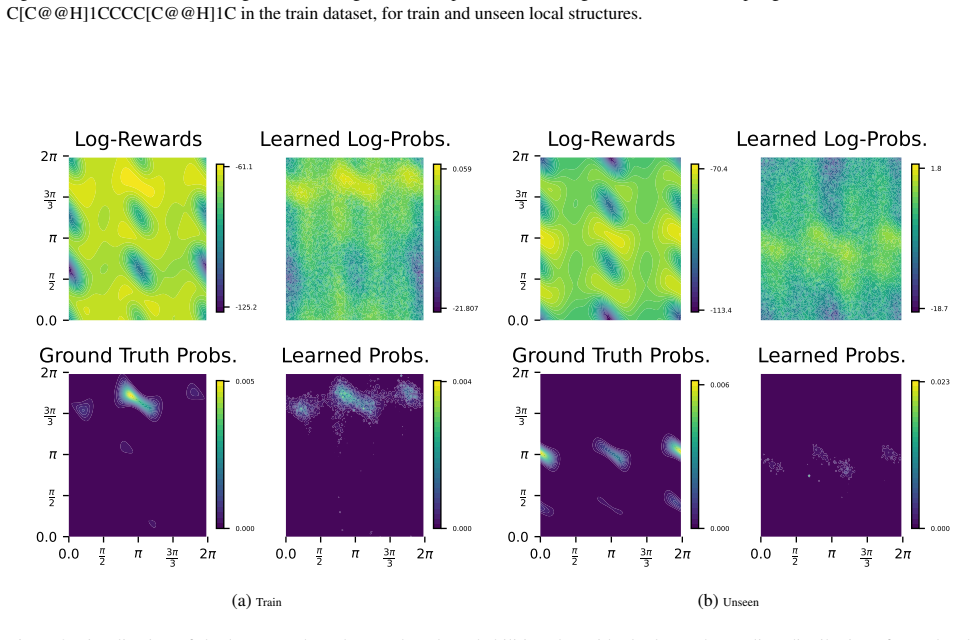
Torsional-GFN treats a conformation as the combination of a local structure L (bond lengths and angles) and a vector Φ of torsion angles, and learns to sample Φ on the hypertorus [0,2π]^m with probability proportional to exp(-E(c(Φ,L))/k_BT), where E is the MMFF94s energy. The model is a continuous conditional GFlowNet trained with the VarGrad loss, with forward and backward policies parameterized as mixtures of von Mises distributions whose weights, locations, and concentrations are produced by a new graph neural network, VectorGNN. Across six FreeSolv molecules with two rotatable bonds, the learned sampling distribution tracks the reward landscape for training local structures and follows the shift of modes for unseen local structures from MD. The paper reports that the energy histogram of samples is closer to MD energies than uniform random torsion sampling for all training molecules and one of two test molecules, and treats generalization to unseen molecules as preliminary rather than demonstrated.
Load-bearing premise
The load-bearing assumption is that the Jacobian factor sqrt(det(g)) relating torsion-angle volume to Cartesian volume is exactly 1; if it varies significantly across the torsional landscape, the learned distribution is not proportional to the 3D Boltzmann distribution regardless of how well the GFlowNet matches its reward.
Editorial extensions
If this is right
- A single trained Torsional-GFN replaces per-molecule training: the same weights serve every molecule in the training set, and conditioning on (G,L) selects the appropriate landscape.
- For train molecules, sampling torsion angles with MD-sampled local structures yields energy histograms closer to MD than uniform torsion sampling does, so the model can substitute for much more expensive simulation in the torsion dimension.
- Because the model responds to the conditioning local structure, new bond lengths and angles from MD can be fed in without retraining, enabling zero-shot adaptation to geometry changes.
- The method's positive results on two-rotatable-bond molecules indicate a route to larger systems and to learning local structures directly in the GFlowNet, once the current fixed-local-structure conditioning is relaxed.
- The failure on one of the two test molecules shows that cross-molecule generalization is not yet reliable, so immediate expectations should be limited to the trained chemical family.
Reading between the lines
- Editorial inference: the det(g)=1 simplification likely biases sampling toward regions where the Jacobian is large, so including the metric factor in the reward would correct the distribution and could be tested standalone without changing the architecture.
- Editorial inference: the architecture's torque-based parametrization should transfer to molecules with more than two rotatable bonds, but the hypertorus dimension grows; whether the von Mises mixture and VectorGNN scale beyond m=2 is the natural next experiment.
- Editorial inference: since local structures are drawn from MD rather than learned, the method's end-to-end speedup depends on how cheaply those structures can be obtained; learning them inside the GFlowNet, as the authors list as future work, would remove that dependency.
- Editorial inference: measuring det(g) empirically on sampled conformations would give a concrete correction factor and a quantitative test of how far the current approximation deviates from a true Boltzmann sampler.
Editorial analysis
A structured set of objections, weighed in public.
Referee Report
Summary. The paper proposes Torsional-GFN, a conditional continuous GFlowNet that generates molecular conformations by sampling torsion angles conditioned on the molecular graph and a local structure (bond lengths and angles). The torsion sampler is trained with the VarGrad objective against a reward exp(-E/kT) computed with the MMFF94s force field, and the policy network is a new graph neural network, VectorGNN, with reflection-equivariant outputs. The authors train a single model on six FreeSolv molecules with two rotatable bonds and evaluate on two held-out molecules, reporting JSD and correlation metrics on a discretized torsion grid, plus energy histograms compared with molecular dynamics simulations. The paper claims approximate Boltzmann sampling for multiple molecules and zero-shot generalization to unseen local structures and, with more caveats, to unseen molecules.
Significance. If the central claim held, the method would be a meaningful step toward amortized Boltzmann-conformation sampling: a single model replacing per-molecule training, with the ability to condition on new bond lengths and angles without retraining. The paper has concrete strengths: a conditional formulation with an explicit graph neural network policy, an off-policy GFlowNet training scheme that avoids importance-weighting variance, and a serious attempt to compare against MD-derived reference data. The authors are also transparent about several limitations. However, the central claim is currently under-supported: the change-of-variables factor between torsion space and Cartesian space is set to one without justification or quantification, the primary grid-based metrics are self-consistency checks against the training reward rather than external benchmarks, and the only external energy comparison mixes two different force fields. The contribution is therefore significant conditional on fixing these issues.
major comments (3)
- [Section 2.2, Eq. (2); Appendix A.2.2, Eq. (8)] The paper sets det(g)=1 in the change of variables from torsion coordinates to Cartesian coordinates and omits this factor from the reward. As Appendix A.2.2 itself states, sqrt(det(g)) is crucial for sampling from the Boltzmann distribution. With the reward defined as R(Phi|G,L)=exp(-E/kT) and det(g)=1, a perfectly trained GFlowNet yields a Cartesian density proportional to exp(-E/kT)/sqrt(det(g)), not exp(-E/kT), unless sqrt(det(g)) is constant over Phi for each fixed L. The paper provides no evidence or bound for this constancy, so the central claim that the model samples approximately from the Boltzmann distribution in 3D is mathematically unsecured. Please either include the Jacobian factor in the reward, or report its numerical variation over the sampled torsion angles for the studied molecules and show that the resulting bias is negligible.
- [Section 3.2, Table 1; Section 3.1; Appendix A.3.2] The JSDp and rho_{log p, log R} metrics compare the learned sampling distribution with the normalized reward R(Phi|G,L), which is exactly the reward used to train the GFlowNet. Agreement with this target demonstrates self-consistency of the learned sampler with its training signal, not closeness to the Boltzmann distribution in Cartesian space. The energy histograms are the only external comparison, but they are confounded by a force-field mismatch: the MD reference energies are computed with OpenFF 2.1.1 (Appendix A.3.2), while the Torsional-GFN samples are scored with MMFF94s (Section 3.1). Please recompute the MD energies with the same MMFF94s force field, or quantify the force-field difference, before interpreting the histograms as validation of Boltzmann sampling.
- [Table 1; Section 3.2; Section 4] The empirical evidence is mixed even for the stated claims. For the train molecule C1C=CC[C@@H]2... the JSDp values are 0.3613 (train) and 0.4097 (unseen), and for the test molecule CCc1cccc2c1cccc2 the log-probability/reward correlation is -0.0597 with JSDp reported as N/A. The paper itself concedes that the test-molecule results do not show consistent generalization. Please report the missing test-molecule JSDp values, add confidence intervals or standard errors for the metrics, and temper the summary statement that the model samples 'approximately proportional to the Boltzmann distribution for multiple molecules' so that it reflects the molecules for which the evidence is actually strong.
minor comments (6)
- [Throughout] The term 'Jenson-Shannon divergence' should be 'Jensen-Shannon divergence'; the same misspelling appears in several places.
- [Appendix A.3.3] There is a typo: 'The the last equivariant MLP block' should read 'The last equivariant MLP block'.
- [Table 1] The table header is confusing: 'Train' and 'Unseen' appear under the JSDp column but the correlation column rho_{log p, log R} appears to have only one value per molecule. Please clarify which local structures were used for each metric and why JSDp is N/A for the two test molecules.
- [Appendix A.2.2, Eq. (8)] The displayed equality in Eq. (8) mixes differentials inconsistently; the equation should be rewritten so that the change-of-variables relation between p(x|L,G) and p(Phi|L,G) is explicitly dimensionally correct.
- [Appendix A.2.2] The citation for the metric tensor is a blog-style web reference (Physics, 2025); a standard textbook reference on coordinate transformations and metric tensors would be more appropriate.
- [Throughout] There are LaTeX spacing artifacts in author names such as 'V olokhova' and 'No´e'; these should be cleaned in the final version.
Circularity Check
The 2D-grid 'Boltzmann' target is the normalized training reward, making the primary quantitative evaluation a self-consistency check; the physical Boltzmann claim is also left unsecured by the acknowledged det(g)=1 simplification.
-
self definitional
[Section 3.2 ('Proximity to the reward landscape'), with Eq. (3) and Appendix A.2.2]
"we estimate the discretized target distribution P(Φi|G,L) = R(Φi|L,G)/Σ_k R(Φk|L,G), and the discretized sampling distribution Pθ⊤(Φi|G,L) = pθ⊤(Φi|L,G)/Σ_k pθ⊤(Φk|L,G), and compare them using the Jenson-Shannon divergence. We train a GFlowNet model, which is designed to learn sampling probabilities pθ⊤(Φ|G,L) proportional to the reward in Equation (3)."
The 'target distribution' used as ground truth in Table 1 and Figure 1 is the normalized reward R(Φ|G,L), exactly the signal the VarGrad loss trains the GFlowNet to match. JSDp and the log-correlation therefore measure convergence to the training objective, not agreement with an independent Boltzmann ensemble. Equations (2)-(3) make 'approximately Boltzmann' mean 'approximately proportional to the training reward' by construction, and this identification inherits the unverified det(g)=1 setting of Appendix A.2.2. The MD energy histograms are external but compare MMFF94s-scored Torsional-GFN samples to OpenFF-scored MD frames, so they are not a clean independent validation of the physical claim.
full rationale
The main grid-based evaluation is partially circular: the paper's 'true' target P(Φ|G,L) is defined as the normalized reward R(Φ|G,L), which is precisely the quantity the GFlowNet is trained to match. That metric is a valuable training-convergence diagnostic, but it cannot independently confirm the central claim of Boltzmann-proportional sampling. The physical claim is further unsecured by the paper's own admission in Appendix A.2.2: 'While it is crucial to take this factor, sqrt(det(g)), into account to sample from the Boltzmann distribution, in our experiments we set det(g)=1 for simplicity.' Even a perfectly trained model then samples p(Φ) proportional to exp(-E/kT), which is not p(x) proportional to exp(-E/kT) unless det(g) is constant. This is an acknowledged limitation rather than a circular reduction, so I flag it as a correctness risk, not as a separate circular step. The self-citations to Lahlou et al. (2023) and Volokhova et al. (2024) are normal method-building: the continuous GFlowNet convergence result is an established external theorem, and the von Mises mixture and torsion-space ansatz are architectural choices, not unique constraints imported to force the result. Genuine independent content remains in the generalization experiments: the model is evaluated on unseen local structures and molecules with the reward recomputed at test time, and the MD energy histograms provide an external, albeit force-field-mismatched, reference. Overall, the central claim still has independent content, but the headline grid metric reduces to a self-consistency check, giving a partial circularity score of 4.
Assumptions & free parameters
free parameters (6)
- trajectory length n =
6
- behavior policy epsilon =
0.5
- number of mixture components K =
not stated
- grid size for evaluation =
10000
- fixed training local structure =
one arbitrary MD conformation per molecule
- pretraining dataset size =
48000/12000
assumptions (5)
- standard math Continuous GFlowNet theory (Lahlou et al. 2023) and the VarGrad loss are valid for the hypertorus state space
- domain assumption Mixture of von Mises distributions can adequately represent the target torsion-angle posterior
- ad hoc to paper The Jacobian determinant det(g) for the change of variables from torsion to Cartesian coordinates is 1
- domain assumption Local structures L sampled from MD simulations are independent of torsion angles, giving the factorization in Eq. (2)
- domain assumption MMFF94s force field is an adequate proxy for the true molecular internal energy in the Boltzmann weight
Cite this review
Pith. "Pith review of Torsional-GFN: a conditional conformation generator for small molecules." pith.science (2026). https://pith.science/paper/UE2QKOD2
@misc{pith2026250711759,
  author       = {Pith},
  title        = {Pith review of: Torsional-GFN: a conditional conformation generator for small molecules},
  year         = {2026},
  howpublished = {\url{https://pith.science/paper/UE2QKOD2}},
  note         = {Machine review of arXiv:2507.11759}
}
read the original abstract
Generating stable molecular conformations is crucial in several drug discovery applications, such as estimating the binding affinity of a molecule to a target. Recently, generative machine learning methods have emerged as a promising, more efficient method than molecular dynamics for sampling of conformations from the Boltzmann distribution. In this paper, we introduce Torsional-GFN, a conditional GFlowNet specifically designed to sample conformations of molecules proportionally to their Boltzmann distribution, using only a reward function as training signal. Conditioned on a molecular graph and its local structure (bond lengths and angles), Torsional-GFN samples rotations of its torsion angles. Our results demonstrate that Torsional-GFN is able to sample conformations approximately proportional to the Boltzmann distribution for multiple molecules with a single model, and allows for zero-shot generalization to unseen bond lengths and angles coming from the MD simulations for such molecules. Our work presents a promising avenue for scaling the proposed approach to larger molecular systems, achieving zero-shot generalization to unseen molecules, and including the generation of the local structure into the GFlowNet model.
Figures


Figures from the paper (8 more)





Reference graph
Works this paper leans on
-
[1]
J., Mittal, S., Lemos, P., Liu, C.-H., Sendera, M., Ravanbakhsh, S., Gidel, G., Bengio, Y., et al
Akhound-Sadegh, T., Rector-Brooks, J., Bose, A. J., Mittal, S., Lemos, P., Liu, C.-H., Sendera, M., Ravanbakhsh, S., Gidel, G., Bengio, Y., et al. Iterated denoising energy matching for sampling from boltzmann densities. arXiv preprint arXiv:2402.06121, 2024
arXiv 2024
-
[2]
Axelrod, S. and Gomez-Bombarelli, R. Geom, energy-annotated molecular conformations for property prediction and molecular generation. Scientific Data, 9 0 (1): 0 185, 2022
work page 2022
-
[3]
Bengio, Y., Lahlou, S., Deleu, T., Hu, E. J., Tiwari, M., and Bengio, E. Gflownet foundations. The Journal of Machine Learning Research, 24 0 (1): 0 10006--10060, 2023
work page 2023
-
[4]
Boothroyd, S., Behara, P. K., Madin, O. C., Hahn, D. F., Jang, H., Gapsys, V., Wagner, J. R., Horton, J. T., Dotson, D. L., Thompson, M. W., et al. Development and benchmarking of open force field 2.0. 0: The sage small molecule force field. Journal of Chemical Theory and Computation, 19 0 (11): 0 3251--3275, 2023
work page 2023
-
[5]
Eastman, P., Swails, J., Chodera, J. D., McGibbon, R. T., Zhao, Y., Beauchamp, K. A., Wang, L.-P., Simmonett, A. C., Harrigan, M. P., Stern, C. D., et al. Openmm 7: Rapid development of high performance algorithms for molecular dynamics. PLoS computational biology, 13 0 (7): 0 e1005659, 2017
work page 2017
-
[6]
Halgren, T. A. Mmff vi. mmff94s option for energy minimization studies. Journal of computational chemistry, 20 0 (7): 0 720--729, 1999
work page 1999
-
[7]
Hawkins, P. C. Conformation generation: the state of the art. Journal of chemical information and modeling, 57 0 (8): 0 1747--1756, 2017
work page 2017
-
[8]
Hendrycks, D. and Gimpel, K. Gaussian error linear units (gelus). arXiv preprint arXiv:1606.08415, 2016
arXiv 2016
Show all 25 references
-
[9]
F., Ekbote, C
Jain, M., Bengio, E., Hernandez-Garcia, A., Rector-Brooks, J., Dossou, B. F., Ekbote, C. A., Fu, J., Zhang, T., Kilgour, M., Zhang, D., et al. Biological sequence design with gflownets. In International Conference on Machine Learning, pp.\ 9786--9801. PMLR, 2022
2022
-
[10]
Torsional diffusion for molecular conformer generation
Jing, B., Corso, G., Chang, J., Barzilay, R., and Jaakkola, T. Torsional diffusion for molecular conformer generation. Advances in Neural Information Processing Systems, 35: 0 24240--24253, 2022
2022
-
[11]
and No \'e , F
Klein, L. and No \'e , F. Transferable boltzmann generators. arXiv preprint arXiv:2406.14426, 2024
2024 arXiv
-
[12]
N., Bengio, Y., and Malkin, N
Lahlou, S., Deleu, T., Lemos, P., Zhang, D., Volokhova, A., Hern \'a ndez-Garc a, A., Ezzine, L. N., Bengio, Y., and Malkin, N. A theory of continuous generative flow networks. In International Conference on Machine Learning, pp.\ 18269--18300. PMLR, 2023
2023
-
[13]
Crafting papers on machine learning
Langley, P. Crafting papers on machine learning. In Langley, P. (ed.), Proceedings of the 17th International Conference on Machine Learning (ICML 2000), pp.\ 1207--1216, Stanford, CA, 2000. Morgan Kaufmann
2000
-
[14]
Gflownets and variational inference
Malkin, N., Lahlou, S., Deleu, T., Ji, X., Hu, E., Everett, K., Zhang, D., and Bengio, Y. Gflownets and variational inference. arXiv preprint arXiv:2210.00580, 2022
2022 arXiv
-
[15]
Mobley, D. L. and Guthrie, J. P. Freesolv: a database of experimental and calculated hydration free energies, with input files. Journal of computer-aided molecular design, 28: 0 711--720, 2014
2014
-
[16]
and Cho, A
Molani, F. and Cho, A. E. Accurate protein-ligand binding free energy estimation using qm/mm on multi-conformers predicted from classical mining minima. Communications Chemistry, 7 0 (1): 0 247, 2024
2024
-
[17]
Boltzmann generators: Sampling equilibrium states of many-body systems with deep learning
No \'e , F., Olsson, S., K \"o hler, J., and Wu, H. Boltzmann generators: Sampling equilibrium states of many-body systems with deep learning. Science, 365 0 (6457): 0 eaaw1147, 2019
2019
-
[18]
The metric tensor: A complete guide with examples, 2025
Physics, P. The metric tensor: A complete guide with examples, 2025. URL https://profoundphysics.com/metric-tensor-a-complete-guide-with-examples/. Accessed: 2025-05-26
2025
-
[19]
Automated exploration of the low-energy chemical space with fast quantum chemical methods
Pracht, P., Bohle, F., and Grimme, S. Automated exploration of the low-energy chemical space with fast quantum chemical methods. Physical Chemistry Chemical Physics, 22 0 (14): 0 7169--7192, 2020
2020
-
[20]
Rdkit: Open-source cheminformatics
RDKit . Rdkit: Open-source cheminformatics. https://www.rdkit.org. Accessed: 2025-05-25
2025
-
[21]
Richter, L., Boustati, A., N \"u sken, N., Ruiz, F., and Akyildiz, O. D. Vargrad: a low-variance gradient estimator for variational inference. Advances in Neural Information Processing Systems, 33: 0 13481--13492, 2020
2020
-
[22]
and Landrum, G
Riniker, S. and Landrum, G. A. Better informed distance geometry: using what we know to improve conformation generation. Journal of chemical information and modeling, 55 0 (12): 0 2562--2574, 2015
2015
-
[23]
An empirical study of the effectiveness of using a replay buffer on mode discovery in gflownets
Vemgal, N., Lau, E., and Precup, D. An empirical study of the effectiveness of using a replay buffer on mode discovery in gflownets. arXiv preprint arXiv:2307.07674, 2023
2023 arXiv
-
[24]
Towards equilibrium molecular conformation generation with gflownets
Volokhova, A., Koziarski, M., Hern \'a ndez-Garc \' a, A., Liu, C.-H., Miret, S., Lemos, P., Thiede, L., Yan, Z., Aspuru-Guzik, A., and Bengio, Y. Towards equilibrium molecular conformation generation with gflownets. Digital Discovery, 3 0 (5): 0 1038--1047, 2024
2024
-
[25]
write newline
" write newline "" before.all 'output.state := FUNCTION n.dashify 't := "" t empty not t #1 #1 substring "-" = t #1 #2 substring "--" = not "--" * t #2 global.max substring 't := t #1 #1 substring "-" = "-" * t #2 global.max substring 't := while if t #1 #1 substring * t #2 gl...
Reviewed August 6, 2026 · model on record in the stance chip above.
Discussion (0). Sign in to comment.