A Multimodal Data Fusion Attention-Empowered Generative Adversarial Network for Real Time 3D Underwater Sound Speed Field Construction
Pith reviewed 2026-05-19 05:08 UTC · model grok-4.3
The pith
A generative adversarial network fused with multimodal surface data reconstructs 3D underwater sound speed fields to within 0.3 m/s error without any underwater sonar readings.
A machine-rendered reading of the paper's core claim, the machinery that carries it, and where it could break.
Core claim
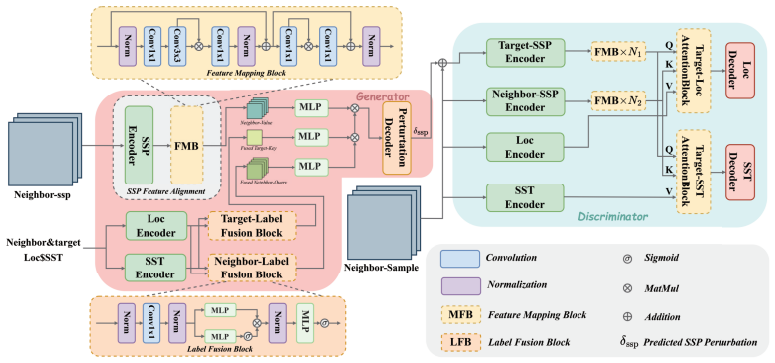
The MDF-RAGAN architecture integrates multimodal data fusion with residual attention blocks to capture global spatial correlations and extract subtle deep-ocean sound velocity perturbations from sea surface temperature variations, enabling accurate 3D sound speed field reconstruction solely from surface observations.
What carries the argument
Multimodal data-fusion generative adversarial network enhanced with residual attention blocks (MDF-RAGAN), which uses attention to capture spatial features and residuals to model perturbations from surface data.
If this is right
- Sound speed profiles can be reconstructed in real time for underwater acoustic applications without on-site measurements.
- The model achieves estimation errors below 0.3 m/s on public datasets.
- It reduces RMSE by nearly half compared to CNN and spatial interpolation methods.
- It provides a 65.8% RMSE reduction over the mean profile method.
- Multi-source fusion and cross-modal attention improve accuracy and robustness of sound speed reconstruction.
Where Pith is reading between the lines
- Similar surface-to-depth fusion techniques might extend to reconstructing other ocean properties like temperature or salinity profiles.
- Integrating additional surface sensors such as salinity or wind data could further refine the velocity estimates in varying conditions.
- Deployment on autonomous surface vehicles could enable continuous monitoring of sound speed fields over large areas.
- The approach may reduce costs for marine acoustic surveys by minimizing reliance on submerged sensors.
Load-bearing premise
Sea surface temperature variations and other multimodal surface observations can capture the subtle changes in deep ocean sound velocity well enough for accurate reconstruction.
What would settle it
Collecting direct underwater sonar measurements in the same locations and comparing them to the model's 3D field predictions; if the differences exceed 0.3 m/s on average, the claim would not hold.
Figures



read the original abstract
Sound speed profiles (SSPs) are crucial underwater parameters that determine the propagation patterns of acoustic signals, directly influencing the energy efficiency of underwater communication and the accuracy of positioning systems. Conventional techniques for obtaining SSPs, such as matched field processing (MFP), compressive sensing (CS), and deep learning (DL), typically depend on on-site sonar measurements, which impose stringent requirements on the deployment of underwater observation systems. To overcome this limitation and enable high-precision sound speed field reconstruction without the need for on-site underwater data collection, we propose a novel multimodal data-fusion generative adversarial network enhanced with residual attention blocks (MDF-RAGAN). This architecture integrates attention mechanisms to capture global spatial feature correlations effectively, while residual modules are employed to extract subtle perturbations in deep-ocean sound velocity distribution caused by sea surface temperature (SST) variations. Experimental results on a public real-world dataset demonstrate that the proposed model outperforms other state-of-the-art methods, achieving an estimation error of less than 0.3 m/s. Specifically, MDF-RAGAN reduces the root mean square error (RMSE) by nearly half compared to convolutional neural network (CNN) and spatial interpolation (SITP) methods, and attains a 65.8\% RMSE reduction relative to the mean profile method. These results highlight the effectiveness of multi-source fusion and cross-modal attention in enhancing the accuracy and robustness of sound speed profile reconstruction.
Editorial analysis
A structured set of objections, weighed in public.
Referee Report
Summary. The manuscript proposes MDF-RAGAN, a multimodal data-fusion generative adversarial network incorporating residual attention blocks, to construct real-time 3D underwater sound speed fields from surface observations such as sea surface temperature without requiring on-site underwater sonar measurements. Attention mechanisms capture global spatial correlations while residual modules extract subtle deep-ocean velocity perturbations. On a public real-world dataset the model is reported to outperform CNN, SITP and mean-profile baselines, achieving estimation error below 0.3 m/s, nearly halving RMSE relative to CNN/SITP and a 65.8% RMSE reduction versus the mean profile.
Significance. If the empirical results prove robust and the surface-to-deep proxy relationship holds, the work could materially reduce dependence on expensive underwater observation infrastructure, benefiting acoustic communication efficiency and positioning accuracy. The technical combination of cross-modal attention and residual blocks for multimodal fusion is a plausible direction for ocean-acoustic reconstruction tasks.
major comments (2)
- Abstract: the central performance claims (error <0.3 m/s, RMSE halved vs. CNN/SITP, 65.8% reduction vs. mean profile) are presented without any description of training procedures, validation splits, error bars, ablation studies or statistical testing. These details are load-bearing for the claim that the model outperforms state-of-the-art methods.
- Abstract: the reconstruction claim rests on the untested premise that sea-surface temperature and other multimodal surface observations suffice to capture subtle deep-ocean sound-velocity perturbations. No physical derivation, sensitivity analysis, or comparison against independent deep measurements (e.g., CTD casts) is supplied to substantiate generalization beyond dataset-specific correlations.
minor comments (2)
- The abstract would benefit from explicit listing of the additional multimodal surface data sources beyond SST that are fused by the model.
- Notation for network components (MDF-RAGAN, residual attention blocks) is introduced clearly but should be expanded with a diagram or pseudocode in the methods section to aid reproducibility.
Simulated Author's Rebuttal
We thank the referee for the constructive and detailed comments. We address each major comment point by point below, indicating where revisions will be made to strengthen the manuscript.
read point-by-point responses
-
Referee: Abstract: the central performance claims (error <0.3 m/s, RMSE halved vs. CNN/SITP, 65.8% reduction vs. mean profile) are presented without any description of training procedures, validation splits, error bars, ablation studies or statistical testing. These details are load-bearing for the claim that the model outperforms state-of-the-art methods.
Authors: We agree that the abstract, constrained by length, does not detail the experimental protocol. The full manuscript covers training procedures (Section 3.2), dataset splits and cross-validation (Section 4.1), ablation studies (Section 4.3), and comparative results with error metrics. In the revision we will append a concise clause to the abstract referencing the validation framework and ensure error bars appear on all reported performance figures. revision: yes
-
Referee: Abstract: the reconstruction claim rests on the untested premise that sea-surface temperature and other multimodal surface observations suffice to capture subtle deep-ocean sound-velocity perturbations. No physical derivation, sensitivity analysis, or comparison against independent deep measurements (e.g., CTD casts) is supplied to substantiate generalization beyond dataset-specific correlations.
Authors: The MDF-RAGAN model is trained end-to-end on a public dataset containing paired surface and in-situ underwater observations, allowing it to learn empirical correlations. While we do not derive a new first-principles physical model, the architecture is motivated by established oceanographic links between SST and sound-speed variability. We will add an explicit sensitivity analysis subsection and a limitations paragraph discussing dataset-specific generalization. Direct comparison against additional independent CTD casts lies outside the present data resources and will be flagged as future work. revision: partial
Circularity Check
No circularity: empirical ML model evaluation on external dataset
full rationale
The paper introduces MDF-RAGAN, a generative adversarial network architecture that fuses multimodal surface observations to reconstruct 3D underwater sound speed fields, and reports empirical RMSE reductions on a public real-world dataset (error <0.3 m/s, ~50% better than CNN/SITP, 65.8% better than mean profile). No mathematical derivation chain, first-principles equations, or predictions are presented that reduce by construction to fitted inputs or self-citations. The central claims rest on standard supervised training and held-out evaluation rather than any self-definitional mapping or load-bearing self-citation. This is the expected non-circular outcome for an applied neural-network paper whose results are falsifiable against the cited dataset.
Axiom & Free-Parameter Ledger
free parameters (2)
- Attention and residual block weights
- Multimodal fusion coefficients
axioms (1)
- domain assumption Sea surface temperature variations and other multimodal surface data can capture subtle perturbations in deep-ocean sound velocity distribution.
Lean theorems connected to this paper
-
IndisputableMonolith/Cost/FunctionalEquation.leanwashburn_uniqueness_aczel unclear?
unclearRelation between the paper passage and the cited Recognition theorem.
residual modules for deeply capturing small disturbances in the deep ocean sound velocity distribution caused by changes of SST
-
IndisputableMonolith/Foundation/AlexanderDuality.leanalexander_duality_circle_linking unclear?
unclearRelation between the paper passage and the cited Recognition theorem.
cross-modal perturbation attention block... Q, K, V projections and scaled dot-product attention
What do these tags mean?
- matches
- The paper's claim is directly supported by a theorem in the formal canon.
- supports
- The theorem supports part of the paper's argument, but the paper may add assumptions or extra steps.
- extends
- The paper goes beyond the formal theorem; the theorem is a base layer rather than the whole result.
- uses
- The paper appears to rely on the theorem as machinery.
- contradicts
- The paper's claim conflicts with a theorem or certificate in the canon.
- unclear
- Pith found a possible connection, but the passage is too broad, indirect, or ambiguous to say the theorem truly supports the claim.
Reference graph
Works this paper leans on
-
[1]
Compressive sound speed profile inversion using beamforming results. Remote Sensing 10, 1–18. doi:10.3390/rs10050704. Erol-Kantarci, M., Mouftah, H.T., Oktug, S.,
-
[2]
IEEE Communications Surveys & Tutorials 13, 487–502
A survey of ar- chitectures and localization techniques for underwater acoustic sensor networks. IEEE Communications Surveys & Tutorials 13, 487–502. doi:10.1109/SURV.2011.020211.00035. Huang, B., Liu, C., Banzon, V., Freeman, E., Graham, G., Han- kins, B., Smith, T., Zhang, H.M., 2021a. Improvements of the daily optimum interpolation sea surface temperat...
-
[3]
URL: https://journals.ametsoc.org/view/journals/clim/34/8/JCLI-D-20-0166.1.xml, doi:10.1175/JCLI-D-20-0166.1. Huang, W., Li, D., Zhang, H., Xu, T., Yin, F.,
-
[4]
Frontiers in Ma- rine Science 10, 1–22
A meta-deep-learning framework for spatio-temporal underwater ssp inversion. Frontiers in Ma- rine Science 10, 1–22. doi:10.3389/fmars.2023.1146333. Huang, W., Liu, M., Li, D., Yin, F., Chen, H., Zhou, J., Xu, H., 2021b. Collaborating ray tracing and ai model for auv-assisted 3-d underwater sound-speed inversion. IEEE Journal of Oceanic Engineering 46, 1372–
-
[5]
Chinese Physics Letters 27, 084303:1–4
Inversion for sound speed profile by using a bottom mounted horizontal line array in shallow water. Chinese Physics Letters 27, 084303:1–4. doi:10.1088/0256-307X/27/8/084303. Li, H., Qu, K., Zhou, J., Aug.,
-
[6]
Reconstructing sound speed profile from remote sensing data: Nonlinear inversion based on self-organizing map. IEEE Access 9, 109754–109762. doi:10.1109/ACCESS.2021.3102608. Li Hong, Xu Fanghua, e.a.,
-
[7]
Dynamic prediction of full-ocean depth ssp by a hierarchical lstm: An experimental result. IEEE Geosci. Remote Sens. Lett. 21, 1–5. doi:10.1109/LGRS.2024.3356552. Luo, J., Yang, Y., Wang, Z., Chen, Y.,
-
[8]
IEEE Internet of Things Journal 8, 13126–13144
Localization algorithm for underwater sensor network: A review. IEEE Internet of Things Journal 8, 13126–13144. doi:10.1109/JIOT.2021.3081918. Piao, S., Yan, X., Li, Q., Li, Z., Wang, Z., Zhu, J.,
-
[9]
Time series prediction of shallow water sound speed profile in the pres- ence of internal solitary wave trains. Ocean Engineering 283, 115058. doi:10.1016/j.oceaneng.2023.115058. Piccolo, J., Haramuniz, G., Michalopoulou, Z.H.,
-
[10]
Inverting tomographic data with neural nets, in: ’Challenges of Our Changing Global Environment’. Conference Proceedings. OCEANS’95 MTS/IEEE, IEEE. pp. 1501–1504. doi:10.1109/OCEANS.1995.528711. Tolstoy, A., Diachok, O., Frazer, L.,
-
[11]
The Journal of the Acoustical Society of America 89, 1119–1127
Acoustic tomography via matched field processing. The Journal of the Acoustical Society of America 89, 1119–1127. doi:10.1121/1.400647. Wang, Y., Cai, W., Weng, D., Sheng, Q.,
-
[12]
A sbe-19plus based real-time monitoring system of ctd data, in: OCEANS 2014 - TAIPEI, pp. 1–4. Wu, P., Zhang, H., Shi, Y., Lu, J., Li, S., Huang, W., Tang, N., Wang, S.,
work page 2014
-
[13]
Applied Ocean Research 150, 104088
Real-time estimation of underwater sound speed profiles with a data fusion convolutional neural net- work model. Applied Ocean Research 150, 104088. URL: https://www.sciencedirect.com/science/article/pii/S0141118724002098, doi:https://doi.org/10.1016/j.apor.2024.104088. Zhang, M., Xu, W., Xu, Y.,
-
[14]
IEEE Journal of Oceanic Engineering 41, 204–216
Inversion of the sound speed with radiated noise of an autonomous underwater vehicle in shallow wa- ter waveguides. IEEE Journal of Oceanic Engineering 41, 204–216. doi:10.1109/JOE.2015.2418172. 30 Zhang, W., Yang, S.e., Huang, Y.w., Li, L.,
-
[15]
Inversion of sound speed profile in shallow water with irregular seabed, in: Advances in Ocean Acoustics: Proceedings of the 3rd International Conference on Ocean Acoustics (OA2012), AIP. pp. 392–399. doi:10.1063/1.4765934. 31
discussion (0)
Sign in with ORCID, Apple, or X to comment. Anyone can read and Pith papers without signing in.