REVIEW 5 major objections 5 minor 34 references
ProtoConNet: Prototypical Augmentation and Alignment for Open-Set Few-Shot Image Classification
T0 review · 5 major / 5 minor · reviewed 2026-08-06 · deepseek-v4-flash
Pith's one-line read ProtoConNet wraps any backbone with clustering, context fusion, and prototype alignment to improve few-shot open-set classification.
desk verdict A competition pipeline with plausible components, but the threshold is tuned on the test set and the decision rule is stated both ways, so the headline gain is not established. read the letter →
The pith
A machine-rendered reading of the paper's core claim, the machinery that carries it, and where it could break.
The reading
What carries the argument
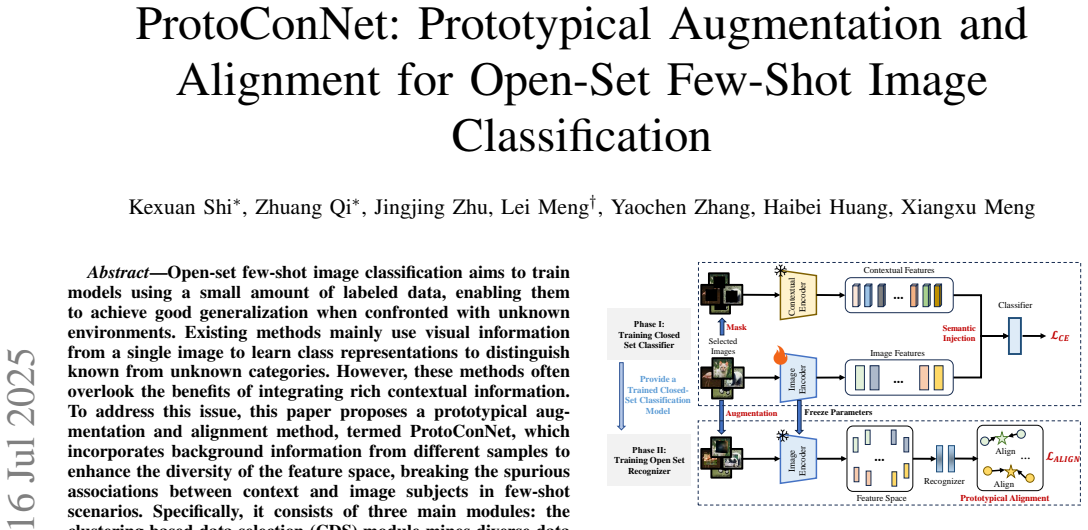
The central object is a context dictionary built from masked images. For each class the method selects representative samples by k-means on pretrained features, masks the central object, clusters the remaining contextual features, and averages each cluster to produce contextual prototypes $z_i$. Image features $f$ are fused as $f_{\text{fuse}} = f + \sum_{i=1}^{\beta} \lambda_i z_i P(z_i)$, with attention weights $\lambda_i$ and cluster-size probabilities $P(z_i)$; this fusion is trained with a cross-entropy loss to produce the closed-set classifier. A separate projector $R(\cdot)$ is then trained with a mean-squared-error loss to align image features to class prototypes, and cosine similarity between $R(f')$ and the predicted prototype is thresholded at $T$ to decide known versus unknown. This two-phase design carries the whole argument: the context dictionary breaks spurious background associations, and the aligned prototype geometry creates the distance gap used for open-set detection.
What would settle it
Run ProtoConNet's TestB evaluation with the threshold $T$ fixed on a held-out validation split before seeing the open-set test set, and repeat all variants over multiple random seeds; if the reported 81.43 open-set accuracy is not reproduced or the margin over the comparison baselines disappears, the central claim of superiority fails.
Extended reading notes
Core claim
ProtoConNet's central claim is that few-shot open-set performance is limited less by the number of samples than by the spurious associations a model learns between an image's subject and its background. To break those associations, the paper builds a three-module pipeline: clustering-based data selection replaces random sampling with diverse, representative samples; contextual-enhanced semantic refinement masks image centers, clusters the remaining contextual features into prototypes, and fuses those prototypes into image features; and prototypical alignment trains a projector that maps features close to their class prototypes, so unknown-class samples fall far away. At inference the similarity between a projected feature and the predicted class prototype is compared to a threshold; below threshold, the sample is treated as unknown and routed to a pretrained zero-shot model. The paper reports that this pipeline improves Top-1 accuracy for known classes and open-set detection across four backbones, with its BEiT-backed two-stage variant reporting 83.62 on the closed-set test and 81.43 on the open-set test and claiming the top positions on both leaderboards.
Load-bearing premise
The load-bearing premise is that the open-set decision threshold $T$ chosen from the four values $\{0.0021, 0.0022, 0.0023, 0.0024\}$ without a validation split is representative; the paper reports that changing $T$ within that range moves open-set accuracy from 86.03 to 74.71, so if $T$ were fixed a priori the claimed TestB advantage could shrink or vanish.
Editorial extensions
If this is right
- If the reported numbers hold, wrapping a backbone with ProtoConNet raises closed-set accuracy while adding open-set detection, so a single model can serve both tasks.
- The paper's ablation attributes most of the open-set gain to prototypical alignment: on the BEiT backbone, adding CDS and CSR takes the open-set score from 49.66 to 53.47, and adding PA takes it to 81.43.
- The method's routing rule means unknown samples are handled by the pretrained zero-shot model rather than rejected outright, so accuracy on unknown classes depends on both the alignment quality and the fallback model.
- The plug-and-play claim entails that the same three modules can be applied to new backbones without redesign; Table II reports gains for CLIP, MAE, DeiT, and BEiT.
Reading between the lines
- A natural extension the paper does not explore is calibrating the threshold $T$ on a held-out validation set; because the reported open-set accuracy drops from 86.03 to 74.71 over the four tested thresholds, a learned or calibrated threshold would likely make the method more portable.
- The context-dictionary idea could be combined with generative augmentation: instead of masking and averaging, one could sample contextual continuations from a diffusion model to create novel backgrounds, which might push feature diversity further.
- The routing-to-zero-shot mechanism suggests a modular route to open-world classification: any closed-set model with prototype alignment can be paired with any zero-shot model, so future work could test whether replacing the fallback model with a stronger vision-language model improves unknown-class accuracy without retraining.
- Because CDS selects samples by clustering, the same selection module could serve as a data-cleaning step for other few-shot pipelines, independent of the context fusion and alignment modules.
Editorial analysis
A structured set of objections, weighed in public.
Referee Report
Summary. The paper proposes ProtoConNet, a framework for open-set few-shot image classification built on three modules: clustering-based data selection (CDS), contextual-enhanced semantic refinement (CSR), and prototypical alignment (PA). CDS uses k-means to choose representative training samples, CSR integrates contextual prototypes into image features, and PA aligns image features to class prototypes and routes low-similarity samples to a zero-shot CLIP model. The authors report results on the Jittor AI Challenge comprehensive dataset, claiming that ProtoConNet tops both Test A and Test B leaderboards and improves multiple backbones. The main empirical claims rest on a threshold T chosen from a small grid, conflicting descriptions of the gating rule, and reported results without variance.
Significance. If the reported gains were rigorously established, the proposed framework would be a useful plug-and-play component for few-shot open-set recognition, and the authors' contributions to the Jittor platform (e.g., Grad-CAM and IVLP implementations) are commendable. However, the central performance claims are not substantiated by the current evaluation protocol. The open-set threshold is selected using test labels, the decision rule is stated inconsistently, and the reported ProtoConNet results lack standard deviations, making it impossible to separate genuine improvement from threshold fitting or run-to-run noise. The paper's core contribution is therefore currently unsupported by the evidence presented.
major comments (5)
- [§V-A-3, Table IV] The open-set threshold T is selected from {0.0021, 0.0022, 0.0023, 0.0024} with no validation split described, and Table IV shows that open-set accuracy varies from 86.03 at T=0.0021 to 74.71 at T=0.0024. Because the TestB results in Table II are obtained after this choice, the reported superiority (e.g., ProtoConNet-BEiT Two: 81.43 vs. BEiT Two: 51.44) may be a selected maximum over the threshold grid on the test labels rather than an intrinsic property of the method. The authors should select T on a hold-out validation set or fix it a priori, and report the sensitivity of the final leaderboard numbers to this choice.
- [§III vs. §IV-D and Figure 3] The paper defines the gating rule inconsistently. Section III states that if s > T, the sample belongs to an unknown class; Section IV-D and Figure 3 state that if the similarity exceeds T, the sample is classified as a known class and the CSR model provides the final prediction, otherwise it is unknown and CLIP is used. These two rules make opposite decisions for the same similarity score. Since the PA module's TestB contribution is exactly this routing decision, the paper does not unambiguously specify the system that was evaluated. This contradiction must be resolved and the entire inference description made consistent.
- [Table II and §V-B] Table II's caption states that all methods were run for three trials and mean and standard deviation are reported, but the ProtoConNet rows contain a single number and Section V-B says that for ProtoConNet methods the authors report performance on specific samples. Without standard deviations and a clear statement of which samples or seeds were used, the reader cannot determine whether the observed gains over the baselines are within run-to-run noise. The authors should report means and standard deviations for ProtoConNet over the same number of trials as the baselines, and ideally also a significance test.
- [Table III, PA ablation] The ablation attributes large TestB gains to the PA module (e.g., BEiT+CDS+CSR: 53.47; +PA: 81.43), but the PA module's inference effect is to threshold cosine similarity and route below-threshold samples to the zero-shot CLIP model. This number therefore includes CLIP's zero-shot predictions on all samples declared unknown, and the contribution of the prototypical alignment itself is not isolated. A control that applies the CLIP zero-shot model alone to the TestB set, or that uses a fixed similarity threshold on the CSR features without training the PA projector, is needed to support the claim that the PA module is responsible for the open-set gains.
- [Abstract vs. §V-A] The abstract states that experimental results from two datasets verified the method, but Section V-A and Table I describe only the Jittor AI Challenge comprehensive dataset; Test A and Test B are test splits of that single dataset, not two datasets. The claim that results were verified on two datasets is therefore not supported by the paper's experiments. This discrepancy should be corrected.
minor comments (5)
- [§V-A-2] There are typos: "ues" should be "use" and "Accurancy" should be "Accuracy".
- [§VI] The conclusion contains a duplicated phrase, "First, First," which should be removed.
- [Eq. (8)] The summation notation in Eq. (8) uses the index i both for the sample and for the contextual prototype groups; this should be clarified, for example by using distinct indices.
- [Figure 5] Figure 5 appears to contain placeholder text ("Threshold", "Performance") rather than an actual data plot; the figure should be replaced with the intended visualization.
- [References] References [5] and [26] appear to be the same paper (Che et al., IJCAI 2023, on multi-relation margin loss) and should be consolidated to avoid duplication.
Circularity Check
TestB open-set superiority is selected over a test-set-tuned threshold grid, making the central comparison partially circular.
-
fitted input called prediction
[Section V-A-3 (Hyper-parameter Settings) and Table IV]
"We tuned the threshold T from {0.0021, 0.0022, 0.0023, 0.0024}. ... Table IV: Threshold 0.0021 0.0022 0.0023 0.0024 / Open-Set 86.03 82.66 78.73 74.71"
The paper's headline claim is that ProtoConNet 'topped both Test A and Test B leaderboards' (Section V-B), and the TestB open-set accuracy is the quantity used to support this. That accuracy is a direct function of the threshold T, which is selected by evaluating the test set over the four-value grid {0.0021, 0.0022, 0.0023, 0.0024}. Since Table IV shows open-set accuracy falling monotonically from 86.03 to 74.71 as T increases, the reported TestB number is the maximum over the grid rather than an independent prediction. Baselines are not given the same test-set threshold selection, so the claimed superiority is partly forced by the selection procedure.
-
other
[Section III Problem Formulation vs. Section IV-D and Figure 3]
"Section III: 'If s > T, it indicates that the sample belongs to an unknown class; otherwise, it belongs to a known class.' Section IV-D: 'If the similarity exceeds threshold T, the sample is classified as a known class... Otherwise, it is classified as unknown, and the pre-trained CLIP model makes a zero-shot prediction.'"
The paper assigns opposite meanings to the same threshold condition. Under Section III, s > T means 'unknown'; under Section IV-D and Figure 3, s > T means 'known'. Because the open-set result depends entirely on which samples are routed to the CLIP zero-shot model, the reported TestB accuracy does not correspond to a uniquely specified decision rule. This is not a derivation-chain circularity in the strict sense, but it is a load-bearing ambiguity: the claimed prediction cannot be reproduced from the paper's own definition.
full rationale
ProtoConNet's closed-set improvements (CDS and CSR) are evaluated with fixed hyperparameters and have independent content. The self-citations to the same research group's earlier work (references [31] and [32]) are used only for k-means and mixup and are not load-bearing. However, the central open-set claim is partially circular: the TestB leaderboard result depends on the known/unknown threshold T, which is tuned on the test split over a four-value grid. Table IV shows open-set accuracy moving monotonically from 86.03 to 74.71 across that grid, so reporting the best value as the method's performance is equivalent to selecting the maximum of the grid. The paper also contradicts itself on which side of T means 'unknown' (Section III vs. Section IV-D/Figure 3), so the evaluated system is not unambiguously specified. In addition, Table II reports no variance for ProtoConNet rows ('performance on specific samples') while baselines are averaged over three seeds, which weakens the comparison, though this is a reporting issue rather than circularity. Overall, the CDS/CSR findings are not circular, but the headline TestB superiority is not an independent prediction because it is mediated by a test-set-tuned threshold.
Assumptions & free parameters
free parameters (4)
- open-set threshold T =
not stated; tuned from {0.0021, 0.0022, 0.0023, 0.0024}
- number of clusters k =
4
- mask size gamma =
chosen from {64, 96, 128}
- number of context prototypes beta =
chosen from {32, 64}
assumptions (5)
- domain assumption Pretrained CLIP features are a reliable feature space for judging which samples are representative.
- domain assumption Masking the image center leaves useful context and removes the subject.
- ad hoc to paper The samples closest to k-means centroids are the most representative training samples.
- domain assumption Cosine similarity between aligned features and class prototypes is a calibrated open-set score with a threshold near 0.002.
- standard math Standard k-means, softmax attention, and MSE optimization behave as expected.
invented entities (2)
-
Contextual prototype dictionary Z = [z1, ..., z_beta]
-
Open-set recognizer R(.)
Cite this review
Pith. "Pith review of ProtoConNet: Prototypical Augmentation and Alignment for Open-Set Few-Shot Image Classification." pith.science (2026). https://pith.science/paper/GITIUNIV
@misc{pith2026250711845,
  author       = {Pith},
  title        = {Pith review of: ProtoConNet: Prototypical Augmentation and Alignment for Open-Set Few-Shot Image Classification},
  year         = {2026},
  howpublished = {\url{https://pith.science/paper/GITIUNIV}},
  note         = {Machine review of arXiv:2507.11845}
}
read the original abstract
Open-set few-shot image classification aims to train models using a small amount of labeled data, enabling them to achieve good generalization when confronted with unknown environments. Existing methods mainly use visual information from a single image to learn class representations to distinguish known from unknown categories. However, these methods often overlook the benefits of integrating rich contextual information. To address this issue, this paper proposes a prototypical augmentation and alignment method, termed ProtoConNet, which incorporates background information from different samples to enhance the diversity of the feature space, breaking the spurious associations between context and image subjects in few-shot scenarios. Specifically, it consists of three main modules: the clustering-based data selection (CDS) module mines diverse data patterns while preserving core features; the contextual-enhanced semantic refinement (CSR) module builds a context dictionary to integrate into image representations, which boosts the model's robustness in various scenarios; and the prototypical alignment (PA) module reduces the gap between image representations and class prototypes, amplifying feature distances for known and unknown classes. Experimental results from two datasets verified that ProtoConNet enhances the effectiveness of representation learning in few-shot scenarios and identifies open-set samples, making it superior to existing methods.
Figures


Figures from the paper (6 more)


Reference graph
Works this paper leans on
-
[1]
Few-shot open-set recognition of hyperspectral images,
D. Pal, Y . Jeppu, and B. Banerjee, “Few-shot open-set recognition of hyperspectral images,” in Advances in Machine Learning and Image Analysis for GeoAI . Elsevier, 2024, pp. 27–53
work page 2024
-
[2]
Toward generalized few-shot open- set object detection,
B. Su, H. Zhang, J. Li, and Z. Zhou, “Toward generalized few-shot open- set object detection,” IEEE Transactions on Image Processing , vol. 33, pp. 1389–1402, 2024
work page 2024
-
[3]
Rd-openmax: Rethinking openmax for robust realistic open-set recognition,
X. Yin, B. Cao, Q. Hu, and Q. Wang, “Rd-openmax: Rethinking openmax for robust realistic open-set recognition,” IEEE Transactions on Neural Networks and Learning Systems , 2024
work page 2024
-
[4]
Few-shot class-incremental learning from an open-set perspective,
C. Peng, K. Zhao, T. Wang, M. Li, and B. C. Lovell, “Few-shot class-incremental learning from an open-set perspective,” in European Conference on Computer Vision . Springer, 2022, pp. 382–397
2022
-
[5]
Boosting few-shot open-set recognition with multi-relation margin loss
Y . Che, Y . An, and H. Xue, “Boosting few-shot open-set recognition with multi-relation margin loss.” in IJCAI, 2023, pp. 3505–3513
work page 2023
-
[6]
Feature-semantic augmentation network for few-shot open-set recognition,
X. Huang and S. H. Choi, “Feature-semantic augmentation network for few-shot open-set recognition,”Pattern Recognition, vol. 156, p. 110781, 2024
work page 2024
-
[7]
Learning to prompt for vision- language models,
K. Zhou, J. Yang, C. C. Loy, and Z. Liu, “Learning to prompt for vision- language models,” International Journal of Computer Vision , vol. 130, no. 9, pp. 2337–2348, 2022
2022
-
[8]
Conditional prompt learning for vision-language models,
Zhou, Kaiyang and Yang, Jingkang and Loy, Chen Change and Liu, Ziwei, “Conditional prompt learning for vision-language models,” in Proceedings of the IEEE/CVF conference on computer vision and pattern recognition, 2022, pp. 16 816–16 825
work page 2022
Show all 34 references
-
[9]
Pre-trained vision and language transformers are few-shot incremental learners,
K.-H. Park, K. Song, and G.-M. Park, “Pre-trained vision and language transformers are few-shot incremental learners,” in Proceedings of the IEEE/CVF Conference on Computer Vision and Pattern Recognition , 2024, pp. 23 881–23 890
2024
-
[10]
Self-regulating prompts: Foundational model adaptation without forgetting,
M. U. Khattak, S. T. Wasim, M. Naseer, S. Khan, M.-H. Yang, and F. S. Khan, “Self-regulating prompts: Foundational model adaptation without forgetting,” in Proceedings of the IEEE/CVF International Conference on Computer Vision , 2023, pp. 15 190–15 200
2023
-
[11]
Maple: Multi-modal prompt learning,
M. U. Khattak, H. Rasheed, M. Maaz, S. Khan, and F. S. Khan, “Maple: Multi-modal prompt learning,” in Proceedings of the IEEE/CVF Conference on Computer Vision and Pattern Recognition , 2023, pp. 19 113–19 122
2023
-
[12]
Learning to prompt knowledge transfer for open-world continual learning,
Y . Li, X. Yang, H. Wang, X. Wang, and T. Li, “Learning to prompt knowledge transfer for open-world continual learning,” in Proceedings of the AAAI Conference on Artificial Intelligence , vol. 38, no. 12, 2024, pp. 13 700–13 708
2024
-
[13]
A survey on few- shot class-incremental learning,
S. Tian, L. Li, W. Li, H. Ran, X. Ning, and P. Tiwari, “A survey on few- shot class-incremental learning,” Neural Networks , vol. 169, pp. 307– 324, 2024
2024
-
[14]
Morgan: Meta-learning- based few-shot open-set recognition via generative adversarial network,
D. Pal, S. Bose, B. Banerjee, and Y . Jeppu, “Morgan: Meta-learning- based few-shot open-set recognition via generative adversarial network,” in Proceedings of the IEEE/CVF Winter Conference on Applications of Computer Vision (WACV), January 2023, pp. 6295–6304
2023
-
[15]
Enhance image classification via inter-class image mixup with diffusion model,
Z. Wang, L. Wei, T. Wang, H. Chen, Y . Hao, X. Wang, X. He, and Q. Tian, “Enhance image classification via inter-class image mixup with diffusion model,” in Proceedings of the IEEE/CVF Conference on Computer Vision and Pattern Recognition , 2024, pp. 17 223–17 233
2024
-
[16]
Collaborative consortium of foundation models for open-world few-shot learning,
S. Shao, Y . Bai, Y . Wang, B. Liu, and B. Liu, “Collaborative consortium of foundation models for open-world few-shot learning,” in Proceedings of the AAAI Conference on Artificial Intelligence , vol. 38, no. 5, 2024, pp. 4740–4747
2024
-
[17]
Joint feature generation and open-set prototype learning for generalized zero-shot open-set classification,
X. Li, M. Fang, and Z. Zhai, “Joint feature generation and open-set prototype learning for generalized zero-shot open-set classification,” Pattern Recognition, vol. 147, p. 110133, 2024
2024
-
[18]
Beit v2: Masked image modeling with vector-quantized visual tokenizers,
Z. Peng, L. Dong, H. Bao, Q. Ye, and F. Wei, “Beit v2: Masked image modeling with vector-quantized visual tokenizers,” arXiv preprint arXiv:2208.06366, 2022
2022 arXiv
-
[19]
Croft: Robust fine-tuning with concurrent optimization for ood generalization and open-set ood detection,
L. Zhu, Y . Yang, Q. Gu, X. Wang, C. Zhou, and N. Ye, “Croft: Robust fine-tuning with concurrent optimization for ood generalization and open-set ood detection,” arXiv preprint arXiv:2405.16417 , 2024
2024 arXiv
-
[20]
An effective deployment of diffusion lm for data augmentation in low-resource sentiment classification,
Z. Chen, L. Wang, Y . Wu, X. Liao, Y . Tian, and J. Zhong, “An effective deployment of diffusion lm for data augmentation in low-resource sentiment classification,” arXiv preprint arXiv:2409.03203 , 2024
2024 arXiv
-
[21]
Instance-conditioned gan data augmentation for representation learning,
P. Astolfi, A. Casanova, J. Verbeek, P. Vincent, A. Romero-Soriano, and M. Drozdzal, “Instance-conditioned gan data augmentation for representation learning,” arXiv preprint arXiv:2303.09677 , 2023
2023 arXiv
-
[22]
Meta-learning with latent embedding optimization,
A. A. Rusu, D. Rao, J. Sygnowski, O. Vinyals, R. Pascanu, S. Osindero, and R. Hadsell, “Meta-learning with latent embedding optimization,” in Proceedings of the International Conference on Learning Representa- tions, 2019
2019
-
[23]
Deit iii: Revenge of the vit,
H. Touvron, M. Cord, and H. J ´egou, “Deit iii: Revenge of the vit,” in European conference on computer vision. Springer, 2022, pp. 516–533
2022
-
[24]
Masked au- toencoders are scalable vision learners,
K. He, X. Chen, S. Xie, Y . Li, P. Doll ´ar, and R. Girshick, “Masked au- toencoders are scalable vision learners,” inProceedings of the IEEE/CVF conference on computer vision and pattern recognition , 2022, pp. 16 000–16 009
2022
-
[25]
Few-shot open-set recognition of hyperspectral images with outlier calibration network,
D. Pal, V . Bundele, R. Sharma, B. Banerjee, and Y . Jeppu, “Few-shot open-set recognition of hyperspectral images with outlier calibration network,” in Proceedings of the IEEE/CVF Winter Conference on Applications of Computer Vision (WACV) , 2022, pp. 3801–3810
2022
-
[26]
Boosting few-shot open-set recognition with multi-relation margin loss,
Y . Che, Y . An, and H. Xue, “Boosting few-shot open-set recognition with multi-relation margin loss,” in Proceedings of the International Joint Conference on Artificial Intelligence , 2023, pp. 3505–3513
2023
-
[27]
Few-shot open-set recognition by trans- formation consistency,
M. Jeong, S. Choi, and C. Kim, “Few-shot open-set recognition by trans- formation consistency,” in Proceedings of the IEEE/CVF Conference on Computer Vision and Pattern Recognition , 2021, pp. 12 566–12 575
2021
-
[28]
Recon- struction guided meta-learning for few shot open set recognition,
S. Nag, D. Raychaudhuri, S. Paul, and A. Roy-Chowdhury, “Recon- struction guided meta-learning for few shot open set recognition,” IEEE Transactions on Pattern Analysis and Machine Intelligence , 2023
2023
-
[29]
Glocal energy-based learning for few-shot open-set recognition,
H. Wang, G. Pang, P. Wang, L. Zhang, W. Wei, and Y . Zhang, “Glocal energy-based learning for few-shot open-set recognition,” in Proceedings of the IEEE/CVF Conference on Computer Vision and Pattern Recognition, 2023, pp. 7507–7516
2023
-
[30]
Learning transferable visual models from natural language supervision,
A. Radford, J. W. Kim, C. Hallacy, A. Ramesh, G. Goh, S. Agarwal, G. Sastry, A. Askell, P. Mishkin, J. Clark et al., “Learning transferable visual models from natural language supervision,” in International conference on machine learning . PMLR, 2021, pp. 8748–8763
2021
-
[31]
Cross-silo prototypical calibration for federated learning with non-iid data,
Z. Qi, L. Meng, Z. Chen, H. Hu, H. Lin, and X. Meng, “Cross-silo prototypical calibration for federated learning with non-iid data,” in Proceedings of the 31st ACM International Conference on Multimedia , 2023, pp. 3099–3107
2023
-
[32]
Cross- training with multi-view knowledge fusion for heterogenous federated learning,
Z. Qi, L. Meng, W. He, R. Zhang, Y . Wang, X. Qi, and X. Meng, “Cross- training with multi-view knowledge fusion for heterogenous federated learning,” arXiv preprint arXiv:2405.20046 , 2024
2024
-
[33]
Grad-cam: Visual explanations from deep networks via gradient-based localization,
R. R. Selvaraju, M. Cogswell, A. Das, R. Vedantam, D. Parikh, and D. Batra, “Grad-cam: Visual explanations from deep networks via gradient-based localization,” in Proceedings of the IEEE international conference on computer vision , 2017, pp. 618–626
2017
-
[34]
Visualizing data using t-sne
L. Van der Maaten and G. Hinton, “Visualizing data using t-sne.” Journal of machine learning research , vol. 9, no. 11, 2008
2008
Reviewed August 6, 2026 · model on record in the stance chip above.
Discussion (0). Sign in to comment.