REVIEW 4 major objections 4 minor 81 references
Steady-state extensional viscosity of wormlike micellar solutions via dissipative particle dynamics simulations
T0 review · 4 major / 4 minor · reviewed 2026-08-06 · deepseek-v4-flash
Pith's one-line read For unentangled wormlike micellar solutions, steady-state extensional viscosity rises with extension rate up to a Weissenberg number near 2 and then falls, because micelles first stretch and then undergo flow-induced scission; the…
desk verdict A solid, honest DPD study that convincingly shows a stretching–scission mechanism for nonmonotonic extensional viscosity, but the claimed unified relation (Eq. 18) is currently a plausible empirical collapse, not a demonstrated prediction. read the letter →
The pith
A machine-rendered reading of the paper's core claim, the machinery that carries it, and where it could break.
The reading
What carries the argument
The central object is the flow-dependent largest dynamically effective aggregation number $\tilde{N}_\Lambda(\dot{\epsilon})$, defined by the crossing of the rotational relaxation time $\tau_r(N_{\rm ag})$ and the flow-modified scission lifetime $\tau_b(N_{\rm ag})$; it is the size above which micelles break before they can complete a slow rotational relaxation. It acts as a truncation scale for the relaxation spectrum: micelles with $N_{\rm ag} < \tilde{N}_\Lambda$ contribute through their polydisperse gyration radii (the term $\Gamma_<$), while micelles with $N_{\rm ag} \ge \tilde{N}_\Lambda$ behave like monodisperse objects of size $\tilde{N}_\Lambda$ (the term $\Gamma_>$). These two contributions enter Eq. (18) together with the Rouse-type identity $\eta_E^{(m)} = \rho_m \zeta_m [\langle R_{g,\parallel}^2\rangle_w + \langle R_{g,\perp}^2\rangle_w/2]$, producing the claimed collapse of the micellar extensional viscosity.
What would settle it
Run the same DPD model with scission disabled (or with micellar breaking time made very long). Eq. (18) and the scission explanation predict that $\eta_E$ should then keep increasing with Wi instead of peaking near Wi ≈ 2; a peak that persists without scission would falsify the mechanism. A complementary check is to measure in one solution the gyration radii, size distribution, and scission lifetimes entering $\Gamma_<$ and $\Gamma_>$; if $\eta_E^{(m)}/(\Gamma_<+\Gamma_>)$ varies systematically with Wi, $\phi$, or temperature, the single-constant collapse is false.
Extended reading notes
Core claim
The central claim is that the nonmonotonic dependence of the steady-state extensional viscosity $\eta_E(\dot{\epsilon})$ on extension rate is governed by a competition between two flow effects on wormlike micelles. Below a Weissenberg number of about 2, micelles stretch and align in the elongation direction, increasing their contribution to the viscosity; above about 2, flow-induced scission becomes significant, reducing the fraction of large micelles and the largest dynamically effective size, so the viscosity decreases. The paper further claims that the micellar contribution to the extensional viscosity can be collapsed by Eq. (18), $\eta_E^{(m)} = \zeta_m [\Gamma_< + \Gamma_>]$, which generalizes the Rouse-type viscosity–gyration-radius relation to polydisperse, reversibly scissionable micelles by using a flow-dependent cutoff $\tilde{N}_\Lambda(\dot{\epsilon})$ instead of the equilibrium cutoff. The collapse is demonstrated for several volume fractions and four temperatures, and the same relation is shown to fail if only polydispersity is included without the scission-modified cutoff.
Load-bearing premise
The load-bearing premise is that a wormlike micelle under flow behaves like an ordinary polymer chain whose slowest relaxation modes are simply cut off at the size where the micelle breaks before it can relax; the paper verifies this picture for permanent polymer chains, where scission is absent, but for scissionable micelles the cutoff is an acknowledged approximation.
Editorial extensions
If this is right
- Below a Weissenberg number of about 2, micellar stretching and alignment raise the extensional viscosity of unentangled wormlike micellar solutions; above about 2, flow-induced scission outweighs stretching and the viscosity falls.
- The location of the viscosity maximum is tied to scission kinetics, so it is not a universal constant of wormlike micelles; systems with longer-lived micelles should peak at larger Wi.
- Eq. (18) offers a structure–property route: measuring or computing gyration radii, the aggregation-number distribution, and scission lifetimes fixes the micellar contribution to the extensional viscosity up to a constant friction coefficient.
- Using the equilibrium cutoff $N_\Lambda$ instead of the flow-dependent $\tilde{N}_\Lambda(\dot{\epsilon})$ overestimates the viscosity at high extension rates, confirming that flow-induced scission enters through kinetics and not only through the size distribution.
- The same simulation protocol reaches steady states at arbitrarily large strains, so the predicted decrease of $\eta_E$ is not a box-collapse artifact.
Reading between the lines
- Beyond the paper, Eq. (18) suggests an inverse route: a measured micellar extensional viscosity, combined with independent gyration-radius and size-distribution data, would constrain the flow-dependent effective size $\tilde{N}_\Lambda(\dot{\epsilon})$ and hence the scission kinetics.
- A testable prediction that follows from the cutoff picture but is not demonstrated here is that chemically longer-lived micelles should shift the viscosity maximum to higher Wi and make the high-rate decline more gradual.
- The paper studies unentangled solutions because dissipative particle dynamics soft-core potentials do not capture entanglement; whether entanglement introduces a second mechanism that changes the Wi near 2 crossover is an open question this relation does not address.
- The same truncation logic could be checked in living-polymer or reversibly breaking polymer simulations with controlled recombination rates, separating the role of scission kinetics from micellar structure.
Signed reviews
Editorial analysis
A structured set of objections, weighed in public.
Referee Report
Summary. The paper reports dissipative particle dynamics (DPD) simulations of nonionic wormlike micellar solutions under steady uniaxial extensional flow, using the generalized Kraynik–Reinelt boundary condition to access long strains. The steady-state extensional viscosity η_E(ε̇) normalized by 3η_0 is found to be nonmonotonic in the Weissenberg number: it rises for Wi ≲ 2, attributed to micellar stretching and alignment, and falls for Wi ≳ 2, attributed to flow-induced scission. The authors characterize the scission kinetics through micelle lifetimes τ_b(Nag), the aggregation-number distribution P(Nag), and the stretching through R_g,∥^2(Nag). They then propose Eq. (18), η_E^(m) = ζ_m [Γ_< + Γ_>], where Γ_< and Γ_> are weighted gyration-radius contributions split at a flow-dependent dynamically effective size Ñ_Λ(ε̇), and ζ_m is a micellar friction coefficient. The collapse of η_E^(m) against Γ_< + Γ_> in Fig. 10(a) is offered as a unified description across temperature, concentration, and extension rate.
Significance. The qualitative central claim is credible and well supported. The simulations are careful: three independent replicates, error bars, long equilibration, a temperature-control check in Appendix A, and a polymer validation of the base viscosity–gyration relation in Appendix B. The GKR method is a genuine technical advance for this system, and the structural evidence for the stretching-versus-scission competition is persuasive. If Eq. (18) were established as a predictive relation, it would be a valuable structure–rheology link for wormlike micelles. However, as presented, Eq. (18) is a consistency collapse with one a priori unknown fitted parameter, not a parameter-free prediction, and the scission-truncation approximation on which it rests is acknowledged by the authors themselves as bold and not separately validated. The paper therefore needs additional work before the quantitative claim can be accepted at the level stated in the abstract.
major comments (4)
- [§4.2, Eq. (18), Fig. 10(a)] The collapse in Fig. 10(a) does not yet establish Eq. (18) as a unified description. The parameter ζ_m is introduced as 'a priori unknown' and is effectively fitted from the same data that define the horizontal axis; both η_E^(m) and Γ_< + Γ_> are computed from the same simulation trajectories. As the authors state at the end of §4.2, 'the physical origin of the value of ζ_m in Eq. (18) warrants further investigation.' Consequently, Fig. 10(a) is a test of internal consistency rather than a prediction for a new thermodynamic state. I request an out-of-sample test: fix ζ_m from a subset of state points (e.g., one temperature or one concentration) and predict the remaining points, or obtain ζ_m from an independent route (e.g., a friction coefficient from equilibrium relaxation data) and then compare Eq. (18) with simulation without refitting.
- [§4.2, Eqs. (15)–(17)] The central approximation that all micelles with Nag ≥ Ñ_Λ contribute as monodisperse micelles of size Ñ_Λ, with gyration radius R_g^2(Ñ_Λ) rather than their actual larger R_g^2, is load-bearing for the collapse. Because Ñ_Λ decreases with Wi, this replacement systematically suppresses Γ_> at high Wi and therefore acts in the same direction as the observed decrease of η_E^(m). The paper acknowledges that this is a 'bold' approximation, but provides no sensitivity analysis. I ask the authors to test the sensitivity of the collapse to the truncation prescription: for example, use the actual R_g^2(Nag) of large micelles with a dynamical weighting, vary the definition of Ñ_Λ, or compare with an alternative threshold, and show that the qualitative and quantitative conclusions are unchanged.
- [Appendix B and §4.2] The validation of Eq. (11) in Appendix B is performed for permanent polymer chains and does not test the scission-truncation step. The paper transfers a Rouse-type relation to reversibly scissionable, polydisperse micelles via Eqs. (12) and (15)–(17). Since this transfer is the basis of Eq. (18), a test that isolates the scission effect is important: for instance, a system where scission kinetics can be tuned while keeping the equilibrium aggregation-number distribution similar, or a lattice/bead-spring model with controlled scission, would directly support the mode-truncation picture. Without such a check, the status of Eq. (18) remains an empirical collapse rather than a demonstrated mechanistic relation.
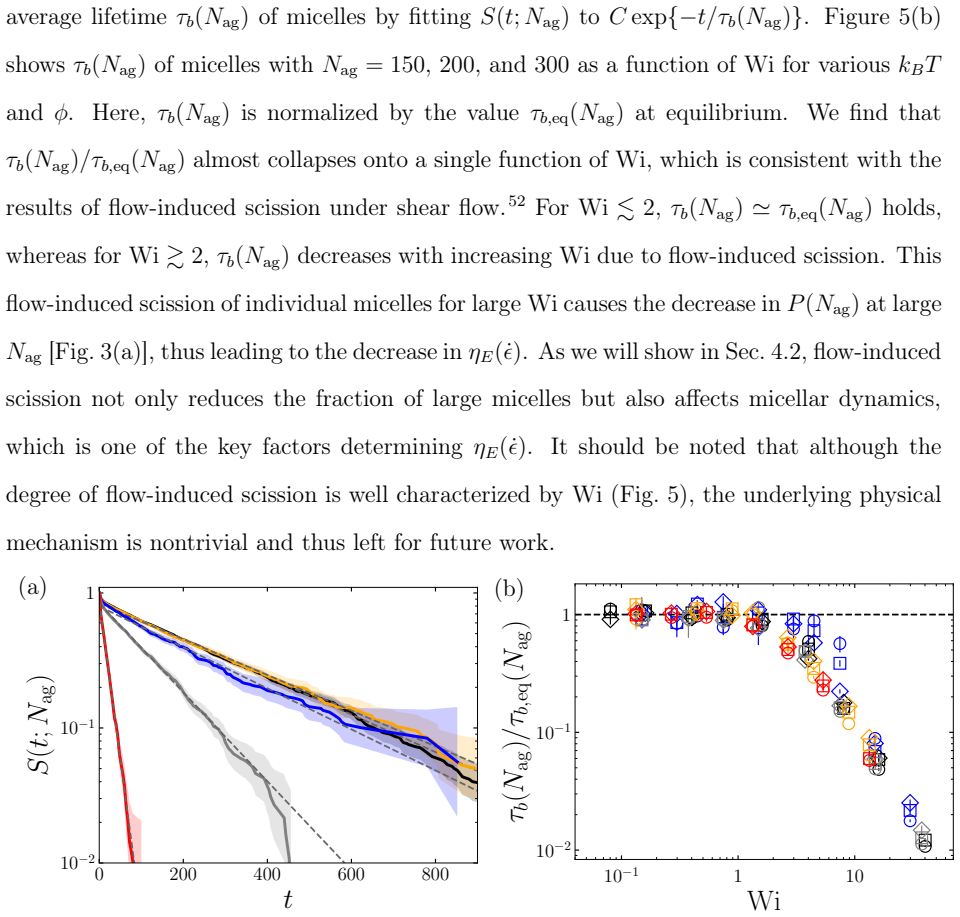
- [§3.1 and §4.1, definition of Wi] The Weissenberg number is defined using τ_Λ obtained from equilibrium τ_r(Nag) and τ_b(Nag), but under strong flow the micelle lifetime τ_b decreases substantially (Fig. 5) and Ñ_Λ changes with Wi. Using an equilibrium-derived τ_Λ to nondimensionalize data that include strong flow-induced scission could mask some of the state dependence. The authors should clarify whether the collapse in Fig. 10 and the Wi ≃ 2 location of the maximum are robust to using a flow-dependent longest time scale, or at least discuss quantitatively why the equilibrium τ_Λ is the appropriate choice.
minor comments (4)
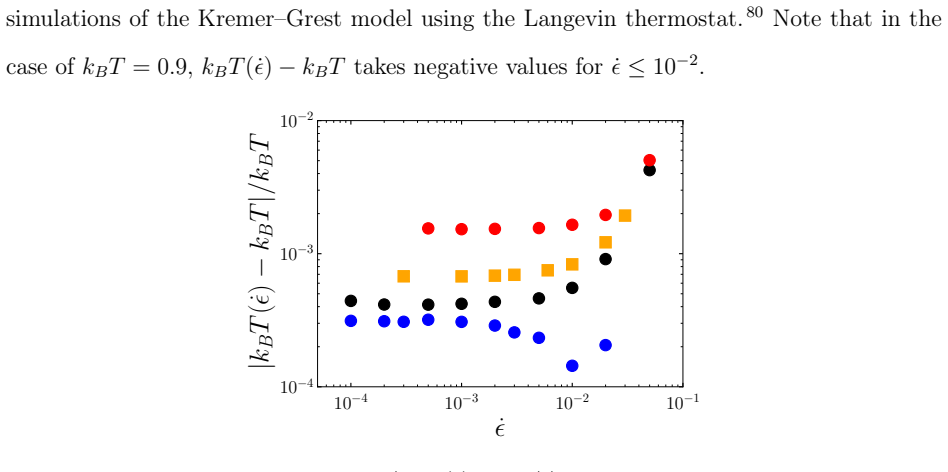
- [Appendix A title] The appendix title contains a typo: 'Temeperature control' should be 'Temperature control'.
- [Eq. (12)] The summation in Eq. (12) appears as 'PM j=1' in the text; it should be typeset as a proper sum with the index and limit clearly shown.
- [§4.2, Eq. (17)] The use of R_g^2(Ñ_Λ) assumes that Ñ_Λ is an integer aggregation number at which gyration radii are evaluated; please state how R_g^2 is obtained when Ñ_Λ falls between sampled Nag values, e.g., by interpolation.
- [Fig. 10(a)] The paper states that the collapse is 'less clear compared with polymer solutions' but does not quantify the goodness of the collapse; reporting the slope, correlation coefficient, and residuals for the linear fits in Fig. 10 would make the comparison more concrete.
Circularity Check
No significant circularity: the nonmonotonic extensional viscosity is a direct simulation observation, and Eq. (18) is an openly proposed one-constant consistency relation rather than a fitted input renamed as a prediction.
full rationale
The paper's central qualitative claim—that the steady-state extensional viscosity eta_E(epsdot) is nonmonotonic and that the maximum near Wi~2 arises from competition between micellar stretching and flow-induced scission—is read directly from the DPD simulations via independent structural observables (P(Nag), tau_b(Nag), R^2_g). It is not derived from the Rouse relation, so it cannot reduce to an input. Equation (18) is explicitly proposed as a relation, not as a first-principles prediction; zeta_m is acknowledged as an a priori unknown single constant. The collapse in Fig. 10(a) with one global prefactor is a nontrivial consistency test of the functional form, not a tautology: if zeta_m were adjusted for every state, the relation would be empty, but the paper does not do that. The underlying Rouse relation (Eq. 11) comes from a theoretical derivation by a coauthor (ref 74), but it is parameter-free in structure and independently checked for polymers in Appendix B; applying it to scissionable, polydisperse micelles is a stated, openly discussed approximation (Eqs. 15-17), a correctness risk rather than circularity. The mode-truncation idea from ref 52 is a self-citation, but the paper labels the approximation bold and tests it against its own saturation data (Fig. 6), and the concept is also anchored in Cates' living-polymer theory. No step in the derivation chain is equivalent to its own input by construction.
Assumptions & free parameters
free parameters (1)
- zeta_m (micellar friction coefficient) =
Not tabulated; slope of the linear fit in Fig. 10(a)
assumptions (5)
- domain assumption Rouse-type relation Eq. (11) holds for wormlike micelles under extensional flow.
- ad hoc to paper Polydispersity weighting via Eq. (12) with Nag proportional to Np is valid for wormlike micelles.
- domain assumption Scission-bounded relaxation: tau(Nag) = tau_r(Nag) for Nag < N_Lambda and tau_Lambda for Nag >= N_Lambda (Eq. 15).
- ad hoc to paper Micelles with Nag >= Ntilde_Lambda contribute to viscosity as monodisperse micelles of size Ntilde_Lambda (Eq. 17).
- domain assumption The SLLOD equations with the generalized Kraynik-Reinelt boundary condition correctly impose steady homogeneous uniaxial extensional flow at arbitrary strains.
invented entities (1)
-
Ntilde_Lambda(epsdot), the flow-dependent largest dynamically effective aggregation number
Cite this review
Pith. "Pith review of Steady-state extensional viscosity of wormlike micellar solutions via dissipative particle dynamics simulations." pith.science (2026). https://pith.science/paper/E56HNA6I
@misc{pith2026250711923,
  author       = {Pith},
  title        = {Pith review of: Steady-state extensional viscosity of wormlike micellar solutions via dissipative particle dynamics simulations},
  year         = {2026},
  howpublished = {\url{https://pith.science/paper/E56HNA6I}},
  note         = {Machine review of arXiv:2507.11923}
}
read the original abstract
We investigate the steady-state extensional viscosity of wormlike micellar solutions using dissipative particle dynamics simulations. As the extension rate increases, the steady-state extensional viscosity initially increases and subsequently decreases after reaching a maximum, as observed in experiments. We reveal that this nonmonotonic behavior arises from the competition between micellar stretching and scission under uniaxial extensional flow. We further propose a relation that connects the extensional viscosity to micellar structures and kinetics. This relation provides a unified description of the extensional viscosity of unentangled wormlike micellar solutions for various temperatures, concentrations, and extension rates.
Figures
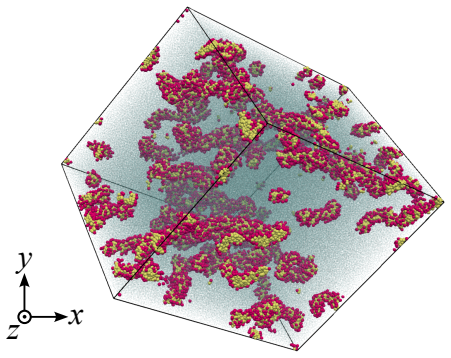


Figures from the paper (10 more)




Reference graph
Works this paper leans on
-
[1]
Dreiss, C. A. Wormlike micelles: where do we stand? R ecent developments, linear rheology and scattering techniques. Soft Matter 2007, 3, 956--970
2007
-
[2]
Viscoelastic wormlike micelles and their applications
Yang, J. Viscoelastic wormlike micelles and their applications. Curr. Opin. Colloid Interface Sci. 2002, 7, 276--281
work page 2002
-
[3]
Drag Reduction of Turbulent Flows by Additives; Kluwer Academic Publishers, 1995
Gyr, A.; Bewersdorff, H.-W. Drag Reduction of Turbulent Flows by Additives; Kluwer Academic Publishers, 1995
work page 1995
-
[4]
Zakin, J. L.; Lu, B.; Bewersdorff, H.-W. Surfactant drag reduction. Rev. Chem. Eng. 1998, 14, 253--320
work page 1998
-
[5]
Flow birefringence and rheological measurements on shear induced micellar structures
Wunderlich, I.; Hoffmann, H.; Rehage, H. Flow birefringence and rheological measurements on shear induced micellar structures. Rheol. Acta 1987, 26, 532--542
work page 1987
-
[6]
Liu, C.-H.; Pine, D. J. Shear-induced gelation and fracture in micellar solutions. Phys. Rev. Lett. 1996, 77, 2121--2124
work page 1996
-
[7]
Spenley, N. A.; Cates, M. E.; McLeish, T. C. B. Nonlinear rheology of wormlike micelles. Phys. Rev. Lett. 1993, 71, 939--942
work page 1993
-
[8]
Britton, M. M.; Callaghan, P. T. Two-phase shear band structures at uniform stress. Phys. Rev. Lett. 1997, 78, 4930--4933
work page 1997
Show all 81 references
-
[9]
L.; Talmon, Y
Lu, B.; Li, X.; Zakin, J. L.; Talmon, Y. A non-viscoelastic drag reducing cationic surfactant system. J. Non-Newtonian Fluid Mech. 1997, 71, 59--72
1997
-
[10]
P.; Mohammadigoushki, H
Rothstein, J. P.; Mohammadigoushki, H. Complex flows of viscoelastic wormlike micelle solutions. J. Non-Newtonian Fluid Mech. 2020, 285, 104382
2020
-
[11]
K.; Warr, G
Prud'homme, R. K.; Warr, G. G. Elongational flow of solutions of rodlike micelles. Langmuir 1994, 10, 3419--3426
1994
-
[12]
Q.; Jamieson, A
Hu, Y.; Wang, S. Q.; Jamieson, A. M. Elongational flow behavior of cetyltrimethylammonium bromide/sodium salicylate surfactant solutions. J. Phys. Chem. 1994, 98, 8555--8559
1994
-
[13]
M.; Moldenaers, P.; Berret, J.-F
Walker, L. M.; Moldenaers, P.; Berret, J.-F. Macroscopic response of wormlike micelles to elongational flow. Langmuir 1996, 12, 6309--6314
1996
-
[14]
Chen, C.-M.; Warr, G. G. Light scattering from wormlike micelles in an elongational field. Langmuir 1997, 13, 1374--1376
1997
-
[15]
G.; Lin, Z
Fischer, P.; Fuller, G. G.; Lin, Z. Branched viscoelastic surfactant solutions and their response to elongational flow. Rheol. Acta 1997, 36, 632--638
1997
-
[16]
L.; Talmon, Y.; Zheng, Y.; Davis, H
Lin, Z.; Lu, B.; Zakin, J. L.; Talmon, Y.; Zheng, Y.; Davis, H. T.; Scriven, L. E. Influence of surfactant concentration and counterion to surfactant ratio on rheology of wormlike micelles. J. Colloid Interface Sci. 2001, 239, 543--554
2001
-
[17]
E.; Davis, H
Lu, B.; Li, X.; Scriven, L. E.; Davis, H. T.; Talmon, Y.; Zakin, J. L. Effect of chemical structure on viscoelasticity and extensional viscosity of drag-reducing cationic surfactant solutions. Langmuir 1998, 14, 8--16
1998
-
[18]
J.; Torres, M
Müller, A. J.; Torres, M. F.; Sáez, A. E. Effect of the flow field on the rheological behavior of aqueous cetyltrimethylammonium p-toluenesulfonate solutions. Langmuir 2004, 20, 3838--3841
2004
-
[19]
E.; Macosko, C
Dontula, P.; Pasquali, M.; Scriven, L. E.; Macosko, C. W. Can extensional viscosity be measured with opposed-nozzle devices? Rheol. Acta 1997, 36, 429--448
1997
-
[20]
J.; Ober, T
Haward, S. J.; Ober, T. J.; Oliveira, M. S. N.; Alves, M. A.; McKinley, G. H. Extensional rheology and elastic instabilities of a wormlike micellar solution in a microfluidic cross-slot device. Soft Matter 2012, 8, 536--555
2012
-
[21]
H.; Sridhar, T
McKinley, G. H.; Sridhar, T. Filament-stretching rheometry of complex fluids. Annu. Rev. Fluid Mech. 2002, 34, 375--415
2002
-
[22]
Rothstein, J. P. Transient extensional rheology of wormlike micelle solutions. J. Rheol. 2003, 47, 1227--1247
2003
-
[23]
Bhardwaj, A.; Richter, D.; Chellamuthu, M.; Rothstein, J. P. The effect of pre-shear on the extensional rheology of wormlike micelle solutions. Rheol. Acta 2007, 46, 861--875
2007
-
[24]
Bhardwaj, A.; Miller, E.; Rothstein, J. P. Filament stretching and capillary breakup extensional rheometry measurements of viscoelastic wormlike micelle solutions. J. Rheol. 2007, 51, 693--719
2007
-
[25]
Chellamuthu, M.; Rothstein, J. P. Distinguishing between linear and branched wormlike micelle solutions using extensional rheology measurements. J. Rheol. 2008, 52, 865--884
2008
-
[26]
Yesilata, B.; Clasen, C.; McKinley, G. H. Nonlinear shear and extensional flow dynamics of wormlike surfactant solutions. J. Non-Newtonian Fluid Mech. 2006, 133, 73--90
2006
-
[27]
Miller, E.; Clasen, C.; Rothstein, J. P. The effect of step-stretch parameters on capillary breakup extensional rheology ( CaBER ) measurements. Rheol. Acta 2009, 48, 625--639
2009
-
[28]
u ller, S.; K \
Sachsenheimer, D.; Oelschlaeger, C.; M \"u ller, S.; K \"u stner, J.; Bindgen, S.; Willenbacher, N. Elongational deformation of wormlike micellar solutions. J. Rheol. 2014, 58, 2017--2042
2014
-
[29]
Exploring sensitivity of the extensional flow to wormlike micellar structure
Omidvar, R.; Dalili, A.; Mir, A.; Mohammadigoushki, H. Exploring sensitivity of the extensional flow to wormlike micellar structure. J. Non-Newtonian Fluid Mech. 2018, 252, 48--56
2018
-
[30]
Sphere sedimentation in wormlike micelles: Effect of micellar relaxation spectrum and gradients in micellar extensions
Wu, S.; Mohammadigoushki, H. Sphere sedimentation in wormlike micelles: Effect of micellar relaxation spectrum and gradients in micellar extensions. J. Rheol. 2018, 62, 1061--1069
2018
-
[31]
Detecting wormlike micellar microstructure using extensional rheology
Omidvar, R.; Wu, S.; Mohammadigoushki, H. Detecting wormlike micellar microstructure using extensional rheology. J. Rheol. 2019, 63, 33--44
2019
-
[32]
Modification of turbulence caused by cationic surfactant wormlike micellar structures in two-dimensional turbulent flow
Fukushima, K.; Kishi, H.; Suzuki, H.; Hidema, R. Modification of turbulence caused by cationic surfactant wormlike micellar structures in two-dimensional turbulent flow. J. Fluid Mech. 2022, 933, A9
2022
-
[33]
Dynamics of falling droplet and elongational properties of dilute nonionic surfactant solutions with drag-reducing ability
Tamano, S.; Ohashi, Y.; Morinishi, Y. Dynamics of falling droplet and elongational properties of dilute nonionic surfactant solutions with drag-reducing ability. Phys. Fluids 2017, 29, 053104
2017
-
[34]
A.; Deblais, A.; Eggers, J.; Bonn, D
Gaillard, A.; Herrada, M. A.; Deblais, A.; Eggers, J.; Bonn, D. Beware of CaBER : Filament thinning rheometry does not always give `the' relaxation time of polymer solutions. Phys. Rev. Fluids 2024, 9, 073302
2024
-
[35]
Effects of moving contact line on filament pinch-off dynamics of viscoelastic surfactant fluids
Wu, S.; Mohammadigoushki, H. Effects of moving contact line on filament pinch-off dynamics of viscoelastic surfactant fluids. Phys. Rev. Fluids 2020, 5, 053303
2020
-
[36]
Uniaxial extension of surfactant micelles: Counterion mediated chain stiffening and a mechanism of rupture by flow-induced Energy Redistribution
Dhakal, S.; Sureshkumar, R. Uniaxial extension of surfactant micelles: Counterion mediated chain stiffening and a mechanism of rupture by flow-induced Energy Redistribution. ACS Macro Lett. 2016, 5, 108--111
2016
-
[37]
Mandal, T.; Larson, R. G. Stretch and breakage of wormlike micelles under uniaxial strain: A simulation study and comparison with experimental results. Langmuir 2018, 34, 12600--12608
2018
-
[38]
M.; Reinelt, D
Kraynik, A. M.; Reinelt, D. A. Extensional motions of spatially periodic lattices. Int. J. Multiphase Flow 1992, 18, 1045--1059
1992
-
[39]
Periodic boundary conditions for long-time nonequilibrium molecular dynamics simulations of incompressible flows
Dobson, M. Periodic boundary conditions for long-time nonequilibrium molecular dynamics simulations of incompressible flows. J. Chem. Phys. 2014, 141, 184103
2014
-
[40]
Hunt, T. A. Periodic boundary conditions for the simulation of uniaxial extensional flow of arbitrary duration. Mol. Simul. 2016, 42, 347--352
2016
-
[41]
A.; Rutledge, G
Nicholson, D. A.; Rutledge, G. C. Molecular simulation of flow-enhanced nucleation in n-eicosane melts under steady shear and uniaxial extension. J. Chem. Phys. 2016, 145, 244903
2016
-
[42]
C.; Alvarez, N
O'Connor, T. C.; Alvarez, N. J.; Robbins, M. O. Relating chain conformations to extensional stress in entangled polymer melts. Phys. Rev. Lett. 2018, 121, 047801
2018
-
[43]
C.; Hopkins, A.; Robbins, M
O'Connor, T. C.; Hopkins, A.; Robbins, M. O. Stress relaxation in highly oriented melts of entangled polymers. Macromolecules 2019, 52, 8540--8550
2019
-
[44]
Viscosity overshoot in biaxial elongational flow: Coarse-grained molecular dynamics simulation of ring--linear polymer mixtures
Murashima, T.; Hagita, K.; Kawakatsu, T. Viscosity overshoot in biaxial elongational flow: Coarse-grained molecular dynamics simulation of ring--linear polymer mixtures. Macromolecules 2021, 54, 7210--7225
2021
-
[45]
Topological transition in multicyclic chains with structural symmetry inducing stress-overshoot phenomena in multicyclic/linear blends under biaxial elongational flow
Murashima, T.; Hagita, K.; Kawakatsu, T. Topological transition in multicyclic chains with structural symmetry inducing stress-overshoot phenomena in multicyclic/linear blends under biaxial elongational flow. Macromolecules 2022, 55, 9358--9372
2022
-
[46]
J.; Koelman, J
Hoogerbrugge, P. J.; Koelman, J. M. V. A. Simulating microscopic hydrodynamic phenomena with dissipative particle dynamics. Europhys. Lett. 1992, 19, 155--160
1992
-
[47]
Statistical mechanics of dissipative particle dynamics
Espa \ n ol, P.; Warren, P. Statistical mechanics of dissipative particle dynamics. Europhys. Lett. 1995, 30, 191--196
1995
-
[48]
Mesoscopic simulation of the crossing dynamics at an entanglement point of surfactant threadlike micelles
Yamamoto, S.; Hyodo, S. Mesoscopic simulation of the crossing dynamics at an entanglement point of surfactant threadlike micelles. J. Chem. Phys. 2005, 122, 204907
2005
-
[49]
Spontaneous self-assembly process for threadlike micelles
Arai, N.; Yasuoka, K.; Masubuchi, Y. Spontaneous self-assembly process for threadlike micelles. J. Chem. Phys. 2007, 126, 244905
2007
-
[50]
M.; Larson, R
Wang, H.; Tang, X.; Eike, D. M.; Larson, R. G.; Koenig, P. H. Scission free energies for wormlike surfactant micelles: D evelopment of a simulation protocol, application, and validation for personal care formulations. Langmuir 2018, 34, 1564--1573
2018
-
[51]
R.; Panoukidou, M.; Del Regno, A.; Anderson, R
Wand, C. R.; Panoukidou, M.; Del Regno, A.; Anderson, R. L.; Carbone, P. The relationship between wormlike micelle scission free energy and micellar composition: The case of sodium lauryl ether sulfate and cocamidopropyl betaine. Langmuir 2020, 12288--12298
2020
-
[52]
Flow-induced scission of wormlike micelles in nonionic surfactant solutions under shear flow
Koide, Y.; Goto, S. Flow-induced scission of wormlike micelles in nonionic surfactant solutions under shear flow. J. Chem. Phys. 2022, 157, 084903
2022
-
[53]
Effect of scission on alignment of nonionic surfactant micelles under shear flow
Koide, Y.; Goto, S. Effect of scission on alignment of nonionic surfactant micelles under shear flow. Soft Matter 2023, 19, 4323--4332
2023
-
[54]
Anionic surfactant solutions under shear using dissipative particle dynamics
Hendrikse, R.; Bayly, A.; Jimack, P. Anionic surfactant solutions under shear using dissipative particle dynamics. J. Chem. Phys. 2023, 158, 214906
2023
-
[55]
Nonmonotonic concentration dependence of the self-diffusion coefficient of surfactants in wormlike micellar solutions
Koide, Y.; Ishida, T.; Uneyama, T.; Masubuchi, Y. Nonmonotonic concentration dependence of the self-diffusion coefficient of surfactants in wormlike micellar solutions. J. Chem. Phys. 2025, 162, 174902
2025
-
[56]
The biphasic effect of ABA triblock copolymers on the self-assembly of surfactants: I nsight from dissipative particle dynamics
Li, J.; Wang, J.; Yao, Q.; Zhang, Y.; Yan, Y.; Zhang, J. The biphasic effect of ABA triblock copolymers on the self-assembly of surfactants: I nsight from dissipative particle dynamics. Mol. Syst. Des. Eng. 2019, 4, 921--928
2019
-
[57]
Pan, G.; Manke, C. W. Effects of solvent quality on the dynamics of polymer solutions simulated by dissipative particle dynamics. J. Rheol. 2002, 46, 1221--1237
2002
-
[58]
J.; Morriss, G
Evans, D. J.; Morriss, G. Statistical Mechanics of Nonequilibrium Liquids; Cambridge University Press, 2008
2008
-
[59]
J.; Todd, B
Daivis, P. J.; Todd, B. D. A simple, direct derivation and proof of the validity of the SLLOD equations of motion for generalized homogeneous flows. J. Chem. Phys. 2006, 124, 194103
2006
-
[60]
D.; Daivis, P
Todd, B. D.; Daivis, P. J. Homogeneous non-equilibrium molecular dynamics simulations of viscous flow: techniques and applications. Mol. Simul. 2007, 33, 189--229
2007
-
[61]
In Cryptography and Lattices; Silverman, J
Semaev, I. In Cryptography and Lattices; Silverman, J. H., Ed.; Springer: Berlin, Heidelberg, 2001; pp 181--193
2001
-
[62]
D.; Daivis, P
Todd, B. D.; Daivis, P. J. The stability of nonequilibrium molecular dynamics simulations of elongational flows. J. Chem. Phys. 2000, 112, 40--46
2000
-
[63]
Cell list algorithms for nonequilibrium molecular dynamics
Dobson, M.; Fox, I.; Saracino, A. Cell list algorithms for nonequilibrium molecular dynamics. J. Comput. Phys. 2016, 315, 211--220
2016
-
[64]
D.; Warren, P
Groot, R. D.; Warren, P. B. Dissipative particle dynamics: Bridging the gap between atomistic and mesoscopic simulation. J. Chem. Phys. 1997, 107, 4423
1997
-
[65]
H.; Kirkwood, J
Irving, J. H.; Kirkwood, J. G. The statistical mechanical theory of transport processes. IV . T he equations of hydrodynamics. J. Chem. Phys. 1950, 18, 817--829
1950
-
[66]
B.; Liu, G
Liu, M. B.; Liu, G. R.; Zhou, L. W.; Chang, J. Z. Dissipative particle dynamics ( DPD ): An overview and recent developments. Arch. Comput. Methods Eng. 2015, 22, 529--556
2015
-
[67]
Vishnyakov, A.; Lee, M.-T.; Neimark, A. V. Prediction of the critical micelle concentration of nonionic surfactants by dissipative particle dynamics simulations. J. Phys. Chem. Lett. 2013, 4, 797--802
2013
-
[68]
Lee, M.-T.; Mao, R.; Vishnyakov, A.; Neimark, A. V. Parametrization of chain molecules in dissipative particle dynamics. J. Phys. Chem. B 2016, 120, 4980--4991
2016
-
[69]
L.; Meier, P
Kaplan, E. L.; Meier, P. Nonparametric estimation from incomplete observations. J. Am. Stat. Assoc. 1958, 53, 457--481
1958
-
[70]
Kinetics and dynamics of wormlike micelles under shear
Huang, C.-C.; Xu, H.; Ryckaert, J.-P. Kinetics and dynamics of wormlike micelles under shear. Europhys. Lett. 2008, 81, 58002
2008
-
[71]
B.; Curtiss, C
Bird, R. B.; Curtiss, C. F.; Armstrong, R. C.; Hassager, O. Dynamics of P olymeric L iquids, Volume 2: Kinetic Theory ; Wiley, 1987
1987
-
[72]
Theory of the shape relaxation of a rouse chain
Doi, M.; Nakajima, H. Theory of the shape relaxation of a rouse chain. Chem. Phys. 1974, 6, 124--129
1974
-
[73]
N.; Suter, U
Theodorou, D. N.; Suter, U. W. Shape of unperturbed linear polymers: Polypropylene. Macromolecules 1985, 18, 1206--1214
1985
-
[74]
Radius of gyration in shear gradient direction governs steady shear viscosity of Rouse-type model
Uneyama, T. Radius of gyration in shear gradient direction governs steady shear viscosity of Rouse-type model. Nihon Reoroji Gakkaishi 2025, 53, 11--19
2025
-
[75]
Viscoelastic properties and molecular structure of amorphous selenium
Faivre, G.; Gardissat, J.-L. Viscoelastic properties and molecular structure of amorphous selenium. Macromolecules 1986, 19, 1988--1996
1986
-
[76]
Cates, M. E. Reptation of living polymers: Dynamics of entangled polymers in the presence of reversible chain-scission reactions. Macromolecules 1987, 20, 2289--2296
1987
-
[77]
Kinetics and dynamic properties of equilibrium polymers
Huang, C.-C.; Xu, H.; Ryckaert, J.-P. Kinetics and dynamic properties of equilibrium polymers. J. Chem. Phys. 2006, 125, 094901
2006
-
[78]
Structure and dynamics of cylindrical micelles at equilibrium and under shear flow
Huang, C.-C.; Ryckaert, J.-P.; Xu, H. Structure and dynamics of cylindrical micelles at equilibrium and under shear flow. Phys. Rev. E 2009, 79, 041501
2009
-
[79]
E.; Candau, S
Cates, M. E.; Candau, S. J. Statics and dynamics of worm-like surfactant micelles. J. Phys.: Condens. Matter 1990, 2, 6869--6892
1990
-
[80]
Elongational viscosity of weakly entangled polymer melt via coarse-grained molecular dynamics simulation
Murashima, T.; Hagita, K.; Kawakatsu, T. Elongational viscosity of weakly entangled polymer melt via coarse-grained molecular dynamics simulation. Nihon Reoroji Gakkaishi 2018, 46, 207--220
2018
-
[81]
Hydrodynamic interaction in polymer solutions simulated with dissipative particle dynamics
Jiang, W.; Huang, J.; Wang, Y.; Laradji, M. Hydrodynamic interaction in polymer solutions simulated with dissipative particle dynamics. J. Chem. Phys. 2007, 126, 044901 mcitethebibliography document
2007
Reviewed August 6, 2026 · model on record in the stance chip above.
Discussion (0). Continue with ORCID to comment.