REVIEW 4 major objections 6 minor 1 cited by
GS-Bias: Global-Spatial Bias Learner for Single-Image Test-Time Adaptation of Vision-Language Models
T0 review · 4 major / 6 minor · reviewed 2026-08-06 · deepseek-v4-flash
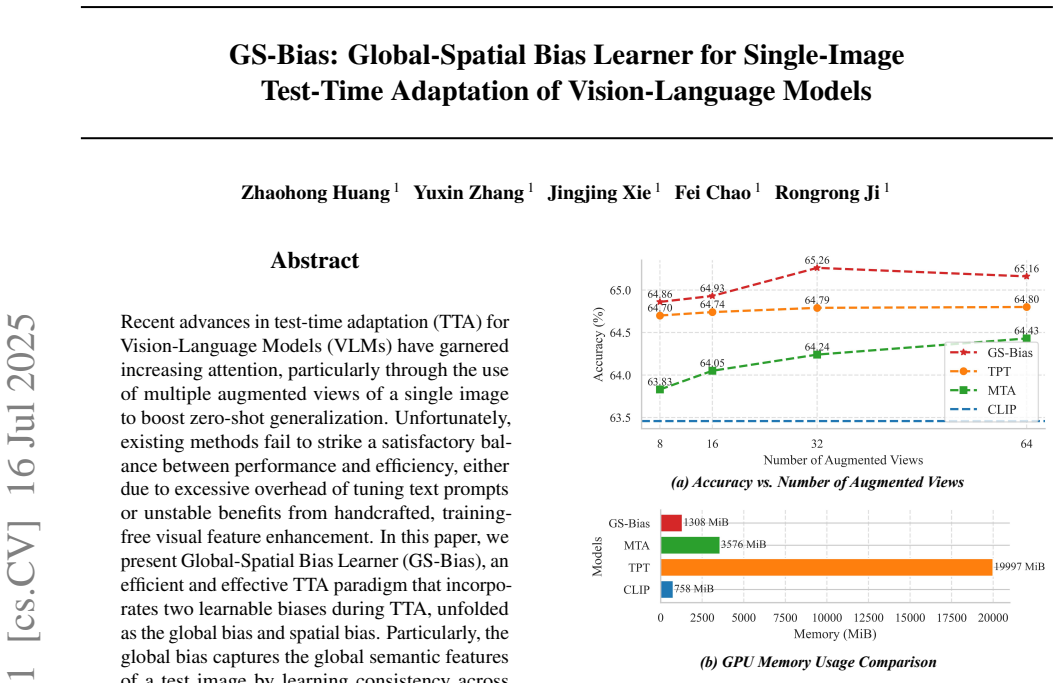
Pith's one-line read GS-Bias adapts CLIP at test time by adding two learnable bias vectors to the output logits, minimizing prediction entropy across augmented views and class-relevant regions, and beats prompt tuning on 15 benchmarks at 6.5% of its memory.
desk verdict A useful logit-level TTA idea with real efficiency gains, but the headline accuracy margins rest on an ensemble apples-to-oranges comparison and hyperparameters tuned on the test benchmarks. read the letter →
The pith
A machine-rendered reading of the paper's core claim, the machinery that carries it, and where it could break.
The reading
What carries the argument
The load-bearing object is a pair of learnable bias vectors, $B_g \in \mathbb{R}^{1\times C}$ and $B_s \in \mathbb{R}^{1\times C}$, added at the logits stage to the frozen CLIP output distribution (Eq. 15). $B_g$ is fit by entropy minimization over confidence-filtered augmented views of the test image (Eqs. 6-7), encoding whole-image semantic consistency; $B_s$ is fit by entropy minimization over the average scores of the top-$K$ spatial regions selected by a category-aware relevance map $M = \frac{1}{C}\sum_c \mathrm{Softmax}(F_s (F_t^c)^T)$ (Eqs. 10-14), encoding regional semantic coherence. Because the only parameters touched by backpropagation are these two vectors, the mechanism's cost is a few matrix-vector operations at the output layer rather than a full forward-backward pass through the vision-language model, which is what yields the reported ten-fold speedup and 6.5% memory footprint relative to prompt tuning.
What would settle it
A direct test is to take a dataset where the object occupies an atypical share of the image (very small foreground or a large object nearly filling the frame) and compare GS-Bias against its global-bias-only variant: if the top-$K$ region selection falls mostly on background or splits the object, the spatial bias should inject a class offset that lowers accuracy below the global-only version. The paper's own Table 7 already shows the number of genuinely significant regions varies widely across datasets, about 12 for EuroSAT versus 19 for ImageNet, so the fixed $K=16$ setting is the natural place to look for the breakdown.
Extended reading notes
Core claim
GS-Bias's central claim is that when CLIP encounters a single test image, its per-image accuracy can be improved by two learnable, zero-initialized bias vectors added at the prediction level, $p_{\text{GS-Bias}}(y|x) = p_{\text{CLIP}}(y|x) + B_g + B_s$ (Eq. 15). The global bias $B_g$ is shared across augmented views of the image and updated by minimizing the entropy of the confidence-filtered average of the view logits (Eqs. 6-7); the spatial bias $B_s$ is shared across the top-$K$ spatial regions most relevant to the target classes, selected by the category-aware map $M = \frac{1}{C}\sum_c \mathrm{Softmax}(F_s (F_t^c)^T)$, and updated by minimizing the entropy of their average class scores (Eqs. 10-14). Both biases are optimized with a handful of lightweight steps, and the final prediction adds them to the untouched CLIP logits, so the pretrained model itself is never modified. The paper reports this recipe reaches 67.03% average accuracy on ten cross-dataset benchmarks (vs. 64.80% for TPT) and 63.01% OOD average on four ImageNet variants (vs. 60.29% for TPT), while using about 6.5% of TPT's memory on ImageNet.
Load-bearing premise
GS-Bias depends on the assumption that the top-$K$ spatial regions flagged as most relevant to the class labels actually carry the class-discriminative information, so that making their average prediction more confident also improves the whole-image prediction; in the paper, $K=16$ is justified after the fact by counting 'significant' regions on the same datasets being evaluated.
Editorial extensions
If this is right
- With only the two bias vectors updated, adaptation on ImageNet runs at roughly 12 FPS with about 1.3 GB of memory, compared with about 1.4 FPS and 20 GB for TPT, making per-image adaptation practical in streaming settings.
- Because the pretrained logits are preserved and the biases start at zero, GS-Bias with ensemble prompts improves on the ensemble-prompt CLIP baseline on all ten cross-dataset datasets, a consistency none of the compared optimizers achieves.
- The ablation attributes the gains to both terms: the global bias alone lifts the cross-dataset average to 65.77, the spatial bias alone to 66.07, and both together to 67.03, so whole-image and region-level consistency capture different failure modes.
- The recipe transfers to other visual backbones: with ResNet50 features as the spatial representation, GS-Bias reports 45.93% OOD average on domain generalization, the best among the methods compared in that table.
Reading between the lines
- Because the bias vectors scale with the number of classes, an extension the paper leaves implicit is factorizing or sharing structure across $B_g$ and $B_s$ to keep the overhead flat on very large label sets such as ImageNet-21K.
- The mechanism is not obviously CLIP-specific: any frozen softmax classifier exposes the same output layer, so the global-plus-spatial bias recipe could be tested on other multimodal encoders or unimodal classifiers with patch-like features.
- A testable follow-up would recompute the category-aware region map after the global bias has been updated, letting region selection and bias learning co-adapt within one image instead of fixing the selected regions once.
Editorial analysis
A structured set of objections, weighed in public.
Referee Report
Summary. The paper proposes GS-Bias, a test-time adaptation method for vision-language models that learns two additive bias vectors: a global bias shared across augmented views and a spatial bias derived from top-K regions in the vision encoder's spatial feature map. Both biases are optimized by entropy minimization at the model output, intentionally avoiding backpropagation through the VLM. The paper reports state-of-the-art results across 10 cross-dataset benchmarks and 4 ImageNet variants, with substantially lower memory usage than TPT, and releases the code.
Significance. If the accuracy claims hold, GS-Bias offers an attractive efficiency/accuracy trade-off for TTA, and the output-level optimization is a conceptually clean alternative to full prompt tuning. The released code and the efficiency analysis are concrete strengths. However, the reported margins over TPT are partly due to prompt ensembling applied only to GS-Bias and to hyperparameters selected on the evaluation benchmarks; the unensembled gains are small. These issues currently weaken the central state-of-the-art claim, although the method's core idea appears sound and the concerns are addressable in revision.
major comments (4)
- [Section 3.2, Eqs. (6), (8), (12), (15)] The text repeatedly states that biases are added to logits, but pCLIP in Eq. (1) and p(y_c | F^i_s) in Eq. (9) are softmax probabilities. Adding Bg or Bs to these probability vectors yields distributions that do not sum to one, and the entropy objectives in Eqs. (3) and (13) are then not defined over a valid probability distribution. Please clarify whether the biases are applied before or after the softmax, revise the equations and terminology accordingly, and explain how the optimization remains well-posed in the actual implementation.
- [Section 4.2, Tables 1 and 2, abstract] The headline improvements over TPT (2.23% cross-dataset, 2.72% OOD) compare GS-Bias + E. with a TPT baseline that does not use prompt ensembling. The unensembled GS-Bias achieves only 64.86 vs 64.80 in Table 1 and 60.69 vs 60.29 in Table 2, which is a much smaller difference and within the range of possible random variation. To support the SOTA claim, the primary comparison should be ensemble-matched (for example, unensembled vs unensembled, or both with the same ensemble), and the remaining margin should be demonstrated to be robust.
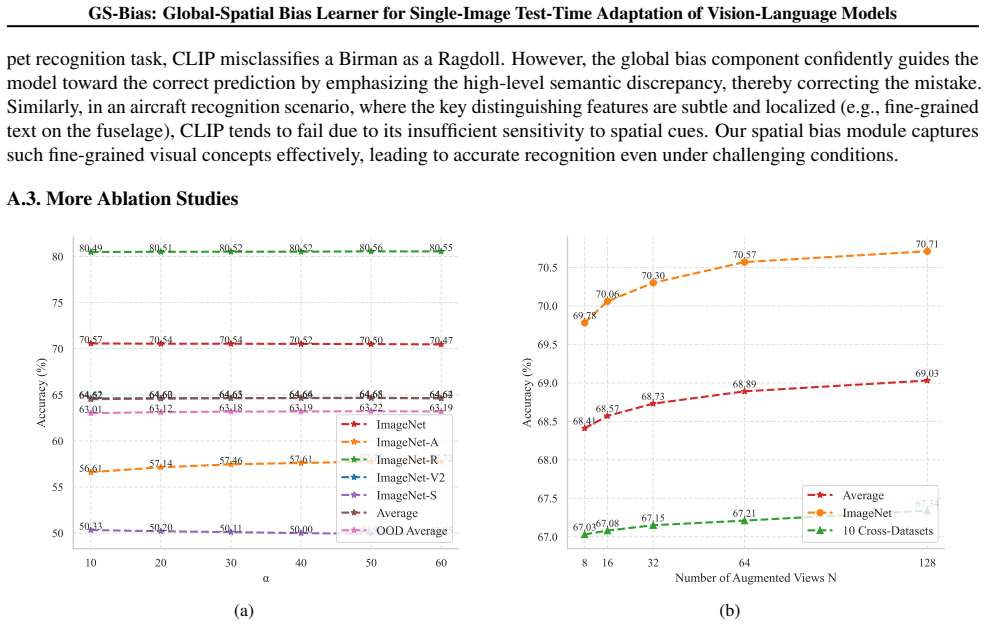
- [Section 4.3, Appendix A.3, Appendix A.4] Hyperparameters K, alpha, beta, and the number of TTA steps are selected by ablations on the same 11 datasets used for evaluation (Fig. 3, Table 5, Fig. 4, Fig. 6, Table 7). Tuning on the test benchmarks can inflate reported accuracy. The authors should adopt a held-out validation procedure, for example tuning on a subset of ImageNet or on a separate dataset, and then fixing the hyperparameters for the reported results. The Limitation statement in A.4 acknowledges reliance on empirical hyperparameters, but the main experimental claims still rest on these test-set-tuned choices.
- [Section 4.2, Tables 1 and 2] No error bars, standard deviations, or multiple seeds are reported. Given that the unensembled cross-dataset margin over TPT is only 0.06 percentage points (64.86 vs 64.80), single-run results are insufficient to establish the improvement. Report mean and standard deviation over at least three runs, or provide a significance test, especially for the average accuracies.
minor comments (6)
- [Abstract and Section 3.2] The phrase "logits outputed" should be "logits output"; please also check the spelling and grammar throughout the manuscript.
- [Section 3.2, third paragraph] "As illustrated in Fig. 1 (c)" should reference Fig. 2 (c), which contains the GS-Bias diagram.
- [Section 3.2, after Eq. (6)] The text "as per Eq. 2" appears to be a wrong cross-reference; the self-entropy is defined in Eq. (3). Please correct the reference.
- [Eq. (11)] The notation "Top-K(M^i)" should be specified precisely, e.g., as the indices of the K largest entries of the vector M.
- [Section 3.2, Eq. (6) description] The phrase "filters high-uncertainty logits smaller than θ" is confusing; it should say that views with entropy above θ are filtered out, matching the indicator function in Eq. (2).
- [Appendix A.3, Table 7] The notation \tilde{K}_a and the normalization used for the significance threshold (0.1) should be defined more clearly in the text accompanying the table.
Circularity Check
The core empirical SOTA claim is partially circular: the key hyperparameters (K, α, β) are selected on the very 11 evaluation benchmarks whose SOTA numbers are reported, so the headline gains are in-sample optima rather than independent predictions.
-
fitted input called prediction
[Section 4.3 'The effects of K' and Table 7; Section 4.1 Implementation details]
"Notably, this setting also yields the best performance in Figure 3, making it a reasonable and well-justified choice in our experiments. ... For the learning of GS-Bias, the number of important spatial regions K in Eq.12 is fixed at 16."
The spatial-region count K is chosen by maximizing accuracy on the same 11 datasets used for evaluation (Figure 3), then justified post hoc by counting 'significant regions' on those same datasets (Table 7, average ≈16.43). The paper fixes K=16 and reports SOTA accuracy on those same benchmarks. The reported gain is therefore an in-sample optimum: the justification cites the very performance it was tuned to produce, so the 'prediction' is statistically forced by construction.
-
fitted input called prediction
[Section 4.3 'The effects of α and β' and Table 5; Section 4.1 Implementation details]
"To determine the effective configuration, we fixed one learning rate (i.e., α = 1 or β = 1) and observed how performance varied with changes in the other. ... The learning rates for the biases in Eq. 7 and Eq. 14 are set to α = 1 and β = 1 for cross-domain generalization, whereas for domain generalization, α = 10 and β = 1."
The learning rates α and β are selected by ablating on ImageNet plus the 10 cross-dataset benchmarks (Table 5) and on the domain-generalization datasets (Figure 6), which are exactly the benchmarks used for the final reported numbers. The chosen configuration is the one that maximizes those test accuracies. Presenting the resulting accuracies as generalizable SOTA results, without a held-out validation split, makes the headline improvement a fitted quantity rather than an independent prediction.
full rationale
The methodological core of GS-Bias — adding logit-level global and spatial biases and optimizing them by entropy minimization — is self-contained and does not reduce equation-by-equation to its inputs; there is no definitional circularity in Eqs. 6–15. However, the central claim of the paper is empirical state-of-the-art accuracy, and that claim is partially circular because the decisive hyperparameters are tuned on the evaluation benchmarks themselves. K is both selected by Figure 3 accuracy on the 11 test datasets and justified by Table 7's measurement of 'significant regions' on those same datasets; α and β are chosen from Table 5 and Figure 6 ablations on the same benchmarks. The appendix's own limitation statement acknowledges 'reliance on empirically selected hyperparameters.' In addition, the headline gains are reported for 'GS-Bias + E.' against non-ensembled TPT/DiffTPT baselines, an evaluation confound that further weakens the advertised margins, though that is a fairness issue rather than a circularity per se. Because the reported SOTA numbers are in-sample optima over the tested hyperparameters, a validation-locked, ensemble-matched replication is required before the central accuracy claim can be considered independently established. No self-citation chain or imported uniqueness theorem is involved, so the circularity is not of the self-citation kind; it is a fitted-input issue, and a score of 6 reflects that the claimed predictions are partially forced by construction.
Assumptions & free parameters
free parameters (6)
- alpha (global bias learning rate) =
1 (cross-dataset), 10 (domain generalization)
- beta (spatial bias learning rate) =
1
- K (number of selected spatial regions) =
16
- rho (views selection rate) =
0.5 (cross-dataset), 0.3 (domain generalization)
- BS (number of augmented views) =
8 (cross-dataset), 64 (domain generalization)
- TTA steps =
5
assumptions (4)
- domain assumption Entropy minimization over augmented views is a valid proxy for improving image classification accuracy at test time.
- domain assumption The top-K spatial regions selected by softmax(F_s F_t^T) contain the class-discriminative content.
- ad hoc to paper Adding a bias vector to softmax probabilities or logits without renormalization preserves argmax accuracy.
- domain assumption Random-crop augmentation provides sufficient view diversity for single-image TTA.
Cite this review
Pith. "Pith review of GS-Bias: Global-Spatial Bias Learner for Single-Image Test-Time Adaptation of Vision-Language Models." pith.science (2026). https://pith.science/paper/IEK3GQGO
@misc{pith2026250711969,
  author       = {Pith},
  title        = {Pith review of: GS-Bias: Global-Spatial Bias Learner for Single-Image Test-Time Adaptation of Vision-Language Models},
  year         = {2026},
  howpublished = {\url{https://pith.science/paper/IEK3GQGO}},
  note         = {Machine review of arXiv:2507.11969}
}
read the original abstract
Recent advances in test-time adaptation (TTA) for Vision-Language Models (VLMs) have garnered increasing attention, particularly through the use of multiple augmented views of a single image to boost zero-shot generalization. Unfortunately, existing methods fail to strike a satisfactory balance between performance and efficiency, either due to excessive overhead of tuning text prompts or unstable benefits from handcrafted, training-free visual feature enhancement. In this paper, we present Global-Spatial Bias Learner (GS-Bias), an efficient and effective TTA paradigm that incorporates two learnable biases during TTA, unfolded as the global bias and spatial bias. Particularly, the global bias captures the global semantic features of a test image by learning consistency across augmented views, while spatial bias learns the semantic coherence between regions in the image's spatial visual representation. It is worth highlighting that these two sets of biases are directly added to the logits outputed by the pretrained VLMs, which circumvent the full backpropagation through VLM that hinders the efficiency of existing TTA methods. This endows GS-Bias with extremely high efficiency while achieving state-of-the-art performance on 15 benchmark datasets. For example, it achieves a 2.23% improvement over TPT in cross-dataset generalization and a 2.72% improvement in domain generalization, while requiring only 6.5% of TPT's memory usage on ImageNet.
Figures


Figures from the paper (2 more)

Forward citations
Cited by 1 Pith paper
-
MuRA: Multi-Rank Adaptation for Efficient and Effective Test-Time Vision-Language Generalization
MuRA improves label-free test-time adaptation of CLIP by routing each image's tokens to a weighted mix of rank-2 through rank-32 LoRA experts at the deepest visual layer.
Reference graph
Works this paper leans on
-
[1]
Flamingo: a visual language model for few-shot learning
Alayrac, J.-B., Donahue, J., Luc, P., Miech, A., Barr, I., Hasson, Y., Lenc, K., Mensch, A., Millican, K., Reynolds, M., et al. Flamingo: a visual language model for few-shot learning. NeurIPS, 2022
work page 2022
-
[2]
Food-101--mining discriminative components with random forests
Bossard, L., Guillaumin, M., and Van Gool, L. Food-101--mining discriminative components with random forests. In ECCV, 2014
work page 2014
-
[3]
Plot: Prompt learning with optimal transport for vision-language models
Chen, G., Yao, W., Song, X., Li, X., Rao, Y., and Zhang, K. Plot: Prompt learning with optimal transport for vision-language models. In ICLR, 2023
work page 2023
-
[4]
A simple framework for contrastive learning of visual representations
Chen, T., Kornblith, S., Norouzi, M., and Hinton, G. A simple framework for contrastive learning of visual representations. In Int. Conf. Mach. Intell., 2020
work page 2020
-
[5]
Chen, Z., Pan, Y., Ye, Y., Lu, M., and Xia, Y. Each test image deserves a specific prompt: Continual test-time adaptation for 2d medical image segmentation. In CVPR, 2024
work page 2024
-
[6]
Describing textures in the wild
Cimpoi, M., Maji, S., Kokkinos, I., Mohamed, S., and Vedaldi, A. Describing textures in the wild. In CVPR, 2014
work page 2014
-
[7]
Comaniciu, D. and Meer, P. Mean shift analysis and applications. In ICCV, 1999
work page 1999
-
[8]
Imagenet: A large-scale hierarchical image database
Deng, J., Dong, W., Socher, R., Li, L.-J., Li, K., and Fei-Fei, L. Imagenet: A large-scale hierarchical image database. In CVPR, 2009
2009
Show all 46 references
-
[9]
An image is worth 16x16 words: Transformers for image recognition at scale
Dosovitskiy, A. An image is worth 16x16 words: Transformers for image recognition at scale. arXiv preprint arXiv:2010.11929, 2020
2010 arXiv
-
[10]
Learning generative visual models from few training examples: An incremental bayesian approach tested on 101 object categories
Fei-Fei, L., Fergus, R., and Perona, P. Learning generative visual models from few training examples: An incremental bayesian approach tested on 101 object categories. In CVPR, 2004
2004
-
[11]
Diverse data augmentation with diffusions for effective test-time prompt tuning
Feng, C.-M., Yu, K., Liu, Y., Khan, S., and Zuo, W. Diverse data augmentation with diffusions for effective test-time prompt tuning. In ICCV, 2023
2023
-
[12]
Nemesis: Normalizing the soft-prompt vectors of vision-language models
Fu, S., Wang, X., Huang, Q., and Zhang, Y. Nemesis: Normalizing the soft-prompt vectors of vision-language models. In ICLR, 2024
2024
-
[13]
Clip-adapter: Better vision-language models with feature adapters
Gao, P., Geng, S., Zhang, R., Ma, T., Fang, R., Zhang, Y., Li, H., and Qiao, Y. Clip-adapter: Better vision-language models with feature adapters. IJCV, 2024
2024
-
[14]
Deep residual learning for image recognition
He, K., Zhang, X., Ren, S., and Sun, J. Deep residual learning for image recognition. In CVPR, 2016
2016
-
[15]
Eurosat: A novel dataset and deep learning benchmark for land use and land cover classification
Helber, P., Bischke, B., Dengel, A., and Borth, D. Eurosat: A novel dataset and deep learning benchmark for land use and land cover classification. IEEE Journal of Selected Topics in Applied Earth Observations and Remote Sensing, 2019
2019
-
[16]
The many faces of robustness: A critical analysis of out-of-distribution generalization
Hendrycks, D., Basart, S., Mu, N., Kadavath, S., Wang, F., Dorundo, E., Desai, R., Zhu, T., Parajuli, S., Guo, M., et al. The many faces of robustness: A critical analysis of out-of-distribution generalization. In ICCV, 2021 a
2021
-
[17]
Natural adversarial examples
Hendrycks, D., Zhao, K., Basart, S., Steinhardt, J., and Song, D. Natural adversarial examples. In CVPR, 2021 b
2021
-
[18]
Scaling up visual and vision-language representation learning with noisy text supervision
Jia, C., Yang, Y., Xia, Y., Chen, Y.-T., Parekh, Z., Pham, H., Le, Q., Sung, Y.-H., Li, Z., and Duerig, T. Scaling up visual and vision-language representation learning with noisy text supervision. In Int. Conf. Mach. Intell., 2021
2021
-
[19]
Efficient test-time adaptation of vision-language models
Karmanov, A., Guan, D., Lu, S., El Saddik, A., and Xing, E. Efficient test-time adaptation of vision-language models. In CVPR, 2024
2024
-
[20]
3d object representations for fine-grained categorization
Krause, J., Stark, M., Deng, J., and Fei-Fei, L. 3d object representations for fine-grained categorization. In Proceedings of the IEEE international conference on computer vision workshops, 2013
2013
-
[21]
Gallop: Learning global and local prompts for vision-language models
Lafon, M., Ramzi, E., Rambour, C., Audebert, N., and Thome, N. Gallop: Learning global and local prompts for vision-language models. ECCV, 2024
2024
-
[22]
Monotta: Fully test-time adaptation for monocular 3d object detection
Lin, H., Zhang, Y., Niu, S., Cui, S., and Li, Z. Monotta: Fully test-time adaptation for monocular 3d object detection. In ECCV, 2025
2025
-
[23]
Dart: Dual-modal adaptive online prompting and knowledge retention for test-time adaptation
Liu, Z., Sun, H., Peng, Y., and Zhou, J. Dart: Dual-modal adaptive online prompting and knowledge retention for test-time adaptation. In AAAI, 2024
2024
-
[24]
Fine-grained visual classification of aircraft
Maji, S., Rahtu, E., Kannala, J., Blaschko, M., and Vedaldi, A. Fine-grained visual classification of aircraft. arXiv preprint arXiv:1306.5151, 2013
2013 arXiv
-
[25]
Locoop: Few-shot out-of-distribution detection via prompt learning
Miyai, A., Yu, Q., Irie, G., and Aizawa, K. Locoop: Few-shot out-of-distribution detection via prompt learning. NeurIPS, 2024
2024
-
[26]
and Zisserman, A
Nilsback, M.-E. and Zisserman, A. Automated flower classification over a large number of classes. In 2008 Sixth Indian conference on computer vision, graphics & image processing, 2008
2008
-
[27]
M., Vedaldi, A., Zisserman, A., and Jawahar, C
Parkhi, O. M., Vedaldi, A., Zisserman, A., and Jawahar, C. Cats and dogs. In CVPR, 2012
2012
-
[28]
W., Hallacy, C., Ramesh, A., Goh, G., Agarwal, S., Sastry, G., Askell, A., Mishkin, P., Clark, J., et al
Radford, A., Kim, J. W., Hallacy, C., Ramesh, A., Goh, G., Agarwal, S., Sastry, G., Askell, A., Mishkin, P., Clark, J., et al. Learning transferable visual models from natural language supervision. In Int. Conf. Mach. Intell., 2021 a
2021
-
[29]
W., Hallacy, C., Ramesh, A., Goh, G., Agarwal, S., Sastry, G., Askell, A., Mishkin, P., Clark, J., et al
Radford, A., Kim, J. W., Hallacy, C., Ramesh, A., Goh, G., Agarwal, S., Sastry, G., Askell, A., Mishkin, P., Clark, J., et al. Learning transferable visual models from natural language supervision. In Int. Conf. Mach. Intell., 2021 b
2021
-
[30]
Do imagenet classifiers generalize to imagenet? In Int
Recht, B., Roelofs, R., Schmidt, L., and Shankar, V. Do imagenet classifiers generalize to imagenet? In Int. Conf. Mach. Intell., 2019
2019
-
[31]
Test-time prompt tuning for zero-shot generalization in vision-language models
Shu, M., Nie, W., Huang, D.-A., Yu, Z., Goldstein, T., Anandkumar, A., and Xiao, C. Test-time prompt tuning for zero-shot generalization in vision-language models. NeurIPS, 2022
2022
-
[32]
Ucf101: A dataset of 101 human actions classes from videos in the wild
Soomro, K. Ucf101: A dataset of 101 human actions classes from videos in the wild. arXiv preprint arXiv:1212.0402, 2012
2012 arXiv
-
[33]
Test-time training with self-supervision for generalization under distribution shifts
Sun, Y., Wang, X., Liu, Z., Miller, J., Efros, A., and Hardt, M. Test-time training with self-supervision for generalization under distribution shifts. In Int. Conf. Mach. Intell., 2020
2020
-
[34]
Sus-x: Training-free name-only transfer of vision-language models
Udandarao, V., Gupta, A., and Albanie, S. Sus-x: Training-free name-only transfer of vision-language models. In ICCV, 2023
2023
-
[35]
Attention is all you need
Vaswani, A. Attention is all you need. NeurIPS, 2017
2017
-
[36]
Tent: Fully test-time adaptation by entropy minimization
Wang, D., Shelhamer, E., Liu, S., Olshausen, B., and Darrell, T. Tent: Fully test-time adaptation by entropy minimization. In Int. Conf. Mach. Intell., 2021
2021
-
[37]
Wang, H., Ge, S., Lipton, Z., and Xing, E. P. Learning robust global representations by penalizing local predictive power. NeurIPS, 2019
2019
-
[38]
S., Yoon, E., Tee, J
Yoon, H. S., Yoon, E., Tee, J. T. J., Hasegawa-Johnson, M. A., Li, Y., and Yoo, C. D. C- TPT : Calibrated test-time prompt tuning for vision-language models via text feature dispersion. In ICLR, 2024
2024
-
[39]
and Ben Ayed, I
Zanella, M. and Ben Ayed, I. On the test-time zero-shot generalization of vision-language models: Do we really need prompt learning? In CVPR, 2024
2024
-
[40]
Dual prototype evolving for test-time generalization of vision-language models
Zhang, C., Stepputtis, S., Sycara, K., and Xie, Y. Dual prototype evolving for test-time generalization of vision-language models. NeurIPS, 2024 a
2024
-
[41]
Historical test-time prompt tuning for vision foundation models
Zhang, J., Huang, J., Zhang, X., Shao, L., and Lu, S. Historical test-time prompt tuning for vision foundation models. NeurIPS, 2024 b
2024
-
[42]
Memo: Test time robustness via adaptation and augmentation
Zhang, M., Levine, S., and Finn, C. Memo: Test time robustness via adaptation and augmentation. NeurIPS, 2022 a
2022
-
[43]
Tip-adapter: Training-free adaption of clip for few-shot classification
Zhang, R., Zhang, W., Fang, R., Gao, P., Li, K., Dai, J., Qiao, Y., and Li, H. Tip-adapter: Training-free adaption of clip for few-shot classification. In ECCV, 2022 b
2022
-
[44]
C., and Liu, Z
Zhou, K., Yang, J., Loy, C. C., and Liu, Z. Conditional prompt learning for vision-language models. In CVPR, 2022 a
2022
-
[45]
C., and Liu, Z
Zhou, K., Yang, J., Loy, C. C., and Liu, Z. Learning to prompt for vision-language models. IJCV, 2022 b
2022
-
[46]
write newline
" write newline "" before.all 'output.state := FUNCTION n.dashify 't := "" t empty not t #1 #1 substring "-" = t #1 #2 substring "--" = not "--" * t #2 global.max substring 't := t #1 #1 substring "-" = "-" * t #2 global.max substring 't := while if t #1 #1 substring * t #2 gl...
Reviewed August 6, 2026 · model on record in the stance chip above.
Discussion (0). Sign in to comment.