REVIEW 4 major objections 4 minor 55 references
Thermodynamics of FLRW universe in Quadratic Gravity
T0 review · 4 major / 4 minor · reviewed 2026-08-06 · deepseek-v4-flash
Pith's one-line read In D-dimensional FLRW quadratic gravity, the apparent horizon acquires a thermodynamic equation of state whose critical points are fixed by one quadratic-coupling parameter, sigma, altering the stability of the early universe compared…
desk verdict Central Eq. (27) is algebraically inconsistent with the paper's own criticality conditions, so the phase-transition analysis collapses; the D-dimensional framework is otherwise competent. read the letter →
The pith
A machine-rendered reading of the paper's core claim, the machinery that carries it, and where it could break.
The reading
What carries the argument
The load-bearing object is the generalized Misner-Sharp energy $E_{\mathrm{eff}}$, defined by integrating the unified first law $dE = A\Psi_a dx^a + W\,dV$ after imposing the integrability condition $\partial_r A(t,r) = \partial_t B(t,r)$. The apparent-horizon radius $R_A = 1/\sqrt{H^2 + k/a^2}$ sets the geometric scale, the Hawking temperature $T = |\kappa_g|/(2\pi)$ comes from the surface gravity, and the thermodynamic pressure is identified with the work density $W = (\rho - p)/2$. All quadratic corrections are packed into the single parameter $\sigma$, which controls the critical radius, the critical temperature, and the signs of the entropy, specific heat, enthalpy, and Gibbs free energy. Criticality is imposed through the standard conditions $(\partial P/\partial R_A)_T = 0$ and $(\partial^2 P/\partial R_A^2)_T = 0$, which produce the closed-form critical point.
What would settle it
Compute $\partial_r A(t,r) - \partial_t B(t,r)$ explicitly using the energy-momentum components in Eq. (5); if this quantity is nonzero for generic $D$, $\alpha$, $\beta$, $\gamma$, and $a(t)$, then the unified first law is not integrable and the effective Misner-Sharp energy, the thermodynamic pressure, and the critical points (26)-(27) are not defined for those backgrounds.
Extended reading notes
Core claim
The central claim is that the thermodynamics of the apparent horizon in D-dimensional FLRW quadratic gravity is fully described by the effective Misner-Sharp energy obtained from the unified first law, and that the resulting equation of state $P(R_A,T)$ has critical points at the radius $R_c^{(\pm)}$ given by Eq. (27) and critical temperature $T_c$ given by Eq. (26). The quadratic couplings $\alpha$, $\beta$, $\gamma$ appear in every thermodynamic quantity only through $\sigma = (D-4)(D-2)[(D-2)(D-1)\alpha + (D-3)D\gamma]$, which acts as a pseudo-charge. The paper shows that $\sigma$ controls whether the critical radius is real and positive: for $\sigma < 0$ the branch $R_c^{(-)}$ is physical for $D>4$, for $\sigma > 0$ the branch $R_c^{(+)}$ is physical for $D>4$, and for $\sigma = 0$ or $D = 4$ the critical radius collapses to zero, matching general relativity with phase transitions only at $R_A = 0$. On this basis the paper concludes that the quadratic terms change the stability conditions of the cosmic horizon, allowing new phases that are absent in Einstein gravity.
Load-bearing premise
The whole thermodynamic construction assumes that the differential form $A(t,r)\,dt + B(t,r)\,dr$ is integrable, so the effective Misner-Sharp energy exists; the paper states this as an assumption after Eq. (10) and never verifies $\partial_r A = \partial_t B$ for the quadratic-gravity stress tensor it derives.
Editorial extensions
If this is right
- If $\sigma < 0$ and $D > 4$, the apparent horizon has a finite critical radius $R_c^{(-)}$, so a genuine phase transition can occur in the early universe where general relativity predicts none.
- For $\sigma > 0$ and $D > 4$, the physical critical branch is $R_c^{(+)}$, while for $\sigma = 0$ or $D = 4$ the critical radius shrinks to zero, limiting phase transitions to the very beginning of the universe.
- The signs of the Gibbs free energy and specific heat depend on the signs of $\alpha$ and $\gamma$, so the early universe may be thermodynamically unstable and then become stable as the horizon grows.
- Because $\sigma$ multiplies a factor $R_A^{D-4}$ in the entropy and enthalpy, higher dimensions amplify the deviation from general relativity, making quadratic effects easier to detect in $D > 4$ cosmological models.
Reading between the lines
- If the integrability condition $\partial_r A = \partial_t B$ fails for generic FLRW backgrounds, the formalism would be restricted to a special subclass of spacetimes, and the critical-point calculation would need to start from a different quasi-local energy definition.
- Treating $\sigma$ as an independent thermodynamic variable would extend the system into an extended phase space with a $\sigma$-conjugate work term, in analogy with black-hole chemistry, potentially revealing additional phase structure beyond the critical points reported here.
- Connecting the critical temperature $T_c$ to a specific cosmological epoch would require an explicit solution for $a(t)$; a natural next step is to see whether the predicted phase transition leaves imprints in the primordial spectrum or in the horizon-scale observables of early-universe cosmology.
Editorial analysis
A structured set of objections, weighed in public.
Referee Report
Summary. The paper studies the thermodynamics of the apparent horizon in a D-dimensional FLRW universe in quadratic gravity. It derives field equations from an action with R^2, R_{\mu\nu}^2, and Gauss-Bonnet-type couplings, constructs a generalized Misner-Sharp energy, and then uses the unified first law to obtain a thermodynamic pressure P(R_A,T). The central claim is that the criticality conditions \partial P/\partial R_A=0 and \partial^2 P/\partial R_A^2=0 yield a critical temperature (26) and critical radii (27), from which the paper derives Wald entropy, enthalpy, specific heat, and Gibbs free energy, and concludes that quadratic couplings change thermodynamic stability relative to general relativity. The manuscript is clearly organized and explicitly checks several GR limits, but the main critical-point calculation is internally inconsistent with the paper's own equation of state.
Significance. If the claimed critical points were correct, the paper would provide a concrete, falsifiable prediction for phase transitions in a higher-dimensional FLRW setting, and the coupling combination \sigma would be a useful thermodynamic pseudo-charge. The authors also correctly stress the dimensional reduction to GR when D=4 or \sigma=0, and they do not tune free constants to force conclusions. However, the central algebraic derivation is not sound: the critical radii Eq. (27) do not solve the manuscript's own criticality conditions when applied to Eq. (23), and the integrability condition on which the whole Misner-Sharp construction rests is assumed rather than verified. In its present form the paper does not establish the phase structure that forms its main conclusion.
major comments (4)
- [Sec. 4, Eqs. (23)-(27)] Solving the criticality conditions (24) and (25) with the equation of state (23) does not lead to the critical radius (27). Writing y=R_A^2 and A=D(D-2), the first condition gives Eq. (26), and substituting it into \partial^2 P/\partial R_A^2=0 yields A^2(D-3)y^2 - 12A\kappa\sigma y + 12(\kappa\sigma)^2(D-5)=0. This quadratic has roots y=0 and y=2\kappa\sigma/5 at D=5 and a double root y=\kappa\sigma/12 at D=6, whereas Eq. (27) gives y=0 or y=-14\kappa\sigma/5 at D=5 and y\approx \kappa\sigma/225 at D=6. The two sets of roots do not agree, so the claimed critical radii R_c^{(\pm)}, the bifurcation structure, and the subsequent stability analysis in Sections 4 and 5 are not supported by the manuscript's own equations.
- [Sec. 3, Eq. (10)] The integrability condition (10) is stated as an assumption after Eq. (9) and is never checked for the A(t,r) and B(t,r) computed from Eq. (5). The generalized Misner-Sharp energy (11), the work density, the pressure P(R_A,T), and all thermodynamic quantities derived from them depend on this integration. Since the paper itself notes that the condition can fail in modified gravity, as in f(R) gravity cited in [38], an explicit verification is required; without it the thermodynamic construction is conditional whenever the background fields are not shown to satisfy Eq. (10).
- [Sec. 4, Eq. (21) and Sec. 2, Eq. (5)] The constraint used to eliminate higher time derivatives is inconsistent with the condition stated earlier. Section 2 states that the higher-derivative terms in Eq. (5) do not appear when 4(D-1)\alpha + D\beta = 0, whereas Eq. (21) imposes \beta = +4(D-1)\alpha/D, which gives 4(D-1)\alpha + D\beta = 8(D-1)\alpha. The sign is opposite. Since Eqs. (22) and (23), and therefore all subsequent thermodynamic results, are derived under Eq. (21), this discrepancy must be resolved; if the intended condition is \beta = -4(D-1)\alpha/D, then the expressions for \rho, p, and P in Section 4 need to be recomputed.
- [Sec. 5, Eqs. (32)-(34)] The formula (34) is presented as the Wald entropy but it is obtained by integrating V'(R_A)C(R_A), and no derivation is given showing that this integral equals the Wald entropy of the quadratic-gravity action. In addition, the displayed expression contains an explicit factor 2\sigma/(D-4), which is ambiguous at D=4, the dimension on which much of the discussion focuses. If the D-dependent prefactor in \sigma is retained, the ratio has a finite limit, but as written Eq. (34) is not well defined at D=4.
minor comments (4)
- [Sec. 1] In the last paragraph of the introduction, the sentence 'Finally, we to show discuss how these results...' contains a typographical error and should be corrected.
- [Sec. 3] The heading and the opening sentence use 'Meisner-Sharp energy' instead of 'Misner-Sharp energy'; this should be corrected throughout.
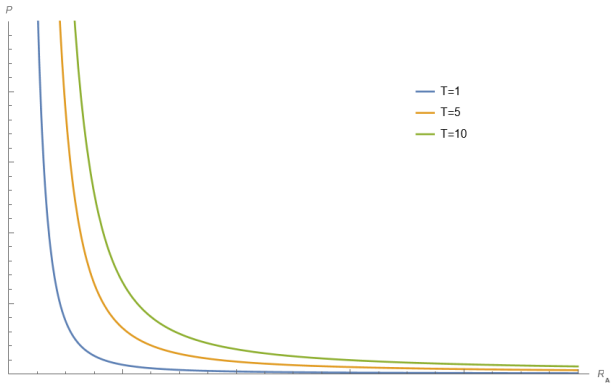
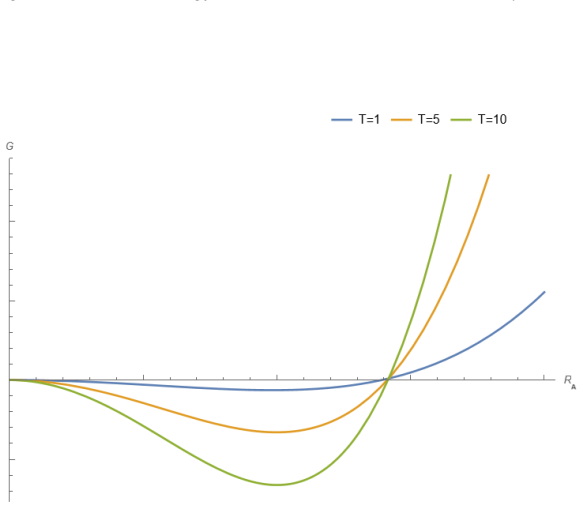
- [Figs. 1-6] The figures are discussed qualitatively in the text but no axis labels, units, or fixed parameter values are provided in the captions; the temperature values and the chosen D should also be stated so that the plots can be checked against Eq. (23).
- [Sec. 2, Eq. (4) and Sec. 4, Eq. (15)] The symbol \kappa is used both for the gravitational constant 8\pi G_D and for the surface gravity \kappa_g in Eq. (15); the double use is confusing and should be noted or the surface gravity relabelled.
Circularity Check
No load-bearing circularity: the EoS and critical-point program follow from the action through external published inputs; the only definitional element is the 'Wald entropy', constructed from the same equation of state it later interprets. The central critical-radius formula (27) fails the paper's own conditions (24)-(25), an internal consistency defect rather than circularity.
-
self definitional
[Section 5, Eqs. (31)-(34)]
"The Wald entropy can be obtained as follows S = Z V ′(RA)C(RA)dRA, (32) where V ′(RA) represents the derivative of the volume with respect to RA, and C(RA) is obtained from the equation of state as [52] C(RA) = 1 DκR3 A (4πκσ + 2D(D − 2)πR2 A). (33) By integrating (32), we have S = 4π (D+1)/2 DΓ[(D − 1)/2] RD−4 A ( DR2 A κ + 2σ D − 4 ). (34) The above relation shows that the entropy has a direct dependence on the parameter σ, which is due to the presence of quadratic terms in the gravitational action."
The quantity labeled 'Wald entropy' (34) is not computed from Wald's Noether-charge formula for action (1); it is defined by construction as the first-law integral (32) of the temperature coefficient C(RA) read off from the same equation of state (23) used in all later analysis. The specific heat (36), enthalpy (35), and Gibbs free energy (37) therefore add no information beyond the σ-dependence already in (23); the stability conclusions drawn from their signs restate the EoS in new variables. The 'Wald' label imports an independent status the quantity lacks. This is a definitional/labelling limitation rather than a fitted-parameter loop, and it does not feed back into Section 4's critical-point derivation, which uses only (23).
full rationale
The paper's derivation chain is essentially self-contained and, in the load-bearing sense, non-circular. The field equations (2)-(3) and the perfect-fluid form of the effective energy-momentum tensor for the FLRW metric are imported from the group's earlier published work [10,33]; these are external, statable results—the components (5) can be verified directly from (2)-(4)—so under the reviewing rules they count as independent support rather than circularity. The restriction (21) that removes higher derivatives is presented openly as a choice ('we can eliminate the contribution of the higher derivative of the scale factor by the following choice [10]'), so no ansatz is smuggled in by citation. Section 3's generalized Misner-Sharp energy (11)-(12) is obtained by integrating the unified first law under an integrability condition (10) that the paper states ('assuming that integrability condition holds') but never verifies; that is an unresolved assumption to be weighed in the correctness pass, not a circular step. Section 4's equation of state (23) follows algebraically from (5) with (21) and the identifications (14)-(20), and the critical temperature (26) does follow from the first criticality condition (24). The claimed critical radius (27), however, does not solve the paper's own equations: substituting (26) into ∂²P/∂RA²=0 built from (23) gives [D(D−2)]²(D−3)y² − 12D(D−2)κσy + 12(κσ)²(D−5) = 0, which at D=5 has roots y=0 and y=2κσ/5, and at D=6 a double root y=κσ/12, whereas (27) gives y=0 or −14κσ/5 and y≈κσ/225 respectively. This is an internal algebraic inconsistency in the paper's central prediction—a correctness risk for the referee report—not circularity: (27) is neither fitted nor defined in terms of the phase-transition claim, it is simply not entailed by (24)-(25). A further unstated sign assumption converts the absolute value in (16) into T=(1−ṘA/2)/(2πRA) when (5) becomes (22). The one genuinely definitional element is in Section 5: the 'Wald entropy' (34) is constructed by Eq. (32) from the same EoS (23) that it later interprets, so the stability language ('quadratic terms change the stability conditions') partly restates the EoS's own σ-dependence under the unsupported 'Wald' label. No data are fitted and no constants are tuned, so nothing reduces to a fit. Overall circularity is therefore minor.
Assumptions & free parameters
free parameters (4)
- alpha (Ricci-scalar-squared coupling) =
not fitted; varied by hand, e.g. +1 or -1 in Figures 1-6
- gamma (Gauss-Bonnet-type coupling) =
not fitted; varied by hand, e.g. +1 or -1
- D (spacetime dimension) =
not fitted; chosen integer
- Lambda (cosmological constant) =
not fitted; input parameter
assumptions (6)
- domain assumption For quadratic gravity the unified first law holds in the form dE = A Psi dx + W dV (Eq. 7).
- ad hoc to paper The integrability condition (10) is satisfied by the computed A(t,r) and B(t,r).
- domain assumption Comparison of dE = -T dS + W dV with dU = T dS - P dV identifies U = -E and P = W (Eqs. 17-19).
- domain assumption The apparent-horizon temperature is given by the GR surface-gravity formula (Eqs. 14-16).
- ad hoc to paper Entropy can be obtained by integrating V'(R_A) C(R_A) (Eq. 32), and this equals Wald entropy.
- ad hoc to paper The constraint beta = -4(D-1) alpha / D is imposed to eliminate higher time derivatives.
invented entities (1)
-
sigma as a thermodynamic pseudo-charge
Cite this review
Pith. "Pith review of Thermodynamics of FLRW universe in Quadratic Gravity." pith.science (2026). https://pith.science/paper/Q2QIBZO3
@misc{pith2026250712055,
  author       = {Pith},
  title        = {Pith review of: Thermodynamics of FLRW universe in Quadratic Gravity},
  year         = {2026},
  howpublished = {\url{https://pith.science/paper/Q2QIBZO3}},
  note         = {Machine review of arXiv:2507.12055}
}
abstract
In this paper, we investigate the thermodynamic aspects of quadratic gravity in a $D$-dimensional Friedmann-Lemaitre-Robertson-Walker (FLRW) universe. First, we derive the field equations and the effective energy-momentum tensor for quadratic gravity. Then, using these equations, we obtain the generalized Misner-Sharp energy within the framework of this model. We consider the thermodynamic behavior of the apparent horizon and derive the equations of state related to the pressure, temperature, and radius of the apparent horizon. Using the thermodynamic pressure, we obtain the critical points corresponding to phase transitions. We determine the critical temperature and critical radius in terms of model parameters, including the quadratic coupling and the cosmological constant. We also examine key thermodynamic quantities, such as Wald entropy, specific heat at constant pressure, enthalpy, Gibbs free energy. By examining the behavior of these quantities, we can gain insight into the thermodynamic stability of the quadratic gravity model. In particular, we find that quadratic terms change the stability conditions and can lead to new thermodynamic behaviors compared to general relativity.
Figures


Figures from the paper (3 more)


Reference graph
Works this paper leans on
-
[38]
R. G. Cai and L. M. Cao, Phys. Rev. D 75 (2007), 064008 doi:10.1103/PhysRevD.75.064008 [arXiv:gr-qc/0611071 [gr-qc]]
arXiv 2007
-
[1]
T. Clifton, P. G. Ferreira, A. Padilla and C. Skordis, Phys. Rept. 513 (2012), 1-189 doi:10.1016/j.physrep.2012.01.001 [arXiv:1106.2476 [astro-ph.CO]]
arXiv 2012
- [2]
-
[3]
Y . S. Myung, Phys. Rev. D 105 (2022) no.12, 124015 doi:10.1103/PhysRevD.105.124015 [arXiv:2204.06750 [gr-qc]]
work page Pith review arXiv 2022
- [4]
-
[5]
T. P. Sotiriou and V . Faraoni, Rev. Mod. Phys. 82 (2010), 451-497 doi:10.1103/RevModPhys.82.451 [arXiv:0805.1726 [gr-qc]]
arXiv 2010
-
[6]
A. De Felice and S. Tsujikawa, Living Rev. Rel. 13 (2010), 3 doi:10.12942/lrr- 2010-3 [arXiv:1002.4928 [gr-qc]]
arXiv 2010
-
[7]
Quantum symmetry, the cosmological constant and Planck scale phenomenology
G. Amelino-Camelia, L. Smolin and A. Starodubtsev, Class. Quant. Grav. 21 (2004), 3095-3110 doi:10.1088/0264-9381/21/13/002 [arXiv:hep-th/0306134 [hep- th]]
work page Pith review arXiv 2004
Show all 55 references
-
[8]
A. K. Sanyal and B. Modak, Class. Quant. Grav. 19 (2002), 515-526 doi:10.1088/0264-9381/19/3/307 [arXiv:gr-qc/0107070 [gr-qc]]
2002 arXiv
-
[9]
Salvio, Phys
A. Salvio, Phys. Rev. D 99 (2019) no.10, 103507 doi:10.1103/PhysRevD.99.103507 [arXiv:1902.09557 [gr-qc]]
2019 arXiv
-
[10]
G ¨urses, Y
M. G ¨urses, Y . Heydarzade and C ¸ . S ¸ent¨urk, Phys. Rev. D110 (2024) no.2, 024073 doi:10.1103/PhysRevD.110.024073 [arXiv:2401.09784 [gr-qc]]
2024 arXiv
-
[11]
J. F. Donoghue and G. Menezes, Nuovo Cim. C 45 (2022) no.2, 26 doi:10.1393/ncc/i2022-22026-7 [arXiv:2112.01974 [hep-th]]
2022 arXiv
- [12]
-
[13]
Alonso-Serrano, L
A. Alonso-Serrano, L. J. Garay and M. Li ˇska, Phys. Rev. D 111 (2025) no.6, 064019 doi:10.1103/PhysRevD.111.064019 [arXiv:2409.06645 [gr-qc]]
2025
-
[14]
Cecotti and R
S. Cecotti and R. Kallosh, JHEP 05 (2014), 114 doi:10.1007/JHEP05(2014)114 [arXiv:1403.2932 [hep-th]]
2014 arXiv
-
[15]
Ashtekar and P
A. Ashtekar and P. Singh, Class. Quant. Grav. 28 (2011), 213001 doi:10.1088/0264-9381/28/21/213001 [arXiv:1108.0893 [gr-qc]]
2011 arXiv
-
[16]
Bojowald and A
M. Bojowald and A. Skirzewski, eConf C0602061 (2006), 03 doi:10.1142/S0219887807001941 [arXiv:hep-th/0606232 [hep-th]]
2006 arXiv
-
[17]
Date and S
G. Date and S. Sengupta, Class. Quant. Grav. 26 (2009), 105002 doi:10.1088/0264-9381/26/10/105002 [arXiv:0811.4023 [gr-qc]]. 17
2009 arXiv
-
[18]
H. Lu, A. Perkins, C. N. Pope and K. S. Stelle, Phys. Rev. Lett. 114 (2015) no.17, 171601 doi:10.1103/PhysRevLett.114.171601 [arXiv:1502.01028 [hep-th]]
2015 arXiv
-
[19]
E. N. Saridakis et al. [CANTATA], Springer, 2021, ISBN 978-3-030- 83714-3, 978-3-030-83717-4, 978-3-030-83715-0 doi:10.1007/978-3-030-83715-0 [arXiv:2105.12582 [gr-qc]]
2021 arXiv
-
[20]
Ayzenberg, K
D. Ayzenberg, K. Yagi and N. Yunes, Phys. Rev. D 89 (2014) no.4, 044023 doi:10.1103/PhysRevD.89.044023 [arXiv:1310.6392 [gr-qc]]
2014 arXiv
-
[21]
J. D. Barrow and S. Hervik, Phys. Rev. D 74 (2006), 124017 doi:10.1103/PhysRevD.74.124017 [arXiv:gr-qc/0610013 [gr-qc]]
2006 arXiv
-
[22]
J. D. Barrow and J. D. Middleton, Phys. Rev. D 75 (2007), 123515 doi:10.1103/PhysRevD.75.123515 [arXiv:gr-qc/0702098 [gr-qc]]
2007 arXiv
-
[23]
Chakraborty and D
S. Chakraborty and D. Gregoris, Eur. Phys. J. C 81 (2021) no.10, 944 doi:10.1140/epjc/s10052-021-09697-2 [arXiv:2103.07718 [gr-qc]]
2021 arXiv
-
[24]
Beltran Jimenez, L
J. Beltran Jimenez, L. Heisenberg and T. S. Koivisto, JCAP 04 (2016), 046 doi:10.1088/1475-7516/2016/04/046 [arXiv:1602.07287 [hep-th]]
2016 arXiv
-
[25]
Alvarez-Gaume, A
L. Alvarez-Gaume, A. Kehagias, C. Kounnas, D. L ¨ust and A. Riotto, Fortsch. Phys. 64 (2016) no.2-3, 176-189 doi:10.1002/prop.201500100 [arXiv:1505.07657 [hep-th]]
2016 arXiv
-
[26]
Sebastiani, Phys
L. Sebastiani, Phys. Dark Univ. 42 (2023), 101296 doi:10.1016/j.dark.2023.101296 [arXiv:2307.04509 [gr-qc]]
2023
-
[27]
Padmanabhan, Curr
T. Padmanabhan, Curr. Sci. 109 (2015), 2236-2242 doi:10.18520/v109/i12/2236- 2242 [arXiv:1512.06546 [gr-qc]]
2015 arXiv
-
[28]
Bamba, C
K. Bamba, C. Q. Geng and S. Tsujikawa, Int. J. Mod. Phys. D 20 (2011), 1363- 1371 doi:10.1142/S0218271811019542 [arXiv:1101.3628 [gr-qc]]
2011 arXiv
-
[29]
Sen, JHEP 09 (2005), 038 doi:10.1088/1126-6708/2005/09/038 [arXiv:hep- th/0506177 [hep-th]]
A. Sen, JHEP 09 (2005), 038 doi:10.1088/1126-6708/2005/09/038 [arXiv:hep- th/0506177 [hep-th]]
2005
-
[30]
Camps, JHEP 03 (2014), 070 doi:10.1007/JHEP03(2014)070 [arXiv:1310.6659 [hep-th]]
J. Camps, JHEP 03 (2014), 070 doi:10.1007/JHEP03(2014)070 [arXiv:1310.6659 [hep-th]]
2014 arXiv
-
[31]
Saavedra and F
J. Saavedra and F. Tello-Ortiz, Eur. Phys. J. Plus 139 (2024) no.7, 657 doi:10.1140/epjp/s13360-024-05467-7 [arXiv:2310.08781 [gr-qc]]
2024 arXiv
-
[32]
Bellucci, S
S. Bellucci, S. Ferrara, A. Shcherbakov and A. Yeranyan, JHEP 10 (2009), 024 doi:10.1088/1126-6708/2009/10/024 [arXiv:0906.4910 [hep-th]]
2009 arXiv
-
[33]
Gurses and Y
M. Gurses and Y . Heydarzade, Eur. Phys. J. C 80 (2020) no.11, 1061 doi:10.1140/epjc/s10052-020-08641-0 [arXiv:2009.12825 [gr-qc]]
2020 arXiv
-
[34]
Pravda, A
V . Pravda, A. Pravdova, J. Podolsky and R. Svarc, Phys. Rev. D 95 (2017) no.8, 084025 doi:10.1103/PhysRevD.95.084025 [arXiv:1606.02646 [gr-qc]]. 18
2017 arXiv
-
[35]
R. G. Cai, L. M. Cao, Y . P. Hu and N. Ohta, Phys. Rev. D 80 (2009), 104016 doi:10.1103/PhysRevD.80.104016 [arXiv:0910.2387 [hep-th]]
2009 arXiv
-
[36]
A. R. Akbarieh, N. S. Ilkhchi and Y . Heydarzade, [arXiv:2506.04469 [gr-qc]]
-
[37]
S. A. Hayward, S. Mukohyama and M. C. Ashworth, Phys. Lett. A 256 (1999), 347-350 doi:10.1016/S0375-9601(99)00225-X [arXiv:gr-qc/9810006 [gr-qc]]
1999 arXiv
-
[39]
I. D. Gialamas and K. Tamvakis, JCAP 03 (2023), 042 doi:10.1088/1475- 7516/2023/03/042 [arXiv:2212.09896 [gr-qc]]
2023 arXiv
-
[40]
W. P. F. de Medeiros, D. M ¨uller, O. F. Piattella, M. J. Lazo and D. A. Sales, [arXiv:2502.03653 [gr-qc]]
-
[41]
Abdusattar, S
H. Abdusattar, S. B. Kong, Y . Yin and Y . P. Hu, JCAP 08 (2022) no.08, 060 doi:10.1088/1475-7516/2022/08/060 [arXiv:2203.10868 [gr-qc]]
2022 arXiv
-
[42]
D. W. Tian and I. Booth, Phys. Rev. D 92 (2015) no.2, 024001 doi:10.1103/PhysRevD.92.024001 [arXiv:1411.6547 [gr-qc]]
2015 arXiv
-
[43]
Abdolmaleki and T
A. Abdolmaleki and T. Najafi, Int. J. Mod. Phys. D 25 (2016) no.04, 1650040 doi:10.1142/S0218271816500401 [arXiv:1504.03544 [gr-qc]]
2016 arXiv
-
[44]
Akbar and R
M. Akbar and R. G. Cai, Phys. Rev. D 75 (2007), 084003 doi:10.1103/PhysRevD.75.084003 [arXiv:hep-th/0609128 [hep-th]]
2007 arXiv
-
[45]
Cognola, R
G. Cognola, R. Myrzakulov, L. Sebastiani and S. Zerbini, Phys. Rev. D88 (2013) no.2, 024006 doi:10.1103/PhysRevD.88.024006 [arXiv:1304.1878 [gr-qc]]
2013 arXiv
-
[46]
I. Bena, M. Berkooz, J. de Boer, S. El-Showk and D. Van den Bleeken, JHEP 11 (2012), 171 doi:10.1007/JHEP11(2012)171 [arXiv:1205.5023 [hep-th]]
2012 arXiv
-
[47]
Y . P. Hu, H. A. Zeng, Z. M. Jiang and H. Zhang, Phys. Rev. D 100 (2019) no.8, 084004 doi:10.1103/PhysRevD.100.084004 [arXiv:1812.09938 [gr-qc]]
2019 arXiv
-
[48]
Arcadi, A
G. Arcadi, A. Djouadi and M. Kado, Eur. Phys. J. C 81 (2021) no.7, 653 doi:10.1140/epjc/s10052-021-09411-2 [arXiv:2101.02507 [hep-ph]]
2021 arXiv
-
[49]
Abdusattar, S
H. Abdusattar, S. B. Kong, H. Zhang and Y . P. Hu, Phys. Dark Univ. 42 (2023), 101330 doi:10.1016/j.dark.2023.101330 [arXiv:2301.01938 [gr-qc]]
2023
-
[50]
Hansen, D
D. Hansen, D. Kubiznak and R. Mann, Phys. Lett. B 771 (2017), 277-280 doi:10.1016/j.physletb.2017.04.076 [arXiv:1610.03079 [gr-qc]]
2017 arXiv
-
[51]
R. J. Yang, Entropy 16 (2014), 4483-4488 doi:10.3390/e16084483 [arXiv:1405.6909 [gr-qc]]
2014 arXiv
-
[52]
Zheng and R
Y . Zheng and R. J. Yang, Universe 6 (2020) no.3, 47 doi:10.3390/universe6030047 [arXiv:1907.05868 [gr-qc]]. 19
2020 arXiv
-
[53]
Rudra and B
P. Rudra and B. Pourhassan, Phys. Dark Univ. 33 (2021), 100849 doi:10.1016/j.dark.2021.100849 [arXiv:2008.11034 [gr-qc]]
2021
-
[54]
Cs ´aki, M
C. Cs ´aki, M. Geller, Z. Heller-Algazi and A. Ismail, JHEP 06 (2023), 202 doi:10.1007/JHEP06(2023)202 [arXiv:2301.10247 [hep-ph]]
2023 arXiv
-
[55]
Mahdavian Yekta and H
D. Mahdavian Yekta and H. Golchin, Eur. Phys. J. C 80 (2020) no.5, 473 doi:10.1140/epjc/s10052-020-8045-0 [arXiv:2004.00866 [hep-th]]. 20
2020 arXiv
Reviewed August 6, 2026 · model on record in the stance chip above.
Discussion (0). Sign in to comment.