Single domain spectroscopic signatures of a magnetic Kagome metal
Pith reviewed 2026-05-19 04:44 UTC · model grok-4.3
The pith
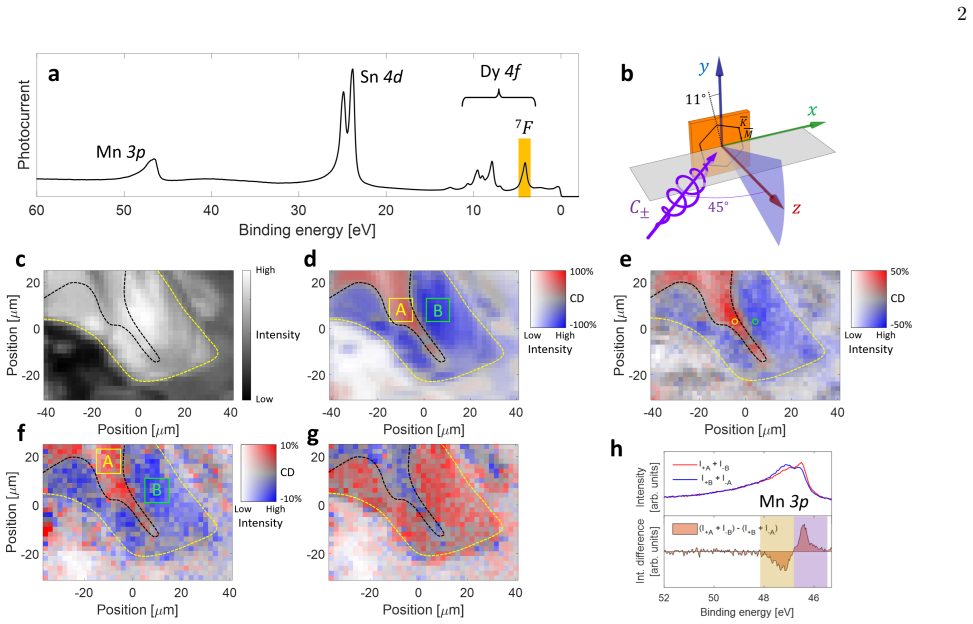
Tuning micro-focused circular-dichroic ARPES to Dy 4f features resolves single magnetic domains in DyMn6Sn6 and confirms ferrimagnetic Dy-Mn alignment.
A machine-rendered reading of the paper's core claim, the machinery that carries it, and where it could break.
Core claim
High-resolution micro-focused circular-dichroic angle-resolved photoemission on DyMn6Sn6, when the kinetic energy is tuned to Dy 4f multiplet features, resolves magnetic domains in cryo-cooled samples. Both the Dy 4f and Mn 3p dichroism signals agree quantitatively with Hartree-Fock modeling that establishes ferrimagnetic alignment of the Dy and Mn local moments. Signatures detected in the Mn 3d-dominated valence bands are related to orbital magnetization through direct comparison with ab initio electronic-structure calculations.
What carries the argument
Micro-focused circular-dichroic ARPES tuned to core-level multiplets, which generates magnetic contrast from the orientation of local moments.
Load-bearing premise
The observed circular dichroism contrast at Dy 4f energies is produced predominantly by the local magnetic moment orientation rather than by final-state effects or experimental artifacts.
What would settle it
A temperature sweep or applied field that fails to produce the domain reorientation and dichroism reversal predicted by the Hartree-Fock model for ferrimagnetic Dy-Mn alignment.
Figures


read the original abstract
Spin- and orbital-resolved access to the electronic bands is necessary to establish key properties of quantum materials such as the quantum-geometric tensor. Despite recent revival on magnetic Kagome compounds, no spectroscopic access to their magnetic properties has been available so far due to small domain sizes and lack of appropriate techniques. Furthermore, their real space magnetic texture is often complex and temperature-dependent. We investigate the magnetic Kagome metal DyMn$_6$Sn$_6$ using high-resolution micro-focused circular-dichroic angle-resolved photoemission ($\mu$-CD-ARPES) to probe its magnetic and electronic properties. By tuning the kinetic energy to various features of the Dy $4f$ multiplet, we resolve magnetic domains in samples cryo-cooled down to 20 K. Smaller, but clear signatures are detected in the Mn $3p$ levels. The behavior of both Dy $4f$ and Mn $3p$ features are in remarkable agreement with our modeling based on the Hartree-Fock method, revealing ferrimagnetic alignment of Dy and Mn local moments, and further strengthening our interpretation. Adjusting the energy to the Mn $3d$-dominated valence bands reveals signatures which we relate to the orbital magnetization through a comparison to {\it ab initio} electronic structure calculations. Our study establishes the spectroscopic access to a single magnetic domain in a Kagome metal, paving the way for further research into imaging magnetic phases of novel magnetic materials using $\mu$-CD-ARPES.
Editorial analysis
A structured set of objections, weighed in public.
Referee Report
Summary. The manuscript reports the application of micro-focused circular-dichroic angle-resolved photoemission spectroscopy (μ-CD-ARPES) to the Kagome metal DyMn6Sn6. By tuning the kinetic energy to features of the Dy 4f multiplet in samples cooled to 20 K, the authors resolve magnetic domains. Smaller signatures are observed in the Mn 3p levels. Both sets of features show remarkable agreement with Hartree-Fock modeling that indicates ferrimagnetic alignment of Dy and Mn local moments. Signatures in the Mn 3d-dominated valence bands are compared to ab initio calculations and related to orbital magnetization.
Significance. If the magnetic origin of the observed dichroism holds, the work establishes spectroscopic access to single magnetic domains in a Kagome metal, addressing the challenge of small and complex domain structures in these materials. The agreement with independent Hartree-Fock and ab initio calculations is a clear strength that supports the ferrimagnetic interpretation and the link to orbital magnetization.
major comments (2)
- [Abstract and μ-CD-ARPES measurements] Abstract and description of μ-CD-ARPES measurements: the central claim that the circular dichroism contrast when tuned across the Dy 4f multiplet (and the Mn 3p signal) is dominated by the projection of local moments onto the light helicity is load-bearing for both the domain imaging and the ferrimagnetic alignment conclusion. The manuscript does not report control measurements (temperature dependence above the ordering temperature, sample azimuth reversal, or linear dichroism comparison) that would isolate this from possible final-state interference, surface effects, or geometric artifacts.
- [Hartree-Fock modeling] Hartree-Fock modeling section: while the agreement with both Dy 4f and Mn 3p features is described as remarkable and used to reveal ferrimagnetic alignment, the text provides no quantitative metrics of fit quality, error bars on the modeled dichroism, or domain-size statistics, making it difficult to judge whether the match robustly supports the claimed alignment over alternative interpretations.
minor comments (1)
- [Abstract] The abstract uses the qualitative phrase 'remarkable agreement' without a corresponding quantitative comparison or residual analysis in the main text; adding this would improve clarity and allow readers to assess the strength of the modeling support.
Simulated Author's Rebuttal
We thank the referee for their careful reading and constructive comments on our manuscript. We address each major point below and indicate revisions made to strengthen the presentation.
read point-by-point responses
-
Referee: [Abstract and μ-CD-ARPES measurements] Abstract and description of μ-CD-ARPES measurements: the central claim that the circular dichroism contrast when tuned across the Dy 4f multiplet (and the Mn 3p signal) is dominated by the projection of local moments onto the light helicity is load-bearing for both the domain imaging and the ferrimagnetic alignment conclusion. The manuscript does not report control measurements (temperature dependence above the ordering temperature, sample azimuth reversal, or linear dichroism comparison) that would isolate this from possible final-state interference, surface effects, or geometric artifacts.
Authors: We agree that explicit control measurements would provide additional support. Our data were acquired at 20 K, well below the ferrimagnetic ordering temperature of DyMn6Sn6. The observed contrast exhibits a pronounced energy dependence that tracks the Dy 4f multiplet structure and shows opposite signs for Dy and Mn features, consistent with the ferrimagnetic alignment. This multiplet-specific behavior is difficult to reconcile with final-state interference or geometric artifacts, which would lack such atomic-like specificity. In the revised manuscript we have added a paragraph discussing why non-magnetic contributions are inconsistent with the data and with the Hartree-Fock modeling. Sample azimuth reversal was not performed in the present experiment owing to beam-time constraints, but the domain contrast reverses with light helicity as expected for a magnetic origin. revision: partial
-
Referee: [Hartree-Fock modeling] Hartree-Fock modeling section: while the agreement with both Dy 4f and Mn 3p features is described as remarkable and used to reveal ferrimagnetic alignment, the text provides no quantitative metrics of fit quality, error bars on the modeled dichroism, or domain-size statistics, making it difficult to judge whether the match robustly supports the claimed alignment over alternative interpretations.
Authors: We thank the referee for this observation. In the revised manuscript we now include quantitative measures of agreement: the root-mean-square deviation between measured and calculated dichroism spectra for both the Dy 4f and Mn 3p regions, together with estimated uncertainties on the modeled intensities arising from variations in the input moment directions and magnitudes. We have also added statistics on the observed domain sizes extracted from the μ-CD-ARPES maps, including the typical lateral extent and the fraction of the scanned area occupied by each domain orientation. These additions allow a more objective assessment of the robustness of the ferrimagnetic interpretation. revision: yes
Circularity Check
No circularity: experimental CD contrast matched to independent Hartree-Fock and ab initio calculations
full rationale
The paper reports μ-CD-ARPES measurements on cryo-cooled DyMn6Sn6, with intensity contrasts at Dy 4f and Mn 3p levels compared to separate Hartree-Fock modeling of multiplets and ab initio band calculations. The modeling assumes standard atomic and electronic structure inputs independent of the specific domain-resolved data; agreement is presented as validation of ferrimagnetic Dy-Mn alignment rather than a derivation that reduces to a fit or self-citation by the paper's own equations. No load-bearing step equates a claimed prediction to its input by construction, and the central spectroscopic access claim rests on external benchmarks (calculations and experimental contrast) that do not collapse into tautology.
Axiom & Free-Parameter Ledger
axioms (1)
- domain assumption Hartree-Fock method provides an accurate description of the Dy and Mn local-moment alignment in this compound.
Reference graph
Works this paper leans on
-
[1]
J.-X. Yin, B. Lian, and M. Z. Hasan, Topological kagome magnets and superconductors, Nature612, 647 (2022)
work page 2022
-
[2]
J.-X. Yin, W. Ma, T. A. Cochran, X. Xu, S. S. Zhang, H.-J. Tien, N. Shumiya, G. Cheng, K. Jiang, B. Lian, Z. Song, G. Chang, I. Belopolski, D. Multer, M. Litske- vich, Z.-J. Cheng, X. P. Yang, B. Swidler, H. Zhou, H. Lin, T. Neupert, Z. Wang, N. Yao, T.-R. Chang, S. Jia, and M. Zahid Hasan, Quantum-limit Chern topo- logical magnetism in TbMn6Sn6, Nature 5...
work page 2020
-
[3]
H. Li, S.Cheng, G.Pokharel, P. Eck, C. Bigi, F. Mazzola, G. Sangiovanni, S. D. Wilson, D. Di Sante, Z. Wang, and I. Zeljkovic, Spin Berry curvature-enhanced orbital Zeeman effect in a kagome metal, Nature Physics 20, 1103–1109 (2024)
work page 2024
-
[4]
W. Ma, X. Xu, J.-X. Yin, H. Yang, H. Zhou, Z.-J. Cheng, Y. Huang, Z. Qu, F. Wang, M. Z. Hasan, and S. Jia, Rare Earth Engineering in RMn6Sn6 (R = Gd−Tm, Lu) Topological Kagome Magnets, Phys. Rev. Lett.126, 246602 (2021)
work page 2021
-
[5]
M. Li, Q. Wang, G. Wang, Z. Yuan, W. Song, R. Lou, Z. Liu, Y. Huang, Z. Liu, H. Lei, Z. Yin, and S. Wang, Dirac cone, flat band and saddle point in kagome magnet YMn6Sn6, Nature Communications12, 3129 (2021)
work page 2021
-
[6]
D. Clatterbuck and K. Gschneidner, Magnetic properties of RMn6Sn6 (R=Tb, Ho, Er, Tm, Lu) single crystals, Journal of Magnetism and Magnetic Materials207, 78 (1999)
work page 1999
-
[7]
B. El Idrissi, G. Venturini, B. Malaman, and D. Fruchart, Magnetic structures of TbMn6Sn6 and HoMn6Sn6 com- pounds from neutron diffraction study, Journal of the Less Common Metals175, 143 (1991)
work page 1991
-
[8]
B. Malaman, G. Venturini, R. Welter, J. Sanchez, P. Vul- liet, and E. Ressouche, Magnetic properties of RMn6Sn6 (R=Gd–Er) compounds from neutron diffraction and Mössbauer measurements, Journal of Magnetism and Magnetic Materials 202, 519 (1999)
work page 1999
-
[9]
Y. Lee, R. Skomski, X. Wang, P. P. Orth, Y. Ren, B. Kang, A. K. Pathak, A. Kutepov, B. N. Harmon, R. J. McQueeney, I. I. Mazin, and L. Ke, Interplay between magnetism and band topology in the kagome magnets RMn6Sn6, Phys. Rev. B108, 045132 (2023)
work page 2023
- [10]
- [11]
-
[12]
A. Bose, T. G. Saunderson, A. Shahee, L. Zhang, T. Hajiri, A. Rajan, D. Go, H. Asano, U. Schwin- genschlögl, A. Manchon, Y. Mokrousov, and M. Kläui, Fluctuation-mediated spin-orbit torque enhancement in the noncollinear antiferromagnet Mn3Ni0.35Cu0.65N (2024), arXiv:2401.16021 [cond-mat.mes-hall]
-
[13]
F. Gerken, Calculated photoemission spectra of the 4f states in the rare-earth metals, Journal of Physics F: Metal Physics 13, 703 (1983)
work page 1983
-
[14]
R. J. Koch, C. Jozwiak, A. Bostwick, B. Stripe, M. Cordier, Z. Hussain, W. Yun, and E. Rotenberg, Nano focusing of soft x-rays by a new capillary mirror optic, Synchrotron Radiation News31, 50–52 (2018)
work page 2018
-
[15]
F. J. García de Abajo, M. A. Van Hove, and C. S. Fadley, Multiple scattering of electrons in solids and molecules: A cluster-model approach, Phys. Rev. B 63, 075404 7 (2001)
work page 2001
-
[16]
H. Daimon, T. Nakatani, S. Imada, S. Suga, Y. Kagoshima, and T. Miyahara, Strong circular dichro- ism in photoelectron diffraction from nonchiral, nonmag- netic material–direct observation of rotational motion of electrons, Japanese Journal of Applied Physics32, L1480 (1993)
work page 1993
-
[17]
H. Boban, M. Qahosh, X. Hou, T. Sobol, E. Beyer, M. Szczepanik, D. Baranowski, S. Mearini, V. Feyer, Y. Mokrousov, Y. Zhou, Y. Su, K. Jin, T. Wichmann, J. Martinez-Castro, M. Ternes, F. S. Tautz, F. Lüpke, C. M. Schneider, J. Henk, and L. Plucinski, Scattering makes a difference in circular dichroic angle-resolved pho- toemission, Phys. Rev. B111, 115127 (2025)
work page 2025
-
[18]
J. Stohr and H. C. Siegmann, Magnetism, 2006th ed., Springer Series in Solid-State Sciences (Springer, Berlin, Germany, 2006)
work page 2006
-
[19]
B. T. Thole, P. Carra, F. Sette, and G. van der Laan, X-ray circular dichroism as a probe of orbital magnetiza- tion, Phys. Rev. Lett.68, 1943 (1992)
work page 1943
-
[20]
R.Resta,Magneticcirculardichroismversusorbitalmag- netization, Phys. Rev. Res.2, 023139 (2020)
work page 2020
-
[21]
M. Kang, S. Kim, Y. Qian, P. M. Neves, L. Ye, J. Jung, D. Puntel, F. Mazzola, S. Fang, C. Jozwiak, A. Bost- wick, E. Rotenberg, J. Fuji, I. Vobornik, J.-H. Park, J. G. Checkelsky, B.-J. Yang, and R. Comin, Measurements of the quantum geometric tensor in solids, Nature Physics 21, 110–117 (2024)
work page 2024
-
[22]
S. Kim, Y. Chung, Y. Qian, S. Park, C. Jozwiak, E. Rotenberg, A. Bostwick, K. S. Kim, and B.-J. Yang, Direct measurement of the quantum metric tensor in solids, Science 388, 1050–1054 (2025)
work page 2025
- [23]
-
[24]
D. Y. Usachov, G. Poelchen, I. I. Tupitsyn, K. A. Bokai, D. Glazkova, A. V. Tarasov, M. Mende, A. V. Fedorov, V. S. Stolyarov, C. Krellner, and D. V. Vyalikh, Resonant 4f photoelectron diffraction: Insight into Yb compounds, Phys. Rev. B109, L241118 (2024)
work page 2024
-
[25]
D. Y. Usachov, D. Glazkova, A. V. Tarasov, S. Schulz, G. Poelchen, K. A. Bokai, O. Y. Vilkov, P. Dudin, K. Kummer, K. Kliemt, C. Krellner, and D. V. Vya- likh, Estimating the orientation of 4f magnetic moments by classical photoemission, J. Phys. Chem. Lett. 13, 7861–7869 (2022)
work page 2022
-
[26]
J. P. Perdew, K. Burke, and M. Ernzerhof, Generalized gradient approximation made simple, Phys. Rev. Lett. 77, 3865 (1996)
work page 1996
- [27]
-
[28]
D. Wortmann, G. Michalicek, N. Baadji, M. Bet- zinger, G. Bihlmayer, J. Bröder, T. Burnus, J. Enko- vaara, F. Freimuth, C. Friedrich, C.-R. Gerhorst, S. Granberg Cauchi, U. Grytsiuk, A. Hanke, J.-P. Hanke, M. Heide, S. Heinze, R. Hilgers, H. Janssen, D. A. Klüppelberg, R. Kovacik, P. Kurz, M. Lezaic, G. K. H. Madsen, Y. Mokrousov, A. Neukirchen, M. Redies...
-
[29]
C. Li, A. J. Freeman, H. J. F. Jansen, and C. L. Fu, Mag- netic anisotropy in low-dimensional ferromagnetic sys- tems: Fe monolayers on ag(001), au(001), and pd(001) substrates, Phys. Rev. B42, 5433 (1990)
work page 1990
-
[30]
PAULING FILE Multinaries Edition – 2022
DyMn6Sn6 (T = 2 K) Crystal Structure: Datasheet from “PAULING FILE Multinaries Edition – 2022” , Ed.: P. Villars. Copyright 2023 Springer-Verlag Berlin Heidel- berg & Material Phases Data System (MPDS), Switzer- land & National Institute for Materials Science (NIMS), Japan
work page 2022
discussion (0)
Sign in with ORCID, Apple, or X to comment. Anyone can read and Pith papers without signing in.