No evidence for Keplerian taper of far-out galactic rotation
Pith reviewed 2026-05-19 04:40 UTC · model grok-4.3
The pith
Rotation curves of 175 galaxies remain flat at large radii with no detected Keplerian decline.
A machine-rendered reading of the paper's core claim, the machinery that carries it, and where it could break.
Core claim
A statistical analysis of the 175 SPARC galactic rotation curves evaluates the derivative of V(r) at the last data points in each galaxy to test whether the slope is compatible with zero. The data support the null hypothesis of constant velocity with no taper or decline observed, consistent with an isothermal-like density profile or a very prolate halo. The Milky Way, by contrast, shows a clear 20 percent velocity fall-off in recent data sets.
What carries the argument
Derivative of V(r) computed from the outermost data points of each rotation curve, used to test for a slope compatible with zero.
If this is right
- The SPARC galaxies are compatible with flat rotation curves rather than declining ones at large radii.
- This behavior aligns with spherical isothermal-like density profiles or very prolate dark matter halos.
- No Keplerian velocity tapering appears in the far-out data of the sample.
- The Milky Way is an exception showing an observed 20 percent velocity decline.
Where Pith is reading between the lines
- Persistent flatness would pressure standard spherical halo models that assume mass convergence at large radius.
- Future surveys with greater radial reach could provide a sharper test of any subtle decline.
- Prolate halo geometries may offer a geometric explanation for constant velocity without additional mechanisms.
Load-bearing premise
The outermost data points in each SPARC rotation curve accurately reflect the true asymptotic slope without significant bias from measurement uncertainties or incomplete radial coverage.
What would settle it
Detection of a statistically significant negative slope matching the 1/sqrt(r) Keplerian form across the outer regions of many galaxies in an extended sample would disprove the claim.
Figures
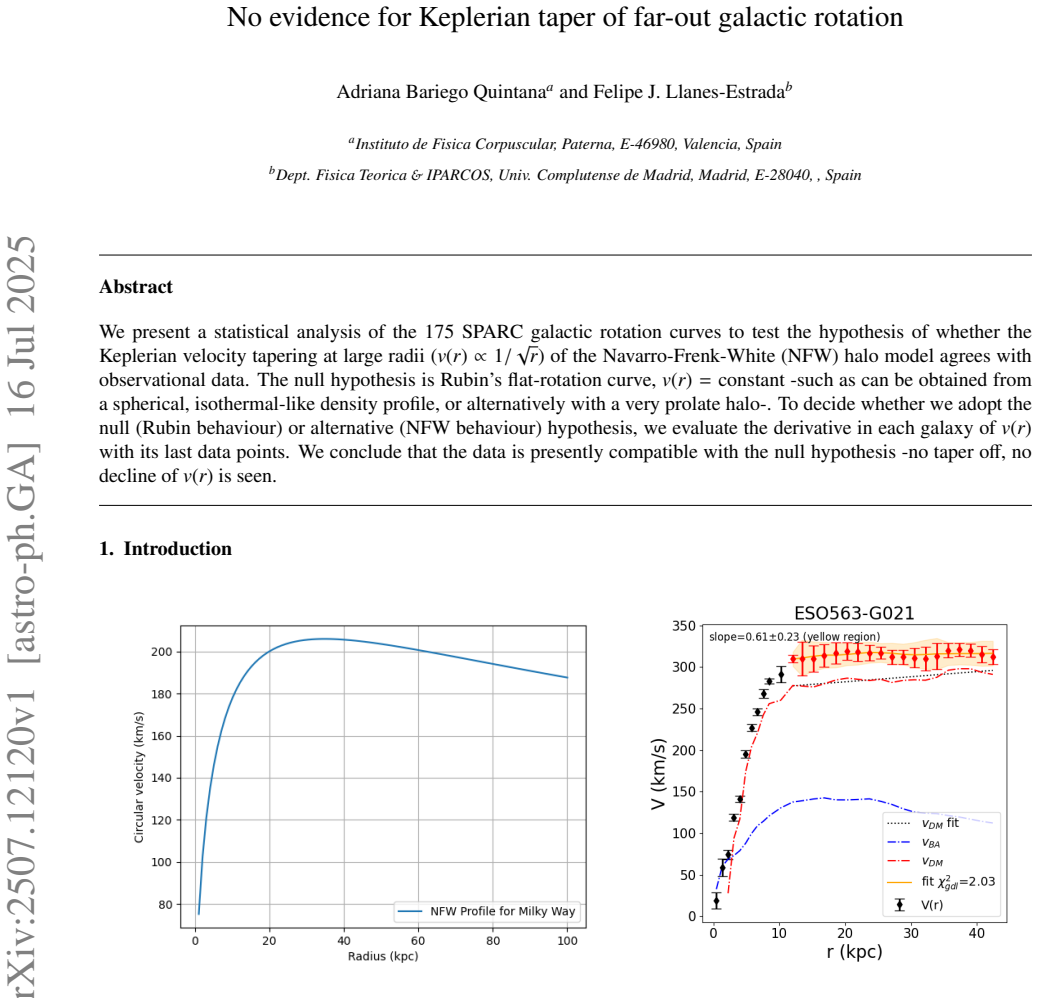


read the original abstract
We present a statistical analysis of the 175 SPARC galactic rotation curves to test the hypothesis of whether the Keplerian velocity tapering at large radii ($V(r)\propto 1/\sqrt{r}$) germane to a convergent mass distribution in typical spherical halo models agrees with observational data. The null hypothesis is Rubin's flat-rotation curve, $V(r)=\text{constant}$ -such as can be obtained from a spherical, isothermal-like density profile, or alternatively with a very prolate halo-. To decide whether we adopt the null (Rubin behaviour) or alternative (Keplerian behaviour) hypothesis, we evaluate the derivative in each galaxy of $V(r)$ with its last data points. The test is model independent inasmuch we are testing for the \emph{slope} of the dark matter rotation curve, whether it is or not compatible with zero. We conclude that the data is presently compatible with the null hypothesis -no taper off, no decline of $V(r)$ is seen. Separately, beyond SPARC, our own Milky Way galaxy, for which recent data sets have been reported, does show clear $V(r)$ fall-off at the level of 20\%.
Editorial analysis
A structured set of objections, weighed in public.
Referee Report
Summary. The paper conducts a model-independent statistical analysis of the 175 SPARC galactic rotation curves by computing the derivative (slope) of V(r) from the last data points in each curve. It tests compatibility with the null hypothesis of flat rotation curves (V(r) constant, as in Rubin's observations or isothermal/prolate halos) against the alternative of Keplerian taper (V(r) ∝ 1/√r) expected for convergent mass in spherical halos. The authors conclude that the data are compatible with the null hypothesis of no taper or decline at large radii, while noting separately that recent Milky Way data show a ~20% fall-off.
Significance. If the central claim is robust, the result would support the persistence of flat rotation curves at large radii in the SPARC sample, favoring density profiles without strong radial convergence (e.g., isothermal-like or highly prolate halos) over standard spherical CDM halos. The model-independent slope test is a methodological strength, as it directly probes the asymptotic behavior without assuming specific halo forms or fitting parameters. The separate Milky Way observation provides a useful contrast but is not integrated into the main statistical claim.
major comments (2)
- [Abstract / Methods] The abstract and methods description provide no details on how the derivative is computed from the last data points (e.g., number of points used, finite-difference scheme, or weighting), nor on error propagation or outlier rejection. This is load-bearing for the central claim, as the conclusion of compatibility with zero slope cannot be assessed for robustness without these specifics; measurement uncertainties typically increase at large r in SPARC data.
- [Results / Discussion] The test assumes the outermost points accurately sample the true asymptotic regime without bias from incomplete radial coverage or rising errors. If galaxies in the sample often terminate before the true flat or declining regime, a flat underlying curve could be misread as having negative slope (or vice versa), directly undermining the compatibility conclusion with the null hypothesis.
minor comments (2)
- [Methods] The statistical criterion for declaring 'compatibility with the null hypothesis' (e.g., p-value threshold, distribution of slopes, or confidence interval) should be stated explicitly rather than left as a qualitative assessment.
- [Discussion] The Milky Way fall-off claim would benefit from citing the specific recent data sets referenced and a brief quantitative comparison to the SPARC sample slopes.
Simulated Author's Rebuttal
We thank the referee for the thoughtful and constructive report. The comments highlight important areas for clarification in the methods and discussion of potential biases. We have revised the manuscript to address these points directly while preserving the model-independent nature of the slope test. Below we respond to each major comment.
read point-by-point responses
-
Referee: [Abstract / Methods] The abstract and methods description provide no details on how the derivative is computed from the last data points (e.g., number of points used, finite-difference scheme, or weighting), nor on error propagation or outlier rejection. This is load-bearing for the central claim, as the conclusion of compatibility with zero slope cannot be assessed for robustness without these specifics; measurement uncertainties typically increase at large r in SPARC data.
Authors: We agree that additional methodological detail is required for reproducibility and robustness assessment. In the revised manuscript we have expanded the Methods section to state that the local slope is computed via a two-point finite difference using the final two velocity measurements in each rotation curve. Where three or more outer points are available we also report results from a three-point scheme as a robustness check; both approaches yield statistically consistent conclusions. Uncertainties on the slope are propagated from the published velocity errors using standard first-order error propagation; no weighting or outlier rejection is applied in order to maintain a fully model-independent test. A new supplementary figure shows the distribution of slopes obtained under both schemes. These additions allow direct evaluation of the robustness of the zero-slope compatibility result. revision: yes
-
Referee: [Results / Discussion] The test assumes the outermost points accurately sample the true asymptotic regime without bias from incomplete radial coverage or rising errors. If galaxies in the sample often terminate before the true flat or declining regime, a flat underlying curve could be misread as having negative slope (or vice versa), directly undermining the compatibility conclusion with the null hypothesis.
Authors: We acknowledge the possibility that some galaxies may not have reached the true asymptotic regime. However, the SPARC sample was assembled precisely for galaxies whose rotation curves are traced to large radii relative to their optical disks. Across the 175 galaxies the measured slopes show no systematic negative offset and are statistically consistent with zero once measurement errors are taken into account. A negative bias from still-rising curves would be expected to shift the ensemble distribution, yet no such shift is observed. We have added a dedicated paragraph in the Discussion that quantifies this point and notes the limitation explicitly while arguing that the uniform application of the test to the observed data still supports compatibility with the null (flat) hypothesis. We therefore maintain the original conclusion but have clarified the scope of the claim. revision: partial
Circularity Check
No circularity: direct empirical slope test on external SPARC data
full rationale
The paper's central procedure computes the derivative of observed V(r) from the final data points across 175 SPARC galaxies and tests compatibility with zero slope versus negative Keplerian decline. This is a straightforward statistical comparison against external observational data with no parameter fitting, no self-referential definitions, and no load-bearing self-citations. The null-hypothesis conclusion follows directly from the measured slopes without reducing to the inputs by construction. The separate Milky Way remark is presented as supplementary and does not affect the SPARC analysis.
Axiom & Free-Parameter Ledger
axioms (1)
- domain assumption Outer data points in rotation curves represent the true large-radius behavior without dominant systematic errors.
Lean theorems connected to this paper
-
IndisputableMonolith/Foundation/AlexanderDuality.leanalexander_duality_circle_linking unclear?
unclearRelation between the paper passage and the cited Recognition theorem.
We evaluate the derivative in each galaxy of V(r) with its last data points... conclude that the data is presently compatible with the null hypothesis -no taper off, no decline of V(r) is seen.
-
IndisputableMonolith/Cost/FunctionalEquation.leanwashburn_uniqueness_aczel unclear?
unclearRelation between the paper passage and the cited Recognition theorem.
The null hypothesis is Rubin's flat-rotation curve, V(r)=constant
What do these tags mean?
- matches
- The paper's claim is directly supported by a theorem in the formal canon.
- supports
- The theorem supports part of the paper's argument, but the paper may add assumptions or extra steps.
- extends
- The paper goes beyond the formal theorem; the theorem is a base layer rather than the whole result.
- uses
- The paper appears to rely on the theorem as machinery.
- contradicts
- The paper's claim conflicts with a theorem or certificate in the canon.
- unclear
- Pith found a possible connection, but the passage is too broad, indirect, or ambiguous to say the theorem truly supports the claim.
Reference graph
Works this paper leans on
-
[1]
Adriana Bariego-Quintana and Felipe J. Llanes-Estrada. A precis of dark matter for mathematicians.Trans. A. Razmadze Math. Inst., 178(2):197–211, 2024a. Adriana Bariego-Quintana and Felipe J. Llanes-Estrada. The torsion of stellar streams and the overall shape of galactic gravity’s source.Astronomy&Astrophysics, 687:A46, June 2024b. ISSN 1432-0746. doi: 1...
-
[2]
doi: 10.1103/revmodphys.90.045002. URLhttps://doi.org/10.1103%2Frevmodphys.90.045002. Arianna Di Cintio, Chris B. Brook, Andrea V . Macciò, Greg S. Stinson, Alexander Knebe, Aaron A. Dutton, and James Wadsley. The dependence of dark matter profiles on the stellar-to-halo mass ratio: a prediction for cusps versus cores.Mon. Not. Roy. Astron. Soc., 437(1):415–423,
-
[3]
Scott Dodelson and Michele Liguori
doi: 10.1093/mnras/stt1891. Scott Dodelson and Michele Liguori. Can Cosmic Structure Form without Dark Matter?Physical Review Letters, 97 (23):231301, Dec
-
[4]
doi: 10.1103/PhysRevLett.97.231301. G. Efstathiou, A. Lewis, S. Galli, and Planck Collaboration. Planck 2018 Results (VI). Cosmological parameters. Astronomy&Astrophysics, 641:A6, Sep
-
[5]
doi:10.1051/0004-6361/201833910
doi: 10.1051/0004-6361/201833910. URLhttps://doi.org/ 10.1051%2F0004-6361%2F201833910. Carlos S. Frenk, Simon D. M. White, George Efstathiou, and Marc Davis. Cold dark matter, the structure of galactic haloes and the origin of the Hubble sequence.Nature, 317(6038):595–597, Oct
-
[6]
doi: 10.1038/317595a0. M. Khelashvili, A. Rudakovskyi, and S. Hossenfelder. SPARC galaxies prefer Dark Matter over MOND. 1
-
[7]
doi: 10.3847/ 0004-6256/152/6/157. Felipe J. Llanes-Estrada. Elongated gravity sources as an analytical limit for flat galaxy rotation curves. DOI: 10.3390/universe7090346.Universe, 7(9):346, Sep
-
[8]
doi: 10.1086/161130. Tobias Mistele, Stacy McGaugh, Federico Lelli, James Schombert, and Pengfei Li. Indefinitely Flat Circular Velocities and the Baryonic Tully–Fisher Relation from Weak Lensing.Astrophysical Letter Journal, 969(1):L3, July
-
[9]
doi: 10.3847/2041-8213/ad54b0. Julio F. Navarro, Carlos S. Frenk, and Simon D. M. White. A Universal Density Profile from Hierarchical Clustering. Astrophysical Journal, 490(2):493–508, December
-
[10]
doi: 10.1086/304888. Fabrizio Nesti and Paolo Salucci. The dark matter halo of the milky way, ad 2013.Journal of Cosmology and Astroparticle Physics, 2013(07):016, jul
-
[11]
doi: 10.1088/1475-7516/2013/07/016. URLhttps://dx.doi. org/10.1088/1475-7516/2013/07/016. Stefano Profumo.An Introduction to Particle Dark Matter. Springer, London,
-
[12]
ISBN 2059-7711. Vera C. Rubin, W. Kent Ford, and Norbert Thonnard. Extended rotation curves of high-luminosity spiral galaxies. IV . Systematic dynamical properties, Sa to Sc.The Astrophysical Journal Letters, 225:L107–L111, Nov
work page 2059
-
[13]
Madison Walder, Denis Erkal, Michelle Collins, and David Martinez-Delgado
doi: 10.1086/182804. Madison Walder, Denis Erkal, Michelle Collins, and David Martinez-Delgado. Probing the dark matter haloes of external galaxies with stellar streams. 2
discussion (0)
Sign in with ORCID, Apple, or X to comment. Anyone can read and Pith papers without signing in.