REVIEW 3 major objections 4 minor 1 cited by
Ultra-strong Quantum Squeezing Mediated by Plasma Waves
T0 review · 3 major / 4 minor · reviewed 2026-08-06 · deepseek-v4-flash
Pith's one-line read Fully ionized plasma can mediate ultra-strong two-mode squeezing of light via stimulated Raman scattering, with predicted 20–40 dB noise reduction.
desk verdict Plasma SRS is a genuinely new route to phonon-mediated two-mode squeezing, but Eq. (9)'s thermal-noise term is off by a factor of two, making the headline numbers ~3 dB too optimistic. read the letter →
The pith
A machine-rendered reading of the paper's core claim, the machinery that carries it, and where it could break.
The reading
What carries the argument
The mechanism is phonon-mediated four-wave mixing, in which two copropagating pump lasers with frequency difference 2ω_p drive two stimulated Raman scattering pathways: a Stokes process that creates a plasma phonon together with a lower-frequency photon, and an anti-Stokes process that absorbs a phonon while producing a higher-frequency photon. The two pathways are coherently combined so that the plasma phonon's quantum state is transferred to the optical fields, generating a two-mode squeezed state. The analysis is carried out with a Bogoliubov transformation into hybrid modes b3 = a3 $\cosh$ r + a4^† $\sinh$ r and b4 = a4 $\cosh$ r + a3^† $\sinh$ r, under which each plasma phonon mode couples to only one hybrid mode; this diagonalization reveals the noise-isolating structure that survives thermal excitation. The load-bearing identity is Eq. (9), derived from quantum Langevin equations with a Markovian reservoir for the damped phonons, giving the covariance and the squeezing condition (2 n_th + 1) < $e^{{2r}}$.
What would settle it
Measure the joint quadrature variance of the two output modes in a plasma with controlled density, temperature, and pump ratio, and compare the asymptotic value to (n_th + 1/2)$e^{{-2r}}$; if the measured floor is higher, or if increasing Landau damping degrades rather than stabilizes the squeezing, the central claim fails. A kinetic-theory derivation of the interaction Hamiltonian that yields additional coupling terms would also refute the model.
Extended reading notes
Core claim
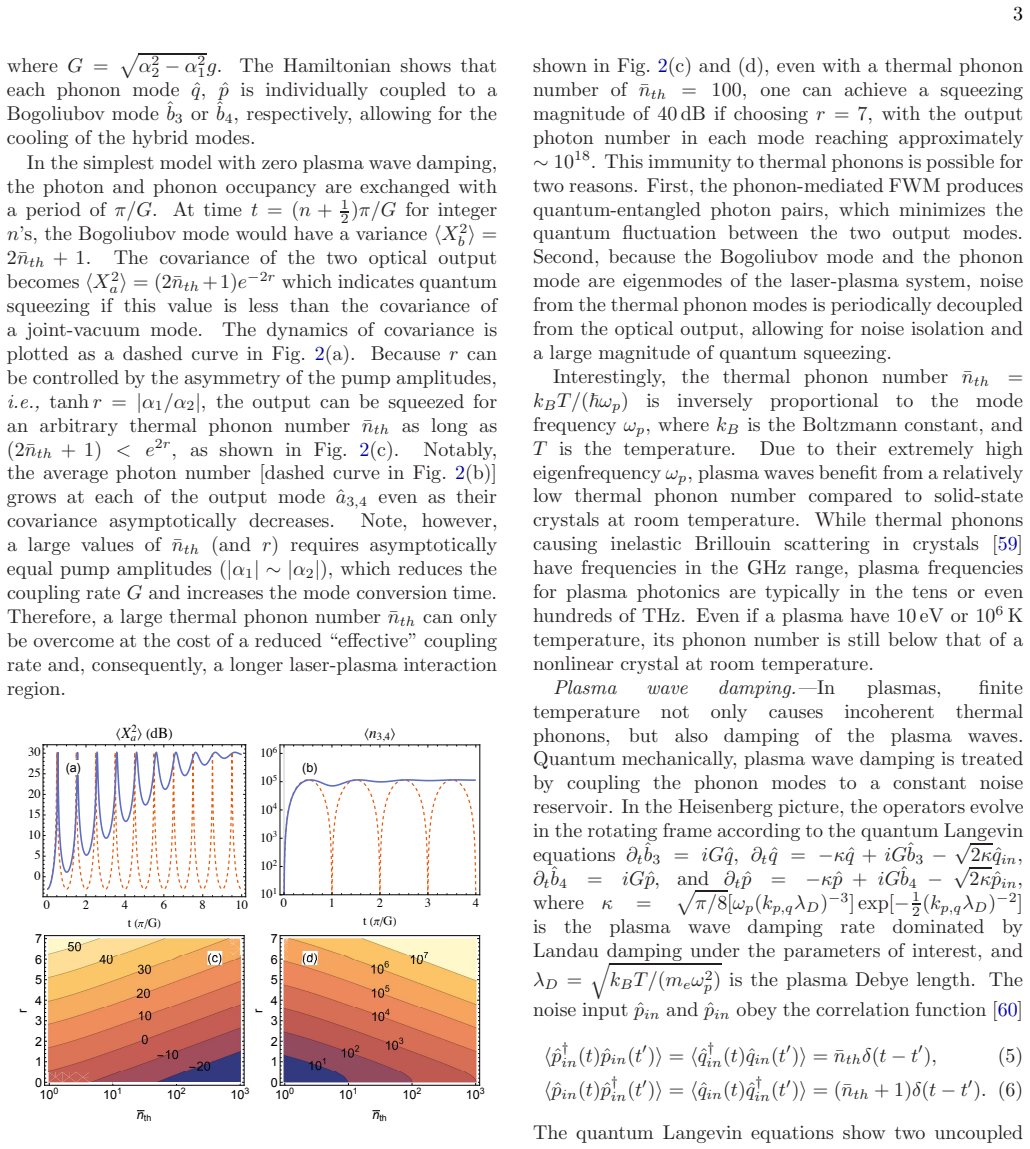
The central result is Eq. (9): the joint quadrature variance of the two output optical modes evolves as ⟨$X_a^{2}$⟩ = M + (1 - M)(n_th + 1/2)$e^{{-2r}}$, where M = $e^{{-κt}}$(G/Δ)^2 $cos^{2}$(Δt - φ), κ is the Landau damping rate of the plasma wave, and r = arctanh(|α1/α2|) is set by the ratio of the two pump amplitudes. In the asymptotic limit t → ∞, M → 0, and ⟨$X_a^{2}$⟩ → (n_th + 1/2)$e^{{-2r}}$, which is below the vacuum level of 1 whenever (2 n_th + 1) < $e^{{2r}}$. Because r grows arbitrarily large as the pump amplitudes approach equality, the achievable squeezing is in principle unbounded, and the authors compute 20 dB for a 1 cm plasma at 1 eV and 40 dB for a 2.5 cm channel, with average photon numbers of $10^{3}$–$10^{6}$ per mode. The paper also claims that finite plasma wave damping is beneficial: it damps the oscillation in the squeezing magnitude and produces a stable asymptotic value rather than degrading it.
Load-bearing premise
The result hinges on the assumed interaction Hamiltonian (2) with two independent, equally coupled, Markovian-damped phonon modes and undepleted classical pumps; if the actual plasma coupling contains extra terms, correlated phonon noise, or significant pump depletion, the predicted squeezing formula will not hold.
Editorial extensions
If this is right
- A 1 cm, 1 eV plasma driven by ~10^16 W/cm^2 two-color pumps should yield 20 dB of two-mode squeezing, about four times the best single-pass solid-state result.
- Lengthening the plasma to 2.5 cm in a channel raises the predicted squeezing to 40 dB with ~10^6 photons per output mode.
- Because plasma frequency is far above phonon frequencies in solids, even a 10 eV plasma has a lower thermal phonon number than a room-temperature crystal, so thermal noise is not a barrier.
- Combining the two outputs on a balanced beam splitter converts the two-mode squeezed state into a single-mode squeezed state suitable for interferometry and strong-field experiments.
- The scheme scales favorably to short wavelengths: at 1 nm and density 10^21 cm^-3, 40 dB squeezing requires pump amplitudes three orders of magnitude smaller than at optical wavelengths.
Reading between the lines
- If Eq. (9) is confirmed, the asymptotic squeezing is set only by n_th and r, so longer plasma channels with nearly balanced pumps could in principle push squeezing beyond 40 dB, limited by pump depletion and other effects outside the model.
- The damping-stabilized regime suggests a reservoir-engineering picture in which Landau damping cools the Bogoliubov modes; this could be extended to prepare other continuous-variable states, such as Schrödinger-cat-like superpositions, in plasma.
- A natural check of the two-mode structure is to measure the cross-correlation of the two output channels: the model predicts their noise is quantum-correlated even when each individual channel is noisy, a signature that distinguishes this mechanism from independent thermal emission.
- The same phonon-mediation idea might be applied to other nonlinear plasma processes, but with ion-acoustic phonons the much lower frequency would raise thermal phonon numbers and likely erase the advantage seen here.
Editorial analysis
A structured set of objections, weighed in public.
Referee Report
Summary. The paper proposes a scheme for generating two-mode squeezed light via stimulated Raman scattering in fully ionized plasma. Two copropagating pump beams with frequency separation 2ωp drive Stokes and anti-Stokes processes mediated by Langmuir waves. The authors introduce an interaction Hamiltonian (Eq. 2), apply a Bogoliubov transformation (Eq. 3), and solve quantum Langevin equations that include plasma-wave damping. They derive formulas for the joint-quadrature covariance (Eq. 9) and the output photon number (Eq. 10), and give concrete parameters yielding 20 dB and 40 dB squeezing. The central claim is that plasma waves can mediate ultra-strong, thermally robust squeezing at pump intensities inaccessible to conventional solids.
Significance. If the results are correct after revision, this paper offers a conceptually new platform for ultra-strong squeezing: SRS-mediated four-wave mixing in plasma, with a first-order nonlinearity and no material damage threshold. The analytic model is transparent, the experimental parameters are concrete and falsifiable, and the claimed robustness to thermal phonons (squeezing even when n_th≈100) is striking. The paper also correctly notes that the high Langmuir-wave frequency gives a low thermal occupation compared with phonons in solids. However, the current version contains an explicit algebraic error in Eq. (9), an underived central Hamiltonian, and a numerical inconsistency in the photon-number claim. These issues must be resolved before the quantitative claims can be accepted.
major comments (3)
- [Model and two-mode squeezing, Eq. (9)] The asymptotic term in Eq. (9) should be (2 n_th + 1)e^{-2r}, not (n_th + 1/2)e^{-2r}. From the Bogoliubov transformation (3), X_a = e^{-r} X_b with X_b = (b3 + b3^† + b4 + b4^†)/√2. In the damped steady state each b-mode is a harmonic oscillator thermalized to occupation n_th; a single quadrature (b + b^†)/√2 has variance n_th + 1/2, so X_b, being the sum of two independent such quadratures, has variance 2 n_th + 1. Hence <X_a^2> = (2 n_th + 1)e^{-2r}. This agrees with the paper's own zero-damping result in the same section, but Eq. (9) reduces to (n_th + 1/2)e^{-2r}; for n_th = 0 it predicts (1/2)e^{-2r} instead of the correct two-mode squeezed vacuum result e^{-2r}. Please correct Eq. (9), the sentence stating that the asymptotic covariance is (n_th + 1/2)e^{-2r}, and any curves or derived quantities that use this formula.
- [Model and two-mode squeezing, Eq. (2)] The interaction Hamiltonian (2) is asserted rather than derived from the standard SRS interaction or from plasma kinetic theory. All subsequent results, including Eqs. (4), (9), and (10), depend on this Hamiltonian and on the assumptions that the two phonon modes p and q are independent, equally coupled, Markovian-damped oscillators, that the pumps are undepleted, and that no additional couplings or correlated noise sources are present. Please provide a derivation of Eq. (2), or a precise reference from which it follows, and state the approximations under which the neglected terms are small.
- [Model and two-mode squeezing, paragraph after Fig. 2] The claim that for n_th = 100 and r = 7 'the output photon number in each mode reach[es] approximately ~10^18' is inconsistent with Eq. (10). Substituting n_th = 100 and r = 7 into Eq. (10) gives n_th cosh^2 r + (n_th + 1) sinh^2 r ≈ 6×10^7. Please correct the numerical claim or specify if a different quantity (e.g., total photons over a volume or many modes) is intended.
minor comments (4)
- [Model and two-mode squeezing, first paragraph] The text says 'a frequency difference equal to the plasma frequency'; this should read 'twice the plasma frequency', consistent with Eq. (1) and with the abstract.
- [Single-mode squeezing output] Xc1 is defined as (a3 + a3^† + a4 + a4^†)/2, which equals X_a/√2. Saying it is 'identical to the covariance Xa' is imprecise; the noise reduction factor relative to the vacuum level is the same, but the normalization differs.
- [Entire text] There are several typographical errors, including 'Universi ty' in the affiliation, 'breams' instead of 'beams', and 'acheive' instead of 'achieve'.
- [Equation (10)] Please define ⟨n3,4⟩ explicitly as the per-mode photon number before Eq. (10) to avoid ambiguity with a total photon number.
Circularity Check
No significant circularity: the squeezing prediction is an explicit Langevin solution with independent physical inputs; only a non-load-bearing self-citation appears.
full rationale
The derivation chain is self-contained in the usual model-calculation sense. Equation (2) posits a Hamiltonian, Equation (3) defines a Bogoliubov transformation controlled by the pump amplitude ratio, and the subsequent quantum Langevin equations are solved explicitly to produce Equations (9)-(10). The asymptotic squeezing floor and the threshold condition (2 n_th + 1) < e^{2r} are mathematical consequences of that model; no parameter is fitted to the claimed output. The pump ratio r, thermal occupation n_th, and Landau damping rate kappa are stated physical controls or inputs, not fit constants, so the quoted 20/40 dB numbers are computed consequences rather than renamed inputs. The self-citation [39] supplies the phonon normalization that fixes the coupling rate g, but the asymptotic squeezing magnitude and thermal-noise threshold are independent of g, so this citation is not load-bearing for the central claim. No uniqueness theorem is imported to force the chosen mechanism. The apparent factor-of-two discrepancy between the damped result Eq. (9) and the zero-damping statement <X_b^2> = 2 n_th + 1 is an internal consistency or arithmetic concern, not a circularity, and does not raise the circularity score.
Assumptions & free parameters
free parameters (1)
- r (squeezing parameter) =
4 or 6 for 20/40 dB at nth=10; up to 7 for nth=100
assumptions (4)
- domain assumption The interaction Hamiltonian in Eq. (2) with coupling g = ckp/2 sqrt(omega_p/omega_3) correctly models the SRS-mediated four-wave mixing.
- domain assumption The pump lasers are undepleted classical coherent fields with constant amplitudes alpha1 and alpha2 over the interaction length.
- domain assumption The two plasma phonon modes p and q are independent quantum harmonic oscillators with equal frequency omega_p, equal coupling G, and independent Markovian reservoirs at temperature T.
- domain assumption The output optical modes start in vacuum and no sources of noise other than thermal phonons and the vacuum reservoir implied by damping are present.
Cite this review
Pith. "Pith review of Ultra-strong Quantum Squeezing Mediated by Plasma Waves." pith.science (2026). https://pith.science/paper/QOP6EARL
@misc{pith2026250712288,
  author       = {Pith},
  title        = {Pith review of: Ultra-strong Quantum Squeezing Mediated by Plasma Waves},
  year         = {2026},
  howpublished = {\url{https://pith.science/paper/QOP6EARL}},
  note         = {Machine review of arXiv:2507.12288}
}
abstract
Quantum squeezed states enable precision measurements beyond the standard quantum limit, but conventional solid-state media fundamentally limit pump intensities to the ionization threshold. We demonstrate that plasma waves can mediate ultra-strong two-mode squeezing through stimulated Raman scattering, achieving up to ultrastrong squeezing using $10^{16}{Wcm^{-2}}$ pump lasers. Employing two copropagating pump beams with frequency difference matching twice the plasma frequency, we generate quantum-correlated photon pairs through phonon-mediated four-wave mixing. The process exhibits remarkable thermal noise tolerance, allowing strong squeezing even with large thermal phonon numbers. This plasma-based approach produces squeezed states with ultrahigh photon numbers, opening new possibilities for strong-field applications across optical to X-ray wavelengths.
Figures

Forward citations
Cited by 1 Pith paper
-
Nonlinear Compton scattering in a quantized pump field
A fully quantized Furry-picture treatment of nonlinear Compton scattering with a single-mode pump, including Wigner-function reduction and predictions for Fock and squeezed coherent pump states.
Reference graph
Works this paper leans on
- [39]
-
[1]
D. F. Walls, Squeezed states of light, Nature 306, 141 (1983)
1983
-
[2]
G. S. Agarwal, Quantum Optics (Cambridge University Press, 2012)
2012
-
[3]
J. Aasi et al. , Enhanced sensitivity of the ligo gravitational wave detector by using squeezed states of light, Nature Photonics 7, 613 (2013)
work page 2013
-
[4]
D. Ganapathy et al. (LIGO O4 Detector Collaboration), Broadband quantum enhancement of the ligo detectors with frequency-dependent squeezing, Phys. Rev. X 13, 041021 (2023)
work page 2023
-
[5]
C. Moodley and A. Forbes, All-digital quantum ghost imaging: tutorial, J. Opt. Soc. Am. B 40, 3073 (2023)
work page 2023
-
[6]
S. Mukamel, M. Freyberger, W. Schleich, M. Bellini, A. Zavatta, G. Leuchs, C. Silberhorn, R. W. Boyd, L. L. S´ anchez-Soto, A. Stefanov, M. Barbieri, A. Paterova, L. Krivitsky, S. Shwartz, K. Tamasaku, K. Dorfman, F. Schlawin, V. Sandoghdar, M. Raymer, A. Marcus, O. Varnavski, T. Goodson, Z.-Y. Zhou, B.-S. Shi, S. Asban, M. Scully, G. Agarwal, T. Peng, A....
work page 2020
-
[7]
Even Tzur, M
M. Even Tzur, M. Birk, A. Gorlach, M. Kr¨ uger, I. Kaminer, and O. Cohen, Photon-statistics force in ultrafast electron dynamics, Nature Photonics 17, 501 (2023)
2023
Show all 70 references
-
[8]
Rasputnyi, Z
A. Rasputnyi, Z. Chen, M. Birk, O. Cohen, I. Kaminer, M. Kr¨ uger, D. Seletskiy, M. Chekhova, and F. Tani, High-harmonic generation by a bright squeezed vacuum, Nature Physics 20, 1960 (2024)
2024
-
[9]
Khalaf and I
M. Khalaf and I. Kaminer, Compton scattering driven by intense quantum light, Science Advances 9, eade0932 (2023)
2023
-
[10]
Di Piazza and K
A. Di Piazza and K. Qu, Control of quantum radiation by squeezing the quantum vacuum fluctuation (2025), to be submitted
2025
-
[11]
P. A. Franken and J. F. Ward, Optical harmonics and nonlinear phenomena, Rev. Mod. Phys. 35, 23 (1963)
1963
-
[12]
Canagasabey, C
A. Canagasabey, C. Corbari, A. V. Gladyshev, F. Liegeois, S. Guillemet, Y. Hernandez, M. V. Yashkov, A. Kosolapov, E. M. Dianov, M. Ibsen, and P. G. Kazansky, High-average-power second-harmonic generation from periodically poled silica fibers, Opt. Lett. 34, 2483 (2009)
2009
-
[13]
Q. Lin, F. Yaman, and G. P. Agrawal, Photon-pair generation by four-wave mixing in optical fibers, Opt. Lett. 31, 1286 (2006)
2006
-
[14]
Garay-Palmett, D
K. Garay-Palmett, D. B. Kim, Y. Zhang, F. A. Dom ´ ınguez-Serna, V. O. Lorenz, and A. B. U’Ren, Fiber- based photon-pair generation: tutorial, J. Opt. Soc. Am. B 40, 469 (2023)
2023
-
[15]
Kim and P
C. Kim and P. Kumar, Quadrature-squeezed light detection using a self-generated matched local oscillator , Phys. Rev. Lett. 73, 1605 (1994)
1994
-
[16]
Vahlbruch, M
H. Vahlbruch, M. Mehmet, K. Danzmann, and R. Schnabel, Detection of 15 db squeezed states of light and their application for the absolute calibration of photoelectric quantum efficiency, Phys. Rev. Lett. 117, 110801 (2016)
2016
-
[17]
Varma, Y
S. Varma, Y. H. Chen, and H. M. Milchberg, Trapping and Destruction of Long-Range High-Intensity Optical Filaments by Molecular Quantum Wakes in Air, Phys. Rev. Lett. 101, 205001 (2008)
2008
-
[18]
Varma, Y.-H
S. Varma, Y.-H. Chen, J. P. Palastro, A. B. Fallahkair, E. W. Rosenthal, T. Antonsen, and H. M. Milchberg, Molecular quantum wake-induced pulse shaping and extension of femtosecond air filaments, Phys. Rev. A 86, 023850 (2012)
2012
-
[19]
Zahedpour, J
S. Zahedpour, J. K. Wahlstrand, and H. M. Milchberg, Quantum Control of Molecular Gas Hydrodynamics, Phys. Rev. Lett. 112, 143601 (2014)
2014
-
[20]
I. K. Kominis, G. Kolliopoulos, D. Charalambidis, and P. Tzallas, Quantum-optical nature of the recollision process in high-order-harmonic generation, Phys. Rev. A 89, 063827 (2014)
2014
-
[21]
I. A. Gonoskov, N. Tsatrafyllis, I. K. Kominis, and 6 P. Tzallas, Quantum optical signatures in strong-field laser physics: Infrared photon counting in high-order- harmonic generation, Scientific Reports 6, 32821 (2016)
2016
-
[22]
Tsatrafyllis, I
N. Tsatrafyllis, I. K. Kominis, I. A. Gonoskov, and P. Tzallas, High-order harmonics measured by the photon statistics of the infrared driving-field exiting the atomic medium, Nature Communications 8, 15170 (2017)
2017
-
[23]
Lewenstein, M
M. Lewenstein, M. F. Ciappina, E. Pisanty, J. Rivera- Dean, P. Stammer, T. Lamprou, and P. Tzallas, Generation of optical schr¨ odinger cat states in intense laser–matter interactions, Nature Physics 17, 1104 (2021)
2021
-
[24]
Tsatrafyllis, S
N. Tsatrafyllis, S. K¨ uhn, M. Dumergue, P. Foldi, S. Kahaly, E. Cormier, I. A. Gonoskov, B. Kiss, K. Varju, S. Varro, and P. Tzallas, Quantum optical signatures in a strong laser pulse after interaction with semiconductors, Phys. Rev. Lett. 122, 193602 (2019)
2019
-
[25]
Gonoskov, R
I. Gonoskov, R. Sondenheimer, C. H¨ unecke, D. Kartashov, U. Peschel, and S. Gr¨ afe, Nonclassical light generation and control from laser-driven semiconductor intraband excitations, Phys. Rev. B 109, 125110 (2024)
2024
-
[26]
M. E. Tzur, M. Birk, A. Gorlach, I. Kaminer, M. Kr¨ uger, and O. Cohen, Generation of squeezed high-order harmonics, Phys. Rev. Res. 6, 033079 (2024)
2024
-
[27]
Stammer, J
P. Stammer, J. Rivera-Dean, T. Lamprou, E. Pisanty, M. F. Ciappina, P. Tzallas, and M. Lewenstein, High photon number entangled states and coherent state superposition from the extreme ultraviolet to the far infrared, Phys. Rev. Lett. 128, 123603 (2022)
2022
-
[28]
Gorlach, O
A. Gorlach, O. Neufeld, N. Rivera, O. Cohen, and I. Kaminer, The quantum-optical nature of high harmonic generation, Nature Communications 11, 4598 (2020)
2020
-
[29]
Stammer, J
P. Stammer, J. Rivera-Dean, A. Maxwell, T. Lamprou, A. Ord´ o˜ nez, M. F. Ciappina, P. Tzallas, and M. Lewenstein, Quantum electrodynamics of intense laser-matter interactions: A tool for quantum state engineering, PRX Quantum 4, 010201 (2023)
2023
-
[30]
Theidel, V
D. Theidel, V. Cotte, R. Sondenheimer, V. Shiriaeva, M. Froidevaux, V. Severin, A. Merdji-Larue, P. Mosel, S. Fr¨ ohlich, K.-A. Weber, U. Morgner, M. Kovacev, J. Biegert, and H. Merdji, Evidence of the quantum optical nature of high-harmonic generation, PRX Quantum 5, 040319 (2024)
2024
-
[31]
Shvets, N
G. Shvets, N. J. Fisch, A. Pukhov, and J. Meyer-ter Vehn, Superradiant amplification of an ultrashort laser pulse in a plasma by a counterpropagating pump, Phys. Rev. Lett. 81, 4879 (1998)
1998
-
[32]
V. M. Malkin, G. Shvets, and N. J. Fisch, Fast compression of laser beams to highly overcritical powers, Phys. Rev. Lett. 82, 4448 (1999)
1999
-
[33]
Cheng, Y
W. Cheng, Y. Avitzour, Y. Ping, S. Suckewer, N. J. Fisch, M. S. Hur, and J. S. Wurtele, Reaching the nonlinear regime of raman amplification of ultrashort laser pulses, Phys. Rev. Lett. 94, 045003 (2005)
2005
-
[34]
J. Ren, W. Cheng, S. Li, and S. Suckewer, A new method for generating ultraintense and ultrashort laser pulses, Nature Physics 3, 732 (2007)
2007
-
[35]
J. Ren, S. Li, A. Morozov, S. Suckewer, N. A. Yampolsky, V. M. Malkin, and N. J. Fisch, A compact double-pass Raman backscattering amplifier/compressora, Physics of Plasmas 15, 056702 (2008)
2008
-
[36]
K. Qu, I. Barth, and N. J. Fisch, Plasma wave seed for raman amplifiers, Phys. Rev. Lett. 118, 164801 (2017)
2017
-
[37]
Vieux, S
G. Vieux, S. Cipiccia, D. W. Grant, N. Lemos, P. Grant, C. Ciocarlan, B. Ersfeld, M. S. Hur, P. Lepipas, G. G. Manahan, G. Raj, D. Reboredo Gil, A. Subiel, G. H. Welsh, S. M. Wiggins, S. R. Yoffe, J. P. Farmer, C. Aniculaesei, E. Brunetti, X. Yang, R. Heathcote, G. Nersisyan, C...
2017
-
[38]
R. K. Kirkwood, D. P. Turnbull, T. Chapman, S. C. Wilks, M. D. Rosen, R. A. London, L. A. Pickworth, W. H. Dunlop, J. D. Moody, D. J. Strozzi, P. A. Michel, L. Divol, O. L. Landen, B. J. MacGowan, B. M. Van Wonterghem, K. B. Fournier, and B. E. Blue, Plasma-based beam combiner...
2018
-
[40]
V. M. Malkin and N. J. Fisch, Towards megajoule x- ray lasers via relativistic four-photon cascade in plasma, Phys. Rev. E 101, 023211 (2020)
2020
-
[41]
V. M. Malkin and N. J. Fisch, Resonant four-photon scattering of collinear laser pulses in plasma, Phys. Rev. E 102, 063207 (2020)
2020
-
[42]
V. M. Malkin and N. J. Fisch, Super-resonant four- photon collinear laser frequency multiplication in plasma , Phys. Rev. E 105, 045207 (2022)
2022
-
[43]
Griffith, K
A. Griffith, K. Qu, and N. J. Fisch, Modulation-slippage trade-off in resonant four-wave upconversion, Physics of Plasmas 28, 052112 (2021)
2021
-
[44]
V. M. Malkin, G. Shvets, and N. J. Fisch, Detuned Raman Amplification of Short Laser Pulses in Plasma, Phys. Rev. Lett. 84, 1208 (2000)
2000
-
[45]
M. S. Hur, B. Ersfeld, H. Lee, H. Kim, K. Roh, Y. Lee, H. S. Song, M. Kumar, S. Yoffe, D. A. Jaroszynski, and H. Suk, Laser pulse compression by a density gradient plasma for exawatt to zettawatt lasers, Nature Photonics 17, 1074 (2023)
2023
-
[46]
S. L. Braunstein and P. van Loock, Quantum information with continuous variables, Rev. Mod. Phys. 77, 513 (2005)
2005
-
[47]
Weedbrook, S
C. Weedbrook, S. Pirandola, R. Garc ´ ıa-Patr´ on, N. J. Cerf, T. C. Ralph, J. H. Shapiro, and S. Lloyd, Gaussian quantum information, Rev. Mod. Phys. 84, 621 (2012)
2012
-
[48]
P. Rabl, A. Shnirman, and P. Zoller, Generation of squeezed states of nanomechanical resonators by reservoir engineering, Phys. Rev. B 70, 205304 (2004)
2004
-
[49]
A. S. Parkins, E. Solano, and J. I. Cirac, Unconditional two-mode squeezing of separated atomic ensembles, Phys. Rev. Lett. 96, 053602 (2006)
2006
-
[50]
T. P. Purdy, P.-L. Yu, R. W. Peterson, N. S. Kampel, and C. A. Regal, Strong optomechanical squeezing of light, Phys. Rev. X 3, 031012 (2013)
2013
-
[51]
Wang and A
Y.-D. Wang and A. A. Clerk, Reservoir-engineered entanglement in optomechanical systems, Phys. Rev. Lett. 110, 253601 (2013)
2013
-
[52]
Tian, Robust photon entanglement via quantum interference in optomechanical interfaces, Phys
L. Tian, Robust photon entanglement via quantum interference in optomechanical interfaces, Phys. Rev. Lett. 110, 233602 (2013)
2013
-
[53]
Qu and G
K. Qu and G. S. Agarwal, Strong squeezing via phonon mediated spontaneous generation of photon pairs, New Journal of Physics 16, 113004 (2014)
2014
-
[54]
Qu and G
K. Qu and G. S. Agarwal, Generating quadrature 7 squeezed light with dissipative optomechanical coupling, Phys. Rev. A 91, 063815 (2015)
2015
-
[55]
Magrini, V
L. Magrini, V. A. Camarena-Ch´ avez, C. Bach, A. Johnson, and M. Aspelmeyer, Squeezed light from a levitated nanoparticle at room temperature, Phys. Rev. Lett. 129, 053601 (2022)
2022
-
[56]
A. A. Balakin, G. M. Fraiman, N. J. Fisch, and V. M. Malkin, Noise suppression and enhanced focusability in plasma raman amplifier with multi-frequency pump, Physics of Plasmas 10, 4856 (2003)
2003
-
[57]
R. L. Berger, D. S. Clark, A. A. Solodov, E. J. Valeo, and N. J. Fisch, Inverse bremsstrahlung stabilization of noise in the generation of ultrashort intense pulses by backward raman amplification, Physics of Plasmas 11, 1931 (2004)
2004
-
[58]
Sheffield, D
J. Sheffield, D. Froula, S. Glenzer, and N. Luhmann, Plasma Scattering of Electromagnetic Radiation: Theory and Measurement Techniques (Academic Press, 2010)
2010
-
[59]
J. E. S. C´ esar, A. S. Coelho, K. N. Cassemiro, A. S. Villar, M. Lassen, P. Nussenzveig, and M. Martinelli, Extra phase noise from thermal fluctuations in nonlinear optical crystals, Phys. Rev. A 79, 063816 (2009)
2009
-
[60]
Lax, Quantum noise
M. Lax, Quantum noise. iv. quantum theory of noise sources, Phys. Rev. 145, 110 (1966)
1966
-
[61]
Umstadter, Relativistic laser–plasma interactions, Journal of Physics D: Applied Physics 36, R151 (2003)
D. Umstadter, Relativistic laser–plasma interactions, Journal of Physics D: Applied Physics 36, R151 (2003)
2003
-
[62]
A. G. York, H. M. Milchberg, J. P. Palastro, and T. M. Antonsen, Direct acceleration of electrons in a corrugated plasma waveguide, Phys. Rev. Lett. 100, 195001 (2008)
2008
-
[63]
J. P. Palastro, K. G. Miller, M. R. Edwards, A. L. Elliott, L. S. Mack, D. Singh, and A. G. R. Thomas, Arbitrary-velocity laser pulses in plasma waveguides (2025), arXiv:2503.15690
2025 arXiv
-
[64]
Marqu` es, L
J.-R. Marqu` es, L. Lancia, T. Gangolf, M. Blecher, S. Bola˜ nos, J. Fuchs, O. Willi, F. Amiranoff, R. L. Berger, M. Chiaramello, S. Weber, and C. Riconda, Joule-level high-efficiency energy transfer to subpicosecond laser pulses by a plasma-based amplifier, Phys. Rev. X 9, 021008 (2019)
2019
-
[65]
Tanaka, L
K. Tanaka, L. M. Goldman, W. Seka, M. C. Richardson, J. M. Soures, and E. A. Williams, Stimulated Raman Scattering from uv-Laser-Produced Plasmas, Phys. Rev. Lett. 48, 1179 (1982)
1982
-
[66]
L. A. Wilson, G. J. Tallents, J. Pasley, D. S. Whittaker, S. J. Rose, O. Guilbaud, K. Cassou, S. Kazamias, S. Daboussi, M. Pittman, O. Delmas, J. Demailly, O. Neveu, and D. Ros, Energy transport in short-pulse- laser-heated targets measured using extreme ultraviolet laser back...
2012
-
[67]
K. R. Manes, O. C. Barr, E. S. Bliss, R. P. Drake, R. O. Godwin, D. G. Gritton, J. S. Hildum, F. W. Holloway, C. A. Hurley, B. C. Johnson, and et al., Novette facility: activation and experimental results, Laser and Particle Beams 3, 173–188 (1985)
1985
-
[68]
R. P. Drake, R. E. Turner, B. F. Lasinski, E. A. Williams, K. Estabrook, W. L. Kruer, E. M. Campbell, and T. W. Johnston, X-ray emission caused by raman scattering in long-scale-length plasmas, Phys. Rev. A 40, 3219 (1989)
1989
-
[69]
S. H. Glenzer, G. Gregori, R. W. Lee, F. J. Rogers, S. W. Pollaine, and O. L. Landen, Demonstration of Spectrally Resolved X-Ray Scattering in Dense Plasmas, Phys. Rev. Lett. 90, 175002 (2003)
2003
-
[70]
S. H. Glenzer, O. L. Landen, P. Neumayer, R. W. Lee, K. Widmann, S. W. Pollaine, R. J. Wallace, G. Gregori, A. H¨ oll, T. Bornath, R. Thiele, V. Schwarz, W.-D. Kraeft, and R. Redmer, Observations of Plasmons in Warm Dense Matter, Phys. Rev. Lett. 98, 065002 (2007)
2007
Reviewed August 6, 2026 · model on record in the stance chip above.
Discussion (0). Continue with ORCID to comment.