REVIEW 2 major objections 4 minor 76 references
Uncertainty and entropies of classical channels
T0 review · 2 major / 4 minor · reviewed 2026-08-06 · deepseek-v4-flash
Pith's one-line read The three approaches to classical channel uncertainty define the same preorder, so channel entropy can be grounded in a canonical order.
desk verdict The channel majorization equivalences are real and the proofs I checked hold, but the abstract's 'unique extension' claim only holds for min- and max-entropy, so the package needs a toned-down abstract and a cleanup pass. read the letter →
The pith
A machine-rendered reading of the paper's core claim, the machinery that carries it, and where it could break.
The reading
What carries the argument
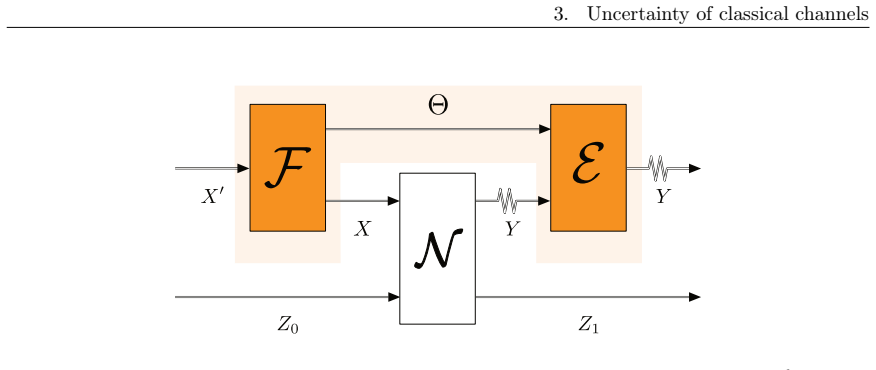
The load-bearing object is the classical superchannel in standard form: every classical superchannel decomposes uniquely as a sum of pre-processing maps and post-processing channels, and it is a random-permutation superchannel exactly when all of its post-processings are doubly stochastic. The axiomatic definition is carried by conditionally uniform channels—channels whose output marginal on Y is maximally mixed—and Theorem 3.2.8 proves that a classical superchannel is completely uniformity-preserving exactly when it is a random-permutation superchannel. Theorem 3.2.14 then equates that convertibility with dominance of winning chances in all t-games, via a Farkas-lemma linear-programming argument.
What would settle it
Enumerate all classical superchannels with two input and two output states in standard form and check whether every completely uniformity-preserving one is a random-permutation superchannel; a single counterexample would falsify Theorem 3.2.8. Equivalently, linear programming can test any channel pair for predictability dominance for all sorted vectors while checking whether no random-permutation superchannel exists, which would falsify Theorem 3.2.14.
Extended reading notes
Core claim
The paper's central claim is that uncertainty in a classical channel is not a matter of taste: the relation 'N is at least as uncertain as M' is the same preorder whether defined constructively (M is obtained from N by a random-permutation superchannel), axiomatically (a completely uniformity-preserving superchannel sends N to M), or operationally (N gives no worse winning chances than M in every t-game). The two load-bearing theorems are Theorem 3.2.8, which identifies completely uniformity-preserving superchannels with random-permutation superchannels, and Theorem 3.2.14, which equates this convertibility with dominance of t-game winning probabilities. On this preorder the paper defines classical channel entropy as an additive antitone and proves that the familiar state entropies extend to the channel domain, with minimal output entropy as the maximal extension of any quasiconcave entropy.
Load-bearing premise
The three definitions coincide only under the chosen axiom that legitimate operations must preserve not just the most random channel but every channel that is uniform on its output; this axiom is a modeling choice, not forced by the other two approaches.
Editorial extensions
If this is right
- Channel majorization is a single well-defined preorder, so any comparison of classical channels by uncertainty is invariant across the constructive, axiomatic, and operational perspectives.
- Replacement channels embed state majorization into channel majorization, meaning the new order directly generalizes the classical uncertainty order for probability vectors.
- Minimal output entropy is the maximal extension of any quasiconcave state entropy to classical channels, giving it a distinguished role among additive channel uncertainty measures.
- Max-entropy and min-entropy have unique extensions to the channel domain, so those two endpoint measures of state uncertainty lift to channels without ambiguity.
- The operational t-game characterization gives a finite test of channel majorization: a channel is at least as uncertain as another exactly when it never offers a higher winning chance in any guessing game.
Reading between the lines
- The three-way equivalence leans on a specific modeling choice: 'uncertainty non-decreasing' means preserving every conditionally uniform channel, not just the maximally randomizing one; a weaker axiom would leave the constructive and operational orders intact but could break the triality.
- Because the classical channel preorder is the incoherent slice of the quantum channel domain, the same axiomatic template could be used to define a majorization preorder for general quantum channels, with the classical result as the dephased special case.
- The t-game characterization suggests a decision-theoretic reading: channel entropy is exactly an additive utility consistent with dominance in every finite guessing game, so new candidate channel entropies can be tested by checking monotonicity under random-permutation superchannels.
Editorial analysis
A structured set of objections, weighed in public.
Referee Report
Summary. This manuscript, an MSc thesis, develops a majorization preorder for classical channels. It reviews majorization, relative majorization, and conditional majorization, then proposes three ways of defining channel majorization: constructively via random-permutation superchannels, axiomatically via completely uniformity-preserving superchannels, and operationally via t-game winning probabilities. The central result is that these three approaches coincide, so classical channel majorization is well defined. The paper then defines a channel entropy as an additive antitone of this preorder and studies the optimal extensions of state entropies to the channel domain, claiming that the usual state entropies are uniquely extended.
Significance. The main preorder results are coherent and valuable. The Farkas/linear-programming reduction in Theorem 3.2.14, the convex-combination argument in Theorem 3.2.4, and the standard-form partial-order argument in Theorem 3.3.6 are convincing, so the equivalence of the constructive, axiomatic, and operational definitions gives a genuine foundation for comparing channel uncertainty. The sandwich theorem for entropy extensions and the proof that min- and max-entropy have unique extensions are useful contributions. The manuscript is also transparent that some results and figures originate from the collaboration reported in [1].
major comments (2)
- [§3.2.2, Definition 3.2.7 and Theorem 3.2.8] The abstract's claim that the well-known state entropies are uniquely extended to channels is not supported by the text. Theorem 4.2.2 only establishes the sandwich L ≤ H' ≤ U for every extension H' of a state entropy H, where L = sup{H(q) : q ≻ N} and U = inf{H(q) : N ≻ q}; uniqueness follows only when L = U, and Theorem 4.2.6 proves this coincidence for min- and max-entropy only. For Shannon entropy the two optimal-extension bounds differ. Consider the standard-form channel N with columns p1 = (0.8, 0.1, 0.1)^T and p2 = (0.6, 0.4, 0)^T. A state q with q ≻ N must satisfy q1 ≥ 0.8 and q1 + q2 ≥ 1, so L = H(0.8, 0.2) ≈ 0.722. On the other side, the admissibility condition N ≻ q contains q = p1, and since the minimum of the concave function H over the convex hull of the columns is attained at an extreme point, U = H(p1) ≈ 0.922. Thus L < U, and the claim of a unique optimal extension is false for Shannon entropy; the abstract and the discussion in §4.2 should be revised to state that uniqueness holds for H_min and H_max, while for other entropies the optimal extensions only provide a sandwich.
- [Theorem 3.2.4, proof] The axiomatic approach rests on a postulate that is introduced only after plain uniformity preservation fails. The counterexample in §3.2.2 motivating the definition is legitimate, but the paper does not derive complete uniformity preservation from an independent operational principle; it is chosen so that the class of allowable superchannels matches the constructive random-permutation class. Consequently Theorem 3.2.8, although internally sound, partly builds the desired equivalence into the definition. For the advertised conceptual independence of the three approaches, the manuscript should either justify the complete-uniformity-preservation axiom from a prior principle, or explicitly present it as a normative modeling choice and discuss how sensitive the equivalence is to weakening it.
minor comments (4)
- [§2.3.1, Definition 2.3.4] The sum in the Ky Fan k-norm definition starts at i = 0 but should start at i = 1; also the norm is defined on Rn using absolute values, while the subsequent majorization definition for probability vectors does not require this, so the relationship should be made explicit.
- [Theorem 1.4.6] The domain notation for an entropy is ill-formed: the expression S_{n∈N} Prob(n) × Prob(n) is ambiguous, and the additivity condition under tensor product requires functions defined on probability vectors of varying dimension; this should be written as a union of product domains.
- [Theorem 3.2.4] The 'Krause representation' should be the 'Kraus representation'. There are also several minor typos elsewhere, such as 'purposed' for 'proposed', that should be corrected in a final pass.
- [Theorem 3.2.4, proof] The proof begins with 'N = N^↓', but the theorem is stated for arbitrary N; since every channel is equivalent to its non-increasing-column version by random-permutation superchannels, the reduction should be stated explicitly before invoking this assumption.
Circularity Check
No significant circularity: the three majorization characterizations are proven from stated definitions, and the only load-bearing use of prior work is non-circular; the abstract's 'uniquely extended' claim is an overgeneralization but not a circular step.
full rationale
The thesis proves its central equivalence theorems directly from the definitions it introduces. The constructive random-permutation superchannels, the axiomatic completely-uniformity-preserving superchannels, and the operational t-game winning chances are not identified with each other by definition; Theorem 3.2.8 and Theorem 3.2.14 supply actual arguments (including a Farkas-lemma duality step) for the equivalences. The choice of the 'completely uniformity-preserving' axiom is motivated by an explicit counterexample, and the equivalence with random-permutation superchannels is a substantive theorem rather than a restatement of the definition. No parameter is fitted to data and then renamed as a prediction. The self-citation to the author's own article [1] appears in the Preface and in figure credits only; the main theorems do not rest on an unverified result imported from that citation. The abstract's claim that 'the well-known entropies are uniquely extended' exceeds what Theorem 4.2.6 proves, since uniqueness is established only for min- and max-entropy while Shannon and other Renyi entropies generally have distinct optimal lower and upper extensions. That is a correctness or scope-of-claim problem, not a circularity: the theorem does not define the conclusion into its assumptions. Overall, no circular step in the derivation chain was found.
Assumptions & free parameters
assumptions (5)
- domain assumption Finite-dimensional Hilbert space framework
- standard math Birkhoff-von Neumann theorem (doubly stochastic matrices are convex combinations of permutations)
- standard math Farkas lemma and strong duality of linear programs
- ad hoc to paper Complete uniformity preservation axiom
- standard math Classical superchannel realization in standard form
Cite this review
Pith. "Pith review of Uncertainty and entropies of classical channels." pith.science (2026). https://pith.science/paper/IWESOGRR
@misc{pith2026250712310,
  author       = {Pith},
  title        = {Pith review of: Uncertainty and entropies of classical channels},
  year         = {2026},
  howpublished = {\url{https://pith.science/paper/IWESOGRR}},
  note         = {Machine review of arXiv:2507.12310}
}
read the original abstract
In this thesis, I studied a mathematical development to define and quantify the uncertainty inherent in classical channels. This thesis starts with the introduction and background on how to formally think about uncertainty in the domain of classical states. The concept of probability vector majorization and its variants, relative majorization and conditional majorization, are reviewed. This thesis introduces three conceptually distinct approaches to formalize the notion of uncertainty inherent in classical channels. These three approaches define the same preordering on the domain of classical channels, leading to characterizations from many perspectives. With the solid foundation of uncertainty comparison, classical channel entropy is then defined to be an additive monotone with respect to the majorization relation. The well-known entropies in the domain of classical states are uniquely extended to the domain of channels via the optimal extensions, providing not only a solid foundation but also the quantifiers of uncertainty inherent in classical channels.
Figures


Figures from the paper (10 more)




Reference graph
Works this paper leans on
-
[1]
Inevitable negativity: Additivity commands negative quantum channel en- tropy
Gour, G. et al. “Inevitable negativity: Additivity commands negative quantum channel en- tropy”. In:Phys. Rev. A111 (5 May 2025), p. 052424.doi: 10.1103/PhysRevA.111.052424
-
[2]
A mathematical theory of communication
Shannon, C. E. “A mathematical theory of communication”. In:The Bell System Tech. J.27.3 (1948), pp. 379–423.doi: 10.1002/j.1538-7305.1948.tb01338.x
arXiv 1948
-
[3]
Recent results in the Shannon theory
Wyner, A. “Recent results in the Shannon theory”. In: IEEE Trans. Inform. Theory 20.1 (1974), pp. 2–10.doi: 10.1109/tit.1974.1055171
-
[4]
A Resource Framework for Quantum Shannon Theory
Devetak, I., Harrow, A. W., and Winter, A. J. “A Resource Framework for Quantum Shannon Theory”. In: IEEE Trans. Inform. Theory54.10 (2008), pp. 4587–4618.doi: 10.1109/tit. 2008.928980
arXiv 2008
-
[5]
Conditions for coherence transformations under incoherent operations
Du, S., Bai, Z., and Guo, Y. “Conditions for coherence transformations under incoherent operations”. In:Phys. Rev. A91 (5 May 2015), p. 052120.doi: 10.1103/PhysRevA.91.052120
-
[6]
Operational Resource Theory of Coherence
Winter, A. J. and Yang, D. “Operational Resource Theory of Coherence.” In:Phys. Rev. Lett. 116 12 (2015), p. 120404
work page 2015
-
[7]
Comparison of incoherent operations and measures of coherence
Chitambar, E. and Gour, G. “Comparison of incoherent operations and measures of coherence”. In: Phys. Rev. A94 (5 Nov. 2016), p. 052336.doi: 10.1103/PhysRevA.94.052336
-
[8]
Operational one-to-one mapping between coherence and entanglement mea- sures
Zhu, H. et al. “Operational one-to-one mapping between coherence and entanglement mea- sures”. In:Phys. Rev. A96 (3 Sept. 2017), p. 032316.doi: 10.1103/PhysRevA.96.032316
Show all 76 references
-
[9]
Maximal coherence and the resource theory of purity
Streltsov, A. et al. “Maximal coherence and the resource theory of purity”. In:New J Phys20 (5 2018), p. 053058.doi: 10.1088/1367-2630/aac484
2018 doi
-
[10]
The second laws of quantum thermodynamics
Brandão, F. et al. “The second laws of quantum thermodynamics”. In:Proc. Natl. Acad. Sci. 112.11 (2015), pp. 3275–3279.doi: 10.1073/pnas.1411728112. 127
2015 doi
-
[12]
The resource theory of informational nonequilibrium in thermodynamics
Gour, G. et al. “The resource theory of informational nonequilibrium in thermodynamics”. In: Phys. Rep.583 (2015). The resource theory of informational nonequilibrium in thermodynam- ics, pp. 1–58.issn: 0370-1573. doi: 10.1016/j.physrep.2015.04.003
2015 doi
-
[13]
Thermodynamik quantenmechanischer Gesamtheiten
Neumann, J. v. “Thermodynamik quantenmechanischer Gesamtheiten”. ger. In:Nachr. Ges. Wiss. Gottingen, Math.-Phys. Kl.1927 (1927), pp. 273–291
1927
-
[14]
Entropy, von Neumann and the von Neumann Entropy
Petz, D. “Entropy, von Neumann and the von Neumann Entropy”. In:John von Neumann and the Foundations of Quantum Physics. Ed. by M. Rédei and M. Stöltzner. Dordrecht: Springer Netherlands, 2001, pp. 83–96.isbn: 978-94-017-2012-0.doi: 10.1007/978-94-017-2012-0_7
2001 doi
-
[15]
Concentrating partial entanglement by local operations
Bennett, C. H. et al. “Concentrating partial entanglement by local operations”. In:Phys. Rev. A 53 (4 Apr. 1996), pp. 2046–2052.doi: 10.1103/PhysRevA.53.2046
1996 doi
-
[16]
Conditions for a Class of Entanglement Transformations
Nielsen, M. A. “Conditions for a Class of Entanglement Transformations”. In:Phys. Rev. Lett. 83 (2 July 1999), pp. 436–439.doi: 10.1103/PhysRevLett.83.436
1999 doi
-
[17]
Entanglement monotones
Vidal, G. “Entanglement monotones”. In: J. Mod. Opt.47.2-3 (2000), pp. 355–376.doi: 10. 1080/09500340008244048
2000
-
[18]
Majorization and the interconversion of bipartite states
Nielsen, M. A. and Vidal, G. “Majorization and the interconversion of bipartite states”. In: Quantum Inf. Comput.1 (2001), pp. 76–93
2001
-
[19]
Quantifying Superposition
Aberg, J. Quantifying Superposition. 2006. arXiv:quant-ph/0612146 [quant-ph]
2006 arXiv
-
[20]
H., Littlewood, J
Hardy, G. H., Littlewood, J. E., and Pólya, G.Inequalities. Cambridge University Press, 1934
1934
-
[21]
Three observations on linear algebra
Birkhoff, G. “Three observations on linear algebra”. In:Univ. Nac. Tacuman, Rev. Ser. A5 (1946), pp. 147–151
1946
-
[22]
Conditional uncertainty principle
Gour, G. et al. “Conditional uncertainty principle”. In: Phys. Rev. A 97.4 (4 Apr. 2018), p. 042130. doi: 10.1103/PhysRevA.97.042130
2018 doi
-
[23]
Brandsen, S. et al. Quantum conditional entropy from information-theoretic principles. 2021. arXiv: 2110.15330 [quant-ph]
2021 arXiv
-
[24]
A-unital Operations and Quantum Conditional Entropy
Vempati, M. et al. “A-unital Operations and Quantum Conditional Entropy”. In:Quantum 6 (Feb. 2022), p. 641.issn: 2521-327x. doi: 10.22331/q-2022-02-02-641
2022 doi
-
[25]
Majorization formulation of uncertainty in quantum mechanics
Partovi, M. H. “Majorization formulation of uncertainty in quantum mechanics”. In: Phys. Rev. A84 (5 Nov. 2011), p. 052117.doi: 10.1103/PhysRevA.84.052117. 128
2011 doi
-
[27]
Majorization entropic uncertainty relations*
Puchała, Z., Rudnicki, Ł., and Życzkowski, K. “Majorization entropic uncertainty relations*”. In: J. Phys. A: Math. Theor.46.27 (June 2013), p. 272002.doi: 10.1088/1751-8113/46/27/ 272002
2013 doi
-
[28]
Fundamental limitations for quantum and nanoscale ther- modynamics
Horodecki, M. and Oppenheim, J. “Fundamental limitations for quantum and nanoscale ther- modynamics”. In:Nat. Commun.4.1 (June 26, 2013), p. 2059.doi: 10.1038/ncomms3059
2013 doi
-
[29]
Relative submajorization and its use in quantum resource theories
Renes, J. M. “Relative submajorization and its use in quantum resource theories”. In:J. Math. Phys. 57.12 (Dec. 2016), p. 122202.issn: 0022-2488. doi: 10.1063/1.4972295
2016 doi
-
[30]
The private classical capacity and quantum capacity of a quantum channel
Devetak, I. “The private classical capacity and quantum capacity of a quantum channel”. In: IEEE Trans. Inform. Theory51.1 (2005), pp. 44–55.doi: 10.1109/tit.2004.839515
2005
-
[31]
Entanglement-Assisted Communication of Classical and Quantum Information
Hsieh, M.-H. and Wilde, M. M. “Entanglement-Assisted Communication of Classical and Quantum Information”. In: IEEE Trans. Inform. Theory 56.9 (2010), pp. 4682–4704. doi: 10.1109/tit.2010.2053903
2010
-
[32]
NoisyChannelCodingviaPrivacyAmplificationandInformation Reconciliation
Renes,J.M.andRenner,R.“NoisyChannelCodingviaPrivacyAmplificationandInformation Reconciliation”. In:IEEE Trans. Inform. Theory57.11 (2011), pp. 7377–7385.doi: 10.1109/ tit.2011.2162226
2011
-
[33]
Strong converse exponents for a quantum channel discrimination problem and quantum-feedback-assisted communication
Cooney, T., Mosonyi, M., and Wilde, M. M. “Strong converse exponents for a quantum channel discrimination problem and quantum-feedback-assisted communication”. In:Commun. Math. Phys. 344.3 (2016), pp. 797–829
2016
-
[34]
A channel-based framework for steering, non-locality and beyond
Hoban, M. J. and Sainz, A. B. “A channel-based framework for steering, non-locality and beyond”. In:New J. Phys.20.5 (May 2018), p. 053048.doi: 10.1088/1367-2630/aabea8
2018 doi
-
[35]
Dynamical Entanglement
Gour, G. and Scandolo, C. M. “Dynamical Entanglement”. In:Phys. Rev. Lett.125 (18 Oct. 2020), p. 180505.doi: 10.1103/PhysRevLett.125.180505
2020 doi
-
[36]
Entanglement of a bipartite channel
Gour, G. and Scandolo, C. M. “Entanglement of a bipartite channel”. In:Phys. Rev. A103.6 (June 2021). doi: 10.1103/physreva.103.062422
2021 doi
-
[37]
Operational resource theory of quantum channels
Liu, Y. and Yuan, X. “Operational resource theory of quantum channels”. In:Phys. Rev. Res. 2 (1 Feb. 2020), p. 012035.doi: 10.1103/PhysRevResearch.2.012035
2020 doi
-
[38]
Quantifying Dynamical Coherence with Dy- namical Entanglement
Theurer, T., Satyajit, S., and Plenio, M. B. “Quantifying Dynamical Coherence with Dy- namical Entanglement”. In:Phys. Rev. Lett.125 (13 Sept. 2020), p. 130401.doi: 10.1103/ PhysRevLett.125.130401
2020
-
[39]
and Scandolo, C
Gour, G. and Scandolo, C. M.Dynamical Resources. 2020. arXiv:2101.01552 [quant-ph]. 129
2020 arXiv
-
[41]
Fundamental limitations on distillation of quantum channel re- sources
Regula, B. and Takagi, R. “Fundamental limitations on distillation of quantum channel re- sources”. In:Nat. Commun.12.1 (July 20, 2021), p. 4411.doi: 10.1038/s41467-021-24699- 0
2021 doi
-
[42]
One-Shot Manipulation of Dynamical Quantum Resources
Regula, B. and Takagi, R. “One-Shot Manipulation of Dynamical Quantum Resources”. In: Phys. Rev. Lett.127 (6 Aug. 2021), p. 060402.doi: 10.1103/PhysRevLett.127.060402
2021 doi
-
[43]
Experimental quantification of dynamical coherence via entangling two qubits
He, R.-D. et al. “Experimental quantification of dynamical coherence via entangling two qubits”. In:Opt. Express30.7 (Mar. 2022), pp. 10346–10353.doi: 10.1364/oe.453504
2022 doi
-
[44]
Teleporting an unknown quantum state via dual classical and Einstein- Podolsky-Rosen channels
Bennett, C. H. et al. “Teleporting an unknown quantum state via dual classical and Einstein- Podolsky-Rosen channels”. In:Phys. Rev. Lett.70 (13 Mar. 1993), pp. 1895–1899.doi: 10. 1103/PhysRevLett.70.1895
1993
-
[45]
Communication via one- and two-particle operators on Einstein-Podolsky-Rosen states
Bennett, C. H. and Wiesner, S. J. “Communication via one- and two-particle operators on Einstein-Podolsky-Rosen states”. In:Phys. Rev. Lett.69 (20 Nov. 1992), pp. 2881–2884.doi: 10.1103/PhysRevLett.69.2881
1992 doi
-
[46]
Hypothesis testing and entropies of quantum channels
Yuan, X. “Hypothesis testing and entropies of quantum channels”. In:Phys. Rev. A99 (3 Mar. 2019), p. 032317.doi: 10.1103/PhysRevA.99.032317
2019 doi
-
[47]
Quantifying the resource content of quantum channels: An operational approach
Li, L., Bu, K., and Liu, Z.-W. “Quantifying the resource content of quantum channels: An operational approach”. In:Phys. Rev. A101 (2 Feb. 2020), p. 022335.doi: 10.1103/PhysRevA. 101.022335
2020 doi
-
[48]
Entropy of a quantum channel
Gour, G. and Wilde, M. M. “Entropy of a quantum channel”. In:Phys. Rev. Res.3 (2 May 2021), p. 023096.issn: 2643-1564. doi: 10.1103/PhysRevResearch.3.023096
2021 doi
-
[49]
Positive functions onC ∗-algebras
Stinespring, W. F. “Positive functions onC ∗-algebras”. In:Proceedings of the American Math- ematical Society6.2 (1955), pp. 211–6.doi: 10.1090/s0002-9939-1955-0069403-4
1955 doi
-
[50]
Quantum resource theories
Gour, G. Quantum resource theories. eng. Cambridge University Press, 2025. isbn: 1-009- 56090-5
2025
-
[51]
Kraus, K. et al. States, effects, and operations : fundamental notions of quantum theory : lectures in mathematical physics at the University of Texas at Austin. eng. Lecture notes in physics ; 190. Berlin: Springer-Verlag, 1983.isbn: 3540127321
1983
-
[52]
Transforming quantum operations: Quan- tum supermaps
Chiribella, G., D’Ariano, G. M., and Perinotti, P. “Transforming quantum operations: Quan- tum supermaps”. In:Europhys. Lett.83.3 (2008), p. 30004
2008
-
[53]
Comparison of quantum channels by superchannels
Gour, G. “Comparison of quantum channels by superchannels”. In:IEEE Trans. Inform. The- ory 65.9 (2019), pp. 5880–5904.doi: 10.1109/tit.2019.2907989. 130
2019
-
[55]
Universal Uncertainty Relations
Friedland, S., Gheorghiu, V., and Gour, G. “Universal Uncertainty Relations”. In:Phys. Rev. Lett. 111 (23 Dec. 2013), p. 230401.doi: 10.1103/PhysRevLett.111.230401
2013 doi
-
[56]
Whatisentropy?Aperspectivefromgamesofchance
Brandsen,S.,Geng,I.J.,andGour,G.“Whatisentropy?Aperspectivefromgamesofchance”. In: Phys. Rev. E105 (2 Feb. 2022), p. 024117.doi: 10.1103/PhysRevE.105.024117
2022 doi
-
[57]
W., Olkin, I., and Arnold, B
Marshall, A. W., Olkin, I., and Arnold, B. C. Inequalities: Theory of Majorization and Its Applications. 2nd ed. Springer Series in Statistics. Springer, 2011.doi: 10.1007/978-0-387- 68276-1
2011 doi
-
[58]
On Measures of Entropy and Information
Rényi, A. “On Measures of Entropy and Information”. In:Berkeley Symp. on Math. Statist. and Prob.(1961), pp. 547–561
1961
-
[59]
Khinchin, A. Y. Mathematical foundations of information theory. New York: Dover, 1957
1957
-
[60]
Why the Shannon and Hartley entropies are ‘natural’
Aczél, J., Forte, B., and Ng, C. T. “Why the Shannon and Hartley entropies are ‘natural’”. In: Adv. Appl. Probab.6.1 (1974), pp. 131–146.doi: 10.2307/1426210
1974 doi
-
[61]
An axiomatic definition of Shannon’s entropy
Nambiar, K., Varma, P. K., and Saroch, V. “An axiomatic definition of Shannon’s entropy”. In: Appl. Math. Lett.5.4 (1992), pp. 45–46.issn: 0893-9659.doi: 10.1016/0893-9659(92)90084- M
1992 doi
-
[62]
Entropy and Relative Entropy From Information-Theoretic Principles
Gour, G. and Tomamichel, M. “Entropy and Relative Entropy From Information-Theoretic Principles”. In:IEEE Trans. Inform. Theory67.10 (2021), pp. 6313–6327.doi: 10.1109/tit. 2021.3078337
2021
-
[63]
The incompleteness of Rényi entropies
Hässelbarth, W. “The incompleteness of Rényi entropies”. In:Theor. Chim. Acta70.2 (Aug. 1986), pp. 119–121.issn: 1432-2234. doi: 10.1007/bf00532209
1986 doi
-
[64]
On Information and Sufficiency
Kullback, S. and Leibler, R. A. “On Information and Sufficiency”. In:The Annals of Mathe. Statist. 22.1 (1951), pp. 79–86.doi: 10.1214/aoms/1177729694
1951
-
[65]
Optimal extensions of resource measures and their applica- tions
Gour, G. and Tomamichel, M. “Optimal extensions of resource measures and their applica- tions”. In:Phys. Rev. A102 (6 Dec. 2020), p. 062401.doi: 10.1103/PhysRevA.102.062401
2020 doi
-
[66]
Semicausal operations are semilocalizable
Eggeling, T., Schlingemann, D., and Werner, R. F. “Semicausal operations are semilocalizable”. In: Europhys. Lett.57.6 (Mar. 2002), p. 782.doi: 10.1209/epl/i2002-00579-4
2002 doi
-
[67]
Dynamical resource theory of quantum coherence
Saxena, G., Chitambar, E., and Gour, G. “Dynamical resource theory of quantum coherence”. In: Phys. Rev. Res.2 (2 June 2020), p. 023298.doi: 10.1103/PhysRevResearch.2.023298
2020 doi
-
[68]
Gour, G. et al. Inevitable Negativity: Additivity Commands Negative Quantum Channel En- tropy. 2024. arXiv:2406.13823 [quant-ph]. 131
2024 arXiv
-
[69]
Conclusion and outlook
-
[70]
Minimal entropy of states emerging from noisy quantum channels
King, C. and Ruskai, M. “Minimal entropy of states emerging from noisy quantum channels”. In: IEEE Trans. Inform. Theory47.1 (2001), pp. 192–209.doi: 10.1109/18.904522
2001 doi
-
[71]
Das, S., Goswami, K., and Pandey, V.Conditional entropy and information of quantum pro- cesses. 2024. arXiv:2410.01740 [quant-ph]
2024 arXiv
-
[72]
Trade-off relations for operation entropy of complementary quantum channels
Czartowski, J., Braun, D., and Życzkowski, K. “Trade-off relations for operation entropy of complementary quantum channels”. In:Int. J. Quantum Inf.17.05 (2019), p. 1950046. doi: 10.1142/s0219749919500461
2019 doi
-
[73]
An entropy function of a quantum channel
Chu, Y. et al. “An entropy function of a quantum channel”. In:Quantum Inf Process22.1 (Dec. 2022), p. 27.issn: 1573-1332. doi: 10.1007/s11128-022-03778-1
2022 doi
-
[74]
TheOperationalMeaningofMin-andMax-Entropy
Konig,R.,Renner,R.,andSchaffner,C.“TheOperationalMeaningofMin-andMax-Entropy”. In: IEEE Trans. Inform. Theory 55.9 (2009), pp. 4337–4347. doi: 10 . 1109 / tit . 2009 . 2025545
2009
-
[75]
Probability : Theory and Examples
Durrett, R. Probability : Theory and Examples. eng. Fifth edition. Cambridge series in statis- tical and probabilistic mathematics ; 49. Cambridge, England: Cambridge University Press,
-
[76]
Probability and measure
Billingsley, P. Probability and measure. eng. Anniversary ed. Wiley series in probability and statistics. Hoboken, N.J: Wiley, 2012.isbn: 9781118122372. 132 Appendix A Miscellaneous A.1 Probability theory and Shannon entropy We present necessary terminologies and theorems from...
2012
-
[77]
for any A ∈ F, we haveP (A) > P(∅) = 0, and
-
[78]
Definition A.1.2.Given a probability space(Ω, F , P)
for any countable collections of disjoint sets{Ai : i ∈ N} ⊆ F, we have that P [ i∈NAi ! = X i∈N P (Ai) Central to probability theory is a notion of random variable, which actually is a function rather than a variable. Definition A.1.2.Given a probability space(Ω, F , P). A fu...
-
[79]
A vector b is in a conic hull of{a1, . . . ,an}
-
[80]
There is n such that n · ai ≥ 0 and n · b < 0 for all i ∈ [n]. Proof. Notice that b is either inside or outside the cone. It is enough to show that2 is equivalent with b being outside the cone. Denote the cone byK. Suppose that b is outside K, then there exists a hyperplane se...
Reviewed August 6, 2026 · model on record in the stance chip above.
Discussion (0). Sign in to comment.