REVIEW 3 major objections 5 minor 54 references
Invariant non-equilibrium dynamics of transcriptional regulation optimize information flow
T0 review · 3 major / 5 minor · reviewed 2026-08-06 · deepseek-v4-flash
Pith's one-line read A constant promoter switching time across expression levels forces non-equilibrium four-state regulation and marks near-optimal information flow.
desk verdict A smart model-class result about TC-invariance and non-equilibrium cycles that overstates its own universality; worth engaging, but the minimality proof is not as general as the Discussion implies. read the letter →
The pith
A machine-rendered reading of the paper's core claim, the machinery that carries it, and where it could break.
The reading
What carries the argument
The load-bearing object is the four-state "cycle model" of promoter regulation: states $00$, $10$, $01$, $11$ tracking enhancer activity (first bit) and promoter activity (second bit), with a TF binding rate $f$ that tunes mean activity and an unbinding rate $b = 60\,\text{min}^{-1}$. The rates are reparametrized into control parameters $r$ (basal deactivation), $\eta$ (balance between enhancer facilitation, $\alpha_1 = E^{2\eta}$, and stabilization, $\beta_1 = E^{2(1-\eta)}$), $\gamma$ (cycle directionality, with $\gamma = 0$ the detailed-balance manifold), and $\nu$ (branch asymmetry). Two analytical tools carry the argument: the noise-filtering mismatch $\Delta = \max_\tau |\phi_2(\tau) - \phi_N(\tau)| \leq \delta$, which defines when a multi-state model is faithfully coarse-grainable to a two-state model (and is satisfied exactly, $\delta = 0$, precisely when $T_C$ is strictly invariant and equal to $1/(q+r)$), and the information-theoretic channel $p(M|P_{ON})$ through an mRNA birth-death process, whose capacity defines information flow $I$, paired with the switching speed $V = \langle 1/T_C \rangle$ as the kinetic constraint. The Pareto front of $I$ versus $V$ is the locus where flat $T_C$ functions appear.
What would settle it
Measure, in any organism, the full $T_C(P_{ON})$ curve at single-gene temporal resolution over a $10^3$-fold expression range and find the correlation time varying systematically with expression level beyond the measurement noise—that would remove the phenomenon the paper explains. Conversely, exhibit any Markov model satisfying detailed balance with any number of states that yields exactly constant $T_C$ over that range, and the claim that invariance requires broken detailed balance is refuted; the authors' own analytical result covers only the four-state cycle class.
Extended reading notes
Core claim
The central discovery is a necessity result with a functional payoff. Within a broad class of continuous-time Markov models of a promoter regulated by a transcription factor, a strictly invariant switching correlation time $T_C = T_{ON}T_{OFF}/(T_{ON}+T_{OFF})$ forces the architecture to have four states and to violate detailed balance: two-state models require implausible fine-tuning of rates, multi-site cooperative equilibrium models tie $T_C$ to the TF residence time $1/b$ and lose two-state interpretability, and a three-state reduction fails. The minimal successful scheme is a four-state cycle in which an enhancer both facilitates promoter activation and stabilizes the active state; when these two effects are balanced ($\eta \approx 1/2$) and TF binding is fast compared with promoter switching, the model coarse-grains exactly into a two-state description with constant $T_C = 1/(q+r)$. The authors prove analytically that no assignment of rates satisfying detailed balance within this cycle yields invariant $T_C$, and demonstrate numerically that non-equilibrium cycle models sit on—and the best-fit Drosophila model sits near—the Pareto front of information flow versus switching speed, where flat $T_C$ functions are the signature of optimal information transmission under a kinetic constraint.
Load-bearing premise
The argument stands on the empirical claim, taken from a preprint co-authored by two of this paper's authors, that the switching correlation time $T_C$ is truly constant—precisely, and across genes and organisms—so that $T_C$-invariance is a real experimental law; if that invariance is approximate, gene-specific, or measurement-dependent, the minimality proof and the optimality link lose their empirical footing.
Editorial extensions
If this is right
- Measured $T_C$-invariance becomes a diagnostic: a flat $T_C(P_{ON})$ plateau in any system implies at least four promoter states and a non-equilibrium cycle, so single-cell time-course data can now rule out equilibrium architectures.
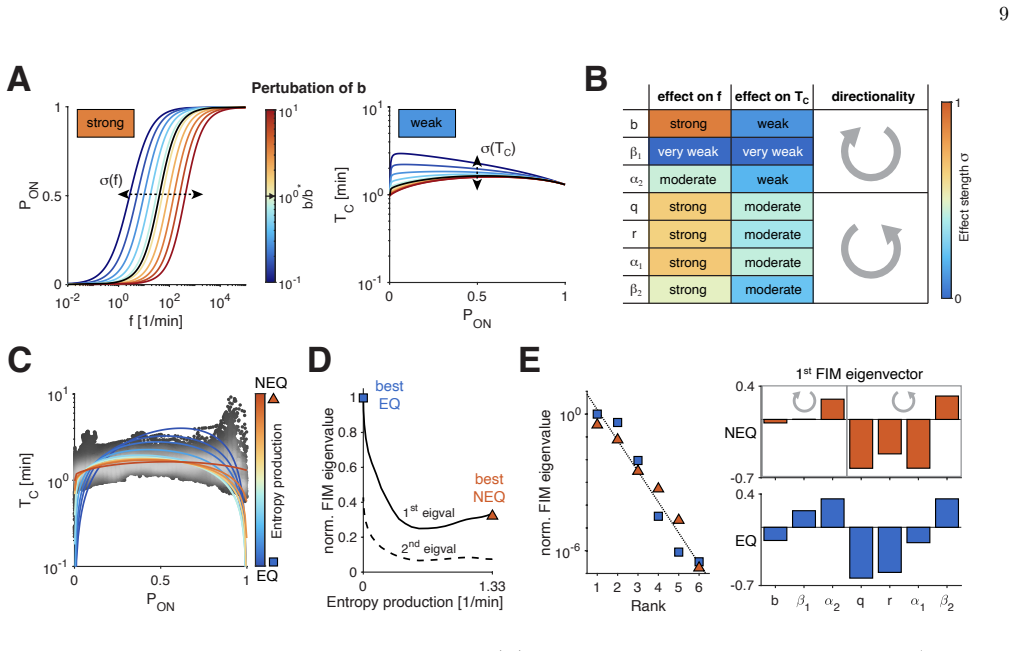
- Non-equilibrium operation pays for itself: relative to the best equilibrium models at the same switching speed, the cycle model gains up to roughly one bit of information transmission, enough to be a meaningful selection target.
- The model predicts specific perturbation robustness: changing TF residence time, TF levels, or enhancer mutations shifts induction curves strongly but leaves $T_C$ nearly untouched, because only the cycle-aligned rates ($q$, $r$, $\alpha_1$) carry the sensitivity.
- Optimality is not a single point: ensembles of near-optimal models with moderate dissipation approach the performance plateau, implying that evolution may favor solutions with reaction rates two orders of magnitude slower than the theoretical maximum would require.
- The switching-speed constraint, not energy dissipation alone, is the operative bottleneck: equilibrium models with fast kinetics can suppress noise, so a complete theory of regulatory design must identify what caps $V$.
Reading between the lines
- If the cited preprint's report of cross-species conservation holds, the framework predicts convergent evolution: organisms from yeast to mammals should show flat $T_C$ plateaus together with detectable energy dissipation in promoter dynamics, a combination checkable in existing and future time-series datasets.
- A direct experimental test the paper leaves implicit: engineering an enhancer that biases the facilitation-stabilization balance away from $\eta \approx 1/2$ should bow the $T_C(P_{ON})$ curve, and reversing the cycle's flux direction should destroy invariance while preserving the induction curve.
- The information-optimality link suggests a broader principle: any stochastic molecular switch whose downstream readout integrates over a fixed window may be selected to keep its switching correlation time constant across its operating range, extending the argument from transcription to signaling and post-transcriptional regulation.
- Because the Fisher-information analysis shows only a few rate combinations are constrained by $T_C$ data, higher-temporal-resolution measurements resolving short-time ON/OFF distributions could discriminate the cycle topology from alternative non-equilibrium architectures, which current data cannot do.
Editorial analysis
A structured set of objections, weighed in public.
Referee Report
Summary. The paper claims that the empirically observed invariance of the promoter switching correlation time TC across expression levels requires regulatory architectures with at least four promoter states and broken detailed balance, and that this invariance is a signature of optimized information flow under a kinetic switching-speed constraint. The authors construct a four-state cycle model, fit it to Drosophila gap gene data, show analytically that equilibrium models within this cycle class cannot produce flat TC, rule out the four asymptotic three-state limits of the cycle, and then use numerical sampling of effective two-state models and cycle models to argue that TC-invariance lies on the Pareto front of information flow versus switching speed. The manuscript also reports robustness analyses and Fisher Information Matrix results for the fitted model.
Significance. If the universal necessity claim were established, the paper would provide a striking bridge from an empirical scaling law to non-equilibrium mechanism and evolutionary optimality. The specific contributions are solid and well integrated: Bayesian inference on single-cell transcription data, an analytical proof within the four-state cycle class, a clear coarse-graining criterion, a systematic perturbation analysis, and a quantitative Pareto-front framework linking information flow to switching speed. The paper is also careful to present numerical support and to acknowledge the lack of a general proof for the optimality link. However, the headline conclusion substantially overreaches the presented proofs, since the minimality and non-equilibrium necessity results are established only for a restricted model class, not for all possible three- or four-state regulatory networks.
major comments (3)
- [Results (cycle model); Fig. S6; SI Sec. 5.7] The Abstract and Discussion state that reproducing TC-invariance 'requires' at least four promoter states and broken detailed balance, but this universal necessity is not proven. SI Sec. 5.7 is explicitly restricted to the four-state cycle model class ('a result we prove analytically for all r and η within the four-state cycle model class'), and Fig. S6 examines only four asymptotic three-state limits of that same cycle. A generic three-state continuous-time Markov chain with two TF-dependent rates, or an equilibrium four-state network outside this cycle class, is not ruled out; in particular, the dismissal of Limit IV as non-mechanistic relies on an infinite-rate limit and an omitted reverse transition. Since this is the central claim of the paper, the conclusion should be narrowed to 'within the cycle-model class' or supported by an exhaustive search or proof over the relevant space of small regulatory networks.
- [Introduction; Ref. [9]] The empirical premise of TC-invariance is load-bearing and comes from Ref. [9], a preprint co-authored by two of the present authors. The manuscript asserts this invariance as established across 'diverse genes and organisms,' but the main-text analysis fits only Drosophila data. If the invariance is less precise or less universal than reported, the fitted constraints, the minimality argument, and the optimality link all lose their empirical anchor. The paper should either include the relevant data and error analysis or explicitly frame all conclusions as conditional on the validity of this empirical claim.
- [Results (Fig. 3); Discussion] The statement that TC-invariance is 'a specific consequence of optimizing information flow under kinetic constraints' is supported only numerically, and the Discussion explicitly notes that a general analytical proof remains elusive. Moreover, the result depends on the particular choice of switching-speed constraint V = <1/TC>; the manuscript itself acknowledges that the appropriate mathematical form of the kinetic constraint is unclear. The claim should therefore be presented as a numerical conjecture, and the sensitivity of the Pareto front to alternative constraints (e.g., a bound on the maximum reaction rate) should be checked before a general optimality conclusion is drawn.
minor comments (5)
- [Figure captions] Several figure captions contain typos: 'TC-invariace' in Fig. 1B, 'Pertubation of b' in Fig. 4A, 'Informarion flow' in Fig. 3A and Fig. S7, and 'Informatipon flow' in Fig. S8.
- [Results] In the paragraph introducing the coarse-graining criterion, the phrase 'satisfies the the two-state criterion' contains a duplicated article.
- [Eq. (1) and SI Appendix Sec. 5.8] The coarse-graining criterion δ is defined, but the relationship between the exact condition δ = 0 and the practical threshold δ < 0.1 is described only in prose; a precise statement of how δ controls the effective two-state approximation would improve reproducibility.
- [Fig. 2B caption] The caption states that 'uninformative priors' and a 'Gaussian likelihood in log-space' were used, but the likelihood function and prior ranges are not given in the main text; please provide these details in the SI.
- [Fig. S7 and main text] The notation for information flow is inconsistent: the main text uses I, while Fig. S7 uses Φ; please unify the notation.
Circularity Check
No significant circularity: the information-optimality result is an independent computation, and the empirical TC-invariance input is external data.
full rationale
The paper's central empirical input is TC-invariance, cited to [9,11]. Although both references include present authors, the invariance is a measured, externally falsifiable quantity that is not derived within this paper, so the self-citation does not make the argument circular. The four-state cycle model is admittedly constructed so that two embedded two-state models share identical TC, but the paper does not present this construction as a prediction; it is an explicit modeling choice. The claimed functional result—that invariant TC arises on the Pareto front of information flow versus switching speed—is obtained by sampling generic TC(PON) functions and computing channel capacities with an independent objective (Arimoto-Blahut), not by fitting or renaming the TC data. The analytic no-equilibrium-invariance result and the coarse-graining condition are stated within the cycle-model class. The main weakness is scope: the universal claim that TC-invariance requires at least four states and broken detailed balance is stronger than the cycle-class proof and the four three-state limits in Fig. S6 support. That is an overgeneralization/correctness concern, not circularity, because no load-bearing step reduces to its own input by construction.
Assumptions & free parameters
free parameters (4)
- r =
1.04 min^-1
- eta =
0.48
- gamma =
-6.32
- nu =
-1.69
assumptions (6)
- domain assumption Promoter activity can be modeled as a continuous-time Markov process over discrete states.
- domain assumption The empirical T_C-invariance from ref [9] is accurate and universal across expression levels.
- ad hoc to paper Coverage of the model space via the specific cycle topology and its limits is sufficient to conclude minimality.
- domain assumption Information flow is quantified by channel capacity with unconstrained input distribution p(P_ON).
- ad hoc to paper The switching speed constraint V = <1/T_C> is the relevant kinetic limit.
- domain assumption Coarse-grainability to a two-state model is required and measured by Delta <= delta.
Cite this review
Pith. "Pith review of Invariant non-equilibrium dynamics of transcriptional regulation optimize information flow." pith.science (2026). https://pith.science/paper/CHCMBXNV
@misc{pith2026250712395,
  author       = {Pith},
  title        = {Pith review of: Invariant non-equilibrium dynamics of transcriptional regulation optimize information flow},
  year         = {2026},
  howpublished = {\url{https://pith.science/paper/CHCMBXNV}},
  note         = {Machine review of arXiv:2507.12395}
}
abstract
Eukaryotic gene regulation is based on stochastic yet controlled promoter switching, during which genes transition between transcriptionally active and inactive states. Despite the molecular complexity of this process, recent studies reveal a surprising invariance of the "switching correlation time" ($T_C$), which characterizes promoter activity fluctuations, across gene expression levels in diverse genes and organisms. A biophysically plausible explanation for this invariance remains missing. Here, we show that this invariance imposes stringent constraints on minimal yet plausible models of transcriptional regulation, requiring at least four system states and non-equilibrium dynamics that break detailed balance. Using Bayesian inference on Drosophila gap gene expression data, we demonstrate that such models (i) accurately reproduce the observed $T_C$-invariance; (ii) remain robust to parameter perturbations; and (iii) maximize information transmission from transcription factor concentration to gene expression. These findings suggest that eukaryotic gene regulation has evolved to balance precision with reaction rate and energy dissipation constraints, favoring non-equilibrium architectures for optimal information transmission.
Figures


Figures from the paper (1 more)
Reference graph
Works this paper leans on
-
[9]
P.-T. Chen, B. Zoller, M. Levo, and T. Gregor, Com- mon bursting relationships underlie eukaryotic transcrip- tion dynamics, arXiv 10.48550/arxiv.2304.08770 (2023), 2304.08770
-
[1]
J. Rodriguez and D. R. Larson, Transcription in Living Cells: Molecular Mechanisms of Bursting, Annual Re- view of Biochemistry89, 1 (2020)
work page 2020
-
[2]
J.V.MeeussenandT.L.Lenstra,Timewilltell: compar- ing timescales to gain insight into transcriptional burst- ing, Trends in Genetics 10.1016/j.tig.2023.11.003 (2024)
-
[3]
W. J. d. Jonge, H. P. Patel, J. V. Meeussen, and T. L. Lenstra, Following the tracks: How transcription fac- tor binding dynamics control transcription, Biophysical Journal 121, 1583 (2022)
work page 2022
-
[4]
K. Wagh, D. A. Stavreva, A. Upadhyaya, and G. L. Hager, Transcription Factor Dynamics: One Molecule at a Time, Annual Review of Cell and Developmental Biol- ogy 39, 277 (2023)
work page 2023
-
[5]
J. Rodriguez, G. Ren, C. R. Day, K. Zhao, C. C. Chow, and D. R. Larson, Intrinsic Dynamics of a Human Gene Reveal the Basis of Expression Heterogeneity, Cell176, 213 (2019)
work page 2019
-
[6]
Y. Wan, D. G. Anastasakis, J. Rodriguez, M. Palan- gat, P. Gudla, G. Zaki, M. Tandon, G. Pegoraro, C. C. Chow, M. Hafner, and D. R. Larson, Dynamic imaging of nascent RNA reveals general principles of transcription dynamics and stochastic splice site selection, Cell184, 2878 (2021)
work page 2021
-
[7]
K. Tantale, E. Garcia-Oliver, M.-C. Robert, A. L’Hostis, Y. Yang, N. Tsanov, R. Topno, T. Gostan, A. Kozulic- Pirher, M. Basu-Shrivastava, K. Mukherjee, V. Slani- nova, J.-C. Andrau, F. Mueller, E. Basyuk, O. Rad- ulescu, and E. Bertrand, Stochastic pausing at latent HIV-1 promoters generates transcriptional bursting, Na- ture Communications12, 4503 (2021)
work page 2021
Show all 54 references
-
[8]
V. L. Pimmett, M. Dejean, C. Fernandez, A. Trullo, E. Bertrand, O. Radulescu, and M. Lagha, Quantita- tive imaging of transcription in living Drosophila em- bryos reveals the impact of core promoter motifs on pro- moter state dynamics, Nature Communications12, 4504 (2021)
2021
-
[10]
Trzaskoma, S
P. Trzaskoma, S. Jung, A. Pękowska, C. H. Bohrer, X. Wang, F. Naz, S. Dell’Orso, W. D. Dubois, A. Oliv- era, S. V. Vartak, Y. Zhao, S. Nayak, A. Overmiller, 12 M. I. Morasso, V. Sartorelli, D. R. Larson, C. C. Chow, R. Casellas, and J. J. O’Shea, 3D chromatin architecture, BRD...
2024
-
[11]
Zoller, S
B. Zoller, S. C. Little, and T. Gregor, Diverse Spatial Ex- pression Patterns Emerge from Unified Kinetics of Tran- scriptional Bursting, Cell175, 835 (2018)
2018
-
[12]
Paulsson, Models of stochastic gene expression, Physics of Life Reviews2, 157 (2005)
J. Paulsson, Models of stochastic gene expression, Physics of Life Reviews2, 157 (2005)
2005
-
[13]
A. Raj, C. S. Peskin, D. Tranchina, D. Y. Vargas, and S. Tyagi, Stochastic mRNA Synthesis in Mammalian Cells, PLoS Biology4, e309 (2006)
2006
-
[14]
Tkačik, T
G. Tkačik, T. Gregor, and W. Bialek, The Role of Input Noise in Transcriptional Regulation, PLoS ONE3, e2774 (2008), q-bio/0701002
2008 arXiv
-
[15]
J. M. Smith, Optimization theory in evolution, Annual review of ecology and systematics9, 31 (1978)
1978
-
[16]
Hledík, N
M. Hledík, N. Barton, and G. Tkačik, Accumulation and maintenance of information in evolution, Proceedings of the National Academy of Sciences119, e2123152119 (2022)
2022
-
[17]
T. R. Sokolowski, T. Gregor, W. Bialek, and G. Tkačik, Deriving a genetic regulatory network from an optimiza- tion principle, Proceedings of the National Academy of Sciences 122, e2402925121 (2025)
2025
-
[18]
Młynarski, M
W. Młynarski, M. Hledík, T. R. Sokolowski, and G. Tkačik, Statistical analysis and optimality of neural systems, Neuron109, 1227 (2021)
2021
-
[19]
Zoller, T
B. Zoller, T. Gregor, and G. Tkačik, Eukaryotic gene regulation at equilibrium, or non?, Current Opinion in Systems Biology , 100435 (2022)
2022
-
[20]
Tkačik and P
G. Tkačik and P. R. t. Wolde, Information processing in biochemical networks, Annual Review of Biophysics54 (2025)
2025
-
[21]
Tkačik, C
G. Tkačik, C. G. Callan, and W. Bialek, Information flow and optimization in transcriptional regulation, Pro- ceedings of the National Academy of Sciences105, 12265 (2008), 0705.0313
2008 arXiv
-
[22]
C. C. Govern and P. R. t. Wolde, Optimal resource al- location in cellular sensing systems, Proceedings of the National Academy of Sciences111, 17486 (2014)
2014
-
[23]
R. Grah, B. Zoller, and G. Tkačik, Nonequilibrium mod- els of optimal enhancer function, Proceedings of the Na- tional Academy of Sciences117, 31614 (2020)
2020
-
[24]
S. A. Cepeda-Humerez, G. Rieckh, and G. Tkačik, Stochastic proofreading mechanism alleviates crosstalk in transcriptional regulation, Physical review letters115, 248101 (2015)
2015
-
[25]
Estrada, F
J. Estrada, F. Wong, A. DePace, and J. Gunawardena, Information Integration and Energy Expenditure in Gene Regulation, Cell166, 234 (2016)
2016
-
[26]
Scholes, A
C. Scholes, A. H. DePace, and A. Sanchez, Com- binatorial Gene Regulation through Kinetic Con- trol of the Transcription Cycle, Cell Systems 4, 10.1016/j.cels.2016.11.012 (2017)
2017 doi
-
[27]
N. C. Lammers, A. I. Flamholz, and H. G. Garcia, Competing constraints shape the nonequilibrium limits of cellular decision-making, Proceedings of the National Academy of Sciences120, e2211203120 (2023)
2023
-
[28]
Martinez-Corral, K.-M
R. Martinez-Corral, K.-M. Nam, A. H. DePace, and J. Gunawardena, The Hill function is the universal Hop- field barrier for sharpness of input–output responses, Proceedings of the National Academy of Sciences121, e2318329121 (2024)
2024
-
[29]
M. L. Perkins, J. Crocker, and G. Tkačik, Chromatin en- ables precise and scalable gene regulation with factors of limited specificity, Proceedings of the National Academy of Sciences122, e2411887121 (2025)
2025
-
[30]
D. M. Suter, N. Molina, D. Gatfield, K. Schneider, U. Schibler, and F. Naef, Mammalian Genes Are Tran- scribed with Widely Different Bursting Kinetics, Science 332, 472 (2011)
2011
-
[31]
Zoller, D
B. Zoller, D. Nicolas, N. Molina, and F. Naef, Structure of silent transcription intervals and noise characteristics of mammalian genes, Molecular Systems Biology11, 823 (2015)
2015
-
[32]
C. Li, F. Cesbron, M. Oehler, M. Brunner, and T. Höfer, Frequency Modulation of Transcriptional Bursting En- ables Sensitive and Rapid Gene Regulation, Cell Systems 6, 409 (2018)
2018
-
[33]
Wong and J
F. Wong and J. Gunawardena, Gene regulation in and out of equilibrium, Annual review of biophysics49, 199 (2020)
2020
-
[34]
Shelansky, S
R. Shelansky, S. Abrahamsson, M. Doody, C. R. Brown, H. P. Patel, T. L. Lenstra, D. R. Larson, and H. Boeger, A Telltale Sign of Irreversibility in Transcriptional Reg- ulation, bioRxiv , 2022.06.27.497819 (2022)
2022
-
[35]
P. B. Warren, S. Tănase-Nicola, and P. R. t. Wolde, Ex- act results for noise power spectra in linear biochemical reaction networks, The Journal of Chemical Physics125, 144904 (2006), q-bio/0512041
2006 arXiv
-
[36]
Lestas, J
I. Lestas, J. Paulsson, N. E. Ross, and G. Vinnicombe, Noise in Gene Regulatory Networks, IEEE Transactions on Automatic Control53, 189 (2008)
2008
-
[37]
Tkačik, C
G. Tkačik, C. G. Callan Jr, and W. Bialek, Information capacity of genetic regulatory elements, Physical Review E—Statistical, Nonlinear, and Soft Matter Physics78, 011910 (2008)
2008
-
[38]
Rieckh and G
G. Rieckh and G. Tkačik, Noise and information trans- mission in promoters with multiple internal states, Bio- physical journal106, 1194 (2014)
2014
-
[39]
L. A. Mirny, Nucleosome-mediated cooperativity be- tween transcription factors, Proceedings of the National Academy of Sciences107, 22534 (2010), 0901.2905
2010 arXiv
-
[40]
Tkačik and A
G. Tkačik and A. M. Walczak, Information transmis- sion in genetic regulatory networks: a review, Jour- nal of Physics: Condensed Matter 23, 153102 (2011), 1101.4240
2011 arXiv
-
[41]
Blahut, Computation of channel capacity and rate- distortion functions, IEEE Transactions on Information Theory 18, 460 (1972)
R. Blahut, Computation of channel capacity and rate- distortion functions, IEEE Transactions on Information Theory 18, 460 (1972)
1972
-
[42]
M. K. Transtrum, B. B. Machta, K. S. Brown, B. C. Daniels, C. R. Myers, and J. P. Sethna, Perspective: Sloppiness and emergent theories in physics, biology, and beyond, The Journal of Chemical Physics143, 010901 (2015)
2015
-
[43]
W. J. Blake, M. Kærn, C. R. Cantor, and J. J. Collins, Noise in eukaryotic gene expression, Nature 422, 633 (2003)
2003
-
[44]
Shelansky, S
R. Shelansky, S. Abrahamsson, C. R. Brown, M. Doody, T. L. Lenstra, D. R. Larson, and H. Boeger, Single gene analysis in yeast suggests nonequilibrium regulatory dy- namics for transcription, Nature Communications 15, 6226 (2024)
2024
-
[45]
S. D. Mahdavi, G. L. Salmon, P. Daghlian, H. G. Garcia, and R. Phillips, Flexibility and sensitivity in gene reg- ulation out of equilibrium, Proceedings of the National 13 Academy of Sciences121, e2411395121 (2024)
2024
-
[46]
Tünnermann, G
J. Tünnermann, G. Roth, J. Cramard, and L. Giorgetti, Enhancer control of promoter activity and variability via frequency modulation of clustered transcriptional bursts, bioRxiv , 2025 (2025)
2025
-
[47]
Reinhardt, G
M. Reinhardt, G. Tkačik, and P. R. Ten Wolde, Path weight sampling: Exact monte carlo computation of the mutual information between stochastic trajectories, Physical Review X13, 041017 (2023)
2023
-
[48]
B. B. Machta, R. Chachra, M. K. Transtrum, and J. P. Sethna, Parameter space compression underlies emergent theories and predictive models, Science342, 604 (2013)
2013
-
[49]
Bauer, W
M. Bauer, W. Bialek, C. Goddard, C. M. Holmes, K. Kr- ishnamurthy, S. E. Palmer, R. Pang, D. J. Schwab, and L. Susman, Optimization and variability can coexist, arXiv preprint arXiv:2505.23398 (2025)
2025 arXiv
-
[50]
Malaguti and P
G. Malaguti and P. R. Ten Wolde, Theory for the opti- mal detection of time-varying signals in cellular sensing systems, Elife10, e62574 (2021)
2021
-
[51]
Sella and A
G. Sella and A. E. Hirsh, The application of statistical physics to evolutionary biology, Proceedings of the Na- tional Academy of Sciences102, 9541 (2005)
2005
-
[52]
N. H. Barton and G. Tkacik, Evolution and information content of optimal gene regulatory architectures, bioRxiv , 2025 (2025). 14 SUPPLEMENTAL FIGURES 10-3 102 f [1/min] 0 0.5 1 PON C A D E Simple regulatory models RepressionActivation ON OFF kON kOFF Enhancer Promoter TF kON ...
2025
-
[53]
β1→0 and α1→0, limit akin to repression
-
[54]
q→∞ and r→0, no more regulation through f. I. α2→∞ and β2→∞ II. α2→0 and β2→0 III. r→∞ and q→0 IV. α1→∞ and β1→∞ B C b’=124 min-1 α2=1.10 103 FIG. S6. Three-state model cannot generate invariant correlation time. (A)Three-state models can be derived as asymptotic limits of the...
Reviewed August 6, 2026 · model on record in the stance chip above.
Discussion (0). Continue with ORCID to comment.