REVIEW 3 major objections 5 minor 35 references
Evaluation of Neural Surrogates for Physical Modelling Synthesis of Nonlinear Elastic Plates
T0 review · 3 major / 5 minor · reviewed 2026-08-06 · deepseek-v4-flash
Pith's one-line read This paper finds that neural surrogates trained on short sequences fail to capture the long-sequence dynamics of nonlinear elastic plates, and shows why time-domain error alone is a misleading evaluation metric.
desk verdict Useful negative-result benchmark for neural plate surrogates, but the spectral 'excess' diagnosis rests on a backwards Gaussian-width argument and needs recomputation against ground truth. read the letter →
The pith
A machine-rendered reading of the paper's core claim, the machinery that carries it, and where it could break.
The reading
What carries the argument
The load-bearing machinery is the Berger plate model, a nonlinear PDE for thin elastic plates, projected onto the plate's linear eigenfunctions so that the nonlinearity appears as a global tension modulation of otherwise linear modal oscillators. Ground-truth trajectories are generated with the Functional Transformation Method (FTM), and models are trained with MSE loss using short output blocks, temporal bundling, and the pushforward trick. The evaluation compares normalized time-domain errors but also uses spectrograms and time-averaged radial spatial power spectra to reveal where energy accumulates in space and time. The Koopman-inspired LTI models use autoencoders with diagonal linear latent dynamics, whose eigenvalues are clipped to remain stable.
What would settle it
Compute the time-averaged radial spatial power spectrum of the ground-truth FTM trajectories themselves for the stated 0.02 to 0.1 m Gaussian initial widths, and compare the energy above 50 $m^{-1}$ in ground truth and model outputs; if the ground truth carries non-negligible energy in that band, the excess-energy diagnosis collapses. A simpler check is whether any model, when rolled out for a full second, conserves total modal energy or grows without bound within a few hundred steps.
Extended reading notes
Core claim
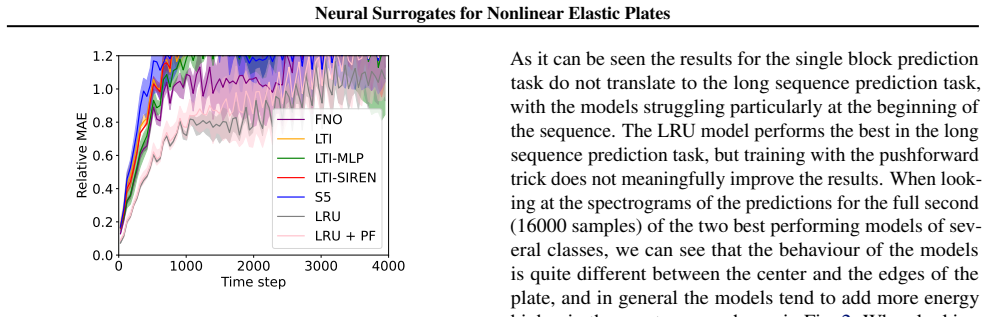
The paper's central claim is stated in its conclusions: "none of the models are able to capture the dynamics of the plate in the long sequence prediction task, making them not suitable in the current state." Even the best time-domain model, the Linear Recurrent Unit, degrades badly in autoregressive rollout, and training with the pushforward trick does not meaningfully help. The paper shows that looking only at prediction error in the time domain is insufficient, because the models tend to add energy higher in the spectrum, especially beyond roughly 50 $m^{-1}$ where the Gaussian initial conditions imply little energy should exist. In the FNO case, the spatial spectrum looks similar across sequence lengths while the temporal spectrum becomes unstable, suggesting the model is not learning coherent spatiotemporal modes. This decorrelation is linked to a conceptual issue: Koopman-inspired autoencoder models compress into a low-dimensional latent space rather than expanding into the high-dimensional space that Koopman theory would suggest.
Load-bearing premise
The claim that models add excess high-wavenumber energy rests on the assumption that the true plate response has almost no energy above roughly 50 $m^{-1}$, inferred only from the minimum 0.02 m width of the Gaussian initial conditions, and this expected floor is never computed from the actual ground-truth power spectra.
Editorial extensions
If this is right
- None of the evaluated models, trained and rolled out this way, is suitable as a stand-in for numerical solvers in nonlinear plate audio synthesis.
- Single-block prediction quality does not transfer to autoregressive rollout, so reported time-domain error on short blocks should not be used as the sole success metric.
- The excess energy concentrated above roughly 50 m^-1 means neural surrogates colour the sound with spurious high-frequency content even when overall error looks low.
- Pushforward training and temporal bundling, as applied here, do not meaningfully stabilise long rollouts.
- Spatial and temporal frequency content must be evaluated together, because spatial agreement can coexist with temporal instability, as the FNO results show.
Reading between the lines
- A direct test of a spectral-loss training variant, such as multi-resolution spectrogram loss, could reveal whether the high-wavenumber excess is an artifact of MSE training or an architectural limit.
- Because the ground truth is generated from Gaussian velocity profiles, percussive or impulse-like excitations with broadband spatial content may change the failure pattern; evaluating on such inputs is a natural next experiment.
- The plate's dispersion relation, linking spatial and temporal frequencies, could serve as a physics-based metric: a surrogate that has truly learned the modes should trace the same dispersion curve as the FTM solution.
- The diagnostic recipe implied by the paper, reporting energy in physical bands above the excitation floor, could be applied to other learned physical-modelling synthesis methods.
Editorial analysis
A structured set of objections, weighed in public.
Referee Report
Summary. The paper evaluates seven neural surrogates for the Berger nonlinear plate model used in physical modelling synthesis: a Fourier Neural Operator, three Koopman/LTI variants, S5, and LRU with and without the pushforward trick. Each model is trained on short temporal blocks and then evaluated both on single-block prediction and on autoregressive long-sequence rollout. The main empirical claims are that single-block prediction errors do not predict rollout quality, that LRU is the strongest single-block model but still degrades substantially in rollout, and that spectral analysis reveals an excess of high-wavenumber spatial energy and a decoupling between spatial and temporal spectral behavior in the model outputs. The paper concludes that current neural surrogates are not suitable for long-sequence audio synthesis and that spectral diagnostics are needed in evaluation.
Significance. If the findings hold, the paper provides a useful negative benchmark for neural PDE surrogates in the audio physical-modelling setting. The study is honest in reporting failure rather than overclaiming success, and it addresses a real gap in evaluation practice by going beyond scalar time-domain errors and examining spectral content. The normalized metrics, the comparison across several model families, and the three-seed reporting are strengths, as is the availability of the architecture code. The main weakness is that the spectral 'excess energy' conclusion rests on an unsupported ground-truth spectral floor, and the strong universal negative claim is based on a small test set. The central rollout-error finding is credible, but the spectral evidence needs to be verified against the actual FTM ground-truth spectra before the paper's main evaluation recommendation is fully established.
major comments (3)
- [Section 4, Fig. 3] The claim that 'we would not expect to see much energy' beyond wavenumber 50 m^-1 is not supported by the stated initial-condition parameters. For a Gaussian velocity profile with spatial standard deviation sigma, the wavenumber power spectrum decays as exp(-sigma^2 k^2); the minimum sigma of 0.02 m yields the broadest spectrum, with only -4.3 dB at k = 50 m^-1 and -8.5 dB at k = 70 m^-1 relative to the peak. The paper should compute the actual radial power spectrum of the FTM ground truth, quantify the model excess in specific wavenumber bands, and revise the 'models add high-wavenumber energy' claim accordingly. This is load-bearing because the spectral diagnosis is a central motivation for the paper's main recommendation that spectral evaluation is necessary.
- [Section 4 and Appendix C.4] The conclusion that 'none of the models are able to capture the dynamics of the plate in the long sequence prediction task' is a strong universal negative statement supported by a test set of only 10 trajectories and three seeds. The paper should report the distribution of rollout errors across the test trajectories and seeds, show confidence intervals, and frame the negative conclusion as applying to the evaluated benchmark rather than to the entire class of neural surrogates. This does not require new experiments, but the current wording overgeneralizes from a small sample.
- [Section 4, Fig. 2 and Fig. 3] The paper describes the long-sequence task as generating up to 4000 steps, which at a 16 kHz sampling rate is only 250 ms and is far shorter than the 'hundreds of thousands of timesteps' mentioned in the introduction. The text also refers to spectrograms 'for the full second (16000 samples)', while Figure 3 is described as averaged over the first 4000 samples. Please clarify exactly which rollout lengths are used in each figure and, if possible, report how the errors evolve over the full 1 s trajectory. Without this clarification, the link between the reported rollout failure and audio-scale synthesis remains unclear.
minor comments (5)
- [Section 1 and Section 5] There are several typographical errors: 'This is is particularly relevant' in Section 1, 'neccesarily' and 'woud' in Section 5, and 'as see in Fig. 2b' in Section 4. These should be fixed in a revision.
- [Figure 1 caption] The caption says 'output legth 49'; this should be 'output length 49'.
- [Section 4] The sentence 'the last step of the output is used as input for the next prediction of the next block' is redundant; 'the last step of the output is used as input for the next block' would be clearer.
- [Figure 3] The legend and line styles for the ground-truth curve should be made more visually distinct, for example with a thicker black line, to make the comparison easier for readers with color vision deficiencies.
- [Appendix A, Eq. (8)] The symbols S(u) and S0 are used in the nonlinear tension term but S0 is not explicitly defined in the main text or appendix; please define it at first use.
Circularity Check
No significant circularity: the benchmark compares neural surrogates against an external FTM solver ground truth on held-out trajectories, and no fitted parameter is repackaged as a prediction.
full rationale
This paper is an empirical benchmark study, not a derivation. The ground-truth trajectories are generated by the Functional Transformation Method (FTM), an external numerical solver, and the neural models are trained on short blocks and then evaluated autoregressively on held-out trajectories. This is the intended design for a surrogate-accuracy study. The central claim that models fail at long-sequence prediction is based on measured errors against this external ground truth, not on any quantity fitted from the target results. The models are fitted to solver-generated training data, but the evaluation is on separate test trajectories, and the paper does not rename a fitted constant as a predicted quantity. The spectral analysis in Section 4 relies on a qualitative expectation about high-wavenumber energy based on the Gaussian initial-condition width; while this expectation is not computed from the actual ground-truth spectra and may be directionally questionable, that is a weakness in the supporting evidence, not circular reasoning. The paper's self-citations (De La Vega Martin & Sandler 2023; Diaz et al. 2024) are used as related-work references for known error accumulation in neural PDE surrogates; they are not load-bearing for the present results. No equation in the paper reduces to its own input, and no uniqueness theorem or ansatz is imported from the authors' prior work to force the conclusions. Therefore, the circularity score is 0.
Assumptions & free parameters
free parameters (5)
- Berger nonlinear coupling coefficient C_NL =
not stated
- Number of FTM modes per dimension =
15 (225 total)
- Initial condition parameters =
velocity 5 to 25 m/s, Gaussian std 0.02 to 0.1 m
- Temporal bundling output lengths =
49, 199, 399 steps
- FNO truncation modes and hidden channels =
20 modes per dimension, 32 hidden channels
assumptions (5)
- domain assumption Berger plate approximation: tension nonlinearity is homogeneous and depends only on the global state
- standard math FTM with 225 modes yields ground truth accurate enough for model comparison
- ad hoc to paper Negligible ground-truth energy beyond wavenumber 50 m^-1
- domain assumption Gaussian velocity initial conditions and no external forcing are sufficient to represent audio synthesis use cases
- domain assumption MSE training and standard hyperparameters make a fair test of each architecture class
Cite this review
Pith. "Pith review of Evaluation of Neural Surrogates for Physical Modelling Synthesis of Nonlinear Elastic Plates." pith.science (2026). https://pith.science/paper/5F2MEWYR
@misc{pith2026250712563,
  author       = {Pith},
  title        = {Pith review of: Evaluation of Neural Surrogates for Physical Modelling Synthesis of Nonlinear Elastic Plates},
  year         = {2026},
  howpublished = {\url{https://pith.science/paper/5F2MEWYR}},
  note         = {Machine review of arXiv:2507.12563}
}
read the original abstract
Physical modelling synthesis aims to generate audio from physical simulations of vibrating structures. Thin elastic plates are a common model for drum membranes. Traditional numerical methods like finite differences and finite elements offer high accuracy but are computationally demanding, limiting their use in real-time audio applications. This paper presents a comparative analysis of neural network-based approaches for solving the vibration of nonlinear elastic plates. We evaluate several state-of-the-art models, trained on short sequences, for prediction of long sequences in an autoregressive fashion. We show some of the limitations of these models, and why is not enough to look at the prediction error in the time domain. We discuss the implications for real-time audio synthesis and propose future directions for improving neural approaches to model nonlinear vibration.
Figures


Reference graph
Works this paper leans on
-
[1]
write newline
" write newline "" before.all 'output.state := FUNCTION n.dashify 't := "" t empty not t #1 #1 substring "-" = t #1 #2 substring "--" = not "--" * t #2 global.max substring 't := t #1 #1 substring "-" = "-" * t #2 global.max substring 't := while if t #1 #1 substring * t #2 global.max substring 't := if while FUNCTION format.date year duplicate empty "emp...
-
[2]
Efficient synthesis of tension modulation in strings and membranes based on energy estimation
Avanzini, F., Marogna, R., and Bank, B. Efficient synthesis of tension modulation in strings and membranes based on energy estimation. The Journal of the Acoustical Society of America, 131 0 (1): 0 897--906, January 2012. ISSN 0001-4966. doi:10.1121/1.3651097. URL http://asa.scitation.org/doi/10.1121/1.3651097
-
[3]
Berger, H. M. A New Approach to the Analysis of Large Deflections of Plates . Doctoral Thesis , California Institute of Technology, January 1954. URL https://resolver.caltech.edu/CaltechETD:etd-12042003-163054
work page 1954
- [4]
-
[5]
Brandstetter, J., Welling, M., and Worrall, D. E. Lie Point Symmetry Data Augmentation for Neural PDE Solvers . In Proceedings of the 39th International Conference on Machine Learning , pp.\ 2241--2256. PMLR, June 2022 a . URL https://proceedings.mlr.press/v162/brandstetter22a.html. ISSN: 2640-3498
work page 2022
-
[6]
Brandstetter, J., Worrall, D. E., and Welling, M. Message Passing Neural PDE Solvers . In Proceedings of ICLR 2022 , April 2022 b . URL https://openreview.net/forum?id=vSix3HPYKSU
work page 2022
-
[7]
Brunton, S. L., Brunton, B. W., Proctor, J. L., and Kutz, J. N. Koopman Invariant Subspaces and Finite Linear Representations of Nonlinear Dynamical Systems for Control . PLOS ONE, 11 0 (2): 0 e0150171, February 2016. ISSN 1932-6203. doi:10.1371/journal.pone.0150171. URL https://journals.plos.org/plosone/article?id=10.1371/journal.pone.0150171. Publisher:...
-
[8]
S., Giampaolo, F., Rozza, G., Raissi, M., and Piccialli, F
Cuomo, S., di Cola, V. S., Giampaolo, F., Rozza, G., Raissi, M., and Piccialli, F. Scientific machine learning through physics-informed neural networks: where we are and what's next, February 2022. URL http://arxiv.org/abs/2201.05624. arXiv:2201.05624 [physics] type: article
arXiv 2022
Show all 35 references
-
[9]
and Sandler, M
De La Vega Martin, C. and Sandler, M. Physical Modelling of Stiff Membrane Vibration using Neural Networks with Spectral Convolution Layers . In Proceedings of the 10th Convention of the European Acoustics Association , Turin, 2023
2023
-
[10]
Towards Efficient Modelling of String Dynamics : A Comparison of State Space and Koopman based Deep Learning Methods
Diaz, R., De La Vega Martin, C., and Sandler, M. Towards Efficient Modelling of String Dynamics : A Comparison of State Space and Koopman based Deep Learning Methods . In Proc. Int . Conf . Digital Audio Effects ( DAFx -24) , 2024. URL https://dafx24.surrey.ac.uk/wp-content/up...
2024
-
[11]
Fletcher, N. H. and Rossing, T. D. The physics of musical instruments. Springer New York, New York, NY, 1st edition edition, January 1991. ISBN 978-0-387-94151-6. doi:10.1007/978-1-4612-2980-3. URL http://link.springer.com/10.1007/978-1-4612-2980-3
1991 doi
-
[12]
Deep learning
Goodfellow, I., Bengio, Y., and Courville, A. Deep learning. MIT Press, 2016
2016
-
[13]
Modeling sequences with structured state spaces
Gu, A. Modeling sequences with structured state spaces. PhD thesis, Stanford University, Stanford, California, 2023
2023
-
[14]
Efficiently Modeling Long Sequences with Structured State Spaces , August 2022
Gu, A., Goel, K., and Ré, C. Efficiently Modeling Long Sequences with Structured State Spaces , August 2022. URL http://arxiv.org/abs/2111.00396. arXiv:2111.00396 [cs]
2022 arXiv
-
[15]
Diagonal State Spaces are as Effective as Structured State Spaces
Gupta, A., Gu, A., and Berant, J. Diagonal State Spaces are as Effective as Structured State Spaces . In Advances in Neural Information Processing Systems , volume 35, May 2022. URL https://openreview.net/forum?id=RjS0j6tsSrf
2022
-
[16]
A., Shen, Q., Kawaguchi, K., and Karniadakis, G
Hu, Z., Daryakenari, N. A., Shen, Q., Kawaguchi, K., and Karniadakis, G. E. State-space models are accurate and efficient neural operators for dynamical systems, September 2024. URL http://arxiv.org/abs/2409.03231. arXiv:2409.03231
2024 arXiv
-
[17]
Huhtala, V., Juvela, L., and Schlecht, S. J. KLANN : Linearising Long - Term Dynamics in Nonlinear Audio Effects Using Koopman Networks . IEEE Signal Processing Letters, 31: 0 1169--1173, 2024. ISSN 1558-2361. doi:10.1109/LSP.2024.3389465. URL https://ieeexplore.ieee.org/docum...
2024
-
[18]
Benchmarking Autoregressive Conditional Diffusion Models for Turbulent Flow Simulation , January 2024
Kohl, G., Chen, L.-W., and Thuerey, N. Benchmarking Autoregressive Conditional Diffusion Models for Turbulent Flow Simulation , January 2024. URL http://arxiv.org/abs/2309.01745. arXiv:2309.01745 [physics]
2024 arXiv
-
[19]
Koopman, B. O. Hamiltonian Systems and Transformation in Hilbert Space . Proceedings of the National Academy of Sciences, 17 0 (5): 0 315--318, May 1931. doi:10.1073/pnas.17.5.315. URL https://www.pnas.org/doi/10.1073/pnas.17.5.315. Publisher: Proceedings of the National Acade...
1931 doi
-
[20]
Neural Operator : Learning Maps Between Function Spaces With Applications to PDEs
Kovachki, N., Li, Z., Liu, B., Azizzadenesheli, K., Bhattacharya, K., Stuart, A., and Anandkumar, A. Neural Operator : Learning Maps Between Function Spaces With Applications to PDEs . Journal of Machine Learning Research, 24 0 (1): 0 4061--4157, January 2023. ISSN 1533-7928. ...
2023
-
[21]
Kramer, M. A. Nonlinear principal component analysis using autoassociative neural networks. AIChE Journal, 37 0 (2): 0 233--243, 1991. ISSN 1547-5905. doi:10.1002/aic.690370209. URL https://onlinelibrary.wiley.com/doi/abs/10.1002/aic.690370209. \_eprint: https://onlinelibrary....
1991 doi
-
[22]
Lu, L., Jin, P., Pang, G., Zhang, Z., and Karniadakis, G. E. Learning nonlinear operators via DeepONet based on the universal approximation theorem of operators. Nature Machine Intelligence, 3 0 (3): 0 218--229, March 2021. ISSN 2522-5839. doi:10.1038/s42256-021-00302-5. URL h...
2021 doi
-
[23]
N., and Brunton, S
Lusch, B., Kutz, J. N., and Brunton, S. L. Deep learning for universal linear embeddings of nonlinear dynamics. Nature Communications, 9 0 (1): 0 4950, November 2018. ISSN 2041-1723. doi:10.1038/s41467-018-07210-0. URL https://www.nature.com/articles/s41467-018-07210-0. Number...
2018 doi
-
[24]
Spectrum of the Koopman Operator , Spectral Expansions in Functional Spaces , and State - Space Geometry
Mezić, I. Spectrum of the Koopman Operator , Spectral Expansions in Functional Spaces , and State - Space Geometry . Journal of Nonlinear Science, 30 0 (5): 0 2091--2145, October 2020. ISSN 1432-1467. doi:10.1007/s00332-019-09598-5. URL https://doi.org/10.1007/s00332-019-09598-5
2020 doi
-
[25]
Koopman Operator , Geometry , and Learning of Dynamical Systems
Mezić, I. Koopman Operator , Geometry , and Learning of Dynamical Systems . Notices of the American Mathematical Society, 68 0 (07): 0 1, August 2021. ISSN 0002-9920, 1088-9477. doi:10.1090/noti2306. URL https://www.ams.org/notices/202107/rnoti-p1087.pdf
2021 doi
-
[26]
E., and Riemer-Sørensen, S
Michałowska, K., Goswami, S., Karniadakis, G. E., and Riemer-Sørensen, S. Neural Operator Learning for Long - Time Integration in Dynamical Systems with Recurrent Neural Networks . In 2024 International Joint Conference on Neural Networks ( IJCNN ) , pp.\ 1--8, Yokohama, Japan...
2024
-
[27]
Morse, P. M. and Ingard, K. U. Theoretical acoustics. International Series In Pure And Applied Physics . McGraw-Hill, 1st edition edition, 1968
1968
-
[28]
B., Ren, P., Mahoney, M
Naiman, I., Erichson, N. B., Ren, P., Mahoney, M. W., and Azencot, O. Generative Modeling of Regular and Irregular Time Series Data via Koopman VAEs . October 2023. URL https://openreview.net/forum?id=eY7sLb0dVF
2023
-
[29]
L., Gu, A., Fernando, A., Gulcehre, C., Pascanu, R., and De, S
Orvieto, A., Smith, S. L., Gu, A., Fernando, A., Gulcehre, C., Pascanu, R., and De, S. Resurrecting recurrent neural networks for long sequences. In Proceedings of the 40th International Conference on Machine Learning , volume 202 of ICML '23 , pp.\ 26670--26698, Honolulu, Haw...
2023
-
[30]
D., Schlecht, S
Parker, J. D., Schlecht, S. J., Rabenstein, R., and Schäfer, M. Physical Modeling using Recurrent Neural Networks with Fast Convolutional Layers . In Proceedings of the 25th International Conference on Digital Audio Effects ( DAFx20in22 ) , Vienna, Austria, June 2022. doi:10.4...
-
[31]
FourCastNet : A Global Data -driven High -resolution Weather Model using Adaptive Fourier Neural Operators , February 2022
Pathak, J., Subramanian, S., Harrington, P., Raja, S., Chattopadhyay, A., Mardani, M., Kurth, T., Hall, D., Li, Z., Azizzadenesheli, K., Hassanzadeh, P., Kashinath, K., and Anandkumar, A. FourCastNet : A Global Data -driven High -resolution Weather Model using Adaptive Fourier...
2022 arXiv
-
[32]
Smith, J. T. H., Warrington, A., and Linderman, S. Simplified State Space Layers for Sequence Modeling . In Proceedings of ICLR 2023 , Kigali, Rwanda, May 2023. URL https://openreview.net/forum?id=Ai8Hw3AXqks
2023
-
[33]
and Rabenstein, R
Trautmann, L. and Rabenstein, R. Digital Sound Synthesis by Physical Modeling Using the Functional Transformation Method . Springer US, Boston, MA, 2003. ISBN 978-1-4613-4900-6 978-1-4615-0049-0. doi:10.1007/978-1-4615-0049-0. URL http://link.springer.com/10.1007/978-1-4615-0049-0
2003 doi
-
[34]
Koopman neural operator as a mesh-free solver of non-linear partial differential equations
Xiong, W., Huang, X., Zhang, Z., Deng, R., Sun, P., and Tian, Y. Koopman neural operator as a mesh-free solver of non-linear partial differential equations. Journal of Computational Physics, 513: 0 113194, September 2024. ISSN 0021-9991. doi:10.1016/j.jcp.2024.113194. URL http...
2024
-
[35]
Continuous PDE Dynamics Forecasting with Implicit Neural Representations
Yin, Y., Kirchmeyer, M., Franceschi, J.-Y., Rakotomamonjy, A., and Gallinari, P. Continuous PDE Dynamics Forecasting with Implicit Neural Representations . In Proceedings of ICLR 2023 , Kigali, Rwanda, May 2023. URL https://openreview.net/forum?id=B73niNjbPs
2023
Reviewed August 6, 2026 · model on record in the stance chip above.
Discussion (0). Sign in to comment.