Shape optimization of metastable states
Pith reviewed 2026-05-19 03:53 UTC · model grok-4.3
The pith
Metastable states can be defined by optimizing their boundaries to maximize a local separation-of-timescales metric tied to accelerated molecular dynamics efficiency.
A machine-rendered reading of the paper's core claim, the machinery that carries it, and where it could break.
Core claim
The central claim is that metastable states should be defined through shape optimization of a local separation of timescale metric that is directly linked to the efficiency of a family of accelerated molecular dynamics algorithms. Analytic expressions for shape-variations of Dirichlet eigenvalues are derived for a class of operators associated with reversible elliptic diffusions and are used to construct a local ascent algorithm that explicitly treats the case of multiple eigenvalues. Tractability for high-dimensional systems is obtained via dynamical coarse-graining or recently obtained low-temperature shape-sensitive spectral asymptotics, and the method is validated on a benchmark biomolec
What carries the argument
Shape-variations of Dirichlet eigenvalues for operators associated with reversible elliptic diffusions, used to drive a local ascent algorithm that optimizes state boundaries for timescale separation.
If this is right
- Accelerated molecular dynamics algorithms become more efficient when supplied with these shape-optimized state definitions.
- Entropic effects and rapid thermal barrier crossing are handled more reliably than with energy-minimization definitions.
- The approach remains computationally feasible in high-dimensional systems through either dynamical coarse-graining or low-temperature asymptotics.
- Long configurational trajectories are sampled more effectively once metastable states are defined this way.
Where Pith is reading between the lines
- The same boundary-optimization logic could be applied to other reversible Markov processes outside molecular dynamics.
- States identified this way may expose metastable regions whose boundaries are set more by entropy than by energy barriers.
- The ascent algorithm might be combined with data-driven approximations to scale to systems with many thousands of degrees of freedom.
Load-bearing premise
The local separation-of-timescale metric continues to predict algorithmic efficiency even after the state boundaries are moved away from conventional energy-minima locations.
What would settle it
Running the accelerated molecular dynamics algorithms on the optimized states versus standard energy-minima states and checking whether the optimized boundaries produce measurably faster convergence or higher effective sampling rates.
Figures






read the original abstract
The definition of metastable states is an ubiquitous task in the design and analysis of molecular simulations, and is a crucial input in a variety of acceleration methods for the sampling of long configurational trajectories. Although standard definitions based on local energy minimization procedures can sometimes be used, these definitions are typically suboptimal, or entirely inadequate when entropic effects are significant, or when the lowest energy barriers are quickly overcome by thermal fluctuations. In this work, we propose an approach to the definition of metastable states, based on the shape-optimization of a local separation of timescale metric directly linked to the efficiency of a family of accelerated molecular dynamics algorithms. To realize this approach, we derive analytic expressions for shape-variations of Dirichlet eigenvalues for a class of operators associated with reversible elliptic diffusions, and use them to construct a local ascent algorithm, explicitly treating the case of multiple eigenvalues. We propose two methods to make our method tractable in high-dimensional systems: one based on dynamical coarse-graining, the other on recently obtained low-temperature shape-sensitive spectral asymptotics. We validate our method on a benchmark biomolecular system, showcasing a significant improvement over conventional definitions of metastable states.
Editorial analysis
A structured set of objections, weighed in public.
Referee Report
Summary. The paper proposes defining metastable states via shape optimization of a local separation-of-timescale metric based on Dirichlet eigenvalues of the reversible elliptic diffusion operator. Analytic shape-variation formulas are derived to enable a local ascent algorithm (explicitly handling multiple eigenvalues), with two tractability approximations (dynamical coarse-graining and low-temperature spectral asymptotics) for high-dimensional systems. The method is validated on a biomolecular benchmark, reporting significant improvement over conventional energy-minima definitions.
Significance. If the optimized states demonstrably improve the practical efficiency of the target accelerated MD family (beyond metric improvement alone), the approach would offer a principled alternative to energy-based state definitions when entropic barriers or rapid crossings dominate. The derivations of shape gradients and the handling of multiplicity are potentially reusable for other spectral optimization problems in diffusion processes.
major comments (2)
- [Validation/benchmark section] Validation/benchmark section: the reported 'significant improvement' is quantified solely via the separation-of-timescale metric on the biomolecular example; no direct measurements (e.g., decorrelation times, transition rates, or effective sampling speedup) are shown for the downstream accelerated MD integrators after boundary variation. This leaves open whether the local metric remains a faithful proxy once states deviate from energy minima.
- [Derivation of shape variations] Derivation of shape variations (around the Dirichlet eigenvalue formulas): while the local ascent is constructed from the derived gradients, the manuscript does not provide an a-priori error bound or sensitivity analysis showing that the metric improvement persists under the dynamical coarse-graining approximation when entropic effects are strong.
minor comments (2)
- [Introduction] Notation for the family of accelerated algorithms and the precise definition of the 'local separation of timescale metric' should be introduced earlier and used consistently to avoid ambiguity when linking to algorithmic efficiency.
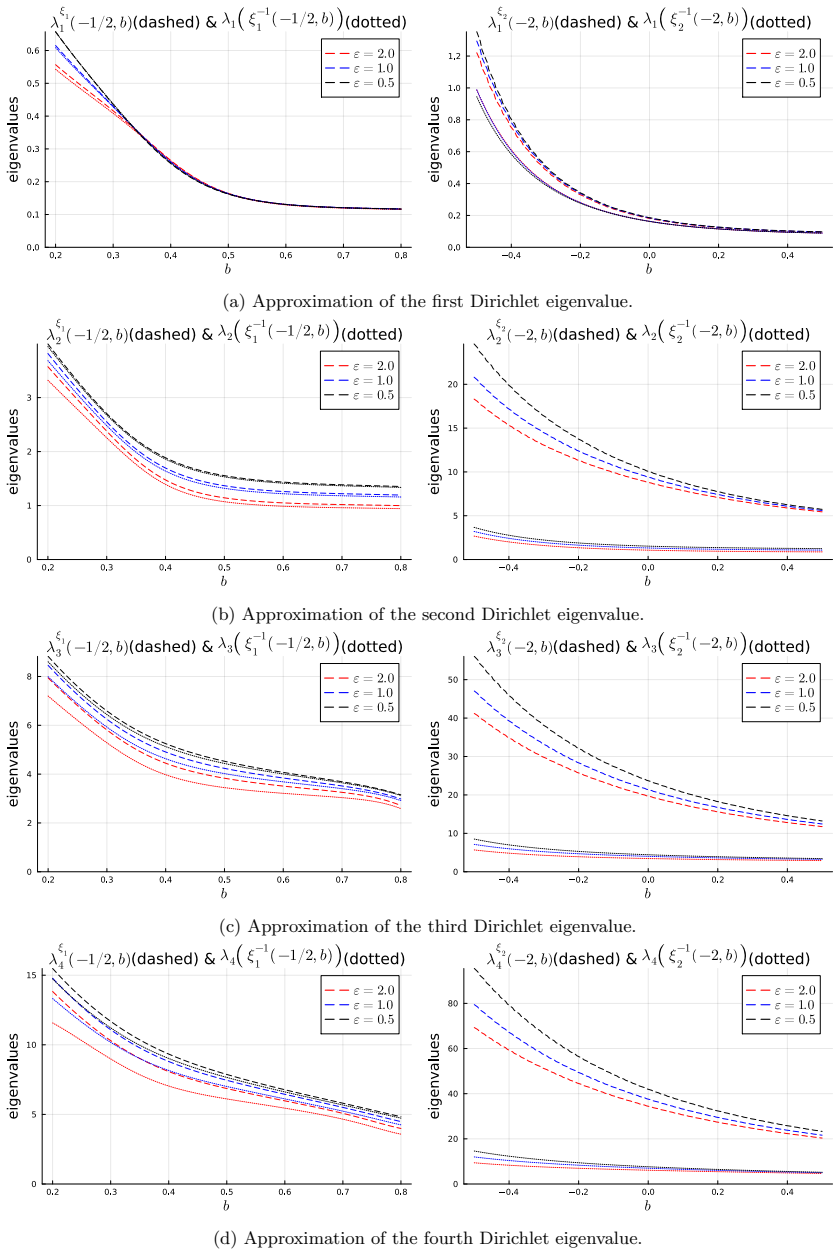
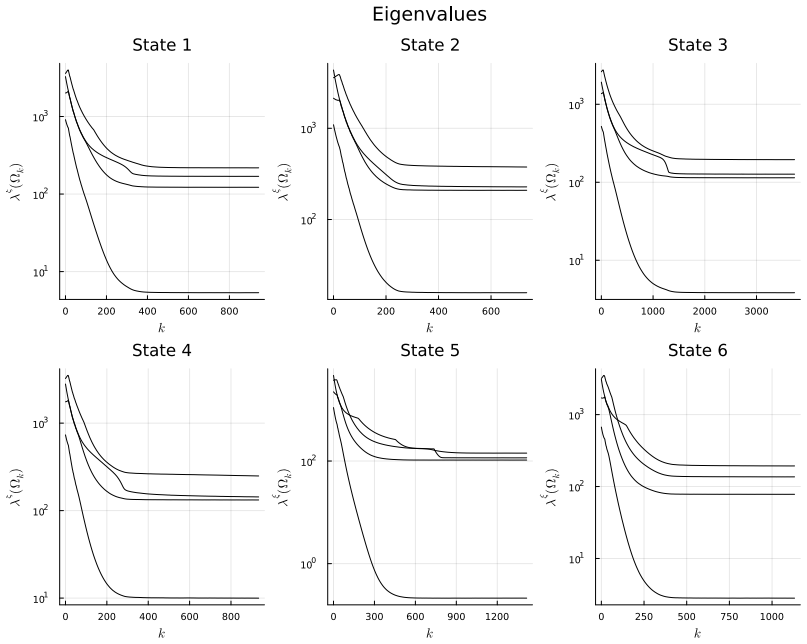
- [Figures] Figure captions for the benchmark results should explicitly state which quantity (metric value, eigenvalue gap, or actual sampling statistic) is plotted and include error bars or variability across runs.
Simulated Author's Rebuttal
We thank the referee for the constructive report and the positive assessment of the significance of the derivations and the handling of eigenvalue multiplicity. Below we respond point-by-point to the two major comments. We agree that both points identify areas where the manuscript can be strengthened and will incorporate revisions accordingly.
read point-by-point responses
-
Referee: [Validation/benchmark section] Validation/benchmark section: the reported 'significant improvement' is quantified solely via the separation-of-timescale metric on the biomolecular example; no direct measurements (e.g., decorrelation times, transition rates, or effective sampling speedup) are shown for the downstream accelerated MD integrators after boundary variation. This leaves open whether the local metric remains a faithful proxy once states deviate from energy minima.
Authors: We agree that direct measurements of decorrelation times or sampling speedup in the downstream accelerated MD integrators would constitute stronger practical validation. The separation-of-timescale metric is derived precisely because it is the quantity that controls the efficiency of the target family of accelerated MD methods; the manuscript therefore treats improvement of this metric as the primary figure of merit for the state definitions. Nevertheless, to address the referee’s concern we will add an explicit discussion in the revised manuscript that recalls the theoretical link between the metric and the expected acceleration, and we will acknowledge that full end-to-end integrator benchmarks remain an important direction for subsequent work. revision: partial
-
Referee: [Derivation of shape variations] Derivation of shape variations (around the Dirichlet eigenvalue formulas): while the local ascent is constructed from the derived gradients, the manuscript does not provide an a-priori error bound or sensitivity analysis showing that the metric improvement persists under the dynamical coarse-graining approximation when entropic effects are strong.
Authors: The dynamical coarse-graining approximation is presented as one of two tractability routes, and its use on the biomolecular benchmark (where entropic barriers are relevant) already provides empirical support that the optimized states improve the metric. We acknowledge, however, that a formal a-priori error bound or dedicated sensitivity study for strong entropic regimes is absent. In the revision we will insert a new subsection that states the assumptions underlying the coarse-graining step, derives a first-order sensitivity estimate with respect to the coarse-graining parameter, and reports a numerical sensitivity check on the benchmark system to quantify how the metric improvement behaves when entropic effects are pronounced. revision: yes
Circularity Check
Derivation chain remains self-contained with independent mathematical derivations and benchmark validation
full rationale
The paper derives new analytic expressions for shape variations of Dirichlet eigenvalues of reversible elliptic diffusion operators and constructs a local ascent algorithm from them to optimize a separation-of-timescale metric. These steps are presented as original mathematical contributions, supplemented by two tractability methods (dynamical coarse-graining and low-temperature spectral asymptotics) and validated on an external biomolecular benchmark that demonstrates improvement over conventional energy-minima definitions. No quoted reduction shows any prediction or central claim equaling its inputs by construction, no fitted parameter is renamed as a prediction, and no load-bearing self-citation chain is required for the core result; the benchmark provides an independent external check against actual sampling performance.
Axiom & Free-Parameter Ledger
axioms (1)
- standard math Reversible elliptic diffusions admit well-defined Dirichlet eigenvalues whose shape derivatives can be expressed analytically.
Lean theorems connected to this paper
-
IndisputableMonolith/Foundation/AlexanderDuality.leanalexander_duality_circle_linking unclear?
unclearRelation between the paper passage and the cited Recognition theorem.
We propose an approach to the definition of metastable states, based on the shape-optimization of a local separation of timescale metric directly linked to the efficiency of a family of accelerated molecular dynamics algorithms. ... derive analytic expressions for shape-variations of Dirichlet eigenvalues
-
IndisputableMonolith/Cost/FunctionalEquation.leanwashburn_uniqueness_aczel unclear?
unclearRelation between the paper passage and the cited Recognition theorem.
N*(Ω) = λ2(Ω) − λ1(Ω) / λ1(Ω) ... optimize the shape of the domain Ω in order to make N*(Ω) as large as possible
What do these tags mean?
- matches
- The paper's claim is directly supported by a theorem in the formal canon.
- supports
- The theorem supports part of the paper's argument, but the paper may add assumptions or extra steps.
- extends
- The paper goes beyond the formal theorem; the theorem is a base layer rather than the whole result.
- uses
- The paper appears to rely on the theorem as machinery.
- contradicts
- The paper's claim conflicts with a theorem or certificate in the canon.
- unclear
- Pith found a possible connection, but the passage is too broad, indirect, or ambiguous to say the theorem truly supports the claim.
Reference graph
Works this paper leans on
-
[1]
G. Allaire and M. Schoenauer , Conception optimale de structures , vol. 58 of SMAI Math´ ematiques et Applications, Springer, 2007
work page 2007
-
[2]
M. Allen and D. Tildesley , Computer Simulation of Liquids , Oxford University Press, 2017
work page 2017
-
[3]
D. Aristoff, Generalizing Parallel Replica dynamics: Trajectory fragments, asynchronous computing, and PDMPs , SIAM/ASA Journal on Uncertainty Quantification, 7 (2019), pp. 685–719
work page 2019
-
[4]
D. Aristoff, M. Johnson, and D. Perez , Arbitrarily accurate, nonparametric coarse graining with Markov renewal processes and the Mori–Zwanzig formulation , AIP Advances, 13 (2023), p. 095131
work page 2023
-
[5]
M. Ashbaugh and R. Benguria , A sharp bound for the ratio of the first two eigenvalues of Dirichlet Laplacians and extensions , Annals of Mathematics, 135 (1992), pp. 601–628
work page 1992
- [6]
-
[7]
Blassel, Paper code repository: https: // github
N. Blassel, Paper code repository: https: // github. com/ noeblassel/ sosad, 2025
work page 2025
-
[8]
, Paper data repository: https: // zenodo. org/ records/ 15727493, 2025
work page 2025
-
[9]
N. Blassel, T. Leli `evre, and G. Stoltz , Quantitative low-temperature asymptotics for reversible diffusions in temperature-dependent domains , arXiv preprint:2501.16082, (2024)
-
[10]
P. Bolhuis, C. Dellago, and D. Chandler , Reaction coordinates of biomolecular iso- merization, Proceedings of the National Academy of Sciences, 97 (2000), pp. 5877–5882
work page 2000
- [11]
-
[12]
M. Chen, Collective variable-based enhanced sampling and machine learning , The European Physical Journal B, 94 (2021), pp. 1–17
work page 2021
-
[13]
D. Chenais, On the existence of a solution in a domain identification problem , Journal of Mathematical Analysis and Applications, 52 (1975), pp. 189–219
work page 1975
- [14]
- [15]
-
[16]
C. Dapogny, P. Frey, F. Omn `es, and Y. Privat , Geometrical shape optimization in fluid mechanics using FreeFem++, Structural and Multidisciplinary Optimization, 58 (2018), pp. 2761–2788. 59
work page 2018
-
[17]
F. De Gournay , Velocity extension for the level-set method and multiple eigenvalues in shape optimization, SIAM Journal on Control and Optimization, 45 (2006), pp. 343–367
work page 2006
-
[18]
P. Del Moral and L. Miclo , A Moran particle system approximation of Feynman–Kac formulae, Stochastic processes and their applications, 86 (2000), pp. 193–216
work page 2000
-
[19]
G. Di Ges`u, T. Leli`evre, D. Le Peutrec, and B. Nectoux , Sharp asymptotics of the first exit point density , Annals of PDE, 5 (2019), pp. 1–174
work page 2019
-
[20]
, The exit from a metastable state: Concentration of the exit point distribution on the low energy saddle points, part 1 , Journal de Math´ ematiques Pures et Appliqu´ ees, 138 (2020), pp. 242–306
work page 2020
-
[21]
Evans, Partial Differential Equations, vol
L. Evans, Partial Differential Equations, vol. 19 of Graduate Studies in Mathematics, Amer- ican Mathematical Society, 2022
work page 2022
-
[22]
A. Ferguson, Machine learning and data science in soft materials engineering , Journal of Physics: Condensed Matter, 30 (2018), p. 043002
work page 2018
- [23]
-
[24]
P. Gkeka, G. Stoltz, A. Fariman, Z. Belkacemi, M. Ceriotti, J. Chodera, A. Din- ner, A. Ferguson, J.-B. Maillet, H. Minoux, C. Peter, F. Pietrucci, A. Silveira, A. Tkatchenko, Z. Trstanova, R. Wiewiora, and T. Leli `evre, Machine learning force fields and coarse-grained variables in molecular dynamics: application to materials and biological systems, Jour...
work page 2020
-
[25]
A. Glielmo, B. Husic, A. Rodriguez, C. Clementi, F. No ´e, and A. Laio , Un- supervised learning methods for molecular simulation data , Chemical Reviews, 121 (2021), pp. 9722–9758
work page 2021
-
[26]
A. Gonz ´alez, Measurement of areas on a sphere using Fibonacci and latitude–longitude lattices, Mathematical Geosciences, 42 (2010), pp. 49–64
work page 2010
-
[27]
Grisvard, Elliptic problems in nonsmooth domains , vol
P. Grisvard, Elliptic problems in nonsmooth domains , vol. 69 of Classics in Applied Math- ematics, SIAM, 2011
work page 2011
-
[28]
J. Hadamard, M´ emoire sur le probl` eme d’analyse relatif ` a l’´ equilibre des plaques ´ elastiques encastr´ ees, vol. 33 of M´ emoires pr´ esent´ es par divers savants ` a l’Acad´ emie des sciences de l’Institut de France., Imprimerie nationale, 1908
work page 1908
-
[29]
E. Haug and B. Rousselet , Design sensitivity analysis in structural mechanics. I. Static response variations, Journal of Structural Mechanics, 8 (1980), pp. 17–41
work page 1980
-
[30]
, Design sensitivity analysis in structural mechanics. II. Eigenvalue variations , Journal of Structural Mechanics, 8 (1980), pp. 161–186
work page 1980
-
[31]
, Design sensitivity analysis in structural mechanics. III. Effects of shape variation , Journal of Structural mechanics, 10 (1982), pp. 273–310
work page 1982
- [32]
-
[33]
F. H´edin and T. Leli`evre, Gen. parRep: A first implementation of the Generalized Parallel Replica dynamics for the long time simulation of metastable biochemical systems , Computer Physics Communications, 239 (2019), pp. 311–324. 60
work page 2019
-
[34]
B. Helffer and F. Nier , Quantitative analysis of metastability in reversible diffusion pro- cesses via a Witten complex approach: The case with boundary , Matem´ atica contemporˆ anea, 26 (2004), pp. 41–85
work page 2004
-
[35]
B. Helffer and J. Sj¨ostrand, Puits multiples en m´ ecanique semi-classique. IV:´Etude du complexe de Witten, Communications in partial differential equations, 10 (1985), pp. 245–340
work page 1985
-
[36]
A. Henrot, Extremum Problems for Eigenvalues of Elliptic Operators , Springer Science & Business Media, 2006
work page 2006
-
[37]
A. Henrot and M. Pierre, Variation et optimisation de formes : une analyse g´ eom´ etrique, vol. 48 of Math´ ematiques et applications, Springer, 2005
work page 2005
-
[38]
S. Hottovy, A. McDaniel, G. Volpe, and J. Wehr , The Smoluchowski-Kramers limit of stochastic differential equations with arbitrary state-dependent friction , Communications in Mathematical Physics, 336 (2015), pp. 1259–1283
work page 2015
-
[39]
L. Journel and P. Monmarch ´e, Uniform convergence of the Fleming–Viot process in a hard killing metastable case , arXiv preprint arXiv:2207.02030, (2022)
-
[40]
Kato, Perturbation Theory for Linear Operators , vol
T. Kato, Perturbation Theory for Linear Operators , vol. 132, Springer Science & Business Media, 2013
work page 2013
- [41]
-
[42]
S. Krantz and H. Parks , Geometric Integration Theory, Cornerstones, Springer Science & Business Media, 2008
work page 2008
-
[43]
S. Krumscheid, M. Pradas, G. Pavliotis, and S. Kalliadasis , Data-driven coarse graining in action: Modeling and prediction of complex systems, Physical Review E, 92 (2015), p. 042139
work page 2015
-
[44]
L. Lagard`ere, L. Jolly, F. Lipparini, F. Aviat, B. Stamm, Z. Jing, M. Harger, H. Torabifard, G. Cisneros, and M. Schnieders , Tinker-HP: A massively parallel molecular dynamics package for multiscale simulations of large complex systems with advanced point dipole polarizable force fields, Chemical Science, 9 (2018), pp. 956–972
work page 2018
-
[45]
C. Le Bris, T. Leli`evre, M. Luskin, and D. Perez, A mathematical formalization of the parallel replica dynamics, Monte–Carlo Methods and Applications, 18 (2012), pp. 119–146
work page 2012
-
[46]
D. Le Peutrec and B. Nectoux, Small eigenvalues of the Witten Laplacian with Dirichlet boundary conditions: the case with critical points on the boundary, Analysis & PDE, 14 (2021), pp. 2595–2651
work page 2021
-
[47]
F. Legoll and T. Leli`evre, Effective dynamics using conditional expectations, Nonlinear- ity, 23 (2010), pp. 21–31
work page 2010
-
[48]
R. Lehoucq, D. Sorensen, and C. Yang , ARPACK users’ guide: Solution of large-scale eigenvalue problems with implicitly restarted Arnoldi methods , Software, Environments, and Tools, SIAM, 1998
work page 1998
-
[49]
B. Leimkuhler and C. Matthews , Molecular Dynamics, vol. 39 of Interdisciplinary Ap- plied Mathematics, Springer Cham, 2016
work page 2016
-
[50]
T. Leli`evre and F. Nier , Low temperature asymptotics for quasistationary distributions in a bounded domain , Analysis & PDE, 8 (2015), pp. 561–628
work page 2015
-
[51]
Optimizing the diffusion coefficient of overdamped
T. Leli`evre, G. Pavliotis, G. Robin, R. Santet, and G. Stoltz, Optimizing the diffu- sion coefficient of overdamped Langevin dynamics , arXiv preprint arXiv:2404.12087, (2024). 61
-
[52]
T. Leli`evre, M. Rachid, and G. Stoltz, A spectral approach to the narrow escape problem in the disk , arXiv preprint, (2024)
work page 2024
-
[53]
T. Leli`evre, M. Rousset, and G. Stoltz , Free Energy Computations - A Mathematical Perspective, Imperial College Press, 2010
work page 2010
-
[54]
T. Leli`evre, R. Santet, and G. Stoltz , Improving sampling by modifying the effective diffusion, arXiv preprint arXiv:2410.00525, (2024)
-
[55]
T. Leli`evre and G. Stoltz, Partial differential equations and stochastic methods in molec- ular dynamics, Acta Numerica, 25 (2016), pp. 681–880
work page 2016
-
[56]
V. Nateghi and F. N ¨uske, Kinetically consistent coarse graining using kernel-based ex- tended dynamic mode decomposition, arXiv preprint:2409.16396, (2024)
- [57]
- [58]
-
[59]
E. Oudet, Numerical minimization of eigenmodes of a membrane with respect to the domain, ESAIM: Control, Optimisation and Calculus of Variations, 10 (2004), pp. 315–330
work page 2004
- [60]
- [61]
- [62]
- [63]
-
[64]
B. Rousselet, Shape design sensitivity of a membrane , Journal of Optimization Theory and Applications, 40 (1983), pp. 595–623
work page 1983
-
[65]
M. Rousset , On the control of an interacting particle estimation of Schr¨ odinger ground states, SIAM journal on mathematical analysis, 38 (2006), pp. 824–844
work page 2006
-
[66]
J. Ryckaert, G. Ciccotti, and H. Berendsen , Numerical integration of the Cartesian equations of motion of a system with constraints: molecular dynamics of n-alkanes , Journal of Computational Physics, 23 (1977), pp. 327–341
work page 1977
-
[67]
Simon, Semiclassical analysis of low lying eigenvalues
B. Simon, Semiclassical analysis of low lying eigenvalues. I. Non-degenerate minima: Asymp- totic expansions, Annales de l’IHP: Physique Th´ eorique, 38 (1983), pp. 295–308
work page 1983
-
[68]
G. Simpson and M. Luskin, Numerical analysis of parallel replica dynamics, ESAIM: Math- ematical Modelling and Numerical Analysis, 47 (2013), pp. 1287–1314
work page 2013
-
[69]
M. Sørensen and A. Voter, Temperature-accelerated dynamics for simulation of infrequent events, The Journal of Chemical Physics, 112 (2000), pp. 9599–9606
work page 2000
-
[70]
Tao, Topics in Random Matrix Theory , vol
T. Tao, Topics in Random Matrix Theory , vol. 132 of Graduate Studies in Mathematics, American Mathematical Soc., 2012
work page 2012
-
[71]
Teschl, Mathematical Methods in Quantum Mechanics, vol
G. Teschl, Mathematical Methods in Quantum Mechanics, vol. 157, American Mathematical Society, 2014. 62
work page 2014
-
[72]
B. Uberuaga, S. Stuart, and A. Voter , Parallel replica dynamics for driven systems: Derivation and application to strained nanotubes, Physical Review B—Condensed Matter and Materials Physics, 75 (2007), p. 014301
work page 2007
-
[73]
D. Villemonais , General approximation method for the distribution of Markov processes conditioned not to be killed , ESAIM: Probability and Statistics, 18 (2014), pp. 441–467
work page 2014
-
[74]
A. Voter, Hyperdynamics: Accelerated molecular dynamics of infrequent events , Physical Review Letters, 78 (1997), p. 3908
work page 1997
- [75]
- [76]
discussion (0)
Sign in with ORCID, Apple, or X to comment. Anyone can read and Pith papers without signing in.