REVIEW 5 major objections 5 minor 2 cited by
Energy-Efficient RSMA-enabled Low-altitude MEC Optimization Via Generative AI-enhanced Deep Reinforcement Learning
T0 review · 5 major / 5 minor · reviewed 2026-08-06 · deepseek-v4-flash
Pith's one-line read A diffusion-augmented DRL agent, GDRS, jointly tunes drone trajectory, offloading, and transmit powers to maximize energy efficiency in RSMA-based low-altitude MEC, outperforming NOMA, FDMA, PPO, and DQN baselines in simulation.
desk verdict Incremental diffusion-DRL + RSMA paper whose key decoding-order proof is algebraically off and whose claimed priority metric reduces to channel-gain sorting in the simulations. read the letter →
The pith
A machine-rendered reading of the paper's core claim, the machinery that carries it, and where it could break.
The reading
What carries the argument
The load-bearing object is the priority score $\upsilon_{k,n,i}=|g_{k,n}|^2(1+1/\rho^{\min}_{k,n,i})$ with $\rho^{\min}_{k,n,i}=2(\mu_{k,n,i}R_{\min})^{-1}$, which ranks each RSMA sub-message by combining channel power with a quality-of-service term; Proposition 1 says decoding in descending order of this score is the near-optimal SIC order, and the paper substitutes it into the optimization to remove the decoding permutation from the action space. The second mechanism is the diffusion-based actor: a denoising diffusion probabilistic model starts from Gaussian noise and iteratively denoises, conditioned on the system state, to produce a softmax action distribution over the mixed discrete-continuous action space. This actor is trained inside a soft actor-critic loop with double critics, target networks, an entropy bonus, and an experience replay buffer; together the two mechanisms convert problem P0 into a Markov decision process over trajectory, offloading, power, and flight time that GDRS learns.
What would settle it
Set $K=2$ ground terminals with two sub-messages each, assign unequal rate-splitting ratios (for example $\mu_{k,n,1}=0.8$ and $\mu_{k,n,2}=0.2$), and compare the energy efficiency of the Proposition 1 ordering with the best ordering found by exhaustive search over the $4!$ permutations in each time slot; any time an exhaustive ordering does better than the proposed one would settle against the claim.
Extended reading notes
Core claim
The paper studies an uplink system in which a UAV-mounted edge server collects computation tasks from $K$ ground terminals over a shared band, with each terminal's message split into sub-messages transmitted at different powers (RSMA). Its central claim is that the system's energy efficiency, defined as processed bits per unit of UAV propulsion energy, can be maximized by jointly optimizing the UAV's 3D trajectory, the binary offloading decisions, the transmit powers, and the successive-interference-cancellation (SIC) decoding order, and that this mixed-integer problem is best handled by a decomposition into a decoding-order subproblem and a continuous-control subproblem. The analytical component, Proposition 1, asserts that the decoding order is near-optimally fixed by sorting sub-messages in descending order of $\upsilon_{k,n,i}=|g_{k,n}|^2(1+1/\rho^{\min}_{k,n,i})$, where $\rho^{\min}_{k,n,i}$ is the minimum SINR needed for that sub-message and follows from the rate-splitting ratio and the rate floor. The algorithmic component, GDRS, embeds a denoising diffusion model into the actor of a soft actor-critic agent, so actions are generated by reverse diffusion conditioned on the current state. On the paper's simulation evidence, GDRS converges faster and reaches higher steady-state reward than PPO- and DQN-based RSMA agents, beats a random-decoding variant, and outperforms FDMA and NOMA counterparts in energy efficiency across transmit power, time horizon, task size, bandwidth, and UAV processing-rate sweeps.
Load-bearing premise
The proof that one decoding order beats another compares only two consecutive sub-messages and assumes all other interference is bounded by a fixed amount the paper never quantifies; if realistic multi-user interference exceeds that bound, the claimed optimal ordering is not guaranteed to hold.
Editorial extensions
If this is right
- A system that adopts Proposition 1 can replace exhaustive search over SIC permutations with a sorting operation, reducing decoding-order complexity to the cost of ordering $K|I|$ sub-messages.
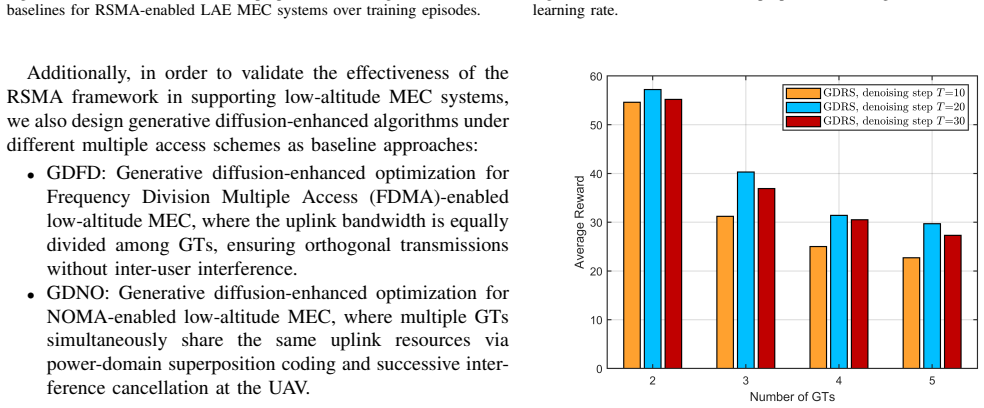
- GDRS converges in about 110 training episodes in the simulated environment, so the diffusion-based actor is presented as a sample-efficient alternative to PPO and DQN for this class of joint trajectory-and-resource problems.
- In the reported sweeps, the RSMA-based scheme with GDRS achieves higher energy efficiency than NOMA and FDMA baselines, with the gap widening as the number of time slots, task sizes, or ground terminals grows.
- At a constrained bandwidth of 0.1 MHz and a UAV processing rate of 500 cycles/s, GDRS improves energy efficiency by about 47.3% over the PPO-based RSMA baseline, indicating the benefit is largest when spectrum and computation are both tight.
- The learned 3D trajectories are more energy-aware than those of the PPO, DQN, and random-decoding baselines, showing that the joint policy exploits the RSMA decoding structure to cut redundant drone motion.
Reading between the lines
- The reported experiments set $\mu_{k,n,i}=0.5$ and $R_{\min}=0.2$ for every sub-message, which makes the Proposition 1 score proportional to channel gain alone; a test with asymmetric rate-splitting ratios would reveal whether the quality-of-service term in the ordering formula carries any real weight.
- Because the objective's denominator counts only UAV propulsion energy, the comparison favors schemes that shift energy cost to the ground terminals; redefining the metric to include ground transmit energy and UAV compute energy could change which multiple-access scheme wins.
- A controlled ablation that keeps Proposition 1 and the soft actor-critic critics fixed but replaces the diffusion generator with a plain Gaussian exploration policy would isolate how much of GDRS's improvement comes from generative exploration rather than from the rest of the pipeline.
- The paper assumes perfect channel state information and known, static ground-terminal locations; training the same GDRS on noisy channel estimates or moving terminals is a natural next test of whether the claimed ordering and reward still hold.
Editorial analysis
A structured set of objections, weighed in public.
Referee Report
Summary. The paper considers an uplink RSMA-enabled UAV-mounted MEC system in which a UAV serves multiple ground terminals over shared spectrum. It formulates a mixed-integer non-convex problem P0 that jointly optimizes the UAV 3D trajectory, offloading decisions, transmit powers, flight times, and the SIC decoding order, with the objective of maximizing the ratio of processed task data to UAV propulsion energy. The authors decompose the problem into a decoding-order sub-problem (P1) and a continuous-discrete control sub-problem (P2). For P1 they propose a 'priority-based RSMA decoding strategy' stated in Proposition 1, which sorts sub-messages by a metric combining channel gain and a required-SINR term. For P2 they construct a Markov decision process and solve it with a generative diffusion model embedded in the actor of a soft actor-critic framework, termed GDRS. The paper reports simulation results (Figs. 3–10) claiming that GDRS outperforms PPO-, DQN-, and diffusion-based baselines, and that the proposed decoding order improves over a random order. The central analytical claim is Proposition 1, and the central simulation claim is that GDRS with this ordering achieves the highest energy efficiency in the tested scenarios.
Significance. If the claims are correct, the paper would contribute a practical integration of diffusion-model-based action generation with DRL for a challenging joint trajectory, offloading, and multiple-access problem, and it would provide a low-complexity decoding-order rule for uplink RSMA. The system model is fairly complete, and the simulation study covers several operating parameters (transmit power, time horizon, task size, UAV processing rate, bandwidth). However, the significance is conditional: Proposition 1, which is used to motivate the algorithm and to explain the performance gap against the random-order baseline, is not established as written; the proposed decoding metric is not actually exercised in the experiments because it reduces to the standard channel-gain ordering under the chosen parameters; and the comparative simulation results are reported without error bars or seed statistics, which weakens the central 'outperforms baselines' assertion. No code or data is released, further limiting reproducibility.
major comments (5)
- [Section III.A, Proposition 1, Eqs. (19)–(20)] The proof of Proposition 1 contains an algebraic inconsistency. In Case a, the first candidate for the maximum combined signal strength χ_a is written as |g_a|^2 P_max (1 + 1/ρ_min^b), and Eq. (20) also uses ρ_min^b for χ_b; therefore the displayed implication 'χ_a ≥ χ_b iff |g_a|^2(1 + 1/ρ_min^a) ≥ |g_b|^2(1 + 1/ρ_min^b)' does not follow from the written expressions. Moreover, P1 in Eq. (13) fixes the power allocation P, while the proof maximizes χ over p_a, p_b ∈ [0, P_max] subject to per-message SINR constraints; at fixed powers the SIC sum rate telescopes and is independent of decoding order, so the pairwise power-feasibility argument does not prove optimality (or near-optimality) for the fixed-power decoding-order problem P1.
- [Section III.A, Eq. (15)] The proof assumes that the cumulative interference from previously decoded sub-messages is upper-bounded by an unquantified constant ε, writing |g_a|^2 p_a + |g_b|^2 p_b + ξ + N_0 ≤ ε. No justification for this bound is provided from the system model, and ε disappears from the final ordering metric, making the derivation conditional on an unverified assumption. In addition, the Proposition statement calls the ordering 'optimal,' while the proof's concluding sentence calls the resulting ordering 'near-optimal'; this inconsistency should be resolved.
- [Section IV.A and Table I] With the simulation settings μ_{k,n,i}=0.5 and R_min=0.2 bit/s/Hz for all k, n, i, the quantity ρ_min_{k,n,i} is identical for every sub-message, so the proposed ordering metric reduces to sorting by |g_{k,n}|^2, which is exactly the channel-gain ordering already adopted in the baselines [37]–[39] that the paper claims to improve. Consequently, the experiments do not exercise the QoS-aware component of the priority strategy, and the GDRS-versus-GDRS-Random gap shown in Figs. 3 and 10 cannot be attributed to the paper's proposed decoding-order metric.
- [Section IV.B, Figs. 3–10] The comparative results are presented as single training curves or single point curves with no error bars, no number of random seeds, and no confidence intervals. Because the central claim is that the proposed GDRS method outperforms the baselines in a stochastic DRL setting, the reported evidence is insufficient to establish that claim; the paper should report statistics over multiple independent runs and clearly state the number of seeds.
- [Section II.E, Eqs. (11)–(12a)] The energy-efficiency objective η divides the total processed data only by the UAV propulsion energy E_uav, while the GTs' transmit powers are optimized in P0 but the corresponding transmission energy is not included in the denominator. The title and abstract's 'energy-efficient' claim is therefore stronger than the metric being optimized. The paper should either incorporate terminal-side transmit energy into the efficiency metric or explicitly restrict the claim to UAV-side energy efficiency.
minor comments (5)
- [Throughout] There are numerous typographical and grammatical issues, including 'a uplink' and 'an mobile' in Section II.B/II.C, inconsistent spacing in 'UA V', and a repeated sentence in the caption discussion of Fig. 9; a careful language edit is needed.
- [Section II.D, Eq. (10)] The sentence 'To further enhance the total amount of processed data, αn is further constrained as' should refer to κ_n, not α_n; this is a notation mismatch.
- [Algorithm 1, lines 5–9] The reverse-diffusion loop is inconsistent: the algorithm initializes z_T ∼ N(0,I) and then uses 'while t < T' with 't ← t + 1', which does not describe a reverse process running from t = T down to 1. Please correct the loop bounds and update direction.
- [References, [42]] Reference [42] is malformed ('author=Ho, Jonathan and Jain, Ajay and Abbeel, Pieter' appears in the title field); it should be formatted as a proper citation of Ho et al., 'Denoising Diffusion Probabilistic Models.'
- [Section IV.A] The learning rate and diffusion-step count are selected using the same average-reward metric on which the final comparative results are reported (Figs. 4 and 5); the paper should clarify whether this hyperparameter selection was performed on held-out scenarios and report the sensitivity or seed variation to avoid overfitting concerns.
Circularity Check
No significant circularity: the headline results come from simulations with trained baselines, and Proposition 1, while analytically fragile, is a derivation rather than a fitted prediction.
full rationale
The paper's main claim is an empirical comparison: GDRS is trained and evaluated on the same simulated RSMA-MEC environment against PPORS, DQNRS, GDFD, GDNO, and GDRS-Random, and no constant is fitted to the reported energy-efficiency values and then renamed as a prediction. The decoding-order Proposition 1 is not imported from a self-citation; it is derived (with a questionable epsilon-bounded interference assumption and an apparent index slip in Eq. (19)) from SINR feasibility, and its reduction to the channel-gain ordering of [37]-[39] under the symmetric settings (mu = 0.5, Rmin = 0.2) is a scope and novelty limitation rather than a circular definition. Self-references such as [13], [30], and [43] support the diffusion-DRL machinery, but the paper also provides its own training curves and baseline comparisons, so those citations are not load-bearing for the central result. Hyperparameter choices such as learning rate and diffusion steps are selected on the same environment, but this is standard tuning, not an input that forces the claimed outcome.
Assumptions & free parameters
free parameters (5)
- Rate-splitting proportion mu_{k,n,i} =
0.5
- Diffusion denoising steps T =
20
- Learning rate tau_a = tau_c =
5e-4
- Reward scaling factors lambda_1, lambda_2 =
Not specified
- Penalty constant c0 =
Not specified
assumptions (6)
- domain assumption Air-to-ground LoS probability model (Eq. 4) and path loss model (Eq. 5) from [34] are accurate for the urban scenario.
- domain assumption Rotary-wing UAV propulsion energy model (Eq. 3) from [33] is exact and omits communication and onboard computing energy of the UAV.
- domain assumption Perfect knowledge of channel state information and GT locations throughout the mission, as stated in the Conclusion.
- ad hoc to paper Interference from previously decoded sub-messages is upper bounded by a constant epsilon in the pairwise proof of Proposition 1 (Eq. 15).
- domain assumption The achievable rate expression (Eq. 7) from [24] applies to uplink RSMA with successive interference cancellation.
- domain assumption Downlink transmission delay and energy from the UAV to GTs are negligible.
Cite this review
Pith. "Pith review of Energy-Efficient RSMA-enabled Low-altitude MEC Optimization Via Generative AI-enhanced Deep Reinforcement Learning." pith.science (2026). https://pith.science/paper/SPKP4UWJ
@misc{pith2026250712910,
  author       = {Pith},
  title        = {Pith review of: Energy-Efficient RSMA-enabled Low-altitude MEC Optimization Via Generative AI-enhanced Deep Reinforcement Learning},
  year         = {2026},
  howpublished = {\url{https://pith.science/paper/SPKP4UWJ}},
  note         = {Machine review of arXiv:2507.12910}
}
read the original abstract
The growing demand for low-latency computing in 6G is driving the use of UAV-based low-altitude mobile edge computing (MEC) systems. However, limited spectrum often leads to severe uplink interference among ground terminals (GTs). In this paper, we investigate a rate-splitting multiple access (RSMA)-enabled low-altitude MEC system, where a UAV-based edge server assists multiple GTs in concurrently offloading their tasks over a shared uplink. We formulate a joint optimization problem involving the UAV 3D trajectory, RSMA decoding order, task offloading decisions, and resource allocation, aiming to mitigate multi-user interference and maximize energy efficiency. Given the high dimensionality, non-convex nature, and dynamic characteristics of this optimization problem, we propose a generative AI-enhanced deep reinforcement learning (DRL) framework to solve it efficiently. Specifically, we embed a diffusion model into the actor network to generate high-quality action samples, improving exploration in hybrid action spaces and avoiding local optima. In addition, a priority-based RSMA decoding strategy is designed to facilitate efficient successive interference cancellation with low complexity. Simulation results demonstrate that the proposed method for low-altitude MEC systems outperforms baseline methods, and that integrating GDM with RSMA can achieve significantly improved energy efficiency performance.
Figures


Figures from the paper (4 more)


Forward citations
Cited by 2 Pith papers
-
Edge General Intelligence Through World Models and Agentic AI: Fundamentals, Solutions, and Challenges
A survey reviewing how world models and agentic AI could be combined to give edge devices predictive, proactive decision-making, with a taxonomy of methods, applications, and challenges.
-
From Denoising to Decision Making: A Survey on Diffusion Model-Enabled Deep Reinforcement Learning for Wireless Networks
A survey compiling DM-enabled DRL algorithms and applications across computation offloading, UAV systems, resource allocation, security, and robotics in wireless networks.
Reference graph
Works this paper leans on
-
[37]
Power Efficient IRS-Assisted NOMA,
J. Zhu, Y . Huang, J. Wang, K. Navaie, and Z. Ding, “Power Efficient IRS-Assisted NOMA,” IEEE Transactions on Communications, vol. 69, no. 2, pp. 900–913, 2021
work page 2021
-
[39]
Optimal and Sub-Optimal Uplink NOMA: Joint User Grouping, Decoding Order, and Power Control,
J. Zhang, L. Zhu, Z. Xiao, X. Cao, D. O. Wu, and X.-G. Xia, “Optimal and Sub-Optimal Uplink NOMA: Joint User Grouping, Decoding Order, and Power Control,” IEEE Wireless Communications Letters , vol. 9, no. 2, pp. 254–257, 2020
work page 2020
-
[1]
E. Calvanese Strinati, S. Barbarossa, J. L. Gonzalez-Jimenez, D. Ktenas, N. Cassiau, L. Maret, and C. Dehos, “6G: The Next Frontier: From Holographic Messaging to Artificial Intelligence Using Subterahertz and Visible Light Communication,” IEEE Vehicular Technology Magazine , vol. 14, no. 3, pp. 42–50, 2019
work page 2019
-
[2]
Survey on Multi-Access Edge Computing for Internet of Things Realization,
P. Porambage, J. Okwuibe, M. Liyanage, M. Ylianttila, and T. Taleb, “Survey on Multi-Access Edge Computing for Internet of Things Realization,” IEEE Communications Surveys & Tutorials, vol. 20, no. 4, pp. 2961–2991, 2018
work page 2018
-
[3]
Integration of D2D, Network Slicing, and MEC in 5G Cellular Networks: Survey and Challenges,
L. Nadeem, M. A. Azam, Y . Amin, M. A. Al-Ghamdi, K. K. Chai, M. F. N. Khan, and M. A. Khan, “Integration of D2D, Network Slicing, and MEC in 5G Cellular Networks: Survey and Challenges,” IEEE Access, vol. 9, pp. 37 590–37 612, 2021
work page 2021
-
[4]
Integrated Sensing and Communication for Low Alti- tude Economy: Opportunities and Challenges,
Y . Jiang, X. Li, G. Zhu, H. Li, J. Deng, K. Han, C. Shen, Q. Shi, and R. Zhang, “Integrated Sensing and Communication for Low Alti- tude Economy: Opportunities and Challenges,” IEEE Communications Magazine, pp. 1–7, 2025
work page 2025
-
[5]
Generative AI-enabled Wireless Communi- cations for Robust Low-altitude Economy Networking,
C. Zhao, J. Wang, R. Zhang, D. Niyato, G. Sun, H. Du, D. I. Kim, and A. Jamalipour, “Generative AI-enabled Wireless Communi- cations for Robust Low-altitude Economy Networking,” arXiv preprint arXiv:2502.18118, 2025. 13
arXiv 2025
-
[6]
S. Jeong, O. Simeone, and J. Kang, “Mobile Edge Computing via a UA V- Mounted Cloudlet: Optimization of Bit Allocation and Path Planning,” IEEE Transactions on Vehicular Technology , vol. 67, no. 3, pp. 2049– 2063, 2018
work page 2018
Show all 44 references
-
[7]
Rate-Splitting Multiple Access: Fundamentals, Survey, and Future Research Trends,
Y . Mao, O. Dizdar, B. Clerckx, R. Schober, P. Popovski, and H. V . Poor, “Rate-Splitting Multiple Access: Fundamentals, Survey, and Future Research Trends,” IEEE Communications Surveys & Tutorials , vol. 24, no. 4, pp. 2073–2126, 2022
2022
-
[8]
Resource Allocation and User Pairing for Rate Splitting Multiple Access Based Wireless Networked Control Systems,
X. Wang, H. Du, L. Feng, D. Niyato, F. Zhou, Z. Yang, and W. Li, “Resource Allocation and User Pairing for Rate Splitting Multiple Access Based Wireless Networked Control Systems,”IEEE Transactions on Communications, pp. 1–1, 2024
2024
-
[9]
Large-Scale Rate-Splitting Multiple Access in Uplink UA V Networks: Effective Secrecy Throughput Maximization Under Limited Feedback Channel,
H. Bastami, H. Behroozi, M. Moradikia, A. Abdelhadi, D. W. K. Ng, and L. Hanzo, “Large-Scale Rate-Splitting Multiple Access in Uplink UA V Networks: Effective Secrecy Throughput Maximization Under Limited Feedback Channel,” IEEE Transactions on Vehicular Technology, vol. 72, n...
2023
-
[10]
Multi- Objective Aerial Collaborative Secure Communication Optimization via Generative Diffusion Model-Enabled Deep Reinforcement Learning,
C. Zhang, G. Sun, J. Li, Q. Wu, J. Wang, D. Niyato, and Y . Liu, “Multi- Objective Aerial Collaborative Secure Communication Optimization via Generative Diffusion Model-Enabled Deep Reinforcement Learning,” IEEE Transactions on Mobile Computing, vol. 24, no. 4, pp. 3041–3058, 2025
2025
-
[11]
DRL-Driven Joint Task Offloading and Resource Alloca- tion for Energy-Efficient Content Delivery in Cloud-Edge Cooperation Networks,
C. Fang, Z. Hu, X. Meng, S. Tu, Z. Wang, D. Zeng, W. Ni, S. Guo, and Z. Han, “DRL-Driven Joint Task Offloading and Resource Alloca- tion for Energy-Efficient Content Delivery in Cloud-Edge Cooperation Networks,” IEEE Transactions on Vehicular Technology, vol. 72, no. 12, pp. 1...
2023
-
[12]
ReaCritic: Large Reasoning Transformer-based DRL Critic-model Scaling For Heterogeneous Networks,
F. You and H. Du, “ReaCritic: Large Reasoning Transformer-based DRL Critic-model Scaling For Heterogeneous Networks,” arXiv preprint arXiv:2505.10992, 2025
2025
-
[13]
Enhancing Deep Reinforcement Learning: A Tutorial on Generative Diffusion Models in Network Optimization,
H. Du, R. Zhang, Y . Liu, J. Wang, Y . Lin, Z. Li, D. Niyato, J. Kang, Z. Xiong, S. Cui, B. Ai, H. Zhou, and D. I. Kim, “Enhancing Deep Reinforcement Learning: A Tutorial on Generative Diffusion Models in Network Optimization,” IEEE Communications Surveys & Tutorials , vol. 26...
2024
-
[14]
Generative AI Enabled Matching for 6G Multiple Access,
X. Wang, H. Du, D. Niyato, L. Zhou, L. Feng, Z. Yang, F. Zhou, and W. Li, “Generative AI Enabled Matching for 6G Multiple Access,”arXiv preprint arXiv:2411.04137, 2024
2024 arXiv
-
[15]
Generative Artificial Intelligence for Mobile Communications: A Diffusion Model Perspective,
X. Xu, X. Mu, Y . Liu, H. Xing, Y . Liu, and A. Nallanathan, “Generative Artificial Intelligence for Mobile Communications: A Diffusion Model Perspective,” IEEE Communications Magazine , pp. 1–8, 2024
2024
-
[16]
DRESS: Diffusion Reasoning-based Reward Shaping Scheme For Intelligent Networks,
F. You, H. Du, X. Hou, Y . Ren, and K. Huang, “DRESS: Diffusion Reasoning-based Reward Shaping Scheme For Intelligent Networks,” arXiv preprint arXiv:2503.07433 , 2025
2025 arXiv
-
[17]
Dynamic Offloading and Trajectory Control for UA V-Enabled Mobile Edge Computing System With Energy Harvesting Devices,
Z. Yang, S. Bi, and Y .-J. A. Zhang, “Dynamic Offloading and Trajectory Control for UA V-Enabled Mobile Edge Computing System With Energy Harvesting Devices,” IEEE Transactions on Wireless Communications , vol. 21, no. 12, pp. 10 515–10 528, 2022
2022
-
[18]
Computation Efficiency Maximization and QoE-Provisioning in UA V-Enabled MEC Communication Systems,
Z. Hu, F. Zeng, Z. Xiao, B. Fu, H. Jiang, and H. Chen, “Computation Efficiency Maximization and QoE-Provisioning in UA V-Enabled MEC Communication Systems,” IEEE Transactions on Network Science and Engineering, vol. 8, no. 2, pp. 1630–1645, 2021
2021
-
[19]
Resource Allocation and Trajectory Design for MISO UA V-Assisted MEC Networks,
B. Liu, Y . Wan, F. Zhou, Q. Wu, and R. Q. Hu, “Resource Allocation and Trajectory Design for MISO UA V-Assisted MEC Networks,” IEEE Transactions on Vehicular Technology , vol. 71, no. 5, pp. 4933–4948, 2022
2022
-
[20]
Bi-Objective Ant Colony Optimization for Trajectory Planning and Task Offloading in UA V- Assisted MEC Systems,
Y . Wang, J. Zhu, H. Huang, and F. Xiao, “Bi-Objective Ant Colony Optimization for Trajectory Planning and Task Offloading in UA V- Assisted MEC Systems,” IEEE Transactions on Mobile Computing , vol. 23, no. 12, pp. 12 360–12 377, 2024
2024
-
[21]
Optimal Trajectory and Resource Allocation for RSMA-UA V Assisted IoT Communications,
J. Feng, X. Liu, Z. Liu, and T. S. Durrani, “Optimal Trajectory and Resource Allocation for RSMA-UA V Assisted IoT Communications,” IEEE Transactions on Vehicular Technology , vol. 73, no. 6, pp. 8693– 8704, 2024
2024
-
[22]
On the Physical Layer Security of the Cooperative Rate- Splitting-Aided Downlink in UA V Networks,
H. Bastami, M. Letafati, M. Moradikia, A. Abdelhadi, H. Behroozi, and L. Hanzo, “On the Physical Layer Security of the Cooperative Rate- Splitting-Aided Downlink in UA V Networks,” IEEE Transactions on Information Forensics and Security , vol. 16, pp. 5018–5033, 2021
2021
-
[23]
Rate Splitting on Mobile Edge Computing for UA V-Aided IoT Systems,
R. Han, Y . Wen, L. Bai, J. Liu, and J. Choi, “Rate Splitting on Mobile Edge Computing for UA V-Aided IoT Systems,” IEEE Transactions on Cognitive Communications and Networking , vol. 6, no. 4, pp. 1193– 1203, 2020
2020
-
[24]
PRU Group Allocation and Dynamic Rate-splitting Design for Power Minimization in IRS- assisted UA V MEC Systems With RSMA,
Q. Zhou, Y . Liu, H. Feng, and L. Wang, “PRU Group Allocation and Dynamic Rate-splitting Design for Power Minimization in IRS- assisted UA V MEC Systems With RSMA,”IEEE Transactions on Green Communications and Networking , pp. 1–1, 2024
2024
-
[25]
J. Kim, E. Hong, J. Jung, J. Kang, and S. Jeong, “Energy Minimization in Reconfigurable Intelligent Surface-assisted Unmanned Aerial Vehicle- enabled Wireless Powered Mobile Edge Computing Systems with Rate- splitting Multiple Access,” Drones, vol. 7, no. 12, p. 688, 2023
2023
-
[26]
Deep Reinforcement Learning Based Resource Allocation in Multi- UA V-Aided MEC Networks,
J. Chen, X. Cao, P. Yang, M. Xiao, S. Ren, Z. Zhao, and D. O. Wu, “Deep Reinforcement Learning Based Resource Allocation in Multi- UA V-Aided MEC Networks,” IEEE Transactions on Communications , vol. 71, no. 1, pp. 296–309, 2023
2023
-
[27]
Optimizing Resource Allocation for Multi-Modal Semantic Communication in Mobile AIGC Networks: A Diffusion- Based Game Approach,
J. Liu, M. Xiao, J. Wen, J. Kang, R. Zhang, T. Zhang, D. Niyato, W. Zhang, and Y . Liu, “Optimizing Resource Allocation for Multi-Modal Semantic Communication in Mobile AIGC Networks: A Diffusion- Based Game Approach,” IEEE Transactions on Cognitive Communi- cations and Networ...
2025
-
[28]
Temporal Spectrum Cartography in Low-Altitude Economy Networks: A Generative AI Framework with Multi-Agent Learning,
C. Zhao, R. Zhang, J. Wang, D. Niyato, G. Sun, H. Du, Z. Li, A. Jamalipour, and D. I. Kim, “Temporal Spectrum Cartography in Low-Altitude Economy Networks: A Generative AI Framework with Multi-Agent Learning,” arXiv preprint arXiv:2505.15571 , 2025
2025 arXiv
-
[29]
Improve the Training Efficiency of DRL for Wireless Communication Resource Allocation: The Role of Generative Diffusion Models,
X. Zhang and J. Yu, “Improve the Training Efficiency of DRL for Wireless Communication Resource Allocation: The Role of Generative Diffusion Models,” arXiv preprint arXiv:2502.07211 , 2025
2025 arXiv
-
[30]
Effective Throughput Maximization for NOMA-Enabled URLLC Transmission in Industrial IoT Systems: A Generative AI-Based Approach,
X. Wang, H. Du, L. Feng, F. Zhou, and W. Li, “Effective Throughput Maximization for NOMA-Enabled URLLC Transmission in Industrial IoT Systems: A Generative AI-Based Approach,” IEEE Internet of Things Journal, vol. 12, no. 10, pp. 13 327–13 339, 2025
2025
-
[31]
Enhanced Secure Beamforming for IRS-Assisted IoT Communication Using a Generative- Diffusion-Model-Enabled Optimization Approach,
J. Zhang, Z. Liu, X. Feng, H. Yang, and S. Liang, “Enhanced Secure Beamforming for IRS-Assisted IoT Communication Using a Generative- Diffusion-Model-Enabled Optimization Approach,” IEEE Internet of Things Journal, vol. 12, no. 10, pp. 13 398–13 414, 2025
2025
-
[32]
A Unified Framework for Guiding Generative AI With Wireless Perception in Resource Constrained Mobile Edge Networks,
J. Wang, H. Du, D. Niyato, J. Kang, Z. Xiong, D. Rajan, S. Mao, and X. Shen, “A Unified Framework for Guiding Generative AI With Wireless Perception in Resource Constrained Mobile Edge Networks,” IEEE Transactions on Mobile Computing , vol. 23, no. 11, pp. 10 344– 10 360, 2024
2024
-
[33]
Joint Trajectory-Task- Cache Optimization in UA V-Enabled Mobile Edge Networks for Cyber- Physical System,
H. Mei, K. Wang, D. Zhou, and K. Yang, “Joint Trajectory-Task- Cache Optimization in UA V-Enabled Mobile Edge Networks for Cyber- Physical System,” IEEE Access, vol. 7, pp. 156 476–156 488, 2019
2019
-
[34]
Optimal LAP Altitude for Maximum Coverage,
A. Al-Hourani, S. Kandeepan, and S. Lardner, “Optimal LAP Altitude for Maximum Coverage,”IEEE Wireless Communications Letters, vol. 3, no. 6, pp. 569–572, 2014
2014
-
[35]
Energy-Efficient Resource Allocation in UA V Based MEC System for IoT Devices,
Y . Du, K. Wang, K. Yang, and G. Zhang, “Energy-Efficient Resource Allocation in UA V Based MEC System for IoT Devices,” in 2018 IEEE Global Communications Conference (GLOBECOM) , 2018, pp. 1–6
2018
-
[36]
Sum- Rate Maximization of Uplink Rate Splitting Multiple Access (RSMA) Communication,
Z. Yang, M. Chen, W. Saad, W. Xu, and M. Shikh-Bahaei, “Sum- Rate Maximization of Uplink Rate Splitting Multiple Access (RSMA) Communication,” IEEE Transactions on Mobile Computing , vol. 21, no. 7, pp. 2596–2609, 2022
2022
-
[38]
Sum Rate Maximization for IRS-Assisted Uplink NOMA,
M. Zeng, X. Li, G. Li, W. Hao, and O. A. Dobre, “Sum Rate Maximization for IRS-Assisted Uplink NOMA,” IEEE Communications Letters, vol. 25, no. 1, pp. 234–238, 2021
2021
-
[40]
Deep Reinforcement Learning for Minimizing Age-of-Information in UA V- Assisted Networks,
M. A. Abd-Elmagid, A. Ferdowsi, H. S. Dhillon, and W. Saad, “Deep Reinforcement Learning for Minimizing Age-of-Information in UA V- Assisted Networks,” in 2019 IEEE Global Communications Conference (GLOBECOM), 2019, pp. 1–6
2019
-
[41]
Improved Denoising Diffusion Prob- abilistic Models,
A. Q. Nichol and P. Dhariwal, “Improved Denoising Diffusion Prob- abilistic Models,” in International conference on machine learning . PMLR, 2021, pp. 8162–8171
2021
-
[42]
Denoising Diffusion Probabilistic Models, author=Ho, Jonathan and Jain, Ajay and Abbeel, Pieter,
“Denoising Diffusion Probabilistic Models, author=Ho, Jonathan and Jain, Ajay and Abbeel, Pieter,” Advances in neural information pro- cessing systems, vol. 33, pp. 6840–6851, 2020
2020
-
[43]
Diffusion-Based Reinforcement Learning for Edge-Enabled AI-Generated Content Services,
H. Du, Z. Li, D. Niyato, J. Kang, Z. Xiong, H. Huang, and S. Mao, “Diffusion-Based Reinforcement Learning for Edge-Enabled AI-Generated Content Services,” IEEE Transactions on Mobile Com- puting, vol. 23, no. 9, pp. 8902–8918, 2024
2024
-
[44]
Joint Deployment and Resource Allocation for Multi-AeBS Networks: A Two-Timescale Optimization Framework Using MADRL,
Y . Zhao, F. Zhou, L. Feng, Y . Sun, W. Li, W. Y . B. Lim, Z. Xiong, S. Mao, and Z. Han, “Joint Deployment and Resource Allocation for Multi-AeBS Networks: A Two-Timescale Optimization Framework Using MADRL,” IEEE Transactions on Communications, pp. 1–1, 2024
2024
Reviewed August 6, 2026 · model on record in the stance chip above.
Discussion (0). Sign in to comment.