REVIEW 4 major objections 6 minor 39 references
LaViPlan : Language-Guided Visual Path Planning with RLVR
T0 review · 4 major / 6 minor · reviewed 2026-08-06 · deepseek-v4-flash
Pith's one-line read Reinforcement rewards, not imitation, sharpen VLM driving plans
desk verdict Competent, incremental RLVR-for-trajectory-planning paper with plausible in-domain gains, but the OOD safety claim is built on a relative min-max score over three models and the data-efficiency claim is not supported by the experimental design. read the letter →
The pith
A machine-rendered reading of the paper's core claim, the machinery that carries it, and where it could break.
The reading
What carries the argument
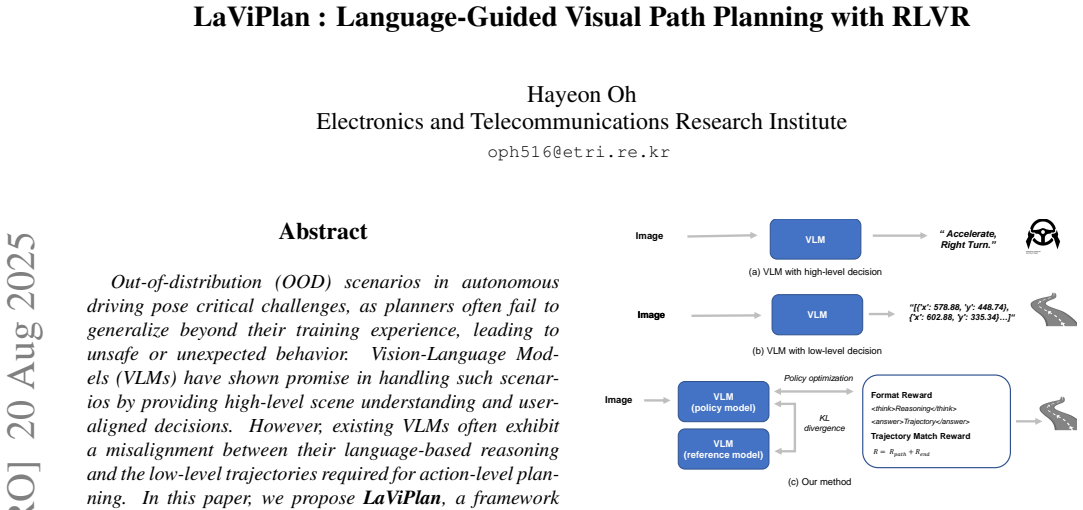
The load-bearing mechanism is Group Relative Policy Optimization (GRPO) applied to a vision-language policy, with a compound verifiable reward $R = R_{\text{format}} + R_{\text{planning}}$. $R_{\text{planning}}$ is the negative logarithm of $(1 + \text{ADE})$ plus $(1 + \text{FDE})$, making trajectory error a differentiable signal in the token-level policy update, while $R_{\text{format}}$ checks the required <think>/<answer> structure. Advantages are computed from group statistics over $G$ sampled trajectories, and the update is clipped and KL-regularized against the supervised reference model. This turns a scalar planning error into a preference signal among candidate trajectories, which the paper argues gives richer supervision than a single ground-truth imitation target.
What would settle it
Run LaViPlan's predicted trajectories through a closed-loop simulator with a rule-based safety checker, or compare them against human-labeled drivable paths on CODA-LM, and measure absolute collision and off-road rates without min-max normalization; if these absolute rates are no better than supervised fine-tuning's, the claimed out-of-domain safety advantage disappears.
Extended reading notes
Core claim
The central claim is that planning-oriented metrics, used as verifiable rewards in GRPO-style reinforcement fine-tuning, realign a VLM's trajectory outputs with its visual reasoning and improve generalization. Given an image and a trajectory-prediction prompt, the model must emit reasoning inside <think> tags and 20 image-plane coordinates inside <answer> tags; the reward adds a format component to a log-smoothed ADE/FDE trajectory-match term, and the policy is kept near a supervised reference model by KL regularization. On ROADWork, LaViPlan achieves ADE 3.62/4.83 and FDE 3.85/6.09 on the easy/hard splits, outperforming every supervised baseline, and on CODA-LM it scores highest under balanced, safety-focused, and equal weighting schemes, with only a fifth of the training budget allocated to reinforcement. The paper treats this as evidence that RLVR is a viable post-training paradigm for aligning language reasoning with action-level driving plans.
Load-bearing premise
The out-of-distribution safety result rests on a min-max normalized safety score computed from bounding-box intersections on CODA-LM, which has no ground-truth trajectories and only three models in the normalization set, so the score is relative rather than an absolute measure of drivability.
Editorial extensions
If this is right
- If RLVR with planning rewards works as claimed, VLM planners can be improved without collecting many new labeled trajectories: only 1,086 reinforcement samples were needed on top of 4,344 supervised ones.
- The in-domain gains, roughly 9 to 13 percent ADE/FDE reductions over supervised fine-tuning, suggest that preference among candidate trajectories provides supervision beyond simple imitation.
- The easy-to-hard sampling ratio becomes a tunable lever: a 6:4 ratio favors in-domain accuracy while a 7:3 ratio favors out-of-domain safety, implying training-set composition should be chosen according to the target deployment.
- The drop in linguistic fidelity alongside better trajectories implies that safety-critical evaluation should weight functional relevance of reasoning over textual similarity to human annotations.
Reading between the lines
- The out-of-domain safety score on CODA-LM is a relative ranking among only three models, not an absolute measure of drivability, so the OOD advantage should be read as suggestive until absolute collision or closed-loop metrics are reported.
- Because the reward is sparse, computed only after the full trajectory is generated, the method would likely benefit from dense step-wise rewards or auxiliary collision penalties, a direction the paper itself flags in its discussion.
- The same recipe could transfer to other structured trajectory-output tasks, such as pedestrian motion forecasting or robot arm path planning, wherever a trajectory error can be computed at the end of a formatted response.
- Since the policy is KL-regularized to a supervised backbone, the ceiling of the approach is partly set by the quality of the supervised fine-tuning stage; a stronger base VLM or better SFT phase would probably shift final trajectory quality as well.
Editorial analysis
A structured set of objections, weighed in public.
Referee Report
Summary. The manuscript proposes LaViPlan, a two-stage framework for vision-language path planning. Stage 1 is supervised fine-tuning (SFT) of a VLM on image-instruction-trajectory pairs; Stage 2 is reinforcement fine-tuning with verifiable rewards (RLVR) using GRPO, where the reward combines a format reward and a planning reward based on ADE and FDE. The method is evaluated on the ROADWork dataset in-domain and on CODA-LM as a zero-shot, out-of-domain benchmark. The reported results show improved ADE/FDE on ROADWork relative to SFT baselines, higher relative safety scores on CODA-LM, and a trade-off in which linguistic fidelity, measured by BERTScore and NLI, decreases while planning-oriented reasoning is claimed to improve. The paper also includes ablations on easy-to-hard sampling ratios and on the presence of explicit reasoning in the two fine-tuning phases.
Significance. If the central claims were fully established, the contribution would be a useful and timely application of RLVR to low-level trajectory planning in autonomous driving, complementing the more common high-level decision use of VLMs. The training recipe is simple and largely reproduces standard GRPO machinery, which is a strength in terms of reproducibility, and the paper uses a publicly available benchmark for the in-domain evaluation. However, the current evidence does not support the full strength of the abstract's claim of out-of-domain improvement, and the 'fewer training samples' contribution is not supported by the experimental comparison. The paper also reports no variance or multiple-run statistics, so the small in-domain gains are not yet statistically grounded.
major comments (4)
- [§4.2.1, Eq. (7), Table 4] The out-of-domain safety score is a relative min-max normalization computed across only three models (Baseline, SFT (5k), LaViPlan), and the raw values of Fail Rate, Collision Count, and Penetration Length are never reported. With three models, Eq. (7) is essentially a rank transform, so the claim that LaViPlan 'achieves the highest safety scores' only means that it ranks first among these three; it does not establish that any of the trajectories are safe or even drivable in an absolute sense. The paper also does not state the number of CODA-LM scenes used, does not report confidence intervals, and CODA-LM has no ground-truth trajectories, so the score cannot measure trajectory accuracy or realism. The qualitative examples in Appendix D are suggestive but cannot replace a quantitative, absolute, or calibrated evaluation.
- [§4, Table 2 and Table 4] The contribution statement that RLVR 'requires significantly fewer training samples compared to supervised fine-tuning' is not supported by the experimental design. The paper states that the SFT baselines are trained on the full 5K samples, while LaViPlan uses 4,344 SFT samples plus 1,086 RFT samples, so the total number of samples is the same as (or slightly greater than) the full dataset. Thus, the comparison cannot demonstrate data efficiency; it demonstrates that adding an RFT phase on top of an SFT phase can improve results, which is a different claim. The authors should either compare LaViPlan with an SFT baseline trained on 4,344 samples only (which appears in Table 5 but is not the headline comparison) or rephrase the claim to be about the relative contribution of the RFT phase rather than about sample efficiency.
- [§4.1 and §4.3, Tables 2, 5, 6] The in-domain improvements are reported as single numbers without error bars, multiple seeds, or significance tests. The gains are often small in absolute terms (for example, ADE Easy 4.12 for SFT (4k) versus 3.62 for LaViPlan in Table 5, and ADE Hard 5.31 versus 4.83), and the comparison in Table 5 is confounded because LaViPlan receives an additional 1,086 RFT samples that the SFT (4k) model does not. Without repeated runs or at least a clear statement of variance, the central claim that RLVR 'improves planning performance' beyond SFT is not yet statistically established. The authors should provide at least three seeds with means and standard deviations for the main ADE/FDE experiments.
- [§4.3.2, Tables 6 and 7] The out-of-domain ablation in Table 7 is used to draw the conclusion that 'out-of-domain robustness requires greater emphasis on hard cases.' However, the evaluation is again the relative min-max safety score from Eq. (7), so the differences between the 9:1, 7:3, and 6:4 ratios are relative comparisons across the same small set of models. The conclusion that a particular easy-to-hard ratio is best for OOD generalization would require an absolute safety measure, raw metric values, and ideally more than one run or a statistical comparison. As written, the domain-sensitivity claim in the text is stronger than the evidence in Table 7.
minor comments (6)
- [Figure 2 caption] There is a typo: 'Qwne2VL-2B-Instruct' should be 'Qwen2VL-2B-Instruct', and the model name should be consistent with Table 2 and the rest of the paper.
- [Figures 4 and 5 captions] The captions of Figures 4 and 5 appear contradictory: Figure 4 says the trajectories in Deasy exhibit lower x-variance than Dhard, while Figure 5 says the trajectories exhibit lower x-variance than Deasy. The captions should be corrected to state the intended ordering.
- [Table 7] Table 7 has formatting problems: the rows for different models are run together without line breaks, making the table difficult to read. The table should be reformatted with each model on a separate row.
- [Eq. (4)] The GRPO objective in Eq. (4) writes the KL divergence term outside the token-level expectation without explicitly defining the expectation over the group and sequence. Clarifying the notation would improve the presentation.
- [Eq. (7)] The set of models k used in the min-max normalization is not explicitly defined. The paper should state that k ranges over the three compared models and specify whether the normalization is performed per evaluation run or pooled across runs.
- [Appendix B, Algorithm 1] The random sampling steps in Algorithm 1 and the construction of Dhard use randomness, but no random seed is reported. Adding the seed would improve reproducibility.
Circularity Check
No significant circularity: reward/evaluation metric overlap is standard RL with held-out evaluation, and the OOD safety score is an external comparator transform, not a fitted input.
full rationale
The paper's derivation chain is self-contained. LaViPlan is trained with a reward built from ADE/FDE (Eq. 5) and then evaluated on held-out ROADWork ADE/FDE (Table 2); because the evaluation set is disjoint from the training set, this is direct objective optimization rather than a fitted parameter renamed as a prediction. The OOD evaluation on CODA-LM uses Eq. 7, a min-max normalized weighted average of externally computed Fail Rate, Collision Count, and Penetration Length across the three compared models. This makes the safety scores relative and, with only three models, weak evidence, but the scores are not constructed from the claim being made; they are transformations of measured trajectory/bbox intersections. There are no load-bearing self-citations (the author does not appear in the reference list), and no uniqueness theorem or ansatz is imported from the author's prior work. The discussion section itself flags limitations (sparse reward, dependence on a strong SFT model), and Appendix D admits reliance on visual inspection for CODA-LM, which indicates the empirical results are not being presented as a forced derivation. The 'fewer training samples' claim is inconsistent with the reported 4,344 + 1,086 = 5,430 total samples versus a 5K SFT baseline, but that is a factual/support issue, not circularity.
Assumptions & free parameters
free parameters (2)
- SFT:RFT split ratio =
4:1
- Easy-to-hard RFT ratio =
6:4 (in-domain), 7:3 (OOD)
assumptions (4)
- standard math GRPO/PPO convergence and KL regularization behavior
- domain assumption ADE and FDE on image-plane coordinates are valid proxies for planning quality
- domain assumption Bounding-box intrusion on CODA-LM is a sufficient proxy for OOD safety
- domain assumption The <think> reasoning content causally influences the trajectory output
Cite this review
Pith. "Pith review of LaViPlan : Language-Guided Visual Path Planning with RLVR." pith.science (2026). https://pith.science/paper/LCKJJCFQ
@misc{pith2026250712911,
  author       = {Pith},
  title        = {Pith review of: LaViPlan : Language-Guided Visual Path Planning with RLVR},
  year         = {2026},
  howpublished = {\url{https://pith.science/paper/LCKJJCFQ}},
  note         = {Machine review of arXiv:2507.12911}
}
read the original abstract
Out-of-distribution (OOD) scenarios in autonomous driving pose critical challenges, as planners often fail to generalize beyond their training experience, leading to unsafe or unexpected behavior. Vision-Language Models (VLMs) have shown promise in handling such scenarios by providing high-level scene understanding and user-aligned decisions. However, existing VLMs often exhibit a misalignment between their language-based reasoning and the low-level trajectories required for action-level planning. In this paper, we propose LaViPlan, a framework that leverages Reinforcement Learning with Verifiable Rewards (RLVR) to fine-tune VLMs using planning-oriented metrics. Experimental results show that LaViPlan improves planning performance across both in-domain and out-of-domain datasets. While linguistic fidelity slightly decreases after RLVR-based fine-tuning, qualitative evaluation indicates that the outputs remain coherent. We also conduct ablation studies to analyze the effects of sampling ratio and reasoning guidance, highlighting how these design choices influence performance. These findings demonstrate the potential of RLVR as a post-training paradigm for aligning language-guided reasoning with action-level planning in autonomous driving.
Figures


Figures from the paper (3 more)


Reference graph
Works this paper leans on
-
[1]
Jinze Bai, Shuai Bai, Shusheng Yang, Shijie Wang, Sinan Tan, Peng Wang, Junyang Lin, Chang Zhou, and Jingren Zhou. Qwen-vl: A versatile vision-language model for un- derstanding, localization, text reading, and beyond. arXiv preprint arXiv:2308.12966, 2023. 1
arXiv 2023
-
[2]
Au- tomated evaluation of large vision-language models on self- driving corner cases
Kai Chen, Yanze Li, Wenhua Zhang, Yanxin Liu, Pengxiang Li, Ruiyuan Gao, Lanqing Hong, Meng Tian, Xinhai Zhao, Zhenguo Li, Dit-Yan Yeung, Huchuan Lu, and Xu Jia. Au- tomated evaluation of large vision-language models on self- driving corner cases. In 2025 IEEE/CVF Winter Conference on Applications of Computer Vision (WACV) , pages 7817– 7826, 2025. 4, 6
work page 2025
-
[3]
Liang Chen, Lei Li, Haozhe Zhao, and Yifan Song. Vinci. r1-v: Reinforcing super generalization ability in vision- language models with less than $3, 2025. 4
work page 2025
-
[4]
Menli: Robust evaluation metrics from natural language inference
Yanran Chen and Steffen Eger. Menli: Robust evaluation metrics from natural language inference. Transactions of the Association for Computational Linguistics, 11:804–825,
-
[5]
Internvl: Scaling up vision foundation models and aligning for generic visual-linguistic tasks
Zhe Chen, Jiannan Wu, Wenhai Wang, Weijie Su, Guo Chen, Sen Xing, Muyan Zhong, Qinglong Zhang, Xizhou Zhu, Lewei Lu, Bin Li, Ping Luo, Tong Lu, Yu Qiao, and Jifeng Dai. Internvl: Scaling up vision foundation models and aligning for generic visual-linguistic tasks. In Proceedings of the IEEE/CVF Conference on Computer Vision and Pat- tern Recognition (CVPR...
work page 2024
-
[6]
Sft memorizes, rl generalizes: A compara- tive study of foundation model post-training
Tianzhe Chu, Yuexiang Zhai, Jihan Yang, Shengbang Tong, Saining Xie, Dale Schuurmans, Quoc V Le, Sergey Levine, and Yi Ma. Sft memorizes, rl generalizes: A compara- tive study of foundation model post-training. arXiv preprint arXiv:2501.17161, 2025. 2
arXiv 2025
-
[7]
Haoyu Fu, Diankun Zhang, Zongchuang Zhao, Jianfeng Cui, Dingkang Liang, Chong Zhang, Dingyuan Zhang, Hongwei Xie, Bing Wang, and Xiang Bai. Orion: A holistic end-to- end autonomous driving framework by vision-language in- structed action generation. arXiv preprint arXiv:2503.19755,
-
[8]
Are we ready for autonomous driving? the kitti vision benchmark suite
Andreas Geiger, Philip Lenz, and Raquel Urtasun. Are we ready for autonomous driving? the kitti vision benchmark suite. In 2012 IEEE conference on computer vision and pat- tern recognition, pages 3354–3361. IEEE, 2012. 4
work page 2012
Show all 39 references
-
[9]
Roadwork: A dataset and benchmark for learn- ing to recognize, observe, analyze and drive through work zones
Anurag Ghosh, Shen Zheng, Robert Tamburo, Khiem Vuong, Juan Alvarez-Padilla, Hailiang Zhu, Michael Cardei, Nicholas Dunn, Christoph Mertz, and Srinivasa G Narasimhan. Roadwork: A dataset and benchmark for learn- ing to recognize, observe, analyze and drive through work zones. ...
2025
-
[10]
Deepseek-r1: Incentivizing reasoning capability in llms via reinforcement learning
Daya Guo, Dejian Yang, Haowei Zhang, Junxiao Song, Ruoyu Zhang, Runxin Xu, Qihao Zhu, Shirong Ma, Peiyi Wang, Xiao Bi, et al. Deepseek-r1: Incentivizing reasoning capability in llms via reinforcement learning. arXiv preprint arXiv:2501.12948, 2025. 2, 11 8
2025 arXiv
-
[11]
Lora: Low-rank adaptation of large language models
Edward J Hu, Yelong Shen, Phillip Wallis, Zeyuan Allen- Zhu, Yuanzhi Li, Shean Wang, Lu Wang, Weizhu Chen, et al. Lora: Low-rank adaptation of large language models. ICLR, 1(2):3, 2022. 11
2022
-
[12]
Human as ai mentor: Enhanced human-in-the-loop rein- forcement learning for safe and efficient autonomous driv- ing
Zilin Huang, Zihao Sheng, Chengyuan Ma, and Sikai Chen. Human as ai mentor: Enhanced human-in-the-loop rein- forcement learning for safe and efficient autonomous driv- ing. Communications in Transportation Research, 4:100127,
-
[13]
Bench2drive: Towards multi-ability bench- marking of closed-loop end-to-end autonomous driving
Xiaosong Jia, Zhenjie Yang, Qifeng Li, Zhiyuan Zhang, and Junchi Yan. Bench2drive: Towards multi-ability bench- marking of closed-loop end-to-end autonomous driving. Ad- vances in Neural Information Processing Systems , 37:819– 844, 2024. 6
2024
-
[14]
Senna: Bridging large vision-language mod- els and end-to-end autonomous driving
Bo Jiang, Shaoyu Chen, Bencheng Liao, Xingyu Zhang, Wei Yin, Qian Zhang, Chang Huang, Wenyu Liu, and Xing- gang Wang. Senna: Bridging large vision-language mod- els and end-to-end autonomous driving. arXiv preprint arXiv:2410.22313, 2024. 1, 2
-
[15]
Alphadrive: Unleashing the power of vlms in autonomous driving via reinforcement learning and reason- ing
Bo Jiang, Shaoyu Chen, Qian Zhang, Wenyu Liu, and Xing- gang Wang. Alphadrive: Unleashing the power of vlms in autonomous driving via reinforcement learning and reason- ing. arXiv preprint arXiv:2503.07608, 2025. 1, 2, 4
2025 arXiv
-
[16]
Adapt: Action-aware driving caption transformer
Bu Jin, Xinyu Liu, Yupeng Zheng, Pengfei Li, Hao Zhao, Tong Zhang, Yuhang Zheng, Guyue Zhou, and Jingjing Liu. Adapt: Action-aware driving caption transformer. In 2023 IEEE International Conference on Robotics and Automation (ICRA), pages 7554–7561. IEEE, 2023. 2
2023
-
[17]
Aligning text- to-image models using human feedback
Kimin Lee, Hao Liu, Moonkyung Ryu, Olivia Watkins, Yuqing Du, Craig Boutilier, Pieter Abbeel, Mohammad Ghavamzadeh, and Shixiang Shane Gu. Aligning text- to-image models using human feedback. arXiv preprint arXiv:2302.12192, 2023. 2
2023 arXiv
-
[18]
Coda: A real-world road corner case dataset for object detection in autonomous driving
Kaican Li, Kai Chen, Haoyu Wang, Lanqing Hong, Chao- qiang Ye, Jianhua Han, Yukuai Chen, Wei Zhang, Chunjing Xu, Dit-Yan Yeung, et al. Coda: A real-world road corner case dataset for object detection in autonomous driving. In European Conference on Computer Vision, pages 406–4...
2022
-
[19]
Visual instruction tuning
Haotian Liu, Chunyuan Li, Qingyang Wu, and Yong Jae Lee. Visual instruction tuning. InAdvances in Neural Information Processing Systems, pages 34892–34916. Curran Associates, Inc., 2023. 1
2023
-
[20]
Visual- rft: Visual reinforcement fine-tuning
Ziyu Liu, Zeyi Sun, Yuhang Zang, Xiaoyi Dong, Yuhang Cao, Haodong Duan, Dahua Lin, and Jiaqi Wang. Visual- rft: Visual reinforcement fine-tuning. arXiv preprint arXiv:2503.01785, 2025. 1, 2, 4
2025 arXiv
-
[21]
Reinforcement learning with verifiable re- wards: Grpo’s effective loss, dynamics, and success amplifi- cation
Youssef Mroueh. Reinforcement learning with verifiable re- wards: Grpo’s effective loss, dynamics, and success amplifi- cation. arXiv preprint arXiv:2503.06639, 2025. 2
2025
-
[22]
Improving agent behav- iors with rl fine-tuning for autonomous driving
Zhenghao Peng, Wenjie Luo, Yiren Lu, Tianyi Shen, Cole Gulino, Ari Seff, and Justin Fu. Improving agent behav- iors with rl fine-tuning for autonomous driving. In European Conference on Computer Vision , pages 165–181. Springer,
-
[23]
Direct preference optimization: Your language model is secretly a reward model
Rafael Rafailov, Archit Sharma, Eric Mitchell, Christo- pher D Manning, Stefano Ermon, and Chelsea Finn. Direct preference optimization: Your language model is secretly a reward model. Advances in neural information processing systems, 36:53728–53741, 2023. 2
2023
-
[24]
Reinforcement learning with sparse rewards using guidance from offline demonstra- tion
Desik Rengarajan, Gargi Vaidya, Akshay Sarvesh, Dileep Kalathil, and Srinivas Shakkottai. Reinforcement learning with sparse rewards using guidance from offline demonstra- tion. arXiv preprint arXiv:2202.04628, 2022. 8
2022 arXiv
-
[25]
Carllava: Vision language models for camera-only closed-loop driving
Katrin Renz, Long Chen, Ana-Maria Marcu, Jan H¨unermann, Benoit Hanotte, Alice Karnsund, Jamie Shotton, Elahe Arani, and Oleg Sinavski. Carllava: Vision language models for camera-only closed-loop driving. arXiv preprint arXiv:2406.10165, 2024. 2
2024 arXiv
-
[26]
Simlingo: Vision-only closed-loop autonomous driving with language-action alignment
Katrin Renz, Long Chen, Elahe Arani, and Oleg Sinavski. Simlingo: Vision-only closed-loop autonomous driving with language-action alignment. In Proceedings of the Computer Vision and Pattern Recognition Conference , pages 11993– 12003, 2025. 2
2025
-
[27]
Proximal policy optimization algo- rithms
John Schulman, Filip Wolski, Prafulla Dhariwal, Alec Rad- ford, and Oleg Klimov. Proximal policy optimization algo- rithms. arXiv preprint arXiv:1707.06347, 2017. 2, 3
2017 arXiv
-
[28]
Waslander, Yu Liu, and Hongsheng Li
Hao Shao, Yuxuan Hu, Letian Wang, Guanglu Song, Steven L. Waslander, Yu Liu, and Hongsheng Li. Lmdrive: Closed-loop end-to-end driving with large language mod- els. In Proceedings of the IEEE/CVF Conference on Com- puter Vision and Pattern Recognition (CVPR), pages 15120– 1513...
2024
-
[29]
Drivelm: Driving with graph visual question answering
Chonghao Sima, Katrin Renz, Kashyap Chitta, Li Chen, Hanxue Zhang, Chengen Xie, Jens Beißwenger, Ping Luo, Andreas Geiger, and Hongyang Li. Drivelm: Driving with graph visual question answering. In Computer Vision – ECCV 2024, pages 256–274, Cham, 2025. Springer Nature Switzerland. 2
2024
-
[30]
Maniplvm-r1: Rein- forcement learning for reasoning in embodied manipula- tion with large vision-language models
Zirui Song, Guangxian Ouyang, Mingzhe Li, Yuheng Ji, Chenxi Wang, Zixiang Xu, Zeyu Zhang, Xiaoqing Zhang, Qian Jiang, Zhenhao Chen, et al. Maniplvm-r1: Rein- forcement learning for reasoning in embodied manipula- tion with large vision-language models. arXiv preprint arXiv:250...
2025 arXiv
-
[31]
Drivevlm: The convergence of autonomous driving and large vision-language models
Xiaoyu Tian, Junru Gu, Bailin Li, Yicheng Liu, Yang Wang, Zhiyong Zhao, Kun Zhan, Peng Jia, Xianpeng Lang, and Hang Zhao. Drivevlm: The convergence of autonomous driving and large vision-language models. arXiv preprint arXiv:2402.12289, 2024. 2
2024 arXiv
-
[32]
What is the alignment objective of grpo? arXiv preprint arXiv:2502.18548, 2025
Milan V ojnovic and Se-Young Yun. What is the alignment objective of grpo? arXiv preprint arXiv:2502.18548, 2025. 2
2025 arXiv
-
[33]
Omnidrive: A holistic vision-language dataset for au- tonomous driving with counterfactual reasoning
Shihao Wang, Zhiding Yu, Xiaohui Jiang, Shiyi Lan, Min Shi, Nadine Chang, Jan Kautz, Ying Li, and Jose M Al- varez. Omnidrive: A holistic vision-language dataset for au- tonomous driving with counterfactual reasoning. InProceed- ings of the Computer Vision and Pattern Recognit...
2025
-
[34]
Rlvr-world: Training world models with reinforce- ment learning
Jialong Wu, Shaofeng Yin, Ningya Feng, and Mingsheng Long. Rlvr-world: Training world models with reinforce- ment learning. arXiv preprint arXiv:2505.13934, 2025. 2
2025
-
[35]
9 Drivegpt4: Interpretable end-to-end autonomous driving via large language model
Zhenhua Xu, Yujia Zhang, Enze Xie, Zhen Zhao, Yong Guo, Kwan-Yee K Wong, Zhenguo Li, and Hengshuang Zhao. 9 Drivegpt4: Interpretable end-to-end autonomous driving via large language model. IEEE Robotics and Automation Let- ters, 2024. 2
2024
-
[36]
Drivegpt4-v2: Harnessing large language model capabilities for enhanced closed-loop autonomous driving
Zhenhua Xu, Yan Bai, Yujia Zhang, Zhuoling Li, Fei Xia, Kwan-Yee K Wong, Jianqiang Wang, and Hengshuang Zhao. Drivegpt4-v2: Harnessing large language model capabilities for enhanced closed-loop autonomous driving. In Proceed- ings of the Computer Vision and Pattern Recognition...
2025
-
[37]
R1-vl: Learn- ing to reason with multimodal large language models via step-wise group relative policy optimization
Jingyi Zhang, Jiaxing Huang, Huanjin Yao, Shunyu Liu, Xikun Zhang, Shijian Lu, and Dacheng Tao. R1-vl: Learn- ing to reason with multimodal large language models via step-wise group relative policy optimization. arXiv preprint arXiv:2503.12937, 2025. 8
2025 arXiv
-
[38]
Bertscore: Evaluating text genera- tion with bert
Tianyi Zhang, Varsha Kishore, Felix Wu, Kilian Q Wein- berger, and Yoav Artzi. Bertscore: Evaluating text genera- tion with bert. arXiv preprint arXiv:1904.09675, 2019. 5
1904 arXiv
-
[39]
Opendrivevla: Towards end-to-end au- tonomous driving with large vision language action model
Xingcheng Zhou, Xuyuan Han, Feng Yang, Yunpu Ma, and Alois C Knoll. Opendrivevla: Towards end-to-end au- tonomous driving with large vision language action model. arXiv preprint arXiv:2503.23463, 2025. 2 10 A. Training Details Table 10. Hyperparameters for language world model...
2025
Reviewed August 6, 2026 · model on record in the stance chip above.
Discussion (0). Sign in to comment.