REVIEW 3 major objections 4 minor 117 references
Generation of Four-Component Schr\"odinger Cat States via Floquet Engineering in a Hybrid Ferromagnet-Superconductor System
T0 review · 3 major / 4 minor · reviewed 2026-08-06 · deepseek-v4-flash
Pith's one-line read A Floquet-engineered setup with two driven qubits and a virtual-photon cavity produces four-component Schrödinger cat states of a magnon mode.
desk verdict The Floquet scheme is appealing, but the central effective-Hamiltonian derivation is internally inconsistent and numerically unsupported. read the letter →
The pith
A machine-rendered reading of the paper's core claim, the machinery that carries it, and where it could break.
The reading
What carries the argument
The load-bearing object is the effective conditional-displacement Hamiltonian, written $$H_{\rm eff} = \xi m^\dagger m + \Gamma_3\$\sigma$^z_1\$\sigma$^z_2 + \Gamma_1\$\sigma$^z_1(m+m^\dagger) + \$\sigma$^z_2(\Gamma_2 m + \Gamma_2^* m^\dagger),$$ reached in three steps: a Floquet-frame expansion of the driven qubit couplings into sidebands weighted by Bessel functions, a rotating-wave approximation that keeps only the $(2n_0-1)$-th sideband, and a canonical perturbative transformation (an anti-Hermitian generator) that eliminates the cavity. Floquet renormalizes each qubit–cavity coupling to $G_j = g_j J_{2n_0-1}(\mu_j)/2$, and the cavity then induces conditional displacement strengths $\Gamma_1$ and $\Gamma_2=\Gamma_1 e^{i\Phi}$ on the magnon, where $\Phi=(2n_0-1)\phi$ is the effective relative phase of the two drives. The central phase-space construction is the joint operator $A=\sigma^z_1+\sigma^z_2 e^{i\Phi}$: a time-ordered exponential expansion of the evolution gives a magnon displacement amplitude $\eta_1(t)=(\Gamma_1/\xi)(1-e^{-i\xi t})$, and the coherent amplitude $\alpha(t)=(1-i)\eta_1(t)$ traces two phase-space directions whose relative angle is controlled by $\Phi$. At $\Phi=(2k+1)\pi/2$ the two-qubit Ising term $\Gamma_3$ vanishes, leaving a pure conditional displacement whose four coherent components sit on orthogonal axes; the argument therefore rides on the selected Floquet sideband being the only near-resonant term and on the cavity's virtual role in generating these displacements.
What would settle it
Run the same full-Hamiltonian simulation of Eq. (1) with realistic transmon frequencies such as $\omega_{q1}/2\pi=\omega_{q2}/2\pi=5$ GHz, keeping the Fig. 2 drive and coupling parameters, and compare the magnon Wigner function at 40–50 ns against the ideal four-component target; if the fidelity falls far below 0.83 or the four-lobed C4 structure disappears, the $\omega_q=0$ assumption is load-bearing.
Extended reading notes
Core claim
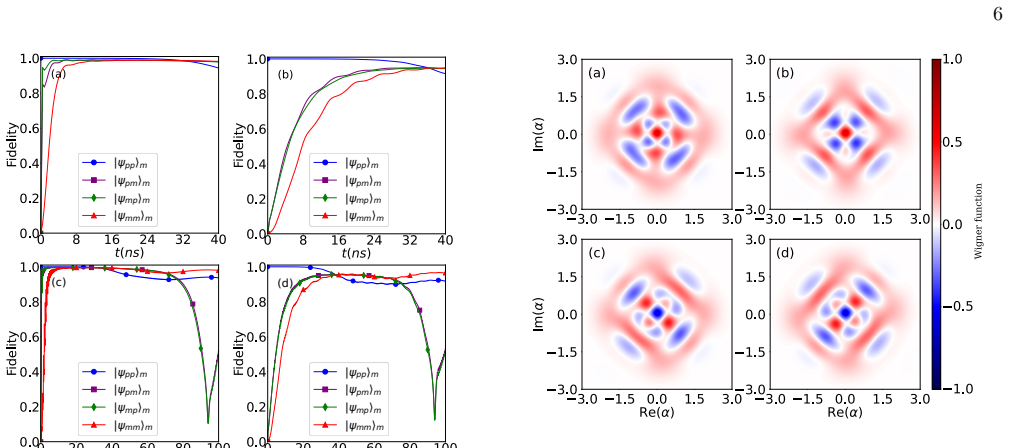
On the paper's own terms, the discovery is that Floquet sideband selection converts the linear qubit–cavity and cavity–magnon couplings of a hybrid ferromagnet–superconductor system into an effective Hamiltonian that conditionally displaces the magnon depending on the two-qubit parity. Starting from $|+\rangle_{q_1}|+\rangle_{q_2}|0\rangle_m$, the evolution entangles the qubits with the magnon so that a joint measurement of the qubits in the $\sigma^x$ basis projects the magnon onto one of four cat-code states, each a superposition of $\alpha$, $-\alpha$, $i\alpha$, $-i\alpha$ with phases fixed by the Floquet drive phase difference. With the first sideband selected ($n_0=1$), choosing the effective phase $\Phi=(2k+1)\pi/2$ removes the two-qubit Ising term and leaves a pure conditional displacement, producing C4-symmetric Wigner functions with $|\alpha|\approx 1.0$ at about 40 ns. The derived effective master equation, including qubit, magnon, and cavity decay plus a hybrid dissipation channel from adiabatic cavity elimination, shows these states persist with fidelity above 0.83 when each decay rate is up to about 1 MHz.
Load-bearing premise
The derivation sets both superconducting qubit transition frequencies to zero ($\omega_{q1}=\omega_{q2}=0$), and real transmons have multi-gigahertz frequencies; if the neglected qubit self-energy terms cannot be dropped at realistic frequencies, the effective Hamiltonian and the reported fidelities do not transfer to hardware.
Editorial extensions
If this is right
- A joint projective measurement of the two qubits in the $\sigma^x$ basis leaves the magnon in one of four cat-code states, so the protocol offers heralded preparation of a bosonic logical state.
- Because the cavity mediates only virtual excitations, cavity decay has a minor effect on fidelity in the studied range, which relaxes a practical constraint for circuit-QED implementation.
- The phase difference $\phi$ tunes the constellation: at $\phi=0$ the state reduces to a two-component cat, and at $\phi=(2k+1)\pi/(4n_0-2)$ it acquires C4 symmetry.
- No higher-order nonlinearity is required; linear qubit–cavity and magnon–cavity couplings plus drives suffice, lowering hardware requirements compared with Kerr-based cat generation.
- The same construction is checked at two parameter sets with drive frequencies near 5 and 8 GHz, suggesting the scheme is not tied to one frequency window.
Reading between the lines
- A natural scaling inference is that adding more driven qubits with independent phase differences would yield $2^N$-component cat constellations under the same conditional-displacement mechanism; the paper demonstrates only the four-component case.
- Whether the zero-qubit-frequency approximation can be relaxed is the key experimental hinge: the static $J_0(\mu)$ qubit self-energy term is not removed by a rotating-wave argument, so its effect on cat fidelity should be quantified before a transmon experiment is attempted.
- The predicted insensitivity to cavity loss suggests one could increase the qubit–cavity and magnon–cavity detunings to reduce Purcell-type errors, at the cost of weaker effective coupling and longer generation time; this trade-off is not mapped in the paper.
- The same Floquet conditional-displacement construction could transfer to other bosonic modes, such as microwave photons or mechanical oscillators, wherever a two-qubit joint parity operator is available.
Signed reviews
Editorial analysis
A structured set of objections, weighed in public.
Referee Report
Summary. The manuscript proposes a Floquet-engineering protocol for generating four-component Schrödinger cat (4C) states of a magnon mode in a hybrid ferromagnet–superconductor system. Two superconducting qubits are each driven by Floquet fields with a relative phase φ, and the cavity-mediated magnon–qubit interaction is treated via a Nakajima transformation to obtain an effective conditional-displacement Hamiltonian. For a specific drive phase, the effective dynamics are claimed to produce C4-symmetric 4C magnon states with amplitudes |α|≈1.0–1.26 on timescales of 40–50 ns. The paper presents Wigner functions, effective-vs-full-Hamiltonian fidelity checks, and master-equation simulations including qubit, magnon, and cavity dissipation.
Significance. If the central claim were correct, the scheme would be of interest because it avoids relying on strong intrinsic nonlinearities and uses a hybrid magnon–qubit platform with demonstrated coupling elements. The paper also makes a useful effort to compare effective and full dynamics and to model dissipation. However, the core effective-Hamiltonian derivation is internally inconsistent as written, and the quantitative predictions cannot be reproduced from the stated equations. In addition, all numerical results assume vanishing superconducting-qubit transition frequencies, which is not a realistic transmon regime. These issues are load-bearing, because they undermine the paper's main quantitative claim and its relevance to the proposed platform.
major comments (3)
- [Section II, Eqs. (4)–(6) and Fig. 2] The Nakajima-transformation derivation is not self-consistent. With Uaux(t)=exp(−iH0t) and H0=δa†a+(δ−Δ_cm)m†m, the g3 term of Eq. (4), g3(ma†e^{iΔ_cm t}+m†ae^{−iΔ_cm t}), is transformed into g3(ma†e^{2iΔ_cm t}+m†ae^{−2iΔ_cm t}) rather than becoming time-independent. Thus the interaction V used in the Schrieffer–Wolff condition V+[S,H0]=0 in Eq. (5) is not the actual transformed interaction, and Eq. (6) is not the correct effective Hamiltonian. Quantitatively, inserting the Fig. 2 parameters (δ/2π=175.3 MHz, Δ_cm/2π=−173 MHz, G/2π≈35 MHz, g3/2π=20 MHz) into Eq. (6) gives Γ1/2π≈−0.03 MHz. With ξ/2π≈348 MHz, Eq. (8) then yields a maximum coherent amplitude |α|≤2√2|Γ1|/ξ≈2×10^{-4}, which is incompatible with the claimed |α|=1.007 in Fig. 2. The numerical Wigner functions therefore appear to rely on sign or detuning conventions that are not stated in the manuscript.
- [Appendix A and parameter sets in Figs. 2–5] The superconducting qubit transition frequencies are set to zero in the derivation and in all numerical simulations ("Hereafter, we set ωq=0 for simplicity", Appendix A; ωq1=ωq2=0 in Figs. 2–5). This removes the qubit energy scale of a transmon. For realistic transmon frequencies of several GHz and the drive frequencies used here (ωf/2π=5 or 8 GHz), the RWA conditions listed in Appendix A (e.g., ωfj≫ωqjJℓ(μj)/2) are not satisfied. The proposed protocol is therefore not demonstrated for the hybrid ferromagnet–superconductor platform claimed in the title and abstract; finite-ωq simulations with parameters satisfying the stated RWA conditions are needed.
- [Section V, Fig. 4 and perturbative validity] The fidelity check between the effective Hamiltonian and the full Hamiltonian in Fig. 4 is performed with the same unphysical qubit parameters (ωq=0), so it does not validate the approximations in a realistic regime. Moreover, the sign inconsistency identified above is not a harmless typo: the alternative convention that would make the g3 term time-independent leads to an effective magnon frequency ξ≈δ+Δ_cm≈2.3 MHz for the stated parameters, which is comparable to or smaller than the coupling strengths and violates the condition ∥V∥≪∥H0∥ used for the perturbative Nakajima transformation. Thus the derivation as written cannot support the claimed large coherent amplitudes.
minor comments (4)
- [Fig. 3 caption] The caption states that panels (i)–(l) show dependence on the "cavity dissipation rate κm"; this should read κc, since the axis labels and the surrounding text indicate cavity decay.
- [Section II, Hamiltonian definitions] The detuning δ is not defined explicitly in the main text; it should be stated alongside Eq. (4) as (2n0−1)ωf−ωc (or the equivalent convention), to avoid ambiguity in the sign conventions used later.
- [Appendix A] The sentence "where the the ground state" contains a duplicated article; please correct it.
- [Abstract and conclusion] The phrase "even if the decoherence of the system is considered" is imprecise; the master equation includes specific rates and channels, and the claim should be stated in terms of the simulated parameter ranges.
Circularity Check
No significant circularity: the effective-Hamiltonian derivation is self-contained and benchmarked against full-Hamiltonian numerics; self-citations are background only.
full rationale
The central derivation is not circular. The paper starts from a concrete physical Hamiltonian (Eq. 1), transforms to the Floquet frame, applies the RWA, and obtains the effective Hamiltonian (Eq. 6) by a standard Nakajima-Schrieffer-Wolff transformation. The 4C states in Eq. (10) are the explicit solution of the conditional-displacement unitary in Eq. (8) with the chosen initial qubit superposition; they are consequences of the Hamiltonian, not fitted targets. The phase choice Φ = π/2 that removes the Ising term is a design freedom, not a circular re-importation of the target state. The full-Hamiltonian versus effective-Hamiltonian fidelity comparison in Fig. 4 is an independent numerical benchmark, and the dissipative master equation is derived from the original Lindblad operators rather than assumed. The authors' self-citations [60, 62] appear only as background for prior magnon cat-state schemes and carry no load-bearing uniqueness or ansatz claim. The physically important caveats — Appendix A's 'Hereafter, we set ωq = 0 for simplicity' and the apparent inconsistency between Eqs. (5)-(6) and the plotted |α| = 1.007 for the Fig. 2 parameters — are correctness/consistency concerns, not circularity: they do not show that the output equals its input by definition or that a fitted parameter is renamed as a prediction.
Assumptions & free parameters
free parameters (3)
- drive phase difference ϕ =
π/2 (Φ = π/2 for n0=1)
- Floquet modulation ratio Ωf/ωf =
0.92 (µ = 1.84)
- qubit transition frequency ωqj =
0
assumptions (6)
- domain assumption Only the (2n0-1)-order Floquet sideband is resonant; all other sidebands are dropped under the rotating-wave approximation.
- domain assumption The Nakajima transformation can be truncated at first order, requiring ∥V∥ ≪ ∥H0∥, i.e., G/δ ≪ 1 and g3/∆cm ≪ 1.
- domain assumption The cavity mode is adiabatically eliminated and acts only as a virtual mediator; its only dissipative effect is the derived hybrid channel.
- domain assumption The initial qubit state is |+⟩|+⟩ and the final measurement is performed in the σx basis.
- ad hoc to paper Superconducting qubit transition frequencies are zero (ωq1 = ωq2 = 0).
- standard math The dynamics are described by a standard Lindblad master equation with a zero-temperature bath.
Cite this review
Pith. "Pith review of Generation of Four-Component Schr\"odinger Cat States via Floquet Engineering in a Hybrid Ferromagnet-Superconductor System." pith.science (2026). https://pith.science/paper/RHF2PZMO
@misc{pith2026250712924,
  author       = {Pith},
  title        = {Pith review of: Generation of Four-Component Schr\"odinger Cat States via Floquet Engineering in a Hybrid Ferromagnet-Superconductor System},
  year         = {2026},
  howpublished = {\url{https://pith.science/paper/RHF2PZMO}},
  note         = {Machine review of arXiv:2507.12924}
}
read the original abstract
Four-component Schr\"odinger cat (4C) states are important physical resources for fault-tolerant quantum computing. However, the generation of 4C states in solid-state platforms remains challenging due to stringent nonlinearity requirements. In this paper, a Floquet-engineering scheme is proposed for generating 4C states in a hybrid ferromagnet-superconductor system. Numerical simulations show that the high-fidelity 4C states can be generated even if the decoherence of the system is considered. These results provide a scalable route to multi-component cat-state engineering in solid-state platforms and open new avenues for quantum computation.
Figures


Figures from the paper (1 more)
Reference graph
Works this paper leans on
-
[1]
Schr¨ odinger, Die gegenw¨ artige Situation in der Quan- tenmechanik, Naturwissenschaften 23, 823 (1935)
E. Schr¨ odinger, Die gegenw¨ artige Situation in der Quan- tenmechanik, Naturwissenschaften 23, 823 (1935)
1935
-
[2]
In the following, we choose k = 0
When Φ = (2 k + 1)π/2 (k ∈ Z), the phase factor η2(t) is sup- pressed, and the two-body Ising interaction term Γ3σz 1σz 2 is eliminated, resulting in pure conditional displacement mechanism. In the following, we choose k = 0. 4 We consider that the initial state of the system is |ψ(0)⟩ = |+⟩q1 |+⟩q2 |0⟩m, where |+⟩qj = (|g⟩qj +|e⟩qj )/ √ 2 (|−⟩qj = (|g⟩qj...
-
[3]
is the eigenstate of σxj with eigenvalue +1 (−1); and |0⟩m is the vacuum state of the magnon mode. The system state at time t, evolved via the unitary evolution operator ˜U (t), is given by |ψ(t)⟩ =|+⟩q1 |+⟩q2 |ψpp⟩m + |+⟩q1 |−⟩q2 |ψpm⟩m + |−⟩q1 |+⟩q2 |ψmp⟩m + |−⟩q1 |−⟩q2 |ψmm⟩m, (9) where the 4C states are defined as |ψpp⟩m =Npp(|α(t)⟩m + |iα(t)⟩m + | −i...
-
[4]
B. C. Sanders, Review of entangled coherent states, Journal of Physics A: Mathematical and Theoretical45, 244002 (2012)
2012
-
[5]
H. Yuan, Y. Cao, A. Kamra, R. A. Duine, and P. Yan, Quantum magnonics: When magnon spintronics meets quantum information science, Physics Reports 965, 1 (2022)
2022
-
[6]
Xia and G
Y. Xia and G. Guo, Nonclassical properties of even and odd coherent states, Physics Letters A 136, 281 (1989)
1989
-
[7]
Janszky and A
J. Janszky and A. V. Vinogradov, Squeezing via one- dimensional distribution of coherent states, Phys. Rev. Lett. 64, 2771 (1990)
1990
-
[8]
Janszky, P
J. Janszky, P. Domokos, and P. Adam, Coherent states on a circle and quantum interference, Phys. Rev. A 48, 2213 (1993)
1993
Show all 117 references
-
[9]
Janszky, P
J. Janszky, P. Domokos, S. Szab´ o, and P. Adam, Quantum-state engineering via discrete coherent-state superpositions, Phys. Rev. A 51, 4191 (1995)
1995
-
[10]
M. O. Scully and M. S. Zubairy, Quantum optics (1999)
1999
-
[11]
X. Yu, B. Wilhelm, D. Holmes, A. Vaartjes, D. Schwien- bacher, M. Nurizzo, A. Kringhøj, M. R. v. Blankenstein, A. M. Jakob, P. Gupta, F. E. Hudson, K. M. Itoh, R. J. Murray, R. Blume-Kohout, T. D. Ladd, N. Anand, A. S. Dzurak, B. C. Sanders, D. N. Jamieson, and A. Morello, Sch...
2025
-
[12]
L. Sun, A. Petrenko, Z. Leghtas, B. Vlastakis, G. Kirch- mair, K. M. Sliwa, A. Narla, M. Hatridge, S. Shankar, J. Blumoff, L. Frunzio, M. Mirrahimi, M. H. Devoret, and R. J. Schoelkopf, Tracking photon jumps with re- peated quantum non-demolition parity measurements, Nature 51...
2014
-
[13]
N. Ofek, A. Petrenko, R. Heeres, P. Reinhold, Z. Legh- tas, B. Vlastakis, Y. Liu, L. Frunzio, S. M. Girvin, L. Jiang, M. Mirrahimi, M. H. Devoret, and R. J. Schoelkopf, Extending the lifetime of a quantum bit with error correction in superconducting circuits, Na- ture 536, 441 (2016)
2016
-
[14]
K. G. Johnson, J. D. Wong-Campos, B. Neyenhuis, J. Mizrahi, and C. Monroe, Ultrafast creation of large schr¨ odinger cat states of an atom, Nature Communica- tions 8, 697 (2017)
2017
-
[15]
Bruno, A
N. Bruno, A. Martin, P. Sekatski, N. Sangouard, R. T. Thew, and N. Gisin, Displacement of entanglement back and forth between the micro and macro domains, Nature Physics 9, 545 (2013)
2013
-
[16]
C. P. Sun, X. X. Yi, S. R. Zhao, L. Zhang, and C. Wang, Dynamic realization of quantum measurements in a quantized stern - gerlach experiment, Quantum and Semiclassical Optics: Journal of the European Optical Society Part B 9, 119 (1997)
1997
-
[17]
X. Pan, J. Schwinger, N.-N. Huang, P. Song, W. Chua, F. Hanamura, A. Joshi, F. Valadares, R. Filip, and Y. Y. Gao, Protecting the quantum interference of cat states by phase-space compression, Phys. Rev. X 13, 021004 (2023)
2023
-
[18]
Brune, E
M. Brune, E. Hagley, J. Dreyer, X. Ma ˆ ıtre, A. Maali, C. Wunderlich, J. M. Raimond, and S. Haroche, Ob- serving the progressive decoherence of the “meter” in a quantum measurement, Phys. Rev. Lett. 77, 4887 (1996)
1996
-
[19]
Schr¨ odinger Cat
C. Monroe, D. M. Meekhof, B. E. King, and D. J. Wineland, A “Schr¨ odinger Cat” Superposition State of an Atom, Science 272, 1131 (1996)
1996
-
[20]
Paavola, M
J. Paavola, M. J. W. Hall, M. G. A. Paris, and S. Manis- calco, Finite-time quantum-to-classical transition for a schr¨ odinger-cat state, Phys. Rev. A84, 012121 (2011)
2011
-
[21]
M. Uria, A. Maldonado-Trapp, C. Hermann-Avigliano, and P. Solano, Emergence of non-gaussian coherent states through nonlinear interactions, Phys. Rev. Res. 5, 013165 (2023)
2023
-
[22]
Kirchmair, B
G. Kirchmair, B. Vlastakis, Z. Leghtas, S. E. Nigg, H. Paik, E. Ginossar, M. Mirrahimi, L. Frunzio, S. M. Girvin, and R. J. Schoelkopf, Observation of quantum state collapse and revival due to the single-photon kerr effect, Nature 495, 205 (2013)
2013
-
[23]
Kikura, H
S. Kikura, H. Goto, and T. Aoki, Engineering propa- gating cat states with driven four-level systems inside a cavity, Physical Review Applied 24 (2025)
2025
-
[24]
Lee, C.-W
S.-Y. Lee, C.-W. Lee, H. Nha, and D. Kaszlikowski, Quantum phase estimation using a multi-headed cat state, J. Opt. Soc. Am. B 32, 1186 (2015)
2015
-
[25]
Zhang, Y.-X
F.-Y. Zhang, Y.-X. Zeng, Q.-C. Wu, and C.-P. Yang, Cat-state encoding of a quantum information processor module with cavity–magnon system, Applied Physics Letters 122, 084001 (2023)
2023
-
[26]
Joshi, K
A. Joshi, K. Noh, and Y. Y. Gao, Quantum information processing with bosonic qubits in circuit qed, Quantum Science and Technology 6, 033001 (2021)
2021
-
[27]
Leghtas, G
Z. Leghtas, G. Kirchmair, B. Vlastakis, R. J. Schoelkopf, M. H. Devoret, and M. Mirrahimi, Hardware-efficient autonomous quantum memory pro- 8 tection, Phys. Rev. Lett. 111, 120501 (2013)
2013
-
[28]
Mirrahimi, Z
M. Mirrahimi, Z. Leghtas, V. V. Albert, S. Touzard, R. J. Schoelkopf, L. Jiang, and M. H. Devoret, Dynam- ically protected cat-qubits: a new paradigm for univer- sal quantum computation, New Journal of Physics 16, 045014 (2014)
2014
-
[29]
D. Han, N. Wang, M. Wang, and X. Su, Simultaneous preparation of two optical cat states based on a non- degenerate optical parametric amplifier, Annalen der Physik 535, 2300010 (2023)
2023
-
[30]
D. Su, I. Dhand, and T. C. Ralph, Universal quantum computation with optical four-component cat qubits, Phys. Rev. A 106, 042614 (2022)
2022
-
[31]
Hastrup, J
J. Hastrup, J. S. Neergaard-Nielsen, and U. L. Ander- sen, Deterministic generation of a four-component opti- cal cat state, Opt. Lett. 45, 640 (2020)
2020
-
[32]
R. W. Heeres, P. Reinhold, N. Ofek, L. Frunzio, L. Jiang, M. H. Devoret, and R. J. Schoelkopf, Imple- menting a universal gate set on a logical qubit encoded in an oscillator, Nature Communications 8, 94
-
[33]
Zeng, Z.-Y
Y. Zeng, Z.-Y. Zhou, E. Rinaldi, C. Gneiting, and F. Nori, Approximate Autonomous Quantum Error Correction with Reinforcement Learning, Phys. Rev. Lett. 131, 050601 (2023)
2023
-
[34]
Y. Zeng, W. Qin, Y.-H. Chen, C. Gneiting, and F. Nori, Neural-Network-Based Design of Approximate Gottesman-Kitaev-Preskill Code, Phys. Rev. Lett. 134, 060601 (2025)
2025
-
[35]
Hofheinz, H
M. Hofheinz, H. Wang, M. Ansmann, R. C. Bialczak, E. Lucero, M. Neeley, A. D. O’Connell, D. Sank, J. Wen- ner, J. M. Martinis, and A. N. Cleland, Synthesizing ar- bitrary quantum states in a superconducting resonator, Nature 459, 546 (2009)
2009
-
[36]
Vlastakis, G
B. Vlastakis, G. Kirchmair, Z. Leghtas, S. E. Nigg, L. Frunzio, S. M. Girvin, M. Mirrahimi, M. H. De- voret, and R. J. Schoelkopf, Deterministically encoding quantum information using 100-photon schr¨ odinger cat states, Science 342, 607 (2013)
2013
-
[37]
S. Bose, K. Jacobs, and P. L. Knight, Preparation of nonclassical states in cavities with a moving mirror, Phys. Rev. A 56, 4175 (1997)
1997
-
[38]
G. Liu, G. Li, H. Tan, and J. Li, Magnon cat states in a cavity-magnon-qubit system via two-magnon driving and dissipation (2025), arXiv:2501.08675
2025 arXiv
-
[39]
Yurke and D
B. Yurke and D. Stoler, Generating quantum mechan- ical superpositions of macroscopically distinguishable states via amplitude dispersion, Phys. Rev. Lett. 57, 13 (1986)
1986
-
[40]
M. Uria, P. Solano, and C. Hermann-Avigliano, Deter- ministic generation of large fock states, Phys. Rev. Lett. 125, 093603 (2020)
2020
-
[41]
Y. Wang, Y. Xia, and Y. Kang, Effective and ro- bust generation of deterministic magnon schr¨ odinger cat states in the hybrid system, Advanced Quantum Tech- nologies (2025)
2025
-
[42]
Yurke, W
B. Yurke, W. Schleich, and D. F. Walls, Quantum su- perpositions generated by quantum nondemolition mea- surements, Phys. Rev. A 42, 1703 (1990)
1990
-
[43]
Schr¨ odinger cat
M. Brune, S. Haroche, J. M. Raimond, L. Davi- dovich, and N. Zagury, Manipulation of photons in a cavity by dispersive atom-field coupling: Quantum- nondemolition measurements and generation of “Schr¨ odinger cat” states, Phys. Rev. A 45, 5193 (1992)
1992
-
[44]
Solano, G
E. Solano, G. S. Agarwal, and H. Walther, Strong- Driving-Assisted Multipartite Entanglement in Cavity QED, Phys. Rev. Lett. 90, 027903 (2003)
2003
-
[45]
Huang, Y.-H
J. Huang, Y.-H. Liu, J.-F. Huang, and J.-Q. Liao, Gen- eration of macroscopic entangled cat states in a longitu- dinally coupled cavity-QED model, Phys. Rev. A 101, 043841 (2020)
2020
-
[46]
Y.-H. Chen, W. Qin, X. Wang, A. Miranowicz, and F. Nori, Shortcuts to Adiabaticity for the Quantum Rabi Model: Efficient Generation of Giant Entangled Cat States via Parametric Amplification, Phys. Rev. Lett. 126, 023602 (2021)
2021
-
[47]
W. Qin, A. Miranowicz, H. Jing, and F. Nori, Gener- ating Long-Lived Macroscopically Distinct Superposi- tion States in Atomic Ensembles, Phys. Rev. Lett. 127, 093602 (2021)
2021
-
[48]
Zhang and C.-P
F.-Y. Zhang and C.-P. Yang, Generation of generalized hybrid entanglement in cavity electro–optic systems, Quantum Science and Technology 6, 025003 (2021)
2021
-
[49]
Zou, L.-B
F. Zou, L.-B. Fan, J.-F. Huang, and J.-Q. Liao, En- hancement of few-photon optomechanical effects with cross-Kerr nonlinearity, Phys. Rev. A99, 043837 (2019)
2019
-
[50]
Lai, J.-Q
D.-G. Lai, J.-Q. Liao, A. Miranowicz, and F. Nori, Noise-tolerant optomechanical entanglement via syn- thetic magnetism, Phys. Rev. Lett. 129, 063602 (2022)
2022
-
[51]
Lai, J.-F
D.-G. Lai, J.-F. Huang, X.-L. Yin, B.-P. Hou, W. Li, D. Vitali, F. Nori, and J.-Q. Liao, Nonreciprocal ground-state cooling of multiple mechanical resonators, Phys. Rev. A 102, 011502 (2020)
2020
-
[52]
W. Qin, A. Miranowicz, G. Long, J. Q. You, and F. Nori, Proposal to test quantum wave-particle super- position on massive mechanical resonators, npj Quan- tum Information 5, 58 (2019)
2019
-
[53]
Y.-X. Zeng, J. Shen, M.-S. Ding, and C. Li, Macroscopic Schr¨ odinger cat state swapping in optomechanical sys- tem, Opt. Express 28, 9587 (2020)
2020
-
[54]
B. Li, W. Qin, Y.-F. Jiao, C.-L. Zhai, X.-W. Xu, L.-M. Kuang, and H. Jing, Optomechanical Schr¨ odinger cat states in a cavity Bose-Einstein condensate, Fundamen- tal Research (2022)
2022
-
[55]
C. C. Gerry, Schr¨ odinger cat states in a Josephson junc- tion, Phys. Rev. B 57, 7474 (1998)
1998
-
[56]
Sun, S.-S
F.-X. Sun, S.-S. Zheng, Y. Xiao, Q. Gong, Q. He, and K. Xia, Remote generation of magnon schr¨ odinger cat state via magnon-photon entanglement, Phys. Rev. Lett. 127, 087203 (2021)
2021
-
[57]
Sharma, V
S. Sharma, V. A. S. V. Bittencourt, A. D. Karenowska, and S. V. Kusminskiy, Spin cat states in ferromagnetic insulators, Phys. Rev. B 103, L100403 (2021)
2021
-
[58]
Lachance-Quirion, Y
D. Lachance-Quirion, Y. Tabuchi, A. Gloppe, K. Usami, and Y. Nakamura, Hybrid quantum systems based on magnonics, Applied Physics Express 12, 070101 (2019)
2019
-
[59]
Zuo, Z.-Y
X. Zuo, Z.-Y. Fan, H. Qian, M.-S. Ding, H. Tan, H. Xiong, and J. Li, Cavity magnomechanics: from clas- sical to quantum, New Journal of Physics 26, 031201 (2024)
2024
-
[60]
Kounalakis, G
M. Kounalakis, G. E. W. Bauer, and Y. M. Blanter, Analog quantum control of magnonic cat states on a chip by a superconducting qubit, Phys. Rev. Lett. 129, 037205 (2022)
2022
-
[61]
Zare Rameshti, S
B. Zare Rameshti, S. Viola Kusminskiy, J. A. Haigh, K. Usami, D. Lachance-Quirion, Y. Nakamura, C.-M. Hu, H. X. Tang, G. E. Bauer, and Y. M. Blanter, Cavity magnonics, Physics Reports 979, 1 (2022). 9
2022
-
[62]
S. He, X. Xin, F.-Y. Zhang, and C. Li, Generation of a schr¨ odinger cat state in a hybrid ferromagnet- superconductor system, Phys. Rev. A 107, 023709 (2023)
2023
-
[63]
Hou, X.-L
Y.-B. Hou, X.-L. Hei, X.-F. Pan, J.-K. Xie, Y.-L. Ren, S.-L. Ma, F.-L. Li, and P.-B. Li, Robust generation of a magnonic cat state via a superconducting flux qubit, Phys. Rev. A 110, 013711 (2024)
2024
-
[64]
S. He, X. Xin, Z. Wang, F.-Y. Zhang, and C. Li, Generation of a squeezed schr¨ odinger cat state in an anisotropic ferromagnet-superconductor coupled sys- tem, Phys. Rev. A 110, 053710 (2024)
2024
-
[65]
Huebl, C
H. Huebl, C. W. Zollitsch, J. Lotze, F. Hocke, M. Greifenstein, A. Marx, R. Gross, and S. T. B. Goen- nenwein, High cooperativity in coupled microwave res- onator ferrimagnetic insulator hybrids, Phys. Rev. Lett. 111, 127003 (2013)
2013
-
[66]
Goryachev, W
M. Goryachev, W. G. Farr, D. L. Creedon, Y. Fan, M. Kostylev, and M. E. Tobar, High-cooperativity cav- ity qed with magnons at microwave frequencies, Phys. Rev. Appl. 2, 054002 (2014)
2014
-
[67]
Zhang, C.-L
X. Zhang, C.-L. Zou, L. Jiang, and H. X. Tang, Strongly coupled magnons and cavity microwave photons, Phys. Rev. Lett. 113, 156401 (2014)
2014
-
[68]
Uchida, J
K. Uchida, J. Xiao, H. Adachi, J. Ohe, S. Takahashi, J. Ieda, T. Ota, Y. Kajiwara, H. Umezawa, H. Kawai, G. E. W. Bauer, S. Maekawa, and E. Saitoh, Spin see- beck insulator, Nature Materials 9, 894 (2010)
2010
-
[69]
Kajiwara, K
Y. Kajiwara, K. Harii, S. Takahashi, J. Ohe, K. Uchida, M. Mizuguchi, H. Umezawa, H. Kawai, K. Ando, K. Takanashi, S. Maekawa, and E. Saitoh, Transmis- sion of electrical signals by spin-wave interconversion in a magnetic insulator, Nature 464, 262 (2010)
2010
-
[70]
Tabuchi, S
Y. Tabuchi, S. Ishino, T. Ishikawa, R. Yamazaki, K. Usami, and Y. Nakamura, Hybridizing ferromagnetic magnons and microwave photons in the quantum limit, Phys. Rev. Lett. 113, 083603 (2014)
2014
-
[71]
J.-X. Wang, Q. Guo, Y. Zhang, G. Li, and T. Zhang, Steady-squeezed-state generation via kerr nonlinearity in cavity magnonics system, Journal of Physics A: Mathematical and Theoretical 58, 235302 (2025)
2025
-
[72]
Tabuchi, S
Y. Tabuchi, S. Ishino, A. Noguchi, T. Ishikawa, R. Ya- mazaki, K. Usami, and Y. Nakamura, Coherent coupling between a ferromagnetic magnon and a superconducting qubit, Science 349, 405 (2015)
2015
-
[73]
Lachance-Quirion, Y
D. Lachance-Quirion, Y. Tabuchi, S. Ishino, A. Noguchi, T. Ishikawa, R. Yamazaki, and Y. Nakamura, Resolving quanta of collective spin excitations in a millimeter-sized ferromagnet, Science Advances 3, e1603150 (2017)
2017
-
[74]
Lu, H.-B
Z.-X. Lu, H.-B. Zhu, X. Zuo, and J. Li, Prepar- ing magnonic non-gaussian states by adding a single magnon onto gaussian states, Phys. Rev. Res. 7, 023242 (2025)
2025
-
[75]
Zhang, C.-L
X. Zhang, C.-L. Zou, N. Zhu, F. Marquardt, L. Jiang, and H. X. Tang, Magnon dark modes and gradient mem- ory, Nature Communications 6, 8914 (2015)
2015
-
[76]
H. Y. Yuan, P. Yan, S. Zheng, Q. Y. He, K. Xia, and M.-H. Yung, Steady bell state generation via magnon- photon coupling, Phys. Rev. Lett. 124, 053602 (2020)
2020
-
[77]
Qi and J
S.-f. Qi and J. Jing, Generation of Bell and Greenberger- Horne-Zeilinger states from a hybrid qubit-photon- magnon system, Phys. Rev. A 105, 022624 (2022)
2022
-
[78]
Hu and H
N. Hu and H. Tan, Steady-state magnon entangle- ment and backaction-evading of a weak magnetic signal via two-tone modulated cavity electromagnonics, Optics Express 32, 35419 (2024)
2024
-
[79]
Z.-X. Liu, H. Xiong, and Y. Wu, Magnon blockade in a hybrid ferromagnet-superconductor quantum system, Phys. Rev. B 100, 134421 (2019)
2019
-
[80]
Xie, S.-l
J.-k. Xie, S.-l. Ma, and F.-l. Li, Quantum-interference- enhanced magnon blockade in an yttrium-iron-garnet sphere coupled to superconducting circuits, Phys. Rev. A 101, 042331 (2020)
2020
-
[81]
Jin and J
Z.-y. Jin and J. Jing, Stabilizing a single-magnon state by optimizing magnon blockade, Phys. Rev. A 110, 012459 (2024)
2024
-
[82]
Liu, Y.-H
Z.-X. Liu, Y.-H. Wu, and J.-H. Sun, Dispersive-induced magnon blockade with a superconducting qubit (2025), arXiv:2504.15559
2025 arXiv
-
[83]
Oka and S
T. Oka and S. Kitamura, Floquet engineering of quan- tum materials, Annual Review of Condensed Matter Physics 10, 387 (2019)
2019
-
[84]
S. Zhou, C. Bao, B. Fan, H. Zhou, Q. Gao, H. Zhong, T. Lin, H. Liu, P. Yu, P. Tang, S. Meng, W. Duan, and S. Zhou, Pseudospin-selective floquet band engineering in black phosphorus, Nature 614, 75 (2023)
2023
-
[85]
S. Ito, M. Sch¨ uler, M. Meierhofer, S. Schlauderer, J. Freudenstein, J. Reimann, D. Afanasiev, K. A. Kokh, O. E. Tereshchenko, J. G¨ udde, M. A. Sentef, U. H¨ ofer, and R. Huber, Build-up and dephasing of floquet–bloch bands on subcycle timescales, Nature 616, 696 (2023)
2023
-
[86]
Ghimire, A
S. Ghimire, A. D. DiChiara, E. Sistrunk, P. Agostini, L. F. DiMauro, and D. A. Reis, Observation of high- order harmonic generation in a bulk crystal, Nature Physics 7, 138 (2011)
2011
-
[87]
Schubert, M
O. Schubert, M. Hohenleutner, F. Langer, B. Urbanek, C. Lange, U. Huttner, D. Golde, T. Meier, M. Kira, S. W. Koch, and R. Huber, Sub-cycle control of tera- hertz high-harmonic generation by dynamical bloch os- cillations, Nature Photonics 8, 119 (2014)
2014
-
[88]
T. T. Luu, M. Garg, S. Y. Kruchinin, A. Moulet, M. T. Hassan, and E. Goulielmakis, Extreme ultravi- olet high-harmonic spectroscopy of solids, Nature 521, 498 (2015)
2015
-
[89]
Vampa, T
G. Vampa, T. J. Hammond, N. Thir´ e, B. E. Schmidt, F. L´ egar´ e, C. R. McDonald, T. Brabec, and P. B. Corkum, Linking high harmonics from gases and solids, Nature 522, 462 (2015)
2015
-
[90]
Liao, J.-F
J.-Q. Liao, J.-F. Huang, and L. Tian, Generation of macroscopic schr¨ odinger-cat states in qubit-oscillator systems, Phys. Rev. A 93, 033853 (2016)
2016
-
[91]
Liao and L
J.-Q. Liao and L. Tian, Macroscopic quantum superpo- sition in cavity optomechanics, Phys. Rev. Lett. 116, 163602 (2016)
2016
-
[92]
Zhang, Q.-C
F.-Y. Zhang, Q.-C. Wu, and C.-P. Yang, Non-Hermitian shortcut to adiabaticity in Floquet cavity electro- magnonics, Phys. Rev. A 106, 012609 (2022)
2022
-
[93]
J. Xu, C. Zhong, X. Han, D. Jin, L. Jiang, and X. Zhang, Floquet cavity electromagnonics, Phys. Rev. Lett. 125, 237201 (2020)
2020
-
[94]
Stehlik, Y.-Y
J. Stehlik, Y.-Y. Liu, C. Eichler, T. R. Hartke, X. Mi, M. J. Gullans, J. M. Taylor, and J. R. Petta, Double quantum dot floquet gain medium, Phys. Rev. X 6, 041027 (2016)
2016
-
[95]
J. V. Koski, A. J. Landig, A. P´ alyi, P. Scarlino, C. Re- ichl, W. Wegscheider, G. Burkard, A. Wallraff, K. En- sslin, and T. Ihn, Floquet spectroscopy of a strongly driven quantum dot charge qubit with a microwave res- 10 onator, Phys. Rev. Lett. 121, 043603 (2018)
2018
-
[96]
Eckardt, Colloquium: Atomic quantum gases in pe- riodically driven optical lattices, Rev
A. Eckardt, Colloquium: Atomic quantum gases in pe- riodically driven optical lattices, Rev. Mod. Phys. 89, 011004 (2017)
2017
-
[97]
Eisert, M
J. Eisert, M. Friesdorf, and C. Gogolin, Quantum many- body systems out of equilibrium, Nature Physics11, 124 (2015)
2015
-
[98]
Lignier, C
H. Lignier, C. Sias, D. Ciampini, Y. Singh, A. Zen- esini, O. Morsch, and E. Arimondo, Dynamical control of matter-wave tunneling in periodic potentials, Phys. Rev. Lett. 99, 220403 (2007)
2007
-
[99]
Jiang, T
L. Jiang, T. Kitagawa, J. Alicea, A. R. Akhmerov, D. Pekker, G. Refael, J. I. Cirac, E. Demler, M. D. Lukin, and P. Zoller, Majorana fermions in equilibrium and in driven cold-atom quantum wires, Phys. Rev. Lett. 106, 220402 (2011)
2011
-
[100]
Potirniche, A
I.-D. Potirniche, A. C. Potter, M. Schleier-Smith, A. Vishwanath, and N. Y. Yao, Floquet symmetry- protected topological phases in cold-atom systems, Phys. Rev. Lett. 119, 123601 (2017)
2017
-
[101]
J.-R. Li, B. Shteynas, and W. Ketterle, Floquet heat- ing in interacting atomic gases with an oscillating force, Phys. Rev. A 100, 033406 (2019)
2019
-
[102]
Sameti and M
M. Sameti and M. J. Hartmann, Floquet engineering in superconducting circuits: From arbitrary spin-spin interactions to the kitaev honeycomb model, Phys. Rev. A 99, 012333 (2019)
2019
-
[103]
Wang, H.-R
X. Wang, H.-R. Li, and F.-L. Li, Generating synthetic magnetism via floquet engineering auxiliary qubits in phonon-cavity-based lattice, New Journal of Physics22, 033037 (2020)
2020
-
[104]
Zhang, C
M. Zhang, C. Wang, Y. Hu, A. Shams-Ansari, T. Ren, S. Fan, and M. Lonˇ car, Electronically programmable photonic molecule, Nature Photonics 13, 36 (2019)
2019
-
[105]
Zhang, P
J. Zhang, P. W. Hess, A. Kyprianidis, P. Becker, A. Lee, J. Smith, G. Pagano, I.-D. Potirniche, A. C. Potter, A. Vishwanath, N. Y. Yao, and C. Monroe, Observation of a discrete time crystal, Nature 543, 217 (2017)
2017
-
[106]
S. Choi, J. Choi, R. Landig, G. Kucsko, H. Zhou, J. Isoya, F. Jelezko, S. Onoda, H. Sumiya, V. Khemani, C. von Keyserlingk, N. Y. Yao, E. Demler, and M. D. Lukin, Observation of discrete time-crystalline order in a disordered dipolar many-body system, Nature 543, 221 (2017)
2017
-
[107]
Z. Gong, R. Hamazaki, and M. Ueda, Discrete time- crystalline order in cavity and circuit qed systems, Phys. Rev. Lett. 120, 040404 (2018)
2018
-
[108]
E. P. Raposo, I. R. R. Gonz´ alez, A. M. S. Macˆ edo, B. C. Lima, R. Kashyap, L. d. S. Menezes, and A. S. L. Gomes, Evidence of a floquet phase in a photonic sys- tem, Phys. Rev. Lett. 122, 143903 (2019)
2019
-
[109]
Walls, Gj milburn, quantum optics (springer, berlin (1994)
D. Walls, Gj milburn, quantum optics (springer, berlin (1994)
1994
-
[110]
Buˇ zek and P
V. Buˇ zek and P. L. Knight, I: Quantum interference, su- perposition states of light, and nonclassical effects (El- sevier, 1995) pp. 1–158
1995
-
[111]
M. O. Scully and M. S. Zubairy, Quantum Optics(Cam- bridge University Press, 1997)
1997
-
[112]
Leonhardt and H
U. Leonhardt and H. Paul, Measuring the quantum state of light, Progress in Quantum Electronics 19, 89 (1995)
1995
-
[113]
Ma, J.-k
S.-l. Ma, J.-k. Xie, and F.-l. Li, Generation of superpo- sition coherent states of microwave fields via dissipation of a superconducting qubit with broken inversion sym- metry, Phys. Rev. A 99, 022302 (2019)
2019
-
[114]
Lachance-Quirion, S
D. Lachance-Quirion, S. P. Wolski, Y. Tabuchi, S. Kono, K. Usami, and Y. Nakamura, Entanglement-based single-shot detection of a single magnon with a super- conducting qubit, Science 367, 425 (2020)
2020
-
[115]
Xu, X.-K
D. Xu, X.-K. Gu, H.-K. Li, Y.-C. Weng, Y.-P. Wang, J. Li, H. Wang, S.-Y. Zhu, and J. Q. You, Quantum control of a single magnon in a macroscopic spin system, Phys. Rev. Lett. 130, 193603 (2023)
2023
-
[116]
Johansson, P
J. Johansson, P. Nation, and F. Nori, Qutip: An open- source python framework for the dynamics of open quantum systems, Computer Physics Communications 183, 1760 (2012)
2012
-
[117]
J0 (µ1) + 2 ∞X n=1 J2n(µ1) cos(2nωf1 t) # + 2σy 1 ∞X n=1 J2n−1(µ1) sin[(2n − 1)ωf1 t] ) + ωq2 2 ( σz 2
J. Johansson, P. Nation, and F. Nori, Qutip 2: A python framework for the dynamics of open quantum systems, Computer Physics Communications 184, 1234 (2013). APPENDIX A: DET AILED CALCULA TIONS OF THE HAMIL TONIANH ′ fram To derive the Hamiltonian H ′ fram, we first apply the ...
2013
Reviewed August 6, 2026 · model on record in the stance chip above.
Discussion (0). Continue with ORCID to comment.