REVIEW 5 major objections 6 minor 1 cited by
FedGA: A Fair Federated Learning Framework Based on the Gini Coefficient
T0 review · 5 major / 6 minor · reviewed 2026-08-06 · deepseek-v4-flash
Pith's one-line read FedGA waits for the Gini coefficient to stabilize, then reweights aggregation toward underperforming clients, improving fairness and worst-client accuracy.
desk verdict An incremental fairness-FL algorithm with plausible experiments, but the key Gini-as-proxy trigger is asserted, not established, and a fixable proof error needs attention; worth reviewing. read the letter →
The pith
A machine-rendered reading of the paper's core claim, the machinery that carries it, and where it could break.
The reading
What carries the argument
The Gini coefficient, defined as $G = \sum_{i,j} |x_i - x_j| / [2(n-1)\sum_j x_j]$ for client accuracies $x_i$, is the fairness signal that carries the argument. FedGA uses the change in $G$ over a window of rounds as a proxy for the global update scale $U_s$ defined in [6], triggering fairness reweighting when $\Delta G$ falls below a threshold $\eta$. The reweighting maps validation accuracy $a_i$ to weight $w_i = \exp\big((1-a_i)/\sum_j (1-a_j) \cdot \lambda\big)$, normalized, so lower-accuracy clients receive larger aggregation weight. A derived identity, $\text{AvgDiff} = 2\mu G$, links the mean accuracy $\mu$ and the Gini coefficient to the average pairwise accuracy difference among clients.
What would settle it
Run FedAvg on datasets with different heterogeneity types and network architectures, recording $U_s$ and $G$ each round; then compare the round at which the condition $\Delta U_s < \eta$ fires with the round at which $\Delta G < \eta$ fires for the same window and threshold. If these rounds diverge substantially, or if $G$ plateaus while $U_s$ continues to shrink (or vice versa), the Gini proxy fails and FedGA's timing premise is refuted.
Extended reading notes
Core claim
The central claim is that the Gini coefficient $G$ of client accuracies can stand in for the expensive global update scale $U_s$ when deciding when fairness intervention should begin. FedGA monitors $\Delta G$ over a sliding window; once $\Delta G < \eta$, it switches from standard aggregation to accuracy-based reweighting, where each client's weight is derived from $1 - a_i$ (with $a_i$ the validation accuracy), normalized and passed through an exponential softmax with strength $\lambda$. The paper reports that this delayed-intervention scheme achieves the highest bottom-10% client accuracy ($38.85 \pm 3.41\%$ on CIFAR-01) and the best reported balance of accuracy and Gini ($68.23 \pm 0.28\%$ accuracy and $0.06673 \pm 0.01113$ Gini on Office10 with ResNet-18). It also proves that the reweighting rule always places the best-performing client below $1/n$ and the worst-performing client above $1/n$ in aggregation weight.
Load-bearing premise
The load-bearing premise is that the Gini coefficient's trajectory mirrors the global model's update scale closely enough for a small change in the Gini coefficient to signal the right moment to start fairness reweighting; the paper supports this only with a single empirical curve on the Synthetic_0_0 dataset and derives no formal relationship between the two quantities.
Editorial extensions
If this is right
- Fairness intervention can be scheduled by monitoring client accuracies alone, avoiding per-parameter update-scale computations that scale with model size.
- The aggregation rule guarantees that the best-performing client receives less than $1/n$ of the aggregation weight and the worst-performing client receives more than $1/n$, so the reweighting always shifts influence toward the tail.
- Delaying intervention until the Gini coefficient stabilizes improves worst-decile client accuracy, by roughly 6–8 percentage points over FedAvg on CIFAR-01, while keeping overall accuracy competitive.
- On Office10 with ResNet-18, FedGA reports both the highest accuracy and the lowest Gini coefficient among the compared methods, indicating that the fairness–accuracy trade-off is not inevitable for that setting.
- Computing the Gini trigger is $O(n^2)$ in the number of clients, versus $O(p \times q \times n)$ for the update-scale trigger, making the intervention-timing step cheaper when model parameters outnumber clients.
Reading between the lines
- Because the trigger is defined by a threshold on $\Delta G$, the same delayed-intervention schedule could in principle be driven by any inequality statistic; testing Theil index or variance as triggers would show whether the gains come from the delay itself or from the specific Gini geometry.
- The reweighting depends on client-reported validation accuracies, so clients that underreport accuracy could inflate their influence; a trusted validation or robust aggregation step would be needed before deployment, a concern the paper does not address.
- The reported speedup over FedGini assumes model parameters vastly outnumber clients; at very large client counts the $O(n^2)$ Gini computation itself could dominate, so the practical gain depends on the deployment regime.
Editorial analysis
A structured set of objections, weighed in public.
Referee Report
Summary. The paper proposes FedGA, a federated learning algorithm that aims to improve client-level fairness by (i) delaying fairness intervention until the Gini coefficient of client accuracies has stabilized, and (ii) reweighting aggregation toward underperforming clients using a softmax of accuracy-based weights. The authors claim a theoretical relationship between the Gini coefficient and the global update scale, prove that best/worst clients receive weights below/above 1/n, analyze complexity relative to FedGini, and present experiments on Office-Caltech-10, CIFAR-10, and Synthetic datasets showing improved Gini, variance, and bottom-10% accuracy while maintaining competitive overall accuracy.
Significance. If the central claims hold, FedGA offers a lightweight and practical fairness mechanism: it avoids the per-parameter cost of FedGini's update-scale computation, achieves consistent fairness gains across feature- and label-heterogeneous benchmarks, and reports results with mean±std over five runs against eight baselines. The theoretical weight-bound result is simple but correct after a fix, and the empirical comparison is reasonably broad. The main weakness is that the algorithm's distinguishing component—the Gini-based trigger—rests on an empirical proxy relationship that is not formally established and is supported only by a single illustrative curve, with key hyperparameters (eta, D) never reported. The Section 4.4 derivation is a definitional identity, not a substantive discovery. These issues affect reproducibility and the contribution's novelty, but they are addressable; the empirical results are plausible and the method is lightweight.
major comments (5)
- [4.3, Eq. (27)] The delayed intervention trigger replaces the global update scale Us in Eq. (8) with the Gini coefficient G in Eq. (9), justified by 'highly similar trends' in Figure 1. However, no formal relationship between G and Us is derived anywhere; Section 4.4 derives only AvgDiff = 2μG, which relates G to mean pairwise accuracy differences, not to Us. Figure 1 is a single trajectory on Synthetic_0_0 with no error bars, no other datasets, and no other architectures. Because the ablation in Section 5.4 is the only evidence that delayed intervention helps, and it compares only FedGA against always-on intervention, the load-bearing assumption that ΔG tracks ΔUs remains unvalidated. Please report η and D values, and provide evidence (e.g., trajectories on multiple datasets/architectures) that the Gini-based trigger does not fire too early or too late under different heterogeneity types.
- [4.4, Eq. (30)] There is a sign error in the worst-client proof. When client z is the worst performer, x_i < x_z for all i, so each term exp(λ(x_i - x_z)/Σx_j) is less than 1, not greater than 1. Consequently the sum in Eq. (27) is strictly less than n, not greater than n. The final conclusion in Eq. (28) (weight > 1/n) actually follows from the corrected denominator being less than n, so the result is not invalidated, but the displayed inequality chain is wrong and must be fixed.
- [5.1 / 5.2] The derivation of AvgDiff = 2μG is a definitional identity: substituting Definition 4 into Eq. (4) yields exactly this relation. The total differential and first-order Taylor expansion are therefore tautological and do not constitute a novel 'formal link' between fairness metrics and client-level performance. The numerical example in Eq. (34) is an illustration of the identity, not a prediction. I recommend reframing this section as an exact algebraic identity and removing the claims of a derived relationship that is separate from the definition of the Gini coefficient.
- [5.4] The hyperparameters η (intervention threshold) and D (sliding window size) are never specified for any experiment, although they control the trigger that differentiates FedGA from always-on fairness weighting. Section 5.3 analyzes only λ; without η and D the main results are not fully reproducible. Please report the values used for each dataset, and ideally a sensitivity analysis of the trigger parameters.
- [Table 8] The execution-time comparison in Table 8 measures only the intervention-timing routine, not the full training procedure. The claim in the abstract and Section 7 that FedGA is computationally lighter should be scoped to the trigger computation; otherwise a reader may infer end-to-end training speedups. Please clarify that the reported times are for the trigger subroutine only.
minor comments (6)
- [Section 3.2] In Definition 3, 'We the define' should read 'We define'.
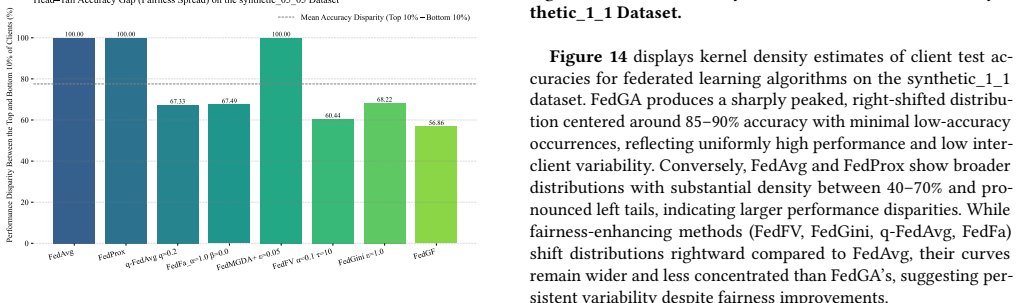
- [Section 5.4] Figure 16's titles use 'FedGF' while the paper's method is FedGA; this inconsistent label should be corrected.
- [Section 3.1] The ablation tables (Tables 6 and 7) are not integrated smoothly with the main text; they appear after the hyperparameter section, and the text says the ablation compares 'FedGA_ablation' but does not specify which hyperparameters (λ, η, D) are shared between the two variants. Please define the ablation configuration explicitly.
- [Figures 3-15] The citation of the delayed-intervention method is inconsistent: the text says 'Li et al. [25]' in Section 3.1 but attributes FedGini to [24] in Sections 2.4 and 6. If FedGini is indeed [24], the citation in Section 3.1 should be corrected.
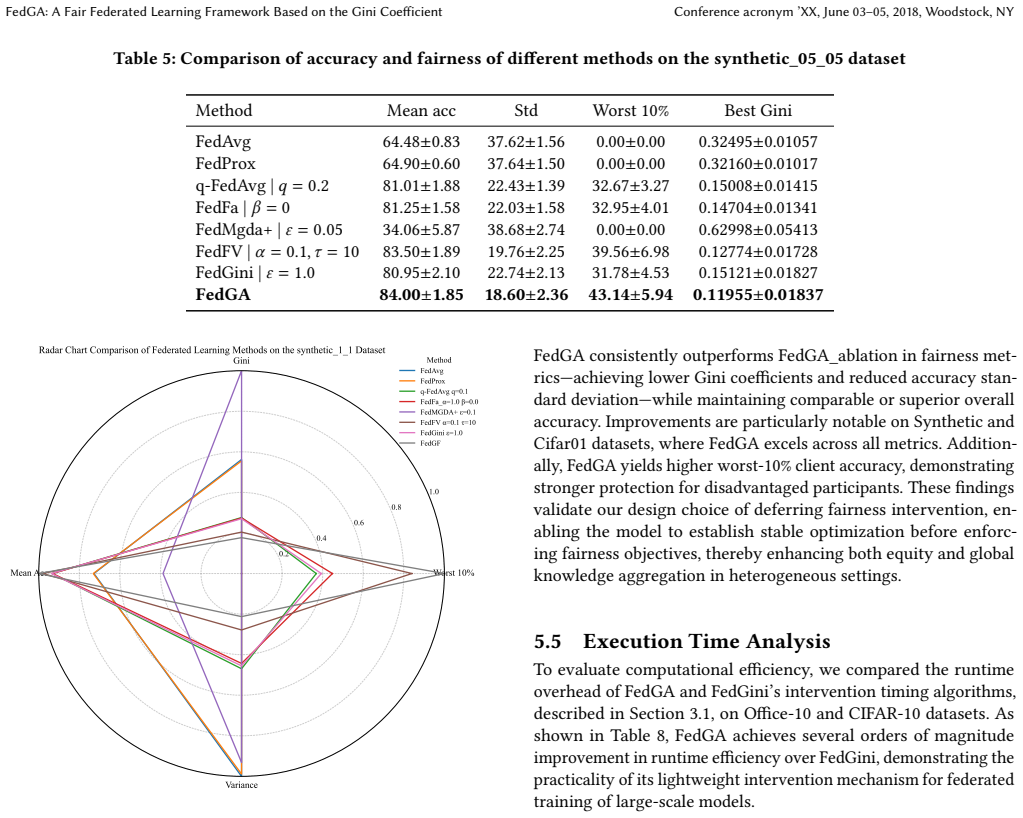
- [Eq. (5)] Many figure captions and axis labels in the provided manuscript are corrupted with '/uni00000029/...' escape sequences, making them unreadable. Please regenerate the figures with clean text.
- [Eq. (5)] The summation indices in Eq. (5) run from 0 to p and 0 to q, giving (p+1)(q+1) terms, while the text says p×q parameters. Minor but should be fixed for consistency (use i=1..p, j=1..q).
Circularity Check
Only Section 4.4 restates the Gini definition as a derived relationship; the central FedGA trigger and reweighting mechanism is empirically self-contained.
-
self definitional
[Section 4.4, Definition 4 and Equations (29)-(30)]
"According to Equation 4, the Gini coefficient can be expressed as: G = ... = ... Therefore,𝐴𝑣𝑔𝐷𝑖𝑓𝑓 (𝜇,𝐺) = 2𝜇𝐺. Taking the total differential of𝐴𝑣𝑔𝐷𝑖𝑓𝑓 (𝜇,𝐺), we have..."
AvgDiff is defined in Definition 4 as the pairwise accuracy-difference sum divided by n(n-1), while the Gini coefficient in Eq. (4) is the same pairwise sum divided by 2(n-1)Σx_j. Substituting μ = Σx_j/n makes G = AvgDiff/(2μ), so AvgDiff = 2μG is an algebraic restatement of the definitions rather than an empirically discovered relationship. The total differential, Taylor expansion, and the numerical example in Eq. (34) merely express this definitional identity in incremental form; they hold for any accuracy vector by construction. This does not affect the core FedGA algorithm, whose delayed-intervention trigger and accuracy-based reweighting are evaluated against external baselines, so the circularity is confined to a secondary theoretical contribution.
full rationale
The central FedGA contribution is a heuristic but empirically evaluated algorithm: monitoring the Gini coefficient to delay fairness intervention and then reweighting aggregation toward low-accuracy clients. The paper benchmarks this algorithm against external baselines (FedAvg, FedProx, q-FedAvg, FedFa, FedMGDA+, FedFV, FedGini) on Office-Caltech-10, CIFAR-10, and Synthetic datasets, so the core claims are self-contained empirical findings rather than consequences of a fitted parameter or a self-citation chain. The only step that reduces to its own input is in Section 4.4, where AvgDiff = 2μG is derived from the definitions of AvgDiff and the Gini coefficient; the subsequent differential and numerical example are true by construction. That identity is not load-bearing for the algorithm's design or for the reported fairness improvements. Separately, the abstract's claim to 'establish a relationship' between G and Us is not actually derived anywhere; Section 4.4 relates G to AvgDiff, not to Us, and the G-as-proxy-for-Us justification rests only on Figure 1. This is a missing-support/correctness concern, not circularity, so it does not raise the circularity score. Overall, the paper is not significantly circular; the flagged definitional identity warrants a score of 2 rather than 0.
Assumptions & free parameters
free parameters (3)
- lambda (fairness intervention strength) =
1 to 10, dataset-dependent
- eta (trigger threshold) =
not reported
- D (sliding window size) =
not reported
assumptions (4)
- domain assumption Standard horizontal federated learning objective (Eq 1-2) with local client data
- ad hoc to paper The Gini coefficient trajectory is a reliable proxy for the global update scale Us in determining intervention timing
- domain assumption Fairness can be improved by reweighting aggregation toward clients with low validation accuracy of the global model
- domain assumption Definition of fairness as uniformity of client performance (following Li et al. [20])
Cite this review
Pith. "Pith review of FedGA: A Fair Federated Learning Framework Based on the Gini Coefficient." pith.science (2026). https://pith.science/paper/LTN4CK6V
@misc{pith2026250712983,
  author       = {Pith},
  title        = {Pith review of: FedGA: A Fair Federated Learning Framework Based on the Gini Coefficient},
  year         = {2026},
  howpublished = {\url{https://pith.science/paper/LTN4CK6V}},
  note         = {Machine review of arXiv:2507.12983}
}
abstract
Fairness has emerged as one of the key challenges in federated learning. In horizontal federated settings, data heterogeneity often leads to substantial performance disparities across clients, raising concerns about equitable model behavior. To address this issue, we propose FedGA, a fairness-aware federated learning algorithm. We first employ the Gini coefficient to measure the performance disparity among clients. Based on this, we establish a relationship between the Gini coefficient $G$ and the update scale of the global model ${U_s}$, and use this relationship to adaptively determine the timing of fairness intervention. Subsequently, we dynamically adjust the aggregation weights according to the system's real-time fairness status, enabling the global model to better incorporate information from clients with relatively poor performance.We conduct extensive experiments on the Office-Caltech-10, CIFAR-10, and Synthetic datasets. The results show that FedGA effectively improves fairness metrics such as variance and the Gini coefficient, while maintaining strong overall performance, demonstrating the effectiveness of our approach.
Figures


Figures from the paper (9 more)



Forward citations
Cited by 1 Pith paper
-
Robust Synchronisation for Federated Learning in The Face of Correlated Device Failure
AW-PSP dynamically weights node sampling by real-time availability predictions and failure correlations to improve robustness, label coverage, and fairness in federated learning under correlated device failures.
Reference graph
Works this paper leans on
-
[1]
Zheng Chai, Yujing Chen, Ali Anwar, Liang Zhao, Yue Cheng, and Huzefa Rang- wala. 2021. FedAT: A high-performance and communication-efficient federated learning system with asynchronous tiers. In Proceedings of the international con- ference for high performance computing, networking, storage and analysis . 1–16
work page 2021
-
[2]
Yang Chen, Xiaoyan Sun, and Yaochu Jin. 2019. Communication-efficient feder- ated deep learning with layerwise asynchronous model update and temporally weighted aggregation. IEEE transactions on neural networks and learning systems 31, 10 (2019), 4229–4238
work page 2019
-
[3]
Liam Collins, Hamed Hassani, Aryan Mokhtari, and Sanjay Shakkottai. 2021. Exploiting Shared Representations for Personalized Federated Learning. In Pro- ceedings of the 38th International Conference on Machine Learning, ICML 2021, 18-24 July 2021, Virtual Event (Proceedings of Machine Learning Research, Vol. 139) , Marina Meila and Tong Zhang (Eds.). PMLR...
work page 2021
-
[4]
Wei Du, Depeng Xu, Xintao Wu, and Hanghang Tong. 2021. Fairness-aware ag- nostic federated learning. InProceedings of the 2021 SIAM International Conference on Data Mining (SDM) . SIAM, 181–189
work page 2021
-
[5]
Moming Duan, Duo Liu, Xianzhang Chen, Yujuan Tan, Jinting Ren, Lei Qiao, and Liang Liang. 2019. Astraea: Self-balancing federated learning for improving classification accuracy of mobile deep learning applications. In 2019 IEEE 37th international conference on computer design (ICCD) . IEEE, 246–254
work page 2019
-
[6]
Robin C Geyer, Tassilo Klein, and Moin Nabi. 2017. Differentially private federated learning: A client level perspective. ArXiv preprint abs/1712.07557 (2017). https: //arxiv.org/abs/1712.07557
arXiv 2017
-
[7]
Corrado Gini. 1912. Variabilità e mutabilità: contributo allo studio delle dis- tribuzioni e delle relazioni statistiche.[Fasc. I.] . Tipogr. di P. Cuppini
work page 1912
-
[8]
Boqing Gong, Yuan Shi, Fei Sha, and Kristen Grauman. 2012. Geodesic flow kernel for unsupervised domain adaptation. In 2012 IEEE Conference on Computer Vision and Pattern Recognition, Providence, RI, USA, June 16-21, 2012 . IEEE Computer Society, 2066–2073. doi:10.1109/CVPR.2012.6247911
arXiv 2012
Show all 37 references
-
[9]
Kaiming He, Xiangyu Zhang, Shaoqing Ren, and Jian Sun. 2016. Deep Residual Learning for Image Recognition. In 2016 IEEE Conference on Computer Vision and Pattern Recognition, CVPR 2016, Las Vegas, NV, USA, June 27-30, 2016 . IEEE Computer Society, 770–778. doi:10.1109/CVPR.2016.90
2016 doi
-
[10]
Zeou Hu, Kiarash Shaloudegi, Guojun Zhang, and Yaoliang Yu. 2022. Federated learning meets multi-objective optimization.IEEE Transactions on Network Science and Engineering 9, 4 (2022), 2039–2051
2022
-
[11]
Li Huang, Yifeng Yin, Zeng Fu, Shifa Zhang, Hao Deng, and Dianbo Liu. 2020. LoAdaBoost: Loss-based AdaBoost federated machine learning with reduced computational complexity on IID and non-IID intensive care data. Plos one 15, 4 (2020), e0230706
2020
-
[12]
Wei Huang, Tianrui Li, Dexian Wang, Shengdong Du, Junbo Zhang, and Tian- qiang Huang. 2022. Fairness and accuracy in horizontal federated learning. Information Sciences 589 (2022), 170–185
2022
-
[13]
Yutao Huang, Lingyang Chu, Zirui Zhou, Lanjun Wang, Jiangchuan Liu, Jian Pei, and Yong Zhang. 2021. Personalized Cross-Silo Federated Learning on Non- IID Data. In Thirty-Fifth AAAI Conference on Artificial Intelligence, AAAI 2021, Thirty-Third Conference on Innovative Applica...
2021
-
[14]
Reddi, Se- bastian U
Sai Praneeth Karimireddy, Satyen Kale, Mehryar Mohri, Sashank J. Reddi, Se- bastian U. Stich, and Ananda Theertha Suresh. 2020. SCAFFOLD: Stochastic Controlled Averaging for Federated Learning. In Proceedings of the 37th Inter- national Conference on Machine Learning, ICML 202...
2020
-
[15]
Jakub Konečn`y, H Brendan McMahan, Daniel Ramage, and Peter Richtárik. 2016. Federated optimization: Distributed machine learning for on-device intelligence. arXiv preprint arXiv:1610.02527 (2016)
2016 arXiv
-
[16]
Alex Krizhevsky, Geoffrey Hinton, et al. 2009. Learning multiple layers of features from tiny images. (2009)
2009
-
[17]
Alex Krizhevsky, Ilya Sutskever, and Geoffrey E. Hinton. 2012. ImageNet Classification with Deep Convolutional Neural Networks. In Advances in Neural Information Processing Systems 25: 26th Annual Conference on Neural Information Processing Systems 2012. Proceedings of a meeti...
2012
-
[18]
Jie Li, Yongli Ren, and Ke Deng. 2022. FairGAN: GANs-based Fairness-aware Learning for Recommendations with Implicit Feedback. In WWW ’22: The ACM Web Conference 2022, Virtual Event, Lyon, France, April 25 - 29, 2022 , Frédérique Laforest, Raphaël Troncy, Elena Simperl, Deepak...
2022
-
[19]
Tian Li, Anit Kumar Sahu, Manzil Zaheer, Maziar Sanjabi, Ameet Talwalkar, and Virginia Smith. 2020. Federated Optimization in Heterogeneous Networks. In Proceedings of Machine Learning and Systems 2020, MLSys 2020, Austin, TX, USA, March 2-4, 2020, Inderjit S. Dhillon, Dimitri...
2020
-
[20]
Tian Li, Maziar Sanjabi, Ahmad Beirami, and Virginia Smith. 2020. Fair Resource Allocation in Federated Learning. In 8th International Conference on Learning Rep- resentations, ICLR 2020, Addis Ababa, Ethiopia, April 26-30, 2020 . OpenReview.net. https://openreview.net/forum?i...
2020
-
[21]
Xiaoxiao Li, Meirui Jiang, Xiaofei Zhang, Michael Kamp, and Qi Dou. 2021. FedBN: Federated Learning on Non-IID Features via Local Batch Normalization. In 9th International Conference on Learning Representations, ICLR 2021, Virtual Event, Austria, May 3-7, 2021 . OpenReview.net...
2021
-
[22]
Xin-Chun Li, Yi-Chu Xu, Shaoming Song, Bingshuai Li, Yinchuan Li, Yunfeng Shao, and De-Chuan Zhan. 2022. Federated Learning with Position-Aware Neurons. In IEEE/CVF Conference on Computer Vision and Pattern Recogni- tion, CVPR 2022, New Orleans, LA, USA, June 18-24, 2022 . IEE...
2022
-
[23]
Xin-Chun Li and De-Chuan Zhan. 2021. FedRS: Federated Learning with Re- stricted Softmax for Label Distribution Non-IID Data. In KDD ’21: The 27th ACM SIGKDD Conference on Knowledge Discovery and Data Mining, Virtual Event, Sin- gapore, August 14-18, 2021, Feida Zhu, Beng Chin...
2021
-
[24]
Xiaoli Li, Siran Zhao, Chuan Chen, and Zibin Zheng. 2023. Heterogeneity-aware fair federated learning. Information Sciences 619 (2023), 968–986
2023
-
[25]
Xin-Chun Li, De-Chuan Zhan, Yunfeng Shao, Bingshuai Li, and Shaoming Song
-
[26]
Wei Liu, Li Chen, Yunfei Chen, and Wenyi Zhang. 2020. Accelerating federated learning via momentum gradient descent. IEEE Transactions on Parallel and Distributed Systems 31, 8 (2020), 1754–1766
2020
-
[27]
Brendan McMahan, Eider Moore, Daniel Ramage, Seth Hampson, and Blaise Agüera y Arcas. 2017. Communication-Efficient Learning of Deep Net- works from Decentralized Data. InProceedings of the 20th International Conference on Artificial Intelligence and Statistics, AISTATS 2017, ...
2017
-
[28]
Mehryar Mohri, Gary Sivek, and Ananda Theertha Suresh. 2019. Agnostic Fed- erated Learning. In Proceedings of the 36th International Conference on Machine Learning, ICML 2019, 9-15 June 2019, Long Beach, California, USA (Proceedings of Machine Learning Research, Vol. 97) , Kam...
2019
-
[29]
Talwalkar
Virginia Smith, Chao-Kai Chiang, Maziar Sanjabi, and Ameet S. Talwalkar. 2017. Federated Multi-Task Learning. In Advances in Neural Information Processing Systems 30: Annual Conference on Neural Information Processing Systems 2017, December 4-9, 2017, Long Beach, CA, USA , Isa...
2017
-
[30]
Jiahui Tian, Xixiang Lv, Renpeng Zou, Bin Zhao, and Yige Li. 2022. A Fair Resource Allocation Scheme in Federated Learning. Journal of Computer Research and Development 59, 6 (2022), 1240–1254. doi:10.7544/issn1000-1239.20201081
2022
-
[31]
Vincent Poor
Jianyu Wang, Qinghua Liu, Hao Liang, Gauri Joshi, and H. Vincent Poor. 2020. Tackling the Objective Inconsistency Problem in Heterogeneous Federated Op- timization. In Advances in Neural Information Processing Systems 33: Annual Conference on Neural Information Processing Syst...
2020
-
[32]
Zheng Wang, Xiaoliang Fan, Jianzhong Qi, Chenglu Wen, Cheng Wang, and Rongshan Yu. 2021. Federated Learning with Fair Averaging. In Proceedings of the Thirtieth International Joint Conference on Artificial Intelligence, IJCAI 2021, Virtual Event / Montreal, Canada, 19-27 Augus...
2021 doi
-
[33]
Cong Xie, Sanmi Koyejo, and Indranil Gupta. 2019. Asynchronous federated optimization. ArXiv preprint abs/1903.03934 (2019). https://arxiv.org/abs/1903. 03934
2019 arXiv
-
[34]
Wenyu Zhang, Xiumin Wang, Pan Zhou, Weiwei Wu, and Xinglin Zhang. 2021. Client selection for federated learning with non-iid data in mobile edge comput- ing. IEEE Access 9 (2021), 24462–24474
2021
-
[35]
Yue Zhao, Meng Li, Liangzhen Lai, Naveen Suda, Damon Civin, and Vikas Chan- dra. 2018. Federated learning with non-iid data. ArXiv preprint abs/1806.00582 (2018). https://arxiv.org/abs/1806.00582
2018 arXiv
-
[36]
Tianfei Zhou and Ender Konukoglu. 2023. FedFA: Federated Feature Augmenta- tion. In The Eleventh International Conference on Learning Representations, ICLR Conference acronym ’XX, June 03–05, 2018, Woodstock, NY ShanBin Liu 2023, Kigali, Rwanda, May 1-5, 2023 . OpenReview.net....
2023
-
[2021]
In Joint European conference on machine learning and knowledge discovery in databases
Fedphp: Federated personalization with inherited private models. In Joint European conference on machine learning and knowledge discovery in databases . Springer, 587–602
Reviewed August 6, 2026 · model on record in the stance chip above.
Discussion (0). Sign in to comment.