REVIEW 3 major objections 4 minor 2 cited by
Gravitational Lensing by Black Holes in Einstein-nonlinear Electrodynamic Theories with Multiple Photon Spheres
T0 review · 3 major / 4 minor · reviewed 2026-08-06 · deepseek-v4-flash
Pith's one-line read For black holes with many photon spheres, only peaks taller than every outer peak affect the image, and each surviving peak produces a bright photon ring.
desk verdict Competent triple-photon-sphere lensing study whose general masking rule is right but under-derived and whose figures are unreproducible without parameter values. read the letter →
The pith
A machine-rendered reading of the paper's core claim, the machinery that carries it, and where it could break.
The reading
What carries the argument
The effective potential $V_{\rm eff}(r) = f(r)/r^2$ for null geodesics, whose local maxima are photon spheres. The paper's masking rule states that, comparing peaks from the outside inward, a peak is visible only when it is larger than every peak outside it; each visible peak yields one critical curve around which higher-order images accumulate. The numerical tool is geodesic ray tracing from two observers, scanning 4000 by 4000 null geodesics until they reach a celestial sphere at $12 r_h$ or the horizon.
What would settle it
A concrete check: choose an Einstein-nonlinear electrodynamic black hole with four photon spheres whose peak heights, ordered from outside in, are 1, 3, 2, 1, and ray trace the celestial-sphere image; if a distinct third bright ring appears beyond the one predicted by the masking rule, the general rule fails.
Extended reading notes
Core claim
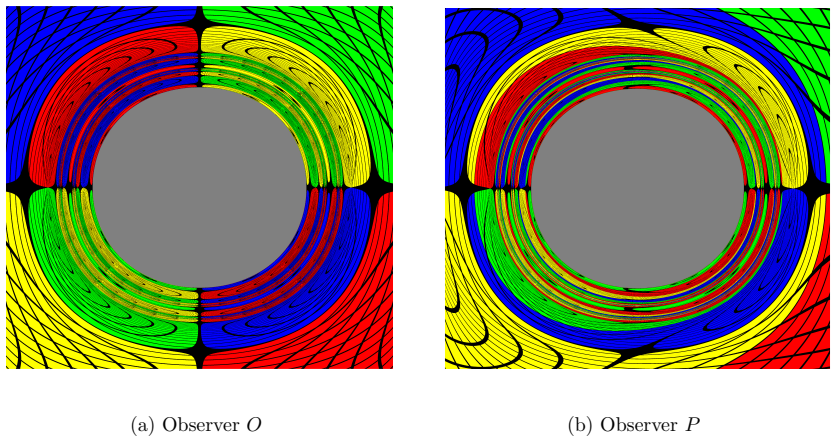
The central claim is that, for black holes in Einstein-nonlinear electrodynamic theories, a peak in the effective potential whose height is below that of any peak outside it is observationally concealed: its critical curve does not appear in the images, and the higher-order images that would have clustered there are absent. After sequential comparison from the outermost peak inward, the surviving M peaks generate M bright photon rings in the image, with higher-order images densely clustered around each ring and the innermost ring coinciding with the shadow's edge. The claim is supported by numerical ray tracing of 4000 by 4000 geodesics for one-, two-, and three-peak potentials, including special cases where the middle or outermost peak is the tallest.
Load-bearing premise
The paper assumes, without proof for more than three peaks, that a peak contributes a distinct ring cluster if and only if it is taller than all peaks farther from the black hole, and that each such peak contributes exactly one ring.
Editorial extensions
If this is right
- A black hole with N photon spheres will show exactly M bright photon rings, where M is the number of peaks that survive the 'taller than all outer peaks' masking rule.
- The smallest critical curve in any image coincides with the edge of the black hole shadow, so the shadow boundary is always produced by the innermost un-masked photon sphere.
- A single-ring image does not imply a single photon sphere: if the outermost peak is tallest, all inner photon spheres are hidden and the image is indistinguishable from that of a single-peak black hole.
- Triple photon spheres produce more higher-order images of point sources than double or single photon spheres, and the number of images can fluctuate strongly with impact parameter.
- Photon-ring observations could in principle reveal the number and arrangement of un-masked photon spheres in the effective potential.
Reading between the lines
- The masking rule likely follows from the radial geodesic equation: a photon cannot reach an inner potential well without having an impact parameter small enough to cross the outer barrier, so a formal proof for arbitrary N should be possible without full ray tracing.
- The same masking phenomenon may apply to quasinormal-mode echoes, which already show wave-packet splitting in three-peak potentials; the echo signal might encode only the un-masked peaks rather than all peaks.
- For rotating black holes, photon spheres become photon regions, and the simple peak-height comparison may need to be replaced by a comparison of effective-potential barriers on each angular slice.
- The observed one-ring images of M87* and Sgr A* do not by themselves rule out multiple photon spheres, so multi-peak models cannot be rejected on shadow shape alone.
Editorial analysis
A structured set of objections, weighed in public.
Referee Report
Summary. The paper studies gravitational lensing by static, spherically symmetric black holes in Einstein-nonlinear electrodynamic theories whose effective potential for null geodesics has multiple local maxima (photon spheres). The authors present the metric and the radial geodesic equation (Eqs. (4), (7), (8)), then numerically trace 4000×4000 null geodesics from a concentric celestial sphere for single-, double-, and triple-peak effective potentials, displaying higher-order images of point sources and images of the celestial sphere. They identify a masking rule: an inner peak is observationally hidden if any peak outside it is higher. From the one-, two-, and three-peak examples they generalize that for N peaks the observable bright rings correspond to the M un-masked peaks, each producing a critical-curve cluster of higher-order images.
Significance. If the results withstand scrutiny, the paper provides a useful phenomenological taxonomy of lensing by multi-photon-sphere black holes and a concrete prediction for the number of bright photon rings under a masking rule. The numerical method is standard and the qualitative behavior is physically plausible. However, the paper's central generalization rests on an extrapolation from three examples rather than a derivation, and the absence of metric parameters for the figures prevents independent verification. The paper explicitly acknowledges its own reliance on prior work (refs. [68,69,73,74,76,84]) but does not yet make the new claims fully reproducible or quantitatively testable.
major comments (3)
- [III E] The generalization to N peaks is stated as a verbal rule: 'Let's assume a black hole with N effective potential peaks... we can expect M bright photon rings where higher-order images accumulate.' This is inferred from examples with N=1,2,3, but it is not derived from Eq. (7). The rule is provable by a turning-point analysis: a ray with impact parameter b can turn at the kth peak if b lies in the interval (b_k, min_{j<k} b_j), which is nonempty exactly when V_k > max_{j<k} V_j, and over this interval the deflection angle diverges logarithmically as b approaches b_k from above, producing one image cluster. The paper should either supply this derivation or state it explicitly; as written, the central claim is an extrapolation.
- [III] The numerical section never specifies the metric parameters (the coefficients c_i in f(r)=1+Σ c_i r^{-i}, or the equivalent α_i) used for any of the figures. The only statement is 'we choose different parameters to keep the radius of event horizon to be r_h=1' (Sec. III). Without the exact functions f(r) for Figs. 1–10, the effective potentials, the critical curves, and the ray-tracing images cannot be reproduced or checked. Please provide the parameter values (e.g., in a table) for each figure, including the values of M and the relevant c_i.
- [III E, Figs. 6-10] The claim that each un-masked photon sphere produces a distinct 'bright photon ring' is supported only by qualitative color images. The paper does not show, for a fixed triple-peak potential, the deflection angle (or the number of images) as a function of impact parameter, nor the radial intensity profile along an image slice. Such a quantitative diagnostic would make the number of rings testable and would also directly check the masking rule; adding it would substantially strengthen the paper's evidence.
minor comments (4)
- [Throughout] There are several typos, including 'multipal' and 'mutilpe' for 'multiple' (e.g., Sec. II and Sec. III), and the phrase 'the radius of event horizon to be rh = 1' should be 'the event horizon radius to be r_h = 1'.
- [I, paragraph 4] The citation to Born and Infeld is incorrect: the text says 'first introduced by Born and Infeld ... [72, 77]' but ref. [72] is a massive-gravity paper and ref. [77] is about nonuniform area quantization; the relevant references are [80] and [81].
- [III D] The description of Fig. 10 is confusing ('the inner peak is the absolute maximum, and the outer peak is larger relative to the middle peak'); please clarify the ordering of all three peak heights in the caption or text.
- [II, Eq. (8)] The effective potential V_eff is defined, but its boundary behavior near the horizon and at infinity is not stated; a short remark that V_eff→0 as r→∞ and diverges as r→r_h would help readers connect the potential-peak condition to the photon-sphere definition.
Circularity Check
No circularity found; the triple-ring and N-peak masking results come from direct integration of Eq. (7), not from fitted inputs; self-citations are background and not load-bearing.
full rationale
The central derivation chain is self-contained. The number of visible rings is not an input to the simulation: the paper integrates the radial null geodesic equation (Eq. 7) with the effective potential (Eq. 8), and photon spheres are determined by Eq. (9) as local maxima of V_eff with the associated impact parameter. The ray-tracing figures are outputs of that integration, so the triple-peak claim (three critical curves, smallest coinciding with the shadow edge) is a result of the dynamics, not a fitted parameter or a definitional equivalence. The general rule in Sec. III E is an inductive extrapolation from the N=1,2,3 cases rather than a proof for arbitrary N; this is a presentation gap, and the masking condition (a peak is hidden when an outer peak is taller) is plausibly derivable from the turning-point structure of Eq. (7), but the step does not reduce the prediction to the paper's inputs. Self-citations (refs. 68, 69, 73, 74, 76, 84) supply background, echo/QNM context, and the numerical setup for painting the celestial sphere; none is invoked as a uniqueness theorem or as a substitute for the direct integration, so these citations are not load-bearing. The numerical section omits the specific metric parameters used for each figure, saying only that 'we choose different parameters to keep the radius of event horizon to be r_h=1'; this is a reproducibility deficiency, not circularity. Overall, the paper's central demonstration is independent of any fitted or self-cited conclusion, and the score reflects only minor non-load-bearing self-citation and the under-derived N>3 generalization.
Assumptions & free parameters
free parameters (2)
- Metric coefficients c_i in f(r)=1+sum_i c_i r^{-i} =
Not stated in text
- Relative peak heights of V_eff =
Qualitative: inner, middle, or outer peak largest
assumptions (4)
- domain assumption The action in Eqs. (1)-(2) with L_EM=sum alpha_i (F^2)^(-i) admits the asymptotically flat black hole metric f(r)=1+sum c_i r^-i with the properties used here.
- standard math Null geodesics of the metric obey Eq. (7) with effective potential V_eff=f(r)/r^2, and unstable circular photon orbits satisfy Eq. (9).
- ad hoc to paper A peak that is lower than any peak outside it cannot produce observable lensing images because rays with the relevant impact parameters are blocked by the outer barrier.
- ad hoc to paper Examples with one, two, and three peaks are sufficient to infer the image pattern for any number of peaks.
Cite this review
Pith. "Pith review of Gravitational Lensing by Black Holes in Einstein-nonlinear Electrodynamic Theories with Multiple Photon Spheres." pith.science (2026). https://pith.science/paper/VSKPG2W2
@misc{pith2026250713048,
  author       = {Pith},
  title        = {Pith review of: Gravitational Lensing by Black Holes in Einstein-nonlinear Electrodynamic Theories with Multiple Photon Spheres},
  year         = {2026},
  howpublished = {\url{https://pith.science/paper/VSKPG2W2}},
  note         = {Machine review of arXiv:2507.13048}
}
read the original abstract
In this paper, we study the gravitational lensing effects of non-linear electrodynamic black holes. Non-linear electrodynamic black holes serve as typical models for multi-event horizon black holes. Depending on the choice of metric parameters, these black holes can possess more than five event horizons. Consequently, within certain parameter ranges, black holes can have more than three photon spheres of varying sizes outside the event horizon. Specifically, we focus on the strong gravitational lensing effects near the triple photon spheres, particularly the formation of higher-order images of point sources and celestial spheres. The presence of one, two, or three or more photon spheres significantly increases the number of higher-order images of a point source. When a black hole is illuminated by a celestial sphere, the three photon spheres generate three critical curves in the black hole image, with the smallest critical curve coinciding with the shadow's edge. Additionally, since non-linear electrodynamic black holes are models of multi-event horizon black holes, we can infer the gravitational lensing effects and the changes in celestial images for black holes with more than three photon spheres by analyzing the distinctions and patterns between the gravitational lensing effects of one, two, and three photon spheres.
Figures


Figures from the paper (7 more)




Forward citations
Cited by 2 Pith papers
-
Boundary-only weak deflection angles from isothermal optical geometry
A conformal isothermal reformulation of optical geometry converts the Gauss-Bonnet area term for weak deflection into boundary integrals evaluated on a flat reference ray, reproducing known finite-distance results for...
-
Topologically equivalent yet radiatively distinct orbits in EMRI system
In dyonic black holes, periodic orbits with identical rotation numbers but spanning different curvature regions generate radiatively distinct gravitational waveforms in EMRIs.
Reference graph
Works this paper leans on
-
[79]
Gao, Black holes with many horizons in the theories of nonlinear electrodynamics, Phys
C. Gao, Black holes with many horizons in the theories of nonlinear electrodynamics, Phys. Rev. D 104, no.6, 064038 (2021) doi:10.1103/PhysRevD.104.064038 [arXiv:2106.13486 [gr-qc]]
arXiv 2021
-
[1]
F. W. Dyson, A. S. Eddington and C. Davidson, A Determination of the Deflection of Light by the Sun’s Gravitational Field, from Observations Made at the Total Eclipse of May 29, 1919, Phil. Trans. Roy. Soc. Lond. A 220, 291-333 (1920) doi:10.1098/rsta.1920.0009
arXiv 1920
-
[2]
A. Einstein, Lens-Like Action of a Star by the Deviation of Light in the Gravitational Field, Science 84, 506-507 (1936) doi:10.1126/science.84.2188.506 16
-
[3]
J. P. Luminet, Image of a spherical black hole with thin accretion disk, Astron. Astrophys. 75, 228-235 (1979)
1979
-
[4]
Mellier, Probing the universe with weak lensing, Ann
Y. Mellier, Probing the universe with weak lensing, Ann. Rev. Astron. Astrophys. 37, 127-189 (1999) doi:10.1146/annurev.astro.37.1.127 [arXiv:astro-ph/9812172 [astro-ph]]
arXiv 1999
-
[5]
M. Bartelmann and P. Schneider, Weak gravitational lensing, Phys. Rept. 340, 291-472 (2001) doi:10.1016/S0370-1573(00)00082-X [arXiv:astro-ph/9912508 [astro-ph]]
arXiv 2001
-
[6]
C. Heymans, E. Grocutt, A. Heavens, M. Kilbinger, T. D. Kitching, F. Simpson, J. Benjamin, T. Erben, H. Hildebrandt and H. Hoekstra, et al. CFHTLenS tomographic weak lensing cosmological parameter constraints: Mitigating the impact of intrinsic galaxy alignments, Mon. Not. Roy. Astron. Soc. 432, 2433 (2013) doi:10.1093/mnras/stt601 [arXiv:1303.1808 [astro-ph.CO]]
arXiv 2013
-
[7]
N. Kaiser and G. Squires, Mapping the dark matter with weak gravitational lensing, Astro- phys. J. 404, 441-450 (1993) doi:10.1086/172297
doi:10.1086/172297 1993
Show all 85 references
-
[8]
Clowe, M
D. Clowe, M. Bradac, A. H. Gonzalez, M. Markevitch, S. W. Randall, C. Jones and D. Zaritsky, A direct empirical proof of the existence of dark matter, Astrophys. J. Lett. 648, L109-L113 (2006) doi:10.1086/508162 [arXiv:astro-ph/0608407 [astro-ph]]
2006 arXiv
-
[9]
Atamurotov, A
F. Atamurotov, A. Abdujabbarov and W. B. Han, Effect of plasma on gravitational lensing by a Schwarzschild black hole immersed in perfect fluid dark matter, Phys. Rev. D 104, no.8, 084015 (2021) doi:10.1103/PhysRevD.104.084015
2021 doi
-
[10]
Biesiada, Strong lensing systems as a probe of dark energy in the universe, Phys
M. Biesiada, Strong lensing systems as a probe of dark energy in the universe, Phys. Rev. D 73, 023006 (2006) doi:10.1103/PhysRevD.73.023006
2006 doi
-
[11]
S. Cao, M. Biesiada, R. Gavazzi, A. Pi´ orkowska and Z. H. Zhu, Cosmology With Strong-lensing Systems, Astrophys. J. 806, 185 (2015) doi:10.1088/0004-637X/806/2/185 [arXiv:1509.07649 [astro-ph.CO]]
2015 arXiv
-
[12]
T. M. C. Abbott et al. [DES], Dark Energy Survey Year 1 Results: Cosmological con- straints from cluster abundances and weak lensing, Phys. Rev. D 102, no.2, 023509 (2020) doi:10.1103/PhysRevD.102.023509 [arXiv:2002.11124 [astro-ph.CO]]
2020 arXiv
-
[13]
T. M. C. Abbott et al. [DES], Dark Energy Survey Year 3 results: Cosmological con- straints from galaxy clustering and weak lensing, Phys. Rev. D 105, no.2, 023520 (2022) doi:10.1103/PhysRevD.105.023520 [arXiv:2105.13549 [astro-ph.CO]]
2022 arXiv
-
[14]
Zhang, Geometrization of light bending and its application to SdS w spacetime, Class
Z. Zhang, Geometrization of light bending and its application to SdS w spacetime, Class. 17 Quant. Grav. 39, no.1, 015003 (2022) doi:10.1088/1361-6382/ac38d1 [arXiv:2112.04149 [gr- qc]]
2022 arXiv
-
[15]
Fan et al
X. Fan et al. [SDSS], The Discovery of a luminous z = 5.80 quasar from the Sloan Digital Sky Survey, Astron. J. 120, 1167-1174 (2000) doi:10.1086/301534 [arXiv:astro-ph/0005414 [astro-ph]]
2000 arXiv
-
[16]
C. Y. Peng, C. D. Impey, H. W. Rix, C. S. Kochanek, C. R. Keeton, E. E. Falco, J. Lehar and B. A. McLeod, Probing the coevolution of supermassive black holes and galaxies using gravitationally lensed quasar hosts, Astrophys. J. 649, 616-634 (2006) doi:10.1086/506266 [arXiv:ast...
2006 arXiv
-
[17]
Oguri and P
M. Oguri and P. J. Marshall, Gravitationally lensed quasars and supernovae in future wide-field optical imaging surveys, Mon. Not. Roy. Astron. Soc. 405, 2579-2593 (2010) doi:10.1111/j.1365-2966.2010.16639.x [arXiv:1001.2037 [astro-ph.CO]]
2010
-
[18]
M. Yue, X. Fan, J. Yang and F. Wang, Revisiting the Lensed Fraction of High-redshift Quasars, Astrophys. J. 925, no.2, 169 (2022) doi:10.3847/1538-4357/ac409b [arXiv:2112.02821 [astro- ph.GA]]
2022 arXiv
-
[19]
Seljak and C
U. Seljak and C. M. Hirata, Gravitational lensing as a contaminant of the gravity wave sig- nal in CMB, Phys. Rev. D 69, 043005 (2004) doi:10.1103/PhysRevD.69.043005 [arXiv:astro- ph/0310163 [astro-ph]]
2004
-
[20]
J. M. Diego, T. Broadhurst and G. Smoot, Evidence for lensing of gravitational waves from LIGO-Virgo data, Phys. Rev. D 104, no.10, 103529 (2021) doi:10.1103/PhysRevD.104.103529 [arXiv:2106.06545 [gr-qc]]
2021 arXiv
-
[21]
Finke, S
A. Finke, S. Foffa, F. Iacovelli, M. Maggiore and M. Mancarella, Probing modified gravitational wave propagation with strongly lensed coalescing binaries, Phys. Rev. D 104, no.8, 084057 (2021) doi:10.1103/PhysRevD.104.084057 [arXiv:2107.05046 [gr-qc]]
2021 arXiv
-
[22]
Schmidt, Weak Lensing Probes of Modified Gravity, Phys
F. Schmidt, Weak Lensing Probes of Modified Gravity, Phys. Rev. D 78, 043002 (2008) doi:10.1103/PhysRevD.78.043002 [arXiv:0805.4812 [astro-ph]]
2008 arXiv
-
[23]
Guzik, B
J. Guzik, B. Jain and M. Takada, Tests of Gravity from Imaging and Spectroscopic Surveys, Phys. Rev. D 81, 023503 (2010) doi:10.1103/PhysRevD.81.023503 [arXiv:0906.2221 [astro- ph.CO]]
2010 arXiv
-
[24]
K. Liao, Z. Li, S. Cao, M. Biesiada, X. Zheng and Z. H. Zhu, The Distance Duality Relation From Strong Gravitational Lensing, Astrophys. J. 822, no.2, 74 (2016) doi:10.3847/0004- 18 637X/822/2/74 [arXiv:1511.01318 [astro-ph.CO]]
2016 arXiv
-
[25]
Goulart, Phantom wormholes in Einstein–Maxwell-dilaton theory, Class
P. Goulart, Phantom wormholes in Einstein–Maxwell-dilaton theory, Class. Quant. Grav. 35, no.2, 025012 (2018) doi:10.1088/1361-6382/aa9dfc [arXiv:1708.00935 [gr-qc]]
2018 arXiv
-
[26]
J. R. Nascimento, A. Y. Petrov, P. J. Porfirio and A. R. Soares, Gravitational lensing in black- bounce spacetimes, Phys. Rev. D 102, no.4, 044021 (2020) doi:10.1103/PhysRevD.102.044021 [arXiv:2005.13096 [gr-qc]]
2020 arXiv
-
[27]
H. C. D. L. Junior, J. Z. Yang, L. C. B. Crispino, P. V. P. Cunha and C. A. R. Herdeiro, Einstein-Maxwell-dilaton neutral black holes in strong magnetic fields: Topological charge, shadows, and lensing, Phys. Rev. D 105, no.6, 064070 (2022) doi:10.1103/PhysRevD.105.064070 [arX...
2022 arXiv
-
[28]
S. U. Islam, J. Kumar and S. G. Ghosh, Strong gravitational lensing by rotating Simpson-Visser black holes, JCAP 10, 013 (2021) doi:10.1088/1475-7516/2021/10/013 [arXiv:2104.00696 [gr-qc]]
2021 arXiv
-
[29]
Tsukamoto, Retrolensing by two photon spheres of a black-bounce spacetime, Phys
N. Tsukamoto, Retrolensing by two photon spheres of a black-bounce spacetime, Phys. Rev. D 105, no.8, 084036 (2022) doi:10.1103/PhysRevD.105.084036 [arXiv:2202.09641 [gr-qc]]
2022 arXiv
-
[30]
Akiyama et al
K. Akiyama et al. [Event Horizon Telescope], First M87 Event Horizon Telescope Re- sults. I. The Shadow of the Supermassive Black Hole, Astrophys. J. Lett. 875, L1 (2019) doi:10.3847/2041-8213/ab0ec7 [arXiv:1906.11238 [astro-ph.GA]]
2019 arXiv
-
[31]
Akiyama et al
K. Akiyama et al. [Event Horizon Telescope], First M87 Event Horizon Telescope Results. II. Array and Instrumentation, Astrophys. J. Lett. 875, no.1, L2 (2019) doi:10.3847/2041- 8213/ab0c96 [arXiv:1906.11239 [astro-ph.IM]]
2019 arXiv
-
[32]
Akiyama et al.[Event Horizon Telescope], First M87 Event Horizon Telescope Results
K. Akiyama et al.[Event Horizon Telescope], First M87 Event Horizon Telescope Results. III. Data Processing and Calibration, Astrophys. J. Lett. 875, no.1, L3 (2019) doi:10.3847/2041- 8213/ab0c57 [arXiv:1906.11240 [astro-ph.GA]]
2019 arXiv
-
[33]
Akiyama et al
K. Akiyama et al. [Event Horizon Telescope], First M87 Event Horizon Telescope Results. IV. Imaging the Central Supermassive Black Hole, Astrophys. J. Lett. 875, no.1, L4 (2019) doi:10.3847/2041-8213/ab0e85 [arXiv:1906.11241 [astro-ph.GA]]
2019 arXiv
-
[34]
Akiyama et al
K. Akiyama et al. [Event Horizon Telescope], Astrophys. J. Lett. 875, no.1, L5 (2019) doi:10.3847/2041-8213/ab0f43 [arXiv:1906.11242 [astro-ph.GA]]
2019 arXiv
-
[35]
Akiyama et al.[Event Horizon Telescope], First M87 Event Horizon Telescope Results
K. Akiyama et al.[Event Horizon Telescope], First M87 Event Horizon Telescope Results. VI. The Shadow and Mass of the Central Black Hole, Astrophys. J. Lett. 875, no.1, L6 (2019) 19 doi:10.3847/2041-8213/ab1141 [arXiv:1906.11243 [astro-ph.GA]]
2019 arXiv
-
[36]
Akiyama et al
K. Akiyama et al. [Event Horizon Telescope], First M87 Event Horizon Telescope Results. VII. Polarization of the Ring, Astrophys. J. Lett. 910, no.1, L12 (2021) doi:10.3847/2041- 8213/abe71d [arXiv:2105.01169 [astro-ph.HE]]
2021 arXiv
-
[37]
Akiyama et al
K. Akiyama et al. [Event Horizon Telescope], First M87 Event Horizon Telescope Results. VIII. Magnetic Field Structure near The Event Horizon, Astrophys. J. Lett. 910, no.1, L13 (2021) doi:10.3847/2041-8213/abe4de [arXiv:2105.01173 [astro-ph.HE]]
2021 arXiv
-
[38]
Falcke, F
H. Falcke, F. Melia and E. Agol, Viewing the shadow of the black hole at the galactic center, Astrophys. J. Lett. 528, L13 (2000) doi:10.1086/312423 [arXiv:astro-ph/9912263 [astro-ph]]
2000 arXiv
-
[39]
K. S. Virbhadra and G. F. R. Ellis, Schwarzschild black hole lensing, Phys. Rev. D 62, 084003 (2000) doi:10.1103/PhysRevD.62.084003 [arXiv:astro-ph/9904193 [astro-ph]]
2000 arXiv
-
[40]
C. M. Claudel, K. S. Virbhadra and G. F. R. Ellis, The Geometry of photon surfaces, J. Math. Phys. 42, 818-838 (2001) doi:10.1063/1.1308507 [arXiv:gr-qc/0005050 [gr-qc]]
2001 arXiv
-
[41]
E. F. Eiroa, G. E. Romero and D. F. Torres, Reissner-Nordstrom black hole lensing, Phys. Rev. D 66, 024010 (2002) doi:10.1103/PhysRevD.66.024010 [arXiv:gr-qc/0203049 [gr-qc]]
2002 arXiv
-
[42]
K. S. Virbhadra, Relativistic images of Schwarzschild black hole lensing, Phys. Rev. D 79, 083004 (2009) doi:10.1103/PhysRevD.79.083004 [arXiv:0810.2109 [gr-qc]]
2009 arXiv
-
[43]
Yumoto, D
A. Yumoto, D. Nitta, T. Chiba and N. Sugiyama, Shadows of Multi-Black Holes: Analytic Ex- ploration, Phys. Rev. D 86, 103001 (2012) doi:10.1103/PhysRevD.86.103001 [arXiv:1208.0635 [gr-qc]]
2012 arXiv
-
[44]
S. W. Wei and Y. X. Liu, Observing the shadow of Einstein-Maxwell-Dilaton-Axion black hole, JCAP 11, 063 (2013) doi:10.1088/1475-7516/2013/11/063 [arXiv:1311.4251 [gr-qc]]
2013 arXiv
-
[45]
A. F. Zakharov, Constraints on a charge in the Reissner-Nordstr¨ om metric for the black hole at the Galactic Center, Phys. Rev. D 90, no.6, 062007 (2014) doi:10.1103/PhysRevD.90.062007 [arXiv:1407.7457 [gr-qc]]
2014 arXiv
-
[46]
Atamurotov, S
F. Atamurotov, S. G. Ghosh and B. Ahmedov, Horizon structure of rotating Ein- stein–Born–Infeld black holes and shadow, Eur. Phys. J. C 76, no.5, 273 (2016) doi:10.1140/epjc/s10052-016-4122-9 [arXiv:1506.03690 [gr-qc]]
2016 arXiv
-
[47]
P. V. P. Cunha, C. A. R. Herdeiro, B. Kleihaus, J. Kunz and E. Radu, Shad- ows of Einstein–dilaton–Gauss–Bonnet black holes, Phys. Lett. B 768, 373-379 (2017) doi:10.1016/j.physletb.2017.03.020 [arXiv:1701.00079 [gr-qc]]. 20
2017 arXiv
-
[48]
Dastan, R
S. Dastan, R. Saffari and S. Soroushfar, Shadow of a Kerr-Sen dilaton-axion Black Hole, [arXiv:1610.09477 [gr-qc]]
-
[49]
M. Amir, B. P. Singh and S. G. Ghosh, Shadows of rotating five-dimensional charged EMCS black holes, Eur. Phys. J. C 78, no.5, 399 (2018) doi:10.1140/epjc/s10052-018-5872-3 [arXiv:1707.09521 [gr-qc]]
2018 arXiv
-
[50]
M. Wang, S. Chen and J. Jing, Shadow casted by a Konoplya-Zhidenko rotating non-Kerr black hole, JCAP 10, 051 (2017) doi:10.1088/1475-7516/2017/10/051 [arXiv:1707.09451 [gr- qc]]
2017 arXiv
-
[51]
¨Ovg¨ un, ˙I
A. ¨Ovg¨ un, ˙I. Sakallı and J. Saavedra, Shadow cast and Deflection angle of Kerr- Newman-Kasuya spacetime, JCAP 10, 041 (2018) doi:10.1088/1475-7516/2018/10/041 [arXiv:1807.00388 [gr-qc]]
2018 arXiv
-
[52]
Perlick, O
V. Perlick, O. Y. Tsupko and G. S. Bisnovatyi-Kogan, Black hole shadow in an ex- panding universe with a cosmological constant, Phys. Rev. D 97, no.10, 104062 (2018) doi:10.1103/PhysRevD.97.104062 [arXiv:1804.04898 [gr-qc]]
2018 arXiv
-
[53]
Kumar, S
R. Kumar, S. G. Ghosh and A. Wang, Shadow cast and deflection of light by charged rotating regular black holes, Phys. Rev. D 100, no.12, 124024 (2019) doi:10.1103/PhysRevD.100.124024 [arXiv:1912.05154 [gr-qc]]
2019 arXiv
-
[54]
T. Zhu, Q. Wu, M. Jamil and K. Jusufi, Shadows and deflection angle of charged and slowly rotating black holes in Einstein-Æther theory, Phys. Rev. D 100, no.4, 044055 (2019) doi:10.1103/PhysRevD.100.044055 [arXiv:1906.05673 [gr-qc]]
2019 arXiv
-
[55]
Ma and H
L. Ma and H. Lu, Bounds on photon spheres and shadows of charged black holes in Einstein-Gauss-Bonnet-Maxwell gravity, Phys. Lett. B 807, 135535 (2020) doi:10.1016/j.physletb.2020.135535 [arXiv:1912.05569 [gr-qc]]
2020
-
[56]
A. K. Mishra, S. Chakraborty and S. Sarkar, Understanding photon sphere and black hole shadow in dynamically evolving spacetimes, Phys. Rev. D 99, no.10, 104080 (2019) doi:10.1103/PhysRevD.99.104080 [arXiv:1903.06376 [gr-qc]]
2019 arXiv
-
[57]
X. X. Zeng, H. Q. Zhang and H. Zhang, Shadows and photon spheres with spherical accre- tions in the four-dimensional Gauss–Bonnet black hole, Eur. Phys. J. C 80, no.9, 872 (2020) doi:10.1140/epjc/s10052-020-08449-y [arXiv:2004.12074 [gr-qc]]
2020 arXiv
-
[58]
X. X. Zeng and H. Q. Zhang, Influence of quintessence dark energy on the shadow of black hole, Eur. Phys. J. C80, no.11, 1058 (2020) doi:10.1140/epjc/s10052-020-08656-7 [arXiv:2007.06333 21 [gr-qc]]
2020 arXiv
-
[59]
X. Qin, S. Chen and J. Jing, Image of a regular phantom compact object and its luminosity under spherical accretions, Class. Quant. Grav. 38, no.11, 115008 (2021) doi:10.1088/1361- 6382/abf712 [arXiv:2011.04310 [gr-qc]]
2021 arXiv
-
[60]
Saurabh and K
K. Saurabh and K. Jusufi, Imprints of dark matter on black hole shadows using spheri- cal accretions, Eur. Phys. J. C 81, no.6, 490 (2021) doi:10.1140/epjc/s10052-021-09280-9 [arXiv:2009.10599 [gr-qc]]
2021 arXiv
-
[61]
Roy and S
R. Roy and S. Chakrabarti, Study on black hole shadows in asymptotically de Sit- ter spacetimes, Phys. Rev. D 102, no.2, 024059 (2020) doi:10.1103/PhysRevD.102.024059 [arXiv:2003.14107 [gr-qc]]
2020 arXiv
-
[62]
P. C. Li, M. Guo and B. Chen, Shadow of a Spinning Black Hole in an Expanding Universe, Phys. Rev. D 101, no.8, 084041 (2020) doi:10.1103/PhysRevD.101.084041 [arXiv:2001.04231 [gr-qc]]
2020 arXiv
-
[63]
Kumar, S
R. Kumar, S. G. Ghosh and A. Wang, Gravitational deflection of light and shadow cast by rotating Kalb-Ramond black holes, Phys. Rev. D 101, no.10, 104001 (2020) doi:10.1103/PhysRevD.101.104001 [arXiv:2001.00460 [gr-qc]]
2020 arXiv
-
[64]
Zhang and J
M. Zhang and J. Jiang, Shadows of accelerating black holes, Phys. Rev. D 103, no.2, 025005 (2021) doi:10.1103/PhysRevD.103.025005 [arXiv:2010.12194 [gr-qc]]
2021 arXiv
-
[65]
G. J. Olmo, D. Rubiera-Garcia and D. S. C. G´ omez, New light rings from multiple critical curves as observational signatures of black hole mimickers, Phys. Lett. B 829, 137045 (2022) doi:10.1016/j.physletb.2022.137045 [arXiv:2110.10002 [gr-qc]]
2022
-
[66]
Guerrero, G
M. Guerrero, G. J. Olmo, D. Rubiera-Garcia and D. G´ omez S´ aez-Chill´ on, Light ring images of double photon spheres in black hole and wormhole spacetimes, Phys. Rev. D 105, no.8, 084057 (2022) doi:10.1103/PhysRevD.105.084057 [arXiv:2202.03809 [gr-qc]]
2022 arXiv
-
[67]
K. S. Virbhadra, Distortions of images of Schwarzschild lensing,” Phys. Rev. D 106, no.6, 064038 (2022) doi:10.1103/PhysRevD.106.064038 [arXiv:2204.01879 [gr-qc]]
2022 arXiv
-
[68]
Q. Gan, P. Wang, H. Wu and H. Yang, Photon spheres and spherical accretion image of a hairy black hole, Phys. Rev. D 104, no.2, 024003 (2021) doi:10.1103/PhysRevD.104.024003 [arXiv:2104.08703 [gr-qc]]
2021 arXiv
-
[69]
Q. Gan, P. Wang, H. Wu and H. Yang, Photon ring and observational appearance of a hairy black hole, Phys. Rev. D 104, no.4, 044049 (2021) doi:10.1103/PhysRevD.104.044049 22 [arXiv:2105.11770 [gr-qc]]
2021 arXiv
-
[70]
H. S. Liu, Z. F. Mai, Y. Z. Li and H. L¨ u, Quasi-topological Electromagnetism: Dark Energy, Dyonic Black Holes, Stable Photon Spheres and Hidden Electromagnetic Duality, Sci. China Phys. Mech. Astron. 63, 240411 (2020) doi:10.1007/s11433-019-1446-1 [arXiv:1907.10876 [hep- th]]
2020 arXiv
-
[71]
de Rham, G
C. de Rham, G. Gabadadze and A. J. Tolley, Resummation of Massive Gravity, Phys. Rev. Lett. 106, 231101 (2011) doi:10.1103/PhysRevLett.106.231101 [arXiv:1011.1232 [hep-th]]
2011 arXiv
-
[72]
Dong and D
R. Dong and D. Stojkovic, Gravitational wave echoes from black holes in massive gravity, Phys. Rev. D 103, no.2, 024058 (2021) doi:10.1103/PhysRevD.103.024058 [arXiv:2011.04032 [gr-qc]]
2021 arXiv
-
[73]
G. Guo, P. Wang, H. Wu and H. Yang, Quasinormal modes of black holes with multiple photon spheres, JHEP 06, 060 (2022) doi:10.1007/JHEP06(2022)060 [arXiv:2112.14133 [gr-qc]]
2022 arXiv
-
[74]
G. Guo, P. Wang, H. Wu and H. Yang, Echoes from hairy black holes, JHEP 06, 073 (2022) doi:10.1007/JHEP06(2022)073 [arXiv:2204.00982 [gr-qc]]
2022 arXiv
-
[75]
Huang, M
H. Huang, M. Y. Ou, M. Y. Lai and H. Lu, Echoes from classical black holes, Phys. Rev. D 105, no.10, 104049 (2022) doi:10.1103/PhysRevD.105.104049 [arXiv:2112.14780 [hep-th]]
2022 arXiv
-
[76]
S. Hui, B. Mu and P. Wang, Echoes from charged black holes influenced by quintessence, Phys. Dark Univ. 43, 101396 (2024) doi:10.1016/j.dark.2023.101396 [arXiv:2305.11200 [gr-qc]]
2024
-
[77]
Chakravarti, R
K. Chakravarti, R. Ghosh and S. Sarkar, Signature of nonuniform area quantization on black hole echoes, Phys. Rev. D 105, no.4, 044046 (2022) doi:10.1103/PhysRevD.105.044046 [arXiv:2112.10109 [gr-qc]]
2022 arXiv
-
[78]
Z. P. Li and Y. S. Piao, Mixing of gravitational wave echoes, Phys. Rev. D 100, no.4, 044023 (2019) doi:10.1103/PhysRevD.100.044023 [arXiv:1904.05652 [gr-qc]]
2019 arXiv
-
[80]
Born, On the quantum theory of the electromagnetic field, Proc
M. Born, On the quantum theory of the electromagnetic field, Proc. Roy. Soc. Lond. A 143, no.849, 410-437 (1934) doi:10.1098/rspa.1934.0010
1934
-
[81]
Born and L
M. Born and L. Infeld, Foundations of the new field theory, Proc. Roy. Soc. Lond. A 144, no.852, 425-451 (1934) doi:10.1098/rspa.1934.0059
1934
-
[82]
Bambi, D
C. Bambi, D. Malafarina and L. Modesto, Non-singular quantum-inspired gravitational col- lapse, Phys. Rev. D 88, 044009 (2013) doi:10.1103/PhysRevD.88.044009 [arXiv:1305.4790 23 [gr-qc]]
2013 arXiv
-
[83]
A. Sang, M. Zhang, S. W. Wei and J. Jiang, Echoes of black holes in Einstein-nonlinear electrodynamic theories, Eur. Phys. J. C 83, no.4, 291 (2023) doi:10.1140/epjc/s10052-023- 11448-4 [arXiv:2209.02559 [gr-qc]]
2023 arXiv
-
[84]
G. Guo, X. Jiang, P. Wang and H. Wu, Gravitational lensing by black holes with multiple photon spheres, Phys. Rev. D 105, no.12, 124064 (2022) doi:10.1103/PhysRevD.105.124064 [arXiv:2204.13948 [gr-qc]]
2022 arXiv
-
[85]
S. E. Gralla, D. E. Holz and R. M. Wald, Black Hole Shadows, Photon Rings, and Lensing Rings, Phys. Rev. D 100, no.2, 024018 (2019) doi:10.1103/PhysRevD.100.024018 [arXiv:1906.00873 [astro-ph.HE]]. 24
2019 arXiv
Reviewed August 6, 2026 · model on record in the stance chip above.
Discussion (0). Sign in to comment.