REVIEW 2 major objections 6 minor 22 references
Optimal regularity up to the boundary for Plateau-quasi-minimizers
T0 review · 2 major / 6 minor · reviewed 2026-08-06 · deepseek-v4-flash
Pith's one-line read Plateau-quasi-minimizers with prescribed boundary data are, up to an equivalent set, exactly the bi-John domains with Ahlfors regular boundary.
desk verdict A serious, mostly careful paper with a plausible main theorem, but Lemma 3.4 has a real gap that blocks the direct implication as written; send it to a referee, not to the printer. read the letter →
The pith
A machine-rendered reading of the paper's core claim, the machinery that carries it, and where it could break.
The reading
What carries the argument
Three mechanisms carry the argument. Hypothesis H packages the assumptions on the boundary datum: $\Sigma=\partial E_0\cap(D\setminus C)$ is Ahlfors regular, $E_0$ satisfies Condition B$'$ (balls of $E_0$ and of its complement on both sides of $\Sigma$), and the two regions outside $C$ are isoperimetric domains. Lemma 3.4 is the key local tool: for balls $B(x,r)$ that avoid $\Sigma$, it compares $P(\Omega_0,B(x,s))$ with $Q\,P(\Omega_0\setminus B(x,r),B(x,s))$ by cutting with the convex set $C$ and using the convex-intersection perimeter inequality (Lemma 2.6); this lets interior Ahlfors regularity and Condition B be replayed at boundary balls. The converse uses a weighted Plateau problem (Definition 5.7), whose minimizers are quasi-minimizers, together with a boundary-comparison estimate (Lemma 5.11) showing that two bi-John competitors with regular boundaries and the same boundary data must have the same boundary almost everywhere.
What would settle it
A concrete check is to compute, in the plane, $P(E\cap K,B(x,r))$ versus $P(E,B(x,r))$ when $E$ is a cusp-shaped set touching the convex set $K$ at a single boundary point with zero density, using boundary data of the type constructed in Section 6; if for some admissible $(D,C,E_0)$ satisfying Hypothesis H there is a Plateau-quasi-minimizer and a boundary ball with $\liminf_{r\to0}P(\Omega_0,B(x,r))/r^{N-1}=0$, then Theorem 3.1 is false, and more narrowly, any example with $P(E\cap K,B)>P(E,B)+c$ for some $c>0$ would disprove the local Lemma 2.6 step used in Lemma 3.4.
Extended reading notes
Core claim
The central claim is Theorem 5.1. Let $(D,C,E_0)$ satisfy Hypothesis H and let $\Omega_0$ be a competitor. Then $\Omega_0$ is a Plateau-quasi-minimizer if and only if there exists an equivalent open set $\Omega$ that is a bi-John domain with regular boundary in the sense of Definition 1.11, meaning $\Omega$ is open, $\operatorname{spt}\mu_\Omega=\partial\Omega$, and $\partial\Omega$ is Ahlfors regular in $D$. Equivalently, every co-dimension one quasi-optimal surface fixed outside a convex set is, up to a negligible modification, a domain whose interior and exterior are both John domains and whose boundary has Hausdorff measure comparable to $r^{N-1}$ in every ball; conversely, every such domain with the same boundary data is a quasi-minimizer. The forward direction is proved by establishing Ahlfors regularity up to the boundary, then uniform rectifiability and the Big Pieces of Lipschitz Graphs property up to the boundary, then isoperimetry for the domain and its complement, and finally invoking the John-domain criterion; the converse is proved through a weighted Plateau problem whose minimizers are automatically quasi-minimizers and which forces the boundary of the given bi-John domain to coincide almost everywhere with the minimizer.
Load-bearing premise
The boundary Ahlfors regularity step assumes a local version of the convex-cut perimeter inequality: replacing a set by its intersection with a convex set inside a ball never increases the perimeter measured in that ball, whereas the paper proves the inequality only for the whole domain.
Editorial extensions
If this is right
- Every Plateau-quasi-minimizer has an equivalent open representative whose topological boundary is Ahlfors regular in $D$, so perimeter in balls scales like $r^{N-1}$ up to the boundary.
- The same representative satisfies Condition B and hence has Big Pieces of Lipschitz Graphs, so the quasi-optimal surface is uniformly rectifiable up to the boundary.
- The characterization is sharp: cusps or other non-John boundary behavior in a set with the same boundary data force the quasi-minimality condition to fail.
- The regularity transfers by bi-Lipschitz maps to non-convex containers such as curved cylinders, because bi-Lipschitz maps preserve essential boundaries, Ahlfors regularity, the BPLG property, and the bi-John property.
- Ahlfors regularity up to the boundary underpins a phase-field, $\Gamma$-convergence type approximation of Plateau's problem.
Reading between the lines
- Editorial inference: the most delicate point to test is the unproved local form of the convex-cut inequality in Lemma 3.4; if it fails, the theorem might still hold but would need a different argument at boundary balls where $\partial C$ and $\partial^*\Omega_0$ interact.
- Editorial inference: the weighted Plateau problem used for the converse suggests a constructive route to quasi-minimizers, namely minimizing perimeter with a large penalty away from a prescribed bi-John boundary and then letting the penalty tend to infinity; the paper does not study this limit.
- Editorial inference: the characterization suggests a compactness heuristic, that uniform John and Ahlfors constants with fixed boundary data should prevent degeneration and make sequences of quasi-minimizers subconverge to quasi-minimizers; the paper does not state such a compactness theorem.
Editorial analysis
A structured set of objections, weighed in public.
Referee Report
Summary. The paper introduces Plateau-quasi-minimizers: finite-perimeter competitors for a De Giorgi-type Plateau problem in a bounded domain D, with a prescribed set E0 outside a convex open set C, satisfying the asymmetric comparison H^{N-1}((∂*Ω0\∂*Ω)∩D) ≤ Q H^{N-1}((∂*Ω\∂*Ω0)∩D). Under Hypothesis H (Ahlfors regularity and Condition B' for Σ=∂E0∩(D\C), plus isoperimetric domain assumptions), the main theorem (Theorem 5.1) asserts that Ω0 is a Plateau-quasi-minimizer if and only if it is equivalent to a bi-John domain with Ahlfors regular boundary. The proof proceeds in three stages: Ahlfors regularity up to the boundary (Section 3), uniform rectifiability/BPLG via Condition B (Section 4), and the bi-John characterization (Section 5), with a weighted Plateau problem for the converse. Section 6 gives a Lipschitz-graph example; Section 7 extends the result to bi-Lipschitz images of C.
Significance. The result, if established, would be a natural and valuable extension of David–Semmes and Rigot to boundary-value (Plateau-type) quasi-minimizers, giving optimal up-to-the-boundary regularity and a converse geometric characterization. The manuscript is largely self-contained, re-proves standard GMT preparatory lemmas, and provides a concrete example and a clean bi-Lipschitz invariance argument. The main theorem is precise and falsifiable. However, the proof of the crucial boundary Ahlfors regularity lemma (Lemma 3.4) contains an unjustified local use of a global convex-intersection inequality; since both directions of Theorem 5.1 rely on Lemma 3.4, the main claim is not established as written.
major comments (2)
- [Lemma 3.4, Case 2 (pp. 17–18)] The proof applies Lemma 2.6 to the measurable set U = B(x,s) ∩ Ω0^(0) and asserts the displayed equality P(B(x,r)∩C, U) = P(B(x,r), U) immediately before (3.11). Lemma 2.6 is a global inequality for open sets; for an arbitrary measurable U the analogous local inequality P(E∩K,U) ≤ P(E,U) is false (for example, take U = E ∩ ∂K, which gives a positive left-hand side and zero right-hand side). The hypothesis Σ ∩ B(x,r) = ∅ only gives ∂*Ω0 ∩ B(x,r) ⊂ C; it does not control Ω0^(0) ∩ ∂C or Ω0^(1) ∩ ∂C, which are exactly the sets responsible for the difference between P(B(x,r)∩C, ·) and P(B(x,r), ·). Concretely, the asserted equality is equivalent to H^{N-1}(B(x,r)∩∂C∩U) = H^{N-1}(∂B(x,r)∩(R^N\C)∩U), and nothing in the assumptions forces this balance. The proof therefore needs a genuinely local estimate of the form P(B(x,r)∩C, W) ≤ P(B(x,r), W) for W = B(x,s)∩(Ω0^(1)∪∂*Ω0), or an additional argument showing the two subtracted terms cancel; none is provided. Since (3.11) is used in Proposition 3.3, Theorem 3.1, Theorem 4.4 and the direct implication of Theorem 5.1, this gap is load-bearing.
- [Proposition 5.8, Section 5.2] The lower-semicontinuity argument states that “U, D\U and U\∂Ω0 are open sets” and applies lower semicontinuity of perimeter to the term H^{N-1}(∂*Ω_n ∩ (D\U)). Since U is open, D\U is closed, and perimeter on a closed set is not lower semicontinuous under L1 convergence. The preceding choice of U with H^{N-1}(∂*Ω_n∩∂U)=0 and H^{N-1}(∂*Ω∩∂U)=0 appears to permit a repair by replacing D\U with D\overline{U}, but as written the existence proof for minimizers of the weighted problem (5.6), which is needed in the converse implication, is incomplete. This issue is local and likely fixable, unlike the gap in Lemma 3.4.
minor comments (6)
- [Section 7.3] The heading “Charectization by bi-John domain” should read “Characterization by bi-John domain”.
- [Lemma 3.4, after the main computation] The sentence “The first inequality from the previous calculation is represented in Figure 6” refers to an equality, not an inequality; the wording should be corrected.
- [Remark 1.9] The displayed inclusion ∂∗F ⊂ ∂∗F ⊂ ∂F appears to contain a typo; presumably one occurrence should be ∂*F (the essential boundary), otherwise the inclusion is circular.
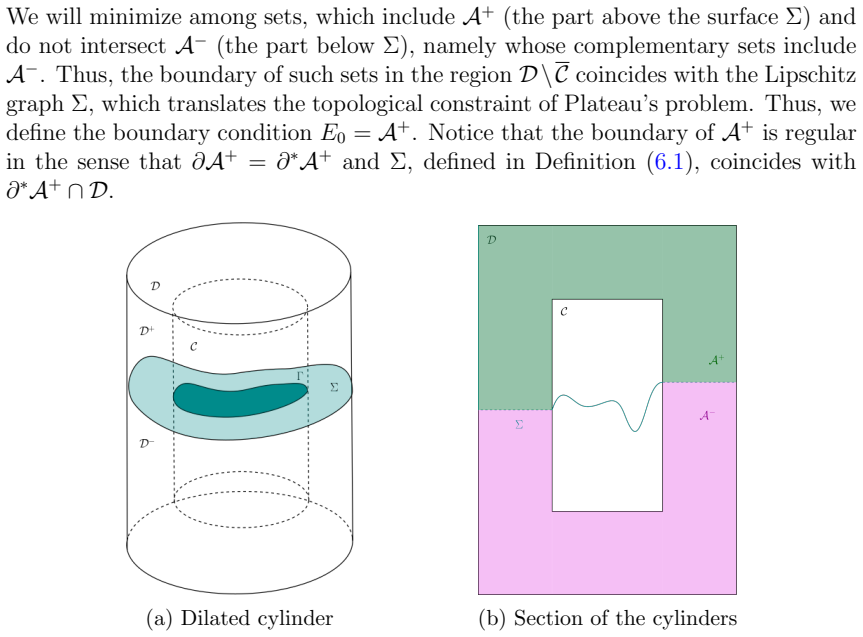
- [Section 6.1] The definition D = λC with λ>1 ensures C ⊂ D only when the dilation is centered at a point of C; since C is an arbitrary convex set, this should be stated explicitly or the dilation center should be chosen inside C.
- [Section 6.1, Definition of E0] The boundary condition E0 = A+ is defined on the side shell of D\C, but the top and bottom caps of the dilated cylinder also belong to D\C and are not described; the example should specify E0 there.
- [Proposition 5.5] When applying (2.5) to P(Ω\ω), the term H^{N-1}({νΩ = -νω}) is omitted without comment; it vanishes for open ω ⊂ Ω because the reduced-boundary normals coincide rather than oppose, but this justification should be stated.
Circularity Check
No significant circularity: the derivation chain is built on external benchmarks and independent arguments; the lone self-citation is motivational only.
full rationale
The direct implication of Theorem 5.1 is assembled from Theorem 3.1 (Ahlfors regularity), Theorem 4.4 (uniform rectifiability/Condition B), Propositions 5.5-5.6 (domains of isoperimetry), and the external David-Semmes criterion [DS98, Theorem 6.1] converting Condition B plus isoperimetry into a John domain. Lemma 3.4, the delicate boundary step, invokes the convex-intersection perimeter bound (Lemma 2.6) to compare P(B(x,r)∩C, U) with P(B(x,r), U); whether that local application is fully justified is a proof-completeness question, not a circularity, since Lemma 2.6 is a standard independent GMT result proved in the paper from first principles. The converse implication defines a genuinely new weighted Plateau problem (5.6), proves its minimizer is a Plateau-quasi-minimizer (Proposition 5.9), invokes the already-proved direct implication to get bi-John regularity, and then uses Lemma 5.11, whose proof rests on the external John-domain maximal estimate [DS98, Lemma 7.12], to force ∂Ω = ∂Ω0 and conclude Ω = Ω0 from connected components and the boundary condition. At no point is a predicted quantity shown to equal, by construction, a fitted or assumed input: the bi-John regularity is not assumed in the direct implication and is not used as a hypothesis in the converse beyond the statement being proved, and the equality of boundaries is derived from quantitative estimates rather than stipulated. The only self-reference, [BBLM25], is cited for motivation ('This regularity result is interesting in itself... used in [BBLM25] to prove a Γ-convergence type result') and plays no role in the proofs. Accordingly the circularity score is 0.
Assumptions & free parameters
assumptions (5)
- standard math Standard results for sets of finite perimeter: coarea formula, relative isoperimetric inequality, Gauss-Green formulas, lower semicontinuity of perimeter
- standard math David-Semmes John-domain theorem (Prop 5.3) and the Hardy-type estimate for John domains (Lemma 5.10)
- standard math Rigot's interior Condition B and the open representative construction (Rigot Lemma 3.4 and Lemma 3.6)
- standard math Buczolich's density-point theorem for bi-Lipschitz maps
- domain assumption Hypothesis H: (H1) Ahlfors regularity of Sigma, (H2) Condition B', (H3) isoperimetric domains, and partial*E0 = partial E0
Cite this review
Pith. "Pith review of Optimal regularity up to the boundary for Plateau-quasi-minimizers." pith.science (2026). https://pith.science/paper/7TL6ZSFX
@misc{pith2026250713189,
  author       = {Pith},
  title        = {Pith review of: Optimal regularity up to the boundary for Plateau-quasi-minimizers},
  year         = {2026},
  howpublished = {\url{https://pith.science/paper/7TL6ZSFX}},
  note         = {Machine review of arXiv:2507.13189}
}
read the original abstract
We study the regularity of quasi-minimal sets (in the sense of David and Semmes) with a boundary condition, which can be interpreted as quasi-minimizers of Plateau's problem in co-dimension one. For these Plateau-quasi-minimizers, we establish the optimal regularity, which is a characterization by bi-John domains with Ahlfors regular boundaries. This requires to investigate the Ahlfors regularity and also the uniform rectifiability of those sets, up to the boundary.
Figures


Figures from the paper (6 more)



Reference graph
Works this paper leans on
-
[1]
Functions of bounded variation and free discontinuity problems
Luigi Ambrosio, Nicola Fusco, and Diego Pallara. Functions of bounded variation and free discontinuity problems . Oxford Mathematical Monographs. The Clarendon Press, Oxford University Press, New York, 2000
2000
-
[2]
Phase field approximation for Plateau's problem: a curve geodesic distance penalty approach
Matthieu Bonnivard, Elie Bretin, Antoine Lemenant, and Eve Machefert. Phase field approximation for plateau's problem: a curve geodesic distance penalty approach. Preprint, arXiv :2506.22273 [math. OC ], 2025
work page Pith review arXiv 2025
-
[3]
Approximation of length minimization problems among compact connected sets
Matthieu Bonnivard, Antoine Lemenant, and Filippo Santambrogio. Approximation of length minimization problems among compact connected sets. SIAM Journal on Mathematical Analysis , 47(2):1489--1529, 2015
work page 2015
-
[4]
Density points and bi-lipschitz functions in R ^m
Zolt \'a n Buczolich. Density points and bi-lipschitz functions in R ^m . Proceedings of the American Mathematical Society , 116(1):53--59, 1992
work page 1992
-
[5]
Convex functions: constructions, characterizations and counterexamples , volume 109
Jonathan M Borwein and Jon D Vanderwerff. Convex functions: constructions, characterizations and counterexamples , volume 109. Cambridge University Press Cambridge, 2010
work page 2010
-
[6]
Morceaux de graphes lipschitziens et int \'e grales singulieres
Guy David. Morceaux de graphes lipschitziens et int \'e grales singulieres. Revista matem \'a tica iberoamericana , 4(1), 1988
work page 1988
-
[7]
Su una teoria generale della misura (r-1) -dimensionale in uno spazio ad r dimensioni
Ennio De Giorgi. Su una teoria generale della misura (r-1) -dimensionale in uno spazio ad r dimensioni. Ann. Mat. Pura Appl. (4) , 36:191--213, 1954
work page 1954
-
[8]
Nuovi teoremi relativi alle misure (r-1) -dimensionali in uno spazio ad r dimensioni
Ennio De Giorgi. Nuovi teoremi relativi alle misure (r-1) -dimensionali in uno spazio ad r dimensioni. Ricerche Mat. , 4:95--113, 1955
work page 1955
Show all 22 references
-
[9]
Complementi alla teoria della misura (n-1) - dimensionale in uno spazio n -dimensionale
Ennio De Giorgi. Complementi alla teoria della misura (n-1) - dimensionale in uno spazio n -dimensionale . Editrice Tecnico Scientifica, Pisa, 1961. Seminario di Matematica della Scuola Normale Superiore di Pisa, 1960-61
1961
-
[10]
A direct approach to plateau's problem
Camillo De Lellis, Francesco Ghiraldin, and Francesco Maggi. A direct approach to plateau's problem. Journal of the European Mathematical Society , 19(8):2219--2240, 2017
2017
-
[11]
Quantitative rectifiability and lipschitz mappings
Guy David and Stephen Semmes. Quantitative rectifiability and lipschitz mappings. Transactions of the American Mathematical Society , 337(2):855--889, 1993
1993
-
[12]
Uniform rectifiability and singular sets
Guy David and Stephen Semmes. Uniform rectifiability and singular sets. In Annales de l'IHP Analyse non lin \'e aire , volume 13, pages 383--443, 1996
1996
-
[13]
Quasiminimal surfaces of codimension 1 and john domains
Guy David and Stephen Semmes. Quasiminimal surfaces of codimension 1 and john domains. pacific journal of mathematics , 183(2):213--277, 1998
1998
-
[14]
Uniform rectifiability and quasiminimizing sets of arbitrary codimension , volume 687
Guy David and Stephen Semmes. Uniform rectifiability and quasiminimizing sets of arbitrary codimension , volume 687. American Mathematical Soc., 2000
2000
-
[15]
Minimal surfaces and functions of bounded variation , volume 80
Enrico Giusti and Graham H Williams. Minimal surfaces and functions of bounded variation , volume 80. Springer, 1984
1984
-
[16]
Rotation and strain
Fritz John. Rotation and strain. Communications on Pure and Applied Mathematics , 14(3):391--413, 1961
1961
-
[17]
A modica--mortola approximation for the steiner problem
Antoine Lemenant and Filippo Santambrogio. A modica--mortola approximation for the steiner problem. Comptes Rendus. Math \'e matique , 352(5):451--454, 2014
2014
-
[18]
Optimal regularity for quasiminimal sets of codimension one in R^2 and R^3
Camille Labourie and Yana Teplitskaya. Optimal regularity for quasiminimal sets of codimension one in R^2 and R^3 . Preprint, arXiv :2411.07210 [math. CA ], 2024
2024 arXiv
-
[19]
Sets of Finite Perimeter and Geometric Variational Problems: An Introduction to Geometric Measure Theory
Francesco Maggi. Sets of Finite Perimeter and Geometric Variational Problems: An Introduction to Geometric Measure Theory . Cambridge University Press, 1 edition, 2012
2012
-
[20]
Injectivity theorems in plane and space
Olli Martio and Jukka Sarvas. Injectivity theorems in plane and space. Annales Fennici Mathematici , 4(2):383--401, 1979
1979
-
[21]
Uniform partial regularity of quasi minimizers for the perimeter
S \'e verine Rigot. Uniform partial regularity of quasi minimizers for the perimeter. Calculus of Variations and Partial Differential Equations , 10(4):389--406, 2000
2000
-
[22]
a is \"a l \
Jussi V \"a is \"a l \"a . Uniform domains. Tohoku Mathematical Journal, Second Series , 40(1):101--118, 1988
1988
Reviewed August 6, 2026 · model on record in the stance chip above.
Discussion (0). Continue with ORCID to comment.