REVIEW 3 major objections 5 minor 21 references
Chute Move Posets are Lattices
T0 review · 3 major / 5 minor · reviewed 2026-08-06 · deepseek-v4-flash
Pith's one-line read For every permutation, the chute-move poset of reduced pipe dreams is a lattice.
desk verdict Strong paper that resolves a 2012 conjecture, but it needs to be self-contained about companion-paper imports and the transpose anti-isomorphism before I'd accept. read the letter →
The pith
A machine-rendered reading of the paper's core claim, the machinery that carries it, and where it could break.
The reading
What carries the argument
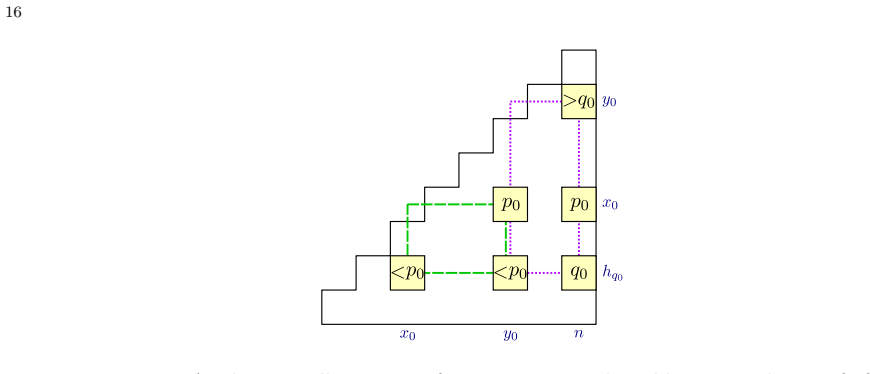
The central object is the Lehmer tableau associated to a reduced pipe dream, obtained by first recording in an inversions tableau $\Theta(P)$ the row where each pair of pipes crosses and then applying a Lehmer-form transform $\Lambda$ that encodes each column by counting absent smaller entries. The bijection $\Phi=\Lambda\circ\Theta$ carries the argument: chute moves between pipe dreams become, through Proposition 3.5, pure or trade increments on boxes of inversions tableaux, and Lemma 3.4 makes those increments act by adding $1$ to the corresponding Lehmer entries. Proposition 6.1 constructs chute moves from such increments, which is what allows the proof to pass from the local cover description to the global componentwise order. Two auxiliary transformations do the remaining work: the transpose, which gives an anti-isomorphism between $\mathrm{PD}(w)$ and $\mathrm{PD}(w^{-1})$, and the triforce embedding, which embeds $\mathrm{PD}(w)$ as an interval in $\mathrm{PD}(\widetilde{w})$ for a larger permutation and is used to handle the hardest join cases and to prove semidistributivity.
What would settle it
For a specific check, compute the reduced pipe dreams for $w=361542$, translate them to Lehmer tableaux, and test every pair with a common lower cover for a join in the chute-move order; a single missing join, or a pair with $\Phi(P)\le\Phi(P')$ but $P\not\le_{\mathrm{chute}}P'$, would refute Theorems 1.1 and 6.14.
Extended reading notes
Core claim
On the paper's own terms, the central result is that the locally defined chute-move order on reduced pipe dreams is actually a well-behaved global structure. Theorem 1.1 states that $\mathrm{PD}(w)$ is a lattice for every $w \in S_n$, and Theorem 1.2 adds that it is semidistributive and polygonal, all of whose polygons are diamonds or pentagons. The engine behind both theorems is the isomorphism $\Phi:\mathrm{PD}(w)\to\mathrm{LT}(w)$ of Theorem 6.14, which identifies the chute-move order with componentwise comparison of Lehmer tableaux; this makes order comparability, and therefore lattice operations, computationally transparent. The bridge from local to global is completed by showing that each chute move corresponds to a small multiset of increments in an inversions tableau, and that increments can be converted back into chute moves.
Load-bearing premise
The argument stands on the companion paper's dictionary: every reduced pipe dream corresponds to exactly one inversions tableau, and every chute move changes that tableau in one specified way; if that dictionary fails for some permutation, the lattice proof does not go through.
Editorial extensions
If this is right
- For fixed $w$, two pipe dreams $P$ and $P'$ satisfy $P\le_{\mathrm{chute}}P'$ exactly when $\Phi(P)\le\Phi(P')$ entrywise, so comparability in the chute-move order can be read off directly from Lehmer tableaux.
- Since $\mathrm{PD}(w)$ is a semidistributive lattice, it carries a canonical join complex, a bijective rowmotion operator, and the order-complex contractibility or sphere homotopy behavior that semidistributive lattices have.
- Every interval generated by two covers of the same element is a diamond or a pentagon, so the local geometry of the chute-move poset is completely described by those two shapes.
- The previously known $\nu$-Tamari lattice cases are subsumed: the theorem covers all permutations, not only the special class treated earlier.
- Because $\Phi$ is an isomorphism, every lattice-theoretic statement about $\mathrm{PD}(w)$ has a translation into a statement about integer-filled Lehmer tableaux, giving a uniform way to reason about meets and joins.
Reading between the lines
- A consequence the paper leaves implicit is that lattice operations in $\mathrm{PD}(w)$ can be approached through integer-valued Lehmer tableaux, which suggests a direct algorithmic route to meets and joins without simulating individual chute moves.
- The triforce embedding makes the lattice structure of $\mathrm{PD}(w)$ sit inside that of a larger permutation, so structural questions about joins might be studied by induction on $n$ rather than case by case.
- Because the transpose map is asserted rather than proved to reverse the chute-move order, making that argument explicit would transfer every join computation to a meet computation and could simplify proofs of additional lattice properties.
- The paragraph after the main theorems flags the canonical join complex as open; the structural ingredients proved here, semidistributivity, polygonal intervals, and the tableau isomorphism, are exactly the data such a description would need.
Signed reviews
Editorial analysis
A structured set of objections, weighed in public.
Referee Report
Summary. The paper proves Rubey's conjecture that the chute move poset PD(w) of reduced pipe dreams for a permutation w is a lattice, and establishes the stronger structural statements that PD(w) is semidistributive and polygonal with all polygons diamonds or pentagons. The main device is a bijection Φ from PD(w) to Lehmer tableaux LT(w); the core of the paper (Section 6) proves that Φ is an isomorphism between the chute order and the componentwise order on LT(w). The lattice property is then derived via the Björner–Edelman–Ziegler criterion (Section 7), and semidistributivity is proved in Section 8 with the aid of the triforce embedding.
Significance. If correct, the paper resolves a conjecture open since 2012 and, more importantly, supplies a global order description: comparability in PD(w) can be tested by componentwise comparison of Lehmer tableaux, making the order algorithmically accessible. The semidistributivity and polygonality results are new and connect PD(w) to the representation theory of finite semidistributive lattices, rowmotion, and canonical join complexes. The main proof is detailed, and the hard direction (increments imply chute reachability) is proved in the paper itself. However, the result currently rests on several foundational statements imported from the same-group unpublished companion paper [1] and on an unproved anti-isomorphism in Section 5.1; these dependencies are load-bearing.
major comments (3)
- [§3 (Theorem 3.3, Proposition 3.5, Corollary 3.7)] Theorem 3.3, Proposition 3.5, and Corollary 3.7 are cited to the companion preprint [1] and are not proved in the present manuscript. These are load-bearing: Theorem 3.3 identifies reduced pipe dreams with inversions tableaux; Proposition 3.5 is the exact translation of chute moves into increments, used in Lemmas 6.11–6.13 and in the lattice-theoretic Lemmas 7.2–7.4; and Corollary 3.7 supplies one half of Theorem 6.14. The paper's own contribution is the converse direction, Lemma 6.13, but without [1] the proof of Theorem 1.1 is not self-contained. If [1] is not yet published, please include proofs of these results in an appendix; if it has been accepted, state this explicitly.
- [§5.1] The assertion that transposition P ↦ P^T is a poset anti-isomorphism between PD(w) and PD(w^{-1}) is stated without proof. This fact is used in an essential way in Lemma 6.12 (to convert (P')^T ≤ P^T into P ≤ P'), in Corollary 7.6 (to obtain the meet-side polygon statement), and in the proof of Theorem 1.2 (to reduce join-semidistributivity to meet-semidistributivity). Because the statement concerns the global chute order, not just single moves, the proof should be supplied rather than left as immediate.
- [§5.2, Proposition 5.3] The proof of Proposition 5.3 states that P1 ≤chute P2 if and only if P1^★ ≤chute P2^★ is immediate, but the equivalence is not as trivial as the forward direction. The reverse direction requires using the order-convexity of the embedded set to show that a chute-move path in PD(w^★) between embedded pipe dreams can be replaced by a path in PD(w). The current one-sentence justification is not sufficient, and Proposition 5.3 is used in Lemma 7.4 and Lemmas 8.1–8.2. Please expand this proof.
minor comments (5)
- [§3] The set of tableaux of shape D is denoted 'T D' at one point and 'TD' elsewhere; define the set of tableaux, say as T(D), once and use the notation consistently.
- [§6.2, proof of Lemma 6.13] In the final displayed chain of the proof, the string 'Θ^{-1}(↑B T ≤chute Θ^{-1}(T′))' appears to have a missing parenthesis; it should read 'Θ^{-1}(↑B T) ≤chute Θ^{-1}(T′)'.
- [§5.1] The formula Φ(P)(i,j) = row_P(i,j) − |A_{i,j}(P)| − 1 is asserted as immediate from the relevant definitions. Since it is used in the proof of Proposition 5.2, a one-sentence derivation from the definition of Λ would help the reader.
- [§7, proof of Lemma 7.2] The sentence 'The sets B1 and B2 are disjoint' should be justified; it follows from the assumptions on SW(R1) and SW(R2), but the argument is omitted.
- [§1, Reference [4]] The note that Billey–McCausland–Minnerath have a simultaneous proof is useful, but if their preprint is publicly available, a citation with an arXiv identifier would be preferable.
Circularity Check
No circularity: the lattice theorem is not assumed; the imported companion-paper results are independent of the lattice claim.
full rationale
The derivation chain for Theorems 1.1 and 1.2 does not take the lattice conclusion as an input. The translation to Lehmer tableaux rests on three results imported from the companion preprint [1]: Theorem 3.3 (Theta is a bijection PD(w) to IT(w)), Proposition 3.5 (a chute move corresponds exactly to a multiset of increments in the inversions tableau), and Corollary 3.7 (P <=chute P' implies Phi(P) <= Phi(P')). These are parameter-free statements about pipe dreams and tableaux; none of them states or presupposes that PD(w) is a lattice. The paper's own hard work is the reverse direction in Theorem 6.14 and Lemmas 6.10-6.13, converting Lehmer inequality into chute reachability, followed by the local-join lemmas 7.2-7.4 and the Bjorner-Edelman-Ziegler criterion. The cited results also do not reduce to fitted data or to the target result. The self-citation to [1] is load-bearing, but under the stated hard rule it is independent support because it is parameter-free with assumptions that do not include the lattice property, so it does not raise the circularity score. The transpose anti-isomorphism asserted without proof in Section 5.1 is used in Lemma 6.12, Corollary 7.6, and the proof of Theorem 1.2; this is an omitted proof and a verification risk, but it is not a circular reduction, since it is not defined in terms of, or equivalent to, the lattice theorem. No equation or definition makes comparability in LT(w) identical to chute order by construction: Corollary 3.7 supplies only one direction, and the paper proves the converse. Hence no circular step can be exhibited, and the appropriate finding is no significant circularity.
Assumptions & free parameters
assumptions (8)
- domain assumption Theta is a bijection from PD(w) to IT(w) (Theorem 3.3 of [1]).
- domain assumption Chute moves on pipe dreams are characterized by increments of inversions tableaux (Proposition 3.5 of [1]).
- domain assumption P <=_chute P' implies Phi(P) <= Phi(P') (Corollary 3.7 of [1]).
- domain assumption PD(w) has a minimum and a maximum element (Rubey, Theorem 3.8 of [19]).
- domain assumption P maps to P^T is a poset anti-isomorphism PD(w) to PD(w^{-1}).
- domain assumption Restricting an inversions tableau to columns <= j yields an inversions tableau for the permutation obtained by deleting larger values.
- standard math A finite lattice is meet-semidistributive iff the set {gamma : gamma ^ beta = alpha} has a maximum for every cover alpha < beta (Freese et al., Proposition 2.1).
- standard math A finite poset with min and max is a lattice if any two elements covering the same element have a join (Björner-Edelman-Ziegler, Proposition 7.1).
Cite this review
Pith. "Pith review of Chute Move Posets are Lattices." pith.science (2026). https://pith.science/paper/D3MBAKPF
@misc{pith2026250713214,
  author       = {Pith},
  title        = {Pith review of: Chute Move Posets are Lattices},
  year         = {2026},
  howpublished = {\url{https://pith.science/paper/D3MBAKPF}},
  note         = {Machine review of arXiv:2507.13214}
}
abstract
For each permutation $w$, we consider the set $\mathrm{PD}(w)$ of reduced pipe dreams for $w$, partially ordered so that cover relations correspond to (generalized) chute moves. Settling a conjecture of Rubey from 2012, we prove that $\mathrm{PD}(w)$ is a lattice. To establish this result, we provide a global description of the partial order on $\mathrm{PD}(w)$ by showing that $\mathrm{PD}(w)$ is isomorphic to a poset consisting of objects called Lehmer tableaux. In addition, we prove that $\mathrm{PD}(w)$ is a semidistributive polygonal lattice whose polygons are all diamonds or pentagons.
Figures


Figures from the paper (11 more)




Reference graph
Works this paper leans on
- [1]
-
[2]
E. Barnard. The canonical join complex. Electron. J. Combin., 26 (2019)
2019
-
[3]
N. Bergeron and S. Billey. RC-graphs and Schubert polynomials. Experiment. Math., 2 (1993), 257–269
work page 1993
- [4]
- [5]
- [6]
-
[7]
A. Bj¨ orner, P. H. Edelman, and G. M. Ziegler. Hyperplane arrangements with a lattice of regions. Discrete Comput. Geom., 5 (1990), 263–288
work page 1990
-
[8]
C. Ceballos, A. Padrol, and C. Sarmiento. The ν-Tamari lattice via ν-trees, ν-bracket vectors, and subword complexes. Electron. J. Combin., 27 (2020)
work page 2020
Show all 21 references
-
[9]
Fomin and A
S. Fomin and A. N. Kirillov. Grothendieck polynomials and the Yang–Baxter equation. Proceedings of the 6th International Conference on Formal Power Series and Algebraic Combinatorics. Discrete Math. Theor. Comput. Sci., 24 (1994)
1994
-
[10]
Fomin and A
S. Fomin and A. N. Kirillov. Yang–Baxter equation, symmetric functions, and Schubert polynomials. Discrete Math., 153 (1996), 123–143
1996
-
[11]
Fomin and R
S. Fomin and R. P. Stanley. Schubert polynomials and the nil-Coxeter algebra. Adv. Math., 103 (1994), 196–207
1994
-
[12]
Freese, J
R. Freese, J. Jeˇ zek, and J. B. Nation. Free lattices, vol. 42 of Mathematical Surveys and Monographs. American Mathematical Society, Providence, RI, 1995. 27
1995
-
[13]
Hamaker, O
Z. Hamaker, O. Pechenik, and A. Weigandt. Gr¨ obner geometry of Schubert polynomials through ice.Adv. Math., 398 (2022)
2022
-
[14]
Knutson and E
A. Knutson and E. Miller. Gr¨ obner geometry of Schubert polynomials. Ann. Math., 161 (2005), 1245–1318
2005
-
[15]
Knutson and E
A. Knutson and E. Miller. Subword complexes in Coxeter groups. Adv. Math., 184 (2004), 161–176
2004
-
[16]
McConville
T. McConville. Crosscut-simplicial lattices. Order, 34 (2017), 465–477
2017
-
[17]
N. Reading. Noncrossing arc diagrams and canonical join representations. SIAM J. Discrete Math., 29 (2015), 736–750
2015
-
[18]
Reading, D
N. Reading, D. Speyer, and H. Thomas. The fundamental theorem of finite semidistributive lattices. Selecta Math., 27 (2021), 1–53
2021
-
[19]
M. Rubey. Maximal 0-1-fillings of moon polyominoes with restricted chain lengths and RC-graphs. Adv. Appl. Math., 48 (2012), 290–305
2012
-
[20]
Serrano and C
L. Serrano and C. Stump. Maximal fillings of moon polyominoes, simplicial complexes, and Schubert polynomials. Electron. J. Combin., 19 (2012)
2012
-
[21]
Thomas and N
H. Thomas and N. Williams. Rowmotion in slow motion. Proc. Lond. Math. Soc., 119 (2019), 1149–1178. Department of Mathematics, Massachusetts Institute of Technology, Cambridge, MA 02139, USA Email address: ilani af@mit.edu Department of Mathematics, Harvard University, Cambrid...
2019
Reviewed August 6, 2026 · model on record in the stance chip above.
Discussion (0). Continue with ORCID to comment.