REVIEW 3 major objections 5 minor 1 cited by
Inversions Tableaux
T0 review · 3 major / 5 minor · reviewed 2026-08-06 · deepseek-v4-flash
Pith's one-line read Schubert polynomials are generated by inversions tableaux, a new filling model on inversion diagrams.
desk verdict A genuinely new tableau model for Schubert polynomials with a plausible main theorem, but the inverse bijection proof has a concrete gap that needs closing. read the letter →
The pith
A machine-rendered reading of the paper's core claim, the machinery that carries it, and where it could break.
The reading
What carries the argument
The central object is the inversions tableau, defined on the staircase-shaped inversion diagram of a permutation, with shaded boxes carrying entries. The load-bearing condition is weak balance, a rectangle rule stating that for every triple i<j<k, the entry in box (i,k) lies weakly between the entries in boxes (i,j) and (j,k); this replaces the strict median condition in Edelman and Greene's balanced tableaux. Together with column-distinctness and the row bound, weak balance characterizes exactly those fillings that come from reduced pipe dreams via the map that records each crossing's row.
What would settle it
Enumerate all fillings of the inversion diagram of a small permutation such as 4321 that satisfy rules (IT1), (IT2), and (IT3'), and run the inverse construction from the proof of Theorem 3.13 on each one; a single filling for which the construction either fails to produce a reduced pipe dream or forces two pipes to cross twice would disprove the claimed bijection.
Extended reading notes
Core claim
The paper claims that for any permutation w, the Schubert polynomial S_w equals the sum over inversions tableaux of shape w of the monomial $x^{{wt(T)}}$, where wt(T) records the number of boxes filled with each integer. An inversions tableau is a filling of the shaded boxes of the inversion diagram of w with entries 1 through n, subject to three rules: the tableau is weakly balanced (the rectangle rule holds), no column contains a repeated entry, and every entry in row i is at most i. The proof passes through a bijection with reduced pipe dreams: the entry in box (i,j) records the row in which pipes i and j cross, and the inverse construction shows that every such tableau arises from a unique reduced pipe dream.
Load-bearing premise
The proof of the main bijection assumes that from any weakly balanced filling satisfying the column and row rules, one can always order the boxes so that adding crossings one at a time, in the prescribed order and at the prescribed rows, produces a reduced pipe dream for the correct permutation without any two pipes crossing twice.
Editorial extensions
If this is right
- Schubert polynomials acquire a tableau model on par with the SSYT model for Schur polynomials, allowing direct comparisons with weak Bruhat order via the inversion diagram.
- For Grassmannian permutations, inversions tableaux specialize exactly to reverse semistandard Young tableaux of the corresponding Young diagram, giving a short proof that the Schubert polynomial is a Schur polynomial.
- For dominant permutations there is a unique inversions tableau and the Schubert polynomial is a single monomial equal to the Lehmer code, recovering a classical criterion.
- The construction extends without the row bound to unbounded inversions tableaux, yielding a tableau model for Stanley symmetric functions.
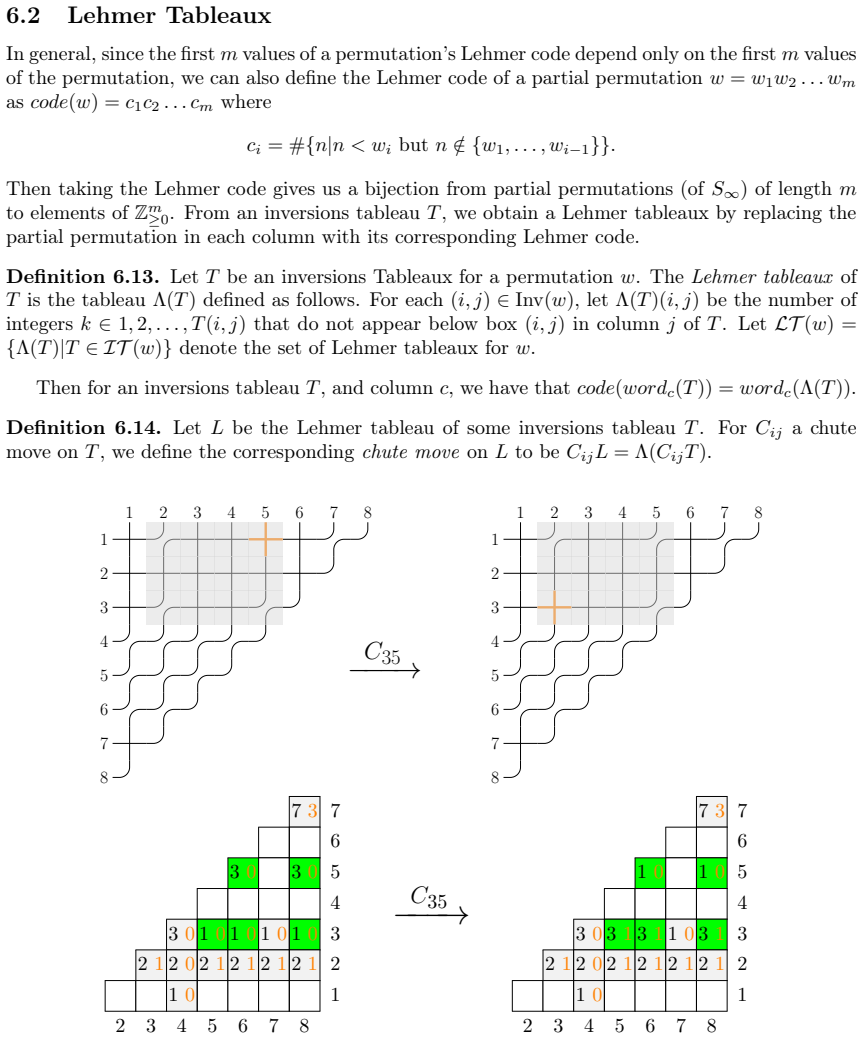
- Generalized chute moves act on inversions tableaux column-by-column, and the associated Lehmer tableaux provide a way to compare pipe dreams in Rubey's chute move poset.
Reading between the lines
- The bijection with a-compatible sequences in Remark 3.16 suggests that inversions tableaux can be used to give an efficient dynamic-programming or insertion algorithm for computing individual Schubert monomials, since the inverse construction builds a reduced word and its compatible sequence directly from the tableau.
- If the weakly balanced rectangle rule is genuinely local, inversions tableaux could support a direct Littlewood-Richardson-type rule for Schubert structure coefficients in vexillary cases, bypassing the more intricate geometry of pipe dream intersections.
- The column-wise description of chute moves and the monotonicity of Lehmer tableaux under chute moves may make Rubey's lattice conjecture checkable by verifying a local confluence property on the tableau side, which appears to be the direction of the forthcoming work.
- Because inversions tableaux visibly interpolate between Schubert and Schur combinatorics, they may yield testable new positivity statements for skew Schubert polynomials or for products of Schur and Schubert polynomials.
Signed reviews
Editorial analysis
A structured set of objections, weighed in public.
Referee Report
Summary. The paper introduces "inversions tableaux," fillings of an inversions diagram of a permutation w, and claims that the generating function over these tableaux equals the Schubert polynomial S_w. The main tool is a weight-preserving bijection between reduced pipe dreams and inversions tableaux (Theorem 3.13). The paper also derives formulae for the lexicographically maximal and minimal monomials of Schubert polynomials, characterizes inversions tableaux for dominant and Grassmannian permutations, defines unbounded inversions tableaux for Stanley symmetric functions, and discusses chute moves, a new "mediocre Bruhat order," and Lehmer tableaux as preparation for a forthcoming proof of Rubey's chute-move lattice conjecture.
Significance. If Theorem 3.13 is correct, inversions tableaux form a genuinely new tableau model for Schubert polynomials that specializes directly to reverse semistandard Young tableaux in the Grassmannian case. The paper is clearly written, contains many instructive examples, and offers attractive applications: a simple encoding of Lehmer codes, extremal monomials, dominant permutations, and a bridge to chute-move posets. However, the main bijection is not established as written: the inverse construction in the proof of Theorem 3.13 fails on a valid three-box example, and the paper conflates weak Bruhat order with the inversion-containment order. These are load-bearing issues, so the central claim currently lacks a rigorous proof. The remaining sections contain useful structural results, but most depend on the main bijection or on Proposition 6.3, which is also under-proved.
major comments (3)
- [Section 3, proof of Theorem 3.13] The inverse construction is not well-defined. For w = 321, the tableau T with T(1,2) = 1, T(1,3) = 1, T(2,3) = 2 is a valid inversions tableau in IT(321). The only total order satisfying Lemma 3.11(3) is (1,2), (1,3), (2,3), so the proof’s reversed order is (2,3), (1,3), (1,2). After the first step adds the crossing of pipes 2 and 3 at row 2, pipes 1 and 3 are not adjacent at row 1, so the second step cannot add the crossing of pipes 1 and 3 at row 1. Thus the induction in the paragraphs beginning “To complete the proof” and “Again by Proposition 3.7” fails on a concrete tableau, and the two cases illustrated in Figure 4 do not cover this configuration. Since the inverse map is the load-bearing step connecting tableaux to pipe dreams, the proof of the main theorem is incomplete.
- [Section 2, Definition 2.1 and following paragraph] The statement “u < w in weak Bruhat order exactly when Inv(u) ⊂ Inv(w)” is false for the left weak order defined in Definition 2.1. For example, in S_3, Inv(132) = {(2,3)} is contained in Inv(231) = {(1,3),(2,3)}, but 132 and 231 are not related by the stated left weak cover relations. The poset of inversion sets ordered by containment is the strong Bruhat order, not the weak Bruhat order. This matters because Proposition 3.7 and the proof of Theorem 3.13 identify the poset ID_n with weak Bruhat order and use maximal chains in it; reversing a balanced-tableau order does not, in general, produce a chain in weak Bruhat order. The terminology and the underlying poset identification need to be corrected before the bijection argument can be assessed.
- [Section 6, Proposition 6.3] Proposition 6.3, which asserts that chute moves on tableaux correspond exactly to chute moves on pipe dreams, is not proved in sufficient detail. The forward direction is dismissed with “we can see that the corresponding inversions tableaux satisfy all the conditions,” and the reverse direction contains an argument whose key step, “by 3, we must have T(l,j) = T′(l,j)”, is not justified from the stated conditions; the reference appears to conflate Definition 6.2(3) with a conclusion that is being proved. The figures and the assertion that the pipes form the rectangular grid of Definition 6.1 require a careful formal proof. Since this proposition is the bridge between the tableau model and Rubey’s chute-move posets, it is load-bearing for the paper’s claimed applications.
minor comments (5)
- [Lemma 3.15 proof] In the proof of Lemma 3.15, the first induction step should cite condition (IT3), not (IT3’), because (IT3’) is the statement being proved; the same mislabeling occurs later when bounding T(k,k+1) by k.
- [Corollary 6.4] The statement of Corollary 6.4 uses m both as a dummy index and as the entry to be found: “T(i(x), k) = m” should be “T(i_x, k) = x”, and the notation i_x should be defined explicitly.
- [Definition 6.13] The phrase “integers k ∈ 1, 2, . . . , T(i,j)” is malformed; it should read “integers k ∈ {1, 2, . . . , T(i,j)}”.
- [Proposition 5.4 proof] The sentence “Sliding shaded boxes together and rotating by 180 degrees, we then get a flag SSYT” skips the verification that the flag bounds are exactly (b_1, . . . , b_{n-k}) and that the rotation preserves the strict column and weak row conditions; a more explicit bijection on entries would clarify the proof.
- [Various] There are numerous typos, including “necesessarily” in Lemma 3.11, “permtuation” in the proof of Theorem 6.12, “filed” in Definition 2.6, and inconsistent uses of “tableaux” versus “tableau”; a careful copyedit is needed.
Circularity Check
No circularity: the main theorem is proven by a weight-preserving bijection to pipe dreams and an external Bergeron–Billey generating function, with no fitted inputs or load-bearing self-citations.
full rationale
The paper derives Theorem 3.13 by constructing an explicit weight-preserving bijection between inversions tableaux and reduced pipe dreams, then invoking the known Bergeron–Billey pipe dream formula (Theorem 2.3) as an external, independently established result. The forward map is defined directly from a pipe dream by recording crossing rows, and the inverse map uses Edelman and Greene's balanced tableaux theorem (Proposition 3.7) together with Lemma 3.11, which is an equivalence between weak balancedness and the existence of a compatible total order. No parameter is fitted to the Schubert polynomial, and no conclusion of the paper is assumed in its own proof. The references to forthcoming joint work with Defant, Mularczyk, Nguyen, and Tung on Rubey's conjecture are motivational and are not used in any proof of the paper's results. The only noted weakness, a possible gap in the well-definedness of the inverse bijection, is a correctness or rigor concern about a sketched argument, not a circularity: even if the inverse construction failed as written, the claimed formula would not be equivalent to its inputs by construction. The Grassmannian, inverse Grassmannian, and Stanley symmetric function results all follow from the same independent bijection rather than from a renaming or fitted input. Therefore no significant circularity is present.
Assumptions & free parameters
assumptions (4)
- domain assumption Schubert polynomials are generated by reduced pipe dreams (Bergeron-Billey, Theorem 2.3).
- standard math Edelman-Greene bijection between maximal chains in weak Bruhat order and balanced staircase tableaux (Proposition 3.7, from [6, Theorem 4.2]).
- domain assumption The Schubert polynomial of a k-Grassmannian permutation is the Schur polynomial s_{λ_w}(x1,...,xk) (Proposition 5.1, from [1]).
- domain assumption Stanley symmetric functions are the stable limits of Schubert polynomials (Definition 3.18, from [16]).
invented entities (4)
-
inversions tableaux
independent evidence
-
unbounded inversions tableaux
independent evidence
-
mediocre Bruhat order
independent evidence
-
Lehmer tableaux
independent evidence
Cite this review
Pith. "Pith review of Inversions Tableaux." pith.science (2026). https://pith.science/paper/UW7EIJYK
@misc{pith2026250711516,
  author       = {Pith},
  title        = {Pith review of: Inversions Tableaux},
  year         = {2026},
  howpublished = {\url{https://pith.science/paper/UW7EIJYK}},
  note         = {Machine review of arXiv:2507.11516}
}
read the original abstract
We introduce inversions tableaux, a new combinatorial model for Schubert polynomials and Stanley symmetric functions that directly specializes to semi-standard Young tableaux in the Grassmannian case. They are a modification of the balanced staircase tableaux of Edelman and Greene. We explicitly describe inversions tableaux that correspond to the lexicographically minimal and maximal monomials in each Schubert polynomial and characterize the unique inversions tableau for dominant permutations. We also characterize the action of generalized chute moves on inversions tableaux, and establish related background that will be used to prove Rubey's chute moves conjecture in upcoming work.
Figures


Figures from the paper (8 more)


Forward citations
Cited by 1 Pith paper
-
Chute Move Posets are Lattices
Every chute move poset of reduced pipe dreams is a lattice, it is isomorphic to a Lehmer tableaux poset, and it is semidistributive and polygonal with diamonds or pentagons as polygons.
Reference graph
Works this paper leans on
-
[1]
A combinatorial construction of the Schubert polynomials
Nantel Bergeron. “A combinatorial construction of the Schubert polynomials”. In:J. Comb. Theory A.60 (1992), pp. 168–182
work page 1992
-
[2]
RC-graphs and Schubert polynomials
Nantel Bergeron and Sara Billey. “RC-graphs and Schubert polynomials”. In:Experimental Mathematics 2.4 (1993), pp. 257–269
work page 1993
-
[3]
Schubert cells and cohomology of the spaces G/P
I. N Bernstein, Israel M Gel’fand, and Sergei I Gel’fand. “Schubert cells and cohomology of the spaces G/P”. In:Russian Mathematical Surveys28.3 (1973), p. 1
work page 1973
-
[4]
Some combinatorial properties of Schubert polynomials
Sara C Billey, William Jockusch, and Richard P Stanley. “Some combinatorial properties of Schubert polynomials”. In:Journal of Algebraic Combinatorics2.4 (1993), pp. 345–374
work page 1993
-
[5]
Désingularisation des variétés de Schubert généralisées
Michel Demazure. “Désingularisation des variétés de Schubert généralisées”. In:Annales sci- entifiques de l’École Normale Supérieure7.1 (1974), pp. 53–88
work page 1974
-
[6]
Paul Edelman and Curtis Greene. “Balanced tableaux”. In:Advances in Mathematics63.1 (1987), pp. 42–99
work page 1987
-
[7]
Schubert Polynomials and the Nilcoxeter Algebra
S. Fomin and R.P. Stanley. “Schubert Polynomials and the Nilcoxeter Algebra”. In:Advances in Mathematics 103.2 (1994), pp. 196–207
work page 1994
-
[8]
Balanced Labellings and Schubert Polynomials
Sergey Fomin, Curtis Greene, Victor Reiner, and Mark Shimozono. “Balanced Labellings and Schubert Polynomials”. In:European Journal of Combinatorics18.4 (1997), pp. 373–
work page 1997
Show all 19 references
-
[9]
The Yang-Baxter equation, symmetric functions, and Schubert polynomials
Sergey Fomin and Anatol N Kirillov. “The Yang-Baxter equation, symmetric functions, and Schubert polynomials”. In:Discrete Mathematics153.1-3 (1996), pp. 123–143. 19
1996
-
[10]
Back stable Schubert calculus
Thomas Lam, Seung Jin Lee, and Mark Shimozono. “Back stable Schubert calculus”. In: Compositio Mathematica157.5 (2021), pp. 883–962
2021
-
[11]
Polynômes de Schubert
Alain Lascoux and Marcel-Paul Schützenberger. “Polynômes de Schubert”. In:CR Acad. Sci. Paris Sér. I Math294.13 (1982), pp. 447–450
1982
-
[12]
Skew Schubert polynomials
Cristian Lenart and Frank Sottile. “Skew Schubert polynomials”. In:Proc. Amer. Math. Soc. 131 (2003), pp. 3319–3328
2003
-
[13]
Group characters and algebra
Dudley Ernest Littlewood and Archibald Read Richardson. “Group characters and algebra”. In: Philosophical Transactions of the Royal Society of London. Series A, Containing Papers of a Mathematical or Physical Character233.721-730 (1934), pp. 99–141
1934
-
[14]
Maximal 0–1-fillings of moon polyominoes with restricted chain lengths and rc-graphs
Martin Rubey. “Maximal 0–1-fillings of moon polyominoes with restricted chain lengths and rc-graphs”. In:Advances in Applied Mathematics48.2 (2012), pp. 290–305.issn: 0196-8858. doi: https://doi.org/10.1016/j.aam.2011.05.005. url: https://www.sciencedirect. com/science/article...
2012 doi
-
[15]
Richard P. Stanley. Enumerative combinatorics. Vol. 2. Vol. 62. Cambridge Studies in Ad- vanced Mathematics. With a foreword by Gian-Carlo Rota and appendix 1 by Sergey Fomin. Cambridge University Press, Cambridge, 1999, pp. xii+581. isbn: 0-521-56069-1; 0-521- 78987-7. doi: 1...
1999 doi
-
[16]
On the number of reduced decompositions of elements of Coxeter groups
Richard P. Stanley. “On the number of reduced decompositions of elements of Coxeter groups”. In:Eur. J. Comb5.4 (1984), pp. 359–372
1984
-
[17]
A concise proof of the Littlewood-Richardson rule
John R Stembridge. “A concise proof of the Littlewood-Richardson rule”. In:the electronic journal of combinatorics(2002), N5–N5
2002
-
[18]
Flagged Schur functions, Schubert polynomials, and symmetrizing op- erators
Michelle L. Wachs. “Flagged Schur functions, Schubert polynomials, and symmetrizing op- erators”. In:J. Combin. Theory Ser. A40.2 (1985), pp. 276–289. 20
1985
-
[389]
doi: https : / / doi
issn: 0195-6698. doi: https : / / doi . org / 10 . 1006 / eujc . 1996 . 0109. url: https : //www.sciencedirect.com/science/article/pii/S0195669896901092
1996
Reviewed August 6, 2026 · model on record in the stance chip above.
Discussion (0). Continue with ORCID to comment.