DiffClean: Diffusion-based Makeup Removal for Accurate Age Estimation
Pith reviewed 2026-05-19 03:44 UTC · model grok-4.3
The pith
A text-guided diffusion model removes facial makeup to restore accurate age estimation and face verification.
A machine-rendered reading of the paper's core claim, the machinery that carries it, and where it could break.
Core claim
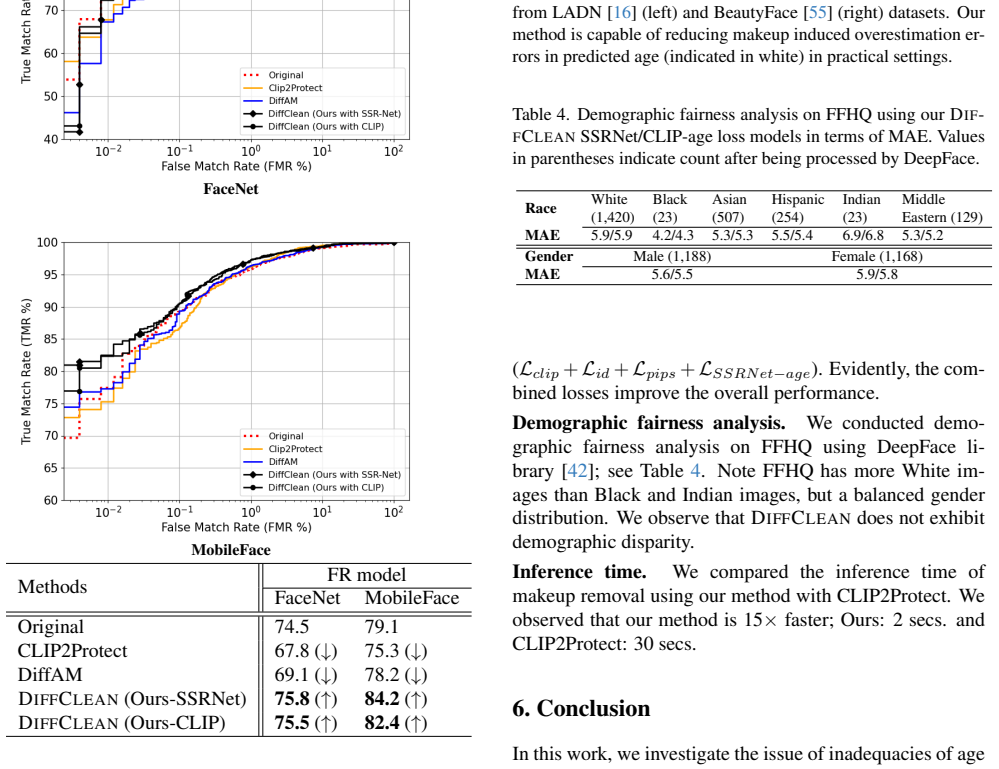
DiffClean erases makeup traces using a text-guided diffusion model to defend against makeup attacks on age estimation, achieving a 5.8% improvement in minor versus adult accuracy and a 5.1% increase in true match rate at a false match rate of 0.01% for face verification, while outperforming baselines in quality metrics.
What carries the argument
DiffClean, the text-guided diffusion model that removes makeup traces from facial images without introducing artifacts that affect perceived age or identity.
If this is right
- Age verification systems gain reliability in protecting minors from restricted online content.
- Face recognition pipelines become more resistant to cosmetic changes that shift apparent identity.
- The same removal step works across both computer-generated and physically applied makeup styles.
- Downstream biometric tasks receive cleaner input images that improve standard quality scores.
Where Pith is reading between the lines
- The cleaning step could serve as preprocessing for other appearance-altering factors such as heavy lighting or digital filters.
- Existing age estimators might see immediate gains by routing inputs through this model rather than requiring full retraining.
- Performance differences across skin tones or makeup traditions could be measured to check for uneven benefits.
Load-bearing premise
The diffusion model can erase makeup without changing the person's actual facial structures that determine perceived age and identity.
What would settle it
Age estimation accuracy or face verification performance drops when DiffClean is run on images that have no makeup at all, or the gains disappear on a new collection of real makeup photographs.
Figures


read the original abstract
Accurate age verification can protect underage users from unauthorized access to online platforms and e-commerce sites that provide age-restricted services. However, accurate age estimation can be confounded by several factors, including facial makeup that can induce changes to alter perceived identity and age to fool both humans and machines. In this work, we propose DiffClean which erases makeup traces using a text-guided diffusion model to defend against makeup attacks. DiffClean improves age estimation (minor vs. adult accuracy by 5.8%) and face verification (TMR by 5.1% at FMR=0.01%) compared to images with makeup. Our method is robust across digitally simulated and real-world makeup styles, and outperforms multiple baselines in terms of biometric and perceptual quality. Our codes are available at https://github.com/Ektagavas/DiffClean.
Editorial analysis
A structured set of objections, weighed in public.
Referee Report
Summary. The paper proposes DiffClean, a text-guided diffusion model for removing facial makeup traces to improve biometric performance. It claims that applying DiffClean to makeup-affected images yields a 5.8% gain in minor-vs-adult age estimation accuracy and a 5.1% increase in TMR at FMR=0.01% for face verification, with robustness across simulated and real-world makeup styles and superiority over baselines in biometric and perceptual quality metrics. Code is released at the provided GitHub link.
Significance. If the core assumption holds, the work addresses a practical vulnerability in age-restricted access systems and demonstrates a targeted use of diffusion models for makeup removal. The empirical gains and open code are positive elements that could support follow-on research in makeup-robust biometrics.
major comments (2)
- [Experiments / Results] The reported gains (5.8% age accuracy, 5.1% TMR) are measured exclusively on before/after pairs of makeup images. No control experiment is described that applies the identical text-guided diffusion process to clean (non-makeup) faces and measures any resulting shift in the age estimator or verifier outputs; without this, it is impossible to separate makeup removal from incidental changes to wrinkles, skin texture, or lighting that the generative prior may introduce.
- [Method] The method section does not specify the exact text prompt(s) used for guidance, whether they are fixed or image-dependent, or any mechanism to constrain the diffusion process to cosmetic layers only. This leaves open the possibility that the model is performing broader face editing rather than targeted removal, which directly affects the validity of the biometric improvement claims.
minor comments (2)
- [Abstract] The abstract omits dataset names, number of images, choice of age estimator and verifier, and any mention of error bars or statistical testing; these details should be added for a self-contained summary.
- [Figures / Tables] Figure captions and table headers should explicitly state whether metrics are computed on the original makeup images, the DiffClean outputs, or both, to avoid ambiguity when comparing to baselines.
Simulated Author's Rebuttal
We thank the referee for the constructive comments, which highlight important aspects for strengthening the experimental validation and methodological clarity of our work. We address each major comment below and will update the manuscript accordingly.
read point-by-point responses
-
Referee: [Experiments / Results] The reported gains (5.8% age accuracy, 5.1% TMR) are measured exclusively on before/after pairs of makeup images. No control experiment is described that applies the identical text-guided diffusion process to clean (non-makeup) faces and measures any resulting shift in the age estimator or verifier outputs; without this, it is impossible to separate makeup removal from incidental changes to wrinkles, skin texture, or lighting that the generative prior may introduce.
Authors: We agree that a control experiment applying DiffClean to clean faces would help isolate the effects of makeup removal from potential incidental generative changes. In the revised manuscript, we will include results from processing non-makeup images through the same pipeline and report any shifts in age estimation accuracy and verification TMR to demonstrate that such changes are minimal and do not account for the observed biometric gains. revision: yes
-
Referee: [Method] The method section does not specify the exact text prompt(s) used for guidance, whether they are fixed or image-dependent, or any mechanism to constrain the diffusion process to cosmetic layers only. This leaves open the possibility that the model is performing broader face editing rather than targeted removal, which directly affects the validity of the biometric improvement claims.
Authors: We will revise the method section to explicitly detail the fixed text prompts used for guidance (e.g., prompts focused on makeup removal such as 'face with no makeup'), confirm they are not image-dependent, and describe any guidance or conditioning mechanisms intended to prioritize cosmetic alterations over other facial attributes. This addition will clarify the targeted nature of the process. revision: yes
Circularity Check
No circularity: empirical evaluation chain is self-contained
full rationale
The paper describes an empirical pipeline: a text-guided diffusion model is trained or conditioned to remove makeup, then evaluated by measuring downstream biometric metrics (age estimation accuracy, face verification TMR) on before/after image pairs. No derivation, equation, or uniqueness theorem is invoked that reduces to a fitted parameter or self-citation by construction. Performance numbers are reported as direct experimental comparisons against makeup-affected inputs and baselines; the central claim does not rely on renaming a known result or smuggling an ansatz through prior self-work. The method is therefore not circular under the defined criteria.
Axiom & Free-Parameter Ledger
axioms (1)
- domain assumption Text-guided diffusion models can perform precise makeup removal while preserving identity and age-related facial features.
Lean theorems connected to this paper
-
IndisputableMonolith/Cost/FunctionalEquation.leanwashburn_uniqueness_aczel unclear?
unclearRelation between the paper passage and the cited Recognition theorem.
DIFFCLEAN uses the ablated diffusion model (ADM) with guided diffusion ... combination of CLIP loss ... biometric loss ... age loss ... perceptual loss
-
IndisputableMonolith/Foundation/AlphaCoordinateFixation.leanJ_uniquely_calibrated_via_higher_derivative unclear?
unclearRelation between the paper passage and the cited Recognition theorem.
Ltotal = λclip Lclip + λid Lid + λlpips Llpips + λL1 LL1 + λage Lage
What do these tags mean?
- matches
- The paper's claim is directly supported by a theorem in the formal canon.
- supports
- The theorem supports part of the paper's argument, but the paper may add assumptions or extra steps.
- extends
- The paper goes beyond the formal theorem; the theorem is a base layer rather than the whole result.
- uses
- The paper appears to rely on the theorem as machinery.
- contradicts
- The paper's claim conflicts with a theorem or certificate in the canon.
- unclear
- Pith found a possible connection, but the passage is too broad, indirect, or ambiguous to say the theorem truly supports the claim.
Reference graph
Works this paper leans on
-
[1]
Assessing the influencing factors on the accuracy of underage facial age estimation
Felix Anda, Brett A Becker, David Lillis, Nhien-An Le- Khac, and Mark Scanlon. Assessing the influencing factors on the accuracy of underage facial age estimation. In In- ternational Conference on Cyber Security and Protection of Digital Services (Cyber Security), pages 1–8. IEEE, 2020. 2, 3
work page 2020
-
[2]
Deep- uage: improving underage age estimation accuracy to aid csem investigation
Felix Anda, Nhien-An Le-Khac, and Mark Scanlon. Deep- uage: improving underage age estimation accuracy to aid csem investigation. Forensic Science International: Digital Investigation, 32:300921, 2020. 2, 3
work page 2020
-
[3]
Grigory Antipov, Moez Baccouche, Sid-Ahmed Berrani, and Jean-Luc Dugelay. Apparent age estimation from face im- ages combining general and children-specialized deep learn- ing models. In Proceedings of the IEEE Conference on Com- puter Vision and Pattern Recognition Workshops (CVPRW), pages 96–104, 2016. 2
work page 2016
-
[4]
Cross-age reference coding for age-invariant face recogni- tion and retrieval
Bor-Chun Chen, Chu-Song Chen, and Winston H Hsu. Cross-age reference coding for age-invariant face recogni- tion and retrieval. In Computer Vision–ECCV 2014: 13th European Conference, Zurich, Switzerland, September 6-12, 2014, Proceedings, Part VI 13 , pages 768–783. Springer,
work page 2014
-
[5]
Auto- matic facial makeup detection with application in face recog- nition
Cunjian Chen, Antitza Dantcheva, and Arun Ross. Auto- matic facial makeup detection with application in face recog- nition. In International Conference on Biometrics (ICB) , pages 1–8. IEEE, 2013. 3
work page 2013
-
[6]
Impact of facial cosmetics on automatic gender and age estimation algorithms
Cunjian Chen, Antitza Dantcheva, and Arun Ross. Impact of facial cosmetics on automatic gender and age estimation algorithms. International Conference on Computer Vision Theory and Applications (VISAPP), 2:182–190, 2014. 1, 3
work page 2014
-
[7]
Beautyglow: On- demand makeup transfer framework with reversible genera- tive network
Hung-Jen Chen, Ka-Ming Hui, Szu-Yu Wang, Li-Wu Tsao, Hong-Han Shuai, and Wen-Huang Cheng. Beautyglow: On- demand makeup transfer framework with reversible genera- tive network. In Proceedings of the IEEE/CVF Conference on computer vision and pattern recognition , pages 10042– 10050, 2019. 1, 3
work page 2019
-
[8]
Albert Clap ´es, Ozan Bilici, Dariia Temirova, Egils Avots, Gholamreza Anbarjafari, and Sergio Escalera. From appar- ent to real age: gender, age, ethnic, makeup, and expression bias analysis in real age estimation. In proceedings of the IEEE conference on computer vision and pattern recognition workshops, pages 2373–2382, 2018. 2, 3
work page 2018
-
[9]
Hannah Davis and Janice Attard-Johnson. Your id, please? the effect of facemasks and makeup on perceptions of age of young adult female faces. Applied Cognitive Psychology, 36 (2):453–459, 2022. 1
work page 2022
-
[10]
Quantifying the impact cosmetic make- up has on age perception and the first impression projected
Steven H Dayan, Katherine Cho, Mary Siracusa, and Se- lika Gutierrez-Borst. Quantifying the impact cosmetic make- up has on age perception and the first impression projected. Journal of drugs in dermatology : JDD, 14 4:366–74, 2015. 3
work page 2015
-
[11]
Gender, age, and emotions for flickr-faces-hq dataset (ffhq)
DCGM. Gender, age, and emotions for flickr-faces-hq dataset (ffhq). https://github.com/DCGM/ffhq- features-dataset. [Online accessed: 21 st February, 2025]. 4
work page 2025
-
[12]
Diffusion models beat GANs on image synthesis
Prafulla Dhariwal and Alexander Nichol. Diffusion models beat GANs on image synthesis. Advances in neural informa- tion processing systems, 34:8780–8794, 2021. 3, 4
work page 2021
-
[13]
Facial cosmetics database and impact analysis on auto- matic face recognition
Marie-Lena Eckert, Neslihan Kose, and Jean-Luc Duge- lay. Facial cosmetics database and impact analysis on auto- matic face recognition. In IEEE 15th international workshop on multimedia signal processing (MMSP) , pages 434–439. IEEE, 2013. 3
work page 2013
-
[14]
Quantifying the makeup effect in female faces and its applications for age es- timation
Ranran Feng and Balakrishnan Prabhakaran. Quantifying the makeup effect in female faces and its applications for age es- timation. In IEEE International Symposium on Multimedia, pages 108–115. IEEE, 2012. 1, 2
work page 2012
-
[15]
RetinaMask: Learning to predict masks improves state-of-the-art single-shot detection for free
Cheng-Yang Fu, Mykhailo Shvets, and Alexander C Berg. Retinamask: Learning to predict masks improves state- of-the-art single-shot detection for free. arXiv preprint arXiv:1901.03353, 2019. 4
work page internal anchor Pith review Pith/arXiv arXiv 1901
-
[16]
LADN: Local adversarial disentangling network for facial makeup and de-makeup
Qiao Gu, Guanzhi Wang, Mang Tik Chiu, Yu-Wing Tai, and Chi-Keung Tang. LADN: Local adversarial disentangling network for facial makeup and de-makeup. In Proceedings of the IEEE International Conference on Computer Vision , pages 10481–10490, 2019. 5, 6, 8
work page 2019
-
[17]
Asuman Gunay and Vasif V . Nabiyev. Automatic age classi- fication with lbp. In 23rd International Symposium on Com- puter and Information Sciences, pages 1–4, 2008. 2
work page 2008
-
[18]
Guodong Guo, Guowang Mu, Yun Fu, and Thomas S. Huang. Human age estimation using bio-inspired features. In IEEE Conference on Computer Vision and Pattern Recog- nition, pages 112–119, 2009. 2
work page 2009
-
[19]
Face au- thentication with makeup changes
Guodong Guo, Lingyun Wen, and Shuicheng Yan. Face au- thentication with makeup changes. IEEE Transactions on Circuits and Systems for Video Technology, 24(5):814–825,
-
[20]
Hu Han, Charles Otto, and Anil K. Jain. Age estimation from face images: Human vs. machine performance. In Interna- tional Conference on Biometrics (ICB), pages 1–8, 2013. 2
work page 2013
-
[21]
Heterogeneous face attribute estimation: A deep multi-task learning approach
Hu Han, Anil K Jain, Fang Wang, Shiguang Shan, and Xilin Chen. Heterogeneous face attribute estimation: A deep multi-task learning approach. IEEE transactions on pattern analysis and machine intelligence, 40(11):2597–2609, 2017. 2
work page 2017
-
[22]
Quinn, Austin Hom, and Patrick Grother
Kayee Hanaoka, Mei Ngan, Joyce Yang, George W. Quinn, Austin Hom, and Patrick Grother. Face Analysis Technol- ogy Evaluation (FATE) Age Estimation & Verification.NIST Interagency Report NIST IR 8525 https://nvlpubs. nist.gov/nistpubs/ir/2014/NIST.IR.7995. pdf, 2014. 2
work page 2014
-
[23]
Makeup- robust face verification
Junlin Hu, Yongxin Ge, Jiwen Lu, and Xin Feng. Makeup- robust face verification. In IEEE International Conference on Acoustics, Speech and Signal Processing , pages 2342–
-
[24]
PSGAN: Pose and expression robust spatial-aware GAN for customizable makeup transfer
Wentao Jiang, Si Liu, Chen Gao, Jie Cao, Ran He, Jiashi Feng, and Shuicheng Yan. PSGAN: Pose and expression robust spatial-aware GAN for customizable makeup transfer. In Proceedings of the IEEE/CVF Conference on Computer Vision and Pattern Recognition, pages 5194–5202, 2020. 1, 3
work page 2020
-
[25]
Progressive Growing of GANs for Improved Quality, Stability, and Variation
Tero Karras, Timo Aila, Samuli Laine, and Jaakko Lehtinen. Progressive growing of gans for improved quality, stability, and variation. arXiv preprint arXiv:1710.10196, 2017. 2, 7
work page internal anchor Pith review Pith/arXiv arXiv 2017
-
[26]
A style-based generator architecture for generative adversarial networks
Tero Karras, Samuli Laine, and Timo Aila. A style-based generator architecture for generative adversarial networks. In Proceedings of the IEEE/CVF conference on computer vi- sion and pattern recognition, pages 4401–4410, 2019. 4, 5
work page 2019
-
[27]
Mivolo: Multi- input transformer for age and gender estimation
Maksim Kuprashevich and Irina Tolstykh. Mivolo: Multi- input transformer for age and gender estimation. In Inter- national Conference on Analysis of Images, Social Networks and Texts, pages 212–226. Springer, 2023. 2, 5
work page 2023
-
[28]
Comparing different classifiers for au- tomatic age estimation
Andreas Lanitis, Chrisina Draganova, and Chris Christodoulou. Comparing different classifiers for au- tomatic age estimation. IEEE Transactions on Systems, Man, and Cybernetics, Part B (Cybernetics), 34(1):621–628,
-
[29]
Age and gender classification us- ing convolutional neural networks
Gil Levi and Tal Hassner. Age and gender classification us- ing convolutional neural networks. In Proceedings of the IEEE conference on computer vision and pattern recognition workshops, pages 34–42, 2015. 2
work page 2015
-
[30]
Beautygan: Instance-level facial makeup transfer with deep generative adversarial network
Tingting Li, Ruihe Qian, Chao Dong, Si Liu, Qiong Yan, Wenwu Zhu, and Liang Lin. Beautygan: Instance-level facial makeup transfer with deep generative adversarial network. In Proceedings of the 26th ACM international conference on Multimedia, pages 645–653, 2018. 1, 3, 5
work page 2018
-
[31]
Anti-makeup: Learning a bi-level adversarial network for makeup-invariant face verification
Yi Li, Lingxiao Song, Xiang Wu, Ran He, and Tieniu Tan. Anti-makeup: Learning a bi-level adversarial network for makeup-invariant face verification. In Proceedings of the AAAI Conference on Artificial Intelligence, 2018. 3
work page 2018
-
[32]
FP- age: Leveraging face parsing attention for facial age estima- tion in the wild
Yiming Lin, Jie Shen, Yujiang Wang, and Maja Pantic. FP- age: Leveraging face parsing attention for facial age estima- tion in the wild. IEEE Transactions on Image Processing ,
-
[33]
Facial age estima- tion using a multi-task network combining classification and regression
Na Liu, Fan Zhang, and Fuqing Duan. Facial age estima- tion using a multi-task network combining classification and regression. IEEE Access, 8:92441–92451, 2020. 2
work page 2020
-
[34]
Lip- stick ain’t enough: beyond color matching for in-the-wild makeup transfer
Thao Nguyen, Anh Tuan Tran, and Minh Hoai. Lip- stick ain’t enough: beyond color matching for in-the-wild makeup transfer. In Proceedings of the IEEE/CVF Con- ference on computer vision and pattern recognition , pages 13305–13314, 2021. 1, 3
work page 2021
-
[35]
Improved denoising diffusion probabilistic models
Alexander Quinn Nichol and Prafulla Dhariwal. Improved denoising diffusion probabilistic models. In International conference on machine learning, pages 8162–8171. PMLR,
-
[36]
Ordinal regression with multiple output cnn for age estimation
Zhenxing Niu, Mo Zhou, Le Wang, Xinbo Gao, and Gang Hua. Ordinal regression with multiple output cnn for age estimation. In Proceedings of the IEEE conference on computer vision and pattern recognition, pages 4920–4928,
-
[37]
Lifespan age trans- formation synthesis
Roy Or-El, Soumyadip Sengupta, Ohad Fried, Eli Shecht- man, and Ira Kemelmacher-Shlizerman. Lifespan age trans- formation synthesis. In 16th European Conference on com- puter Vision (ECCV), page 739–755, 2020. 5
work page 2020
-
[38]
Unconstrained age estimation with deep convolutional neu- ral networks
Rajeev Ranjan, Sabrina Zhou, Jun Cheng Chen, Amit Ku- mar, Azadeh Alavi, Vishal M Patel, and Rama Chellappa. Unconstrained age estimation with deep convolutional neu- ral networks. In Proceedings of the IEEE international conference on computer vision workshops , pages 109–117,
-
[39]
Deep ex- pectation of real and apparent age from a single image with- out facial landmarks
Rasmus Rothe, Radu Timofte, and Luc Van Gool. Deep ex- pectation of real and apparent age from a single image with- out facial landmarks. International Journal of Computer Vi- sion, 126(2):144–157, 2018. 2
work page 2018
-
[40]
MAD: Makeup All- in-One with Cross-Domain Diffusion Model
Bo-Kai Ruan and Hong-Han Shuai. MAD: Makeup All- in-One with Cross-Domain Diffusion Model. Proceedings of the IEEE Conference on Computer Vision and Pattern Recognition Workshops (CVPRW), 2025. 3
work page 2025
-
[41]
Differential effects of makeup on per- ceived age
Richard Russell, Carlota Batres, Sandra Courr `eges, Gwena¨el Kaminski, Fr ´ed´erique Soppelsa, Fr ´ed´erique Morizot, and Aur´elie Porcheron. Differential effects of makeup on per- ceived age. British Journal of Psychology , 110(1):87–100,
-
[42]
A benchmark of facial recognition pipelines and co-usability performances of mod- ules
Sefik Serengil and Alper Ozpinar. A benchmark of facial recognition pipelines and co-usability performances of mod- ules. Journal of Information Technologies , 17(2):95–107,
-
[43]
Clip2protect: Protecting facial privacy using text- guided makeup via adversarial latent search
Fahad Shamshad, Muzammal Naseer, and Karthik Nandaku- mar. Clip2protect: Protecting facial privacy using text- guided makeup via adversarial latent search. In Proceedings of the IEEE/CVF Conference on Computer Vision and Pat- tern Recognition, pages 20595–20605, 2023. 1, 3, 5, 6
work page 2023
-
[44]
Learning local features for age estimation on real-life faces
Caifeng Shan. Learning local features for age estimation on real-life faces. In Proceedings of the 1st ACM Interna- tional Workshop on Multimodal Pervasive Video Analysis , page 23–28, New York, NY , USA, 2010. Association for Computing Machinery. 2
work page 2010
-
[45]
Deep differentiable random forests for age esti- mation
Wei Shen, Yilu Guo, Yan Wang, Kai Zhao, Bo Wang, and Alan Yuille. Deep differentiable random forests for age esti- mation. IEEE Transactions on Pattern Analysis and Machine Intelligence, 43(2):404–419, 2021. 2
work page 2021
-
[46]
Chaojun Shi, Shiwei Zhao, Ke Zhang, Yibo Wang, and Longping Liang. Face-based age estimation using improved swin transformer with attention-based convolution.Frontiers in Neuroscience, 17, 2023. 2
work page 2023
-
[47]
Very Deep Convolutional Networks for Large-Scale Image Recognition
Karen Simonyan and Andrew Zisserman. Very deep convo- lutional networks for large-scale image recognition. arXiv preprint arXiv:1409.1556, 2014. 4
work page internal anchor Pith review Pith/arXiv arXiv 2014
-
[48]
Diffam: Diffusion-based adversarial makeup transfer for facial privacy protection
Yuhao Sun, Lingyun Yu, Hongtao Xie, Jiaming Li, and Yongdong Zhang. Diffam: Diffusion-based adversarial makeup transfer for facial privacy protection. InProceedings of the IEEE/CVF conference on computer vision and pattern recognition, pages 24584–24594, 2024. 1, 3, 4, 5, 6
work page 2024
-
[49]
Shmt: Self- supervised hierarchical makeup transfer via latent diffusion models
Zhaoyang Sun, Shengwu Xiong, Yaxiong Chen, Fei Du, Weihua Chen, Fan Wang, and Yi Rong. Shmt: Self- supervised hierarchical makeup transfer via latent diffusion models. Advances in Neural Information Processing Sys- tems, 37:16016–16042, 2024. 3
work page 2024
-
[50]
Content-style decoupling for unsupervised makeup transfer without generating pseudo ground truth
Zhaoyang Sun, Shengwu Xiong, Yaxiong Chen, and Yi Rong. Content-style decoupling for unsupervised makeup transfer without generating pseudo ground truth. InProceed- ings of the IEEE/CVF Conference on Computer Vision and Pattern Recognition, pages 7601–7610, 2024. 3
work page 2024
-
[51]
Influence of make-up on facial recognition
Sayako Ueda and Takamasa Koyama. Influence of make-up on facial recognition. Perception, 39(2):260–264, 2010. 2
work page 2010
-
[52]
Let me guess how old you are: ef- fects of age, gender, and facial expression on perceptions of age
Manuel C V oelkle, Natalie C Ebner, Ulman Lindenberger, and Michaela Riediger. Let me guess how old you are: ef- fects of age, gender, and facial expression on perceptions of age. Psychology and aging, 27(2):265, 2012. 1
work page 2012
-
[53]
Deeply-learned feature for age estimation
Xiaolong Wang, Rui Guo, and Chandra Kambhamettu. Deeply-learned feature for age estimation. In IEEE Winter Conference on Applications of Computer Vision, pages 534–
-
[54]
Who are you expecting? biases in face perception reveal prior expectations for sex and age
Tamara Lea Watson, Yumiko Otsuka, and Colin Walter Giles Clifford. Who are you expecting? biases in face perception reveal prior expectations for sex and age. Journal of Vision, 16(3):5–5, 2016. 1
work page 2016
-
[55]
BeautyREC: Ro- bust, Efficient, and Component-Specific Makeup Transfer
Qixin Yan, Chunle Guo, Jixin Zhao, Yuekun Dai, Chen Change Loy, and Chongyi Li. BeautyREC: Ro- bust, Efficient, and Component-Specific Makeup Transfer . In IEEE/CVF Conference on Computer Vision and Pattern Recognition Workshops (CVPRW), pages 1102–1110, 2023. 5, 6, 8
work page 2023
-
[56]
Elegant: Exquisite and locally editable gan for makeup trans- fer
Chenyu Yang, Wanrong He, Yingqing Xu, and Yang Gao. Elegant: Exquisite and locally editable gan for makeup trans- fer. In European Conference on Computer Vision , pages 737–754. Springer, 2022. 1, 3, 5
work page 2022
-
[57]
SSR-Net: A compact soft stage- wise regression network for age estimation
Tsun-Yi Yang, Yi-Hsuan Huang, Yen-Yu Lin, Pi-Cheng Hsiu, and Yung-Yu Chuang. SSR-Net: A compact soft stage- wise regression network for age estimation. InIJCAI, page 7,
-
[58]
Age estimation by multi- scale convolutional network
Dong Yi, Zhen Lei, and Stan Z Li. Age estimation by multi- scale convolutional network. In Asian conference on com- puter vision, pages 144–158. Springer, 2014. 2
work page 2014
-
[59]
Age classification in unconstrained conditions using lbp variants
Juha Ylioinas, Abdenour Hadid, and Matti Pietik ¨ainen. Age classification in unconstrained conditions using lbp variants. In Proceedings of the 21st International Conference on Pat- tern Recognition (ICPR), pages 1257–1260, 2012. 2
work page 2012
-
[60]
Soft- ranking label encoding for robust facial age estimation.IEEE Access, 8:134209–134218, 2020
Xusheng Zeng, Junyang Huang, and Changxing Ding. Soft- ranking label encoding for robust facial age estimation.IEEE Access, 8:134209–134218, 2020. 2
work page 2020
-
[61]
Makeup removal for face verification based upon deep learning
Haoyu Zhang, Zhaohui Wang, and Jiawei Hou. Makeup removal for face verification based upon deep learning. In 2021 IEEE 6th International Conference on Signal and Im- age Processing (ICSIP), pages 446–450. IEEE, 2021. 3
work page 2021
-
[62]
Stable- makeup: When real-world makeup transfer meets diffusion model
Yuxuan Zhang, Lifu Wei, Qing Zhang, Yiren Song, Jiaming Liu, Huaxia Li, Xu Tang, Yao Hu, and Haibo Zhao. Stable- makeup: When real-world makeup transfer meets diffusion model. arXiv preprint arXiv:2403.07764, 2024. 3
-
[63]
Age progres- sion/regression by conditional adversarial autoencoder
Zhifei Zhang, Yang Song, and Hairong Qi. Age progres- sion/regression by conditional adversarial autoencoder. In IEEE Conference on Computer Vision and Pattern Recogni- tion (CVPR). IEEE, 2017. 3, 4, 5
work page 2017
discussion (0)
Sign in with ORCID, Apple, or X to comment. Anyone can read and Pith papers without signing in.