REVIEW 3 major objections 8 minor 94 references
Butter: Frequency Consistency and Hierarchical Fusion for Autonomous Driving Object Detection
T0 review · 3 major / 8 minor · reviewed 2026-08-06 · deepseek-v4-flash
Pith's one-line read This paper claims that Butter, a one-stage detector with a frequency-adaptive feature-consistency component and a progressive hierarchical fusion network in its neck, reaches mAP@50 of 94.4 on KITTI, 53.7 on BDD100K, and 53.2 on…
desk verdict A YOLO-style efficiency paper with a solid experimental surface but an internal contradiction in the loss function and an undocumented KITTI protocol, so the central claim isn't verifiable as written. read the letter →
The pith
A machine-rendered reading of the paper's core claim, the machinery that carries it, and where it could break.
The reading
What carries the argument
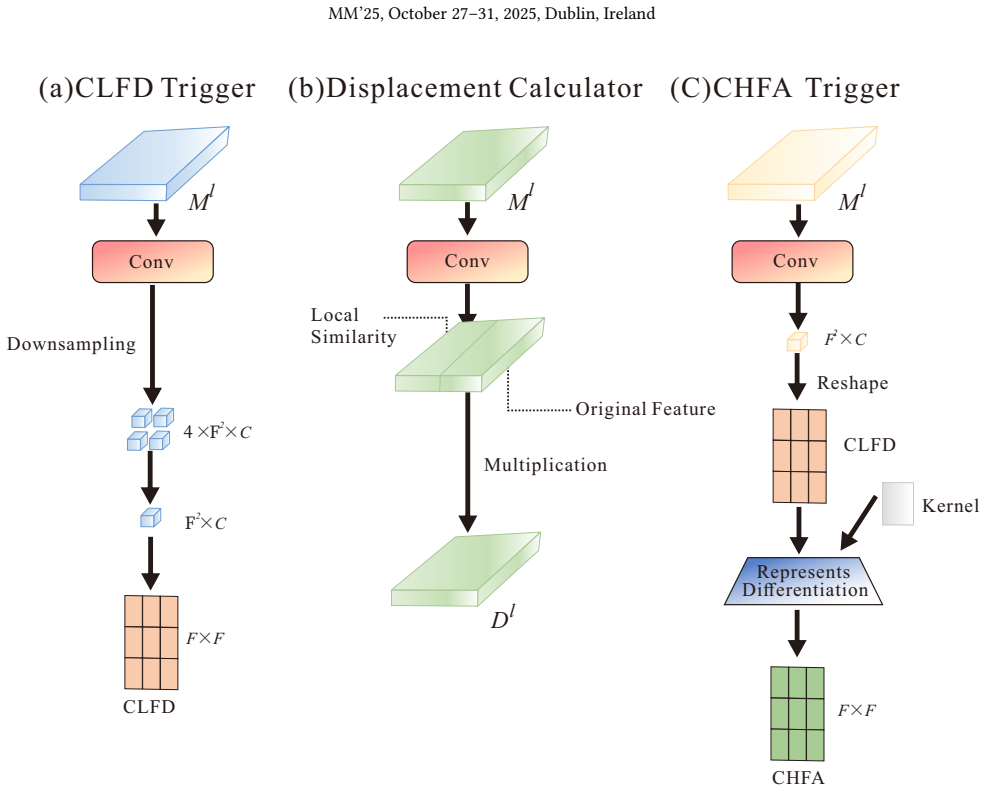
The load-bearing machinery is the neck. FAFCE is a three-stage frequency-consistency block: it first fuses upsampled high-level features with low-level features, then resamples the result according to a learned displacement field so that high-level features shift toward areas of high intra-category similarity, and finally refines the fusion with learnable weights; inside it, the CLFD trigger damps low frequencies with spatially varying softmax-weighted kernels and the CHFA trigger amplifies high frequencies by subtracting a low-frequency kernel from an identity kernel. PHFFNet is the progressive fusion pathway that fuses features level by level so non-adjacent levels interact only through intermediate fused features, with CASF assigning per-pixel weights that sum to 1. The four-head output and the lightweight backbone support the parameter-efficiency claim, but the accuracy claim is carried by the two neck modules.
What would settle it
Train all four models from scratch on the same KITTI split with the paper's stated hyper-parameters, including 640 by 640 input, 300 epochs, SGD, weight decay 5e-4, and batch size 8, then evaluate with one shared mAP@50 script. If Butter's 94.4 does not reproduce, or if the same-protocol margin over YOLOv12-S falls well below the reported 4.1 points, or if YOLOv12-S retrained under the identical protocol exceeds Butter, the central claim of superior accuracy at lower complexity is falsified.
Extended reading notes
Core claim
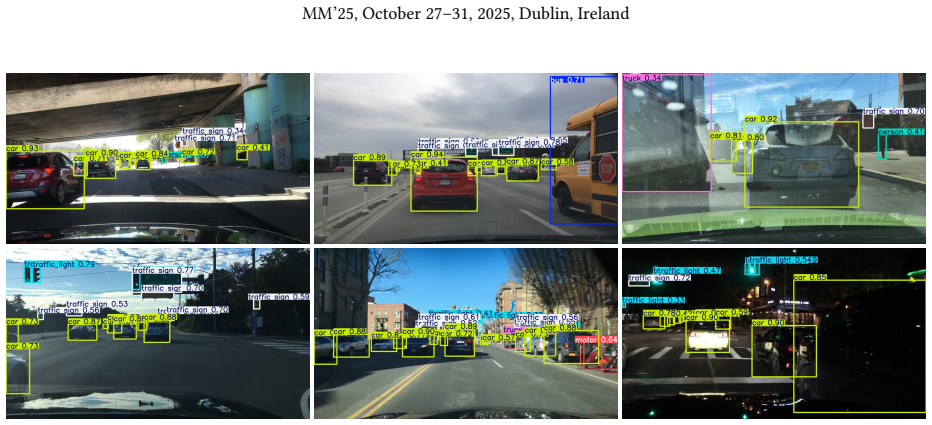
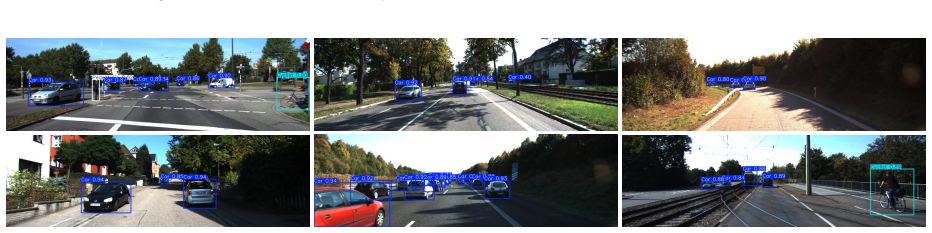
On the paper's own terms, the discovery is that a carefully rebuilt neck can make a one-stage detector both more accurate and lighter. Butter pairs two modules: FAFCE applies a contextual high-frequency amplifier to restore object boundaries, a contextual low-frequency damper to suppress noise and smooth high-level features, and a displacement calculator that resamples features toward regions of higher intra-category similarity; PHFFNet merges features level by level, first C2 with C3, then the result with C4, then with C5, using Context-Aware Spatial Fusion weights that sum to one at each spatial location. Around these, the model uses a lightweight HGNetV2 backbone with DWConv, GhostConv, RepConv, and LightConv, SPPF and CBAM after the last stage, and four detection heads. The reported outcome is mAP@50 of 94.4 on KITTI, 53.7 on BDD100K, and 53.2 on Cityscapes with 5.4M parameters, exceeding Hyper-YOLO-S, YOLOv11-S, and YOLOv12-S on all three datasets and cutting parameters by roughly 64 percent relative to Hyper-YOLO-S. The supplementary material adds that on MS COCO the same model scores 60.9 mAP@50, below YOLOv12-S and Hyper-YOLO-S, which the authors attribute to driving-scene specialization.
Load-bearing premise
The central claim assumes that the baseline numbers for Hyper-YOLO, YOLOv11, and YOLOv12 were produced under exactly the same training and evaluation protocol as Butter, including the same KITTI train and validation split, the same 640 by 640 input size, the same 300-epoch SGD schedule, and the same mAP@50 computation, but the paper states this without documenting the split or evaluator, so the reported margins could partly be protocol artifacts.
Editorial extensions
If this is right
- If the results replicate under matched training and evaluation, a 5.4M-parameter detector can outperform 9 to 15M-parameter YOLO variants on KITTI, BDD100K, and Cityscapes, easing real-time deployment on vehicle hardware.
- FAFCE-style frequency damping and amplification could be reused as a drop-in replacement for naive upsampling-and-add fusion in other feature-pyramid detectors, since it targets boundary precision and cross-level consistency.
- PHFFNet's progressive merging offers a template for shrinking the semantic gap between non-adjacent pyramid levels without adding heavy graph or attention modules.
- The four-head configuration suggests that head count, not just backbone and neck, is a meaningful accuracy-complexity knob for driving-scene detectors.
- The COCO result indicates that the claimed advantage does not transfer to generic object detection, so the benefit appears tied to driving-scene data.
Reading between the lines
- The reported margins over the baselines range from 0.5 to 4.1 mAP points depending on dataset and rival; those are small enough that evaluation-protocol differences, especially the undocumented KITTI split and mAP@50 script, could account for them, so an independent reproduction is the first test.
- FAFCE's mechanism predicts that its benefit concentrates on small objects and boundary-heavy classes; the supplementary small-object AP gain on KITTI is consistent with that prediction and could be tested on BDD100K's pedestrian and cyclist classes.
- Because Butter processes per-frame monocular RGB input, a natural extension is to feed the displacement field across consecutive frames to enforce temporal consistency of boundaries, which the authors list as future work.
- The COCO shortfall suggests the frequency-consistency modules may exploit dataset-specific scale or background statistics; an experiment varying input resolution on Cityscapes would show whether the gain is scale-driven.
Editorial analysis
A structured set of objections, weighed in public.
Referee Report
Summary. The paper proposes Butter, a real-time object detector for autonomous driving with two main architectural innovations: a Frequency-Adaptive Feature Consistency Enhancement (FAFCE) component that applies frequency-domain damping/amplification and feature resampling, and a Progressive Hierarchical Feature Fusion Network (PHFFNet) with Context-Aware Spatial Fusion (CASF) that progressively merges multi-scale features. The backbone is a lightweight HGNetV2 variant with DWConv, SPPF, and CBAM, and the head uses four detection heads. The authors report mAP@50 of 94.4 on KITTI, 53.7 on BDD100K, and 53.2 on Cityscapes with 5.4M parameters, claiming to outperform several recent YOLO and Hyper-YOLO variants. The supplementary material contains additional ablations, COCO results, and implementation details.
Significance. If the reported results are reproducible, Butter would be a reasonably competitive lightweight detector for autonomous driving, and the FAFCE/PHFFNet design ideas (frequency-consistent fusion and progressive hierarchical aggregation) are worth investigating further. The authors provide public code and model links, which is a strength. However, the empirical claims are currently not verifiable because the training objective is described inconsistently and the KITTI evaluation protocol is undocumented. The reported improvements over the strongest baselines are small (0.6-1.8 mAP points), so protocol artifacts could change the conclusions. The paper is therefore better seen as an architecture proposal with promising but unverified experimental evidence.
major comments (3)
- [Sec. 3.5 and Appendix A.7, Eqs. (25)-(27)] The training objective is described inconsistently. Section 3.5 defines L_total = λ1·L_IoU + λ2·L_cls + λ3·L_dfl and states that L_IoU 'quantifies the overlap between predicted and ground-truth bounding boxes', that L_cls uses focal loss or cross-entropy, and that L_dfl addresses class imbalance. However, Appendix A.7 Eq. (25) gives a sum-of-squared coordinate error (a YOLOv1-style loss), Eq. (26) is a squared-error classification loss, and Eq. (27) is a focal loss labeled as L_dfl. These equations do not match the main-text description, and none is the standard IoU or distribution focal loss used in modern YOLO detectors. Because the exact optimization objective is therefore not specified unambiguously, the reported results cannot be independently reproduced. Please replace the appendix equations with the exact loss functions used in the experiments, including the definition of the DFL term, and align the text with those equations.
- [Sec. 4.1, Tables 1-3] The KITTI evaluation protocol is not documented. KITTI has no official detection train/val split, yet the paper does not specify the split used for Table 1, the set of object classes evaluated, or the script used to compute mAP@50. The statement that baselines were 'trained with the official code under the same settings' does not provide this information. Since the reported advantages over the strongest baselines are only 0.6-1.8 mAP points, these margins could be artifacts of split choice or evaluation details rather than genuine gains. The paper must state the exact split (e.g., number of training and validation images), the class list, the metric definition (e.g., COCO-style or PASCAL-style AP with per-class averaging), and should provide the evaluation script or a precise pointer to it.
- [Sec. 4.3, Table 4] Table 4 shows that adding FAFCE decreases the parameter count from 6.9M (row 4) to 5.4M while increasing mAP@50 from 93.2 to 94.4. The main text explains this only as 'after adding FAFCE, the parameter count was reduced by 1.5M' with no explanation of why adding a module reduces total parameters. Supplementary A.6 clarifies that FAFCE replaces 'heavier fusion blocks', but this is not mentioned in the main text. Without that explanation, the ablation is confusing and the abstract's claim that FAFCE leads to 'reducing model complexity' is not self-evident. Please state explicitly what components FAFCE replaces and why the net parameter count decreases.
minor comments (8)
- [Figure 1] In Figure 1, the caption and the text reference 'Hyper-YOLO [13]', but reference [13] in the bibliography is the KITTI dataset; the Hyper-YOLO citation should be [10].
- [Sec. 3.2 (Head Branch)] The Head Branch paragraph mentions handling 'lane line recognition' and 'multiple tasks in complex scenarios', but Butter is an object detection model and the experiments do not include lane detection; please remove or clarify this statement.
- [Sec. 4.1] The paper writes 'GFlops (Giga Floating Point Operations per second)'; GFLOPs are floating point operations, not operations per second. Please correct this terminology.
- [Sec. 3.3, Eq. (5)] Equation (5) and the surrounding text define eB^{l+1} as the feature map 'from the amplifier', but Eq. (3) defines eB^{l+1} as the output of the low-frequency damping before upsampling. This notation is confusing; please rename the variables or correct the description.
- [Sec. 3.5] The hyperparameters λ1, λ2, λ3 are not given in the main text; they appear only in Appendix Table 5. Please include them in Section 3.5 or provide a direct reference to the table.
- [Supplementary A.6(c)] The sentence 'In response to reviewer WVLL's suggestion' reveals identifying information about a reviewer and is inappropriate for a public manuscript; please remove it.
- [References] Reference [9] cites Falk et al. for U-Net, but the original U-Net paper is Ronneberger et al. (2015); if U-Net is intended, please cite the original source.
- [Sec. 4.1 and Figure 4] The metric is called 'mAP@50' in Section 4.1 but 'mAP50' and 'mAP50-95' in Figure 4 and elsewhere; please use consistent notation throughout.
Circularity Check
No circularity: the paper's claims are empirical benchmark measurements, and its equations define the proposed architecture rather than reducing to fitted inputs or self-cited results.
full rationale
Butter is an empirical architecture paper: the central claims are mAP@50 measurements on KITTI, BDD100K, and Cityscapes, compared against external baseline models. No fitted parameter is later renamed as a prediction; the loss weights (Table 5) and module designs are hyperparameters and architectural choices, not quantities derived from the target results. The equations in Sections 3.3 and 3.4 (FAFCE and PHFFNet) define the proposed components in terms of learnable weights and spatial fusion, and the reported gains are benchmark outcomes rather than consequences of those definitions. The self-citations appearing in the paper (e.g., [8], [25], [28], [30], [38], [54], [58], [81], [84-86]) are used for related-work context or loose motivation and are not load-bearing for the main empirical claim; there is no imported uniqueness theorem, no ansatz smuggled in via prior authors' work, and no known result merely renamed. The undocumented KITTI split and the inconsistent loss description between Section 3.5 and Appendix A.7 are reproducibility and correctness concerns, not circular reductions. The derivation chain is therefore self-contained with respect to circularity.
Assumptions & free parameters
free parameters (1)
- loss weighting coefficients lambda_1, lambda_2, lambda_3 =
7.5, 0.5, 1.5
assumptions (3)
- standard math Nyquist-Shannon sampling theorem governs loss of high-frequency information in feature downsampling
- domain assumption mAP@50 on KITTI, BDD100K, and Cityscapes is the appropriate measure of real-time autonomous driving detection performance
- domain assumption The baseline methods (Hyper-YOLO, YOLOv11, YOLOv12) were trained under settings identical to Butter
invented entities (2)
-
FAFCE (Frequency-Adaptive Feature Consistency Enhancement)
-
PHFFNet with CASF (Progressive Hierarchical Feature Fusion Network with Context-Aware Spatial Fusion)
Cite this review
Pith. "Pith review of Butter: Frequency Consistency and Hierarchical Fusion for Autonomous Driving Object Detection." pith.science (2026). https://pith.science/paper/DAPZQIIH
@misc{pith2026250713373,
  author       = {Pith},
  title        = {Pith review of: Butter: Frequency Consistency and Hierarchical Fusion for Autonomous Driving Object Detection},
  year         = {2026},
  howpublished = {\url{https://pith.science/paper/DAPZQIIH}},
  note         = {Machine review of arXiv:2507.13373}
}
read the original abstract
Hierarchical feature representations play a pivotal role in computer vision, particularly in object detection for autonomous driving. Multi-level semantic understanding is crucial for accurately identifying pedestrians, vehicles, and traffic signs in dynamic environments. However, existing architectures, such as YOLO and DETR, struggle to maintain feature consistency across different scales while balancing detection precision and computational efficiency. To address these challenges, we propose Butter, a novel object detection framework designed to enhance hierarchical feature representations for improving detection robustness. Specifically, Butter introduces two key innovations: Frequency-Adaptive Feature Consistency Enhancement (FAFCE) Component, which refines multi-scale feature consistency by leveraging adaptive frequency filtering to enhance structural and boundary precision, and Progressive Hierarchical Feature Fusion Network (PHFFNet) Module, which progressively integrates multi-level features to mitigate semantic gaps and strengthen hierarchical feature learning. Through extensive experiments on BDD100K, KITTI, and Cityscapes, Butter demonstrates superior feature representation capabilities, leading to notable improvements in detection accuracy while reducing model complexity. By focusing on hierarchical feature refinement and integration, Butter provides an advanced approach to object detection that achieves a balance between accuracy, deployability, and computational efficiency in real-time autonomous driving scenarios. Our model and implementation are publicly available at https://github.com/Aveiro-Lin/Butter, facilitating further research and validation within the autonomous driving community.
Figures


Figures from the paper (9 more)





Reference graph
Works this paper leans on
-
[1]
Bachute and Javed M
Mrinal R. Bachute and Javed M. Subhedar. 2021. Autonomous driving archi- tectures: insights of machine learning and deep learning algorithms. Machine Learning with Applications 6 (2021), 100164
2021
-
[2]
Aduen Benjumea, Izzeddin Teeti, Fabio Cuzzolin, and Andrew Bradley. 2021. YOLO-Z: Improving small object detection in YOLOv5 for autonomous vehicles. https://arxiv.org/abs/2112.11798. arXiv preprint arXiv:2112.11798
arXiv 2021
-
[3]
Linwei Chen, Ying Fu, Kaixuan Wei, Dezhi Zheng, and Felix Heide. 2023. Instance segmentation in the dark. International Journal of Computer Vision 131, 8 (2023), 2198–2218
2023
-
[4]
Long Chen, Shaobo Lin, Xiankai Lu, Dongpu Cao, Hangbin Wu, Chi Guo, and Fangyuan Wang. 2021. Deep neural network based vehicle and pedestrian detec- tion for autonomous driving: A survey. IEEE Transactions on Intelligent Trans- portation Systems 22, 6 (2021), 3234–3246
2021
-
[5]
Liang-Chieh Chen, Yukun Zhu, George Papandreou, Florian Schroff, and Hartwig Adam. 2018. Encoder-Decoder with Atrous Separable Convolution for Semantic Image Segmentation. In Proceedings of European Conference on Computer Vision . 801–818
2018
-
[6]
Marius Cordts, Mohamed Omran, Sebastian Ramos, Timo Rehfeld, Markus En- zweiler, Rodrigo Benenson, Uwe Franke, Stefan Roth, and Bernt Schiele. 2016. The cityscapes dataset for semantic urban scene understanding. In Proceedings of the IEEE conference on computer vision and pattern recognition . 3213–3223
2016
-
[7]
Yutong Dai, Hao Lu, and Chunhua Shen. 2021. Learning Affinity-Aware Upsam- pling for Deep Image Matting. In Proceedings of IEEE Conference on Computer Vision and Pattern Recognition . 6841–6850
2021
-
[8]
Kairui Ding, Boyuan Chen, Yuchen Su, Huan ang Gao, Bu Jin, Chonghao Sima, Wuqiang Zhang, Xiaohui Li, Paul Barsch, Hongyang Li, and Hao Zhao. 2024. Hint- AD: Holistically Aligned Interpretability in End-to-End Autonomous Driving. arXiv preprint arXiv:2409.06702 (2024)
arXiv 2024
Show all 94 references
-
[9]
Thorsten Falk, Dominic Mai, Robert Bensch, Özgün Çiçek, Ahmed Abdulka- dir, Yassine Marrakchi, Anton Böhm, Jan Deubner, Zoe Jäckel, Katharina Sei- wald, Alexander Dovzhenko, Olaf Tietz, Cristina Dal Bosco, Sean Walsh, Deniz Saltukoglu, Tuan Leng Tay, Marco Prinz, Klaus Palme, ...
2019
-
[10]
Yifan Feng, Jiangang Huang, Shaoyi Du, Shihui Ying, Jun-Hai Yong, Yipeng Li, Guiguang Ding, Rongrong Ji, and Yue Gao. 2024. Hyper-YOLO: When Visual Object Detection Meets Hypergraph Computation. IEEE Transactions on Pattern Analysis and Machine Intelligence (2024). Early Access
2024
-
[11]
Daiheng Gao, Shilin Lu, Shaw Walters, Wenbo Zhou, Jiaming Chu, Jie Zhang, Bang Zhang, Mengxi Jia, Jian Zhao, Zhaoxin Fan, et al . 2024. EraseAnything: Enabling Concept Erasure in Rectified Flow Transformers. arXiv preprint arXiv:2412.20413 (2024)
2024 arXiv
-
[12]
Le-yuan Gao, Zhong Qu, Shi-yan Wang, and Shu-fang Xia. 2024. A Lightweight Neural Network Model of Feature Pyramid and Attention Mechanism for Traffic Object Detection. IEEE Transactions on Intelligent Vehicles 9, 2 (2024), 3422–3435. doi:10.1109/TIV.2023.3345271
2024
-
[13]
Andreas Geiger, Philip Lenz, and Raquel Urtasun. 2012. Are we ready for au- tonomous driving? the kitti vision benchmark suite. In 2012 IEEE conference on computer vision and pattern recognition . IEEE, 3354–3361
2012
-
[14]
Golnaz Ghiasi, Tsung-Yi Lin, and Quoc V. Le. 2019. NAS-FPN: Learning Scalable Feature Pyramid Architecture for Object Detection. InProceedings of the IEEE/CVF Conference on Computer Vision and Pattern Recognition . 7036–7045
2019
-
[15]
Ross Girshick, Jeff Donahue, Trevor Darrell, and Jitendra Malik. 2016. Region- based convolutional networks for accurate object detection and segmentation. IEEE Transactions on Pattern Analysis and Machine Intelligence 38, 1 (January 2016), 142–158
2016
-
[16]
Jocher Glenn. 2023. Yolov8. https://github.com/ultralytics/ultralytics/tree/main. Accessed: 2025-03-02
2023
-
[17]
Julia Grabinski, Steffen Jung, Janis Keuper, and Margret Keuper. 2022. Frequen- cyLowCut Pooling - Plug & Play against Catastrophic Overfitting. In Proceedings of European Conference on Computer Vision . 36–57
2022
-
[18]
Xuyao Guo, Feng Jiang, Quanzhen Chen, Yuxuan Wang, Kaiyue Sha, and Jing Chen. 2025. Deep learning-enhanced environment perception for autonomous driving: MDNet with CSP-DarkNet53. Pattern Recognition 160 (2025), 111174. doi:10.1016/j.patcog.2024.111174
2025
-
[19]
Abhishek Gupta, Alagan Anpalagan, Ling Guan, and Ahmed Sharyar Khwaja
-
[20]
Howard, Menglong Zhu, Bo Chen, Dmitry Kalenichenko, Weijun Wang, Tobias Weyand, Marco Andreetto, and Hartwig Adam
Andrew G. Howard, Menglong Zhu, Bo Chen, Dmitry Kalenichenko, Weijun Wang, Tobias Weyand, Marco Andreetto, and Hartwig Adam. 2017. MobileNets: Efficient Convolutional Neural Networks for Mobile Vision Applications. arXiv preprint arXiv:1704.04861 (2017). https://arxiv.org/abs/...
2017 arXiv
-
[21]
Jinze Huang, Xiaohan Yu, Dong An, Xin Ning, Jincun Liu, and Prayag Tiwari
-
[22]
Shihua Huang, Zhichao Lu, Ran Cheng, and Cheng He. 2021. FaPN: Feature- Aligned Pyramid Network for Dense Image Prediction. In Proceedings of IEEE International Conference on Computer Vision . 864–873
2021
-
[23]
Huang, and Humphrey Shi
Zilong Huang, Yunchao Wei, Xinggang Wang, Wenyu Liu, Thomas S. Huang, and Humphrey Shi. 2021. AlignSeg: Feature-Aligned Segmentation Networks. IEEE Transactions Pattern Analysis and Machine Intelligence 44, 1 (2021), 550–557
2021
-
[24]
Zhipeng Huang, Zhizheng Zhang, Cuiling Lan, Zheng-Jun Zha, Yan Lu, and Baining Guo. 2023. Adaptive Frequency Filters As Efficient Global Token Mixers. In Proceedings of IEEE International Conference on Computer Vision . 1–11
2023
-
[25]
Bu Jin, Yupeng Zheng, Pengfei Li, Weize Li, Yuhang Zheng, Sujie Hu, Xinyu Liu, Jinwei Zhu, Zhijie Yan, Haiyang Sun, Kun Zhan, Peng Jia, Xiaoxiao Long, Yilun Chen, and Hao Zhao. 2024. TOD 3Cap: Towards 3D Dense Captioning in Outdoor Scenes. In European Conference on Computer Vi...
2024
-
[26]
Rahima Khanam and Muhammad Hussain. 2024. Yolov11: An overview of the key architectural enhancements. arXiv preprint arXiv:2410.17725 (2024)
2024 arXiv
-
[27]
Leyang Li, Shilin Lu, Yan Ren, and Adams Wai-Kin Kong. 2025. Set you straight: Auto-steering denoising trajectories to sidestep unwanted concepts. arXiv preprint arXiv:2504.12782 (2025)
2025 arXiv
-
[28]
Pengfei Li, Beiwen Tian, Yongliang Shi, Xiaoxue Chen, Hao Zhao, Guyue Zhou, and Ya-Qin Zhang. 2022. TOIST: Task Oriented Instance Segmentation Trans- former with Noun-Pronoun Distillation. In Advances in Neural Information Pro- cessing Systems (NeurIPS), Vol. 35. 17597–17611
2022
-
[29]
Xiangtai Li, Jiangning Zhang, Yibo Yang, Guangliang Cheng, Kuiyuan Yang, Yunhai Tong, and Dacheng Tao. 2023. Sfnet: Faster and Accurate Semantic Segmentation via Semantic Flow. International Journal of Computer Vision (2023), 1–24
2023
-
[30]
Yang Li, Xiaoxue Chen, Hao Zhao, Jiangtao Gong, Guyue Zhou, Federico Rossano, and Yixin Zhu. 2023. Understanding Embodied Reference with Touch-Line Transformer. InInternational Conference on Learning Representations (ICLR). https: //yang-li-2000.github.io/Touch-Line-Transforme...
2023
-
[31]
Zongyi Li, Nikola Kovachki, Kamyar Azizzadenesheli, Burigede Liu, Kaushik Bhattacharya, Andrew Stuart, and Anima Anandkumar. 2021. Fourier neural op- erator for parametric partial differential equations. In Proceedings of International Conference on Learning Representations . 1–12
2021
-
[32]
Tsung-Yi Lin, Piotr Dollár, Ross Girshick, Kaiming He, Bharath Hariharan, and Serge Belongie. 2017. Feature Pyramid Networks for Object Detection. In Pro- ceedings of IEEE Conference on Computer Vision and Pattern Recognition . 936–944
2017
-
[33]
Tsung-Yi Lin, Michael Maire, Serge Belongie, James Hays, Pietro Perona, Deva Ramanan, Piotr Dollár, and C Lawrence Zitnick. 2014. Microsoft coco: Common objects in context. In Computer Vision–ECCV 2014: 13th European Conference, Zurich, Switzerland, September 6-12, 2014, Proce...
2014
-
[34]
Xiaojian Lin and Michael Losavio. 2025. A Comprehensive Survey on Bias and Fairness in Generative AI: Legal, Ethical, and Technical Responses. https://ssrn. com/abstract=5164147 Available at SSRN: https://ssrn.com/abstract=5164147
2025
-
[35]
Songtao Liu, Di Huang, and Yunhong Wang. 2019. Learning Spatial Fusion for Single-Shot Object Detection. arXiv preprint arXiv:1911.09516 (2019)
2019 arXiv
-
[36]
Shu Liu, Lu Qi, Haifang Qin, Jianping Shi, and Jiaya Jia. 2018. Path Aggregation Network for Instance Segmentation. In Proceedings of the IEEE Conference on Computer Vision and Pattern Recognition . 8759–8768
2018
-
[37]
Wei Liu, Dragomir Anguelov, Dumitru Erhan, Christian Szegedy, Scott Reed, Cheng-Yang Fu, and Alexander C. Berg. 2016. SSD: Single shot multibox detec- tor. In In Computer Vision–ECCV 2016: 14th European Conference, Amsterdam, The Netherlands, October 11–14, 2016, Proceedings, ...
2016
-
[38]
Xinyu Liu, Beiwen Tian, Zhen Wang, Rui Wang, Kehua Sheng, Bo Zhang, Hao Zhao, and Guyue Zhou. 2023. Delving into Shape-aware Zero-shot Semantic Segmentation. In Proceedings of the IEEE/CVF Conference on Computer Vision and Pattern Recognition (CVPR). IEEE, 2999–3009
2023
-
[39]
Yuxuan Liu, Yuan Yixuan, and Ming Liu. 2021. Ground-aware monocular 3D object detection for autonomous driving. IEEE Robotics and Automation Letters 6, 2 (2021), 919–926
2021
-
[40]
Shilin Lu, Yanzhu Liu, and Adams Wai-Kin Kong. 2023. Tf-icon: Diffusion-based training-free cross-domain image composition. In Proceedings of the IEEE/CVF International Conference on Computer Vision . 2294–2305
2023
-
[41]
Shilin Lu, Zilan Wang, Leyang Li, Yanzhu Liu, and Adams Wai-Kin Kong. 2024. Mace: Mass concept erasure in diffusion models. In Proceedings of the IEEE/CVF Conference on Computer Vision and Pattern Recognition . 6430–6440
2024
-
[42]
Shilin Lu, Zihan Zhou, Jiayou Lu, Yuanzhi Zhu, and Adams Wai-Kin Kong. 2024. Robust watermarking using generative priors against image editing: From bench- marking to advances. arXiv preprint arXiv:2410.18775 (2024)
2024 arXiv
-
[43]
Cheng Luo, Qinliang Lin, Weicheng Xie, Bizhu Wu, Jinheng Xie, and Linlin Shen
-
[44]
Jialiang Ma and Bin Chen. 2020. Dual Refinement Feature Pyramid Networks for Object Detection. arXiv preprint arXiv:2012.01733 (2020)
2020 arXiv
-
[45]
Wenping Ma, Mingyu Yue, Yue Wu, Yongzhe Yuan, Hao Zhu, and Biao Hou
-
[46]
Salma Abdel Magid, Yulun Zhang, Donglai Wei, Won-Dong Jang, Zudi Lin, Yun Fu, and Hanspeter Pfister. 2021. Dynamic high-pass filtering and multi-spectral at- tention for image super-resolution. InProceedings of IEEE International Conference on Computer Vision. 4288–4297
2021
-
[47]
Bharat Mahaur and K. K. Mishra. 2023. Small-object detection based on YOLOv5 in autonomous driving systems. Pattern Recognition Letters 168 (2023), 115–122
2023
-
[48]
Yanwei Pang, Yazhao Li, Jianbing Shen, and Ling Shao. 2019. Towards bridging semantic gap to improve semantic segmentation. In Proceedings of IEEE Interna- tional Conference on Computer Vision . 4230–4239
2019
-
[49]
Ioannis Pitas. 2000. Digital image processing algorithms and applications . John Wiley & Sons
2000
-
[50]
Zequn Qin, Pengyi Zhang, Fei Wu, and Xi Li. 2021. FcaNet: Frequency channel attention networks. In Proceedings of IEEE International Conference on Computer Vision. 783–792
2021
-
[51]
Hamprecht, Yoshua Bengio, and Aaron Courville
Nasim Rahaman, Aristide Baratin, Devansh Arpit, Felix Draxler, Min Lin, Fred A. Hamprecht, Yoshua Bengio, and Aaron Courville. 2019. On the spectral bias of neural networks. In Proceedings of International Conference on Machine Learning . 5301–5310
2019
-
[52]
Yongming Rao, Wenliang Zhao, Zheng Zhu, Jiwen Lu, and Jie Zhou. 2021. Global filter networks for image classification. In Proceedings of Advances in Neural Information Processing Systems, Vol. 34. 980–993
2021
-
[53]
Shaoqing Ren, Kaiming He, Ross Girshick, and Jian Sun. 2017. Faster R-CNN: Towards real-time object detection with region proposal networks. IEEE Transac- tions on Pattern Analysis and Machine Intelligence 39, 6 (June 2017), 1137–1149
2017
-
[54]
Yaomin Shen, XiaoJian Lin, and Wei Fan. 2025. A-MESS: Anchor-based Multi- modal Embedding with Semantic Synchronization for Multimodal Intent Recog- nition. In IEEE International Conference on Multimedia and Expo . IEEE, Nantes, France. https://arxiv.org/pdf/2503.19474 To appear
2025 arXiv
-
[55]
Aitken, Rob Bishop, Daniel Rueckert, and Zehan Wang
Wenzhe Shi, Jose Caballero, Ferenc Huszár, Johannes Totz, Andrew P. Aitken, Rob Bishop, Daniel Rueckert, and Zehan Wang. 2016. Real-Time Single Image and Video Super-Resolution Using an Efficient Sub-Pixel Convolutional Neural Network. In Proceedings of IEEE Conference on Comp...
2016
-
[56]
Sakthitharan Subramanian, Rajesh S., P. I. Britto, and S. Sankaran. 2023. MDHO: mayfly deer hunting optimization algorithm for optimal obstacle avoidance based path planning using mobile robots. Cybernetics and Systems (2023), 1–20
2023
-
[57]
Xiangyan Tang, Wenhang Xu, Keqiu Li, Mengxue Han, Zhizhong Ma, and Ruili Wang. 2024. PIAENet: Pyramid integration and attention enhanced network for object detection. Information Sciences 670 (2024), 120576. doi:10.1016/j.ins.2024. 120576
2024 doi
-
[58]
Beiwen Tian, Mingdao Liu, Huan ang Gao, Pengfei Li, Hao Zhao, and Guyue Zhou. 2023. Unsupervised Road Anomaly Detection with Language Anchors. In 2023 IEEE International Conference on Robotics and Automation (ICRA) . IEEE, 7778–7785
2023
-
[59]
Di Tian, Yi Han, and Shu Wang. 2024. Object feedback and feature information retention for small object detection in intelligent transportation scenes. Expert Systems with Applications 238 (2024), 121811. doi:10.1016/j.eswa.2023.121811
2024
-
[60]
Yunjie Tian, Qixiang Ye, and David Doermann. 2025. Yolov12: Attention-centric real-time object detectors. arXiv preprint arXiv:2502.12524 (2025)
2025 arXiv
-
[61]
Hatem Tilijani, Ameni Jouila, and Khaled Nouri. 2023. Optimized sliding mode control based on cuckoo search algorithm: Application for 2df robot manipulator. Cybernetics and Systems (2023), 1–17
2023
-
[62]
Ao Wang, Hui Chen, Lihao Liu, Zija Lin, Jungong Han, and Guiguang Ding. 2024. Yolov10: Real-time end-to-end object detection. Advances in Neural Information Processing Systems 37 (2024), 107984–108011
2024
-
[63]
Chengcheng Wang, Wenwei He, Yifan Nie, Jianyuan Guo, Chang Liu, Yufei Wang, and Kai Han. 2023. Gold-YOLO: Efficient Object Detector via Gather-and- Distribute Mechanism. In Advances in Neural Information Processing Systems , Vol. 36. 51094–51112
2023
-
[64]
Chien-Yao Wang, I-Hau Yeh, and Hong-Yuan Mark Liao. 2024. Yolov9: Learning what you want to learn using programmable gradient information. In European Conference on Computer Vision (ECCV) . Springer Nature Switzerland, Cham, 1–21
2024
-
[65]
Haohan Wang, Xindi Wu, Zeyi Huang, and Eric P. Xing. 2020. High-frequency component helps explain the generalization of convolutional neural networks. In Proceedings of IEEE Conference on Computer Vision and Pattern Recognition . 8684–8694
2020
-
[66]
Jiaqian Wang, Kai Chen, Rui Xu, Ziwei Liu, Chen Change Loy, and Dahua Lin
-
[67]
Jian Wang, Fan Li, and Lijun He. 2025. A Unified Framework for Adversarial Patch Attacks against Visual 3D Object Detection in Autonomous Driving. IEEE Transactions on Circuits and Systems for Video Technology (2025)
2025
-
[68]
Jian Wang, Fan Li, Song Lv, Lijun He, and Chao Shen. 2025. Physically realizable adversarial creating attack against vision-based BEV space 3D object detection. IEEE Transactions on Image Processing (2025)
2025
-
[69]
Sheng-ye Wang, Zhong Qu, Cui-jin Li, and Le-yuan Gao. 2023. BANet: Small and multi-object detection with a bidirectional attention network for traffic scenes. Engineering Applications of Artificial Intelligence 117 (2023), 105504
2023
-
[70]
Yongfu Wang, Yang Liu, Ran Yi, and Yanchen Jiang. 2025. Real-time traffic object detection algorithm with deep stochastic configuration networks. Information Sciences 700 (2025), 121848. doi:10.1016/j.ins.2024.121848
2025
-
[71]
IEEE Trans- actions on Pattern Analysis and Machine Intelligence 44, 9 (2021), 4674–4687
CARAFE++: Unified Content-Aware ReAssembly of Features. IEEE Trans- actions on Pattern Analysis and Machine Intelligence 44, 9 (2021), 4674–4687
2021
-
[72]
Dong Wu, Man-Wen Liao, Wei-Tian Zhang, Xing-Gang Wang, Xiang Bai, Wen- Qing Cheng, and Wen-Yu Liu. 2022. Yolop: You only look once for panoptic driving perception. Machine Intelligence Research 19, 6 (2022), 550–562
2022
-
[73]
Yue Wu, Yue Zhang, Wenping Ma, Maoguo Gong, Xiaolong Fan, and Mingyang Zhang. 2023. RORNet: Partial-to-Partial Registration Network with Reliable Overlapping Representations. IEEE Transactions on Neural Networks and Learning Systems (2023). doi:10.1109/TNNLS.2023.3286943
2023
-
[74]
Zhiqin John Xu and Hanxu Zhou. 2021. Deep frequency principle towards un- derstanding why deeper learning is faster. In Proceedings of the AAAI Conference on Artificial Intelligence, Vol. 35. 10541–10550
2021
-
[75]
Cubuk, and Justin Gilmer
Dong Yin, Raphael Gontijo Lopes, Jonathon Shlens, Ekin D. Cubuk, and Justin Gilmer. 2019. A Fourier perspective on model robustness in computer vision. In Proceedings of Advances in Neural Information Processing Systems , Vol. 32
2019
-
[76]
Sanghyun Woo, Jongchan Park, Joon-Young Lee, and In So Kweon. 2018. CBAM: Convolutional Block Attention Module. In European Conference on Computer Vision (ECCV). 3–19. doi:10.1007/978-3-030-01234-2_1
2018 doi
-
[77]
Fisher Yu, Dequan Wang, Evan Shelhamer, and Trevor Darrell. 2018. Deep layer aggregation. In Proceedings of IEEE Conference on Computer Vision and Pattern Recognition. 2403–2412
2018
-
[78]
Georgios Zamanakos, Lazaros Tsochatzidis, Angelos Amanatiadis, and Ioannis Pratikakis. 2021. A comprehensive survey of LIDAR-based 3D object detection methods with deep learning for autonomous driving. Computers & Graphics 99 (2021), 153–181
2021
-
[79]
Zeiler and Rob Fergus
Matthew D. Zeiler and Rob Fergus. 2014. Visualizing and Understanding Con- volutional Networks. In Proceedings of European Conference on Computer Vision . 818–833
2014
-
[80]
Dong Zhang, Hanwang Zhang, Jinhui Tang, Meng Wang, Xiansheng Hua, and Qianru Sun. 2020. Feature Pyramid Transformer. In Computer Vision–ECCV 2020: 16th European Conference, Glasgow, UK, August 23–28, 2020, Proceedings, Part XXVIII 16. Springer, 323–339
2020
-
[81]
Fangzhou Yu, Hao Chen, Xiaozhi Wang, Wenjia Xian, Yue Chen, Fang Liu, and Trevor Darrell. 2020. BDD100K: A diverse driving dataset for heterogeneous multitask learning. In Proceedings of the IEEE/CVF Conference on Computer Vision and Pattern Recognition. 2636–2645
2020
-
[82]
Liu Zhang, Jincun Liu, Yaoguang Wei, Dong An, and Xin Ning. 2025. Self- supervised learning-based multi-source spectral fusion for fruit quality evalu- ation: A case study in mango fruit ripeness prediction. Information Fusion 117 (2025), 102814
2025
-
[83]
Richard Zhang. 2019. Making convolutional networks shift-invariant again. In Proceedings of International Conference on Machine Learning . 7324–7334
2019
-
[84]
Wenxin Zhang, Xiaojian Lin, Wenjun Yu, Guangzhen Yao, Jingxing Zhong, Yu Li, Renda Han, Songcheng Xu, Hao Shi, and Cuicui Luo. 2025. DConAD: A Differencing-based Contrastive Representation Learning Framework for Time Series Anomaly Detection. In Proceedings of the Internationa...
2025 arXiv
-
[85]
Wenxin Zhang, Ding Xu, Guangzhen Yao, Xiaojian Lin, Renxiang Guan, Chengze Du, Renda Han, Xi Xuan, and Cuicui Luo. 2025. FreCT: Frequency-augmented Convolutional Transformer for Robust Time Series Anomaly Detection. In Pro- ceedings of the International Conference on Intellige...
2025 arXiv
-
[86]
Hanxue Zhang, Haoran Jiang, Qingsong Yao, Yanan Sun, Renrui Zhang, Hao Zhao, Hongyang Li, Hongzi Zhu, and Zetong Yang. 2025. Detect Anything 3D in the Wild. arXiv preprint arXiv:2504.07958 (2025). https://github.com/OpenDriveLab/ DetAny3D
2025
-
[87]
Gangming Zhao, Weifeng Ge, and Yizhou Yu. 2021. GraphFPN: Graph Feature Pyramid Network for Object Detection. In Proceedings of the IEEE/CVF Interna- tional Conference on Computer Vision . 2763–2772
2021
-
[88]
Yongqiang Zhao, Rui Han, and Yuan Rao. 2019. A New Feature Pyramid Network for Object Detection. In Proceedings of International Conference on Virtual Reality and Intelligent Systems. 428–431. doi:10.1109/ICVRIS.2019.00110
2019
-
[89]
Xueyan Zou, Fanyi Xiao, Zhiding Yu, and Yong Jae Lee. 2023. Delving deeper into anti-aliasing in convnets. International Journal of Computer Vision 131, 1 (2023), 67–81. MM’25, October 27–31, 2025, Dublin, Ireland Butter: Frequency Consistency and Hierarchical Fusion for Auton...
2023
-
[91]
Wenxin Zhang, Jingxing Zhong, Guangzhen Yao, Renda Han, Xiaojian Lin, Lei Jiang, Zeyu Zhang, and Cuicui Luo. 2025. Dual-channel Heterophilic Message Passing for Graph Fraud Detection. In Proceedings of the International Joint Conference on Neural Networks (IJCNN) . https://arx...
2025 arXiv
-
[2021]
Array 10 (2021), 100057
Deep learning for object detection and scene perception in self-driving cars: Survey, challenges, and open issues. Array 10 (2021), 100057
2021
-
[2022]
In Proceedings of IEEE Conference on Computer Vision and Pattern Recognition
Frequency-driven imperceptible adversarial attack on semantic similarity. In Proceedings of IEEE Conference on Computer Vision and Pattern Recognition . 15315–15324. MM’25, October 27–31, 2025, Dublin, Ireland
2025
-
[2023]
IEEE Transactions on Neural Networks and Learning Systems (2023)
Explore the Influence of Shallow Information on Point Cloud Registration. IEEE Transactions on Neural Networks and Learning Systems (2023). doi:10.1109/ TNNLS.2023.3284035
2023
-
[2025]
Expert Systems with Applications 264 (2025), 125653
Uniformity and deformation: A benchmark for multi-fish real-time tracking in the farming. Expert Systems with Applications 264 (2025), 125653
2025
Reviewed August 6, 2026 · model on record in the stance chip above.
Discussion (0). Continue with ORCID to comment.