REVIEW 3 major objections 6 minor 70 references
Variations in Volatile-Driven Activity of Comet C/2017 K2 (PanSTARRS) Revealed by Long-Term Multi-Wavelength Observations
T0 review · 3 major / 6 minor · reviewed 2026-08-06 · deepseek-v4-flash
Pith's one-line read Forbidden oxygen line ratios in C/2017 K2 show its coma switched from supervolatile CO/CO$_2$ to water as the comet crossed roughly 3 au.
desk verdict A careful, data-rich study of C/2017 K2 that deserves review, but the G/R-based CO2-to-water switch is overinterpreted and needs a revision. read the letter →
The pith
A machine-rendered reading of the paper's core claim, the machinery that carries it, and where it could break.
The reading
What carries the argument
The central diagnostic is the green-to-red ratio of the forbidden oxygen lines, $$G/R = I(5577\,\mathrm{\AA})/(I(6300\,\mathrm{\AA})+I(6364\,\mathrm{\AA})),$$ which tracks which parent molecules feed oxygen atoms in the coma. Festou & Feldman (1981) calibrated this ratio against the relative contributions of H$_2$O, CO$_2$, and CO photodissociation, with water near $G/R \approx 0.1$ and higher values for CO and CO$_2$. Around this diagnostic the paper assembles an eight-year TRAPPIST light curve, Haser-model production rates of OH, NH, CN, C$_3$ and C$_2$, the dust proxy $A(0)f\rho$, and simultaneous CRIRES+ infrared spectra of parent volatiles. The drop in $G/R$ across 3 au is the load-bearing piece of evidence for the activity-switch claim.
What would settle it
Measure K2's G/R ratio beyond about 3.5 au with high signal-to-noise and simultaneously measure direct production rates of CO, CO$_2$, and O$_2$ (for example from infrared spectra); if the ratio does not stay high outside 3 au, or if the parent fractions inferred from G/R disagree with the directly measured CO$_2$ and CO production rates, the activity-switch claim would be refuted.
Extended reading notes
Core claim
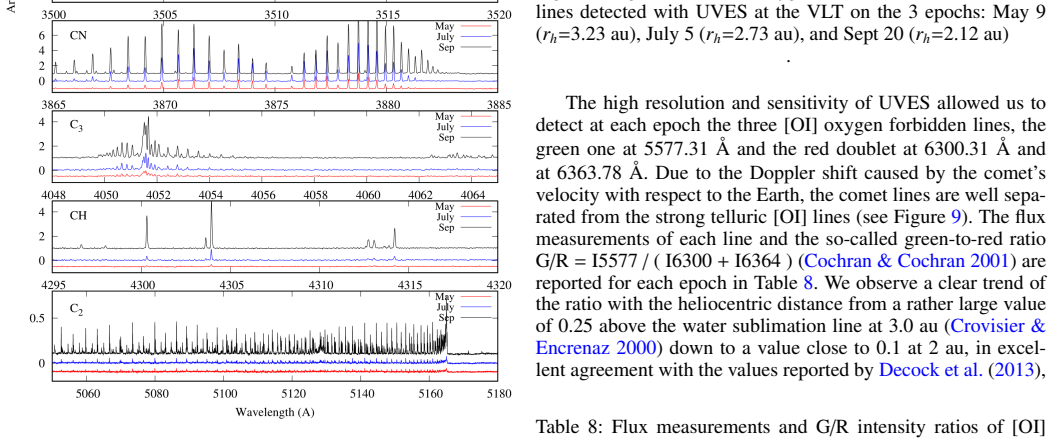
The paper establishes that C/2017 K2's coma underwent a composition-driven activity transition. Using high-resolution UVES spectra at three epochs in 2022, the authors measured the forbidden oxygen line ratio $G/R = I(5577\,\mathrm{\AA})/(I(6300\,\mathrm{\AA})+I(6364\,\mathrm{\AA}))$ and found a monotonic drop with decreasing heliocentric distance: 0.25 at 3.23 au, 0.14–0.15 at 2.73 au, and 0.08 at 2.12 au. Following Festou & Feldman (1981), they interpret this as a switch from a coma whose oxygen atoms come mostly from CO and CO$_2$ photodissociation to one dominated by H$_2$O photodissociation once water sublimation begins inside roughly 3 au. Supporting pieces are the non-detection of OH before the second epoch, CO emission too faint to measure in May 2022, the detection of CO$_2^+$ without CO$^+$, and a temporary stall in brightness and dust production between 3.6 and 2.7 au attributed to depletion of near-surface CO and CO$_2$. The paper also finds that K2's dust colors stayed constant across the entire campaign, that its gas composition is “typical” with a high dust-to-gas ratio, and that HCN is the likely parent of CN while C$_2$ is more likely from C$_2$H$_2$ than from C$_2$H$_6$.
Load-bearing premise
The G/R ratio is read through the Festou & Feldman (1981) calibration, which assumes the coma's oxygen atoms come only from photodissociation of H$_2$O, CO$_2$, and CO and that no other oxygen source (such as O$_2$ or dust sputtering) and no collisional quenching perturbs the line ratios between 2 and 3 au.
Editorial extensions
If this is right
- If the G/R interpretation holds, K2's distant activity, detected out to 23.75 au, was driven by supervolatile sublimation, and the comet's modest brightness near perihelion reflects a real loss of CO/CO$_2$ surface ice before water sublimation could take over.
- The plateau and subsequent steep fading in the light curve imply that dynamically new comets can undergo a volatile-exhaustion phase on their first inner-solar-system passage, so brightness alone may underestimate their nuclear volatile content.
- The constant dust colors over eight years and across roughly 6 au of heliocentric distance indicate that the dust grain properties in the coma did not change, supporting comparisons of K2's dust with other long-period comets regardless of observing epoch.
- The parent–daughter abundance matching (HCN→CN, C$_2$H$_2$→C$_2$) means simultaneous optical and infrared spectroscopy can be used to trace specific ice abundances in K2 and similar comets.
- The similarity of K2's NiI/FeI ratio to other comets, despite its dynamically new status, supports the idea that metal abundance ratios are set at formation rather than by subsequent processing.
Reading between the lines
- If the G/R drop at 3 au is a generic property of comets, archival spectra of other long-period comets observed between 2.5 and 3.5 au should show the same steep decline; this can be checked without new observations.
- A direct test that goes beyond the paper would be measuring O$_2$ in K2's coma in the 2–4 au range; if O$_2$ is abundant, the G/R-based H$_2$O/CO$_2$/CO partition would need revision, since O$_2$ photodissociation also produces oxygen atoms.
- The inferred near-surface depletion of CO and CO$_2$ suggests that “dynamically new” comets may be classified by their outer-layer composition rather than their bulk composition, and future missions to pristine comets could look for a layered volatile structure rather than uniform ice.
- One extension of the authors' method is to follow the post-perihelion branch: if the same G/R pattern appears as the comet recedes beyond 3 au, it would confirm that the transition follows the local sublimation temperature rather than an irreversible depletion of the nucleus.
Signed reviews
Editorial analysis
A structured set of objections, weighed in public.
Referee Report
Summary. This paper presents an eight-year photometric and spectroscopic study of the dynamically new Oort cloud comet C/2017 K2 (PanSTARRS) from 15.18 au pre-perihelion to 8.46 au post-perihelion, using TRAPPIST broadband and narrowband imaging, VLT/UVES optical echelle spectroscopy, and VLT/CRIRES+ near-infrared spectroscopy. The authors derive light curves, colors, Haser-model production rates of OH, NH, CN, C3, and C2, the dust proxy A(0)fρ, and production rates and mixing ratios of infrared parent species. The central result is a heliocentric-distance trend in the [OI] green-to-red (G/R) ratio, from 0.25 at 3.23 au to 0.08 at 2.1 au, which they interpret as a transition from CO/CO2-driven activity to water-driven sublimation inside ~3 au, with a specifically CO2-dominated phase at the largest distances. Secondary results include constant dust colors, a 'typical' C2/CN taxonomy, a high dust-to-gas ratio, iron and nickel abundances, and parent-daughter associations (HCN to CN, C2H2 to C2).
Significance. If the central interpretation holds, the paper offers a valuable long-baseline view of a dynamically new comet crossing the water sublimation line, with simultaneous optical and infrared coverage on several epochs. The dataset is substantial: 271 nights of TRAPPIST imaging, three epochs of high-resolution UVES spectra, and three epochs of CRIRES+ spectra with contemporaneous optical data. The G/R measurements are new for this object and are consistent with independent MUSE and other reported values for K2, which strengthens the observational basis. The paper also makes useful quantitative comparisons with the A'Hearn et al. (1995) taxonomy and the Lippi et al. (2021) infrared statistics. However, the central compositional-switch claim is not fully supported by the same-epoch infrared measurements, and the specificity of the 'CO2 domination' wording exceeds what the data demonstrate. The archival value of the light curve and production-rate tables is clear, but the interpretive conclusion needs to be either better quantified or appropriately qualified.
major comments (3)
- [§3.2.1, Tables 8 and 11] The interpretation of the G/R drop as a clean compositional switch is not quantitatively reconciled with the simultaneous CRIRES+ CO/H2O mixing ratios. Using the Festou & Feldman (1981) calibration cited by the authors, a linear decomposition of the observed G/R at rh=2.12 au from H2O (G/R≈0.1) and CO at 13.9% (if CO has G/R≈0.2 as implied by the text) predicts G/R≈0.11, whereas the observed value is 0.08±0.004. At rh=2.73 au, the same exercise with CO at 10.7% predicts G/R≈0.11, whereas the observed values are 0.14–0.15. The paper does not perform this check. The residual could indicate CO2 or an error in the adopted parent-specific G/R values, but without an explicit quantitative comparison the claimed 'clear' transition from CO2 to H2O is not established. Please add this decomposition with propagated uncertainties and discuss the residual explicitly.
- [§3.2.1 and §4] The attribution of the high G/R=0.25 at 3.23 au specifically to CO2 is fragile. CO is not detected at that epoch (only an upper limit, Table 11), CO2 is not directly measured, and the detection of CO2+ ions does not quantify the neutral CO2 production rate. The text itself acknowledges in §3.2.1 that 'we cannot then argue it was especially rich in CO or CO2 compared to others', yet the Summary/Conclusion (Section 4) states that 'The switch from a CO2 domination to an H2O dominated coma is also clear'. Please either derive quantitative constraints on the CO and CO2 contributions from the G/R value and the non-detections, or rephrase the conclusion to say 'CO/CO2-dominated' activity, consistent with the abstract and with the caveats stated earlier in the paper.
- [§3.2.1] The potential effect of collisional quenching of O(1S) on the green line is not assessed. The gas production rates in Table A.1 rise from roughly 10^28 to 10^29 mol/s between the May and September 2022 epochs, and within the innermost part of the 0.45''×10'' slit the coma density can approach the critical density for quenching (n_crit ~10^10 cm^-3). If quenching suppresses the green line preferentially at the later epochs, the G/R drop could be partially attributable to density effects rather than composition. A simple order-of-magnitude estimate, e.g., n(r)=Q/(4π v r^2) with v~0.5 km/s evaluated across the slit footprint, should be presented to show that quenching is negligible or to quantify a correction. This is a standard check for the forbidden-oxygen ratio diagnostic and is needed to support the compositional reading.
minor comments (6)
- [§3.2.1] The sentence 'The nondetection of CO and the detection of CO2+ might point to CO2 to be the main contributor at larger heliocentric distances than 2.5 au' is appropriately hedged, but the phrase 'might point' is then abandoned in Section 4. Please keep the language consistent throughout.
- [§3.3 and Table 10] The statement that C2 is 'more likely to be dissociated from C2H2 than from C2H6' is based on upper limits for C2H2 (Table 11). The upper limits are consistent with C2H2 being the dominant parent, but they do not positively identify it. Please clarify that this is an inference from upper limits and the relative abundances, not a detection.
- [Table A.1] Several entries in Table A.1 have quoted uncertainties larger than the central value, e.g., 2022-04-27 OH = 1.66±2.67e+28 mol/s and 2023-09-20 OH = 3.51±53.70e+26 mol/s. These values appear to be typographical errors or are not scientifically meaningful. Please correct or remove them.
- [§2.1] The phrase 'Johnson-Cousin' should be 'Johnson-Cousins'.
- [Figure 3] The four panels of Figure 3 use different x-axis ranges and do not all show the rh scale. Adding the heliocentric-distance range to each panel caption or axis would improve readability.
- [Equation (2)] In Equation (2), the expression 'm⊙,R−HR' should have a clear separation (e.g., m⊙,R − HR) and HR should be explicitly defined as the absolute magnitude in the R band.
Circularity Check
No significant circularity: the paper's claims rest on observed flux ratios, external calibrations, and comparison catalogs, not on fitted parameters recycled as predictions.
full rationale
The derivation chain is self-contained against external benchmarks. The Haser-model production rates (Section 3.1.2) use literature scale lengths (A'Hearn et al. 1995) and g-factors from Schleicher's website, and are then compared with independent SOHO/Schleicher measurements; no fitted quantity is renamed as a prediction. The central G/R-based compositional inference (Section 3.2.1) is an observed forbidden-oxygen line ratio calibrated through Festou & Feldman (1981), an external study, and is compared with literature G/R datasets (Decock et al. 2013; Kwon et al. 2023; Cambianica et al. 2023). The CO2-to-H2O switch is therefore read off an external diagnostic rather than being imposed by the paper's own definitions. The infrared abundances are measured with CRIRES+/UVES and compared with the Lippi et al. (2021) box statistics, the Ejeta et al. (2025) iSHELL results, and JWST results (Woodward et al. 2025); these are comparison data sets, not arguments whose force depends on the current paper. Self-citations (Lippi et al. 2020/2021/2023, Manfroid et al. 2021, Hutsemekers et al. 2021) are methodological or comparative; none is invoked as a uniqueness theorem or as a substitute for the present measurements. The skeptic's quenching and CO/H2O consistency concerns are important scientific caveats but are not instances of circularity, since the G/R ratio is measured, not fitted.
Assumptions & free parameters
free parameters (4)
- Geometric albedo of dust, p =
0.04
- Dust bulk density, rho =
500 kg/m^3
- Mean particle radius, a_bar =
100 micron
- Dust ejection velocity, v_ej =
14 m/s
assumptions (4)
- domain assumption Haser model assumptions: spherically symmetric coma, one-step photodissociation of parent into daughter at constant velocity
- domain assumption Scale lengths from A'Hearn et al. (1995), scaled as r_h^2, are valid for C/2017 K2
- domain assumption Fluorescence efficiencies (g-factors) from Schleicher's website and A'Hearn (1982) are correct for K2
- domain assumption The Festou and Feldman (1981) calibration maps G/R ratio to the relative oxygen contribution from H2O, CO2, and CO photodissociation
Cite this review
Pith. "Pith review of Variations in Volatile-Driven Activity of Comet C/2017 K2 (PanSTARRS) Revealed by Long-Term Multi-Wavelength Observations." pith.science (2026). https://pith.science/paper/HIFZOJ2X
@misc{pith2026250713451,
  author       = {Pith},
  title        = {Pith review of: Variations in Volatile-Driven Activity of Comet C/2017 K2 (PanSTARRS) Revealed by Long-Term Multi-Wavelength Observations},
  year         = {2026},
  howpublished = {\url{https://pith.science/paper/HIFZOJ2X}},
  note         = {Machine review of arXiv:2507.13451}
}
abstract
Context. A comprehensive study of comets over a wide heliocentric distance range helps us understand the physical processes driving their activity and reveals compositional differences across dynamical groups. C/2017 K2 (PANSTARRS) is a Dynamically New Oort Cloud comet (DNC) that showed activity as far as 23.75 au and displayed a CO-rich coma at 6.72 au, making it a key object to investigate pre- and post-perihelion behavior. Aims. We aim to study the long-term activity evolution and chemical composition of C/2017 K2 using photometry and spectroscopy, from October 2017 (r$_h$ = 15.18 au) pre-perihelion to April 2025 (r$_h$ = 8.46 au) post-perihelion. Methods. Broad-band and narrow-band imaging from both TRAPPIST telescopes enabled us to produce an 8-year light curve, color analysis, and derivation of activity slopes. Production rates of OH, NH, CN, C$_3$, and C$_2$ were computed using a Haser model, along with the dust proxy A(0)f$\rho$. High-resolution spectra from CRIRES$^+$ and UVES at three epochs (May - September 2022) provided simultaneous observations of parent and daughter species as the comet crossed the water sublimation zone. Results. The light curve of C/2017 K2 shows a complex evolution with varying slopes and a brightness plateau around perihelion, indicating multiple active species. Coma colors remained constant, suggesting uniform dust properties and similarity to other active long-period comets. Gas production rates indicate a typical C$_2$/CN composition with a high dust-to-gas ratio. Analysis of forbidden oxygen lines shows a transition from CO and CO$_2$-driven activity to water-driven sublimation inside 3 au. Infrared spectra reveal C/2017 K2 as a typical-to-enriched comet, with HCN identified as the main parent of CN, and C$_2$ likely originating from C$_2$H$_2$ rather than C$_2$H$_6$.
Figures


Figures from the paper (9 more)




Reference graph
Works this paper leans on
-
[1]
A'Hearn , M. F. 1982, in IAU Colloq. 61: Comet Discoveries, Statistics, and Observational Selection, ed. L. L. Wilkening , 433--460
work page 1982
-
[2]
A'Hearn , M. F., Millis , R. C., Schleicher , D. O., Osip , D. J., & Birch , P. V. 1995, Icarus, 118, 223
work page 1995
-
[3]
A'Hearn , M. F., Schleicher , D. G., Millis , R. L., Feldman , P. D., & Thompson , D. T. 1984, The Astronomical Journal, 89, 579
work page 1984
-
[4]
Aravind , K., Venkataramani , K., Ganesh , S., et al. 2024, , 530, 393
work page 2024
-
[5]
Ballester , P., Modigliani , A., Boitquin , O., et al. 2000, The Messenger, 101, 31
work page 2000
-
[6]
Bessell , M. S. 1990, , 102, 1181
work page 1990
-
[7]
Bonev , B. P. 2005, PhD thesis, University of Toledo, Ohio
work page 2005
-
[8]
Cambianica , P., Cremonese , G., Munaretto , G., et al. 2021, , 656, A160
work page 2021
Show all 70 references
-
[9]
2023, , 674, L14
Cambianica , P., Munaretto , G., Cremonese , G., et al. 2023, , 674, L14
2023
-
[10]
Cochran , A. L. & Cochran , W. D. 2001, , 154, 381
2001
-
[11]
2025, arXiv e-prints, arXiv:2505.11699
Combi , M., M \"a kinen , T., Bertaux , J.-L., Quemerais , E., & Ferron , S. 2025, arXiv e-prints, arXiv:2505.11699
2025 arXiv
-
[12]
& Encrenaz , T., eds
Crovisier , J. & Encrenaz , T., eds. 2000, Comet science : the study of remnants from the birth of the solar system
2000
-
[13]
2013, , 555, A34
Decock , A., Jehin , E., Hutsem \'e kers , D., & Manfroid , J. 2013, , 555, A34
2013
-
[14]
1981, in ESA Special Publication, Vol
Divine , N. 1981, in ESA Special Publication, Vol. 174, The Comet Halley. Dust and Gas Environment, ed. B. Battrick & E. Swallow
1981
-
[15]
J., Anglada-Escude , G., Baade , D., et al
Dorn , R. J., Anglada-Escude , G., Baade , D., et al. 2014, The Messenger, 156, 7
2014
-
[16]
A., et al
Ejeta , C., Gibb , E., DiSanti , M. A., et al. 2025, , 169, 102
2025
-
[17]
L., Schleicher , D
Farnham , T. L., Schleicher , D. G., & A'Hearn , M. F. 2000, Icarus, 147, 180
2000
-
[18]
& Feldman , P
Festou , M. & Feldman , P. D. 1981, , 103, 154
1981
-
[19]
F., Tsiganis , K., & Morbidelli , A
Gomes , R., Levison , H. F., Tsiganis , K., & Morbidelli , A. 2005, Nature, 435, 466
2005
-
[20]
Hanner , M. S. & Newburn , R. L. 1989, , 97, 254
1989
-
[21]
1957, Bulletin de la Societe Royale des Sciences de Liege, 43, 740
Haser , L. 1957, Bulletin de la Societe Royale des Sciences de Liege, 43, 740
1957
-
[22]
C., & Huebner , W
Helbert , J., Rauer , H., Boice , D. C., & Huebner , W. F. 2005, , 442, 1107
2005
-
[23]
2024, in European Planetary Science Congress, EPSC2024--1139
Hmiddouch , S., Jehin , E., Jabiri , A., et al. 2024, in European Planetary Science Congress, EPSC2024--1139
2024
-
[24]
2006, , 367, 449
Holmberg , J., Flynn , C., & Portinari , L. 2006, , 367, 449
2006
-
[25]
E., Knight , M
Holt , C. E., Knight , M. M., Kelley , M. S. P., et al. 2024, , 5, 273
2024
-
[26]
2018, , 155, 25
Hui , M.-T., Jewitt , D., & Clark , D. 2018, , 155, 25
2018
-
[27]
2021, , 652, L1
Hutsem \'e kers , D., Manfroid , J., Jehin , E., Opitom , C., & Moulane , Y. 2021, , 652, L1
2021
-
[28]
2011, The Messenger, 145, 2
Jehin , E., Gillon , M., Queloz , D., et al. 2011, The Messenger, 145, 2
2011
-
[29]
K., Christoforidis , A., & Kissel , J
Jessberger , E. K., Christoforidis , A., & Kissel , J. 1988, , 332, 691
1988
-
[30]
2015, , 150, 201
Jewitt , D. 2015, , 150, 201
2015
-
[31]
2019, , 157, 65
Jewitt , D., Agarwal , J., Hui , M.-T., et al. 2019, , 157, 65
2019
-
[32]
2017, , 847, L19
Jewitt , D., Hui , M.-T., Mutchler , M., et al. 2017, , 847, L19
2017
-
[33]
H., Snodgrass , C., Tubiana , C., et al
Jones , G. H., Snodgrass , C., Tubiana , C., et al. 2024, , 220, 9
2024
-
[34]
2004, in Society of Photo-Optical Instrumentation Engineers (SPIE) Conference Series, Vol
Kaeufl , H.-U., Ballester , P., Biereichel , P., et al. 2004, in Society of Photo-Optical Instrumentation Engineers (SPIE) Conference Series, Vol. 5492, Ground-based Instrumentation for Astronomy, ed. A. F. M. Moorwood & M. Iye , 1218--1227
2004
-
[35]
& Pan-STARRS Team
Kaiser , N. & Pan-STARRS Team . 2002, in American Astronomical Society Meeting Abstracts, Vol. 201, American Astronomical Society Meeting Abstracts, 122.07
2002
-
[36]
& Dybczy \'n ski , P
Kr \'o likowska , M. & Dybczy \'n ski , P. A. 2018, , 615, A170
2018
-
[37]
G., Bagnulo , S., Markkanen , J., et al
Kwon , Y. G., Bagnulo , S., Markkanen , J., et al. 2024, , 168, 164
2024
-
[38]
G., Opitom , C., & Lippi , M
Kwon , Y. G., Opitom , C., & Lippi , M. 2023, , 674, A206
2023
-
[39]
2023, , 676, A105
Lippi , M., Vander Donckt , M., Faggi , S., et al. 2023, , 676, A105
2023
-
[40]
L., Mumma , M
Lippi , M., Villanueva , G. L., Mumma , M. J., et al. 2020, , 159, 157
2020
-
[41]
L., Mumma , M
Lippi , M., Villanueva , G. L., Mumma , M. J., & Faggi , S. 2021, , 162, 74
2021
-
[42]
& Liu , X
Liu , B. & Liu , X. 2024, , 683, A51
2024
-
[43]
2021, , 593, 372
Manfroid , J., Hutsem \'e kers , D., & Jehin , E. 2021, , 593, 372
2021
-
[44]
Marcus , J. N. 2007, International Comet Quarterly, 29, 39
2007
-
[45]
J., Laher , R
Masci , F. J., Laher , R. R., Rusholme , B., et al. 2019, , 131, 018003
2019
-
[46]
J., Kleyna , J
Meech , K. J., Kleyna , J. T., Hainaut , O., et al. 2017, , 849, L8
2017
-
[47]
J., & A'Hearn , M
Meier , R., Wellnitz , D., Kim , S. J., & A'Hearn , M. F. 1998, , 136, 268
1998
-
[48]
F., & Gomes, R
Morbidelli, A., Tsiganis, K., Crida, A., Levison, H. F., & Gomes, R. 2007, The Astronomical Journal, 134, 1790
2007
-
[49]
, Opitom, C
Moulane, Y., Jehin, E. , Opitom, C. , et al. 2018, A&A, 619, A156
2018
-
[50]
2019, , 624, A64
Opitom , C., Hutsem \'e kers , D., Jehin , E., et al. 2019, , 624, A64
2019
-
[51]
2015, Astronomy & Astrophysics, 574, A38
Opitom, C., Jehin, E., Manfroid, J., et al. 2015, Astronomy & Astrophysics, 574, A38
2015
-
[52]
2004, in Society of Photo-Optical Instrumentation Engineers (SPIE) Conference Series, Vol
Paufique , J., Biereichel , P., Donaldson , R., et al. 2004, in Society of Photo-Optical Instrumentation Engineers (SPIE) Conference Series, Vol. 5490, Advancements in Adaptive Optics, ed. D. Bonaccini Calia , B. L. Ellerbroek , & R. Ragazzoni , 216--227
2004
-
[53]
L., Mumma , M
Radeva , Y. L., Mumma , M. J., Villanueva , G. L., & A'Hearn , M. F. 2011, , 729, 135
2011
-
[54]
Schleicher , D. G. 2010, , 140, 973
2010
-
[55]
Schleicher , D. G. & A'Hearn , M. F. 1988, , 331, 1058
1988
-
[56]
G., Millis , R
Schleicher , D. G., Millis , R. L., & Birch , P. V. 1998, , 132, 397
1998
-
[57]
L., Liuzzi , G., Faggi , S., et al
Villanueva , G. L., Liuzzi , G., Faggi , S., et al. 2022, Fundamentals of the Planetary Spectrum Generator
2022
-
[58]
L., Mumma , M
Villanueva , G. L., Mumma , M. J., Bonev , B. P., et al. 2012, , 113, 202
2012
-
[59]
L., Mumma , M
Villanueva , G. L., Mumma , M. J., DiSanti , M. A., et al. 2011, , 216, 227
2011
-
[60]
L., Smith , M
Villanueva , G. L., Smith , M. D., Protopapa , S., Faggi , S., & Mandell , A. M. 2018, , 217, 86
2018
-
[61]
J., Wells , L., Micheli , M., & Sato , H
Wainscoat , R. J., Wells , L., Micheli , M., & Sato , H. 2017, Central Bureau Electronic Telegrams, 4393, 1
2017
-
[62]
Whipple , F. L. 1950, , 111, 375
1950
-
[63]
Willmer , C. N. A. 2018, , 236, 47
2018
-
[64]
2017, , 129, 031001
Womack , M., Sarid , G., & Wierzchos , K. 2017, , 129, 031001
2017
-
[65]
E., Bockelee-Morvan , D., Harker , D
Woodward , C. E., Bockelee-Morvan , D., Harker , D. E., et al. 2025, arXiv e-prints, arXiv:2504.19849
2025 arXiv
-
[66]
2021, , 914, L17
Yang , B., Jewitt , D., Zhao , Y., et al. 2021, , 914, L17
2021
-
[67]
2022, , 3, 135
Zhang , Q., Kolokolova , L., Ye , Q., & Vissapragada , S. 2022, , 3, 135
2022
-
[68]
L., Jewitt , D., & Hui , M
Zhang , X. L., Jewitt , D., & Hui , M. T. 2019, , 487, 2919
2019
-
[69]
, " * write output.state after.block = add.period write newline
ENTRY address archiveprefix author booktitle chapter edition editor howpublished institution eprint journal key month note number organization pages publisher school series title type volume year label extra.label sort.label short.list INTEGERS output.state before.all mid.sent...
-
[70]
write newline
" write newline "" before.all 'output.state := FUNCTION n.dashify 't := "" t empty not t #1 #1 substring "-" = t #1 #2 substring "--" = not "--" * t #2 global.max substring 't := t #1 #1 substring "-" = "-" * t #2 global.max substring 't := while if t #1 #1 substring * t #2 gl...
Reviewed August 6, 2026 · model on record in the stance chip above.
Discussion (0). Continue with ORCID to comment.