REVIEW 3 major objections 9 minor 80 references
An efficient and energy stable framework for phase field simulations of grain growth in additive manufacturing
T0 review · 3 major / 9 minor · reviewed 2026-08-06 · deepseek-v4-flash
Pith's one-line read A stabilized semi-implicit finite element scheme lets phase field simulations of grain growth in additive manufacturing use time steps at least two orders of magnitude larger than explicit schemes while still satisfying a revisited…
desk verdict Useful practical speed-up for phase-field AM simulations, but the strict energy-stability proof does not hold; the claim should be softened. read the letter →
The pith
A machine-rendered reading of the paper's core claim, the machinery that carries it, and where it could break.
The reading
What carries the argument
The key machinery is the stabilized semi-implicit time integration (first- and second-order) with the stabilization coefficient $\alpha \ge W$, where $W$ is the height of the multiwell potential in the homogeneous free energy; the choice $\alpha = W$ follows from bounding the second derivative of the modified free energy using $\sum_j \phi_j^2 \le 1$ and $\gamma_{PF}=3/2$. The revisited discrete energy law $E(\{\phi^{k+1}\},T^{k+1})-E(\{\phi^{k}\},T^{k+1})\le 0$, evaluated with the temperature fixed at the new time step, supplies the stability criterion because the temperature is prescribed externally. The finite element weak form with phase-dependent mobilities, large in solid-liquid interfaces and small in bulk solid regions, carries the spatial discretization, and the Rosenthal moving-heat-source temperature field provides the thermal history.
What would settle it
Run the same stabilized scheme with a large time step or with initial conditions that cause the order parameters to overshoot so that $\sum_j \phi_j^2 > 1$ somewhere, and compute the discrete energy difference $E(\{\phi^{k+1}\},T^{k+1})-E(\{\phi^{k}\},T^{k+1})$; if it becomes positive during solidification, the claimed energy stability fails. Alternatively, reduce the thermal undercooling so that the multiwell and gradient terms are comparable to the driving force on the interface and check whether the energy still decreases; a violation would show that the interface-dominance assumption is load-bearing.
Extended reading notes
Core claim
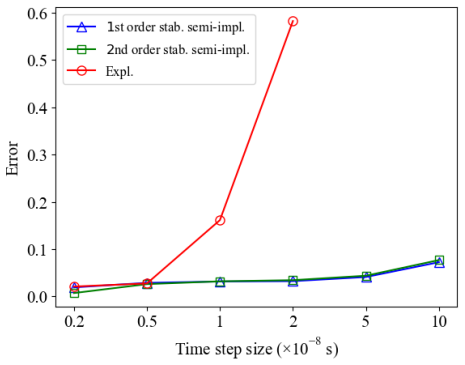
The central claim is that the proposed first- and second-order stabilized semi-implicit schemes, with the stabilization coefficient chosen as $\alpha \ge W$, strictly enforce the revisited discrete energy law $E(\{\phi^{k+1}\},T^{k+1})-E(\{\phi^{k}\},T^{k+1})\le 0$ and permit time steps of order $10^{-7}$ seconds in 2D and 3D grain growth simulations, two orders of magnitude larger than the order $10^{-9}$ seconds needed by explicit Euler, without loss of accuracy. The paper argues that the acceleration is achieved without violating energy stability because on the solid-liquid interface the thermal driving force dominates the phase field equation, so the energy-decrease requirement reduces to controlling the solid-phase free energy through a suitable stabilization term.
Load-bearing premise
The proof that the interface contribution to the energy decreases assumes that on the solid-liquid interface the phase field equation is dominated by the thermal driving force term, so the multiwell and gradient contributions can be ignored, and it also assumes that the sum of the squared order parameters never exceeds 1; if either fails, the energy-decrease guarantee does not follow.
Editorial extensions
If this is right
- The same $\alpha \ge W$ recipe extends the stabilized semi-implicit scheme to other phase field models whose free energy has a polynomial multiwell structure, preserving the revisited energy law.
- The first-order stabilized scheme can serve as the default for production simulations, while the second-order version is available when accuracy at large time steps needs improvement.
- The framework eliminates the initialization stage required by explicit schemes, because it can create diffuse interfaces directly from the initial grain structure.
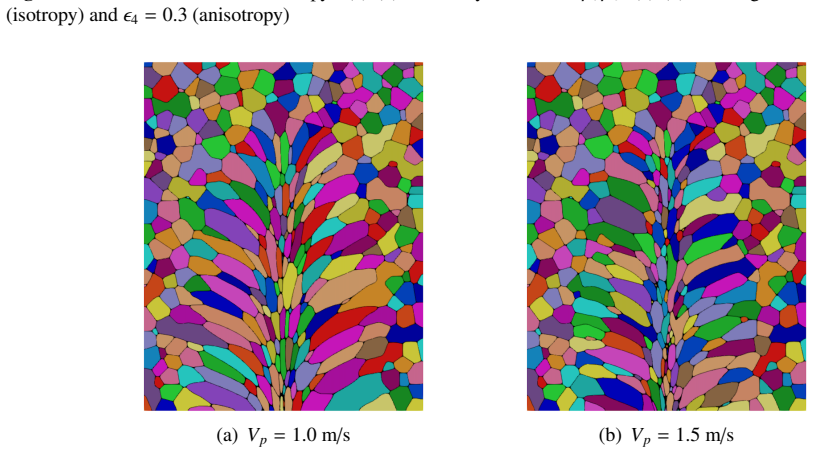
- Parametric 3D simulations reproduce known physical trends: kinetic anisotropy selects grains aligned with the heat flow, and higher scan speeds shrink the melt pool and weaken grain selection.
Reading between the lines
- Because $\alpha \ge W$ is a global upper bound, an adaptive local stabilization coefficient based on the pointwise second derivative of the free energy could plausibly allow still larger time steps or better accuracy than the paper demonstrates, though the paper does not test this.
- The energy-stability argument is tailored to regimes where the thermal driving force dominates the interface; for solidification at low undercooling or with strong capillarity, one would need to stabilize the multiwell and gradient terms explicitly, an extension the paper does not make.
- The two-orders-of-magnitude time-step gain could be multiplied by spatial accelerations such as adaptive meshing or tensor-decomposed solvers, bringing full 3D melt-pool-scale simulations closer to reach, even though the paper does not couple these approaches.
- Enforcing the constraint $\sum_j \phi_j^2 \le 1$ explicitly after each update would make the stability proof unconditional for the discrete solution and is a testable modification of the scheme.
Signed reviews
Editorial analysis
A structured set of objections, weighed in public.
Referee Report
Summary. The paper proposes a stabilized semi-implicit finite element framework for phase field simulations of grain growth during rapid solidification in additive manufacturing. The method is applied to a phase field model of 316L stainless steel with a Rosenthal temperature field. The main claims are that the stabilized scheme permits time steps two orders of magnitude larger than explicit schemes and that it strictly satisfies a revisited discrete energy law of the form E(φ^{k+1},T^{k+1}) - E(φ^k,T^{k+1}) ≤ 0. A stability analysis in Section 2.7 motivates the choice of stabilization coefficient α ≥ W, and 2D and 3D simulations, including parametric studies on kinetic anisotropy and scan speed, are presented.
Significance. The paper addresses a real computational bottleneck in phase field simulations of additive manufacturing, and the proposed scheme is simple and easy to implement. The numerical results, including the comparison with experimental observations reported in [33], demonstrate substantial practical improvements in allowable time step size. The framework is not specific to the particular phase field model and could therefore be useful to a broader community. The main limitation is that the theoretical energy-stability proof is not rigorous; the claim of 'strictly' satisfying the energy law is supported only by heuristic arguments and numerical examples, which matters because the energy stability argument is the central justification for advocating the method.
major comments (3)
- [§2.7, Eq. (40)] The reduction of the governing equation on the solid-liquid interface to the temperature driving force alone is not justified. In a diffuse-interface model, the term κΔφ_i is precisely what balances the multiwell potential W ∂(φ_i^4/4 - φ_i^2/2)/∂φ_i in a steady interface profile, and its magnitude is of order W/ζ. For the parameters in Table 1, W = 6γ_SL/ζ ≈ 5.88×10^-12 J/μm^3 while the thermal driving force L(T_liq-T)/T_liq is much smaller when the interface is near the liquidus temperature. No estimate is given showing that the neglected terms are small. Consequently, the assertion that ∂φ_i/∂t ≥ 0 forces a decrease of the energy on Ω_sl is incomplete: even if h({φ}) decreases, the gradient energy (κ/2)|∇φ_i|^2 and the multiwell term can increase as the interface moves, so Eq. (39) is not proven.
- [§2.7, Eq. (45)] The bound α ≥ W is derived using the inequality Σ_j φ_j^2 ≤ 1, which is asserted on physical grounds but not proven for this multi-phase Allen-Cahn-type model. The model does not impose a constraint such as Σ_i φ_i = 1, and nothing in the evolution equations prevents the order parameters from overlapping, particularly near triple junctions or during rapid solidification. If the sum of squares exceeds 1 somewhere, the supremum of ∂²f/∂φ_i² can exceed 2W, and the proposed stabilizing coefficient may be insufficient. Since α is the key parameter that controls the energy stability, this is a load-bearing gap in the analysis.
- [§2.6–§2.7] The energy-stability analysis is carried out on the continuous PDE rather than on the discrete semi-implicit scheme. The scheme in Eq. (29) is not shown to satisfy a discrete analog of Eq. (27) by a direct calculation. The cited proofs in [55,54] apply to the Allen-Cahn equation with constant mobility and a simple polynomial free energy; here the mobility M_i({φ}) is non-constant (Eq. (12)) and the temperature field enters as an external forcing. The numerical checks in Figs. 4 and 10 are encouraging for the particular cases tested, but they do not replace the missing discrete estimate. The abstract and conclusions state that the scheme 'strictly' satisfies the energy law; this claim is stronger than what the analysis supports.
minor comments (9)
- [§1] The phrase 'To exam the performance' should read 'To examine the performance'.
- [§2.6] The sentence 'This semi-implicit time integration scheme could be used for phase field simulations. However, it does not grantee the energy stability' contains a typo: 'grantee' should be 'guarantee'.
- [§2.7] The sentence beginning 'The is obtained by following the proofs' is incomplete; it should be 'This is obtained by following the proofs'.
- [§2.5, Eqs. (24)–(26)] The notation in Eqs. (24)–(26) with the vertical-bar subscripts is confusing. Please clarify that the restriction is on the term ∂f/∂T ∂T/∂t being set to zero, and state explicitly that this defines the revisited energy law used for numerical stability rather than the physical free energy dissipation.
- [§3.1] The typo 'V oronoi' should be 'Voronoi'.
- [§3.2] The statement that the test mobility M_i = 6.34×10^15 μm^3/(J·s) corresponds to a representative value of L_s^b should be made precise: L_s^b is defined in Section 2.3 as μ0 T_Liq/(150 ζ L), which yields a specific value; please state it or clarify the correspondence.
- [§3.3] The error metric in Eq. (46) is reported only for the final time in one 2D configuration. Reporting the time evolution of the error, or results for additional configurations, would strengthen the accuracy claim.
- [Fig. 10] The caption of Figure 10 is too sparse. It should specify which time integration scheme (first- or second-order), the time step used, and the simulation parameters, so that the energy decrease can be independently interpreted.
- [§2.6] The statement that the stabilized scheme 'can enable arbitrarily large time steps' is too strong, since accuracy limits the usable time step, as the paper itself acknowledges later in the same paragraph. Please rephrase to indicate unconditional energy stability in the sense of Eq. (27), subject to accuracy constraints.
Circularity Check
No significant circularity: the stabilization coefficient and energy law are derived from the model, and the speed-up claim is externally benchmarked.
full rationale
The paper's central claim is that the stabilized semi-implicit scheme permits two-orders-of-magnitude larger time steps while satisfying the revisited discrete energy law (27). This claim does not reduce to its inputs. The stabilization coefficient alpha >= W is obtained from the curvature bound of the modified multiwell potential f_tilde using the physical constraint sum_j phi_j^2 <= 1, not from fitting the target energy decrease or the speed-up. The revisited energy law (27) is deduced from the continuous gradient-flow identity (23) by setting dT/dt = 0, rather than being defined to match the scheme. The large-time-step performance is benchmarked against an explicit Euler scheme and against experimental microstructure trends [33], so it is externally anchored. The only self-citations (e.g., [54] for tensor decomposition and for the known limitation of unstabilized semi-implicit schemes) are background or future-work and are not load-bearing. Two assumptions in Section 2.7 should be flagged as correctness concerns, not circularity: Eq (40) drops the kappa Delta phi_i and multiwell terms on the solid-liquid interface based on an unquantified claim that the temperature driving force is dominant, and Eq (44)-(45) uses sum_j phi_j^2 <= 1 without proof. These gaps mean the interface part of the stability proof is not established by the text; however, the numerical energy-change check in Figure 10 is an independent verification, and no equation is shown to be equivalent to another by construction. Hence no circular step is present.
Assumptions & free parameters
free parameters (1)
- stabilization coefficient alpha =
W (model parameter, not fitted)
assumptions (4)
- domain assumption The phase field model assumes negligible composition variations and solidification near absolute stability.
- domain assumption Grains grow only by epitaxial growth; no new nucleation occurs.
- domain assumption Solid-liquid interfacial energy is isotropic; kinetic anisotropy enters only through orientation-dependent mobility.
- ad hoc to paper On the solid-liquid interface, the phase field equation can be approximated by the temperature driving force alone, and sum_j phi_j^2 <= 1 holds.
Cite this review
Pith. "Pith review of An efficient and energy stable framework for phase field simulations of grain growth in additive manufacturing." pith.science (2026). https://pith.science/paper/KZYC7QTI
@misc{pith2026250713492,
  author       = {Pith},
  title        = {Pith review of: An efficient and energy stable framework for phase field simulations of grain growth in additive manufacturing},
  year         = {2026},
  howpublished = {\url{https://pith.science/paper/KZYC7QTI}},
  note         = {Machine review of arXiv:2507.13492}
}
read the original abstract
Phase field simulations play a key role in the understanding of microstructure evolution in additive manufacturing. However, they have been found extremely computationally expensive. One of the reasons is the small time step requirement to resolve the complex microstructure evolution during the rapid solidification process. This paper investigates the possibility of using a class of stabilized time integration algorithms to accelerate such phase field simulations by increasing the time steps, based on a phase field model dedicated to simulating the solidification of 316L stainless steel during additive manufacturing, particularly in a regime where the solid-liquid interface is moving fast and there is absolute interfacial stability with negligible composition variations. The specific computational framework, incorporating the finite element method and the stabilized time integration algorithms, was developed. A theoretical analysis on energy stability was conducted, based on a revisited energy law derived for the phase field model. The numerical results confirmed that the proposed framework can effectively enforce the numerical stability and a decreasing energy requirement for the phase field simulations with at least two orders-of-magnitude larger time steps over conventional explicit methods. 2D and 3D phase field simulations have been conducted with relevant physical and kinetic parameters for 316L stainless steel. This computational framework can be easily adapted for different phase field models and open numerous opportunities for efficient phase field simulations.
Figures


Figures from the paper (16 more)






Reference graph
Works this paper leans on
-
[33]
A. F. Chadwick, J. G. S. Macías, A. Samaei, G. J. Wagner, M. V . Upadhyay, P. W. V oorhees, On microstructure development during laser melting and resolidification: An experimentally validated simulation study, Acta Materialia 282 (2025) 120482. doi:10.1016/j.actamat.2023.120482
-
[1]
W. E. Frazier, Metal additive manufacturing: A review, Journal of Materials Engineering and Performance 23 (2014) 1917–1928. doi:10.1007/s11665-014-0958-z
-
[2]
I. Gibson, D. W. Rosen, B. Stucker, Additive Manufacturing Technologies: 3D Printing, Rapid Prototyping, and Direct Digital Manufacturing, 2nd ed., Springer, New York, 2015. doi:10.1007/978-1-4939-2113-3
-
[3]
D. Herzog, V . Seyda, E. Wycisk, C. Emmelmann, Additive manufacturing of metals, Acta Materialia 117 (2016) 371–392. doi:10.1016/j.actamat.2016.07.019
-
[4]
Y . M. Wang, T. V oisin, J. T. McKeown, J. Ye, N. P. Calta, Z. Li, Z. Zeng, Y . Zhang, W. Chen, T. T. Roehling, R. T. Ott, M. K. Santala, P. J. Depond, M. J. Matthews, A. V . Hamza, T. Zhu, Additively manufactured hierarchical stainless steels with high strength and ductility, Nature Materials 17 (2018) 63–71. doi:10.1038/nmat5021, epub 2017 Oct 30
- [5]
-
[6]
M. Armstrong, H. Mehrabi, N. Naveed, An overview of modern metal additive manufacturing technology, Manufacturing Letters 32 (2022) 32–36. doi:10.1016/j.mfglet.2022.02.003
-
[7]
T. DebRoy, H. L. Wei, J. S. Zuback, T. Mukherjee, J. W. Elmer, J. O. Milewski, A. M. Beese, A. Wilson-Heid, A. De, W. Zhang, Additive manufacturing of metallic components - process, structure and properties, Progress in Materials Science 92 (2018) 112–224. doi:10.1016/j.pmatsci.2017.10.001
Show all 80 references
-
[8]
B. Song, X. Zhao, S. Li, C. Han, Q. Wei, S. Wen, J. Liu, Y . Shi, Differences in microstructure and properties between selective laser melting and traditional manufacturing for fabrication of metal parts: a review, Frontiers of Mechanical Engineering 10 (2015) 111–125. doi:10....
2015 doi
-
[9]
Z. Wang, T. A. Palmer, A. M. Beese, Effect of processing parameters on microstructure and tensile properties of austenitic stainless steel 304l made by directed energy deposition additive manufacturing, Acta Materialia 110 (2016) 226–235. doi:10.1016/j.actamat.2016.03.019
2016 doi
-
[10]
Y . Kok, X. Tan, P. Wang, M. Nai, N. Loh, E. Liu, S. Tor, Anisotropy and heterogeneity of microstructure and mechanical properties in metal additive manufacturing: a critical review, Materials & Design 139 (2018) 565–586. doi:10.1016/j.matdes.2017.11.021
2018 doi
-
[11]
Kurose, Y
T. Kurose, Y . Abe, M. Santos, Y . Kanaya, A. Ishigami, S. Tanaka, H. Ito, Influence of the layer directions on the properties of 316l stainless steel parts fabricated through fused deposition of metals, Materials 13 (2020) 2493. doi:10.3390/ma13112493
2020 doi
-
[12]
C. Guo, S. Li, S. Shi, X. Li, X. Hu, Q. Zhu, R. Ward, Effect of processing parameters on surface roughness, porosity and cracking of as-built in738lc parts fabricated by laser powder bed fusion, Journal of Materials Processing Technology 285 (2020) 116788. doi:10.1016/j.jmatpr...
2020
-
[13]
M. Li, Y . Bai, X. Gao, L. Cui, Q. Zhou, J. Zhang, M. Zhang, Microstructure and mechanical properties of 308l stainless steel fabricated by laminar plasma additive manufacturing, Materials Science and Engineering: A 770 (2020) 138523. doi:10.1016/j.msea.2019.138523
2020
-
[14]
Henry, M
T. Henry, M. Morales, D. Cole, C. Shumeyko, J. Riddick, Mechanical behavior of 17–4 ph stainless steel processed by atomic diffusion additive manufacturing, The International Journal of Advanced Manufacturing Technology (2021). doi:10.1007/s00170-021-06785-1
2021 doi
-
[15]
W. Kurz, M. Rappaz, R. Trivedi, Progress in modelling solidification microstructures in metals and alloys. part ii: Dendrites from 2001 to 2018, International Materials Reviews (2020) 1–47. doi:10.1080/09506608.2020.1757894. 21
2020
-
[16]
GANDIN, J.-L
C.-A. GANDIN, J.-L. DESBIOLLES, M. RAPPAZ, P. THEVOZ, A three-dimensional cellular automation-finite element model for the prediction of solidification grain structures, Metallurgical and Materials Transactions A 30 (1999) 3153–3165. doi:10.1007/s11661-999-0226-2
1999 doi
-
[17]
Zinovieva, A
O. Zinovieva, A. Zinoviev, V . Ploshikhin, Three-dimensional modeling of the microstructure evo- lution during metal additive manufacturing, Computational Materials Science 141 (2018) 207–220. doi:10.1016/j.commatsci.2017.09.018
2018 doi
-
[18]
Y . Lian, Z. Gan, C. Yu, D. Kats, W. Liu, G. Wagner, A cellular automaton finite volume method for microstructure evolution during additive manufacturing, Materials & Design 169 (2019) 107672. doi:10.1016/j.matdes.2019.107672
2019
-
[19]
Y . Yu, Y . Li, F. Lin, W. Yan, A multi-grid cellular automaton model for simulating dendrite growth and its appli- cation in additive manufacturing, Additive Manufacturing 47 (2023) 102284. doi:10.1016/j.addma.2021.102284
2023
-
[20]
Q. Xie, X. Yan, S. Yin, X. Li, M. Liu, Y . Wang, L. Zhuang, An extended version of cellular automata model for powder bed fusion to unravel the dependence of microstructure on printing areas for inconel 625, Additive Manufacturing 73 (2023) 103676. doi:10.1016/j.addma.2023.103676
2023
-
[21]
C. C. Battaile, The kinetic monte carlo method: Foundation, implementation, and application, Computer Methods in Applied Mechanics and Engineering 197 (2008) 3386–3398. doi:10.1016/j.cma.2008.03.010
2008 doi
-
[22]
T. M. Rodgers, J. D. Madison, V . Tikare, Simulation of metal additive manufacturing microstructures using kinetic monte carlo, Computational Materials Science 135 (2017) 78–89. doi:10.1016/j.commatsci.2017.03.053
2017 doi
-
[23]
T. M. Rodgers, J. E. Bishop, J. D. Madison, Direct numerical simulation of mechanical response in synthetic additively manufactured microstructures, Modelling and Simulation in Materials Science and Engineering 26 (2018). doi:10.1088/1361-651X/aac616
2018 doi
-
[24]
K. L. Johnson, T. M. Rodgers, O. D. Underwood, J. D. Madison, K. R. Ford, S. R. Whetten, D. J. Dagel, J. E. Bishop, Simulation and experimental comparison of the thermo-mechanical history and 3d microstructure evolution of 304l stainless steel tubes manufactured using lens, Co...
2018 doi
-
[25]
T. R. Rodgers, D. M. Moser, F. Abdeljawad, O. D. U. Jackson, J. D. Carroll, B. H. Jared, D. S. Bolin- tineanu, J. A. Mitchell, J. D. Madison, Simulation of powder bed metal additive manufacturing mi- crostructures with coupled finite difference–monte carlo method, Additive Man...
2021
-
[26]
Chen, Phase-field models for microstructure evolution, Annual review of materials research 32 (2002) 113–140
L.-Q. Chen, Phase-field models for microstructure evolution, Annual review of materials research 32 (2002) 113–140
2002
-
[27]
Boettinger, J
W. Boettinger, J. Warren, C. Beckermann, A. Karma, Phase-field simulation of solidification, Annual Review of Materials Research 32 (2002) 163–194
2002
-
[28]
Keller, G
T. Keller, G. Lindwall, S. Ghosh, L. Ma, B. Lane, F. Zhang, U. Kattner, E. Lass, J. Heigel, Y . Idell, M. Williams, A. Allen, J. Guyer, L. Levine, Application of finite element, phase-field, and calphad- based methods to additive manufacturing of ni-based superalloys, Acta Mat...
2017 doi
-
[29]
Y . Ji, L. Chen, L.-Q. Chen, Understanding microstructure evolution during additive manufacturing of metallic alloys using phase-field modeling, in: Thermo-mechanical modeling of additive manufacturing, 2018, pp. 93– 116
2018
-
[30]
A. V . Dubrov, F. K. Mirzade, V . D. Dubrov, On modeling of heat transfer and molten pool behavior in multi- layer and multi-track laser additive manufacturing process, in: B. Bodermann, K. Frenner, R. M. Silver (Eds.), Modeling Aspects in Optical Metrology VII, SPIE, Munich, ...
2019 doi
-
[31]
M. Yang, L. Wang, W. Yan, Phase-field modeling of grain evolutions in additive manufacturing from nucleation, growth, to coarsening, npj Computational Materials 7 (2021) 56. doi:10.1038/s41524-021-00524-6
2021 doi
-
[32]
A. F. Chadwick, P. W. V oorhees, The development of grain structure during additive manufacturing, Acta Materialia 211 (2021) 116862
2021
-
[34]
Rappaz, C.-A
M. Rappaz, C.-A. Gandin, Probabilistic modelling of microstructure formation in solidification processes, Acta Metallurgica et Materialia 41 (1993) 345–360. doi:10.1016/0956-7151(93)90065-Z
1993 doi
-
[35]
Gandin, M
C.-A. Gandin, M. Rappaz, A coupled finite element-cellular automaton model for the prediction of den- dritic grain structures in solidification processes, Acta Metallurgica et Materialia 42 (1994) 2233–2246. doi:10.1016/0956-7151(94)90302-6
1994 doi
-
[36]
G. J. Merchant, S. H. Davis, Morphological instability in rapid directional solidification, Acta Metallurgica et Materialia 38 (1990) 2683–2693
1990
-
[37]
L. X. Lu, N. Sridhar, Y . W. Zhang, Phase field simulation of powder bed-based additive manufacturing, Acta Materialia 144 (2018) 801–809. doi:10.1016/j.actamat.2017.11.033
2018 doi
-
[38]
P. W. Liu, et al., Investigation on evolution mechanisms of site-specific grain structures dur- ing metal additive manufacturing, Journal of Materials Processing Technology 257 (2018) 191–202. doi:10.1016/j.jmatprotec.2018.02.042
2018 doi
-
[39]
P. Liu, Z. Wang, Y . Xiao, ..., Insight into the mechanisms of columnar to equiaxed grain transition during metallic additive manufacturing, Additive Manufacturing 26 (2019) 22–29. doi:10.1016/j.addma.2018.12.019
2019 doi
-
[40]
Provatas, N
N. Provatas, N. Goldenfeld, J. Dantzig, Efficient computation of dendritic microstructures using adaptive mesh refinement, Physical Review Letters 80 (1998) 3308
1998
-
[41]
C.-s. Zhu, S. Xu, L. Feng, D. Han, K.-m. Wang, Phase-field model simulations of alloy directional solidification and seaweed-like microstructure evolution based on adaptive finite element method, Computational Materials Science 160 (2019) 53–61
2019
-
[42]
DeWitt, S
S. DeWitt, S. Rudraraju, D. Montiel, W. B. Andrews, K. Thornton, Prisms-pf: A general framework for phase- field modeling with a matrix-free finite element method, npj Computational Materials 6 (2020) 29
2020
-
[43]
W. Feng, P. Yu, S. Hu, Z.-K. Liu, Q. Du, L.-Q. Chen, Spectral implementation of an adaptive moving mesh method for phase-field equations, Journal of Computational Physics 220 (2006) 498–510
2006
-
[44]
R. Li, Y . Gao, Z. Chen, Adaptive discontinuous galerkin finite element methods for the allen-cahn equation on polygonal meshes, Numerical Algorithms 95 (2024) 1981–2014
2024
-
[45]
D. Liu, Y . Wang, Multi-fidelity physics-constrained neural network and its application in materials modeling, Journal of Mechanical Design 141 (2019) 121403
2019
-
[46]
Montes de Oca Zapiain, J
D. Montes de Oca Zapiain, J. A. Stewart, R. Dingreville, Accelerating phase-field-based microstructure evolution predictions via surrogate models trained by machine learning methods, npj Computational Materials 7 (2021) 3
2021
-
[47]
Peivaste, N
I. Peivaste, N. H. Siboni, G. Alahyarizadeh, R. Ghaderi, B. Svendsen, D. Raabe, J. R. Mianroodi, Machine- learning-based surrogate modeling of microstructure evolution using phase-field, Computational Materials Sci- ence 214 (2022) 111750
2022
-
[48]
T. Xue, Z. Gan, S. Liao, J. Cao, Physics-embedded graph network for accelerating phase-field simulation of microstructure evolution in additive manufacturing, npj Computational Materials 8 (2022) 201. 23
2022
-
[49]
C. Hu, S. Martin, R. Dingreville, Accelerating phase-field predictions via recurrent neural networks learning the microstructure evolution in latent space, Computer Methods in Applied Mechanics and Engineering 397 (2022) 115128
2022
-
[50]
J. Y . Choi, T. Xue, S. Liao, J. Cao, Accelerating phase-field simulation of three-dimensional microstructure evolution in laser powder bed fusion with composable machine learning predictions, Additive Manufacturing 79 (2024) 103938
2024
-
[51]
H. Song, L. Jiang, Q. Li, A reduced order method for Allen–Cahn equations, Journal of computational and applied mathematics 292 (2016) 213–229
2016
-
[52]
X. Zhou, M. Azaiez, C. Xu, Reduced-order modelling for the Allen–Cahn equation based on scalar auxiliary variable approaches, J. Math. Study 52 (2019) 258–276
2019
-
[53]
Tyrylgin, Y
A. Tyrylgin, Y . Chen, M. Vasilyeva, E. T. Chung, Multiscale model reduction for the Allen–Cahn problem in perforated domains, Journal of Computational and Applied Mathematics 381 (2021) 113010
2021
-
[54]
Y . Lu, C. Yuan, H. Guo, Convolution tensor decomposition for efficient high-resolution solutions to the allen– cahn equation, Computer Methods in Applied Mechanics and Engineering 433 (2025) 117507
2025
-
[55]
J. Shen, X. Yang, Numerical approximations of allen–cahn and cahn–hilliard equations, Discrete and Continuous Dynamical Systems - Series B 28 (2010) 1669–1691
2010
-
[56]
S. M. Wise, C. Wang, J. S. Lowengrub, An energy-stable and convergent finite-difference scheme for the phase field crystal equation, SIAM Journal on Numerical Analysis 47 (2009) 2269–2288. doi:10.1137/080738143
2009 doi
-
[57]
Z. Hu, S. M. Wise, C. Wang, J. S. Lowengrub, Stable and efficient finite-difference nonlinear-multigrid schemes for the phase field crystal equation, Journal of Computational Physics 228 (2009) 5323–5339. doi:10.1016/j.jcp.2009.04.020
2009 doi
-
[58]
X. Yang, L. Ju, Efficient linear schemes with unconditional energy stability for the phase field elastic bending energy model, Computer Methods in Applied Mechanics and Engineering 315 (2017) 691–712. doi:10.1016/j.cma.2016.10.041
2017 doi
-
[59]
J. Zhao, Q. Wang, X. Yang, Numerical approximations for a phase field dendritic crystal growth model based on the invariant energy quadratization approach, International Journal for Numerical Methods in Engineering 110 (2017) 279–300. doi:10.1002/nme.5372
2017 doi
-
[60]
J. Shen, X. Yang, H. Yu, Efficient energy stable numerical schemes for a phase field moving contact line model, Journal of Computational Physics 284 (2015) 617–630. doi:10.1016/j.jcp.2014.12.046
2015 doi
-
[61]
Gomez, Y
H. Gomez, Y . Leng, T. Hu, S. Mukherjee, V . Calo, Phase-field modeling for flow simulation, in: Frontiers in Computational Fluid-Structure Interaction and Flow Simulation: Research from Lead Investigators Under Forty-2023, 2023, pp. 79–117
2023
-
[62]
A. F. Chadwick, P. W. V oorhees, Recursive grain remapping scheme for phase-field models of additive manufacturing, International Journal for Numerical Methods in Engineering 123 (2022) 3093–3110. URL: http://dx.doi.org/10.1002/nme.6966. doi:10.1002/nme.6966
2022 doi
-
[63]
S. M. Allen, J. W. Cahn, A microscopic theory for antiphase boundary motion and its application to antiphase domain coarsening, Acta Metall. 27 (1979) 1085–1095
1979
-
[64]
Pinomaa, M
T. Pinomaa, M. Lindroos, M. Walbrühl, N. Provatas, A. Laukkanen, The significance of spatial length scales and solute segregation in strengthening rapid solidification microstructures of 316l stainless steel, Acta Materialia 184 (2020) 1–16. doi:10.1016/j.actamat.2019.10.044. 24
2020 doi
-
[65]
Karayagiz, L
K. Karayagiz, L. Johnson, R. Seede, V . Attari, B. Zhang, X. Huang, S. Ghosh, T. Duong, I. Karaman, A. Elwany, et al., Finite interface dissipation phase field modeling of ni–nb under additive manufacturing conditions, Acta Materialia 185 (2020) 320–339
2020
-
[66]
Rosenthal, The theory of moving sources of heat and its application to metal treatments, Transactions of the ASME 68 (1946) 849–866
D. Rosenthal, The theory of moving sources of heat and its application to metal treatments, Transactions of the ASME 68 (1946) 849–866
1946
-
[67]
Steinbach, Phase-field models in materials science, Modelling and Simulation in Materials Science and Engineering 17 (2009) 073001
I. Steinbach, Phase-field models in materials science, Modelling and Simulation in Materials Science and Engineering 17 (2009) 073001. doi:10.1088/0965-0393/17/7/073001
2009 doi
-
[68]
S. Wang, R. Sekerka, A. Wheeler, B. Murray, S. Coriell, R. Braun, G. McFadden, Thermodynamically-consistent phase-field models for solidification, Physica D: Nonlinear Phenomena 69 (1993) 189–200
1993
-
[69]
Moelans, A quantitative and thermodynamically consistent phase-field interpolation function for multi-phase systems, Acta Materialia 59 (2011) 1077–1086
N. Moelans, A quantitative and thermodynamically consistent phase-field interpolation function for multi-phase systems, Acta Materialia 59 (2011) 1077–1086. doi:10.1016/j.actamat.2010.10.038
2011 doi
-
[70]
Moelans, B
N. Moelans, B. Blanpain, P. Wollants, Quantitative analysis of grain boundary properties in a general- ized phase field model for grain growth in anisotropic systems, Physical Review B 78 (2008) 024113. doi:10.1103/PhysRevB.78.024113
2008 doi
-
[71]
Rowenhorst, A
D. Rowenhorst, A. Rollett, G. Rohrer, M. Groeber, M. Jackson, P. J. Konijnenberg, M. De Graef, Consistent representations of and conversions between 3d rotations, Modelling and Simulation in Materials Science and Engineering 23 (2015) 083501
2015
-
[72]
Q. Du, V . Faber, M. Gunzburger, Centroidal voronoi tessellations: Applications and algorithms, SIAM Review 41 (1999) 637–676. doi:10.1137/S0036144599352836
1999 doi
-
[73]
Lloyd, Least squares quantization in pcm, IEEE Transactions on Information Theory 28 (1982) 129–137
S. Lloyd, Least squares quantization in pcm, IEEE Transactions on Information Theory 28 (1982) 129–137. doi:10.1109/TIT.1982.1056489
1982
-
[74]
D. Sun, M. Asta, J. Hoyt, Crystal-melt interfacial free energies and mobilities in fcc and bcc fe, Physical Review B 69 (2004) 174103. doi:10.1103/PhysRevB.69.174103
2004 doi
-
[75]
Kim, Thermophysical Properties of Stainless Steels, Technical Report, Argonne National Laboratory, Ar- gonne, IL, 1975
C. Kim, Thermophysical Properties of Stainless Steels, Technical Report, Argonne National Laboratory, Ar- gonne, IL, 1975
1975
-
[76]
URL:https://www.python.org
Python, Version 3.X, Python Software Foundation, 2026. URL:https://www.python.org
2026
-
[77]
J. P. MacSleyne, J. P. Simmons, M. D. Graef, On the use of moment invariants for the automated analysis of 3d particle shapes, Modelling and Simulation in Materials Science and Engineering 16 (2008) 045008. doi:10.1088/0965-0393/16/4/045008
2008 doi
-
[78]
Berghaus, S
M. Berghaus, S. Florian, K. Solanki, C. Zinn, H. Wang, B. Butz, H. Apmann, A. von Hehl, Effect of high laser scanning speed on microstructure and mechanical properties of additively manufactured 316l, Progress in Additive Manufacturing 10 (2024) 1119–1132. doi:10.1007/s40964-0...
2024 doi
-
[79]
U. S. Bertoli, B. E. MacDonald, J. M. Schoenung, Stability of cellular microstructure in laser pow- der bed fusion of 316l stainless steel, Materials Science and Engineering: A 739 (2019) 109–117. doi:10.1016/j.msea.2018.10.051
2019 doi
-
[80]
D. J. Pearce, An Improved Algorithm for Finding the Strongly Connected Components of a Directed Graph, Technical Report, Victoria University of Wellington, 2005. 25
2005
Reviewed August 6, 2026 · model on record in the stance chip above.
Discussion (0). Continue with ORCID to comment.