REVIEW 4 major objections 5 minor 1 cited by
LLM-Based Community Surveys for Operational Decision Making in Interconnected Utility Infrastructures
T0 review · 4 major / 5 minor · reviewed 2026-08-06 · deepseek-v4-flash
Pith's one-line read This paper claims that LLM-generated community personas, combined with a hetero-functional graph of infrastructure dependencies, can produce stable disaster repair priority rankings that recover the full-data ranking from just 60 percent…
desk verdict A candid proof of concept for LLM persona surveys in repair prioritization; internally coherent but the headline recovery claim needs an external benchmark before it carries operational weight. read the letter →
The pith
A machine-rendered reading of the paper's core claim, the machinery that carries it, and where it could break.
The reading
What carries the argument
The central machinery is a hetero-functional graph, a directed graph whose nodes are functionalities such as generate power, transport water, or consume water in a residential area, and whose edges are dependency relations. This graph imposes a partial order of repair tasks, but the bottom-layer consumption nodes do not depend on one another, leaving many pairs incomparable. The paper resolves this ambiguity by training a neural pairwise comparator on soft labels aggregated from LLM-persona responses, applying the chainization algorithm to add pseudo-pairs, and then ranking all nodes with PageRank to produce a total order.
What would settle it
Collect real residents' pairwise repair preferences in communities matched to the simulated scenarios and compare the resulting global ranking with the LLM-persona ranking; if Kendall's tau between them is low, say below 0.5, the claim that these priorities reflect community preferences fails.
Extended reading notes
Core claim
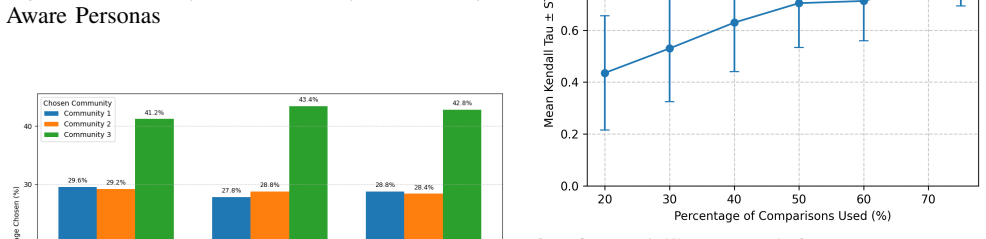
The paper claims that a repair-priority total order can be produced by combining technical dependency structure with synthetic community preferences. In the toy three-community power and water system, the hetero-functional graph fixes which functionalities must be repaired before others, and the LLM personas resolve the remaining incomparabilities. The authors report that the resulting ranking can be approximated from 60 percent of the pairwise comparisons with Kendall's tau above 0.7, that the same global ranking emerges for community-aware and community-unaware personas, and that the Social Vulnerability Score is the dominant factor in the personas' choices. They present this as a proof of concept and state plainly that the simulated preferences may not match how real people behave in stressful situations.
Load-bearing premise
The load-bearing premise is that LLM personas built from census attributes and disaster scenarios produce preferences that can stand in for real community members during a disaster; the paper itself notes this is unvalidated.
Editorial extensions
If this is right
- Using only 60 percent of the pairwise comparisons, chainization with pseudo-pairs recovers the full-data ranking with Kendall's tau above 0.7, so survey effort can be nearly halved.
- The final global ranking was identical for community-aware and community-unaware personas, showing that community identity did not drive prioritization in this scenario.
- Top-ranked repairs stay stable across prompt variations, while lower-ranked items shift; removing the Social Vulnerability Score explanation gives the highest agreement with the original ranking, tau = 0.72.
- The system ranks school and residential repairs highest and places the most vulnerable community near the top, indicating that vulnerability weighs more than affiliation in LLM choices.
- The unified ranking can be produced pre-disaster and used for planning and cross-sector investment decisions, not only for immediate response.
Reading between the lines
- If the central claim holds, the dominance of the Social Vulnerability Score in LLM choices suggests real residents may also weight vulnerability heavily, but this needs direct elicitation to confirm.
- The 60-percent recovery result implies active learning could select the most informative pairwise comparisons and cut survey burden further than random sampling does.
- The method's reliance on simulated personas means it could be repurposed to generate synthetic preferences for new communities from prior survey data, a direction the authors flag for future work.
- A single cross-sector repair list suits planning and investment decisions, but field deployment would need to respect specialized crews for water, power, and transportation.
Editorial analysis
A structured set of objections, weighed in public.
Referee Report
Summary. The paper proposes a pipeline for disaster repair prioritization: a hetero-functional graph (HFG) imposes a partial order on repair tasks; LLM-generated personas, built from census-like attributes, answer pairwise comparison questions; a neural comparator learns preferences from aggregated soft labels; and a chainization algorithm with pseudo-pairs converts partial data into a total order. Experiments examine the effect of community awareness, partial-data recovery, and prompt sensitivity. The headline claim is that using 60% of the pairwise comparisons yields Kendall tau above 0.7 against the full-data ranking, and that top priorities are stable across prompt variations.
Significance. If the claims were externally validated, the paper would offer a scalable and low-cost way to elicit community input for infrastructure repair prioritization, and the public release of code and data is a clear strength. The prompt-sensitivity analysis is a useful first step toward understanding how LLM-generated preferences depend on prompt design. However, the current significance is limited because the evaluation is self-referential and the proxy-survey premise is unvalidated; as it stands, the result is best read as an internal-consistency proof of concept rather than a demonstrated recovery of community preferences.
major comments (4)
- [§III-E and §IV-B] The ground truth used in the recovery experiment is not an external or human-generated ranking: it is the output of the same neural comparator trained on all 36 pairwise questions followed by PageRank, and the pseudo-pairs in §III-E are generated from the model's own preliminary ranking with hard labels [1.0, 0.0]. The reported Kendall tau above 0.7 therefore measures self-consistency of the pipeline rather than recovery of a stable or externally meaningful repair order. I ask for evaluation against held-out pairwise judgments (e.g., leave-one-question-out or a random-feature baseline such as ranking by SVS alone) and for an ablation that removes pseudo-pair fine-tuning.
- [§III-B and §V] The paper's central premise is that LLM-generated personas stand in for real community members during disasters, but no evidence is offered that the simulated preferences match any real population. The manuscript itself concedes in §V that "the preferences generated by the model may not fully match how real people behave." Given that every downstream ranking, recovery experiment, and sensitivity analysis is built on these simulated preferences, the operational conclusions in the Discussion ("reliable prioritization") require either validation against real survey data or a careful narrowing of the claims to "internally consistent LLM-generated preferences." The community-aware versus community-unaware comparison does not address this external validity gap.
- [§IV-B and Figure 6] The recovery curves report only mean Kendall's tau and Top-K overlap, averaged over 100 random trials, with no error bars, confidence intervals, or per-trial variability. With only 36 pairwise questions and a small feature space, the reader cannot assess whether the improvement at 60% is statistically meaningful or an artifact of a particular random split. Please report standard deviations or confidence intervals and, ideally, significance tests against a random-feature or majority-vote comparator.
- [§V] The Discussion states that "we do not ... run explicit ablations to isolate the impact of pseudo-pair fine-tuning." Without such an ablation, the improvement attributed to chainization with pseudo-pairs could be due simply to training on additional synthetic data derived from the model's own predictions. An ablation comparing (i) no pseudo-pairs, (ii) pseudo-pairs from a random ranking, and (iii) pseudo-pairs from the model's preliminary ranking is needed to support the specific mechanism claimed in the headline result.
minor comments (5)
- [§III-B] Persona generation uses GPT-3.5-turbo at temperature 0.9 and response generation at 0.7, but no seed or reproducibility details are given beyond the date and time; given the stochasticity of the API, please report whether the main results are stable across repeated generations.
- [§III-D] The edge direction in the preference graph is defined as "when option 1 is preferred over option 2, an edge (option2 → option1) is added"; since PageRank is used instead of topological sorting, please clarify how edge weights and directions translate into the final ranking and whether cycles are resolved in a way that respects the HFG partial order.
- [§IV-C and Table IV] The claim that "the very top priorities remain stable" is not fully supported by Table IV: the top item changes across variants (e.g., Power Residential in Community 2 is first under "Without SVS" and "Choice First"), and several Kendall tau values have p > 0.05. Please qualify the stability claim.
- [§IV-A] The community-aware versus community-unaware comparison shows identical final rankings, but only one disaster scenario is tested; the conclusion that community identity does not influence prioritization is therefore limited to this toy setting and should be stated as such.
- [§II] Reference [12], which identifies systematic biases in LLM personas, is directly relevant to the paper's external validity limitation; consider using it more prominently in the Discussion to frame the scope of the claims.
Circularity Check
The headline recovery claim is an internal-consistency loop: the 'ground-truth' full-data ranking and the pseudo-pair labels are both outputs of the same LLM-persona + comparator pipeline, so the >0.7 Kendall tau is self-referential rather than external validation.
-
fitted input called prediction
[Section IV-B (Accuracy with Limited Pairwise Comparisons) and Section V (Discussion)]
"Then, we applied Kendall’s τ correlation between the final inferred ranking and the ranking obtained from the full dataset. ... These results show that we can recover good global rankings from limited preference data, which offers a practical way to reduce the burden on survey participants while maintaining decision quality."
The full-data ranking is not an external ground truth: it is produced by the same neural pairwise comparator trained on all 36 LLM-persona questions, followed by PageRank on the model's predicted preference graph. The subset experiment trains another instance of that comparator on a sample of the same questions, then measures agreement with the full-data model's output. Both sides of the Kendall tau are generated by the same LLM-synthetic responses and the same feature-based architecture, so the reported 'recovery' is an internal self-consistency check, not a prediction of real community preferences.
-
fitted input called prediction
[Section III-E (Random Subset Sampling and Fine-Tuning with Pseudo-Pairs)]
"Based on the recovered initial global rank, we generate synthetic pseudo-pairs. We do this by assuming that for any two facilities that have a clear ranking relationship (e.g., A > B), a pseudo-comparison is added with a hard label indicating definite preference,i.e., [1.0, 0.0]."
Pseudo-pairs are constructed from the model's own preliminary ranking: pairs with A>B in that ranking are turned into hard training labels [1.0,0.0]. Thus the model is fine-tuned on its own prior outputs; any resulting ranking is partially a reflection of those self-generated labels rather than of additional independent evidence from the sampled comparisons. Since the evaluation target is also an output of the same model family, the experiment is a closed loop of self-confirmation. The paper's own limitation statement admits no ablation was run to isolate the effect of pseudo-pair fine-tuning, so the contribution of this self-referential step to the reported tau cannot be separated.
full rationale
The paper is transparent that this is a proof of concept and that LLM personas are proxies; I do not count that as circularity by itself. The circular component is confined to the evaluation of the recovery claim. In Section IV-B, the ranking 'obtained from the full dataset' is not a measured community preference order; it is the PageRank of the preference graph predicted by the neural comparator trained on all 36 aggregated LLM responses. The subset model is trained on a random sample of those same questions and then fine-tuned on pseudo-pairs whose hard labels are generated from the subset model's own preliminary ranking (Section III-E). Comparing the subset ranking to the full-data model ranking therefore measures self-consistency of one synthetic-data/model pipeline, not whether 60% of questions recovers an accurate or externally meaningful order. The Discussion's 'reliable prioritization' inference overreaches. However, the result is not forced by construction: the subset model genuinely does not see the held-out comparisons, and the Kendall tau could in principle have been low. The circularity is partial and is exacerbated by the admitted absence of external benchmarks, expert-heuristic comparisons, and pseudo-pair ablations. Other components (HFG partial order, prompt sensitivity analysis, community-aware vs unaware comparison) are not circular. No load-bearing self-citation chain or imported uniqueness theorem is present; the relevant citations to chainization [33] and HFG [8-10] are external. I assign score 5.
Assumptions & free parameters
free parameters (5)
- Temperature for persona generation =
0.9
- Temperature for response generation =
0.7
- Learning rate for comparator network =
1e-3
- Batch size =
8
- Social Vulnerability Score (SVS) scale in prompts =
Inconsistent: paper states 0-1 normalized, prompt template says 0-1, but simulation setup and sample response use…
assumptions (4)
- domain assumption The hetero-functional graph correctly encodes the repair dependencies of the toy infrastructure
- domain assumption LLM personas with census attributes produce preferences representative of real community members
- standard math Aggregating persona votes into soft labels and learning a comparator yields a meaningful social consensus ranking
- standard math PageRank scores provide a consistent total order from the learned pairwise preference graph
Cite this review
Pith. "Pith review of LLM-Based Community Surveys for Operational Decision Making in Interconnected Utility Infrastructures." pith.science (2026). https://pith.science/paper/WWXBUOCS
@misc{pith2026250713577,
  author       = {Pith},
  title        = {Pith review of: LLM-Based Community Surveys for Operational Decision Making in Interconnected Utility Infrastructures},
  year         = {2026},
  howpublished = {\url{https://pith.science/paper/WWXBUOCS}},
  note         = {Machine review of arXiv:2507.13577}
}
read the original abstract
We represent interdependent infrastructure systems and communities alike with a hetero-functional graph (HFG) that encodes the dependencies between functionalities. This graph naturally imposes a partial order of functionalities that can inform the sequence of repair decisions to be made during a disaster across affected communities. However, using such technical criteria alone provides limited guidance at the point where the functionalities directly impact the communities, since these can be repaired in any order without violating the system constraints. To address this gap and improve resilience, we integrate community preferences to refine this partial order from the HFG into a total order. Our strategy involves getting the communities' opinions on their preferred sequence for repair crews to address infrastructure issues, considering potential constraints on resources. Due to the delay and cost associated with real-world survey data, we utilize a Large Language Model (LLM) as a proxy survey tool. We use the LLM to craft distinct personas representing individuals, each with varied disaster experiences. We construct diverse disaster scenarios, and each simulated persona provides input on prioritizing infrastructure repair needs across various communities. Finally, we apply learning algorithms to generate a global order based on the aggregated responses from these LLM-generated personas.
Figures


Figures from the paper (6 more)



Forward citations
Cited by 1 Pith paper
-
LISTEN to Your Preferences: An LLM Framework for Multi-Objective Selection
LISTEN uses LLMs as zero-shot preference oracles, via iterative utility refinement (LISTEN-U) or tournament comparisons (LISTEN-T), to select preferred items from large multi-objective candidate sets.
Reference graph
Works this paper leans on
-
[1]
N. Doorn, P. Gardoni, and C. Murphy, “A multidisciplinary definition and evaluation of resilience: The role of social justice in defining resilience,” Sustainable and Resilient In- frastructure, vol. 4, no. 3, pp. 112–123, 2019
work page 2019
-
[2]
D. P. Eisenman, K. M. Cordasco, S. Asch, J. F. Golden, and D. Glik, “Disaster planning and risk communication with vulnerable communities: lessons from hurricane katrina,” American journal of public health , vol. 97, no. Supplement_1, pp. S109–S115, 2007
work page 2007
-
[3]
Disasters and communities: vul- nerability, resilience and preparedness,
D. Paton and D. Johnston, “Disasters and communities: vul- nerability, resilience and preparedness,” Disaster Prevention and Management: An International Journal , vol. 10, no. 4, pp. 270–277, 2001
work page 2001
-
[4]
W. Zhai, Z.-R. Peng, and F. Yuan, “Examine the effects of neighborhood equity on disaster situational awareness: Harness machine learning and geotagged twitter data,” In- ternational Journal of Disaster Risk Reduction , vol. 48, p. 101611, 2020
work page 2020
-
[5]
Social vulnera- bility and short-term disaster assistance in the united states,
O. Drakes, E. Tate, J. Rainey, and S. Brody, “Social vulnera- bility and short-term disaster assistance in the united states,” International Journal of Disaster Risk Reduction , vol. 53, p. 102010, 2021
work page 2021
-
[6]
S. J. Domingue and C. T. Emrich, “Social vulnerability and procedural equity: Exploring the distribution of disaster aid across counties in the united states,” The American Review of Public Administration , vol. 49, no. 8, pp. 897–913, 2019
work page 2019
-
[7]
Public demand urgency for equitable infrastructure restoration planning,
Y . Chen and W. Ji, “Public demand urgency for equitable infrastructure restoration planning,” International Journal of Disaster Risk Reduction , vol. 64, p. 102510, 2021
work page 2021
-
[8]
W. C. Schoonenberg, I. S. Khayal, and A. M. Farid, A Hetero- functional graph theory for modeling interdependent smart City infrastructure. Springer, 2019
work page 2019
Show all 41 references
-
[9]
A hetero-functional graph structural analysis of the american multi-modal energy sys- tem,
D. J. Thompson and A. M. Farid, “A hetero-functional graph structural analysis of the american multi-modal energy sys- tem,” Sustainable Energy, Grids and Networks , vol. 38, p. 101254, 2024
2024
-
[10]
Robustness assess- ment of hetero-functional graph theory based model of inter- dependent urban utility networks,
S. Munikoti, K. Lai, and B. Natarajan, “Robustness assess- ment of hetero-functional graph theory based model of inter- dependent urban utility networks,” Reliability Engineering & System Safety , vol. 212, p. 107627, 2021
2021
-
[11]
Agentic llm framework for adaptive decision discourse,
A. Dolant and P. Kumar, “Agentic llm framework for adaptive decision discourse,” arXiv preprint arXiv:2502.10978 , 2025
2025
-
[12]
Llm gen- erated persona is a promise with a catch,
A. Li, H. Chen, H. Namkoong, and T. Peng, “Llm gen- erated persona is a promise with a catch,” arXiv preprint arXiv:2503.16527, 2025
2025 arXiv
-
[13]
Argumentative experience: Reducing confir- mation bias on controversial issues through llm-generated multi-persona debates,
L. Shi, H. Liu, Y . Wong, U. Mujumdar, D. Zhang, J. Gwizdka, and M. Lease, “Argumentative experience: Reducing confir- mation bias on controversial issues through llm-generated multi-persona debates,” arXiv preprint arXiv:2412.04629 , 2024
2024
-
[14]
A rag-based multi-agent llm system for natural hazard resilience and adaptation,
Y . Xie, B. Jiang, T. Mallick, J. D. Bergerson, J. K. Hutchison, D. R. Verner, J. Branham, M. R. Alexander, R. B. Ross, Y . Feng, L.-A. Levy, W. Su, and C. J. Taylor, “A rag-based multi-agent llm system for natural hazard resilience and adaptation,” 2025. [Online]. Available: ...
2025 arXiv
-
[15]
Integrating sentiment analysis and reinforce- ment learning for equitable disaster response: A novel ap- proach
S. Alqithami, “Integrating sentiment analysis and reinforce- ment learning for equitable disaster response: A novel ap- proach.” Sustainability (2071-1050) , vol. 17, no. 3, 2025
2025
-
[16]
Intelligent urban emergency response: Integrating large language models, multi-objective optimization, and reinforcement learning,
S. Chen, G. Luo, and L. Chen, “Intelligent urban emergency response: Integrating large language models, multi-objective optimization, and reinforcement learning,” in 2024 IEEE Smart World Congress (SWC) . IEEE, 2024, pp. 1469–1476
2024
-
[17]
En- hancing emergency decision-making with knowledge graphs and large language models,
M. Chen, Z. Tao, W. Tang, T. Qin, R. Yang, and C. Zhu, “En- hancing emergency decision-making with knowledge graphs and large language models,” International Journal of Disaster Risk Reduction , vol. 113, p. 104804, 2024
2024
-
[18]
Eq- uitable prioritization of bridge rehabilitation projects using a spatial multi-criteria decision support framework,
N. Mohamadiazar, A. Ebrahimian, and A. Azizinamini, “Eq- uitable prioritization of bridge rehabilitation projects using a spatial multi-criteria decision support framework,” Trans- portation Research Record , p. 03611981241254110, 2024
2024
-
[19]
A decision support system for infrastructure rehabilitation planning,
M. Hastak, Q. Cui, B. Safi, and S. Gokhale, “A decision support system for infrastructure rehabilitation planning,” in Computing in Civil Engineering (2005) , 2005, pp. 1–10
2005
-
[20]
A multi-criteria decision-making model using socio-technical attributes for transportation bridge maintenance prioritisation,
R. Das and M. Nakano, “A multi-criteria decision-making model using socio-technical attributes for transportation bridge maintenance prioritisation,” International Journal of Construction Management, vol. 23, no. 4, pp. 579–585, 2023
2023
-
[21]
Decision-making criteria and indicators for water and sanitation projects in developing countries,
M. Garfì and L. Ferrer-Martí, “Decision-making criteria and indicators for water and sanitation projects in developing countries,” Water Science and Technology , vol. 64, no. 1, pp. 83–101, 2011
2011
-
[22]
Multicriteria-decision support for master plan scheduling: urban regeneration of an industrial area in north- ern italy,
F. Dell’Anna, M. Berta, M. Bottero, G. Mallia, and V . Morgese, “Multicriteria-decision support for master plan scheduling: urban regeneration of an industrial area in north- ern italy,” Construction Management and Economics , vol. 42, no. 5, pp. 476–501, 2024
2024
-
[23]
Prioritizing infrastructure investment: a framework for gov- ernment decision making,
D. Marcelo, C. Mandri-Perrott, S. House, and J. Schwartz, “Prioritizing infrastructure investment: a framework for gov- ernment decision making,” World Bank Policy Research Work- ing Paper, no. 7674, 2016
2016
-
[24]
Design of a prioritization methodology for equitable infrastructure planning,
R. Dhansinghani, A. Ibrahim, A. Kannoth, C. Miller, L. Nguyen, S. Pham, and R. Bailey, “Design of a prioritization methodology for equitable infrastructure planning,” in 2022 Systems and Information Engineering Design Symposium (SIEDS). IEEE, 2022, pp. 315–320
2022
-
[25]
Priority-based decision model for rehabilitation of water networks using fahp,
S. Karasneh and S. Moqbel, “Priority-based decision model for rehabilitation of water networks using fahp,” Water Con- servation & Management , vol. 8, no. 1, 2024
2024
-
[26]
Integrating sustainability in municipal wastew- ater infrastructure decision-analysis using the analytic hi- erarchy process,
H. S. Galal, “Integrating sustainability in municipal wastew- ater infrastructure decision-analysis using the analytic hi- erarchy process,” Ph.D. dissertation, University of British Columbia, 2013
2013
-
[27]
The bridge maintenance factors model: a pls-sem approach,
N. P. Pramesti, H. Priyosulistyo, A. Aminullah, and A. Koes- margono, “The bridge maintenance factors model: a pls-sem approach,” Age, vol. 22, p. 18, 2021
2021
-
[28]
Multi-criteria decision support for annual rehabilitation programmes in drinking wa- ter networks,
R. Baur, P. Le Gauffre, and S. Sægrov, “Multi-criteria decision support for annual rehabilitation programmes in drinking wa- ter networks,” Water Science and Technology: Water Supply , vol. 3, no. 1-2, pp. 43–50, 2003
2003
-
[29]
Preference completion: Large-scale collaborative ranking from pairwise comparisons,
D. Park, J. Neeman, J. Zhang, S. Sanghavi, and I. Dhillon, “Preference completion: Large-scale collaborative ranking from pairwise comparisons,” in International Conference on Machine Learning . PMLR, 2015, pp. 1907–1916
2015
-
[30]
Preference completion from partial rankings,
S. Gunasekar, O. O. Koyejo, and J. Ghosh, “Preference completion from partial rankings,” Advances in Neural In- formation Processing Systems , vol. 29, 2016
2016
-
[31]
Semi-supervised learning to rank with preference regularization,
M. Szummer and E. Yilmaz, “Semi-supervised learning to rank with preference regularization,” in Proceedings of the 20th ACM international conference on Information and knowledge management, 2011, pp. 269–278
2011
-
[32]
Gnnrank: Learning global rankings from pairwise comparisons via directed graph neural networks,
Y . He, Q. Gan, D. Wipf, G. D. Reinert, J. Yan, and M. Cu- curingu, “Gnnrank: Learning global rankings from pairwise comparisons via directed graph neural networks,” in interna- tional conference on machine learning . PMLR, 2022, pp. 8581–8612
2022
-
[33]
Order learning using partially ordered data via chainization,
S.-H. Lee and C.-S. Kim, “Order learning using partially ordered data via chainization,” in European Conference on Computer Vision. Springer, 2022, pp. 196–211
2022
-
[34]
CommRank-HFG,
A. Okeukwu-Ogbonnaya, “CommRank-HFG,” https://github. com/adaezy/CommRank-HFG, 2025
2025
-
[35]
Social vulnerability score: a scalable index for representing social vulnerability in virtual community resilience testbeds,
S. A. Enderami and E. Sutley, “Social vulnerability score: a scalable index for representing social vulnerability in virtual community resilience testbeds,” Natural Hazards , vol. 120, no. 7, pp. 6457–6480, 2024
2024
-
[36]
Ranking under uncer- tainty,
O. Zuk, L. Ein-Dor, and E. Domany, “Ranking under uncer- tainty,” arXiv preprint arXiv:1206.5280 , 2012
2012 arXiv
-
[37]
Koios: Top-k semantic overlap set search,
P. Mundra, J. Zhang, F. Nargesian, and N. Augsten, “Koios: Top-k semantic overlap set search,” in 2023 IEEE 39th Inter- national Conference on Data Engineering (ICDE) . IEEE, 2023, pp. 1531–1543
2023
-
[38]
State of what art? a call for multi- prompt llm evaluation,
M. Mizrahi, G. Kaplan, D. Malkin, R. Dror, D. Shahaf, and G. Stanovsky, “State of what art? a call for multi- prompt llm evaluation,” Transactions of the Association for Computational Linguistics , vol. 12, pp. 933–949, 2024
2024
-
[39]
Posix: A prompt sensitivity index for large language models,
A. Chatterjee, H. K. Renduchintala, S. Bhatia, and T. Chakraborty, “Posix: A prompt sensitivity index for large language models,” arXiv preprint arXiv:2410.02185 , 2024
2024 arXiv
-
[40]
Prompt sentiment: The catalyst for llm change,
V . Gandhi and S. Gandhi, “Prompt sentiment: The catalyst for llm change,” arXiv preprint arXiv:2503.13510 , 2025
2025 arXiv
-
[41]
Does prompt formatting have any impact on llm performance?
J. He, M. Rungta, D. Koleczek, A. Sekhon, F. X. Wang, and S. Hasan, “Does prompt formatting have any impact on llm performance?” arXiv preprint arXiv:2411.10541 , 2024
2024 arXiv
Reviewed August 6, 2026 · model on record in the stance chip above.
Discussion (0). Sign in to comment.