REVIEW 3 major objections 5 minor 29 references
A large language model, guided by one natural-language priority statement, can pick the preferred item from thousands of multi-attribute candidates.
Reviewed by Pith at T0; open to challenge. T0 means a machine referee read the full paper against a public rubric. the ladder, T0–T4 →
T0 review · deepseek-v4-flash
2026-08-04 07:34 UTC pith:MS6EBGAT
load-bearing objection Useful, clearly written LLM selection framework; the headline claims rest on a coarse ranking metric, and the appendix's own utility metric reverses some conclusions, so treat the method ranking as provisional. the 3 major comments →
LISTEN to Your Preferences: An LLM Framework for Multi-Objective Selection
The pith
A machine-rendered reading of the paper's core claim, the machinery that carries it, and where it could break.
Core claim
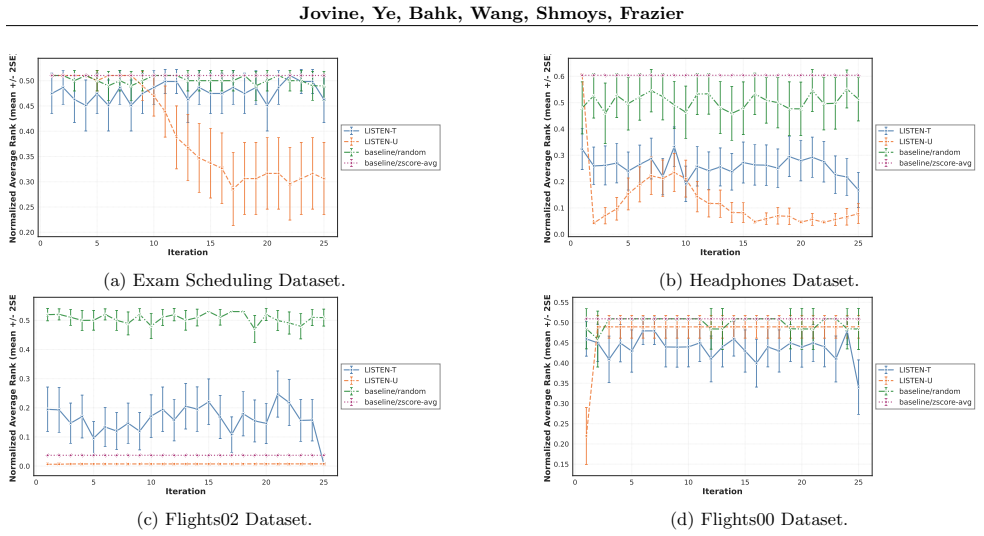
The paper's central claim is that an LLM can act as a zero-shot preference oracle for multi-objective selection: given a set of items described by numerical, categorical, and textual attributes, plus a natural-language utterance describing the decision maker's goals, the framework can identify the most preferred item using only a small number of LLM calls. The claim is supported by two mechanisms. LISTEN-U assumes a linear utility function over normalized numerical attributes and iteratively asks the LLM to critique the current best solution and propose refined weights; this lets it improve dramatically even on the lowest-concordance dataset, exam scheduling. LISTEN-T avoids parametric assum
What carries the argument
The key machinery is the LLM used as a zero-shot preference oracle inside two iterative algorithms. LISTEN-U maintains a weight vector for a linear utility function u(s)=w^T s_num; each iteration it shows the LLM the current best solution unnormalized and asks for revised weights, then rescales scores across the whole set using normalized attributes. LISTEN-T samples batches of size B uniformly, asks the LLM to pick the best in each batch, and then runs a final LLM playoff over the batch champions. A supporting object is the concordance metric: the proportion of 1,000 random linear utility functions for which the argmax equals the human's top-ranked item; low concordance flags datasets where
Load-bearing premise
The evaluation treats the rankings of one self-selected expert per domain—the same person who wrote the preference utterance—as ground truth; if that expert's preferences or phrasing do not represent the target user population, the relative ranking of the algorithms could change.
What would settle it
Have several independent human experts rank the same candidate items from the same written preference utterance, then rerun the comparison. If LISTEN-T no longer consistently beats the z-score baseline across those experts, or if LISTEN-U fails to outperform baselines on the high-concordance headphones dataset, the central claim would be refuted. A cheaper check: re-estimate the concordance metric using each expert's top-ranked item and see whether the predicted 'hard' datasets stay hard.
If this is right
- If the claims hold, a decision maker can replace pairwise comparisons or utility queries with one natural-language sentence, and the LLM will select from thousands of options within a few dozen calls.
- LISTEN-U's iterative refinement can overcome a bad initial linear model on low-concordance problems, so parametric utility methods need not be abandoned when preferences are non-linear.
- LISTEN-T provides a robust fallback that never underperforms the z-score baseline across the tested domains, so a non-parametric tournament is a safe default when preference structure is unknown.
- Including the natural-language preference utterance was never harmful and often helped, particularly for subjective preferences like headphone shopping, so richer preference text is a safe investment.
- The concordance metric gives a dataset-inherent difficulty score, independent of any algorithm, which can predict when a linear-utility method will pay off.
Where Pith is reading between the lines
- The paper's single-expert ground truth leaves open whether these methods generalize to a population; a direct extension would be to test LISTEN with multiple experts who independently rank the same items and see if LISTEN-T remains robust and LISTEN-U still wins on high-concordance subsets.
- The concordance metric could be repurposed as an online diagnostic: before running LISTEN-U, sample a few random linear utilities, compare their top items, and decide which algorithm to deploy—this is a testable extension the paper does not run.
- If natural-language preference oracles become reliable, the bottleneck shifts to writing good utterances; the paper's ablations suggest the marginal value of utterance detail is domain-dependent, so future work might learn to rewrite user statements for maximal selectivity.
Editorial analysis
A structured set of objections, weighed in public.
Referee Report
Summary. The paper proposes LISTEN, an agentic LLM framework for selecting a single preferred item from a large multi-attribute candidate set using only a natural-language preference utterance. Two algorithms are presented: LISTEN-U, which iteratively asks an LLM to refine the weights of a linear utility function, and LISTEN-T, which samples small batches and runs an LLM tournament. Using one expert-authored preference utterance and partial expert rankings per domain, the authors compare against random and z-score baselines on flight, shopping, and exam-scheduling datasets, reporting Normalized Average Rank (NAR) over 25 iterations, plus a concordance metric meant to predict when linear-utility methods succeed. They report that LISTEN-U excels on exam scheduling and high-concordance domains while failing on one flight dataset, and that LISTEN-T is robust across all.
Significance. The potential contribution is real: if LLMs can translate a short preference statement into a good selection after a bounded number of calls, it would reduce the elicitation burden in multi-objective choice. Strengths include the clear algorithmic framework, two LLMs, 50 replications with error bars, public code/data, and an honest appendix that introduces a second metric. However, the empirical case is not yet conclusive: the primary metric collapses all unranked items into one score, and the authors’ own auxiliary metric reverses several method rankings. The single-expert ground truth also limits generalization. The work is a promising proof of concept, but the central claims are metric-dependent and need strengthening.
major comments (3)
- [§4.4, Table 1, Appendix B.3] The primary metric makes the central ranking fragile. NAR assigns every unranked item the same value (m+1+N)/2, and Table 1 shows m/N is 0.020–0.195. Consequently NAR is essentially a top-m hit rate: every miss is scored ~0.5 and only hits inside a tiny ranked set receive differentiated credit. The paper itself concedes this in Appendix B, yet the alternative AUS metric reverses the conclusions on low-concordance datasets: B.3 reports that on Exam, LISTEN-U’s NAR improves while its AUS shows little improvement, and on Flights00/01 LISTEN-U is best by AUS but worst by NAR. The statement in §4.5 that LISTEN-U “progressively refines its utility function to find dramatically better solutions” on Exam is therefore not supported independently of a metric that cannot distinguish among the vast majority of items. Please report a metric that gives partial credit to unranked items or top-k hit rat
- [§4.1, §5] The ground truth for every dataset is a single self-selected expert who also wrote the natural-language utterance used by the algorithms. There is no inter-rater reliability, no held-out expert, and no multi-user validation. The paper acknowledges this as a limitation, but it is load-bearing because the method ranking—especially the claim that LISTEN-U “excels” on a given dataset—could change with a different expert’s preferences or phrasing. At minimum, add a second expert for a subset of datasets or an utterance-sensitivity analysis; otherwise the conclusions should be framed as a single-user proof of concept.
- [§1.1, §4.5] The paper uses “significantly outperforms” and “best performance” without formal significance tests. The 50-replication error bars are helpful, but overlapping intervals and multiple comparisons across 25 iterations and five datasets make informal comparisons unreliable. Report paired tests (e.g., bootstrap or Wilcoxon over seeds) for the final iteration and for the learning trajectory, and correct for multiple comparisons.
minor comments (5)
- [§4.2] Please clarify what randomness is used for LISTEN-U, since the algorithm is deterministic given the LLM outputs. Is it sampling temperature, and how is it controlled across replications?
- [Appendix B.1] The ranked-vs-unranked comparisons always label the ranked item as preferred. This can bias the fitted utility function, especially when ranked items are a tiny subset. Please justify this choice or test its sensitivity.
- [Figures 5 and 9] The “Hidden ground truth max” line and the scaling of AUS are not clearly defined. The AUS ranges differ wildly across datasets (e.g., ~0.04 for Exam vs ~80 for Flights01), making the plots hard to interpret. Add definitions and axis explanations.
- [Appendix E.1] The text contains informal phrasing (“chalked up to differences in LLM”) and a typo (“performing”). Also, the Gemini 2.5 reference has a placeholder author list “(and many authors)” that should be completed.
- [§4.7, Appendix D] The claim that including the preference utterance “never degraded performance” is asserted from plots without numerical support. Report the relevant aggregated numbers for the final iteration.
Circularity Check
No significant circularity: the central evaluation chain is empirical and the algorithm outputs are not derived from the human rankings or from the auxiliary fitted utility.
full rationale
The paper's central claim is an empirical comparison of LISTEN-U, LISTEN-T, and baselines against human rankings. The algorithm outputs are produced by LLM calls from the natural-language utterance and candidate sets; the human rankings are not used to construct or refine those outputs. Normalized Average Rank is coarse (all unranked items share one average rank), but that is a metric-resolution limitation, not a circular reduction: the metric does not define the algorithms' outputs. The concordance metric is an independent dataset property (fraction of random linear utilities matching the human top item), and the validation in Section 4.6 is a separate experimental test, not a fitted-input-as-prediction step. The Average Utility Score in Appendix B fits a linear utility to the same human rankings and then scores algorithm outputs with it; although this is a self-referential evaluation form and can flatter a linear-utility method like LISTEN-U, the paper does not use it to generate the algorithm's choices, and it explicitly reports divergence between NAR and AUS and frames AUS as complementary, not as a prediction. The only self-citation, Ye et al. (2024), is used to generate the exam-scheduling candidate set and is not load-bearing for the framework's claims. The acknowledged single-expert ground-truth limitation is a benchmarking-validity concern, not a circular-derivation concern. No equation or metric in the paper reduces the claimed predictions to their own inputs by construction, so no circular step is present.
Axiom & Free-Parameter Ledger
free parameters (5)
- LISTEN-T batch size B =
not reported in the paper (only in code)
- Number of refinement iterations T =
25 in all plots
- Concordance sampling distribution =
U[-1,1] with 1,000 samples
- AUS logistic-regression hyperparameters =
q=0.95, N=10,000, 5,000/5,000 split
- Domain prompt templates and preference utterance wording =
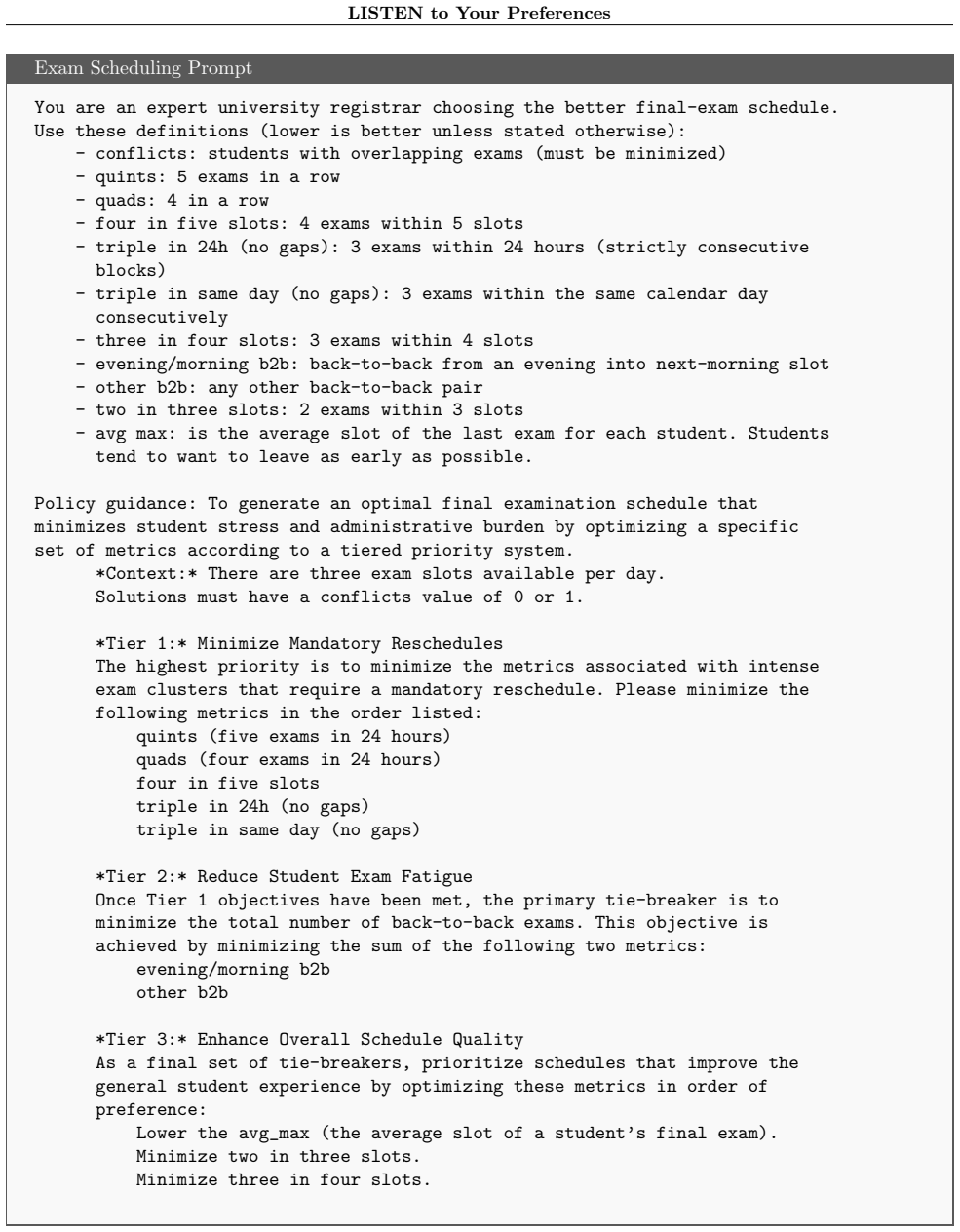
hand-authored per dataset
axioms (5)
- domain assumption A pretrained LLM can act as a zero-shot preference oracle whose comparative judgments align with the target human's preferences (Section 3.1).
- domain assumption Linear utility over normalized numerical attributes is an adequate preference model for LISTEN-U's intended settings (Algorithm 1).
- domain assumption Single-expert rankings of a small subset of items constitute valid ground truth (Section 4.1).
- domain assumption The concordance metric—fraction of random linear utilities matching the human's top pick—measures the difficulty a parametric approach will face (Section 4.4).
- domain assumption The natural-language utterance U faithfully and completely expresses the same preferences used to produce the ground-truth ranking (Section 4.1).
read the original abstract
Human experts often struggle to select the best option from a large set of items with multiple competing objectives, a process bottlenecked by the difficulty of formalizing complex, implicit preferences. To address this, we introduce LISTEN (LLM-based Iterative Selection with Trade-off Evaluation from Natural-language), an agentic LLM-based framework that treats the LLM as a decision-making agent capable of iteratively refining its internal preference model and taking actions (e.g., proposing utilities or selecting candidates) to maximize alignment with a user's implicit goals. To operate within LLM constraints like context windows and inference costs, we propose two iterative algorithms: LISTEN-U, which uses the LLM to refine a parametric utility function, and LISTEN-T, a non-parametric method that performs tournament-style selections over small batches of solutions. Evaluated on diverse tasks including flight booking, shopping, and exam scheduling, our results show LISTEN-U excels when preferences are parametrically aligned (a property we measure with a novel concordance metric), while LISTEN-T offers more robust performance overall. This work explores a promising direction for steering complex multi-objective decisions directly with natural language, reducing the cognitive burden of traditional preference elicitation. Code is available at https://github.com/AdamJovine/LISTEN; data is available at https://huggingface.co/datasets/AdamJovine/LISTEN-benchmark.
Figures





Reference graph
Works this paper leans on
-
[1]
AhmadiTeshnizi, A., Gao, W., and Udell, M. (2023). Optimus: Optimization modeling using mip solvers and large language models. arXiv preprint arXiv:2310.06116
Pith/arXiv arXiv 2023
-
[2]
E., Korikov, A., Toroghi, A., and Sanner, S
Austin, D. E., Korikov, A., Toroghi, A., and Sanner, S. (2024). Bayesian optimization with llm-based acquisition functions for natural language preference elicitation. arXiv preprint arXiv:2405.00981
Pith/arXiv arXiv 2024
-
[3]
Bang, S. and Song, H. (2025). Llm-based user profile management for recommender system. arXiv preprint arXiv:2502.14541
Pith/arXiv arXiv 2025
-
[4]
Branke, J. (2008). Multiobjective optimization: Interactive and evolutionary approaches , volume 5252. Springer Science & Business Media
2008
-
[5]
C., Jacobsson, H., Szpektor, I., Jiang, N.-J., Haridasan, K., and (and many authors),
Comanici, G., Bieber, E., Schaekermann, M., Pasupat, I., Sachdeva, N., Dhillon, I., Blistein, M., Ram, O., Zhang, D., Rosen, E., Marris, L., Petulla, S., Gaffney, C., Aharoni, A., Lintz, N., Pais, T. C., Jacobsson, H., Szpektor, I., Jiang, N.-J., Haridasan, K., and (and many authors), . (2025). Gemini 2.5: Pushing the frontier with advanced reasoning, mul...
2025
-
[6]
and Alireza B, D
Farzane, K. and Alireza B, D. (2022). A review and evaluation of multi and many-objective optimization: Methods and algorithms. Global Journal of Ecology , 7(2):104–119
2022
-
[7]
Gao, T., Xu, R., Wang, W., and Chen, D. (2025). Take caution in using llms as human surrogates: Scylla ex machina. arXiv preprint arXiv:2410.19599
Pith/arXiv arXiv 2025
-
[8]
Gunantara, N. (2018). A review of multi-objective optimization: Methods and its applications. Cogent Engineering , 5(1):1502242
2018
-
[9]
Huang, C., Tang, Z., Hu, S., Jiang, R., Zheng, X., Ge, D., Wang, B., and Wang, Z. (2025). Orlm: A customizable framework in training large models for automated optimization modeling. Operations Research
2025
-
[10]
Huber, F., Gonzalez, S. R., and Astudillo, R. (2025). Bayesian preference elicitation for decision support in multiobjective optimization. arXiv preprint arXiv:2507.16999
arXiv 2025
-
[11]
Klamkin, M., Deza, A., Cheng, S., Zhao, H., and Van Hentenryck, P. (2025). Dualschool: How reliable are llms for optimization education? arXiv preprint arXiv:2505.21775
Pith/arXiv arXiv 2025
-
[12]
Knowles, J. D. (2006). Parego: A hybrid algorithm with on-line landscape approximation for expensive multiobjective optimization problems. IEEE Transactions on Evolutionary Computation , 10(1):50--66
2006
-
[13]
Lawless, C., Li, Y., Wikum, A., Udell, M., and Vitercik, E. (2025). Llms for cold-start cutting plane separator configuration. In International Conference on the Integration of Constraint Programming, Artificial Intelligence, and Operations Research , pages 51--69. Springer
2025
-
[14]
Lawless, C., Schoeffer, J., Le, L., Rowan, K., Sen, S., Hill, C. S., Suh, J., and Sarrafzadeh, B. (2023). “I Want It That Way”: Enabling Interactive Decision Support Using Large Language Models and Constraint Programming . arXiv preprint arXiv:2312.06908 . Submitted December 12, 2023; revised October 1, 2024
Pith/arXiv arXiv 2023
-
[15]
Li, F. et al. (2025). Aligning with logic: Measuring, evaluating and improving logical preference consistency. In Proceedings of the 42nd International Conference on Machine Learning (ICML) . Poster
2025
-
[16]
The llama 3 herd of models
Meta AI (2024). The llama 3 herd of models
2024
-
[17]
Obayashi, S., Jeong, S., Chiba, K., and Morino, H. (2007). Multi-objective design exploration and its application to regional-jet wing design. Transactions of the Japan Society for Aeronautical and Space Sciences , 50(167):1--8
2007
-
[18]
Okeukwu-Ogbonnaya, A., Amatapu, R., Bergtold, J., and Amariucai, G. (2025). Llm-based community surveys for operational decision making in interconnected utility infrastructures. arXiv preprint arXiv:2507.13577
Pith/arXiv arXiv 2025
-
[19]
Ouyang, L., Wu, J., Jiang, X., Almeida, D., Wainwright, C., Mishkin, P., Zhang, C., Agarwal, S., Slama, K., Ray, A., et al. (2022). Training language models to follow instructions with human feedback. Advances in neural information processing systems , 35:27730--27744
2022
-
[20]
Ozaki, R., Ishikawa, K., Kanzaki, Y., Suzuki, S., Takeno, S., Takeuchi, I., and Karasuyama, M. (2024). Multi-objective bayesian optimization with active preference learning. In Proceedings of the Thirty-Eighth AAAI Conference on Artificial Intelligence , pages 14490--14498, Vancouver, Canada. AAAI Press
2024
-
[21]
Ramamonjison, R., Yu, T., Li, R., Li, H., Carenini, G., Ghaddar, B., He, S., Mostajabdaveh, M., Banitalebi-Dehkordi, A., Zhou, Z., et al. (2023). Nl4opt competition: Formulating optimization problems based on their natural language descriptions. In NeurIPS 2022 competition track , pages 189--203. PMLR
2023
-
[22]
Schwartz, B. (2015). The paradox of choice. Positive psychology in practice: Promoting human flourishing in work, health, education, and everyday life , pages 121--138
2015
-
[23]
and Kumar, V
Sharma, S. and Kumar, V. (2022). A comprehensive review on multi-objective optimization techniques: Past, present and future. Archives of Computational Methods in Engineering , 29(7):5605--5633
2022
-
[24]
Wang, X., Jin, Y., Schmitt, S., and Olhofer, M. (2022). Recent advances in bayesian optimization. arXiv preprint arXiv:2206.03301
Pith/arXiv arXiv 2022
-
[25]
J., Han, X., Fu, X., Zhong, T., Zeng, J., Song, M., et al
Xiao, Z., Zhang, D., Wu, Y., Xu, L., Wang, Y. J., Han, X., Fu, X., Zhong, T., Zeng, J., Song, M., et al. (2023). Chain-of-experts: When llms meet complex operations research problems. In The twelfth international conference on learning representations
2023
-
[26]
V., Zhou, D., and Chen, X
Yang, C., Wang, X., Lu, Y., Liu, H., Le, Q. V., Zhou, D., and Chen, X. (2023). Large language models as optimizers. In The Twelfth International Conference on Learning Representations
2023
-
[27]
Ye, T., Jovine, A., van Osselaer, W., Zhu, Q., and Shmoys, D. B. (2024). Cornell university uses integer programming to optimize final exam scheduling. arXiv preprint arXiv:2409.04959
arXiv 2024
-
[28]
Zhang, H., Zhu, Q., and Dou, Z. (2025). Enhancing reranking for recommendation with llms through user preference retrieval. Proceedings of the 31st International Conference on Computational Linguistics , pages 658--671
2025
-
[29]
Zheng, L., Chiang, W.-L., Sheng, Y., Zhuang, S., Wu, Z., Zhuang, Y., Lin, Z., Li, Z., Li, D., Xing, E., et al. (2023). Judging llm-as-a-judge with mt-bench and chatbot arena. Advances in neural information processing systems , 36:46595--46623
2023
discussion (0)
Sign in with ORCID, Apple, or X to comment. Anyone can read and Pith papers without signing in.