REVIEW 4 major objections 5 minor 41 references
EPSilon: Efficient Point Sampling for Lightening of Hybrid-based 3D Avatar Generation
T0 review · 4 major / 5 minor · reviewed 2026-08-06 · deepseek-v4-flash
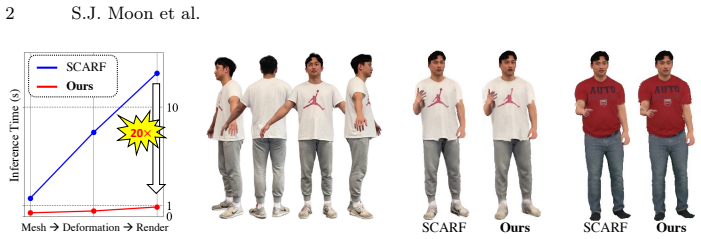
Pith's one-line read Hybrid avatars render 20x faster by skipping empty space.
desk verdict Useful observation-space sampling for hybrid avatars with a real speedup, but the ERO candidate map can drop thin new regions and needs a disocclusion stress test. read the letter →
The pith
A machine-rendered reading of the paper's core claim, the machinery that carries it, and where it could break.
The reading
What carries the argument
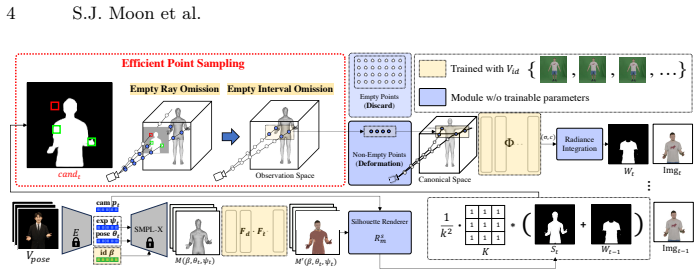
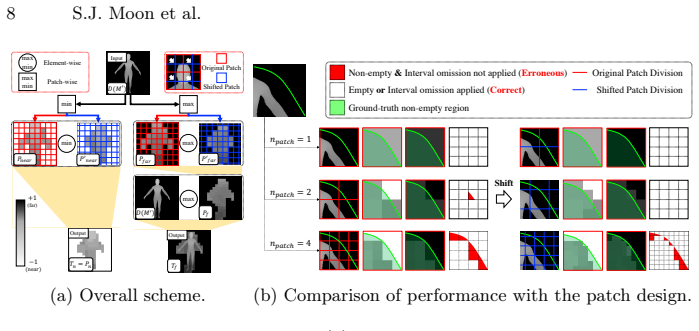
The load-bearing mechanism is the candidate map $\mathrm{cand}_t$ for empty ray omission, combined with the shifted-patch depth interval for empty interval omission. $\mathrm{cand}_t$ scores each ray: during training it is a dilated silhouette $S_t * K_1$ of the refined SMPL mesh $M'$, and at inference it is $(W_{t-1} + S_t) * K_2$, the sum of the previous frame's accumulated opacity weight map and the current silhouette, convolved with a smaller dilation kernel. Rays with score below $\tau_{\mathrm{ERO}} = 0.9$ are skipped. EIO takes the depth map $D(M')$, computes the minimum and maximum depths in each patch of the original and a shifted window (shifted by $k_{\mathrm{patch}}//2$), and sets the near bound to the smaller minimum and the far bound to the larger maximum, so points are sampled only in the vicinity of the mesh. These two pruning steps act before deformation, which is why the speedup transfers directly to the skinning-weight bottleneck.
What would settle it
Render a subject with a quick arm raise or a turn that exposes a region of clothing absent from the previous frame; if EPSilon permanently renders those pixels as background (because the omitted ray is never added to the candidate map), the temporal coverage assumption fails. A quantitative version: compute the fraction of ground-truth non-empty rays that fall outside $\mathrm{cand}_t$ on such frames; if it exceeds the dilation margin, the method's core pruning guarantee is violated.
Extended reading notes
Core claim
The central claim is that the deformation bottleneck in hybrid avatar rendering is avoidable because almost all sampled points are empty. EPSilon therefore prunes both rays and intervals before any skinning-weight deformation runs, using a candidate map for ray pruning and a shifted-patch depth interval for interval pruning. With only 3.9% of the original samples (28 points per ray, no hierarchical sampling), the method produces images within about 0.2 dB PSNR of SCARF on the tested subjects, and in one case (female-4-casual) slightly exceeds it. The paper attributes the retained quality to EIO's concentration of samples near the mesh, which yields a higher density of useful points than uniform sampling of the full cube.
Load-bearing premise
The method assumes that the previous frame's accumulated opacity map, after dilation, already covers every ray that could hold visible content in the current frame, so any region that appears for the first time—through fast motion or disocclusion—can be dropped permanently.
Editorial extensions
If this is right
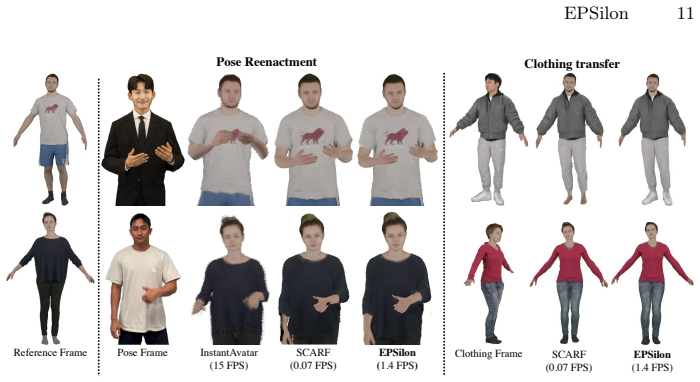
- Hybrid avatar pipelines that currently run at 0.07 FPS could reach around 1.4 FPS on a single GPU, making interactive pose reenactment and virtual try-on practical.
- Because the pruning happens before deformation, the speedup applies to any hybrid method whose deformation uses SMPL skinning weights, not just the specific baseline.
- The removal of hierarchical sampling means a single NeRF stage suffices, simplifying the architecture and cutting training time by about 4x.
- Quality stays within about 0.2 dB PSNR or better of SCARF on the People Snapshot evaluations, so the speed gain does not come at a visible fidelity cost for the tested subjects.
Reading between the lines
- Beyond the paper: the temporal candidate map suggests a natural stress test—sequences with fast motion or newly exposed cloth will reveal whether the previous frame's weight map, even dilated, covers all non-empty rays; a failure would make errors permanent because dropped rays never re-enter the candidate map.
- Beyond the paper: EIO's patch bounds could be made per-pixel using depth uncertainty, trading a little extra computation for tighter intervals around complex cloth geometry.
- Beyond the paper: because pruning happens before deformation, EPSilon's strategy composes with other NeRF acceleration techniques (hash encodings, tensor decompositions), which may push hybrid avatars toward real-time.
Editorial analysis
A structured set of objections, weighed in public.
Referee Report
Summary. EPSilon is a hybrid SMPL-X + NeRF avatar pipeline with two parameter-free sampling-pruning mechanisms. Empty Ray Omission (ERO) builds a per-frame candidate map from the previous frame's accumulated opacity and the current mesh silhouette, applies an averaging convolution, and skips rays whose candidate score falls below 0.9. Empty Interval Omission (EIO) restricts per-ray sampling to near-mesh depth intervals using patch-wise and shifted-window min/max depth statistics. On People Snapshot and self-captured data the paper reports PSNR/SSIM comparable to SCARF while using 3.9% of the sample budget, roughly 20x faster inference, and 4x faster training.
Significance. If the stated results hold, the contribution is useful: it attacks the deformation bottleneck of LBS-based hybrid avatars, is orthogonal to rendering-level accelerators, and involves no trainable parameters or architectural changes. The ablation in Table 4 shows that simple ray/interval pruning can reduce sample count by an order of magnitude on the tested subject. However, the current evidence is weaker than the abstract claims: quality comparisons have no error bars, novel-pose and clothing-transfer evaluations are qualitative only, one load-bearing temporal assumption in ERO is not stress-tested, and essential implementation details are relegated to an absent appendix. The core idea is plausible and worth publication after the missing evidence and analyses are supplied.
major comments (4)
- [§3.2, Eq. (5)] The ERO candidate-map construction has a load-bearing temporal failure mode that is not addressed. In Eq. (5), cand_t depends on W_{t-1}, but W_t is computed only for rays that pass Eq. (4). If a ray is misclassified as empty at frame t, it contributes no opacity, so its W_t is zero; at future frames the only support for a clothing-only pixel is the mesh silhouette S_t, which does not contain clothes. A single miss can therefore become self-sustaining under fast motion or disocclusion. Moreover, K2 is an averaging filter, not a dilation, and the threshold is 0.9: a newly visible one-pixel-wide cloth region has candidate value roughly 1/k2^2 after the average, which is far below 0.9, so thin or boundary content is eroded rather than dilated. The quantitative evaluation in Tables 2 and 4 is reconstruction/ablation on smooth sequences, while pose reenactment in Fig. 6 is qualitative only. Please add an explicit experiment with fast motions, disocclusion, or newly appearing clothing, report missed-ray rates over time, or replace the averaging kernel and fixed threshold with a true max-dilation strategy and re-evaluate.
- [Tables 2 and 4] The central 'maintained quality' claim is not statistically supported. The reported PSNR differences between EPSilon and SCARF, e.g., 30.59 vs 30.52 on male-3-casual and 30.14 vs 29.39 on female-3-casual in Table 2, are within the typical run-to-run variance of NeRF training, yet no error bars, confidence intervals, or multiple-seed results are reported. The entire speed/quality ablation in Table 4 is on a single subject (male-3-casual) and reports single numbers per configuration. Please provide repeated-run statistics or per-frame error distributions, especially for the 3.9%-sample configuration whose quality difference from SCARF is about 0.07 dB in PSNR.
- [Appendices referenced throughout (e.g., §§3.1–3.3, §4.1, §4.3)] The manuscript repeatedly defers essential reproducibility details to an appendix: the training scheme in §3.1, hyperparameters such as k1, k2, npatch, tnear, τERO, and ns in §3.2–3.3, the density-distribution evidence in §3.3, implementation and inference environments in §4.1, and qualitative comparisons in §4.3. No appendix is present in this submission. Without these details, the exact training/inference protocols behind Tables 3 and 4, and therefore the claimed 20x/4x speedups, cannot be independently checked. Please include the appendix in the revised manuscript.
- [§4.2, Fig. 6, Table 2] The abstract and introduction claim that EPSilon supports fine pose reenactment and clothing transfer with maintained quality, but these applications are evaluated only qualitatively. Table 2 reports PSNR/SSIM for reconstructions, not for novel-pose reenactment, and Fig. 6 shows qualitative examples without a metric. The quality-maintenance claim for general pose sequences therefore rests on visual inspection. If the held-out reconstruction frames in Table 2 already include novel poses, please state this explicitly; otherwise add a quantitative novel-pose or reenactment evaluation with appropriate metrics.
minor comments (5)
- [§3.2] The paper calls St * K1 and (W_{t-1} + St) * K2 'dilation', but K1 and K2 are averaging filters. With the fixed threshold τERO = 0.9, this is closer to an erosion of thin structures; the terminology should be corrected or the filters changed to max-filter dilation.
- [Table 4] The 'Sampling Ratio' column is not defined in the text. Please state explicitly whether it is the number of evaluated sample locations divided by SCARF's coarse-plus-fine sample budget, and whether it is averaged over frames.
- [Table 1] The caption reports 'Sampling Volume ↓' and 'Error', but neither quantity is defined. Please specify how sampling volume is measured and what counts as an 'error' (e.g., a non-empty pixel whose interval was not narrowed).
- [Table 3 and Fig. 1] Inference-time units are ambiguous: Fig. 1 mentions generating 300 frames while Table 3 reports seconds, and the text elsewhere quotes FPS values of 0.07 and 1.4. Please clarify whether the reported seconds are per frame, per 300 frames, or end-to-end video generation including mesh and silhouette rendering.
- [§4.2] The phrase 'a 0.7% drop of PSNR' should be stated in absolute decibels (about 0.2 dB on average and up to about 0.7 dB on female-3-casual) to avoid confusing relative and absolute metrics.
Circularity Check
No significant circularity: the efficiency and quality claims are empirical comparisons against an external baseline, and no prediction reduces to a fitted parameter or self-citation.
full rationale
EPSilon's central claims—3.9% sampled points, ~20x faster inference, and 4x faster training—are measured against SCARF and InstantAvatar on the People Snapshot dataset (Tables 2-4), not derived from equations that encode the answer. The sampling ratio and latency numbers follow from the implemented algorithm and measured runtimes, and the ablations in Table 4 vary the sampling configuration while holding the trained model fixed, so the reported savings are empirical outcomes rather than construction identities. ERO's use of the previous frame's weight map W_{t-1} to build the candidate map cand_t (Eq. 5) is a recursive algorithmic heuristic, not a circular derivation: it is an assumption about temporal continuity that could fail under fast motion or disocclusion, but that is a correctness or robustness risk, not a case where the claimed result is equivalent to its input by definition. EIO similarly narrows sampling intervals using the SMPL depth map; its benefit is evaluated by comparison with the full-sampling baseline. The paper does not fit a parameter and then predict a closely related quantity, does not invoke a uniqueness theorem from prior work by the same authors, and contains no load-bearing self-citations. Therefore no circular step meets the required evidentiary standard.
Assumptions & free parameters
free parameters (6)
- tau_ERO =
0.9
- kernel_size_k1 =
41
- kernel_size_k2 =
21
- npatch =
2
- n_samples =
28
- tnear
assumptions (5)
- domain assumption Clothes are located near the SMPL-X mesh M'.
- domain assumption The accumulated weight map of the previous frame W_{t-1} is similar to W_t.
- domain assumption Volume density far from the mesh surface is negligible.
- domain assumption Deformation cost dominates rendering and scales linearly with the number of sampled points.
- domain assumption The pre-trained SMPL-X encoder (PyMAF) provides an accurate pose and shape fit for each frame.
Cite this review
Pith. "Pith review of EPSilon: Efficient Point Sampling for Lightening of Hybrid-based 3D Avatar Generation." pith.science (2026). https://pith.science/paper/2A6F2DQS
@misc{pith2026250713648,
  author       = {Pith},
  title        = {Pith review of: EPSilon: Efficient Point Sampling for Lightening of Hybrid-based 3D Avatar Generation},
  year         = {2026},
  howpublished = {\url{https://pith.science/paper/2A6F2DQS}},
  note         = {Machine review of arXiv:2507.13648}
}
read the original abstract
The rapid advancement of neural radiance fields (NeRF) has paved the way to generate animatable human avatars from a monocular video. However, the sole usage of NeRF suffers from a lack of details, which results in the emergence of hybrid representation that utilizes SMPL-based mesh together with NeRF representation. While hybrid-based models show photo-realistic human avatar generation qualities, they suffer from extremely slow inference due to their deformation scheme: to be aligned with the mesh, hybrid-based models use the deformation based on SMPL skinning weights, which needs high computational costs on each sampled point. We observe that since most of the sampled points are located in empty space, they do not affect the generation quality but result in inference latency with deformation. In light of this observation, we propose EPSilon, a hybrid-based 3D avatar generation scheme with novel efficient point sampling strategies that boost both training and inference. In EPSilon, we propose two methods to omit empty points at rendering; empty ray omission (ERO) and empty interval omission (EIO). In ERO, we wipe out rays that progress through the empty space. Then, EIO narrows down the sampling interval on the ray, which wipes out the region not occupied by either clothes or mesh. The delicate sampling scheme of EPSilon enables not only great computational cost reduction during deformation but also the designation of the important regions to be sampled, which enables a single-stage NeRF structure without hierarchical sampling. Compared to existing methods, EPSilon maintains the generation quality while using only 3.9% of sampled points and achieves around 20 times faster inference, together with 4 times faster training convergence. We provide video results on https://github.com/seungjun-moon/epsilon.
Figures

Figures from the paper (3 more)

Reference graph
Works this paper leans on
-
[1]
In: 2018 International Conference on 3D Vision (3DV)
Alldieck, T., Magnor, M., Xu, W., Theobalt, C., Pons-Moll, G.: Detailed human avatars from monocular video. In: 2018 International Conference on 3D Vision (3DV). pp. 98–109. IEEE (2018)
work page 2018
-
[2]
In: Proceedings of the IEEE Conference on Computer Vision and Pattern Recognition
Alldieck, T., Magnor, M., Xu, W., Theobalt, C., Pons-Moll, G.: Video based re- construction of 3d people models. In: Proceedings of the IEEE Conference on Computer Vision and Pattern Recognition. pp. 8387–8397 (2018)
work page 2018
-
[3]
In: European Conference on Computer Vision
Chen, A., Xu, Z., Geiger, A., Yu, J., Su, H.: Tensorf: Tensorial radiance fields. In: European Conference on Computer Vision. pp. 333–350. Springer (2022)
work page 2022
-
[4]
arXiv preprint arXiv:2106.13629 (2021)
Chen, J., Zhang, Y., Kang, D., Zhe, X., Bao, L., Jia, X., Lu, H.: Animatable neural radiance fields from monocular rgb videos. arXiv preprint arXiv:2106.13629 (2021)
arXiv 2021
-
[5]
IEEE Transactions on Pattern Analysis and Machine Intelligence (2023)
Chen, X., Jiang, T., Song, J., Rietmann, M., Geiger, A., Black, M.J., Hilliges, O.: Fast-snarf: A fast deformer for articulated neural fields. IEEE Transactions on Pattern Analysis and Machine Intelligence (2023)
work page 2023
-
[6]
In: Proceedings of the IEEE/CVF International Conference on Computer Vision
Chen, X., Zheng, Y., Black, M.J., Hilliges, O., Geiger, A.: Snarf: Differentiable forward skinning for animating non-rigid neural implicit shapes. In: Proceedings of the IEEE/CVF International Conference on Computer Vision. pp. 11594–11604 (2021)
work page 2021
-
[7]
In: 2021 International Conference on 3D Vision (3DV)
Feng, Y., Choutas, V., Bolkart, T., Tzionas, D., Black, M.J.: Collaborative regres- sion of expressive bodies using moderation. In: 2021 International Conference on 3D Vision (3DV). pp. 792–804. IEEE (2021) 14 S.J. Moon et al
work page 2021
-
[8]
arXiv preprint arXiv:2309.06441 (2023)
Feng, Y., Liu, W., Bolkart, T., Yang, J., Pollefeys, M., Black, M.J.: Learning dis- entangled avatars with hybrid 3d representations. arXiv preprint arXiv:2309.06441 (2023)
arXiv 2023
Show all 41 references
-
[9]
In: SIGGRAPH Asia 2022 Conference Papers
Feng,Y.,Yang,J.,Pollefeys,M.,Black,M.J.,Bolkart,T.:Capturingandanimation of body and clothing from monocular video. In: SIGGRAPH Asia 2022 Conference Papers. pp. 1–9 (2022)
2022
-
[10]
In: Proceedings of the IEEE/CVF international conference on computer vision
He, T., Xu, Y., Saito, S., Soatto, S., Tung, T.: Arch++: Animation-ready clothed human reconstruction revisited. In: Proceedings of the IEEE/CVF international conference on computer vision. pp. 11046–11056 (2021)
2021
-
[11]
In: Proceedings of the IEEE/CVF Conference on Computer Vision and Pattern Recognition
Huang, Z., Xu, Y., Lassner, C., Li, H., Tung, T.: Arch: Animatable reconstruction of clothed humans. In: Proceedings of the IEEE/CVF Conference on Computer Vision and Pattern Recognition. pp. 3093–3102 (2020)
2020
-
[12]
In: Proceedings of the IEEE/CVF Conference on Computer Vision and Pattern Recognition
Jiang, B., Hong, Y., Bao, H., Zhang, J.: Selfrecon: Self reconstruction your digital avatar from monocular video. In: Proceedings of the IEEE/CVF Conference on Computer Vision and Pattern Recognition. pp. 5605–5615 (2022)
2022
-
[13]
In: Proceedings of the IEEE/CVF Conference on Computer Vision and Pattern Recognition
Jiang, T., Chen, X., Song, J., Hilliges, O.: Instantavatar: Learning avatars from monocular video in 60 seconds. In: Proceedings of the IEEE/CVF Conference on Computer Vision and Pattern Recognition. pp. 16922–16932 (2023)
2023
-
[14]
In: European Conference on Computer Vision
Kurz, A., Neff, T., Lv, Z., Zollhöfer, M., Steinberger, M.: Adanerf: Adaptive sam- pling for real-time rendering of neural radiance fields. In: European Conference on Computer Vision. pp. 254–270. Springer (2022)
2022
-
[15]
arXiv preprint arXiv:2305.04966 (2023)
Li, R., Gao, H., Tancik, M., Kanazawa, A.: Nerfacc: Efficient sampling accelerates nerfs. arXiv preprint arXiv:2305.04966 (2023)
2023 arXiv
-
[16]
arXiv preprint arXiv:2210.04847 (2022)
Li, R., Tancik, M., Kanazawa, A.: Nerfacc: A general nerf acceleration toolbox. arXiv preprint arXiv:2210.04847 (2022)
2022 arXiv
-
[17]
ACM Trans
Li, T., Bolkart, T., Black, M.J., Li, H., Romero, J.: Learning a model of facial shape and expression from 4d scans. ACM Trans. Graph.36(6), 194–1 (2017)
2017
-
[18]
Liu, Z., Lin, Y., Cao, Y., Hu, H., Wei, Y., Zhang, Z., Lin, S., Guo, B.: Swin transformer:Hierarchical visiontransformerusingshiftedwindows.In:Proceedings of the IEEE/CVF international conference on computer vision. pp. 10012–10022 (2021)
2021
-
[19]
ACM transactions on graphics (TOG) 34(6), 1–16 (2015)
Loper, M., Mahmood, N., Romero, J., Pons-Moll, G., Black, M.J.: Smpl: A skinned multi-person linear model. ACM transactions on graphics (TOG) 34(6), 1–16 (2015)
2015
-
[20]
Commu- nications of the ACM65(1), 99–106 (2021)
Mildenhall, B., Srinivasan, P.P., Tancik, M., Barron, J.T., Ramamoorthi, R., Ng, R.: Nerf: Representing scenes as neural radiance fields for view synthesis. Commu- nications of the ACM65(1), 99–106 (2021)
2021
-
[21]
arXiv preprint arXiv:2310.03615 (2023)
Morgenstern, W., Bagdasarian, M.T., Hilsmann, A., Eisert, P.: Animatable virtual humans: Learning pose-dependent human representations in uv space for interac- tive performance synthesis. arXiv preprint arXiv:2310.03615 (2023)
2023 arXiv
-
[22]
ACM Transactions on Graphics (ToG)41(4), 1– 15 (2022)
Müller,T.,Evans,A.,Schied,C.,Keller,A.:Instantneuralgraphicsprimitiveswith a multiresolution hash encoding. ACM Transactions on Graphics (ToG)41(4), 1– 15 (2022)
2022
-
[23]
In: Proceedings of the IEEE/CVF International Conference on Computer Vision
Park, K., Sinha, U., Barron, J.T., Bouaziz, S., Goldman, D.B., Seitz, S.M., Martin- Brualla, R.: Nerfies: Deformable neural radiance fields. In: Proceedings of the IEEE/CVF International Conference on Computer Vision. pp. 5865–5874 (2021)
2021
-
[24]
In: Proceedings of the IEEE/CVF conference on computer vision and pattern recognition
Pavlakos, G., Choutas, V., Ghorbani, N., Bolkart, T., Osman, A.A., Tzionas, D., Black, M.J.: Expressive body capture: 3d hands, face, and body from a single im- age. In: Proceedings of the IEEE/CVF conference on computer vision and pattern recognition. pp. 10975–10985 (2019) E...
2019
-
[25]
In: Proceedings of the IEEE/CVF International Conference on Computer Vision
Peng, S., Dong, J., Wang, Q., Zhang, S., Shuai, Q., Zhou, X., Bao, H.: Animatable neural radiance fields for modeling dynamic human bodies. In: Proceedings of the IEEE/CVF International Conference on Computer Vision. pp. 14314–14323 (2021)
2021
-
[26]
In: Proceedings of the IEEE/CVF Conference on Computer Vision and Pattern Recognition
Pumarola, A., Corona, E., Pons-Moll, G., Moreno-Noguer, F.: D-nerf: Neural ra- diance fields for dynamic scenes. In: Proceedings of the IEEE/CVF Conference on Computer Vision and Pattern Recognition. pp. 10318–10327 (2021)
2021
-
[27]
Master’s thesis, ETH (2023)
Qian, Z.: Accelerating Human Avatar Creation Pose-dependent Hybrid Represen- tations for Efficient Rendering of Clothed Human Avatars. Master’s thesis, ETH (2023)
2023
-
[28]
arXiv preprint arXiv:2201.02610 (2022)
Romero, J., Tzionas, D., Black, M.J.: Embodied hands: Modeling and capturing hands and bodies together. arXiv preprint arXiv:2201.02610 (2022)
2022 arXiv
-
[29]
Advances in Neural Information Processing Systems 35, 33999–34011 (2022)
Schwarz, K., Sauer, A., Niemeyer, M., Liao, Y., Geiger, A.: Voxgraf: Fast 3d-aware image synthesis with sparse voxel grids. Advances in Neural Information Processing Systems 35, 33999–34011 (2022)
2022
-
[30]
In: Proceedings of the IEEE/CVF Conference on Computer Vision and Pattern Recognition
Shen, K., Guo, C., Kaufmann, M., Zarate, J.J., Valentin, J., Song, J., Hilliges, O.: X-avatar: Expressive human avatars. In: Proceedings of the IEEE/CVF Conference on Computer Vision and Pattern Recognition. pp. 16911–16921 (2023)
2023
-
[31]
In: Proceedings of the IEEE/CVF International Conference on Computer Vision
Su, Z., Hu, L., Lin, S., Zhang, H., Zhang, S., Thies, J., Liu, Y.: Caphy: Cap- turing physical properties for animatable human avatars. In: Proceedings of the IEEE/CVF International Conference on Computer Vision. pp. 14150–14160 (2023)
2023
-
[32]
In: European conference on computer vision
Wang, S., Schwarz, K., Geiger, A., Tang, S.: Arah: Animatable volume rendering of articulated human sdfs. In: European conference on computer vision. pp. 1–19. Springer (2022)
2022
-
[33]
arXiv preprint arXiv:2204.01218 (2022)
Wang, T., Sarafianos, N., Yang, M.H., Tung, T.: Neural rendering of humans in novel view and pose from monocular video. arXiv preprint arXiv:2204.01218 (2022)
2022 arXiv
-
[34]
Advances in Neural Information Processing Systems 35, 36188–36201 (2022)
Wu, Y., Deng, Y., Yang, J., Wei, F., Chen, Q., Tong, X.: Anifacegan: Animatable 3d-aware face image generation for video avatars. Advances in Neural Information Processing Systems 35, 36188–36201 (2022)
2022
-
[35]
In: Proceedings of the IEEE/CVF International Con- ference on Computer Vision
Xiang, T., Sun, A., Wu, J., Adeli, E., Fei-Fei, L.: Rendering humans from object- occluded monocular videos. In: Proceedings of the IEEE/CVF International Con- ference on Computer Vision. pp. 3239–3250 (2023)
2023
-
[36]
In: Proceedings of the IEEE/CVF Conference on Computer Vision and Pattern Recognition
Xu, H., Song, G., Jiang, Z., Zhang, J., Shi, Y., Liu, J., Ma, W., Feng, J., Luo, L.: Omniavatar: Geometry-guided controllable 3d head synthesis. In: Proceedings of the IEEE/CVF Conference on Computer Vision and Pattern Recognition. pp. 12814–12824 (2023)
2023
-
[37]
In: Proceedings of the IEEE/CVF Conference on Computer Vision and Pattern Recognition
Xu, Q., Xu, Z., Philip, J., Bi, S., Shu, Z., Sunkavalli, K., Neumann, U.: Point-nerf: Point-based neural radiance fields. In: Proceedings of the IEEE/CVF Conference on Computer Vision and Pattern Recognition. pp. 5438–5448 (2022)
2022
-
[38]
Advances in Neural Information Processing Systems33, 2492–2502 (2020)
Yariv, L., Kasten, Y., Moran, D., Galun, M., Atzmon, M., Ronen, B., Lipman, Y.: Multiview neural surface reconstruction by disentangling geometry and appear- ance. Advances in Neural Information Processing Systems33, 2492–2502 (2020)
2020
-
[39]
arXiv preprint arXiv:2303.15387 (2023)
Yi, T., Fang, J., Wang, X., Liu, W.: Generalizable neural voxels for fast human radiance fields. arXiv preprint arXiv:2303.15387 (2023)
2023 arXiv
-
[40]
In: Proceedings of the IEEE/CVF International Conference on Computer Vision
Zhang, H., Tian, Y., Zhou, X., Ouyang, W., Liu, Y., Wang, L., Sun, Z.: Pymaf: 3d human pose and shape regression with pyramidal mesh alignment feedback loop. In: Proceedings of the IEEE/CVF International Conference on Computer Vision. pp. 11446–11456 (2021)
2021
-
[41]
IEEE Transactions on Image Processing (2023)
Zhang, W., Xing, R., Zeng, Y., Liu, Y.S., Shi, K., Han, Z.: Fast learning radiance fields by shooting much fewer rays. IEEE Transactions on Image Processing (2023)
2023
Reviewed August 6, 2026 · model on record in the stance chip above.
Discussion (0). Sign in to comment.