REVIEW 4 major objections 5 minor 46 references
An Enhanced Model-based Approach for Short Text Clustering
T0 review · 4 major / 5 minor · reviewed 2026-08-06 · deepseek-v4-flash
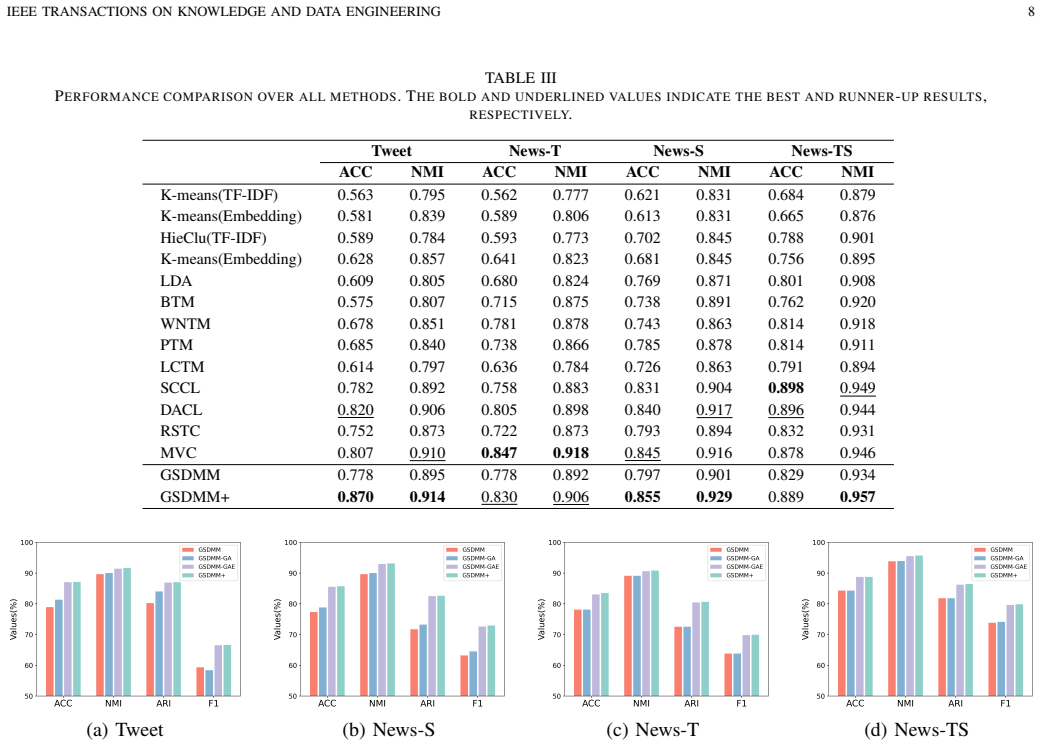
Pith's one-line read GSDMM+ claims to outperform all baselines on Tweet and News-S short-text clustering using only bag-of-words statistics, reaching ACC 0.870 and NMI 0.914 on Tweet.
desk verdict A useful, honest engineering upgrade to GSDMM, but the headline gains partly come from knowing K in advance; worth a real referee, not a desk reject. read the letter →
The pith
A machine-rendered reading of the paper's core claim, the machinery that carries it, and where it could break.
The reading
What carries the argument
The load-bearing object is the collapsed Gibbs sampling conditional for the Dirichlet Multinomial Mixture model, written as a product of a 'richer get richer' cluster-size term and a word-matching term. GSDMM+ modifies that conditional in Equation (28) by replacing the symmetric hyperparameter $\beta$ with the entropy $H(w)$ of each word across current clusters, so low-entropy, topic-specific words receive more influence. Around that core, adaptive initialization seeds clusters from similar documents, and a merging stage represents each cluster by a TF-ICF word distribution and merges the most cosine-similar cluster pairs through a priority queue until $K = K_{real}$.
What would settle it
Run GSDMM+ on the same Tweet and News datasets while withholding $K_{real}$, for example by stopping the merging stage at the cluster count that plain GSDMM reaches through pruning, and compare ACC and NMI; if performance falls to or below the plain GSDMM numbers, the reported gains are explained by the oracle cluster count rather than by the enhanced sampler itself.
Extended reading notes
Core claim
On its own terms, the paper discovers that the collapsed Gibbs sampling conditional for the DMM model can be improved in three concrete ways: initialize clusters by sequential similarity rather than at random, replace the uniform Dirichlet word prior with per-word entropy estimates so that discriminative words dominate, and then merge similar clusters using cosine similarity of TF-ICF word distributions until the number of clusters equals the true category count. With these changes, GSDMM+ reports ACC 0.870 and NMI 0.914 on the Tweet dataset and ACC 0.855 and NMI 0.929 on News-S, outperforming every compared baseline on those two datasets without using text embeddings. The paper also reports that GSDMM+ runs in 158 seconds on Tweet, while contrastive deep baselines take over 2,000 seconds.
Load-bearing premise
The headline numbers depend on giving the algorithm the true number of classes ahead of time, and that number is usually unknown in real unsupervised short-text clustering.
Editorial extensions
If this is right
- On Tweet and News-S, GSDMM+ reports the best ACC and NMI among all compared methods, including deep contrastive clustering models, and improves ACC over plain GSDMM by about nine points on Tweet.
- The method is far faster than deep baselines: GSDMM+ takes 158 seconds on Tweet and 1,392 seconds on News-TS, whereas DACL and RSTC exceed 2,000 and 3,000 seconds respectively on the same datasets.
- Because each cluster is summarized by a word distribution, GSDMM+ yields interpretable representative words per cluster, and the paper shows those words recover coherent event-oriented topics such as Italian politics, Xbox gaming, and HPV vaccination.
- Entropy-based weighting suppresses globally frequent, non-thematic words such as 'news' and 'will' while emphasizing rare, topic-specific words, which is the mechanism that produces finer-grained intermediate clusters before merging.
Reading between the lines
- One extension the paper does not pursue is a fully unsupervised version in which $K_{real}$ is estimated from the merging curve rather than supplied as input; the entropy and TF-ICF machinery would likely carry over, but the reported ACC and NMI gains might shrink without oracle cluster counts.
- The entropy-weighting idea is portable: replacing a symmetric Dirichlet prior with per-word entropies computed from current assignments could be dropped into other DMM-style or biterm samplers, not just the specific Gibbs sampler studied here.
- The TF-ICF merging step assumes that global cosine similarity between cluster word distributions is the right measure of whether two clusters should be one category; on imbalanced or hierarchical label sets, this assumption is testable and may behave differently than on the balanced news-event benchmarks used in the paper.
- A practical follow-up would be to test GSDMM+ as an initialization or regularizer for embedding-based short text clustering, since its fast, interpretable cluster assignments could provide pseudo-labels without the cost of a full deep training run.
Editorial analysis
A structured set of objections, weighed in public.
Referee Report
Summary. The paper proposes GSDMM, a collapsed Gibbs sampling algorithm for the Dirichlet Multinomial Mixture (DMM) model for short text clustering, and GSDMM+, an enhanced version with three modifications: adaptive clustering initialization, entropy-based word weighting (replacing the fixed Dirichlet hyperparameter β with a word-specific entropy value), and granularity adjustment via cluster merging using a TF-ICF similarity measure. Experiments on four benchmark datasets (Tweet, News-T, News-S, News-TS) compare GSDMM and GSDMM+ against topic-model and deep-embedding baselines using ACC and NMI, with additional ablations, running-time analysis, hyper-parameter studies, and qualitative visualization. The authors claim that GSDMM+ consistently outperforms all baselines on the Tweet and News-S datasets without using text embeddings, while retaining high efficiency. The code is publicly available.
Significance. If the reported results hold, GSDMM+ would be a compelling fast, interpretable bag-of-words clustering method that competes with or beats much heavier embedding-based approaches on some benchmarks. The paper's strengths include a careful mathematical derivation of the GSDMM Gibbs update, a broad set of baselines (including several recent deep clustering methods), a public code release, and a running-time comparison. However, the headline claim is weakened by the use of oracle knowledge of the true number of clusters K_real in the merging stage, and by the omission of the entropy-only ablation. The central contribution is therefore defensible only for the known-K setting unless an estimated-K variant is provided and evaluated.
major comments (4)
- [Algorithm 2 and Section IV-A] GSDMM+ takes the true number of categories K_real as input and merges clusters until K equals K_real; Section IV-A confirms that K_real is set to the known category count of each dataset. The central claim in Section IV-B that GSDMM+ 'consistently outperforms all baseline methods' is therefore not established for genuinely unsupervised short-text clustering, where K is unknown and must be estimated. Part of the reported alignment with the true category distribution is built into the procedure rather than discovered. Please add results with an estimated K (e.g., using the number of non-empty clusters after Gibbs sampling, or an explicit K-selection criterion) and temper the superiority claim accordingly.
- [Section IV-C (Structure Analysis)] The ablation omits the entropy-only setting because, as stated in point 3, 'clustering performance deteriorates significantly' without fine-grained adjustment. As a result, the individual contribution of entropy-based word weighting is never quantified, and the reported improvements conflate the entropy module with the cluster-merging module. Please report the numbers for this missing configuration (or explain in detail why it is excluded) so that the effect of each module can be assessed independently.
- [Table III and Section IV-B] The claim that GSDMM+ 'consistently outperforms all baseline methods' is not supported on the News-T dataset, where GSDMM+ is second-best (ACC 0.830 vs. MVC 0.847). Moreover, although 10 independent runs are reported, no standard deviations, error bars, or significance tests are given anywhere in the paper. Please report variance or statistical significance, and qualify the claim to match the actual results (e.g., 'best on Tweet and News-S, competitive on News-T and News-TS').
- [Equation (28) and Section II-C2] Replacing the fixed hyperparameter β with an entropy-derived value H(w) that is recomputed from the current cluster assignments changes the sampling update so that it is no longer a correct Gibbs sampler for the DMM generative model in Eqs. (1)-(4). The entropy term depends on the latent variables being sampled, so the stationary distribution of the resulting Markov chain is not that of the DMM posterior. The paper should either provide a derivation that justifies this update as an approximation to a well-defined model, or explicitly state that this is a heuristic modification rather than a model-based one.
minor comments (5)
- [Table III] The row labeled 'K-means(Embedding)' appears twice (once with ACC 0.581/NMI 0.839 and again with ACC 0.628/NMI 0.857); based on Section IV-A3, the second row should presumably be 'HieClu(Embedding)'.
- [Section IV-D] Table V lists 'GSDMM (w/o Entropy)' with times of 106s and 1341s, but the text refers to 'GSDMM+ with and without entropy.' Please clarify which configuration the row actually corresponds to.
- [Algorithm 2] The entropy update condition 'd % 15 == 0' conflicts with the implementation detail in Section IV-A that says entropy is computed 'once every D/15 iteration'; please clarify the intended update schedule.
- [Table VII] The header contains 'Cluster Cluster' in column 7; this should be 'Cluster 7'.
- [Figures 1-6] The figures show only mean values without any markers of variance; adding error bars or shaded intervals would strengthen the ablation and hyper-parameter analyses.
Circularity Check
Partial circularity: GSDMM+ is given the true cluster count Kreal and merges exactly until K = Kreal, so the claimed alignment of the predicted distribution with the true category distribution is an input by construction, not a discovery; the document assignments within the Kreal clusters are still learned, so the effect is partial.
-
self definitional
[Section II-C (Algorithm 2), Section IV-A (Implementation Detail), Section IV-C (Structure Analysis)]
"Algorithm 2: GSDMM+ Data: Document vector ⃗d, Maximum number of clusters Kmax, Real number of clusters Kreal. ... while K > Kreal do ... K ← K − 1. ... The predefined number of clusters, Kmax, is set to 500 for all datasets, while Kreal corresponds to each dataset's known number of categories. ... Granularity adjustment determines a reasonable number of clusters, ultimately achieving optimal performance and surpassing methods that rely on text embeddings."
The merging loop terminates exactly when K reaches Kreal, so the final number of predicted clusters equals the dataset's true number of categories by construction (Algorithm 2; Section IV-A). ACC and NMI in Table III are then evaluated against those same true category labels, and the paper's stated purpose of merging — 'better align the predicted distribution with the true category distribution' — is realized at the granularity level by feeding in the true count rather than by discovering it. The ablation in Figure 1 credits the granularity-adjustment module (GSDMM-GA) with the gain, yet part of the GSDMM versus GSDMM-GA gap is the oracle-K advantage, since GSDMM alone infers K automatically.
full rationale
The core Gibbs-sampling derivation (Section II-B, Equations 6–25) is self-contained: the conditional distribution is derived from the Dirichlet priors by standard conjugacy, and the sampling probability in Equation (25) follows from the model assumptions. That content, plus the re-benchmarked experiments, means the self-citations in the paper ([12], the KDD'14 GSDMM paper sharing the corresponding author, and [31] MVC, which shares authors) are not load-bearing and do not by themselves raise the circularity score. The one construction-level reduction is the granularity-adjustment module: Algorithm 2 explicitly takes the true number of categories Kreal as input, and the loop 'while K > Kreal' forces the output cluster count to equal the true category count; Section IV-A states Kreal is each dataset's known category count, and ACC/NMI in Section IV-B are computed against those same categories. The abstract's benefit claim — 'better aligning the predicted distribution with the true category distribution' — is therefore, at the granularity level, an input rather than a discovered result, and the Figure 1 ablation attributes the resulting gain to the module. The within-granularity assignment is still learned without labels, so the headline numbers are not forced; hence a score of 5 rather than 6 or higher. The paper is transparent about the known-K target ('we also need to consider how to optimize GSDMM when the number of categories is known'), and the baselines (K-means, LDA, SCCL, MVC) also receive K, so the known-K comparison is internally fair; the overstatement lies in framing the granularity alignment and the 'consistently outperforms' claim without separating the oracle contribution from the learned one.
Assumptions & free parameters
free parameters (6)
- alpha (α) =
0.1
- beta (β) =
0.01
- Kmax =
500
- entropy_update_frequency =
15
- epsilon (entropy smoothing) =
unspecified
- Kreal =
true number of categories per dataset (89 for Tweet, 152 for News-*)
assumptions (5)
- domain assumption Each document is generated by exactly one cluster, and words are conditionally independent given the cluster (Naive Bayes).
- domain assumption Symmetric Dirichlet priors with scalar hyperparameters alpha and beta are appropriate for the mixture weights and cluster-word distributions.
- ad hoc to paper Entropy H(w) calculated from current cluster assignments can be used as a word-specific pseudo-count in place of the fixed beta.
- ad hoc to paper Merging clusters until K equals Kreal improves agreement with the true category structure.
- standard math Dirichlet-multinomial conjugacy and standard Gamma identities are valid for the collapsed derivation.
Cite this review
Pith. "Pith review of An Enhanced Model-based Approach for Short Text Clustering." pith.science (2026). https://pith.science/paper/7CJNSS7C
@misc{pith2026250713793,
  author       = {Pith},
  title        = {Pith review of: An Enhanced Model-based Approach for Short Text Clustering},
  year         = {2026},
  howpublished = {\url{https://pith.science/paper/7CJNSS7C}},
  note         = {Machine review of arXiv:2507.13793}
}
read the original abstract
Short text clustering has become increasingly important with the popularity of social media like Twitter, Google+, and Facebook. Existing methods can be broadly categorized into two paradigms: topic model-based approaches and deep representation learning-based approaches. This task is inherently challenging due to the sparse, large-scale, and high-dimensional characteristics of the short text data. Furthermore, the computational intensity required by representation learning significantly increases the running time. To address these issues, we propose a collapsed Gibbs Sampling algorithm for the Dirichlet Multinomial Mixture model (GSDMM), which effectively handles the sparsity and high dimensionality of short texts while identifying representative words for each cluster. Based on several aspects of GSDMM that warrant further refinement, we propose an improved approach, GSDMM+, designed to further optimize its performance. GSDMM+ reduces initialization noise and adaptively adjusts word weights based on entropy, achieving fine-grained clustering that reveals more topic-related information. Additionally, strategic cluster merging is employed to refine clustering granularity, better aligning the predicted distribution with the true category distribution. We conduct extensive experiments, comparing our methods with both classical and state-of-the-art approaches. The experimental results demonstrate the efficiency and effectiveness of our methods. The source code for our model is publicly available at https://github.com/chehaoa/VEMC.
Figures


Figures from the paper (4 more)




Reference graph
Works this paper leans on
-
[1]
Consensus clustering based on a new probabilistic rand index with application to subtopic retrieval,
C. Carpineto and G. Romano, “Consensus clustering based on a new probabilistic rand index with application to subtopic retrieval,” IEEE Transactions on Pattern Analysis and Machine Intelligence , vol. 34, no. 12, pp. 2315–2326, 2012
work page 2012
-
[2]
W. Feng, C. Zhang, W. Zhang, J. Han, J. Wang, C. Aggarwal, and J. Huang, “Streamcube: Hierarchical spatio-temporal hashtag clustering for event exploration over the twitter stream,” in 2015 IEEE 31st international conference on data engineering . IEEE, 2015, pp. 1561– 1572
work page 2015
-
[3]
Sumblr: continuous summarization of evolving tweet streams,
L. Shou, Z. Wang, K. Chen, and G. Chen, “Sumblr: continuous summarization of evolving tweet streams,” in Proceedings of the 36th international ACM SIGIR conference on Research and development in information retrieval, 2013, pp. 533–542
work page 2013
-
[4]
Content-based recommendation systems,
M. J. Pazzani and D. Billsus, “Content-based recommendation systems,” in The adaptive web: methods and strategies of web personalization . Springer, 2007, pp. 325–341
work page 2007
-
[5]
A survey of clustering data mining techniques,
P. Berkhin, “A survey of clustering data mining techniques,” in Grouping Multidimensional Data, 2006
work page 2006
-
[6]
A survey of text clustering algorithms,
C. C. Aggarwal and C. Zhai, “A survey of text clustering algorithms,” in Mining Text Data. Springer, 2012, pp. 77–128
work page 2012
-
[7]
Concept decompositions for large sparse text data using clustering,
I. S. Dhillon and D. S. Modha, “Concept decompositions for large sparse text data using clustering,” Machine learning, vol. 42, no. 1-2, pp. 143– 175, 2001
work page 2001
-
[8]
Modern hierarchical, agglomerative clustering algorithms,
D. M ¨ullner, “Modern hierarchical, agglomerative clustering algorithms,” arXiv preprint arXiv:1109.2378 , 2011
arXiv 2011
Show all 46 references
-
[9]
A vector space model for automatic indexing,
G. Salton, A. Wong, and C. S. Yang, “A vector space model for automatic indexing,” Commun. ACM, vol. 18, no. 11, pp. 613–620, 1975
1975
-
[10]
Text clas- sification from labeled and unlabeled documents using em,
K. Nigam, A. McCallum, S. Thrun, and T. M. Mitchell, “Text clas- sification from labeled and unlabeled documents using em,” Machine Learning, vol. 39, no. 2/3, pp. 103–134, 2000
2000
-
[11]
Latent dirichlet allocation,
D. M. Blei, A. Y . Ng, and M. I. Jordan, “Latent dirichlet allocation,” J. Mach. Learn. Res. , 2003. [Online]. Available: http: //dl.acm.org/citation.cfm?id=944919.944937
2003
-
[12]
A dirichlet multinomial mixture model-based approach for short text clustering,
J. Yin and J. Wang, “A dirichlet multinomial mixture model-based approach for short text clustering,” in Proceedings of the 20th ACM SIGKDD International Conference on Knowledge Discovery and Data Mining, ser. KDD ’14. New York, NY , USA: Association for Computing Machinery, 2...
2014
-
[13]
McLachlan and K
G. McLachlan and K. Basford, Mixture Models: Inference and Applica- tions to Clustering . Marcel Dekker, New York, 1988
1988
-
[14]
C. M. Bishop and N. M. Nasrabadi, Pattern recognition and machine learning. Springer, 2006, vol. 4, no. 4
2006
-
[15]
Parameter estimation for text analysis,
G. Heinrich, “Parameter estimation for text analysis,” Technical Report, 2009
2009
-
[16]
Dirichlet process,
Y . W. Teh, “Dirichlet process,” in Encyclopedia of machine learning . Springer, 2010, pp. 280–287
2010
-
[17]
V oronoi diagrams,
F. Aurenhammer and R. Klein, “V oronoi diagrams,” Handbook of computational geometry, vol. 5, no. 10, pp. 201–290, 2000
2000
-
[18]
Improving multi-class text classification with naive bayes,
J. D. Rennie, “Improving multi-class text classification with naive bayes,” Ph.D. dissertation, Massachusetts Institute of Technology, 2001
2001
-
[19]
Modeling word burstiness using the dirichlet distribution,
R. E. Madsen, D. Kauchak, and C. Elkan, “Modeling word burstiness using the dirichlet distribution,” in ICML, 2005, pp. 545–552
2005
-
[20]
Tackling the poor assumptions of naive bayes text classifiers,
J. D. Rennie, L. Shih, J. Teevan, and D. R. Karger, “Tackling the poor assumptions of naive bayes text classifiers,” in ICML, 2003, pp. 616– 623
2003
-
[21]
Clustering documents with an exponential-family approxi- mation of the dirichlet compound multinomial distribution,
C. Elkan, “Clustering documents with an exponential-family approxi- mation of the dirichlet compound multinomial distribution,” in ICML, 2006
2006
-
[22]
Simcse: Simple contrastive learning of sentence embeddings,
T. Gao, X. Yao, and D. Chen, “Simcse: Simple contrastive learning of sentence embeddings,” arXiv preprint arXiv:2104.08821 , 2021
2021 arXiv
-
[23]
Latent dirichlet allocation,
D. M. Blei, A. Y . Ng, and M. I. Jordan, “Latent dirichlet allocation,” Journal of machine Learning research , vol. 3, no. Jan, pp. 993–1022, 2003
2003
-
[24]
A biterm topic model for short texts,
X. Yan, J. Guo, Y . Lan, and X. Cheng, “A biterm topic model for short texts,” in Proceedings of the 22nd international conference on World Wide Web, 2013, pp. 1445–1456
2013
-
[25]
Word network topic model: a simple but general solution for short and imbalanced texts,
Y . Zuo, J. Zhao, and K. Xu, “Word network topic model: a simple but general solution for short and imbalanced texts,” Knowledge and Information Systems, vol. 48, pp. 379–398, 2016
2016
-
[26]
Topic modeling of short texts: A pseudo-document view,
Y . Zuo, J. Wu, H. Zhang, H. Lin, F. Wang, K. Xu, and H. Xiong, “Topic modeling of short texts: A pseudo-document view,” inProceedings of the 22nd ACM SIGKDD international conference on knowledge discovery and data mining , 2016, pp. 2105–2114
2016
-
[27]
A latent concept topic model for robust topic inference using word embeddings,
W. Hu and J. Tsujii, “A latent concept topic model for robust topic inference using word embeddings,” in Proceedings of the 54th Annual Meeting of the Association for Computational Linguistics (Volume 2: Short Papers), 2016, pp. 380–386
2016
-
[28]
Supporting clustering with contrastive learning,
D. Zhang, F. Nan, X. Wei, S.-W. Li, H. Zhu, K. McKeown, R. Nallapati, A. O. Arnold, and B. Xiang, “Supporting clustering with contrastive learning,” in Proceedings of the 2021 Conference of the North American Chapter of the Association for Computational Linguistics: Human Lan-...
2021
-
[29]
Clustering of short texts based on dynamic adjustment for contrastive learning,
R. Li and H. Wang, “Clustering of short texts based on dynamic adjustment for contrastive learning,” IEEE Access, vol. 10, pp. 76 069– 76 078, 2022
2022
-
[30]
Robust representation learning with reliable pseudo-labels generation via self-adaptive optimal transport for short text clustering,
X. Zheng, M. Hu, W. Liu, C. Chen, and X. Liao, “Robust representation learning with reliable pseudo-labels generation via self-adaptive optimal transport for short text clustering,” arXiv preprint arXiv:2305.16335 , 2023
2023 arXiv
-
[31]
A multi-view clustering algorithm for short text,
M. Lu, J. Yin, K. Wang, and L. Nie, “A multi-view clustering algorithm for short text,” in 2024 IEEE 40th International Conference on Data Engineering (ICDE). IEEE, 2024, pp. 5101–5110
2024
-
[32]
Visualizing data using t-sne,
L. Van der Maaten and G. Hinton, “Visualizing data using t-sne,” Journal of Machine Learning Research , vol. 9, no. 11, pp. 2579–2605, 2008
2008
-
[33]
C. P. Robert and G. Casella, Monte Carlo statistical methods. Citeseer, 2004, vol. 319
2004
-
[34]
Document clustering via dirichlet process mixture model with feature selection,
G. Yu, R. Huang, and Z. Wang, “Document clustering via dirichlet process mixture model with feature selection,” in SIGKDD, 2010, pp. 763–772
2010
-
[35]
Dirichlet process mixture model for document clustering with feature partition,
R. Huang, G. Yu, Z. Wang, J. Zhang, and L. Shi, “Dirichlet process mixture model for document clustering with feature partition,” IEEE Trans. Knowl. Data Eng. , vol. 25, no. 8, pp. 1748–1759, 2013
2013
-
[36]
Data clustering: 50 years beyond k-means,
A. K. Jain, “Data clustering: 50 years beyond k-means,” Pattern Recog- nition Letters, vol. 31, no. 8, pp. 651–666, 2010
2010
-
[37]
Comparative study of clustering techniques for short text documents,
A. Rangrej, S. Kulkarni, and A. V . Tendulkar, “Comparative study of clustering techniques for short text documents,” in WWW (Companion Volume), 2011, pp. 111–112
2011
-
[38]
Clustering by passing messages between data points,
B. J. Frey and D. Dueck, “Clustering by passing messages between data points,” Science, vol. 315, no. 5814, pp. 972–976, 2007. [Online]. Available: https://www.science.org/doi/abs/10.1126/science.1136800
2007 doi
-
[39]
Clustering short texts using wikipedia,
S. Banerjee, K. Ramanathan, and A. Gupta, “Clustering short texts using wikipedia,” in SIGIR, 2007, pp. 787–788
2007
-
[40]
Probabilistic latent semantic indexing,
T. Hofmann, “Probabilistic latent semantic indexing,” in Proceedings of the 22nd annual international ACM SIGIR conference on Research and development in information retrieval , 1999, pp. 50–57
1999
-
[41]
Short text clustering via convolutional neural networks,
J. Xu, P. Wang, G. Tian, B. Xu, J. Zhao, F. Wang, and H. Hao, “Short text clustering via convolutional neural networks,” in Proceedings of the 1st Workshop on Vector Space Modeling for Natural Language Processing . Denver, Colorado: Association for Computational Linguistics, J...
2015
-
[42]
Deep feature-based text clustering and its explanation,
R. Guan, H. Zhang, Y . Liang, F. Giunchiglia, L. Huang, and X. Feng, “Deep feature-based text clustering and its explanation,” IEEE Transac- tions on Knowledge and Data Engineering , vol. 34, no. 8, pp. 3669– 3680, 2022
2022
-
[43]
Supervised learning of universal sentence representations from natural language inference data,
A. Conneau, D. Kiela, H. Schwenk, L. Barrault, and A. Bordes, “Supervised learning of universal sentence representations from natural language inference data,” arXiv preprint arXiv:1705.02364 , 2017
2017 arXiv
-
[44]
Attentive representation learn- ing with adversarial training for short text clustering,
W. Zhang, C. Dong, J. Yin, and J. Wang, “Attentive representation learn- ing with adversarial training for short text clustering,”IEEE Transactions on Knowledge and Data Engineering , vol. 34, no. 11, pp. 5196–5210, 2022
2022
-
[45]
Attention is all you need,
A. Vaswani, N. Shazeer, N. Parmar, J. Uszkoreit, L. Jones, A. N. Gomez, L. Kaiser, and I. Polosukhin, “Attention is all you need,” in Proceedings of the 31st International Conference on Neural Information Processing IEEE TRANSACTIONS ON KNOWLEDGE AND DATA ENGINEERING 14 System...
2017
-
[46]
Deep em- bedding clustering based on contractive autoencoder,
B. Diallo, J. Hu, T. Li, G. A. Khan, X. Liang, and Y . Zhao, “Deep em- bedding clustering based on contractive autoencoder,” Neurocomputing, vol. 433, pp. 96–107, 2021
2021
Reviewed August 6, 2026 · model on record in the stance chip above.
Discussion (0). Sign in to comment.