REVIEW 4 major objections 6 minor 74 references
When Speed meets Accuracy: an Efficient and Effective Graph Model for Temporal Link Prediction
T0 review · 4 major / 6 minor · reviewed 2026-08-06 · deepseek-v4-flash
Pith's one-line read This paper claims that temporal link prediction needs no complex T-GNN: a hybrid of a recent-neighbor score and a shared-influence PageRank score matches or beats state-of-the-art models while running over 50x faster.
desk verdict EAGLE is a genuinely simple and fast temporal link predictor whose structural module is more empirically grounded than the stress-test suggests; the main soft spots are overbroad speedup claims and a hand-tuned hybrid with a fixed lambda. read the letter →
The pith
A machine-rendered reading of the paper's core claim, the machinery that carries it, and where it could break.
The reading
What carries the argument
The load-bearing object is the structure-aware score in Equation (10): for a candidate pair $(v,u)$, sum $\pi_v(t)[v_i] \cdot \pi_u(t)[v_i]$ over the shared nodes in the top-$k_s$ entries of both endpoints' temporal personalized PageRank vectors. It is the paper's proxy for long-term global structural dependence, and it carries the whole 'global patterns' half of the argument. This score is training-free and deterministic, can be updated incrementally as new events arrive, and is motivated by a cited theorem that multi-hop GCN propagation concentrates on paths that PPR ranks. The time-aware module, by contrast, is the learned half: a two-layer MLP over the averaged features of each node's $k_r$ most recent neighbors. The adaptive weight in Equation (11) is what decides, per node pair, how much of the final score comes from each side.
What would settle it
Take any benchmark graph and keep the set of top-$k_s$ nodes fixed but replace their T-PPR scores in Equation (10) with random values drawn from the same range. If EAGLE-Hybrid's AP/MRR drops only a little, the structural module's contribution is not the T-PPR ranking itself; if it collapses, the specific T-PPR values are doing the work. A complementary test: on a graph with strong recency-driven links and no recurring hubs, EAGLE-Hybrid should reduce to EAGLE-Time via the adaptive weight; if the structural term still hurts, the weight mechanism is over-trusting structure.
Extended reading notes
Core claim
EAGLE's central discovery is that a hybrid of two simple scoring functions is sufficient for state-of-the-art temporal link prediction. The time-aware score represents each endpoint by averaging the concatenated node and edge features of its $k_r$ most recent neighbors, then passes the concatenation of the two endpoint representations through a two-layer MLP. The structure-aware score is computed between endpoints $v$ and $u$ as the sum, over nodes that appear in both of their top-$k_s$ temporal personalized PageRank vectors, of $\pi_v(t)[v_i]\cdot \pi_u(t)[v_i]$, with no learned parameters. The final hybrid score weights the time-aware score by $\exp(-\bar{t}_v)+\exp(-\bar{t}_u)$ and adds the structural score. Across seven datasets, the hybrid beats each module alone, and the paper reports effectiveness at least matching existing T-GNNs while training and inference become dramatically faster and lighter.
Load-bearing premise
The hybrid's effectiveness rests on the premise that two nodes are more likely to link when they share many of the same globally influential neighbors, with influence measured by temporal personalized PageRank; if that shared-influence score does not track future links in evolving graphs, the whole structural half of the model fails.
Editorial extensions
If this is right
- Inference for a node pair touches only $k_r$ most recent neighbors and $k_s$ top T-PPR nodes, so runtime grows with $k_r + k_s$ rather than with multi-hop neighborhoods or a full transformer context.
- The structure-aware score is training-free, so the hybrid can be deployed with almost no learned parameters beyond a two-layer MLP for the time-aware module.
- On datasets where recent interactions dominate, the adaptive weight automatically leans on the time-aware score; where interactions are sparse or old, it leans on the structural score.
- Because no memory banks or multi-hop message passing are needed, training time and peak GPU memory are dramatically lower, which the paper reports as over 50x speedup versus transformer-based T-GNNs.
- The same two representations extend to node classification, where the paper reports large gains and speedups over the same baselines in the appendix.
Reading between the lines
- Beyond the paper: on graphs with stable communities and long timespans, I expect the structure-aware score from Equation (10) to contribute most, while on bursty recency-driven graphs the adaptive weight should down-weight it; the seven benchmarks do not isolate this axis explicitly.
- Beyond the paper: the same T-PPR shared-influence score could serve as a cheap candidate generator or pre-filter ahead of a heavier reranker, since it is training-free and deterministic.
- Beyond the paper: an ablation that replaces the T-PPR values in Equation (10) with binary indicators of shared top-$k_s$ nodes would test whether it is the ranking or the magnitudes that matter; the paper does not run this variant.
Editorial analysis
A structured set of objections, weighed in public.
Referee Report
Summary. The paper proposes EAGLE, a lightweight model for temporal link prediction. It consists of a time-aware module that averages node/edge features over each node's k_r most recent neighbors, and a structure-aware module that computes a score from the sum of products of T-PPR scores over common top-k_s influential nodes. The two scores are combined in Eq. (11) with a validation-tuned scalar lambda. Experiments on seven temporal graph benchmarks compare EAGLE against JODIE, TGAT, TGN, GraphMixer, Zebra, and DyGFormer, reporting AP/MRR/HR@10 and claiming more than a 50x speedup over transformer-based T-GNNs. The paper also includes an appendix on node classification.
Significance. If the structural heuristic in Eq. (10) is valid on temporal graphs, the paper provides a meaningful simplifying result: a two-module model with no multi-hop message passing and no memory banks can match or outperform complex T-GNNs on standard benchmarks. The paper ships an artifact, uses widely adopted benchmarks, and includes ablations and parameter sensitivity studies. However, the central structural score is not validated on temporal graphs, and the headline efficiency claim is not documented across all seven datasets. These gaps currently prevent the significance from being fully established.
major comments (4)
- [§3.2.2, Eq. (10)] The structure-aware score is the main engine of the reported gains on Wikipedia and Reddit: EAGLE-Time achieves AP 69.18 and 31.96 while EAGLE-Hybrid achieves 87.02 and 78.09. Yet Eq. (10) is supported only by a static-graph PPR experiment (Fig. 2) and a static GCN theorem (Thm. 3.1). Neither support establishes that, on a temporal graph, two nodes sharing top-k_s T-PPR nodes are more likely to interact, nor that the product form is appropriate. Please provide a temporal validation of Eq. (10): for example, compare EAGLE-Struc against static-PPR and common-neighbor baselines on the temporal benchmarks, and report the predictive power of the structural term alone with negative controls. Without this, the 'consistently superior' claim rests on an unvalidated heuristic.
- [§3.2.3, Eq. (11)] The hybrid score adds an unbounded structural term to a bounded sigmoid time score, and the only adaptation is a validation-tuned scalar lambda multiplied by exp(-tbar_v)+exp(-tbar_u). This mechanism cannot downweight the structural term when it is uninformative, and the structural term itself has no recency adaptivity. Please report the selected lambda values per dataset and provide ablation results with normalized structural scores (e.g., rank-based or min-max scaling) to support the claim that the model 'balances' the two signals.
- [§4.2.2, Table 4] The abstract's claim of 'more than 50x speedup over effective transformer-based T-GNNs' is not substantiated. Table 4 reports efficiency for only three of the seven datasets (Contacts, Wikipedia, WikiTalk), and DyGFormer either OOMs or times out on two of them; the only completed comparison is Wikipedia, where the speedup is about 91x. Please report efficiency for all datasets on which baselines complete, and state the exact comparison underlying the 50x claim. In addition, Algorithm 1 delegates the T-PPR update to the black-box procedure T-PPR_UPDATING from [25]; because the stated O(n k_s log k_s) update and O(k_s |V|) memory are imported from that reference, the paper should specify or implement the update, or explicitly bound the claims by the cited results.
- [§4.2.1, Table 3] Several 'superior' differences are within one standard deviation of the best baseline: for example, Wikipedia AP is 87.02±0.29 for EAGLE-Hybrid versus 86.96±0.22 for DyGFormer, and Reddit AP is 78.09±0.66 versus 77.92±0.33. To support 'consistently superior performance', please report the number of seeds and run statistical significance tests or provide a clear statement of which differences are significant.
minor comments (6)
- [§3.2.2] The case where the intersection of the top-k_s T-PPR sets is empty is not discussed; if the structural score is zero for many test pairs, ranking behavior should be analyzed. Please report the fraction of test pairs with a non-empty intersection.
- [Appendix A.1, Eq. (14)] The concatenation [h^r_v(t), h^r_v(t)] appears to be a typo for [h^r_v(t), h^s_v(t)], since the structure-aware representation is otherwise unused in the classification head.
- [§4.2.2, Table 4] Efficiency is omitted for AskUbuntu, SuperUser, LastFM, and Reddit; please add these results or explain why they are not reported.
- [§3.2.4] The statement that EAGLE-Struc is 'training-free' is misleading because alpha, beta, and k_s are tuned on validation data; clarify that 'training-free' means no gradient-based optimization.
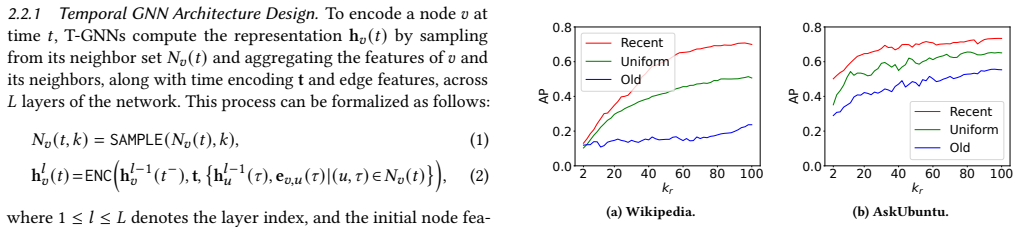
- [§3.1.1, Figure 1] The motivational experiment does not state which base model is used; please specify the predictor and the number of repeats so the observation is reproducible.
- [§3.2.3] The phrase 'adaptive weighting mechanism' is stronger than what is implemented: lambda is a single scalar tuned on the validation set, so the mechanism is static after validation. Consider describing it as a validation-tuned trade-off parameter.
Circularity Check
No circular derivation: EAGLE's claims are supported by held-out test evaluation; the only self-citation (Zebra T-PPR) is a non-load-bearing component.
full rationale
No circular derivation is present. EAGLE's time-aware score (Eq. 7) is an MLP trained on labeled historical interactions and evaluated on held-out test edges with 99 negative samples per positive; hyperparameters (α, β, k_r, k_s, λ) are selected by validation-set performance (Sec. 4.1.4), not fit to the test target. The structure-aware score (Eq. 10) is a fixed, training-free heuristic computed from T-PPR scores; although its temporal support rests on the authors' earlier Zebra paper [25], that self-citation supplies an algorithmic component and its update-complexity bound, and EAGLE is benchmarked independently against Zebra as a baseline rather than deriving its accuracy from Zebra's results. Theorem 3.1 is cited from external work (Xu et al. [56]) and is used only as motivation. The hybrid score (Eq. 11) is a weighted sum of two independently computed scores with a validation-tuned scalar λ; it is not defined in terms of the prediction target. The claimed gains and speedups are empirical numbers from Tables 3-4 and 6-7. The main risk is correctness, not circularity: Eq. (10)'s predictive validity on temporal graphs is supported only by static-graph experiments and a static GCN theorem, so if shared top-k_s T-PPR nodes do not signal future links, the hybrid model degrades toward EAGLE-Time. That is an unvalidated assumption, not a reduction of the output to the input.
Assumptions & free parameters
free parameters (6)
- lambda (trade-off weight) =
tuned on validation set
- alpha (T-PPR termination probability) =
grid {0.1,...,1}
- beta (temporal decay factor) =
grid {0.1,...,1}
- k_r (recent neighbor count) =
grid {10,20,30,40,50}
- k_s (top T-PPR node count) =
grid {10,20,30,40,50}
- Time-aware MLP weights =
learned by training
assumptions (4)
- standard math Theorem 3.1 from [56]: normalized influence in GCN-mean equals sum of path probabilities; motivates PPR as a structural importance measure.
- domain assumption The T-PPR updating algorithm [25] correctly and incrementally maintains the top-k_s transition matrix on dynamic graphs.
- ad hoc to paper Recent neighbors and top T-PPR neighbors are sufficient statistics for temporal link prediction.
- domain assumption Node features x_{v_i}(t) of neighbors are available at current time t when computing h_v(t).
Cite this review
Pith. "Pith review of When Speed meets Accuracy: an Efficient and Effective Graph Model for Temporal Link Prediction." pith.science (2026). https://pith.science/paper/XAZDG5Y4
@misc{pith2026250713825,
  author       = {Pith},
  title        = {Pith review of: When Speed meets Accuracy: an Efficient and Effective Graph Model for Temporal Link Prediction},
  year         = {2026},
  howpublished = {\url{https://pith.science/paper/XAZDG5Y4}},
  note         = {Machine review of arXiv:2507.13825}
}
read the original abstract
Temporal link prediction in dynamic graphs is a critical task with applications in diverse domains such as social networks, recommendation systems, and e-commerce platforms. While existing Temporal Graph Neural Networks (T-GNNs) have achieved notable success by leveraging complex architectures to model temporal and structural dependencies, they often suffer from scalability and efficiency challenges due to high computational overhead. In this paper, we propose EAGLE, a lightweight framework that integrates short-term temporal recency and long-term global structural patterns. EAGLE consists of a time-aware module that aggregates information from a node's most recent neighbors to reflect its immediate preferences, and a structure-aware module that leverages temporal personalized PageRank to capture the influence of globally important nodes. To balance these attributes, EAGLE employs an adaptive weighting mechanism to dynamically adjust their contributions based on data characteristics. Also, EAGLE eliminates the need for complex multi-hop message passing or memory-intensive mechanisms, enabling significant improvements in efficiency. Extensive experiments on seven real-world temporal graphs demonstrate that EAGLE consistently achieves superior performance against state-of-the-art T-GNNs in both effectiveness and efficiency, delivering more than a 50x speedup over effective transformer-based T-GNNs.
Figures


Figures from the paper (2 more)


Reference graph
Works this paper leans on
-
[25]
Yiming Li, Yanyan Shen, Lei Chen, and Mingxuan Yuan. 2023. Zebra: When tem- poral graph neural networks meet temporal personalized PageRank.Proceedings of the VLDB Endowment 16, 6 (2023), 1332–1345
work page 2023
-
[1]
Thierry Bertin-Mahieux, Daniel PW Ellis, Brian Whitman, and Paul Lamere
- [2]
-
[3]
Chaoyi Chen, Dechao Gao, Yanfeng Zhang, Qiange Wang, Zhenbo Fu, Xuecang Zhang, Junhua Zhu, Yu Gu, and Ge Yu. 2023. NeutronStream: A Dynamic GNN Training Framework with Sliding Window for Graph Streams. Proc. VLDB Endow. 17, 3 (Nov. 2023), 455–468. https://doi.org/10.14778/3632093.3632108
arXiv 2023
-
[4]
Huiyuan Chen and Jing Li. 2018. Exploiting structural and temporal evolu- tion in dynamic link prediction. In Proceedings of the 27th ACM International conference on information and knowledge management. 427–436
work page 2018
-
[5]
Xin Chen, Jieming Shi, You Peng, Wenqing Lin, Sibo Wang, and Wenjie Zhang
-
[6]
Weilin Cong, Si Zhang, Jian Kang, Baichuan Yuan, Hao Wu, Xin Zhou, Hanghang Tong, and Mehrdad Mahdavi. 2023. Do We Really Need Complicated Model Ar- chitectures For Temporal Networks?. In The Eleventh International Conference on Learning Representations
work page 2023
-
[7]
Ariel Debrouvier, Eliseo Parodi, Matías Perazzo, Valeria Soliani, and Alejandro Vaisman. 2021. A model and query language for temporal graph databases. The VLDB Journal 30, 5 (2021), 825–858
work page 2021
Show all 74 references
-
[8]
Wenfei Fan, Ruochun Jin, Ping Lu, Chao Tian, and Ruiqi Xu. 2022. Towards event prediction in temporal graphs. Proceedings of the VLDB Endowment 15, 9 (2022), 1861–1874
2022
-
[9]
Chen Gao, Yu Zheng, Nian Li, Yinfeng Li, Yingrong Qin, Jinghua Piao, Yuhan Quan, Jianxin Chang, Depeng Jin, Xiangnan He, et al. 2023. A survey of graph neural networks for recommender systems: Challenges, methods, and directions. ACM Transactions on Recommender Systems 1, 1 (2...
2023
-
[10]
Shihong Gao, Yiming Li, Yanyan Shen, Yingxia Shao, and Lei Chen. 2024. ETC: Efficient Training of Temporal Graph Neural Networks over Large-scale Dynamic Graphs. Proceedings of the VLDB Endowment 17, 5 (2024), 1060–1072
2024
-
[11]
Shihong Gao, Yiming Li, Xin Zhang, Yanyan Shen, Yingxia Shao, and Lei Chen
-
[12]
Johannes Gasteiger, Aleksandar Bojchevski, and Stephan Günnemann. 2018. Predict then propagate: Graph neural networks meet personalized pagerank. arXiv preprint arXiv:1810.05997 (2018)
2018 arXiv
-
[13]
Julia Gastinger, Shenyang Huang, Mikhail Galkin, Erfan Loghmani, Ali Parviz, Farimah Poursafaei, Jacob Danovitch, Emanuele Rossi, Ioannis Koutis, Heiner Stuckenschmidt, Reihaneh Rabbany, and Guillaume Rabusseau. 2024. TGB 2.0: A Benchmark for Learning on Temporal Knowledge Gra...
2024
-
[14]
Proceedings of the ACM on Management of Data 2, 3 (2024), 1–25
SIMPLE: Efficient Temporal Graph Neural Network Training at Scale with Dynamic Data Placement. Proceedings of the ACM on Management of Data 2, 3 (2024), 1–25
2024
-
[15]
Balázs Hidasi and Domonkos Tikk. 2012. Fast ALS-based tensor factorization for context-aware recommendation from implicit feedback. In Machine Learning and Knowledge Discovery in Databases: European Conference, ECML PKDD 2012, Bristol, UK, September 24-28, 2012. Proceedings, P...
2012
-
[16]
Haixing Huang, Jinghe Song, Xuelian Lin, Shuai Ma, and Jinpeng Huai. 2016. Tgraph: A temporal graph data management system. In Proceedings of the 25th ACM International on Conference on Information and Knowledge Management. 2469–2472
2016
-
[17]
Aditya Grover and Jure Leskovec. 2016. node2vec: Scalable feature learning for networks. In Proceedings of the 22nd ACM SIGKDD international conference on Knowledge discovery and data mining. 855–864
2016
-
[18]
Qiang Huang, Xiao Yan, Xin Wang, Susie Xi Rao, Zhichao Han, Fangcheng Fu, Wentao Zhang, and Jiawei Jiang. 2024. Retrofitting Temporal Graph Neural Networks with Transformer. arXiv preprint arXiv:2409.05477 (2024)
2024 arXiv
-
[19]
Shenyang Huang, Farimah Poursafaei, Jacob Danovitch, Matthias Fey, Weihua Hu, Emanuele Rossi, Jure Leskovec, Michael Bronstein, Guillaume Rabusseau, and Reihaneh Rabbany. 2024. Temporal graph benchmark for machine learning on temporal graphs. Advances in Neural Information Pro...
2024
-
[20]
Qiang Huang, Xin Wang, Susie Xi Rao, Zhichao Han, Zitao Zhang, Yongjun He, Quanqing Xu, Yang Zhao, Zhigao Zheng, and Jiawei Jiang. 2024. Benchtemp: A General Benchmark for Evaluating Temporal Graph Neural Networks. In 2024 IEEE 40th International Conference on Data Engineering...
2024
-
[21]
Jure Leskovec, Daniel Huttenlocher, and Jon Kleinberg. 2010. Governance in social media: A case study of the Wikipedia promotion process. In Proceedings of the International AAAI Conference on Web and Social Media, Vol. 4. 98–105
2010
-
[22]
Haoyang Li and Lei Chen. 2021. Cache-based gnn system for dynamic graphs. In Proceedings of the 30th ACM International Conference on Information & Knowledge Management. 937–946
2021
-
[23]
Srijan Kumar, Xikun Zhang, and Jure Leskovec. 2019. Predicting dynamic embedding trajectory in temporal interaction networks. In Proceedings of the 25th ACM SIGKDD International Conference on Knowledge Discovery & Data Mining. ACM, 1269–1278
2019
-
[24]
Yiming Li, Yanyan Shen, Lei Chen, and Mingxuan Yuan. 2023. Orca: Scalable tem- poral graph neural network training with theoretical guarantees. Proceedings of the ACM on Management of Data 1, 1 (2023), 1–27
2023
-
[26]
Haoyang Li and Lei Chen. 2023. Early: Efficient and reliable graph neural network for dynamic graphs. Proceedings of the ACM on Management of Data 1, 2 (2023), 1–28
2023
-
[27]
Zhao Li, Xin Shen, Yuhang Jiao, Xuming Pan, Pengcheng Zou, Xianling Meng, Chengwei Yao, and Jiajun Bu. 2020. Hierarchical bipartite graph neural networks: Towards large-scale e-commerce applications. In 2020 IEEE 36th International Conference on Data Engineering (ICDE). IEEE, ...
2020
-
[28]
Zhao Li, Haishuai Wang, Peng Zhang, Pengrui Hui, Jiaming Huang, Jian Liao, Ji Zhang, and Jiajun Bu. 2021. Live-streaming fraud detection: A heteroge- neous graph neural network approach. InProceedings of the 27th ACM SIGKDD Conference on Knowledge Discovery & Data Mining. 3670–3678
2021
-
[29]
Yiming Li, Yanyan Shen, Lei Chen, and Mingxuan Yuan. 2024. A Caching- based Framework for Scalable Temporal Graph Neural Network Training. ACM Transactions on Database Systems (2024)
2024
-
[30]
Antonio Longa, Veronica Lachi, Gabriele Santin, Monica Bianchini, Bruno Lepri, Pietro Lió, Franco Scarselli, and Andrea Passerini. 2023. Graph Neural Networks for temporal graphs: State of the art, open challenges, and opportunities. ArXiv abs/2302.01018 (2023). https://api.se...
2023 arXiv
-
[31]
Yunkai Lou, Chaokun Wang, Tiankai Gu, Hao Feng, Jun Chen, and Jeffrey Xu Yu. 2023. Time-topology analysis on temporal graphs. The VLDB Journal 32, 4 (2023), 815–843
2023
-
[32]
Lipton, John Berkowitz, and Charles Elkan
Zachary C. Lipton, John Berkowitz, and Charles Elkan. 2015. A Critical Review of Recurrent Neural Networks for Sequence Learning. arXiv:1506.00019 [cs.LG] https://arxiv.org/abs/1506.00019
2015 arXiv
-
[33]
Graham K MacDonald, Kate A Brauman, Shipeng Sun, Kimberly M Carlson, Emily S Cassidy, James S Gerber, and Paul C West. 2015. Rethinking agricultural trade relationships in an era of globalization. BioScience 65, 3 (2015), 275–289
2015
-
[34]
Ibomoiye Domor Mienye, Theo G Swart, and George Obaido. 2024. Recurrent neural networks: A comprehensive review of architectures, variants, and appli- cations. Information 15, 9 (2024), 517
2024
-
[35]
Yuanfu Lu, Xiao Wang, Chuan Shi, Philip S Yu, and Yanfang Ye. 2019. Temporal network embedding with micro-and macro-dynamics. InProceedings of the 28th ACM international conference on information and knowledge management. 469–478
2019
-
[36]
Giang Hoang Nguyen, John Boaz Lee, Ryan A Rossi, Nesreen K Ahmed, Eunyee Koh, and Sungchul Kim. 2018. Continuous-time dynamic network embeddings. In Companion proceedings of the the web conference 2018. 969–976
2018
-
[37]
Ashwin Paranjape, Austin R Benson, and Jure Leskovec. 2017. Motifs in temporal networks. In Proceedings of the tenth ACM international conference on web search and data mining. 601–610
2017
-
[38]
Amirhossein Nadiri and Frank W Takes. 2022. A large-scale temporal analysis of user lifespan durability on the Reddit social media platform. In Companion Proceedings of the Web Conference 2022. 677–685
2022
-
[39]
Bryan Perozzi, Rami Al-Rfou, and Steven Skiena. 2014. Deepwalk: Online learning of social representations. InProceedings of the 20th ACM SIGKDD international conference on Knowledge discovery and data mining. 701–710
2014
-
[40]
Farimah Poursafaei, Shenyang Huang, Kellin Pelrine, and Reihaneh Rabbany
-
[41]
Aldo Pareja, Giacomo Domeniconi, Jie Chen, Tengfei Ma, Toyotaro Suzumura, Hiroki Kanezashi, Tim Kaler, Tao Schardl, and Charles Leiserson. 2020. Evolvegcn: Evolving graph convolutional networks for dynamic graphs. In Proceedings of the AAAI conference on artificial intelligenc...
2020
-
[42]
Emanuele Rossi, Ben Chamberlain, Fabrizio Frasca, Davide Eynard, Federico Monti, and Michael Bronstein. 2020. Temporal graph networks for deep learning on dynamic graphs. arXiv preprint arXiv:2006.10637 (2020)
2020 arXiv
-
[43]
Kiarash Shamsi, Friedhelm Victor, Murat Kantarcioglu, Yulia Gel, and Cuneyt G Akcora. 2022. Chartalist: Labeled graph datasets for utxo and account-based blockchains. Advances in Neural Information Processing Systems 35 (2022), 34926–34939
2022
-
[44]
Aneesh Sharma, Jerry Jiang, Praveen Bommannavar, Brian Larson, and Jimmy Lin. 2016. GraphJet: Real-time content recommendations at Twitter.Proceedings of the VLDB Endowment 9, 13 (2016), 1281–1292
2016
-
[45]
Hongchao Qin, Rong-Hua Li, Ye Yuan, Guoren Wang, Lu Qin, and Zhiwei Zhang
-
[46]
Proceedings of the VLDB Endowment (2022)
Mining bursting core in large temporal graphs. Proceedings of the VLDB Endowment (2022)
2022
-
[47]
Rakshit Trivedi, Mehrdad Farajtabar, Prasenjeet Biswal, and Hongyuan Zha
-
[48]
A Vaswani. 2017. Attention is all you need. Advances in Neural Information Processing Systems (2017)
2017
-
[49]
Gomez, Lukasz Kaiser, and Illia Polosukhin
Ashish Vaswani, Noam Shazeer, Niki Parmar, Jakob Uszkoreit, Llion Jones, Aidan N. Gomez, Lukasz Kaiser, and Illia Polosukhin. 2023. Attention Is All You Need. arXiv:1706.03762 [cs.CL] https://arxiv.org/abs/1706.03762
2023 arXiv
-
[50]
Oleksandr Shchur, Maximilian Mumme, Aleksandar Bojchevski, and Stephan Günnemann. 2018. Pitfalls of graph neural network evaluation. arXiv preprint arXiv:1811.05868 (2018)
2018 arXiv
-
[51]
Jian Tang, Meng Qu, Mingzhe Wang, Ming Zhang, Jun Yan, and Qiaozhu Mei
-
[52]
Xuhong Wang, Ding Lyu, Mengjian Li, Yang Xia, Qi Yang, Xinwen Wang, Xin- guang Wang, Ping Cui, Yupu Yang, Bowen Sun, et al. 2021. Apan: Asynchronous propagation attention network for real-time temporal graph embedding. In Proceedings of the 2021 international conference on man...
2021
-
[53]
Yanbang Wang, Yen-Yu Chang, Yunyu Liu, Jure Leskovec, and Pan Li. 2022. Inductive Representation Learning in Temporal Networks via Causal Anonymous Walks. arXiv:2101.05974 [cs.LG] https://arxiv.org/abs/2101.05974
2022 arXiv
-
[54]
Zonghan Wu, Shirui Pan, Fengwen Chen, Guodong Long, Chengqi Zhang, and S Yu Philip. 2020. A comprehensive survey on graph neural networks. IEEE transactions on neural networks and learning systems 32, 1 (2020), 4–24
2020
-
[55]
Da Xu, Chuanwei Ruan, Evren Korpeoglu, Sushant Kumar, and Kannan Achan
-
[56]
Keyulu Xu, Chengtao Li, Yonglong Tian, Tomohiro Sonobe, Ken-ichi Kawarabayashi, and Stefanie Jegelka. 2018. Representation learning on graphs with jumping knowledge networks. In International conference on machine learning. PMLR, 5453–5462
2018
-
[57]
Lu Wang, Xiaofu Chang, Shuang Li, Yunfei Chu, Hui Li, Wei Zhang, Xiaofeng He, Le Song, Jingren Zhou, and Hongxia Yang. 2021. Tcl: Transformer-based dy- namic graph modelling via contrastive learning.arXiv preprint arXiv:2105.07944 (2021)
2021 arXiv
-
[58]
Peng Wang, BaoWen Xu, YuRong Wu, and XiaoYu Zhou. 2014. Link prediction in social networks: the state-of-the-art. arXiv preprint arXiv:1411.5118 (2014)
2014 arXiv
-
[59]
Le Yu, Leilei Sun, Bowen Du, and Weifeng Lv. 2023. Towards better dynamic graph learning: New architecture and unified library. Advances in Neural Information Processing Systems 36 (2023), 67686–67700
2023
-
[60]
Song Yu, Shufeng Gong, Qian Tao, Sijie Shen, Yanfeng Zhang, Wenyuan Yu, Pengxi Liu, Zhixin Zhang, Hongfu Li, Xiaojian Luo, et al . 2024. LSMGraph: A High-Performance Dynamic Graph Storage System with Multi-Level CSR. Proceedings of the ACM on Management of Data 2, 6 (2024), 1–28
2024
-
[61]
Zihao Yu, Ningyi Liao, and Siqiang Luo. 2024. GENTI: GPU-powered Walk-based Subgraph Extraction for Scalable Representation Learning on Dynamic Graphs. Proceedings of the VLDB Endowment 17, 9 (2024), 2269–2278
2024
-
[62]
Yalong Zhang, Rong-Hua Li, Qi Zhang, Hongchao Qin, Lu Qin, and Guoren Wang. 2024. Efficient Algorithms for Pseudoarboricity Computation in Large Static and Dynamic Graphs. Proceedings of the VLDB Endowment 17, 11 (2024), 2722–2734
2024
-
[63]
Yanping Zheng, Zhewei Wei, and Jiajun Liu. 2023. Decoupled Graph Neural Networks for Large Dynamic Graphs.Proc. VLDB Endow.16, 9 (2023), 2239–2247. https://doi.org/10.14778/3598581.3598595
2023
-
[64]
Yanping Zheng, Lu Yi, and Zhewei Wei. 2025. A survey of dynamic graph neural networks. Frontiers of Computer Science 19, 6 (2025), 1–18
2025
-
[65]
Zhilin Yang, William Cohen, and Ruslan Salakhudinov. 2016. Revisiting semi- supervised learning with graph embeddings. In International conference on machine learning. PMLR, 40–48
2016
-
[66]
Lu Yi, Jie Peng, Yanping Zheng, Fengran Mo, Zhewei Wei, Yuhang Ye, Yue Zixuan, and Zengfeng Huang. 2025. TGB-Seq Benchmark: Challenging Temporal GNNs with Complex Sequential Dynamics. InThe Thirteenth International Conference on Learning Representations. https://openreview.net...
2025
-
[73]
Hongkuan Zhou, Da Zheng, Israt Nisa, Vasileios Ioannidis, Xiang Song, and George Karypis. 2022. Tgl: A general framework for temporal gnn training on billion-scale graphs. arXiv preprint arXiv:2203.14883 (2022)
2022 arXiv
-
[74]
Yuan Zuo, Guannan Liu, Hao Lin, Jia Guo, Xiaoqian Hu, and Junjie Wu. 2018. Embedding temporal network via neighborhood formation. In Proceedings of the 24th ACM SIGKDD international conference on knowledge discovery & data mining. 2857–2866. A APPENDIX A.1 Node Classification ...
2018
-
[2011]
In Ismir, Vol
The million song dataset.. In Ismir, Vol. 2. 10
-
[2015]
In Proceedings of the 24th international conference on world wide web
Line: Large-scale information network embedding. In Proceedings of the 24th international conference on world wide web. 1067–1077
-
[2019]
In International conference on learning representations
Dyrep: Learning representations over dynamic graphs. In International conference on learning representations
-
[2020]
arXiv preprint arXiv:2002.07962 (2020)
Inductive representation learning on temporal graphs. arXiv preprint arXiv:2002.07962 (2020)
2020 arXiv
-
[2022]
Towards better evaluation for dynamic link prediction.Advances in Neural Information Processing Systems 35 (2022), 32928–32941
2022
-
[2024]
Proceedings of the VLDB Endowment 17, 6 (2024), 1324–1336
Minimum Strongly Connected Subgraph Collection in Dynamic Graphs. Proceedings of the VLDB Endowment 17, 6 (2024), 1324–1336
2024
Reviewed August 6, 2026 · model on record in the stance chip above.
Discussion (0). Sign in to comment.