REVIEW 3 major objections 5 minor 34 references
Exact ground state on the 3D analogue of the Shastry-Sutherland model
T0 review · 3 major / 5 minor · reviewed 2026-08-06 · deepseek-v4-flash
Pith's one-line read On a 3D analogue of the Shastry-Sutherland lattice, the product of singlets on each $J_2$ bond is proven to be the exact ground state for $J_2 \geq 2$.
desk verdict A genuinely new 3D lattice with an exact dimer singlet claim, but the proof leans on an unproven geometric decomposition that needs to be nailed down. read the letter →
The pith
A machine-rendered reading of the paper's core claim, the machinery that carries it, and where it could break.
The reading
What carries the argument
The carrying object is the new 3D Shastry-Sutherland lattice itself: a tetragonal deformation of the pyrochlore lattice in which the top bond of every tetrahedron is removed, leaving corner-sharing four-site unit cells made of a square of $J_1$ bonds and one diagonal $J_2$ bond. The argument works by rewriting the Hamiltonian as a sum over single-triangle Hamiltonians, so that a lower bound on each triangle's ground-state energy combines with the equality between the number of spins and the number of triangles to force the global ground state. The singlet product state saturates the triangle-wise bound exactly, which is what makes the solution exact rather than variational.
What would settle it
On any finite cluster with periodic boundary conditions, count how many triangles each bond belongs to when constructing Eq. (4); if any $J_1$ bond is counted other than once or any $J_2$ bond other than twice, the exactness proof does not apply to that cluster. Alternatively, exact diagonalization at $J_2 = 2$ on a cluster that respects the counting would falsify the claim if it produced a ground-state energy per site below $-3J_2/8$.
Extended reading notes
Core claim
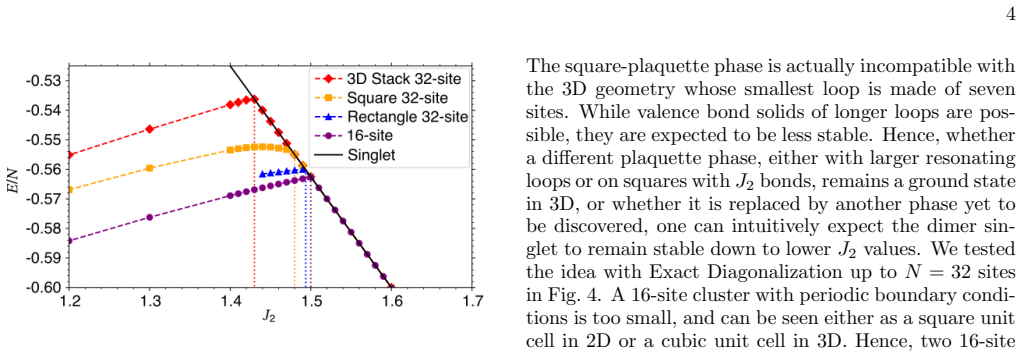
The paper's central discovery is that the three-dimensional analogue of the Shastry-Sutherland model inherits the exact dimer-singlet ground state. For $J_2 \geq 2$, the Hamiltonian can be written as a sum over triangular Hamiltonians, each of which has minimum energy $e_0 = -3J_2/8$. Because the lattice contains as many triangles as spins, the product state $|\psi_0\rangle = \prod_{\langle\langle i,j\rangle\rangle} (|\uparrow_i\downarrow_j\rangle - |\downarrow_i\uparrow_j\rangle)/\sqrt{2}$ over all $J_2$ bonds achieves this lower bound on every triangle and is therefore the exact ground state. The classical Ising and Heisenberg ground-state phase diagrams in a field are shown to be the same as in 2D, with the $1/3$ plateau realized by a 12-site magnetic unit cell and the umbrella phase propagating in three dimensions. Exact diagonalization data are presented as evidence that the dimer-singlet phase extends below $J_2 = 2$, more robustly than in 2D.
Load-bearing premise
The proof assumes that the lattice can be decomposed into triangles in such a way that every $J_1$ bond appears in exactly one triangle and every $J_2$ bond in exactly two, making the triangle-sum Hamiltonian exactly equal to the physical bond Hamiltonian.
Editorial extensions
If this is right
- For $J_2 \geq 2$, the zero-field ground state is a product of uncorrelated singlets, so the model provides a three-dimensional example of an exactly solvable quantum dimer phase.
- The classical Ising phase diagram in a field, including the $1/3$ magnetization plateau, is identical in 2D and 3D despite the absence of four-site loops.
- The classical Heisenberg phase diagram carries over with the same saturation fields, so the 3D lattice supports the same canted Néel and umbrella-type spin configurations.
- The 2D square-plaquette phase cannot exist in 3D because the shortest loop has seven sites, so any intermediate phase between Néel order and the dimer singlet must be of a different nature.
- Exact diagonalization evidence suggests the dimer-singlet phase in 3D is stabilized beyond its 2D counterpart, down to lower $J_2$ values.
Reading between the lines
- The exactness mechanism may generalize: any lattice built from corner-sharing triangles with equal numbers of spins and triangles, and the right bond-multiplicity condition, would admit the same dimer-singlet proof; classifying such lattices could produce more exactly solvable frustrated quantum magnets.
- The absence of inversion symmetry on this lattice allows Dzyaloshinskii-Moriya interactions, so triplon bands could acquire topological character in 3D; the paper raises this but does not compute it.
- A finite-temperature Monte Carlo study of the classical Ising model could test whether the $1/3$ plateau survives beyond zero temperature, since the up-up-down state is highly degenerate and entropically favoured.
- Adding a weak $J_3$ coupling on the removed pyrochlore bonds interpolates between the pyrochlore and 3D Shastry-Sutherland limits; tracking the dimer-singlet phase along this path is a natural next step.
Editorial analysis
A structured set of objections, weighed in public.
Referee Report
Summary. The manuscript introduces a three-dimensional lattice obtained from the pyrochlore lattice by removing the 'top' bond of each tetrahedron and assigning the opposite 'bottom' bond as J2, yielding a local coordination of five bonds per site. The authors claim this is a direct 3D analogue of the Shastry-Sutherland lattice, with the same local spin Hamiltonian. They analyze classical Ising and Heisenberg ground states in a magnetic field, obtaining phase diagrams identical to 2D, including a 1/3 magnetization plateau and an umbrella state. For quantum S = 1/2 they rewrite the Hamiltonian as a sum of triangle Hamiltonians and prove that, for J2 >= 2, the product of singlets on all J2 bonds is the exact ground state, with energy -3J2/8 per site. Exact diagonalization on 16- and 32-site clusters is presented as evidence that the dimer phase is stabilized in 3D relative to 2D.
Significance. If the geometric identities underlying the triangle decomposition are valid, the result is a rare exact ground state for a three-dimensional frustrated quantum spin system, and the construction provides a controlled route to study dimensional effects on exact dimer physics. The proof is elegant and uses only the variational principle and the single-triangle spectrum; no fitting parameters are introduced. The classical phase diagrams are analytically tractable and the ED comparison is a useful first step. The main weakness is that the lattice counting needed for the exact proof is asserted rather than demonstrated, and the global classical spin configurations are described only through figures; these omissions currently prevent the central claims from being fully verifiable from the text alone.
major comments (3)
- [Section IV, Eqs. (1) and (4)] The exact dimer proof requires that (i) each J1 bond appears in exactly one triangle of the decomposition, (ii) each J2 bond appears in exactly two triangles, (iii) the J2 bonds form a perfect matching, and (iv) the number of triangles equals the number of sites. The text asserts 'every site participates in exactly one J2 bond' and 'as many spins as triangles', but the construction ('remove the top bond from each tetrahedron') does not by itself guarantee these properties for all sites. In a corner-sharing pyrochlore, each site belongs to two tetrahedra; a site that is top in both would lose two bonds (degree 4, no J2 incident), while a site bottom in both would have degree 6 and two J2 bonds. The proof therefore needs an explicit argument that the chosen z-axis alternates the roles of each site between its two tetrahedra. Please provide coordinates of the lattice and a counting proof of the identities, or the thermodynamic-limit exactness is not established.
- [Section III, Heisenberg model, J2 >= 1] The local minimization of each triangle determines planar spin components (S_perp,1 = S_perp,2 = -S_perp,0/J2) and a canting angle, but the paper asserts only that the resulting constraints can be closed consistently around the seven-site loop, referring to Fig. 3(b). Because the claimed phase diagram is exact, a constructive global configuration (e.g., explicit spin orientations on the magnetic unit cell) or a proof of absence of frustration on all loops is required; the figure alone does not exclude a contradiction accumulating over longer paths.
- [Section II, Ising model, 1/3 plateau] The 1/3 plateau phase is central to the claimed classical phase diagram, but the paving of the 3D lattice with the three triangular states is described only by Fig. 2(b) and deferred to the Supplemental Material [27]. Please either provide the explicit 12-site magnetic unit cell and the rules for its periodic repetition in the main text, or state the paving algorithm completely, so the exactness of the phase diagram can be checked.
minor comments (5)
- [Section I and Fig. 1] The lattice is defined only verbally and by Fig. 1; no coordinates or explicit tie choices are given. Adding an appendix with the full construction would make the paper self-contained and allow readers to verify the connectivity and J2 matching claims.
- [Fig. 4] The color names in the text (violet, orange, blue, red) are not fully matched in the figure caption; please align the legend and text descriptions so the 2D and 3D clusters are unambiguous.
- [Abstract and Section I] The phrase 'the ground-state phase diagrams ... remain analytically tractable' could be clarified by specifying that these are the zero-temperature phase diagrams in a magnetic field; also, 'locally indistinguishable' should be defined precisely, e.g., by stating the four-site unit cell bond pattern explicitly.
- [Section III, Eq. (2)] The definition of X_t and the rewritten Hamiltonian in Eq. (2) should state which constant has been dropped, and the derivation of the saturation field for J2 >= 1 would benefit from a few intermediate steps so the result can be checked.
- [References] Reference [27] is cited for the Ising derivation; if the Supplemental Material is not included in the arXiv version, this should be indicated, and the main text should summarize the essential steps of the paving construction.
Circularity Check
No circularity: the exact dimer-singlet proof is a self-contained variational argument built on an external single-triangle result; the ED data are corroborative, not fitted inputs.
full rationale
The central claim (Section IV) is an exact lower-bound proof, not a fitted prediction. The paper rewrites H as a sum of triangle Hamiltonians (Eq. 4), diagonalizes a single triangle to obtain e0 = -3J2/8 for J2 >= 2, and invokes the variational principle with |psi0> as a product of J2 singlets. Given the lattice-counting assertions (one J1 bond per triangle, J2 bonds in two triangles, one J2 bond per site, as many spins as triangles), the inequality E >= N_t e0 = N_s(-3J2/8) is saturated by |psi0>, so the conclusion follows rigorously and is independent of the ED data. No parameter is fitted from Fig. 4; the ED comparison is used only to suggest stability of the singlet phase beyond the proven region. The classical Ising and Heisenberg sections import Dublenych (2012) and Moliner et al. (2009), which are external results, and the paper contains no load-bearing self-citations by the present authors. The real weakness is geometrical: the assertion that 'top-bond removal' gives the required uniform degree-5 lattice and exact triangle decomposition is stated rather than proved for the infinite lattice, and finite ED clusters do not establish it. That is an unproven premise that would invalidate the proof if false, but it is not circular because the conclusion is not assumed by the premise and no fitted or self-cited input forces the result. Score 0.
Assumptions & free parameters
assumptions (5)
- domain assumption The 3D SS lattice admits a decomposition H = sum_t H_t with each J1 bond in exactly one triangle and each J2 bond in exactly two triangles.
- standard math Single-triangle ground-state energy is e0 = -3J2/8 for J2 >= 2.
- domain assumption Dublenych's triangular-state classification for Ising ground states extends to the 3D lattice.
- domain assumption The local Heisenberg triangle ground-state pattern can be extended to the entire 3D lattice.
- domain assumption Two 32-site ED clusters are representative of thermodynamic-limit phase stability.
Cite this review
Pith. "Pith review of Exact ground state on the 3D analogue of the Shastry-Sutherland model." pith.science (2026). https://pith.science/paper/H5OGLSF7
@misc{pith2026250713877,
  author       = {Pith},
  title        = {Pith review of: Exact ground state on the 3D analogue of the Shastry-Sutherland model},
  year         = {2026},
  howpublished = {\url{https://pith.science/paper/H5OGLSF7}},
  note         = {Machine review of arXiv:2507.13877}
}
read the original abstract
Exact results in frustrated quantum many-body systems are rare, especially in dimensions higher than one. The Shastry-Sutherland (SS) model stands out as a rare example of a two-dimensional spin system with an exactly solvable dimer singlet ground state. In this work, we introduce a three-dimensional analogue of the SS lattice, constructed by deforming the pyrochlore lattice to preserve the local SS geometry. Despite the dimensional increase and altered topology, the ground-state phase diagrams of classical Ising and Heisenberg spins, remain analytically tractable and closely follow their 2D counterparts, including the existence of a 1/3 magnetization plateau and umbrella states. Most notably, for quantum spins S = 1/2, the dimer singlet state survives as an exact ground state over a finite region of the phase diagram. We argue, using exact diagonalization, that the singlet phase is stabilized beyond its 2D counterpart, suggesting enhanced robustness in three dimensions. These results offer a rare, controlled platform to explore the impact of dimensionality on quantum frustration, exact solvability, and potential spin liquid behavior in 3D, with relevance to emergent topological and magnetic phases.
Figures


Reference graph
Works this paper leans on
-
[27]
See Supplemental Material for more details on the deriva- tion of the Ising phase diagram in a field
-
[1]
Miyahara, in Introduction to Frustrated Magnetism , Vol
S. Miyahara, in Introduction to Frustrated Magnetism , Vol. 164, edited by C. Lacroix, P. Mendels, and F. Mila (Springer Berlin Heidelberg, Berlin, Heidelberg, 2011) pp. 513–536, series Title: Springer Series in Solid-State Sciences
work page 2011
-
[2]
Kitaev, Annals of Physics 321, 2 (2006)
A. Kitaev, Annals of Physics 321, 2 (2006)
2006
-
[3]
A. Y. Kitaev, Annals of Physics 303, 2 (2003)
2003
-
[4]
Sriram Shastry and B
B. Sriram Shastry and B. Sutherland, Physica B+C 108, 1069 (1981)
1981
- [5]
-
[6]
D. S. Rokhsar and S. A. Kivelson, Phys. Rev. Lett. 61, 2376 (1988)
1988
-
[7]
H. Kageyama, K. Yoshimura, R. Stern, N. V. Mushnikov, K. Onizuka, M. Kato, K. Kosuge, C. P. Slichter, T. Goto, and Y. Ueda, Physical Review Letters 82, 3168 (1999)
work page 1999
Show all 34 references
-
[8]
Onizuka, H
K. Onizuka, H. Kageyama, Y. Narumi, K. Kindo, Y. Ueda, and T. Goto, Journal of the Physical Society of Japan 69, 1016 (2000)
2000
-
[9]
Corboz and F
P. Corboz and F. Mila, Physical Review Letters 112, 147203 (2014)
2014
-
[10]
J. L. Jim´ enez, S. P. G. Crone, E. Fogh, M. E. Za- yed, R. Lortz, E. Pomjakushina, K. Conder, A. M. L¨ auchli, L. Weber, S. Wessel, A. Honecker, B. Normand, C. R¨ uegg, P. Corboz, H. M. Rønnow, and F. Mila, Nature 592, 370 (2021)
2021
-
[11]
J. Y. Lee, Y.-Z. You, S. Sachdev, and A. Vishwanath, Physical Review X 9, 041037 (2019)
2019
-
[12]
J. Yang, A. W. Sandvik, and L. Wang, Physical Review B 105, L060409 (2022)
2022
-
[13]
Mezera, J
M. Mezera, J. Menˇ s ´ ıkov´ a, P. Bal´ aˇ z, and M.ˇZonda, Sci- Post Physics Core 6, 088 (2023)
2023
-
[14]
L. L. Viteritti, R. Rende, A. Parola, S. Goldt, and F. Becca, Physical Review B 111, 134411 (2025), arXiv:2311.16889 [cond-mat]
2025 arXiv
-
[15]
R. P. Nutakki, A. Shokry, and F. Vicentini, Design prin- ciples of deep translationally-symmetric neural quantum states for frustrated magnets (2025), arXiv:2505.03466 [cond-mat]
2025
-
[16]
Ueda and S
K. Ueda and S. Miyahara, Journal of Physics: Condensed Matter 11, L175 (1999)
1999
-
[17]
Koga, Journal of the Physical Society of Japan 69, 3509 (2000), arXiv:cond-mat/0009266
A. Koga, Journal of the Physical Society of Japan 69, 3509 (2000), arXiv:cond-mat/0009266
2000 arXiv
-
[18]
Miyahara and K
S. Miyahara and K. Ueda, Journal of the Physical Society of Japan, Suppl. B 69, 72 (2000)
2000
-
[19]
Carpentier and L
D. Carpentier and L. Balents, Physical Review B 65, 024427 (2001)
2001
-
[20]
Chen and H
S. Chen and H. B¨ uttner, The European Physical Journal B 29, 15 (2002)
2002
-
[21]
Surendran and R
N. Surendran and R. Shankar, Physical Review B 66, 024415 (2002)
2002
-
[22]
H. Shik, Y. Li, and H. Lin, Nuclear Physics B 666, 337 (2003)
2003
-
[23]
G. Sun, N. Ma, B. Zhao, A. W. Sandvik, and Z. Y. Meng, Chinese Physics B 30, 067505 (2021)
2021
-
[24]
Kumar, Physical Review B 66, 024406 (2002)
B. Kumar, Physical Review B 66, 024406 (2002)
2002
-
[25]
Sutherland and B
B. Sutherland and B. S. Shastry, Journal of Statistical Physics 33, 477 (1983)
1983
-
[26]
Y. I. Dublenych, Phys. Rev. Lett. 109, 167202 (2012)
2012
-
[28]
M´ esocentre de Calcul Intensif Aquitain
for both the planar ( ⊥) and orthogonal ( z) spin components. Hamiltonian (1) can be rewritten as (up to a constant) H = X t X2 ⊥,t J2 + X 2 z,t J2 − h · Xz,t 1 + J2 . (2) There are two cases to distinguish [29, 30] as outlined below: Case 1, J2 ≥ 1 : It is possible to impose ...
-
[29]
Bilitewski, M
T. Bilitewski, M. E. Zhitomirsky, and R. Moessner, Phys. Rev. Lett. 119, 247201 (2017)
2017
-
[30]
Moliner, D
M. Moliner, D. C. Cabra, A. Honecker, P. Pujol, and F. Stauffer, Phys. Rev. B 79, 144401 (2009)
2009
-
[31]
Grechnev, Phys
A. Grechnev, Phys. Rev. B 87, 144419 (2013)
2013
-
[32]
Koga and N
A. Koga and N. Kawakami, Phys. Rev. Lett. 84, 4461 (2000)
2000
-
[33]
Corboz and F
P. Corboz and F. Mila, Phys. Rev. B 87, 115144 (2013)
2013
-
[34]
Romh´ anyi, K
J. Romh´ anyi, K. Penc, and R. Ganesh, Nature Commu- nications 6, 10.1038/ncomms7805 (2015), number: 1
2015 doi
Reviewed August 6, 2026 · model on record in the stance chip above.
Discussion (0). Sign in to comment.