REVIEW 4 major objections 6 minor 10 references
Novel techniques of imaging interferometry analysis to study gas and plasma density for laser-plasma experiments
T0 review · 4 major / 6 minor · reviewed 2026-08-06 · deepseek-v4-flash
Pith's one-line read This paper proposes training a conditional generative adversarial network on synthetic interferograms so that a single-shot interferogram can be converted automatically into the phase-shift map needed for gas and plasma density…
desk verdict Honest preliminary methods paper: cGAN on synthetic interferograms works on synthetic data, fails on one real interferogram, and the closed-loop validation doesn't carry the automated-diagnostic claim yet. read the letter →
The pith
A machine-rendered reading of the paper's core claim, the machinery that carries it, and where it could break.
The reading
What carries the argument
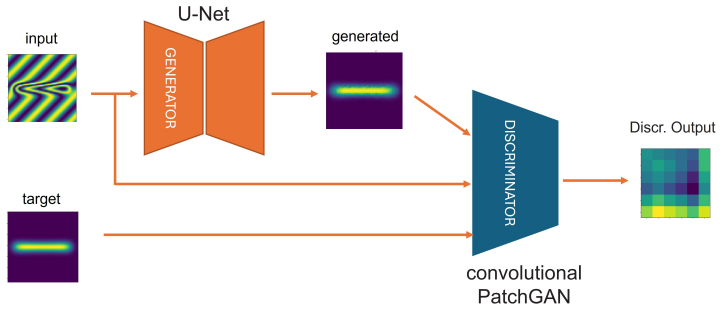
The central machinery is a cGAN trained on synthetic pairs. The generator is a U-Net, an encoder-decoder with skip connections that preserves low-level spatial information; the discriminator is a convolutional PatchGAN that judges whether each image patch is real or generated, making the training sensitive to high-spatial-frequency structure. Training data are produced by a synthetic pipeline that builds a three-dimensional refractive-index distribution with hyperbolic-tangent longitudinal gradients and Laguerre-Gaussian transverse modes, integrates the phase shift along the probe path, and converts the phase shift into fringe patterns with varying spatial frequency and orientation. The network is trained with over 4400 pairs, with on-the-fly rotation, cropping, noise, and intensity changes as data augmentation.
What would settle it
Acquire real interferograms together with an independent phase measurement (for example, by recording the same probe beam with and without the sample, or by an established independent reconstruction routine) and compare the network's recovered phase map against it; if the recovered maximum phase or the fringe-deflection shape disagrees systematically beyond the error seen on synthetic data, the central claim is falsified.
Extended reading notes
Core claim
The paper claims that the image-to-image translation problem "interferogram to phase-shift map" can be learned by a conditional GAN whose generator is a U-Net and whose discriminator is a PatchGAN, and that such a network, trained only on synthetic data, retrieves the phase shift with good accuracy on test interferograms not used in training. On synthetic test images the one-dimensional cuts of the generated phase map follow the target, the maximum phase is reproduced, and the map goes to zero outside the fringe deflection; the largest discrepancies occur where the phase slope is steep. When the same trained network is applied to a real interferogram, the paper reports that the retrieved phase shift is lower than the correct value and the overall shape is not correctly reconstructed. The intended application is a fast, operator-independent diagnostic for neutral gas and plasma density in high-repetition-rate laser-plasma experiments.
Load-bearing premise
The load-bearing premise is that computer-generated fringe patterns are similar enough to real experimental fringes that a network trained only on the synthetic ones can measure real gas and plasma densities, and the paper's own real-interferogram test shows this premise does not yet hold.
Editorial extensions
If this is right
- A trained cGAN would return a phase-shift map from a single interferogram in one forward pass, fast enough for real-time feedback in high-repetition-rate facilities.
- Removing manual choices of region of interest and FFT or wavelet parameters would cut a major source of operator-dependent error in density characterization.
- The synthetic-data pipeline lets the user generate unlimited training pairs covering different plasma lengths, gradients, fringe frequencies, and orientations without requiring experimental ground truth.
- The reported weakness on steep phase slopes identifies where the synthetic training distribution must be enriched before real shots can be analyzed reliably.
- The paper's stated next step, training on experimental images and adding simultaneous interferometry and shadowgraphy acquisition, is the necessary path to a reliable automated diagnostic.
Reading between the lines
- If synthetic-to-real transfer remains poor, a promising fix is fine-tuning the trained generator on a small set of real interferograms paired with an independent phase map, keeping the synthetic data as initialization.
- The observed failure at steep density gradients suggests a targeted test: augment the training set with sharper longitudinal gradients and higher-order transverse modes, then measure whether slope error drops before using real data.
- The same cGAN pairing could transfer to other single-shot phase diagnostics, such as shadowgraphy or wavefront sensing, because it only requires paired fringe images and ground-truth phase maps.
- A quantitative benchmark reporting the relative error in maximum phase and the root-mean-square error of image cuts on a fixed real-data set would let future users compare this approach with FFT-based and wavelet-based routines on equal footing.
Editorial analysis
A structured set of objections, weighed in public.
Referee Report
Summary. The paper proposes a machine-learning approach to interferogram analysis for gas and plasma density measurements. The authors describe a conditional generative adversarial network (cGAN) with a U-Net generator and a PatchGAN discriminator that maps an interferogram image to a phase-shift map. The network is trained on synthetic interferograms generated from analytic refractive-index distributions: longitudinal hyperbolic-tangent gradients, transverse Laguerre-Gaussian profiles, and variable fringe spatial frequency and orientation. The authors report that the trained network reconstructs the phase shift on synthetic test data with 'good accuracy', based on a single example with visual lineouts, but that the same network fails on one experimental interferogram, producing a lower phase shift and incorrect shape. The paper concludes with future steps, including training on experimental images and 3D density reconstruction. The work is explicitly described as ongoing and preliminary.
Significance. If successful, a fast, operator-independent interferogram analysis tool would be valuable for high-repetition-rate laser-plasma experiments, where traditional FFT- and wavelet-based methods require manual input and are time-consuming. The paper's strength is its honest reporting: the authors clearly state that the network does not generalize to a real interferogram, which is a critical piece of evidence for assessing the approach. The choice of a well-established cGAN architecture and the detailed description of the synthetic data generation concept are also positive aspects. However, the current evidence is limited to a qualitative demonstration on synthetic data, with no quantitative error metrics, no comparison to existing methods, and a single real-data failure. The significance of the work as a standalone journal contribution is therefore modest, but it could become a useful preliminary study if the validation is made quantitative and the claims are appropriately scoped.
major comments (4)
- [Section 3, Figure 3] The central claim that 'the trained network could reconstruct the phase shift with good accuracy' is supported only by a single visual example and two lineouts. No quantitative error metrics (e.g., root-mean-square error, peak error, structural similarity) are reported for the synthetic test set. Without error statistics over the full test set, the accuracy claim is not demonstrated. Please report quantitative metrics for all test images, including mean and standard deviation, and specify the number of test images used.
- [Section 3, real interferogram paragraph] The network fails on the one experimental interferogram: the retrieved phase shift is lower than the correct value and the entire shape is not correctly reconstructed. This is a load-bearing result because it directly contradicts the abstract's goal of an operator-independent diagnostic for real laser-plasma experiments. The paper should either (a) train on a more realistic synthetic dataset (including experimental fringe contrast, aberrations, and noise statistics) and demonstrate improvement on multiple real interferograms, or (b) explicitly scope the claims to synthetic-data demonstration and remove the broader diagnostic-implementation framing.
- [Section 2, Eq. (1) and Figure 2] The synthetic data generation workflow is described only qualitatively. The refractive-index model for plasma and gas (e.g., n = 1 - n_e/(2 n_c) in the underdense limit) is not stated, and the exact conversion from phase shift to fringe displacement in the interferogram is not given. This lack of detail prevents the reader from assessing whether the synthetic training distribution is representative of experimental conditions and makes the closed-loop nature of the synthetic validation difficult to evaluate. Please provide the explicit formulas and parameters used in the forward model.
- [Section 3, real interferogram test] For the real-interferogram test, the 'correct value' of the phase shift is not defined, and the reference method used to determine it is not described. The statement that 'the retrieved phase shift was lower than the correct value' is therefore not verifiable. Please specify how the ground-truth phase shift for the real interferogram was obtained (e.g., via an existing analysis routine, a known plasma density profile, or an independent measurement).
minor comments (6)
- [Section 3 heading] The heading 'T raining and preliminary results' contains a typo: 'T raining' should be 'Training'.
- [Section 4, Conclusions] The word 'reconstructred' in 'the phase shift was not correctly reconstructred' is misspelled; it should be 'reconstructed'.
- [Reference [5]] Reference [5] cites the arXiv version of Isola et al. with the journal name written as 'ArXive'; this should be corrected to 'arXiv'.
- [Figure 3] Figure 3 lacks axis labels and colorbars for the phase-shift images, and the lineouts have no units or labels. Adding these would make the comparison between target and generated phase shifts more interpretable.
- [Section 2, data augmentation] The data augmentation step mentions 'randomly rotate, crop, add noise and change the intensity' but gives no parameters (e.g., noise type, standard deviation, rotation range). Specifying these details would improve reproducibility.
- [Section 2, training details] The paper does not report key training hyperparameters (e.g., number of epochs, learning rate, batch size, loss weights, image resolution) or the size of the test set. These are needed for reproducibility and for evaluating whether the training was sufficient.
Circularity Check
No circular derivation: the paper is an honest, preliminary synthetic-data study whose real-data limitation is explicitly acknowledged.
full rationale
The paper's derivation chain is standard: Eq. (1) relates phase shift to refractive index; synthetic interferograms are generated from chosen 3D density distributions via that integral and a fringe-shift conversion; a cGAN is trained on (interferogram, phase map) pairs and tested on held-out synthetic examples. The test target is the phase map from which the held-out interferogram was generated, which makes the synthetic benchmark an inversion of the paper's own generator, but this is a data-generation and generalization issue rather than circularity: the network's output is not derived from the target by construction, the test examples were not used in training, and the paper does not substitute synthetic success for real-data validation. The manuscript explicitly states that on an experimental interferogram 'the retrieved phase shift was lower than the correct value' and 'the entire shape of the phase shift is not correctly reconstructed,' so the central practical claim is explicitly left unsupported rather than being smuggled in. The self-citations ([1], [4]) are contextual references to the authors' related diagnostic work and are not load-bearing evidence for the cGAN results. No fitted parameter is renamed as a prediction, no uniqueness theorem is imported from the authors, and no known result is repackaged under new coordinates. The absence of quantitative error metrics and the failed real-data test are correctness/completeness limitations, not circular steps.
Assumptions & free parameters
free parameters (3)
- Synthetic plasma/gas density profile parameters =
not specified
- Fringe spatial frequency and orientation =
varied
- cGAN training hyperparameters =
not reported
assumptions (4)
- domain assumption Equation (1) correctly models the phase shift of a probe laser crossing a gas or plasma, with reference refractive index 1.
- ad hoc to paper Synthetic density distributions built from Laguerre-Gaussian transverse modes and hyperbolic-tangent longitudinal gradients capture the relevant features of real laser-plasma sources.
- ad hoc to paper A cGAN trained on synthetic pairs will generalize to experimental interferograms.
- domain assumption The U-Net generator and PatchGAN discriminator are appropriate for interferogram-to-phase-shift translation.
Cite this review
Pith. "Pith review of Novel techniques of imaging interferometry analysis to study gas and plasma density for laser-plasma experiments." pith.science (2026). https://pith.science/paper/4TJZD635
@misc{pith2026250713907,
  author       = {Pith},
  title        = {Pith review of: Novel techniques of imaging interferometry analysis to study gas and plasma density for laser-plasma experiments},
  year         = {2026},
  howpublished = {\url{https://pith.science/paper/4TJZD635}},
  note         = {Machine review of arXiv:2507.13907}
}
read the original abstract
Laser-plasma based experiments are always more demanding about the plasma features which need to be generated during the interaction. This is valid for laser-plasma acceleration as well as for inertial confinement fusion experiments. Most of these experiments are moving toward high repetition rate operation regimes, making even more demanding the requests on the plasma sources and the diagnostics to be implemented. Interferometry is one of the most used methods to characterize these sources, since it allows for non-perturbative, single-shot measurements either of the neutral gas or the plasma density. The design of the interferometric setup is non-trivial and needs to be shaped on the actual conditions of the experiment. Similarly, the analysis of the raw data is a complex task, prone to many sources of error and dependent on the manual inputs. In this work, we will present the techniques we are developing for the analysis of the interferograms to measure both the gas and plasma density. We will show the methods, the progress and the problems we encountered in the development of novel routines of analysis based on machine learning. The architectures and the methods to obtain data used for training and testing them will be introduced. The study is ongoing and preliminary results with synthetic data will be presented. The goal is to set up a fast and operator independent diagnostic for the feedback of plasma sources toward high repetition rate experiments.
Figures


Reference graph
Works this paper leans on
-
[1]
Cambridge University press, editor
Hutchinson I.H., Principles of Plasma Diagnostics. Cambridge University press, editor. Cambridge; 2005
work page 2005
-
[2]
Filippi F., et al. Plasma density profile reconstruction of a gas cell for Ionization Induced Laser Wakefield Acceleration. Journal of Instrumentation 18.05 (2023): C05013
work page 2023
-
[3]
Applied Optics 18, 3101 (1985)
K.A.Nugent, Interferogram analysis using an accurate fully automatic algorithm. Applied Optics 18, 3101 (1985)
work page 1985
-
[4]
Tomassini P, et al. Analyzing laser plasma interferograms with a continuous wavelet transform ridge extraction technique: the method. Applied Optics 2001; 40(35):6561–8
work page 2001
-
[5]
Filippi F., et al. Toward an automated tool for interferogram analysis for real time characterization of plasma density profile in laser produced plasmas. Accepted for publication
-
[6]
et al ., Image to Image Translation with Conditional Adversarial Networks
Isola P. et al ., Image to Image Translation with Conditional Adversarial Networks . ArXive (2017). DOI: 10.48550/arXiv.1611.07004
-
[7]
Lee S. et al., Deep learning for high-resolution and high-sensitivity interferometric phase contrast imaging. Sci Rep. 2020;10(1):1–12
work page 2020
-
[8]
Rivenson Y, Wu Y, Ozcan A., Deep learning in holography and coherent imaging. Light Sci Appl. 2019;8(1)
work page 2019
Show all 10 references
-
[9]
U-net: Convolutional networks for biomedical image segmentation." Medical image computing and computer-assisted intervention
Ronneberger O., et al. U-net: Convolutional networks for biomedical image segmentation." Medical image computing and computer-assisted intervention. MICCAI 2015: 18th international conference, Munich, Germany, October 5-9, 2015
2015
-
[10]
Simon and Schuster, 2021
Chollet, F., Deep learning with Python . Simon and Schuster, 2021
2021
Reviewed August 6, 2026 · model on record in the stance chip above.
Discussion (0). Continue with ORCID to comment.