REVIEW 4 major objections 5 minor 185 references
XUE 10. The CO2-rich terrestrial planet-forming region of an externally irradiated Herbig disk
T0 review · 4 major / 5 minor · reviewed 2026-08-06 · deepseek-v4-flash
Pith's one-line read JWST observations of the externally irradiated Herbig disk XUE 10 detect, for the first time in a protoplanetary disk, all four CO2 isotopologues at once, revealing a CO2-rich, water-poor inner disk with possibly non-interstellar oxygen…
desk verdict Genuinely new CO2 isotopologue detections, but the continuum subtraction is model-dependent enough that the rarest lines and the isotope ratios need careful scrutiny. read the letter →
The pith
A machine-rendered reading of the paper's core claim, the machinery that carries it, and where it could break.
The reading
What carries the argument
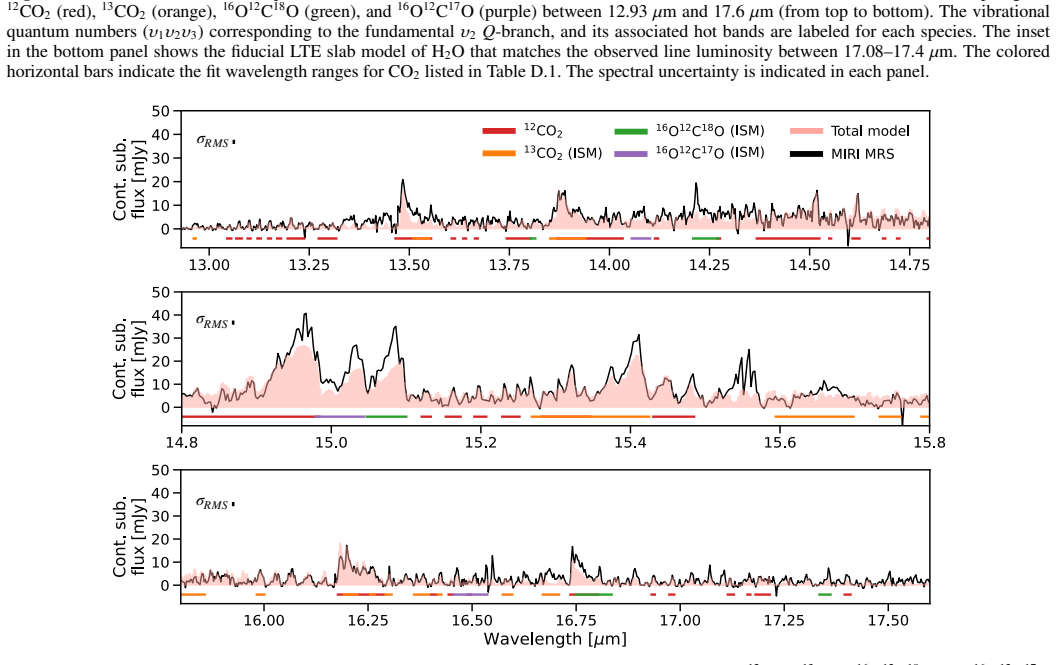
The load-bearing object is the 0D local-thermodynamic-equilibrium slab radiative transfer model, run on grids of total column density, gas temperature, and equivalent emitting radius, with reduced chi-square maps giving the 1-sigma contours. In the 12.9–17.6 micron region the CO2 lines are so strong that they form a pseudo-continuum on top of the dust continuum; the continuum subtraction therefore anchors its spline on model templates of the isotopologue emission, and this choice directly sets the measured column densities. The fitting proceeds sequentially from the brightest species (12CO2) to the fainter isotopologues, includes mutual line shielding, and uses a mix of optically thick Q-branches (peak line optical depths of 90, 55, 4, and 3 for 12CO2, 13CO2, 16O12C18O, and 16O12C17O) and optically thin P- and R-branch lines to constrain the parameter space. The central comparison is the set of column-density ratios among the four isotopologues against interstellar 12C/13C, 16O/18O, and 16O/17O ratios.
What would settle it
Re-fit the 12.9–17.6 micron MIRI MRS spectrum with a non-LTE radiative transfer model and with continuum anchor points taken from a dust-only emission model, then recompute the 16O/18O and 16O/17O column-density ratios; if the ratios return to interstellar values within 1 sigma, the claimed oxygen isotope anomaly is an artifact of the LTE slab and continuum-subtraction assumptions.
Extended reading notes
Core claim
The central claim is that XUE 10's inner disk is CO2-dominated and water-depleted, with CO2 emission bright enough to reveal four isotopic species simultaneously in a protoplanetary disk for the first time. From 0D LTE slab fits to the 12.9–17.6 micron continuum-subtracted spectrum, the authors derive gas temperatures of 300–370 K and column densities from $7.4\times10^{17}$ cm$^{-2}$ for 16O12C17O to $1.3\times10^{20}$ cm$^{-2}$ for 12CO2 over an equivalent emitting radius of 1.15 au, with 13CO2 at $8.3\times10^{19}$ cm$^{-2}$. The resulting 12C/13C, 16O/18O, and 16O/17O column-density ratios depart from interstellar values by factors of several to more than ten; the paper argues that the 13CO2 excess is plausibly an optical-depth artifact, while the 16O12C18O and 16O12C17O excesses may be real abundance anomalies, although 0D slab models cannot definitively separate opacity effects from abundance patterns. The proposed physical picture is that external FUV irradiation removes water by photo-dissociation or advection, CO2 is enhanced in the gas phase through CO + OH, and early inward drift of isotopically anomalous water ice supplies the oxygen isotope pattern.
Load-bearing premise
The derived column densities, temperatures, and isotope ratios all assume that a 0D LTE slab describes the emitting gas and that the model-anchored continuum subtraction in the CO2 pseudo-continuum window removes only dust, not real molecular emission; if either assumption gives way, the extreme CO2 columns and the apparent oxygen isotope anomalies would change.
Editorial extensions
If this is right
- XUE 10 becomes the benchmark case for inner-disk chemistry under external FUV irradiation around intermediate-mass stars, and any disk model for massive clusters must reproduce a CO2/H2O column ratio of at least roughly 130.
- Simultaneous high-significance detection of four CO2 isotopologues at 1.69 kpc demonstrates that JWST/MIRI can push isotope-ratio studies of planet-forming gas well beyond the nearby star-forming regions.
- If the oxygen isotope enhancement in 16O12C18O and 16O12C17O is real, the solids and gas that build terrestrial planets in irradiated clusters can be isotopically distinct from solar-system material, connecting disk environment to planetary isotope composition.
- The strict water upper limit, combined with the absence of OH and CH3+, implies that strong external UV can suppress water vapor without producing the molecular emission signature of a well-developed photo-dissociation region.
Reading between the lines
- A direct test the paper leaves implicit: compare XUE 10 with the survey's other disks across their range of external FUV fields; if the CO2/H2O column ratio increases with FUV exposure, irradiation rather than stellar mass is the controlling variable.
- The same 12.9–17.6 micron analysis applied to nearby non-irradiated T Tauri disks would establish a control sample; a clean separation in 16O/18O versus 16O/17O between irradiated and isolated disks would identify external UV as the fractionation driver.
- If the oxygen isotopologue excesses survive non-LTE modeling, they imply that terrestrial-planet building blocks in massive clusters may resemble certain carbonaceous chondrite isotope reservoirs, giving an environmental pathway to meteoritic anomalies.
- The unidentified 15.5–17 micron emission bump sits exactly under the CO2 bands; fitting it with dust or molecular carriers before re-deriving CO2 columns would provide a sharper test of the claimed CO2 column densities.
Editorial analysis
A structured set of objections, weighed in public.
Referee Report
Summary. The paper presents JWST/MIRI MRS and VLT/FORS2 observations of XUE 10, an F-type Herbig disk in the massive cluster NGC 6357 exposed to strong external FUV radiation. It reports the first simultaneous detection of four CO2 isotopologues (12CO2, 13CO2, 16O12C18O, 16O12C17O) in a protoplanetary disk, together with faint CO emission, the HI Pfalpha line, and upper limits on water. The molecular emission is modeled with 0D LTE slab models, yielding column densities, temperatures, and equivalent emitting radii; the stellar parameters are derived from PHOENIX template fitting to the optical spectrum. The paper interprets the enhanced 16O12C18O and 16O12C17O column densities as a possible oxygen isotope anomaly and discusses in-situ chemistry versus radial-transport scenarios to explain the CO2-rich, water-poor spectrum.
Significance. If the central detections and derived ratios hold, this is an important result: it would be the first simultaneous detection of four CO2 isotopologues in a protoplanetary disk, obtainable only with JWST, and it would extend isotope-ratio studies to the terrestrial planet-forming regions of an externally irradiated Herbig disk. The paper is careful in hedging the isotope anomaly, provides chi-square maps and parameter tables, and places the source in a comparative context with T Tauri and Herbig samples. A notable strength is the explicit acknowledgement of the Ntot-Tgas-Rem degeneracy and the optical-depth ambiguity. However, the central claim rests on a continuum subtraction procedure in the 12.9-17.6 micron region that is partly defined using the same slab model family used for the fits, and the claimed per-isotopologue >5-sigma significances are not quantified in the text. The result is scientifically exciting but the measurement robustness needs to be demonstrated more directly.
major comments (4)
- [Appendix A; Section 4; Tables 2 and 3] In the 12.9-17.6 micron region the continuum anchor points are chosen "based on templates of each isotopologue emission" for different values of temperature, column density, and equivalent emitting radius. Because the same 0D LTE slab models are subsequently fit to the residual spectrum, the continuum level is not independent of the model; a template mismatch can systematically suppress or enhance the fitted line fluxes. Since the claimed >5-sigma detections and the column density ratios in Tables 2 and 3 are all measured on this continuum-subtracted spectrum, these quantities are not yet demonstrated to be robust. Please provide an independent continuum estimate, for example an iterative full-model continuum or a spline anchored on wavelengths selected without reference to isotopologue templates, and show how the fitted parameters, their uncertainties, and the detection significances change.
- [Appendix B; Section 4.1] The broad 15.5-17 micron feature of unknown origin is subtracted before the CO2 fit. This wavelength range overlaps with the 12CO2 and 13CO2 fundamental Q-branches and with several fit windows listed in Table D.1 (for example 16.178-16.290 micron). If any part of the bump is actually CO2 emission, the fitted column densities and the 13CO2/12CO2 ratio will be biased. Please quantify the maximum CO2 flux that could be hidden in the bump and report the resulting systematic uncertainty on the Table 2 parameters.
- [Section 4.2; Table 3] The derived oxygen isotope ratios are 65 +/- 92 for 16O/18O and 174 +/- 247 for 16O/17O, and the 12C/13C anomaly disappears when 13CO2 is fit with a free emitting radius (Table 2). Given these large uncertainties and the Ntot-Tgas-Rem degeneracy, the claim of anomalous 16O12C18O and 16O12C17O abundances needs a formal significance statement, such as a confidence interval or likelihood ratio relative to the ISM ratios that includes the full parameter degeneracy. As written, the abstract's "may be isotopically anomalous" is appropriately hedged, but the paper should not imply that the anomaly is established without this quantitative assessment.
- [Section 3.1; Section 4.1] The paper states that the four isotopologues are detected at >5-sigma significance, but no per-isotopologue signal-to-noise ratio, line flux measurement, or Delta-chi-square significance is provided. The chi-square maps show best-fit locations, not detection significances. Please provide a quantitative significance estimate for each isotopologue, especially 16O12C18O and 16O12C17O, and state the statistical criterion used for the ">5-sigma" claim.
minor comments (5)
- [Figure A.1 caption] The wavelength units in the caption appear to read "7.49-7.51 m" and similar; these should be micrometers (micron).
- [Section 4.1] The phrase "may be own to the higher luminosity" should read "may be due to the higher luminosity."
- [Table 3] The definition of the reported ratios is confusing: the table gives ISM ratios and then a footnote says "we consider half of these ratios," while the observed ratios appear to be molecular column-density ratios. Please clarify explicitly whether the comparison is between elemental oxygen ratios or molecular isotopologue column-density ratios, and how the halving is applied.
- [Section 4.2] The text first argues that 16O12C18O and 16O12C17O may be isotopically anomalous and then states that "the most plausible conclusion is that we are affected by line optical depth effects also toward" these species; this tension should be reconciled in the conclusions.
- [Section 5.2.1] The sentence "This implies that alternatively to thermal effects, a high column density of CO2..." is awkwardly phrased and should be rewritten for clarity.
Circularity Check
No significant circularity: the CO2 isotopologue column densities and isotope ratios are measured by fitting independent LTE slab models to observed line fluxes and then compared to external ISM benchmarks; the continuum-subtraction caveat is a model dependence, not a derivation-equivalent input.
full rationale
The paper's central claim, the first simultaneous >5sigma detection of four CO2 isotopologues in a protoplanetary disk, rests on a standard reduction chain: MIRI MRS spectra, local spline continuum subtraction, a grid of 0D LTE slab models with HITRAN line data, and chi-square fitting of Ntot, Tgas, and Rem. No fitted parameter is renamed as a prediction. The apparent isotope anomalies in Table 3 are ratios of independently fitted column densities from Table 2, compared with external ISM ratios (Milam et al. 2005; Wilson & Rood 1994; Penzias 1981), so the comparison has independent content. The continuum anchor points in Appendix A were chosen with the aid of isotopologue templates, and the unidentified 15.5-17 micron bump (Appendix B) is subtracted before the CO2 fit; these are genuine systematic/model-dependence concerns that could bias the derived columns and detection significances, but they do not constitute an equation-level reduction of the output to the input. The paper explicitly acknowledges the degeneracy between optical depth and abundance (Section 4.2: '0D gas slab models do not allow one to discriminate between line optical depth effects and abundance patterns') and presents the isotope anomalies as tentative. Self-citations (Tabone et al. 2023 for the slab model; Ramirez-Tannus et al. 2023/2025 for reduction and sample context) are present but are code/method or program references, not a uniqueness theorem forcing the result; the fitting grid, HITRAN molecular data, and external ISM standards provide independent support. Therefore the derivation chain is not circular; the minor overlapping-author citations are not load-bearing, corresponding to a score of 2.
Assumptions & free parameters
free parameters (10)
- 12CO2 total column density log10(Ntot) =
20.11 (+2.89/-1.69)
- 12CO2 gas temperature Tgas =
365 K (+438/-186)
- 12CO2 equivalent emitting radius Rem =
1.15 au (+1.89/-0.14)
- 13CO2 total column density =
19.9 (+2.7/-2.9) log10 cm-2
- 16O12C18O column density =
18.3 (+0.8/-1.3) log10 cm-2
- 16O12C17O column density =
17.87 (+1.03/-1.29) log10 cm-2
- 12CO column density =
14.0 (+1.4/-0) log10 cm-2
- H2O upper-limit column density =
1e18 cm-2
- Stellar effective temperature Teff =
7000 K (+400/-300)
- Stellar bolometric luminosity Lbol =
69 +/- 5 Lsun
assumptions (6)
- domain assumption LTE for all modeled molecular gas
- domain assumption Continuum subtraction preserves the molecular features
- domain assumption ISM isotopic ratios are the correct baseline
- domain assumption Outer disk truncation by external FUV
- domain assumption FUV field strength of about 5e3 G0 from prior XUE work
- standard math HITRAN line list completeness and accuracy
Cite this review
Pith. "Pith review of XUE 10. The CO2-rich terrestrial planet-forming region of an externally irradiated Herbig disk." pith.science (2026). https://pith.science/paper/ZUHJOUGY
@misc{pith2026250713921,
  author       = {Pith},
  title        = {Pith review of: XUE 10. The CO2-rich terrestrial planet-forming region of an externally irradiated Herbig disk},
  year         = {2026},
  howpublished = {\url{https://pith.science/paper/ZUHJOUGY}},
  note         = {Machine review of arXiv:2507.13921}
}
abstract
We investigate the James Webb Space Telescope (JWST) MIRI MRS gas molecular content of an externally irradiated Herbig disk, the F-type XUE 10 source, in the context of the eXtreme UV Environments (XUE) program. XUE 10 belongs to the massive star cluster NGC 6357 (1.69 kpc), where it is exposed to an external far-ultraviolet (FUV) radiation $\approx$ 10$^3$ times stronger than in the Solar neighborhood. We modeled the molecular features in the mid-infrared spectrum with Local Thermodynamic Equilibrium (LTE) 0D slab models. We derived basic parameters of the stellar host from a VLT FORS2 optical spectrum using PHOENIX stellar templates. We detect bright CO2 gas with the first simultaneous detection (> 5$\sigma$) of four isotopologues (12CO2, 13CO2, 16O12C18O, 16O12C17O) in a protoplanetary disk. We also detect faint CO emission (2$\sigma$) and the HI Pf$\alpha$ line (8$\sigma$). We also place strict upper limits on the water content, finding a total column density $\lesssim$ 10$^{18}$ cm$^{-2}$. The CO2 species trace low gas temperatures (300-370 K) with a range of column densities of 7.4 $\times$ 10$^{17}$ cm$^{-2}$ (16O12C17O)-1.3 $\times$ 10$^{20}$ cm$^{-2}$ (12CO2) in an equivalent emitting radius of 1.15 au. The emission of 13CO2 is likely affected by line optical depth effects. 16O12C18O and 16O12C17O abundances may be isotopically anomalous compared to the 16O/18O and 16O/17O ratios measured in the interstellar medium and the Solar System. We propose that the mid-infrared spectrum of XUE 10 is explained by H2O removal either via advection or strong photo-dissociation by stellar UV irradiation, and enhanced local CO2 gas-phase production. Outer disk truncation supports the observed CO2-H2O dichotomy. A CO2 vapor enrichment in 18O and 17O can be explained by means of external UV irradiation and early on (10$^{4-5}$ yr) delivery of isotopically anomalous water ice to the inner disk.
Figures


Figures from the paper (6 more)


Reference graph
Works this paper leans on
-
[1]
C., Hollenbach , D., Laughlin , G., & Gorti , U
Adams , F. C., Hollenbach , D., Laughlin , G., & Gorti , U. 2004, , 611, 360
2004
-
[2]
2018, A&A, 616, A19
Agúndez , Roueff, Evelyne , Le Petit, Franck , & Le Bourlot, Jacques . 2018, A&A, 616, A19
2018
-
[3]
2025, OJAp, 8, 54
Allen , M., Anania , R., Andersen , M., et al. 2025, OJAp, 8, 54
2025
-
[4]
E., Bergin, E
Anderson, D. E., Bergin, E. A., Blake, G. A., et al. 2017, , 845, 13
2017
-
[5]
E., Blake, G
Anderson, D. E., Blake, G. A., Cleeves, L. I., et al. 2021, , 909, 55
2021
-
[6]
M., Huang, J., Pérez, L
Andrews, S. M., Huang, J., Pérez, L. M., et al. 2018, , 869, L41
2018
-
[7]
P., Manara , C
Ansdell , M., Williams , J. P., Manara , C. F., et al. 2017, , 153, 240
2017
-
[8]
, Lahuis, F
Antonellini , Kamp, I. , Lahuis, F. , et al. 2016, A&A, 585, A61
2016
Show all 185 references
-
[9]
M., Kamp , I., Henning , T., et al
Arabhavi , A. M., Kamp , I., Henning , T., et al. 2024, Science, 384, 1086
2024
-
[10]
L., Mauc \'o , K., Manara , C
Aru , M. L., Mauc \'o , K., Manara , C. F., et al. 2024, , 687, A93
2024
-
[11]
2025, , 170, 67
Arulanantham, N., Salyk, C., Pontoppidan, K., et al. 2025, , 170, 67
2025
-
[12]
P., Cleeves, L
Ballering, N. P., Cleeves, L. I., Haworth, T. J., et al. 2023, , 954, 127
2023
-
[13]
, Kama, M
Banzatti , Garufi, A. , Kama, M. , et al. 2018, A&A, 609, L2
2018
-
[14]
M., Brittain, S., et al
Banzatti, A., Abernathy, K. M., Brittain, S., et al. 2022, , 163, 174
2022
-
[15]
D., et al
Banzatti , A., Pascucci , I., Bosman , A. D., et al. 2020, , 903, 124
2020
-
[16]
M., Chávez, J
Banzatti, A., Pontoppidan, K. M., Chávez, J. P., et al. 2023, , 165, 72
2023
-
[17]
M., et al
Banzatti, A., Salyk, C., Pontoppidan, K. M., et al. 2025, , 169, 165
2025
-
[18]
L., Cobos , C
Baulch , D. L., Cobos , C. J., Cox , R. A., et al. 1992, J. Phys. Chem. Ref. Data, 21, 411
1992
-
[19]
2008, , 492, 277
Bayo , A., Rodrigo , C., Barrado Y Navascu \'e s , D., et al. 2008, , 492, 277
2008
-
[20]
A., Melnick, G
Bergin, E. A., Melnick, G. J., Gerakines, P. A., Neufeld, D. A., & Whittet, D. C. B. 2005, , 627, L33
2005
-
[21]
2023, , 621, 56
Bern \'e , O., Martin-Drumel , M.-A., Schroetter , I., et al. 2023, , 621, 56
2023
-
[22]
, Alcalá, J
Biazzo , Frasca, A. , Alcalá, J. M. , et al. 2017, A&A, 605, A66
2017
-
[23]
, Palla, F
Biazzo , Randich, S. , Palla, F. , & Briceño, C. 2011, A&A, 530, A19
2011
-
[24]
& Wurm, G
Blum, J. & Wurm, G. 2008, ARA&A, 46, 21
2008
-
[25]
W., Allamandola , L
Boersma , C., Bauschlicher , C. W., Allamandola , L. J., et al. 2010, , 511, A32
2010
-
[26]
A., Gerakines, P
Boogert, A. A., Gerakines, P. A., & Whittet, D. C. 2015, Annu. Rev. Astron., 53, 541–581
2015
-
[27]
2017, A&A, 601, A36
Bosman , Bruderer, Simon , & van Dishoeck, Ewine F. 2017, A&A, 601, A36
2017
-
[28]
D., Bergin, E
Bosman, A. D., Bergin, E. A., Calahan, J. K., & Duval, S. E. 2022, , 933, L40
2022
-
[29]
D., Walsh , C., & van Dishoeck , E
Bosman , A. D., Walsh , C., & van Dishoeck , E. F. 2018, , 618, A182
2018
-
[30]
Boyden, R. D. & Eisner, J. A. 2020, , 894, 74
2020
-
[31]
Boyden , R. D. & Eisner , J. A. 2023, , 947, 7
2023
-
[32]
2012, , 427, 127
Bressan , A., Marigo , P., Girardi , L., et al. 2012, , 427, 127
2012
-
[33]
D., Kamp, I., Meeus, G., Oudmaijer, R
Brittain, S. D., Kamp, I., Meeus, G., Oudmaijer, R. D., & Waters, L. B. F. M. 2023, Space Sci. Rev., 219
2023
-
[34]
D., Rettig, T
Brittain, S. D., Rettig, T. W., Simon, T., & Kulesa, C. 2005, , 626, 283
2005
-
[35]
2013, A&A, 559, A46
Bruderer . 2013, A&A, 559, A46
2013
-
[36]
Bruderer , S., Harsono , D., & van Dishoeck , E. F. 2015, , 575, A94
2015
-
[37]
F., Doty , S
Bruderer , S., van Dishoeck , E. F., Doty , S. D., & Herczeg , G. J. 2012, , 541, A91
2012
-
[38]
2023, JWST Calibration Pipeline
Bushouse , H., Eisenhamer , J., Dencheva , N., et al. 2023, JWST Calibration Pipeline
2023
-
[39]
2004, , 128, 1294
Calvet, N., Muzerolle, J., Briceño, C., et al. 2004, , 128, 1294
2004
-
[40]
2001, A&A, 367, L1
Cami & Yamamura . 2001, A&A, 367, L1
2001
-
[41]
Chiang , E. I. & Goldreich , P. 1997, , 490, 368
1997
-
[42]
Ciesla , F. J. & Cuzzi , J. N. 2006, , 181, 178
2006
-
[43]
Clayton , R. N. 1993, Annu. Rev. Earth Planet. Sci., 21, 115
1993
-
[44]
N., Grossman , L., & Mayeda , T
Clayton , R. N., Grossman , L., & Mayeda , T. K. 1973, Science, 182, 485
1973
-
[45]
Clayton , R. N. & Mayeda , T. K. 1999, , 63, 2089
1999
-
[46]
Coleman , G. A. L. & Haworth , T. J. 2022, , 514, 2315
2022
-
[47]
Concha-Ram \' rez , F., Wilhelm , M. J. C., Portegies Zwart , S., & Haworth , T. J. 2019, , 490, 5678
2019
-
[48]
2003, , 399, 773
Dartois , E., Dutrey , A., & Guilloteau , S. 2003, , 399, 773
2003
-
[49]
Dawson , R. I. & Johnson , J. A. 2018, , 56, 175
2018
-
[50]
de Graauw , T., Whittet , D. C. B., Gerakines , P. A., et al. 1996, , 315, L345
1996
-
[51]
2023, Faraday Discussions, 245
Dishoeck, E., Grant, S., Tabone, B., et al. 2023, Faraday Discussions, 245
2023
-
[52]
Dullemond , C. P. & Dominik , C. 2004, , 421, 1075
2004
-
[53]
J., & Bisbas , T
Facchini , S., Clarke , C. J., & Bisbas , T. G. 2016, , 457, 3593
2016
-
[54]
R., et al
Fang , M., van Boekel , R., King , R. R., et al. 2012, , 539, A119
2012
-
[55]
& Adams, F
Fatuzzo, M. & Adams, F. C. 2008, , 675, 1361
2008
-
[56]
2011, , 732, 106
Fedele, D., Pascucci, I., Brittain, S., et al. 2011, , 732, 106
2011
-
[57]
M., Hughes, A
Flaherty, K. M., Hughes, A. M., Rosenfeld, K. A., et al. 2015, , 813, 99
2015
-
[58]
W., Lang, D., & Goodman, J
Foreman-Mackey, D., Hogg, D. W., Lang, D., & Goodman, J. 2013, PASP, 125, 306–312
2013
-
[59]
, Dharmawardena, T
Fouesneau , Andrae, R. , Dharmawardena, T. , et al. 2022, A&A, 662, A125
2022
-
[60]
2006, , 459, 837
Garcia Lopez , R., Natta , A., Testi , L., & Habart , E. 2006, , 459, 837
2006
-
[61]
Gasman , Temmink, Milou , van Dishoeck, Ewine F. , et al. 2025, A&A, 694, A147
2025
-
[62]
, Grant, Sierra L
Gasman , van Dishoeck, Ewine F. , Grant, Sierra L. , et al. 2023, A&A, 679, A117
2023
-
[63]
V., Feigelson, E
Getman, K. V., Feigelson, E. D., Kuhn, M. A., et al. 2014, , 787, 108
2014
-
[64]
, Matsuura, M
Gielen , Van Winckel, H. , Matsuura, M. , et al. 2009, A&A, 503, 843
2009
-
[65]
E., Meijerink, R., & Najita, J
Glassgold, A. E., Meijerink, R., & Najita, J. R. 2009, , 701, 142
2009
-
[66]
E., Rothman , L
Gordon , I. E., Rothman , L. S., Hargreaves , R. J., et al. 2022, , 277, 107949
2022
-
[67]
L., van Dishoeck, E
Grant, S. L., van Dishoeck, E. F., Tabone, B., et al. 2023, , 947, L6
2023
-
[68]
Gray , R. O. & Corbally , J., C. 2009, Stellar Spectral Classification (Princeton University Press)
2009
-
[69]
Gross , R. E. & Cleeves , L. I. 2025, , 980, 189
2025
-
[70]
G., Drake, J
Guarcello, M. G., Drake, J. J., Wright, N. J., et al. 2023, ApJS, 269, 13
2023
-
[71]
& Blum , J
Gundlach , B. & Blum , J. 2015, , 798, 34
2015
-
[72]
, & Facchini, S
Gárate , Pinilla, Paola , Haworth, Thomas J. , & Facchini, S. 2024, A&A, 681, A84
2024
-
[73]
Habing , H. J. 1968, , 19, 421
1968
-
[74]
Haworth , T. J. & Clarke , C. J. 2019, , 485, 3895
2019
-
[75]
J., Clarke, C
Haworth, T. J., Clarke, C. J., Rahman, W., Winter, A. J., & Facchini, S. 2018, , 481, 452
2018
-
[76]
J., Coleman , G
Haworth , T. J., Coleman , G. A. L., Qiao , L., Sellek , A. D., & Askari , K. 2023, , 526, 4315
2023
-
[77]
N., Bosman , A
Heays , A. N., Bosman , A. D., & van Dishoeck , E. F. 2017, , 602, A105
2017
-
[78]
Henney , W. J. & O'Dell , C. R. 1999, , 118, 2350
1999
-
[79]
2024, , 136, 054302
Henning , T., Kamp , I., Samland , M., et al. 2024, , 136, 054302
2024
-
[80]
2025, , 537
Houge, A., Krijt, S., Banzatti, A., et al. 2025, , 537
2025
-
[81]
O., Wende-von Berg , S., Dreizler , S., et al
Husser , T. O., Wende-von Berg , S., Dreizler , S., et al. 2013, , 553, A6
2013
-
[82]
R., Avila , J., Greenwood , R
Ireland , T. R., Avila , J., Greenwood , R. C., Hicks , L. J., & Bridges , J. C. 2020, , 216, 25
2020
-
[83]
A., Aller, K
Johnson, J. A., Aller, K. M., Howard, A. W., & Crepp, J. R. 2010, , 122, 905
2010
-
[84]
1998, , 499, 758
Johnstone , D., Hollenbach , D., & Bally , J. 1998, , 499, 758
1998
-
[85]
C., \'A lvarez-M \'a rquez , J., Sloan , G
Jones , O. C., \'A lvarez-M \'a rquez , J., Sloan , G. C., et al. 2023, , 523, 2519
2023
-
[86]
, Woitke, P
Kaeufer , Min, M. , Woitke, P. , Kamp, I. , & Arabhavi, A. M. 2024, A&A, 687, A209
2024
-
[87]
& Dullemond , C
Kamp , I. & Dullemond , C. P. 2004, , 615, 991
2004
-
[88]
F., & Hogerheijde , M
Kamp , I., Tilling , I., Woitke , P., Thi , W. F., & Hogerheijde , M. 2010, , 510, A18
2010
-
[89]
2024, , 689, A231
Kanwar , J., Kamp , I., Jang , H., et al. 2024, , 689, A231
2024
-
[90]
D., Sloan , G
Keller , L. D., Sloan , G. C., Forrest , W. J., et al. 2008, , 684, 411
2008
-
[91]
& Haworth , T
Keyte , L. & Haworth , T. J. 2025, , 537, 598
2025
-
[92]
E., Tielens , A
Kress , M. E., Tielens , A. G. G. M., & Frenklach , M. 2010, ASR, 46, 44
2010
-
[93]
R., McKee , C
Krumholz , M. R., McKee , C. F., & Bland-Hawthorn , J. 2019, , 57, 227
2019
-
[94]
A., Hillenbrand , L
Kuhn , M. A., Hillenbrand , L. A., Sills , A., Feigelson , E. D., & Getman , K. V. 2019, , 870, 32
2019
-
[95]
Lada, C. J. & Lada, E. A. 2003, ARA&A, 41, 57
2003
-
[96]
& Johansen , A
Lambrechts , M. & Johansen , A. 2012, , 544, A32
2012
-
[97]
2015, A&A, 583, A1
Le Roy , Altwegg, Kathrin , Balsiger, Hans , et al. 2015, A&A, 583, A1
2015
-
[98]
L., Bitsch , B., & Henning , T
Lienert , J. L., Bitsch , B., & Henning , T. 2024, , 691, A72
2024
-
[99]
2025, , 978, L30
Long, F., Pascucci, I., Houge, A., et al. 2025, , 978, L30
2025
-
[100]
C., Yin, Q.-Z., Ng, C
Lu, Z., Chang, Y. C., Yin, Q.-Z., Ng, C. Y., & Jackson, W. M. 2014, Science, 346, 61
2014
-
[101]
Lyons , J. R. & Young , E. D. 2005, , 435, 317
2005
-
[102]
F., Ansdell , M., Rosotti , G
Manara , C. F., Ansdell , M., Rosotti , G. P., et al. 2023, in Astronomical Society of the Pacific Conference Series, Vol. 534, Protostars and Planets VII, ed. S. Inutsuka , Y. Aikawa , T. Muto , K. Tomida , & M. Tamura , 539
2023
-
[103]
K., Di Francesco, J., Johnstone, D., et al
Mann, R. K., Di Francesco, J., Johnstone, D., et al. 2014, , 784, 82
2014
-
[104]
2001, , 121, 1050
Massey , P., DeGioia-Eastwood , K., & Waterhouse , E. 2001, , 121, 1050
2001
-
[105]
, Di Carlo, E
Massi , Giannetti, A. , Di Carlo, E. , et al. 2015, A&A, 573, A95
2015
-
[106]
J., et al
McElroy , D., Walsh , C., Markwick , A. J., et al. 2013, , 550, A36
2013
-
[107]
Meeus , Waters, L. B. F. M. , Bouwman, J. , et al. 2001, A&A, 365, 476
2001
-
[108]
M., Blake, G
Meijerink, R., Pontoppidan, K. M., Blake, G. A., Poelman, D. R., & Dullemond, C. P. 2009, , 704, 1471
2009
-
[109]
N., Savage, C., Brewster, M
Milam, S. N., Savage, C., Brewster, M. A., Ziurys, L. M., & Wyckoff, S. 2005, , 634, 1126
2005
-
[110]
, & van Dishoeck, E
Miotello , Bruderer, S. , & van Dishoeck, E. F. 2014, A&A, 572, A96
2014
-
[111]
& Kamp , I
Molano , G. & Kamp , I. 2012 a , , 537, A138
2012
-
[112]
& Kamp , I
Molano , G. & Kamp , I. 2012 b , , 547, A7
2012
-
[113]
2012, , 541, A97
Mordasini , C., Alibert , Y., Benz , W., Klahr , H., & Henning , T. 2012, , 541, A97
2012
-
[114]
2012, A&A, 539, A9
Mulders & Dominik . 2012, A&A, 539, A9
2012
-
[115]
Ndugu , N., Bitsch , B., & Lienert , J. L. 2024, , 691, A32
2024
-
[116]
I., Murray-Clay , R., & Bergin , E
\"O berg , K. I., Murray-Clay , R., & Bergin , E. A. 2011, , 743, L16
2011
-
[117]
J., & Nelson , R
Paine , S., Haworth , T. J., & Nelson , R. P. 2025,
2025
-
[118]
S., & Bruderer, S
Pascucci, I., Herczeg, G., Carr, J. S., & Bruderer, S. 2013, , 779, 178
2013
-
[119]
Pecaut , M. J. & Mamajek , E. E. 2013, , 208, 9
2013
-
[120]
Penzias , A. A. 1981, , 249, 518
1981
-
[121]
2023, , 620, 516
Perotti , G., Christiaens , V., Henning , T., et al. 2023, , 620, 516
2023
-
[122]
, Birnstiel, T
Pinilla , Klarmann, L. , Birnstiel, T. , et al. 2016, A&A, 585, A35
2016
-
[123]
A., Öberg, K
Piso, A.-M. A., Öberg, K. I., Birnstiel, T., & Murray-Clay, R. A. 2015, , 815, 109
2015
-
[124]
Pontoppidan , K. M. & Blevins , S. M. 2014, Faraday Discussions, 168, 49
2014
-
[125]
M., Salyk, C., Blake, G
Pontoppidan, K. M., Salyk, C., Blake, G. A., et al. 2010, , 720, 887
2010
-
[126]
V., Ramírez-Tannus, M
Portilla-Revelo, B., Getman, K. V., Ramírez-Tannus, M. C., et al. 2025, , 985, 72
2025
-
[127]
2020, JOSS, 5, 2308
Prochaska , J., Hennawi , J., Westfall , K., et al. 2020, JOSS, 5, 2308
2020
-
[128]
Qiao , L., Coleman , G. A. L., & Haworth , T. J. 2023, , 522, 1939
2023
-
[129]
2018, , 609, A91
Rab , C., G \"u del , M., Woitke , P., et al. 2018, , 609, A91
2018
-
[130]
C., Backs , F., Bik , A., et al
Ramirez-Tannus , M. C., Backs , F., Bik , A., et al. 2021, JWST Proposal. Cycle 1, ID. \#1759
2021
-
[131]
C., Poorta , J., Bik , A., et al
Ram \' rez-Tannus , M. C., Poorta , J., Bik , A., et al. 2020, , 633, A155
2020
-
[132]
C., Bik, A., Cuijpers, L., et al
Ramírez-Tannus, M. C., Bik, A., Cuijpers, L., et al. 2023, , 958, L30
2023
-
[133]
C., Bik, A., Getman, K
Ramírez-Tannus, M. C., Bik, A., Getman, K. V., et al. 2025
2025
-
[134]
2015, , 574, A116
Reffert , S., Bergmann , C., Quirrenbach , A., Trifonov , T., & K \"u nstler , A. 2015, , 574, A116
2015
-
[135]
Richert , A. J. W., Getman , K. V., Feigelson , E. D., et al. 2018, , 477, 5191
2018
-
[136]
H., Wright, G
Rieke, G. H., Wright, G. S., Böker, T., et al. 2015, PASP, 127, 584
2015
-
[137]
2011, , 733, 113
Roccatagliata, V., Bouwman, J., Henning, T., et al. 2011, , 733, 113
2011
-
[138]
, Bouret, J
Russeil , Adami, C. , Bouret, J. C. , et al. 2017, A&A, 607, A86
2017
-
[139]
M., Banzatti , A., et al
Salyk , C., Pontoppidan , K. M., Banzatti , A., et al. 2025, , 169, 184
2025
-
[140]
M., Blake, G
Salyk, C., Pontoppidan, K. M., Blake, G. A., et al. 2008, ApJ, 676, L49
2008
-
[141]
& Clarke , C
Scally , A. & Clarke , C. 2001, , 325, 449
2001
-
[142]
R., Henning , T., Christiaens , V., et al
Schwarz , K. R., Henning , T., Christiaens , V., et al. 2024, , 962, 8
2024
-
[143]
D., Booth , R
Sellek , A. D., Booth , R. A., & Clarke , C. J. 2020, , 492, 1279
2020
-
[144]
D., Vlasblom , M., & van Dishoeck , E
Sellek , A. D., Vlasblom , M., & van Dishoeck , E. F. 2025, , 694, A79
2025
-
[145]
H., Najita , J
Shu , F. H., Najita , J. R., Shang , H., & Li , Z. Y. 2000, in Protostars and Planets IV, ed. V. Mannings , A. P. Boss , & S. S. Russell , 789--814
2000
-
[146]
Smith , I. W. M., Herbst , E., & Chang , Q. 2004, , 350, 323
2004
-
[147]
L., Pontoppidan, K
Smith, R. L., Pontoppidan, K. M., Young, E. D., & Morris, M. R. 2015, , 813, 120
2015
-
[148]
L., Pontoppidan, K
Smith, R. L., Pontoppidan, K. M., Young, E. D., Morris, M. R., & van Dishoeck, E. F. 2009, , 701, 163–175
2009
-
[149]
M., Hogerheijde , M
Stapper , L. M., Hogerheijde , M. R., van Dishoeck , E. F., et al. 2025, , 693, A49
2025
-
[150]
M., Hogerheijde , M
Stapper , L. M., Hogerheijde , M. R., van Dishoeck , E. F., & Mentel , R. 2022, , 658, A112
2022
-
[151]
Stevenson, D. J. & Lunine, J. I. 1988, Icarus, 75, 146
1988
-
[152]
R., Ghez, A
Stolte, A., Morris, M. R., Ghez, A. M., et al. 2010, , 718, 810
2010
-
[153]
F., et al
Tabone , B., Bettoni , G., van Dishoeck , E. F., et al. 2023, Nat. Astron., 7, 805
2023
-
[154]
P., Duke, M
Taylor, H. P., Duke, M. B., Silver, L. T., & Epstein, S. 1965, Geochim. Cosmochim. Acta, 29, 489
1965
-
[155]
F., Gasman , D., et al
Temmink , M., van Dishoeck , E. F., Gasman , D., et al. 2024 a , , 689, A330
2024
-
[156]
F., Grant , S
Temmink , M., van Dishoeck , E. F., Grant , S. L., et al. 2024 b , , 686, A117
2024
-
[157]
F., Woitke , P., & Kamp , I
Thi , W. F., Woitke , P., & Kamp , I. 2011, , 412, 711
2011
-
[158]
Thiemens, M. H. & Heidenreich, J. E. 1983, Science, 219, 1073
1983
-
[159]
Throop, H. B. & Bally, J. 2005, , 623, L149
2005
-
[160]
Valegård , Waters, L. B. F. M. , & Dominik, C. 2021, A&A, 652, A133
2021
-
[161]
van Boekel , R., Min , M., Waters , L. B. F. M., et al. 2005, , 437, 189
2005
-
[162]
van Terwisga , van Dishoeck, E. F. , Mann, R. K. , et al. 2020, A&A, 640, A27
2020
-
[163]
E., Hacar , A., & van Dishoeck , E
van Terwisga , S. E., Hacar , A., & van Dishoeck , E. F. 2019, , 628, A85
2019
-
[164]
2003, Annu
Van Winckel, H. 2003, Annu. Rev. Astron., 41, 391
2003
-
[165]
van Zadelhoff , van Dishoeck, E. F. , Thi, W.-F. , & Blake, G. A. 2001, A&A, 377, 566
2001
-
[166]
Visser , van Dishoeck, E. F. , & Black, J. H. 2009, A&A, 503, 323
2009
-
[167]
C., Dullemond , C
Visser , R., Geers , V. C., Dullemond , C. P., et al. 2007, , 466, 229
2007
-
[168]
L., et al
Vlasblom , M., Temmink , M., Grant , S. L., et al. 2025, , 693, A278
2025
-
[169]
R., Howarth , I
Walborn , N. R., Howarth , I. D., Lennon , D. J., et al. 2002, , 123, 2754
2002
-
[170]
2015, A&A, 582, A88
Walsh , Nomura, Hideko , & van Dishoeck, Ewine . 2015, A&A, 582, A88
2015
-
[171]
J., & Nomura , H
Walsh , C., Millar , T. J., & Nomura , H. 2013, , 766, L23
2013
-
[172]
2015, PASP, 127, 646
Wells, M., Pel, J.-W., Glasse, A., et al. 2015, PASP, 127, 646
2015
-
[173]
Wilson , T. L. & Rood , R. 1994, , 32, 191
1994
-
[174]
Winn, J. N. & Fabrycky, D. C. 2015, ARA&A, 53, 409
2015
-
[175]
J., Clarke , C
Winter , A. J., Clarke , C. J., Rosotti , G., et al. 2018, , 478, 2700
2018
-
[176]
Winter , A. J. & Haworth , T. J. 2022, Eur. Phys. J. Plus, 137, 1132
2022
-
[177]
J., Kruijssen , J
Winter , A. J., Kruijssen , J. M. D., Chevance , M., Keller , B. W., & Longmore , S. N. 2020, , 491, 903
2020
-
[178]
, Pinte, C
Woitke , Min, M. , Pinte, C. , et al. 2016, A&A, 586, A103
2016
-
[179]
F., Arabhavi , A
Woitke , P., Thi , W. F., Arabhavi , A. M., et al. 2024 a , , 683, A219
2024
-
[180]
F., Arabhavi , A
Woitke , P., Thi , W. F., Arabhavi , A. M., et al. 2024 b , , 683, A219
2024
-
[181]
S., Wright, D., Goodson, G
Wright, G. S., Wright, D., Goodson, G. B., et al. 2015, , 127, 595
2015
-
[182]
2025, , 696, A99
Zannese , M., Tabone , B., Habart , E., et al. 2025, , 696, A99
2025
-
[183]
2024, Nat
Zannese , M., Tabone , B., Habart , E., et al. 2024, Nat. Astron., 8, 577
2024
-
[184]
, " * write output.state after.block = add.period write newline
ENTRY address archiveprefix author booktitle chapter edition editor howpublished institution eprint journal key month note number organization pages publisher school series title type volume year label extra.label sort.label short.list INTEGERS output.state before.all mid.sent...
-
[185]
write newline
" write newline "" before.all 'output.state := FUNCTION n.dashify 't := "" t empty not t #1 #1 substring "-" = t #1 #2 substring "--" = not "--" * t #2 global.max substring 't := t #1 #1 substring "-" = "-" * t #2 global.max substring 't := while if t #1 #1 substring * t #2 gl...
Reviewed August 6, 2026 · model on record in the stance chip above.
Discussion (0). Sign in to comment.