REVIEW 3 major objections 6 minor 127 references
Strong gravitational lensing by black hole in F(R) Euler Heisenberg Gravity's Rainbow
T0 review · 3 major / 6 minor · reviewed 2026-08-06 · deepseek-v4-flash
Pith's one-line read Black holes in a combined F(R), Euler-Heisenberg and Rainbow-gravity framework act as strong gravitational lenses whose deflection, Einstein-ring, and time-delay signatures are controlled by the Euler-Heisenberg parameter and charge…
desk verdict Bozza's machinery is competently applied, but the paper's main regime (R0≠0) uses an asymptotically flat lens equation and an infinity-boundary deflection integral on a metric that is not asymptotically flat, so the headline numbers are not well-defined. read the letter →
The pith
A machine-rendered reading of the paper's core claim, the machinery that carries it, and where it could break.
The reading
What carries the argument
The engine of the paper is the strong-deflection-limit expansion, which writes the deflection angle near the photon sphere as $\alpha_D(u)=-\bar a\log(u/u_{ph}-1)+\bar b$. The coefficients $\bar a$, $\bar b$, and the critical impact parameter $u_{ph}$ are computed from the metric function $G(r)$; the observables then follow from the asymptotically flat lens equation $\psi=\theta-(D_{LS}/D_{OS})\Delta\alpha_n$ via $\theta_\infty=u_{ph}/D_{OL}$, $S=\theta_\infty e^{(\bar b-2\pi)/\bar a}$, $r_{\rm mag}=5\pi/(\bar a\ln 10)$, and $\Delta T_{2,1}=2\pi u_{ph}$, with the Einstein ring radius $\theta_n^E=u_{ph}(1+e_n)/D_{OL}$ for a lens halfway to the source. The metric function $G(r)$ itself is the other central object, carrying the combined F(R), Euler-Heisenberg, and Rainbow modifications through the parameters $R_0$, $f_{R0}$, $\lambda$, $Q$, and the Rainbow functions $f_\epsilon$ and $g_\epsilon$.
What would settle it
Recompute the lensing observables for the same metric using a lens equation that properly handles the non-asymptotically flat background, for example by including the $R_0$ term in the angular-diameter distances or using a differential lens equation: if the deflection angles and the $\lambda$ bounds on M87* and SgrA* change substantially, the central claim fails. Observationally, a future measurement that resolves the outermost relativistic image and finds the angular separation $S$ increasing with $\lambda$ rather than decreasing, or the relative magnification $r_{\rm mag}$ decreasing with $\lambda$, would contradict the predicted trends.
Extended reading notes
Core claim
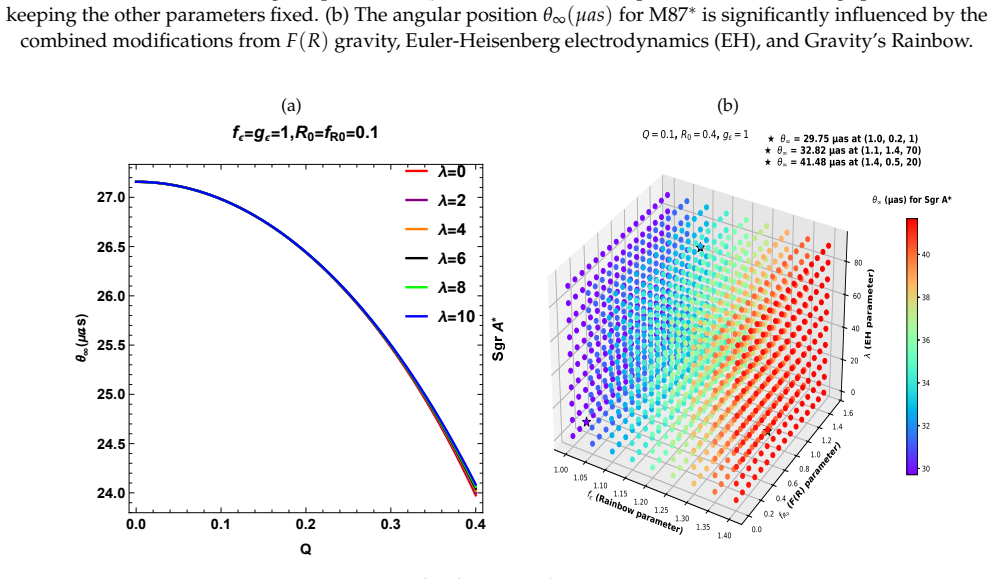
The central claim is that, for a black hole with metric function $G(r)=1-M/r - R_0 r^2/(12g_\epsilon^2) + f_\epsilon^2 (1+f_{R0})^{-1}(Q^2/r^2 - \lambda Q^4/(20r^6))$, a photon sphere exists whose radius $r_{ph}$ and critical impact parameter $u_{ph}$ grow with the Euler-Heisenberg parameter $\lambda$ and shrink with charge $Q$. The strong-deflection angle $\alpha_D(u)=-\bar a\log(u/u_{ph}-1)+\bar b$ is therefore parameter-dependent: for fixed $Q$ it decreases as $\lambda$ grows, while for fixed $\lambda$ it increases with $Q$, and under suitable parameter choices it surpasses both the Reissner-Nordström and Schwarzschild deflection angles. From the lens equation the paper derives the angular position $\theta_\infty$, separation $S$, relative magnification $r_{\rm mag}$, Einstein ring radius $\theta_1^E$, and the time delay $\Delta T_{2,1}=2\pi u_{ph}$, finding that $\lambda$ increases $\theta_\infty$, $r_{\rm mag}$, the Einstein ring, and the time delay while decreasing $S$, and that $Q$ has the opposite effect. The paper further claims that the observed shadow angular diameters of M87* and SgrA* are compatible with this model for $0\le \lambda/M^2\le 6.86\times 10^5$ and $0\le \lambda/M^2\le 1.45\times 10^5$ respectively, and that a comparison of three Rainbow-function models shows the qualitative trends are robust while the quantitative values depend on the choice of Rainbow functions.
Load-bearing premise
The paper uses the lens equation for asymptotically flat spacetime and evaluates the strong-deflection integrals to infinity, even though the metric contains an $R_0 r^2$ term and is therefore not asymptotically flat when $R_0\neq 0$; the paper does not justify why that lens equation still applies.
Editorial extensions
If this is right
- If the central claim holds, the Einstein ring radius and the time delay between relativistic images of a supermassive black hole carry a direct signature of the Euler-Heisenberg parameter: both grow with $\lambda$ for fixed charge, so a larger-than-Schwarzschild ring with a longer time delay would indicate the combined modified-gravity framework.
- The angular separation $S$ between the outermost and innermost relativistic images is predicted to shrink as $\lambda$ grows, meaning the images become more densely packed; resolving $S$ can therefore discriminate between F(R)-EH Rainbow black holes and RN or Schwarzschild black holes.
- The relative magnification $r_{\rm mag}\approx 5\pi/(\bar a\ln 10)$ depends only on the strong-lensing coefficient $\bar a$, so a measurement of the brightness ratio between the first and the remaining relativistic images gives a mass- and distance-independent probe of the modified-gravity parameters.
- The paper's constraints from the observed shadow diameters ($0\le \lambda/M^2\le 6.86\times 10^5$ for M87* and $0\le \lambda/M^2\le 1.45\times 10^5$ for SgrA*) mean the model is not ruled out by current observations, and sharper future shadow measurements can tighten the allowed parameter range.
- The qualitative ordering of observables across the three Rainbow-function models (Model I, Model II, Model III) provides a way to distinguish between different modified dispersion relations if the energy ratio $E/E_p$ is observationally accessible.
Reading between the lines
- Because the paper evaluates all observables using an asymptotically flat lens equation despite the $R_0 r^2$ term in the metric, the reported time delays and Einstein-ring radii for cosmological sources may carry a systematic offset; redoing the analysis with a lens equation that accommodates a non-asymptotically flat background would test whether the qualitative $\lambda$ and $Q$ trends survive.
- A natural extension would be to combine strong-lensing constraints with quasinormal-mode or shadow-bound data, since all these observables probe the same photon-sphere radius; the predicted degeneracy between $\lambda$ and $Q$ could then be broken by measuring the photon-sphere radius through two independent channels.
- The sensitivity comparison over Rainbow-function models suggests that future very-long-baseline interferometric observations that resolve the innermost relativistic images of M87* or SgrA* could decide between the modified dispersion relations as well as between this black-hole model and general-relativity black holes.
Editorial analysis
A structured set of objections, weighed in public.
Referee Report
Summary. The manuscript applies Bozza's strong-deflection-limit formalism to the static, spherically symmetric F(R)-Euler-Heisenberg rainbow black hole metric given in Eq. (8). It computes the photon sphere radius, critical impact parameter, strong-deflection coefficients, deflection angle, and the astrophysical observables (angular position, image separation, relative magnification, Einstein ring radius, and time delay) for several supermassive black holes, including M87* and SgrA*. It also derives allowed ranges for the Euler-Heisenberg parameter lambda/M^2 from EHT shadow sizes and compares three rainbow-function models. The central claim is that combined F(R), Euler-Heisenberg, and rainbow modifications produce novel strong-lensing features, including deflection angles and time delays larger than those of Reissner-Nordstrom and Schwarzschild black holes under certain parameter choices.
Significance. If the quantitative results were valid, the paper would be a useful phenomenological extension of strong-field lensing studies: it provides explicit numerical tables for multiple SMBHs, a comparative analysis of rainbow-function models, and checks that the Schwarzschild limit reproduces standard values (a=1, b=-0.40023, uph/Rs=2.59808, and theta_infty=19.9632 microarcsec for M87*). The computations are mostly routine applications of well-established formulas, and the Schwarzschild-sector checks indicate internal consistency there. However, the central R0 != 0 results are not mathematically grounded because the metric is not asymptotically flat while the deflection integral and lens equation assume asymptotic flatness; the claimed new qualitative features are therefore not established by the present analysis.
major comments (3)
- [Section IV, Eqs. (29) and (35), with Eq. (8)] The deflection integral I(r0) in Eq. (29) integrates to r = infinity, and the lens equation (35) is stated explicitly for asymptotically flat spacetime. However, the metric function G(r) in Eq. (8) contains the term -R0 r^2/(12 g_epsilon^2). For the positive R0 = 0.1 and R0 = 0.4 used throughout Tables I-III and Figures 2-12, the spacetime has a cosmological horizon and no spatial infinity; for R0 < 0 the radial integral to infinity diverges. The paper acknowledges the cosmological horizon in Section II but never replaces Eq. (29) or Eq. (35) with a finite-distance or (A)dS-aware lensing formalism. Consequently alpha_D, a, b, theta_infinity, S, rmag, the Einstein ring radius, and Delta T_{2,1} computed for R0 != 0 are not well defined. The Schwarzschild limit R0 = Q = 0 with f_epsilon = g_epsilon = 1 checks only the one asymptotically flat case and cannot license the R0 != 0 results.
- [Section VII, with Table I and Figs. 4-5] The concluding remarks state that the coefficients a, b, and uph/Rs "increases with the EH parameter lambda" and that these coefficients also increase with Q. Table I and Figs. 4-5 contradict this: for fixed Q, a decreases as lambda increases (for Q = 0.5, a = 1.1309 at lambda = 0 but a = 1.04652 at lambda = 12), and b is non-monotonic in both lambda and Q; only uph/Rs increases with lambda and decreases with Q. In the same section the text says alpha_D decreases with lambda and then adds that this "suggest[s] that the EH parameter lambda enhances gravitational bending effects," which is internally inconsistent. The abstract and the concluding summary therefore do not accurately report the numerical results.
- [Section V, Fig. 12] The claimed bounds 0 <= lambda/M^2 <= 6.86 x 10^5 for M87* and 0 <= lambda/M^2 <= 1.45 x 10^5 for SgrA* are derived by matching 2 theta_infinity to the EHT shadow diameter at a single fiducial choice of f_epsilon, g_epsilon, R0, fR0, and Q. The text itself admits that these ranges "change with different choices of parameter sets," so as presented they are consistency ranges for one parameter combination, not robust astrophysical constraints. The paper should either scan the degenerate parameter space or clearly label the result as a conditional consistency check rather than a constraint.
minor comments (6)
- [Table I] The row labeled "SchwarzSchild BH (Q=0, R0=0)" is misaligned: the values 1, -0.40023, and 2.59808 should be presented as lambda = 0, Q = 0, a = 1, b = -0.40023, uph/Rs = 2.59808, and the spelling "Schwarzschild" should be corrected.
- [Eq. (38)] The term "uphen" should read "u_ph e_n", and the denominator "D LSDOL" should read "D_LS D_OL"; the current notation obscures an otherwise standard formula.
- [Section IV A, text near Figs. 7-8] The text refers to "Figs. 7(b)& 7(b)" where it clearly means Fig. 7(b) and Fig. 8(b), and the same subsection contains several typographical errors such as "rong", "lerong", and "srong" in place of "strong".
- [Section VI, text near Fig. 13] The sentence "From Fig. 13(a), it is observed that strong deflection angle alpha_D, srong lensing observables angular position theta_infinity, and angular separation S ... are much more for Model I" is inaccurate because theta_infinity and S are shown in Figs. 14 and 15, not in Fig. 13(a).
- [Section IV C and Table III] Equation (48), Delta T_{2,1} = 2 pi u_ph, is presented without a derivation or the unit-conversion factors needed to reproduce the tabulated values in minutes from the masses and distances in Table III; the authors should state the conversion explicitly.
- [Table II] The entry "27.047419" in the SgrA* column appears to be a formatting artifact (likely 27.0474 microseconds), and the caption does not explain why NGC 4649 is included or how its distance and mass were combined with the lensing formulas.
Circularity Check
No circular derivation: the strong-lensing results are self-contained given the imported metric and Bozza's standard formalism; the Section V EHT comparison is a genuine parameter constraint, not a prediction, and the only self-citation is non-load-bearing.
full rationale
The central derivation is not circular. The metric (Eq. 8) is taken from Sekhmani et al. [91], and the null-geodesic and strong-deflection-limit analysis (photon sphere Eq. 20; deflection angle Eqs. 28-31; observables Eqs. 42-48) is a direct application of Bozza's independent formalism. The Schwarzschild limit reproduces known values (a=1, b=-0.40023, uph/Rs=2.59808), an external benchmark. Section V constrains lambda/M^2 by requiring the model's theta_infinity (=uph/DOL, Eq. 42) to lie within the EHT shadow diameters; the paper explicitly says 'we impose constraints', so this is an inverse parameter constraint, not a fitted quantity later renamed as a prediction. The only self-citation (Ref. [79], by co-authors Molla, Ghosh, Debnath) appears in an introductory list of lensing studies and is not load-bearing. A separate correctness caveat exists: for R0 != 0 the metric (Eq. 8) is not asymptotically flat, while the lens equation (Eq. 35) is stated for asymptotically flat spacetime; this threatens the validity of the R0 != 0 table entries but is not a circularity, because the computation follows the paper's own stated assumptions rather than importing its conclusions as inputs.
Assumptions & free parameters
free parameters (5)
- EH parameter lambda/M^2 =
0 to 6.86e5 for M87*, 0 to 1.45e5 for SgrA*
- Charge Q/M =
0 to 0.5
- F(R) curvature parameter R0 M^2 =
0.1 or 0.4
- F(R) derivative parameter fR0 =
0.1, 0.2, or 1.1
- Rainbow function values f_epsilon and g_epsilon =
1 (default) or f_epsilon = 0.86
assumptions (5)
- domain assumption The metric function G(r) in Eq. (8) is the F(R)-Euler-Heisenberg-Rainbow black hole spacetime.
- standard math Bozza's strong deflection limit formulas (Eqs. 31 to 34) apply to this spacetime.
- domain assumption The lens equation for asymptotically flat spacetime (Eq. 35) can be used.
- domain assumption Rainbow gravity dispersion relation Eq. (1) and the energy-dependent metric are physical.
- domain assumption Euler-Heisenberg electrodynamics truncated to the Q^4 term.
Cite this review
Pith. "Pith review of Strong gravitational lensing by black hole in F(R) Euler Heisenberg Gravity's Rainbow." pith.science (2026). https://pith.science/paper/XA4N5QHM
@misc{pith2026250713953,
  author       = {Pith},
  title        = {Pith review of: Strong gravitational lensing by black hole in F(R) Euler Heisenberg Gravity's Rainbow},
  year         = {2026},
  howpublished = {\url{https://pith.science/paper/XA4N5QHM}},
  note         = {Machine review of arXiv:2507.13953}
}
read the original abstract
We investigate gravitational lensing in the strong-field regime for a black hole in F(R) Euler Heisenberg Gravity with Rainbow gravity modifications. This black hole spacetime is characterized by the Euler Heisenberg parameter, F(R) parameters, Rainbow functions, the black hole charge Q, and mass M . We numerically compute the strong deflection angle and its associated coefficients, and explore their astrophysical implications for supermassive black holes in different galaxies. Our findings show that increasing the Euler Heisenberg parameter enhances key lensing observables such as the photon sphere radius, critical impact parameter, angular position, relative magnification, Einstein ring radius, and time delay for a fixed Q . Conversely, increasing Q decreases these parameters while keeping other quantities fixed. Additionally, a higher Euler Heisenberg parameter reduces the deflection angle and angular separation S , whereas increasing Q causes both to increase. Our study reveals that black holes in this modified gravity framework can act as strong gravitational lenses, producing deflection angles that surpass those of Reissner Nordstrom and Schwarzschild black holes under specific conditions. These results highlight the unique topological features of modified charged black holes and suggest their potential as astrophysical candidates, offering new insights into their observational signatures. Furthermore, we analyze the sensitivity of the lensing predictions with respect to changes in the functional forms of the Rainbow functions. The combined effects of F(R) gravity, Euler Heisenberg electrodynamics, and Rainbow gravity introduce novel qualitative features not present in the individual models.
Figures


Figures from the paper (13 more)




Reference graph
Works this paper leans on
-
[1]
Lensing observables and the EH Rainbow BH parameters: With the supermassive BHs M87∗, SgrA ∗, and NGC 4649 in the cores of nearby galaxies taken into con- sideration, observables variables θ∞ , S, and rmag are de- termined by numerical simulations, for the EH Rain- bow gravity (see T able II). The mass of M87∗ is about 6.5 × 10⁹M⊙, and it is 16.8 Mpc away...
2022
-
[2]
R. M. Wald, in Black holes, gravitational radiation and the universe: essays in honor of CV Vishveshwara (Springer, 21
-
[3]
Standard general relativity is re- covered in the limit ǫ → 0
using a matching set of orthonormal frame fields, each of which is parameterized by a single variable.[ 16] gǫ(ǫ) = ηab ea(ǫ)eb(ǫ) (3) Where the frame field’s energy dependency is provided by e0(ǫ) = ˜e0 fǫ(ǫ) (4) ei(ǫ) = ˜ei gǫ(ǫ) (5) Energy-independent frame fields are represented by quantities with a tilde. Standard general relativity is re- covered in th...
-
[4]
Journey into a schwarzschild black hole, jila: A joint institute of nist and the university of col- orado boulder,
A. Hamilton, “Journey into a schwarzschild black hole, jila: A joint institute of nist and the university of col- orado boulder,” (2020)
2020
-
[5]
R. M. Wald, General relativity (University of Chicago press, 2010)
2010
-
[6]
6(a) illustrates the variation of the strong deflection angle αD as a function of two parameters: the EH parameter λ and the charge parameter Q
Fig. 6(a) illustrates the variation of the strong deflection angle αD as a function of two parameters: the EH parameter λ and the charge parameter Q. In contrast, Fig. 6(b) demonstrates the dependence of the strong deflection angle αD on three parameters: the EH parameter λ, the F(R) gravity parameter fR0, and the Rainbow parameter fǫ, highlighting how the ...
-
[7]
Smith-Llera, First Look at a Black Hole: How a Photo- graph Solved a Space Mystery (Captured History , 2020)
D. Smith-Llera, First Look at a Black Hole: How a Photo- graph Solved a Space Mystery (Captured History , 2020)
2020
-
[8]
E. H. T. Collaboration, K. Akiyama, A. Alberdi, W. Alef, K. Asada, R. Azuly , et al. , Astrophys. J. Lett 875, L1 (2019)
2019
Show all 127 references
-
[9]
Schutz, Gravity from the ground up: An introductory guide to gravity and general relativity (Cambridge univer- sity press, 2003)
B. Schutz, Gravity from the ground up: An introductory guide to gravity and general relativity (Cambridge univer- sity press, 2003)
2003
-
[10]
P . C. Davies, Reports on Progress in Physics 41, 1313 (1978)
1978
-
[11]
B. P . Abbott, R. Abbott, T. Abbott, M. Abernathy , F. Acer- nese, K. Ackley , C. Adams, T. Adams, P . Addesso, R. Ad- hikari, et al., Physical review letters 116, 241102 (2016)
2016
-
[12]
Amelino-Camelia, Living Reviews in Relativity 16, 1 (2013)
G. Amelino-Camelia, Living Reviews in Relativity 16, 1 (2013)
2013
-
[13]
Akiyama et al., Astrophys
K. Akiyama et al., Astrophys. J. Lett 875, L2 (2019)
2019
-
[14]
S. M. Carroll, J. A. Harvey , V . A. Kosteleck`y, C. D. Lane, and T. Okamoto, Physical Review Letters 87, 141601 (2001)
2001
-
[15]
Hoˇ rava, Physical Review D—Particles, Fields, Gravi- tation, and Cosmology 79, 084008 (2009)
P . Hoˇ rava, Physical Review D—Particles, Fields, Gravi- tation, and Cosmology 79, 084008 (2009)
2009
-
[16]
Magueijo and L
J. Magueijo and L. Smolin, Classical and Quantum Grav- ity 21, 1725 (2004)
2004
-
[17]
It should be noted that the F(R)-EH Rainbow BH satis- fies the criterion d2Ve f f (r) dr2 < 0 for an unstable circular or- bit
can be written as: ˙r2 + Ve f f (r) = 0 (18) where the photon’s effective potential is provided by Ve f f (r) = 1 g(r) ( L2 r2 − E2 f (r) ) (19) A photon’s critical ring orbit is defined by the effec- tive potential function Ve f f (r), which satisfies the cer- tain conditions, ...
-
[18]
Hooft, Classical and Quantum Gravity 13, 1023 (1996)
G. Hooft, Classical and Quantum Gravity 13, 1023 (1996)
1996
-
[19]
Magueijo and L
J. Magueijo and L. Smolin, Physical Review D 67, 044017 (2003)
2003
-
[20]
Dehghani, Physics Letters B 785, 274 (2018)
M. Dehghani, Physics Letters B 785, 274 (2018)
2018
-
[21]
Aounallah, B
H. Aounallah, B. Pourhassan, S. H. Hendi, and M. Faizal, The European Physical Journal C 82, 351 (2022)
2022
-
[22]
Dehghani and B
M. Dehghani and B. Pourhassan, Modern Physics Let- ters A 36, 2150158 (2021)
2021
-
[23]
Garattini and E
R. Garattini and E. N. Saridakis, The European Physical Journal C 75, 1 (2015)
2015
-
[24]
Garattini, Journal of Cosmology and Astroparticle Physics 2013, 017 (2013)
R. Garattini, Journal of Cosmology and Astroparticle Physics 2013, 017 (2013)
2013
-
[25]
Hendi, B
S. Hendi, B. Eslam Panah, S. Panahiyan, and M. Mo- mennia, Advances in High Energy Physics 2016, 9813582 (2016)
2016
-
[26]
Y . Ling, X. Li, and H. Zhang, Modern Physics Letters A 22, 2749 (2007)
2007
-
[27]
Galan and G
P . Galan and G. A. Mena Marugan, Physical Review D—Particles, Fields, Gravitation, and Cosmology 74, 044035 (2006)
2006
- [28]
-
[29]
Leiva, J
C. Leiva, J. Saavedra, and J. Villanueva, Modern Physics Letters A 24, 1443 (2009)
2009
-
[30]
Farag Ali, Physical Review D 89, 104040 (2014)
A. Farag Ali, Physical Review D 89, 104040 (2014)
2014
-
[31]
A. F. Ali, M. Faizal, and B. Majumder, Europhysics Let- ters 109, 20001 (2015)
2015
-
[32]
Gim and W
Y . Gim and W. Kim, Journal of Cosmology and Astropar- ticle Physics 2015, 002 (2015)
2015
-
[33]
S. H. Hendi, M. Faizal, B. E. Panah, and S. Panahiyan, The European Physical Journal C 76, 1 (2016)
2016
-
[34]
Y . Gim, H. Um, and W. Kim, Journal of Cosmology and Astroparticle Physics 2018, 060 (2018)
2018
-
[35]
Garattini, in Journal of Physics: Conference Series , V ol
R. Garattini, in Journal of Physics: Conference Series , V ol. 942 (IOP Publishing, 2017) p. 012011
2017
-
[36]
S. H. Hendi and M. Momennia, Physics Letters B 777, 222 (2018)
2018
-
[37]
B. E. Panah, Physics Letters B 787, 45 (2018)
2018
-
[38]
Abdalla and A
E. Abdalla and A. Marins, International Journal of Mod- ern Physics D 29, 2030014 (2020)
2020
-
[39]
Nojiri and S
S. Nojiri and S. D. Odintsov , International Journal of Ge- ometric Methods in Modern Physics 4, 115 (2007)
2007
-
[40]
Faraoni and S
V . Faraoni and S. Capozziello, Beyond Einstein gravity: A Survey of gravitational theories for cosmology and astro- physics (Springer, 2011)
2011
-
[41]
Nojiri and S
S. Nojiri and S. D. Odintsov , Physics Reports 505, 59 (2011)
2011
-
[42]
Capozziello and M
S. Capozziello and M. De Laurentis, Physics Reports 509, 167 (2011)
2011
-
[43]
Bamba, S
K. Bamba, S. Capozziello, S. Nojiri, and S. D. Odintsov , Astrophysics and Space Science 342, 155 (2012)
2012
-
[44]
Beyond the cosmological standard model, phys,
A. Joyce, B. Jain, J. Khoury , and M. Trodden, “Beyond the cosmological standard model, phys,” (2015)
2015
-
[45]
Nojiri, S
S. Nojiri, S. Odintsov , and V . Oikonomou, Physics Re- ports 692, 1 (2017)
2017
-
[46]
Cooney , S
A. Cooney , S. DeDeo, and D. Psaltis, Physical Review D—Particles, Fields, Gravitation, and Cosmology 82, 064033 (2010)
2010
-
[47]
Cheoun, C
M.-K. Cheoun, C. Deliduman, C. G ¨ ung ¨ or, V . Keles ¸, C. Ryu, T. Kajino, and G. J. Mathews, Journal of Cos- mology and Astroparticle Physics 2013, 021 (2013)
2013
-
[48]
A. V . Astashenok and S. D. Odintsov , Monthly Notices of the Royal Astronomical Society 493, 78 (2020)
2020
-
[49]
A. V . Astashenok, S. Capozziello, S. D. Odintsov , and V . Oikonomou, Physics Letters B 816, 136222 (2021)
2021
-
[50]
Sarmah, S
L. Sarmah, S. Kalita, and A. Wojnar, Physical Review D 105, 024028 (2022)
2022
-
[51]
Kalita and B
S. Kalita and B. Mukhopadhyay , The Astrophysical Jour- nal 909, 65 (2021)
2021
-
[52]
Capozziello, International Journal of Modern Physics D 11, 483 (2002)
S. Capozziello, International Journal of Modern Physics D 11, 483 (2002)
2002
-
[53]
Aditya and D
Y . Aditya and D. Reddy , International Journal of Geo- metric Methods in Modern Physics 15, 1850156 (2018)
2018
-
[54]
Hu and I
W. Hu and I. Sawicki, Physical Review D—Particles, Fields, Gravitation, and Cosmology 76, 064004 (2007)
2007
-
[55]
Capozziello, A
S. Capozziello, A. Stabile, and A. Troisi, Physical Re- view D—Particles, Fields, Gravitation, and Cosmology 76, 104019 (2007)
2007
- [56]
-
[57]
C. G. Darwin, Proceedings of the Royal Society of Lon- don. Series A. Mathematical and Physical Sciences 249, 180 (1959). 22
1959
-
[58]
K. S. Virbhadra and G. F. R. Ellis, Phys. Rev . D62, 084003 (2000) , arXiv:astro-ph/9904193
2000 arXiv
- [59]
-
[60]
Perlick, Living Rev
V . Perlick, Living Rev . Rel.7, 9 (2004)
2004
- [61]
-
[62]
Bambi, K
C. Bambi, K. Freese, S. Vagnozzi, and L. Visinelli, Phys. Rev . D100, 044057 (2019) , arXiv:1904.12983 [gr-qc]
2019 arXiv
-
[63]
Frittelli, T
S. Frittelli, T. P . Kling, and E. T. Newman, Phys. Rev . D61, 064021 (2000) , arXiv:gr-qc/0001037
2000 arXiv
-
[64]
Bozza, S
V . Bozza, S. Capozziello, G. Iovane, and G. Scarpetta, Gen. Rel. Grav .33, 1535 (2001) , arXiv:gr-qc/0102068
2001 arXiv
- [65]
-
[66]
E. F. Eiroa, G. E. Romero, and D. F. Torres, Phys. Rev . D66, 024010 (2002)
2002
-
[67]
Bozza,Phys
V . Bozza,Phys. Rev . D66, 103001 (2002)
2002
-
[68]
E. F. Eiroa and D. F. Torres, Phys. Rev . D69, 063004 (2004)
2004
- [69]
-
[70]
E. F. Eiroa and C. M. Sendra, Phys. Rev . D86, 083009 (2012) , arXiv:1207.5502 [gr-qc]
2012 arXiv
- [71]
-
[72]
Kumar, S
J. Kumar, S. U. Islam, and S. G. Ghosh, Astrophys. J. 938, 104 (2022) , arXiv:2209.04240 [gr-qc]
2022 arXiv
-
[73]
Kumar, S
J. Kumar, S. U. Islam, and S. G. Ghosh, Eur. Phys. J. C 82, 443 (2022) , arXiv:2109.04450 [gr-qc]
2022 arXiv
-
[74]
S. U. Islam and S. G. Ghosh, Phys. Rev . D103, 124052 (2021) , arXiv:2102.08289 [gr-qc]
2021 arXiv
-
[75]
Kumar, S
R. Kumar, S. U. Islam, and S. G. Ghosh, Eur. Phys. J. C 80, 1128 (2020) , arXiv:2004.12970 [gr-qc]
2020 arXiv
-
[76]
S. U. Islam, R. Kumar, and S. G. Ghosh, JCAP 09, 030 (2020) , arXiv:2004.01038 [gr-qc]
2020 arXiv
-
[77]
Narzilloev , S
B. Narzilloev , S. Shaymatov , I. Hussain, A. Ab- dujabbarov , B. Ahmedov , and C. Bambi, Eur. Phys. J. C 81, 849 (2021) , arXiv:2109.02816 [gr-qc]
2021 arXiv
-
[78]
S. U. Islam, S. G. Ghosh, and S. D. Maharaj, Chin. J. Phys. 89, 1710 (2024) , arXiv:2203.00957 [gr-qc]
2024 arXiv
-
[79]
E. F. Eiroa and C. M. Sendra, Class. Quant. Grav .28, 085008 (2011) , arXiv:1011.2455 [gr-qc]
2011 arXiv
- [80]
-
[81]
Panpanich, S
S. Panpanich, S. Ponglertsakul, and L. Tannukij, Phys. Rev . D100, 044031 (2019) , arXiv:1904.02915 [gr-qc]
2019 arXiv
-
[82]
K. A. Bronnikov and K. A. Baleevskikh, Grav . Cosmol.25, 44 (2019) , arXiv:1812.05704 [gr-qc]
2019 arXiv
-
[83]
N. U. Molla, S. G. Ghosh, and U. Debnath, Phys. Dark Univ .44, 101495 (2024)
2024
-
[84]
Channuie, A
P . Channuie, A. Ditta, N. Kaewkhao, and A. ¨Ovg ¨ un, Phys. Dark Univ .48, 101963 (2025) , arXiv:2503.23065 [gr-qc]
2025 arXiv
- [85]
-
[86]
Kuang and A
X.-M. Kuang and A. ¨Ovg ¨ un, Annals Phys. 447, 169147 (2022) , arXiv:2205.11003 [gr-qc]
2022 arXiv
-
[87]
Lambiase, D
G. Lambiase, D. J. Gogoi, R. C. Pantig, and A. ¨Ovg ¨ un, Phys. Dark Univ .48, 101886 (2025) , arXiv:2406.18300 [gr-qc]
2025 arXiv
-
[88]
Ditta, X
A. Ditta, X. Tiecheng, R. Ali, A. ¨Ovg ¨ un, and A. Mah- mood, High Energy Dens. Phys. 52, 101120 (2024)
2024
-
[89]
V erbin, B
Y . V erbin, B. Pulice, A. ¨Ovg ¨ un, and H. Huang, Phys. Rev . D111, 084061 (2025) , arXiv:2412.20989 [gr-qc]
2025 arXiv
-
[90]
D. J. Gogoi, B. Pulic ¸e, and A. ¨Ovg ¨ un, (2024), arXiv:2410.00691 [gr-qc]
2024
-
[91]
Pulic ¸e, R
B. Pulic ¸e, R. C. Pantig, A. ¨Ovg ¨ un, and D. Demir, Class. Quant. Grav .40, 195003 (2023) , arXiv:2308.08415 [gr-qc]
2023 arXiv
- [92]
-
[93]
A. A. Ara ´ ujo Filho, N. Heidari, and A. ¨Ovg ¨ un, (2024), arXiv:2412.08369 [gr-qc]
2024 arXiv
-
[94]
Bozza, General Relativity and Gravitation 42, 2269 (2010)
V . Bozza, General Relativity and Gravitation 42, 2269 (2010)
2010
-
[95]
Sekhmani, S
Y . Sekhmani, S. N. Gashti, M. A. S. Afshar, M. R. Alipour, J. Sadeghi, and J. Rayimbaev , arXiv preprint arXiv:2409.04997 (2024)
2024 arXiv
-
[96]
Cognola, E
G. Cognola, E. Elizalde, S. Nojiri, S. D. Odintsov , and S. Zerbini, Journal of Cosmology and Astroparticle Physics 2005, 010 (2005)
2005
-
[97]
K. S. Virbhadra and G. F. R. Ellis, Phys. Rev . D65, 103004 (2002)
2002
-
[98]
Claudel, K
C.-M. Claudel, K. S. Virbhadra, and G. F. R. Ellis, J. Math. Phys. 42, 818 (2001)
2001
-
[99]
K. S. Virbhadra and G. F. Ellis, Physical Review D 62, 084003 (2000)
2000
-
[100]
K. S. Virbhadra, D. Narasimha, and S. M. Chitre, Astron. Astrophys. 337, 1 (1998), arXiv:astro-ph/9801174
1998 arXiv
-
[101]
Tsukamoto, Physical Review D 95, 064035 (2017)
N. Tsukamoto, Physical Review D 95, 064035 (2017)
2017
-
[102]
Tsukamoto, Physical Review D 94, 124001 (2016)
N. Tsukamoto, Physical Review D 94, 124001 (2016)
2016
-
[103]
Bozza, S
V . Bozza, S. Capozziello, G. Iovane, and G. Scarpetta, General Relativity and Gravitation 33, 1535 (2001)
2001
-
[104]
S. U. Islam, R. Kumar, and S. G. Ghosh, Journal of Cos- mology and Astroparticle Physics 2020, 030 (2020)
2020
-
[105]
Bozza, Physical Review D—Particles, Fields, Gravita- tion, and Cosmology 78, 103005 (2008)
V . Bozza, Physical Review D—Particles, Fields, Gravita- tion, and Cosmology 78, 103005 (2008)
2008
-
[106]
K. S. Virbhadra and G. F. R. Ellis, Phys. Rev . D62, 084003 (2000)
2000
-
[108]
Gillessen, P
S. Gillessen, P . Plewa, F. Eisenhauer, R. Sari, I. Waisberg, M. Habibi, O. Pfuhl, E. George, J. Dexter, S. von Fellen- berg, et al., The Astrophysical Journal 837, 30 (2017)
2017
-
[109]
Kormendy and L
J. Kormendy and L. C. Ho, Annual Review of Astron- omy and Astrophysics 51, 511 (2013)
2013
-
[110]
Einstein, Science 84, 506 (1936)
A. Einstein, Science 84, 506 (1936)
1936
-
[111]
Liebes Jr, Physical Review 133, B835 (1964)
S. Liebes Jr, Physical Review 133, B835 (1964). 23
1964
-
[112]
Mellier, Annual Review of Astronomy and Astro- physics 37, 127 (1999)
Y . Mellier, Annual Review of Astronomy and Astro- physics 37, 127 (1999)
1999
-
[113]
Bartelmann and P
M. Bartelmann and P . Schneider, Physics Reports 340, 291 (2001)
2001
-
[114]
Schmidt, Physical Review D—Particles, Fields, Gravi- tation, and Cosmology 78, 043002 (2008)
F. Schmidt, Physical Review D—Particles, Fields, Gravi- tation, and Cosmology 78, 043002 (2008)
2008
-
[115]
Guzik, B
J. Guzik, B. Jain, and M. Takada, Physical Review D—Particles, Fields, Gravitation, and Cosmology 81, 023503 (2010)
2010
-
[116]
Bozza and L
V . Bozza and L. Mancini, General Relativity and Gravi- tation 36, 435 (2004)
2004
-
[117]
A. F. Ali and M. M. Khalil, EPL 110, 20009 (2015) , arXiv:1408.5843 [gr-qc]
2015 arXiv
-
[118]
Akiyama et al
K. Akiyama et al. (Event Horizon Tele- scope), Astrophys. J. Lett. 875, L1 (2019) , arXiv:1906.11238 [astro-ph.GA]
2019 arXiv
-
[119]
Akiyama et al
K. Akiyama et al. (Event Horizon Tele- scope), Astrophys. J. Lett. 875, L2 (2019) , arXiv:1906.11239 [astro-ph.IM]
2019 arXiv
-
[120]
Akiyama et al
K. Akiyama et al. (Event Horizon Tele- scope), Astrophys. J. Lett. 875, L3 (2019) , arXiv:1906.11240 [astro-ph.GA]
2019 arXiv
-
[121]
Akiyama et al
K. Akiyama et al. (Event Horizon Tele- scope), Astrophys. J. Lett. 875, L4 (2019) , arXiv:1906.11241 [astro-ph.GA]
2019 arXiv
-
[122]
Akiyama et al
K. Akiyama et al. (Event Horizon Tele- scope), Astrophys. J. Lett. 875, L5 (2019) , arXiv:1906.11242 [astro-ph.GA]
2019 arXiv
-
[123]
Akiyama et al
K. Akiyama et al. (Event Horizon Tele- scope), Astrophys. J. Lett. 875, L6 (2019) , arXiv:1906.11243 [astro-ph.GA]
2019 arXiv
-
[124]
Akiyama et al
K. Akiyama et al. (Event Horizon Telescope), Astrophys. J. Lett. 930, L12 (2022)
2022
-
[125]
Amelino-Camelia, J
G. Amelino-Camelia, J. R. Ellis, N. E. Mavromatos, and D. V . Nanopoulos, Int. J. Mod. Phys. A 12, 607 (1997) , arXiv:hep-th/9605211
1997 arXiv
-
[126]
Amelino-Camelia, Living Rev
G. Amelino-Camelia, Living Rev . Rel.16, 5 (2013) , arXiv:0806.0339 [gr-qc]
2013 arXiv
-
[127]
Amelino-Camelia, J
G. Amelino-Camelia, J. R. Ellis, N. E. Mavromatos, D. V . Nanopoulos, and S. Sarkar, Nature 393, 763 (1998) , arXiv:astro-ph/9712103
1998 arXiv
-
[128]
Magueijo and L
J. Magueijo and L. Smolin, Phys. Rev . Lett.88, 190403 (2002) , arXiv:hep-th/0112090
2002 arXiv
Reviewed August 6, 2026 · model on record in the stance chip above.
Discussion (0). Sign in to comment.