REVIEW 3 major objections 5 minor 24 references
Secretive Hotplug Coded Caching
T0 review · 3 major / 5 minor · reviewed 2026-08-06 · deepseek-v4-flash
Pith's one-line read Hotplug coded caching can be made secretive: two schemes built from HpPDAs give explicit memory-rate pairs and beat a baseline secretive scheme in low-memory regions.
desk verdict First take on secrecy in hotplug caching, but the main theorems are unproven because the secrecy proof analyzes raw shares while caches hold MDS-coded shares. read the letter →
The pith
A machine-rendered reading of the paper's core claim, the machinery that carries it, and where it could break.
The reading
What carries the argument
The load-bearing object is the Hotplug Placement Delivery Array (HpPDA): a pair $(P,B)$ in which $P$ is an $F \times K$ array of stars and null entries, $B$ is a $[K',F',Z',S]$ PDA, and every choice of $K'$ active users has a subarray of $P$ that agrees with $B$ in its star positions. The MAN-HpPDA specialises this to rows indexed by all $t$-subsets of $[K]$, with stars encoding which user caches which share; the t-design construction obtains HpPDAs from combinatorial designs and supplies many memory points. Around this combinatorial skeleton the schemes wrap three coding ingredients: a non-perfect $(m,n)$ secret-sharing scheme (any $m$ shares leak nothing, all $n$ recover the file), a Cauchy matrix whose full-rank submatrices make the share generation a secure linear code, and an MDS code that expands $n$ shares into $F$ coded shares so that a user can recover enough shares from its cache plus the transmissions. Delivery messages are XORs of coded shares, each masked with a random key vector held only by the users that message is meant for; the $t=K'-1$ case needs no mask because every active user needs the single transmission.
What would settle it
Use Example 1's $(6,4,6)$ system: a file is split into 3 parts, mixed with 5 keys by an $8 \times 8$ Cauchy matrix to make 8 shares, then expanded by a $(15,8)$ MDS code into 15 coded shares, and each user cache holds the 5 coded shares indexed by 2-subsets containing that user. Compute $I(W_i; Z_k)$ for one file and one cache; the paper's secrecy proof only covers the 8 pre-MDS shares, so a positive mutual information for the stored MDS-coded shares would refute condition (1), while a proof that the MDS submatrices are also full-rank on the key columns would confirm it.
Extended reading notes
Core claim
The paper's central claim is that secrecy can be layered onto hotplug coded caching without abandoning the placement-delivery-array machinery. Theorem 1 states that for any $(K,K',N)$ system and any $t \in [0 : K'-2]$, a $(K,K',F,F',Z,Z',S)$ MAN-HpPDA gives a secretive scheme with memory $M = (N\binom{K-1}{t-1} + \binom{K-1}{t})/\binom{K'-1}{t}$ and rate $R = S/(F'-Z')$, equal to $\binom{K'}{t+1}/\binom{K'-1}{t}$. Theorem 2 gives the analogous existence result for HpPDAs built from a $t$-$ (v,k,\lambda)$ design, with memory $M = NZ/(F'-Z') + \frac{1}{F'-Z'}\sum_{s=1}^{t-2} a_s \binom{K-1}{s}$ and rate $S/(F'-Z')$. In both schemes each file is split into parts and expanded through a non-perfect secret-sharing scheme, then through an MDS code into $F$ coded shares; caches hold shares whose row label contains the user's index plus random key vectors, and the server transmits XORs of requested coded shares masked by keys where needed. The proof of secrecy rests on the full-rank property of every submatrix of a Cauchy matrix: any $Z$ generated shares are claimed to be information-theoretically independent of the file because they are a full-rank linear combination of file parts and uniform keys.
Load-bearing premise
The whole secrecy argument depends on the unproved assumption that the extra MDS coding step, applied after the Cauchy-matrix secret sharing, does not let a user's cached shares leak information about the file.
Editorial extensions
If this is right
- Secrecy no longer requires all $K$ users to be online during delivery: the same HpPDA structure that makes hotplug caching work also supports information-theoretic secrecy.
- At the parameter $t=K'-1$, the MAN-HpPDA scheme achieves rate $R=1$, which meets the lower bound from Lemma 1, so it is optimal at that memory point.
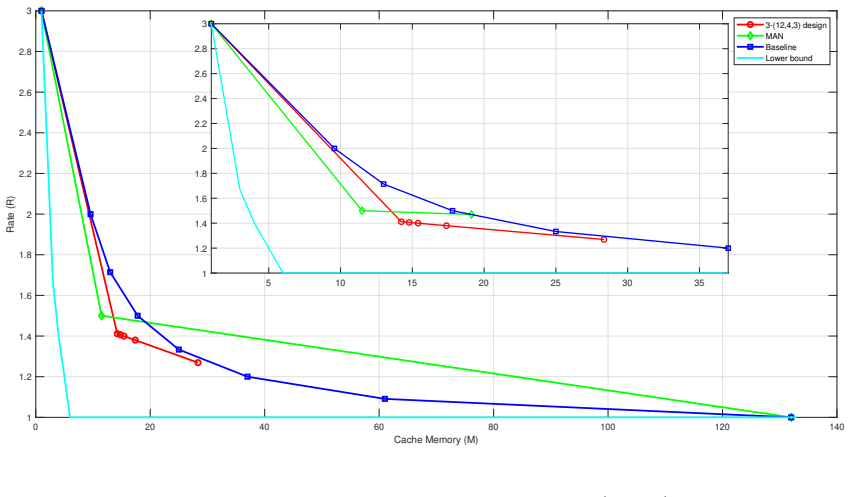
- For an $(8,3,8)$ system, the MAN-based scheme beats the baseline for cache memory $M$ from 1 to 11.9, and the t-design scheme beats it from $M=10.4$ to 15.7; the new schemes fill complementary memory regions.
- For a $(12,3,12)$ system, the t-design scheme beats the baseline across $M=1$ to 28.3, a wider winning region than the MAN-based scheme, giving designers a choice of which HpPDA class to instantiate.
Reading between the lines
- A direct technical check left open by the paper is whether $m$ shares of the MDS-expanded coded shares are as uninformative as $m$ shares of the Cauchy-generated shares; one can settle it by verifying a full-rank condition on the MDS generator restricted to any $m$ output positions.
- The complementary winning regions in the numerical curves suggest a hybrid scheme that chooses between MAN-HpPDAs, t-design HpPDAs, and the baseline PDA according to memory $M$; such a hybrid would likely dominate each individual curve, though the paper does not construct it.
- Since the construction only requires a field of size $2^l \ge 2n$ and works for any sufficiently large file, the same HpPDA-plus-secret-sharing template could be adapted to colluding-user secrecy or demand privacy by changing how the masking keys are generated.
Editorial analysis
A structured set of objections, weighed in public.
Referee Report
Summary. The paper introduces a secrecy constraint into the hotplug coded caching model and proposes two secretive schemes, one based on MAN-HpPDAs and one based on HpPDAs constructed from t-designs. The claimed achievable memory-rate pairs are stated in Theorem 1 and Theorem 2. Each file is first encoded with a non-perfect secret-sharing scheme, the resulting shares are expanded through an MDS code, and selected coded shares together with random keys are placed in the caches; the HpPDA structure is then used to construct the multicast transmissions. The paper proves correctness and rate, gives a secrecy argument based on the Cauchy-matrix construction of the raw shares, and numerically compares the two schemes with a baseline PDA-based secretive scheme for (8,3,8) and (12,3,12) hotplug systems. The main theorems are not proven as written because the secrecy proof analyzes the raw Cauchy shares rather than the MDS-coded shares that are actually stored in the caches.
Significance. If the secrecy proof can be repaired, the paper makes a useful first contribution to secrecy in hotplug coded caching. The rate-memory expressions are derived transparently from the HpPDA parameters rather than fitted to numerical data, and the correctness arguments for the delivery phase are mostly sound. The numerical comparison with the baseline scheme is clearly presented and gives concrete regions of memory where the proposed schemes are claimed to be better. However, the central claim of the paper is the existence of secretive schemes satisfying condition (1), and the current manuscript does not prove that condition for the MDS-coded cache content. The gap is local and appears repairable, so I treat this as a major-revision issue rather than an immediate rejection.
major comments (3)
- [Section V, Proof of Secrecy, equations (9)-(11)] The placement stores the MDS-coded shares C_{i,T}, which are images of the raw shares \tilde{W}_{i,s} under an unspecified MDS generator matrix G. The secrecy proof, however, proves the non-leak property only for any m raw shares \tilde{W}_{i,l_1},...,\tilde{W}_{i,l_m}, using the full-rank property of the Cauchy key submatrix A_2. For the m coded shares held by user k, the key-coefficient matrix is G_U A_2, where G_U is the m x n slice of the MDS generator corresponding to those coded shares. A linear MDS map does not preserve the non-perfect secret-sharing guarantee in general: if G_U A_2 is singular, a linear function of the file is recoverable from the cache alone, violating condition (1). The paper neither states nor proves that G_U A_2 has full rank for every user, so Theorem 1 is unproven as written.
- [Section VI, Secrecy paragraph] The secrecy argument for the t-design scheme asserts that because each file is encoded with a (Z, F'-Z'+Z) non-perfect secret-sharing scheme and each cache stores Z coded shares, the cache leaks nothing. This implication is invalid: the secret-sharing guarantee applies to the raw shares, while the cache stores coded shares produced by the (F, F'-Z'+Z) MDS code. The fact that the number of stored coded shares equals Z is not sufficient to conclude the (Z, F'-Z'+Z) privacy threshold holds for those coded shares. A separate argument involving the MDS generator is required; without it, condition (1) is unproven for Theorem 2.
- [Section V-A, Scheme when t=K'-1] The same gap appears in the t=K'-1 case. The placement in equation (14) stores shares indexed by T, after the text says that an MDS code is used to generate (K choose K'-1) coded shares. If \tilde{W}_{i,T} in (14) denotes the MDS-coded shares, then the invocation of the non-perfect secret-sharing scheme immediately after (14) is unjustified for the same reason as in Section V. If, on the other hand, \tilde{W}_{i,T} denotes the raw shares, then the role and parameters of the MDS code in this subsection need to be clarified. Either way, the secrecy claim in the t=K'-1 case is not established as written.
minor comments (5)
- [Example 1, Delivery Phase] In the displayed transmissions X_{\{1,4,5\}} and X_{\{1,4,6\}}, the terms C_{d4,\{1,5\}} and C_{d4,\{1,6\}} are repeated; the intended terms should be C_{d5,\{1,4\}} and C_{d6,\{1,4\}}.
- [Theorem 1, statement] The range t \in [0:K'-2] is inconsistent with Section V-A, which treats the case t=K'-1, and with the statement that R=1 is achievable at M=N(K-1 choose K'-2). The range should be corrected or the t=K'-1 case should be excluded from Theorem 1 and stated separately.
- [Examples 2 and 3, displayed arrays] The printed arrays P in Examples 2 and 3 appear incomplete: the rows show only a few star entries and no non-star labels for the relevant subarrays, so the reader cannot verify the HpPDA structure or the transmissions from the typeset examples.
- [Section V, Placement Phase] The Cauchy matrix is defined over F_{2^l}, while the file parts and keys are described as elements of F_2^{B/(K'-1 choose t)}. The paper should specify how the arithmetic over F_{2^l} interacts with the binary representation of the shares and keys.
- [Section VII, Numerical comparisons] The comparison plots connect discrete achievable memory-rate points by line segments; the paper should state explicitly whether memory sharing / file splitting is being used to justify the intermediate points on the curves.
Circularity Check
No circular derivation: the memory-rate pairs are direct parameter counts from HpPDA definitions; the main weakness is an unproven secrecy step about MDS-coded shares, which is a proof gap, not circularity.
full rationale
Theorems 1 and 2 derive (M,R) by counting cache contents: Theorem 1 places (K-1 choose t-1) MDS-coded shares and (K-1 choose t) keys per user, giving M=(N Z + binom(K-1,t))/(F'-Z'); each of the S=(K' choose t+1) transmissions has size 1/(F'-Z'), so R=S/(F'-Z'). Theorem 2 similarly counts Z file-shares and the a_s key families, yielding M=N Z/(F'-Z') + (1/(F'-Z')) sum_s a_s binom(K-1,s) and R=S/(F'-Z'). These expressions follow from the HpPDA parameters and the placement/delivery procedures; no fitted constant or target value is inverted to produce the claimed curve. The t-design parameters a_s are free design choices that enumerate valid HpPDAs, not parameters fitted to the baseline. Numerical comparisons plot these closed-form curves against the baseline from [15]; the claimed better-memory regions are read off the formulas, not generated by fitting. The cited HpPDAs from [9],[10] are co-authored by the present authors, but they are parameter-free combinatorial constructions (arrays satisfying Definition 3); the present paper does not rely on a cited uniqueness theorem to forbid alternatives, nor does it smuggle in its desired conclusion via those citations. The one serious weakness is in the secrecy proofs (Sections V and VI): the Cauchy-matrix argument shows any m raw shares satisfy (7a), while the placement (10)-(11) stores MDS-coded images of those shares; the paper does not prove that an arbitrary (F,n) MDS generator preserves the privacy threshold. That is a load-bearing proof gap (and possibly repairable by choosing the MDS code carefully), but it is not circular: the unproven implication is forward (MDS encoding preserves secrecy), not an equivalence in which the conclusion is assumed by definition. Hence no circular step is exhibited and the circularity score is 0.
Assumptions & free parameters
free parameters (2)
- a_s for 1 <= s <= t-1 in t-design HpPDA =
a1=1, a2=2 in Example 3
- t in Theorem 1 =
ranges over [0, K'-2]
assumptions (5)
- standard math Cauchy matrices and all their submatrices have full rank over the chosen field.
- standard math For any m < n, an (m,n) non-perfect secret sharing scheme exists with share size B/(n-m).
- domain assumption The hotplug PDAs from [9,10] have the stated parameters and subarray property.
- ad hoc to paper There exists an (F,n) MDS code such that the m MDS-coded shares stored per user reveal no information about the file; the proof only establishes this for m direct Cauchy shares.
- domain assumption The baseline secretive PDA scheme from [15] can be trivially adapted to the hotplug model.
Cite this review
Pith. "Pith review of Secretive Hotplug Coded Caching." pith.science (2026). https://pith.science/paper/JBI26EJR
@misc{pith2026250713961,
  author       = {Pith},
  title        = {Pith review of: Secretive Hotplug Coded Caching},
  year         = {2026},
  howpublished = {\url{https://pith.science/paper/JBI26EJR}},
  note         = {Machine review of arXiv:2507.13961}
}
read the original abstract
In this work, we consider a coded caching model called \textit{hotplug coded caching}, in which some users are offline during the delivery phase. The concept of Hotplug Placement Delivery Arrays (HpPDAs) for hotplug coded caching systems has been introduced in the literature, and two classes of HpPDAs are known. In this paper, we consider a secrecy constraint in hotplug coded caching setup, where users should not learn anything about any file from their cache content, and active users should not gain any information about files other than their demanded file from either their cache content or the server transmissions. We propose two secretive schemes for the two classes of HpPDAs and compare them with a baseline scheme, which is a secretive scheme using PDAs for the classical coded caching setup and can be trivially adapted for the hotplug coded caching setup. We numerically show that our schemes outperform the baseline scheme in certain memory regions.
Figures

Reference graph
Works this paper leans on
-
[1]
Fundamental limits of ca ching,
M. A. Maddah-Ali and U. Niesen, “Fundamental limits of ca ching,” IEEE Transactions on Information Theory , vol. 60, no. 5, pp. 2856–2867, 2014
work page 2014
-
[2]
An index coding approach to caching with uncoded cache placement,
K. Wan, D. Tuninetti, and P . Piantanida, “An index coding approach to caching with uncoded cache placement,” IEEE Transactions on Informa- tion Theory , vol. 66, no. 3, pp. 1318–1332, 2020
work page 2020
-
[3]
The exact r ate-memory tradeoff for caching with uncoded prefetching,
Q. Y u, M. A. Maddah-Ali, and A. S. Avestimehr, “The exact r ate-memory tradeoff for caching with uncoded prefetching,” IEEE Transactions on Information Theory , vol. 64, no. 2, pp. 1281–1296, 2017
work page 2017
-
[4]
On the placement de livery array design for centralized coded caching scheme,
Q. Y an, M. Cheng, X. Tang, and Q. Chen, “On the placement de livery array design for centralized coded caching scheme,” IEEE Transactions on Information Theory , vol. 63, no. 9, pp. 5821–5833, 2017
work page 2017
-
[5]
Coded Caching Schemes With R educed Subpacketization From Linear Block Codes,
L. Tang and A. Ramamoorthy, "Coded Caching Schemes With R educed Subpacketization From Linear Block Codes," in IEEE Transactions on Information Theory , vol. 64, no. 4, pp. 3099-3120, April 2018
work page 2018
-
[6]
Coded Cac hing based on Combinatorial Designs,
S. Agrawal, K. V . Sushena Sree and P . Krishnan, "Coded Cac hing based on Combinatorial Designs," 2019 IEEE International Symposium on Information Theory (ISIT) , Paris, France, 2019, pp. 1227-1231
work page 2019
-
[7]
On coded caching systems with offl ine users,
Y . Ma and D. Tuninetti, “On coded caching systems with offl ine users,” in 2022 IEEE International Symposium on Information Theory (I SIT). IEEE, 2022, pp. 1133–1138
work page 2022
-
[8]
Demand Privacy in Hotplug Caching Systems
——, “Demand privacy in hotplug caching systems,” arXiv preprint arXiv:2305.06518, 2023
work page Pith review arXiv 2023
Show all 24 references
-
[9]
Improved Hotplug Caching Sche me Using PDAs,
C. Rajput and B. S. Rajan, "Improved Hotplug Caching Sche me Using PDAs," 2024 IEEE International Symposium on Information Th eory (ISIT), Athens, Greece, 2024, pp. 1574-1579
2024
-
[10]
Improved Hotplug Caching Sch eme Using PDAs,
C. Rajput and B. S. Rajan, "Improved Hotplug Caching Sch eme Using PDAs," arXiv:2311.02856
-
[11]
Character izing the rate-memory tradeoff in cache networks within a factor of 2,
Q. Y u, M. A. Maddah-Ali and A. S. Avestimehr, “Character izing the rate-memory tradeoff in cache networks within a factor of 2, " n IEEE Transactions on Information Theory , vol. 65, no. 1, pp. 647-663, 2018
2018
-
[12]
Private Coded Caching,
V . Ravindrakumar, P . Panda, N. Karamchandani and V . M. P rabhakaran, “Private Coded Caching,” in IEEE Transactions on Informati on Forensics and Security, vol. 13, no. 3, pp. 685-694, March 2018
2018
-
[13]
Fundamental limits of secretive coded caching,
V . Ravindrakumar, P . Panda, N. Karamchandani and V . Pra bhakaran, “Fundamental limits of secretive coded caching,” 2016 IEEE International Symposium on Information Theory (ISIT), 2016, pp. 425-429
2016
-
[14]
Secretive Coded Caching wit h Shared Caches
S. S. Meel and B. S. Rajan., “Secretive Coded Caching wit h Shared Caches”, in IEEE Communications Letters, vol. 25, no. 9, pp. 2849-2853, Sept. 2021
2021
-
[15]
Secretive Coded Caching from PDAs,
S. S. Meel and B. S. Rajan, "Secretive Coded Caching from PDAs," 2021 IEEE 32nd Annual International Symposium on Personal, Indoor and Mobile Radio Communications (PIMRC), Helsinki, Finlan d, 2021, pp. 373-379
2021
-
[16]
A Secretiv e Coded Caching for Shared Cache Systems using Placement Delivery A rrays,
E. Peter, K. K. K. Namboodiri and B. S. Rajan, "A Secretiv e Coded Caching for Shared Cache Systems using Placement Delivery A rrays," 2022 IEEE International Symposium on Information Theory (I SIT), Espoo, Finland, 2022, pp. 1402-1407
2022
-
[17]
Device-to-Device Secure Cod ed Caching,
A. A. Zewail and A. Y ener, “Device-to-Device Secure Cod ed Caching,” in IEEE Transactions on Information Forensics and Security , vol. 15, pp. 1513-1524, 2020
2020
-
[18]
Combination Networks With or Without Secrecy Constraints: The Impact of Caching Relays,
A. A. Zewail and A. Y ener, “Combination Networks With or Without Secrecy Constraints: The Impact of Caching Relays,” in IEEE Journal on Selected Areas in Communications, vol. 36, no. 6, pp. 1140-1 152, June 2018
2018
-
[19]
Ac cess Points Cooperation Based Secretive Coded Caching in Fog Rad io Access Networks,
Q. Tan, Y . Jiang, Y . Huang, F. -C. Zheng and D. Niyato, "Ac cess Points Cooperation Based Secretive Coded Caching in Fog Rad io Access Networks," in IEEE Transactions on V ehicular Technology, v ol. 74, no. 2, pp. 2826-2839, Feb. 2025
2025
-
[20]
Secure Coded Caching with Colluding U sers,
K. Ma and S. Shao, “Secure Coded Caching with Colluding U sers,” Available on arXiv: 1910.08268 [cs.IT], Oct. 2019
1910 arXiv
-
[21]
Secrecy and Privacy in Multi- Access Combinatorial Topology
M. Chinnapadamala and B. S. Rajan," Secrecy and Privacy in Multi- Access Combinatorial Topology", arXiv:2504.09952
-
[22]
D. R. Stinson, Combinatorial designs: constructions and analysis . Springer, 2004, vol. 480
2004
-
[23]
Cramer, I
R. Cramer, I. Damgård and J. Nielsen, Secure Multiparty Computation and Secret Sharing. Cambridge, U.K.: Cambridge University Press, 2015
2015
-
[24]
Optimizing Cauchy Reed-Solomon C odes for Fault-Tolerant Network Storage Applications,
J. S. Plank and L. Xu, “Optimizing Cauchy Reed-Solomon C odes for Fault-Tolerant Network Storage Applications,” in Fifth IE EE International Symposium on Network Computing and Applications (NCA ’06), pp. 173- 180, 2006
2006
Reviewed August 6, 2026 · model on record in the stance chip above.
Discussion (0). Continue with ORCID to comment.