REVIEW 4 major objections 5 minor 48 references
Evaluation of Human Visual Privacy Protection: A Three-Dimensional Framework and Benchmark Dataset
T0 review · 4 major / 5 minor · reviewed 2026-08-06 · deepseek-v4-flash
Pith's one-line read A three-dimensional framework and human-centric dataset, HR-VISPR, aim to make visual-privacy evaluation objective and interpretable, with a privacy metric that spreads anonymization-method rankings three times wider than the previous…
desk verdict A useful benchmark dataset and evaluation scaffold, but the privacy metric's claimed alignment with human perception is unmeasured and contradicted by the paper's own examples. read the letter →
The pith
A machine-rendered reading of the paper's core claim, the machinery that carries it, and where it could break.
The reading
What carries the argument
The machinery is the HR-VISPR dataset paired with the class-based mean average precision (cMAP) privacy metric. HR-VISPR contains 10.11k images with 18 binary human-related labels covering biometric, soft-biometric, and non-biometric attributes, cleaned from VISPR by removing text-only and noisy samples and correcting context. The argument runs through cMAP, computed as the average per-attribute mean average precision of a privacy classifier on anonymized images: a larger drop in cMAP relative to the original images indicates stronger privacy protection. Around this axis, the framework adds utility measured by object-detection F1 scores and practicality measured as a weighted combination of throughput, robustness, and intelligibility, with robustness computed by detecting and matching human instances and intelligibility by the CMMD distribution distance.
What would settle it
Show humans a set of HR-VISPR images anonymized by each of the 11 methods and ask them to identify attributes such as skin color, hair color, clothing type, or the presence of the same person across images; if human recognition rates disagree with the cMAP ordering — for example, people readily recognize attributes in LR+SR images while the classifier ranks LR+SR as the most protective, or people cannot recognize the synthetic identities in HS while the classifier ranks HS as the least protective — then the privacy axis fails.
Extended reading notes
Core claim
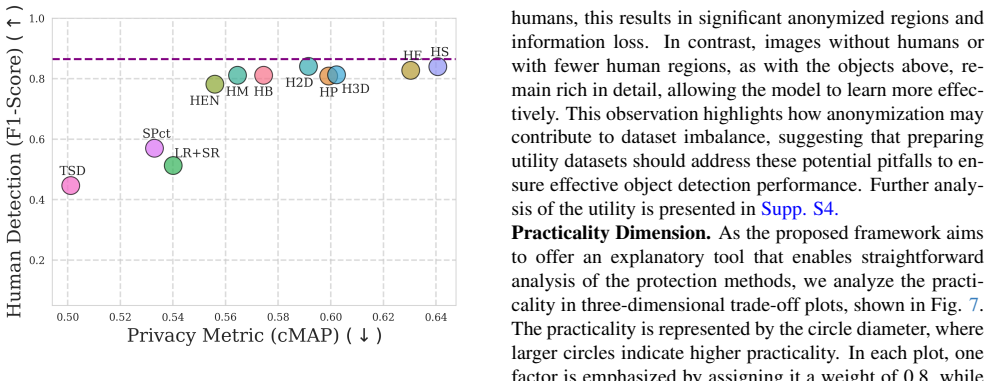
The central claim is that privacy protection can be measured by how much a multi-label attribute classifier's mean average precision drops on anonymized images, and that a classifier trained on the cleaned HR-VISPR dataset makes this measurement discriminative enough to rank eleven anonymization methods in a way that aligns with human visual perception. The paper finds that the VISPR-trained baseline collapses most methods into nearly identical scores, while the HR-VISPR-trained classifier separates them into three privacy tiers, from full-image corruptions (LR+SR, SPct, TSD) through selective human-region methods (HEN, HM, HB) down to partial or avatar methods (H2D, H3D, HP, HE, HS). It also shows attribute-level mAP drops that explain why a method protects face, skin color, and nudity but leaves contextual cues such as uniforms and medical scrubs detectable.
Load-bearing premise
The ranking of protection methods rests entirely on treating the drop in a classifier's mean average precision as a measure of what a person would perceive as privacy-revealing, and the paper does not test that assumption against human judgments.
Editorial extensions
If this is right
- A system designer can choose an anonymization method by weighting privacy, utility, and practicality separately, since the framework no longer merges these dimensions into a single score.
- The HR-VISPR-trained classifier distinguishes among methods that the VISPR-based baseline collapses into nearly identical scores, such as LR+SR, H2D, and H3D, giving finer-grained rankings.
- Attribute-level mAP drops explain why a method protects some attributes while leaving contextual cues like medical scrubs or sportswear detectable, pointing designers to specific leaks.
- Methods that anonymize the whole image (LR+SR, TSD, SPct) rank highest in privacy but lowest in utility, while selective human-region methods such as HM, HEN, and HB achieve the most balanced trade-off.
- The public release of HR-VISPR and its anonymized versions lets future work extend the evaluation framework to video data and to other utility tasks such as action recognition or anomaly detection.
Reading between the lines
- The cMAP proxy equates "unrecognizable to a classifier" with "unrecognizable to a human"; a natural test the paper does not run is a crowdsourced attribute-recognition study on the same anonymized images, which would directly test the alignment claim.
- The paper's own examples suggest the framework could be improved by fusing the privacy score with its robustness (identity dissimilarity) measure, since that would correct the counterintuitive ranking that puts LR+SR above HS.
- The dataset-cleaning recipe of modality unification, label merging, and context correction could be reapplied to other privacy datasets that suffer from noisy or spurious labels, potentially improving their benchmarks as well.
- Because the framework reports per-attribute mAP drops, it could double as a diagnostic tool for anonymization failure, telling designers exactly which visual attributes are still leaking through a given method.
Editorial analysis
A structured set of objections, weighed in public.
Referee Report
Summary. The paper proposes a three-dimensional framework for evaluating visual privacy-protection methods: privacy, utility, and practicality. It introduces HR-VISPR, a curated human-centric dataset with 10.11k images and 18 privacy labels, and trains a multi-label privacy-attribute classifier whose class-based mean average precision (cMAP) drop on anonymized data is used as the privacy score. Utility is measured by human/object detection F1, and practicality by a weighted combination of throughput, robustness, and intelligibility. Eleven anonymization methods are ranked and analyzed in privacy-utility-practicality trade-off plots.
Significance. If the privacy metric were properly validated, the framework would be a valuable benchmark: it provides a public dataset, an attribute-level interpretability analysis, and a systematic comparison of 11 protection methods. The three-dimensional trade-off analysis and the robustness/intelligibility components are useful additions to the literature. However, the central claim that the framework 'differentiates privacy levels in alignment with human visual perception' is not supported by any perceptual measurement, and the paper's own Section 5 contains direct counterexamples to the privacy ranking. These issues are load-bearing for the abstract's main claim, although they are repairable with additional experiments or a more modest claim.
major comments (4)
- [§4.2.1 and Abstract] The central claim that the framework 'differentiates privacy levels in alignment with human visual perception' is not supported by any perceptual measurement. The only evidence offered is the qualitative statement that the rankings are correlated 'when viewed in conjunction with Fig. 3' (Section 4.2.1), and a similar phrase in Section 4.2.2 ('in conjunction with the visualizations... we can see the correlation'). No user study, no perceptual benchmark, and no quantitative comparison with human judgments is reported. Since all privacy rankings in Figures 4 and 5 are derived from the cMAP drop defined in Section 3.2.1, the perception-alignment claim must either be validated with a proper human-perception experiment or removed from the abstract and conclusions.
- [§5, Framework Limitations] Section 5 directly contradicts the alignment claim and the discriminative-power argument. It states that LR+SR is ranked 'highly protective' although 'human perception is powerful and can still recognize attributes, such as clothing, skin, and hair colors,' and that HS ranks lowest 'despite replacing humans with fake identities.' These are not edge cases: LR+SR and HS are the endpoints of the cMAP range reported in Section 4.2.1, and the claimed discriminative power rests on that range. If classifier cMAP does not track human attribute recognition, the privacy dimension measures classifier failure rather than human visual privacy. The suggested remedy of jointly analyzing the robustness metric does not validate the privacy dimension; it supplements it with a different construct.
- [§4.2.1, baseline comparison] The comparison between the HR-VISPR-trained metric and the VISPR baseline is confounded by the label sets and training distributions. The baseline uses seven labels, while HR-VISPR uses 18, and the baseline is trained on the original VISPR distribution rather than the curated HR-VISPR subset. A cMAP range of 0.50-0.65 versus 0.60-0.66 could therefore reflect the number of labels or the evaluation set rather than 'an accurately constructed dataset.' The claim that the wider range 'demonstrates the discriminative power' needs an ablation that holds the label set fixed, for example the same seven labels on both datasets or the same 18 labels on both datasets.
- [§4.2.2, Figures 4-5] The reported privacy and utility scores are point estimates from a single training run, with no error bars, multiple seeds, or statistical tests. Several adjacent methods are ranked against each other within narrow bands (e.g., HM, HB, and HEN in the 0.55-0.59 cMAP band), and without variance estimates it is unclear whether these differences are meaningful. Adding repeated runs or confidence intervals would make the ranking claims more robust.
minor comments (5)
- [Eq. (1)] Equation (1) appears typeset incorrectly: 'NPN −1' does not render as a formula. The intended expression is presumably N divided by the sum of frame processing times; please fix the notation.
- [Table 2] In the HEN row, '43.790.24' should probably be two numbers ('43.79' and '0.24'), and in the H3D row '42.140.04' likewise; the missing separators make the table hard to read.
- [Introduction] There is a typo: 'performance drops presist' should be 'performance drops persist.'
- [References] References [41] and [42] appear to be the same paper by Wu et al. with identical titles; if they are distinct versions, the entries should be differentiated, otherwise they should be merged.
- [Figure 3] The thumbnails in Figure 3 are too small to evaluate the stated qualitative differences, such as 'poor human segmentation' in H2D/H3D or residual details in HP/HE; including zoomed crops of one or two representative scenes would help.
Circularity Check
No construction-level circularity: the privacy metric is an independent classifier-evaluation procedure, and the central claims rest on measurements rather than on definitions or self-citations.
full rationale
The paper's privacy metric is cMAP computed by training a privacy-attribute classifier on original HR-VISPR images and evaluating it on anonymized versions (Section 3.2.1). This is not definitionally equal to its inputs: the classifier is trained on one set and tested on another, and the resulting ranking is an empirical outcome, not a fitted parameter renamed as a prediction. The comparison against the VISPR-trained baseline (Section 4.2.1) is also an independent experimental contrast, not a self-referential construction. The HR-VISPR dataset is derived from VISPR through author-defined curation steps (Section 3.1), and this curation influences the results, but no equation or construction forces the claimed cMAP ranking from those curation choices. The paper's assertion that rankings 'correlate with human perception' is supported only by qualitative visual inspection ('when viewed in conjunction with Fig. 3') and is explicitly contradicted in part by the authors' own Section 5, which states that LR+SR is ranked highly protective despite humans still recognizing attributes and that HS ranks lowest despite replacing identities. These are serious validity problems for the claim of alignment with human visual perception, but they are not circularity: an unsupported or even false empirical claim is not a derivation that reduces to its own premises. There are no load-bearing self-citations, no imported uniqueness theorems, and no ansatz smuggled in through the authors' prior work. The robustness and intelligibility components are separately defined and measured. The adjustable practicality weights are ablations, not predictions disguised as fits. Under the hard rule that circularity requires a quoted equation or construction showing the output is equivalent to the input, no such step exists in this paper. The appropriate finding is therefore no significant circularity (score 0), with the caveat that the perceptual-alignment claim is under-validated and belongs in a correctness assessment rather than a circularity assessment.
Assumptions & free parameters
free parameters (3)
- practicality weights (Wr, Wi, Wt) =
0.8, 0.1, 0.1 for the main three-dimensional plots
- robustness matching thresholds (IoU and SSIM) =
not specified in main text
- safe-image augmentation count =
788
assumptions (5)
- domain assumption Classifier mAP drop on anonymized images is a valid measure of privacy protection level
- domain assumption Utility ground truth generated by a pre-trained YOLO model is accurate
- ad hoc to paper The authors' qualitative viewing of anonymized examples (Fig. 3) is a valid stand-in for human perception
- ad hoc to paper HR-VISPR curation Steps 1-5 (excluding confusing samples, merging attributes, context correction) improves label accuracy
- domain assumption CMMD between original and anonymized datasets measures intelligibility
Cite this review
Pith. "Pith review of Evaluation of Human Visual Privacy Protection: A Three-Dimensional Framework and Benchmark Dataset." pith.science (2026). https://pith.science/paper/JM7PEMTP
@misc{pith2026250713981,
  author       = {Pith},
  title        = {Pith review of: Evaluation of Human Visual Privacy Protection: A Three-Dimensional Framework and Benchmark Dataset},
  year         = {2026},
  howpublished = {\url{https://pith.science/paper/JM7PEMTP}},
  note         = {Machine review of arXiv:2507.13981}
}
read the original abstract
Recent advances in AI-powered surveillance have intensified concerns over the collection and processing of sensitive personal data. In response, research has increasingly focused on privacy-by-design solutions, raising the need for objective techniques to evaluate privacy protection. This paper presents a comprehensive framework for evaluating visual privacy-protection methods across three dimensions: privacy, utility, and practicality. In addition, it introduces HR-VISPR, a publicly available human-centric dataset with biometric, soft-biometric, and non-biometric labels to train an interpretable privacy metric. We evaluate 11 privacy protection methods, ranging from conventional techniques to advanced deep-learning methods, through the proposed framework. The framework differentiates privacy levels in alignment with human visual perception, while highlighting trade-offs between privacy, utility, and practicality. This study, along with the HR-VISPR dataset, serves as an insightful tool and offers a structured evaluation framework applicable across diverse contexts.
Figures


Figures from the paper (4 more)



Reference graph
Works this paper leans on
-
[1]
Overview of the mediaeval 2014 visual privacy task
Atta Badii, Touradj Ebrahimi, Christian Fedorczak, Pavel Korshunov, Tomas Piatrik, V olker Eiselein, and Ahmed A Al-Obaidi. Overview of the mediaeval 2014 visual privacy task. In MediaEval. Citeseer, 2014. 4
work page 2014
-
[2]
Face-off: Adver- sarial face obfuscation, 2020
Varun Chandrasekaran, Chuhan Gao, Brian Tang, Kassem 8 Fawaz, Somesh Jha, and Suman Banerjee. Face-off: Adver- sarial face obfuscation, 2020. 2
work page 2020
-
[3]
Privattnet: predicting privacy risks in images us- ing visual attention
Zhang Chen, Thivya Kandappu, and Vigneshwaran Sub- baraju. Privattnet: predicting privacy risks in images us- ing visual attention. In 2020 25th International Conference on Pattern Recognition (ICPR), pages 10327–10334. IEEE,
work page 2020
-
[4]
Pau Climent-P ´erez and Francisco Florez-Revuelta. Protec- tion of visual privacy in videos acquired with rgb cameras for active and assisted living applications. Multimedia Tools and Applications, 80(15):23649–23664, 2021. 1, 5
work page 2021
-
[5]
Obfusca- tion of images via differential privacy: From facial images to general images
William L Croft, J ¨org-R¨udiger Sack, and Wei Shi. Obfusca- tion of images via differential privacy: From facial images to general images. Peer-to-Peer Networking and Applications, 14:1705–1733, 2021. 2
work page 2021
-
[6]
Video surveillance and privacy: A solvable paradox? Computer, 57(3):91–100, 2024
Rita Cucchiara, Lorenzo Baraldi, Marcella Cornia, and Sara Sarto. Video surveillance and privacy: A solvable paradox? Computer, 57(3):91–100, 2024. 1
work page 2024
-
[7]
Spact: Self-supervised privacy preservation for action recog- nition
Ishan Rajendrakumar Dave, Chen Chen, and Mubarak Shah. Spact: Self-supervised privacy preservation for action recog- nition. In Proceedings of the IEEE/CVF Conference on Com- puter Vision and Pattern Recognition , pages 20164–20173,
-
[8]
A framework for the validation of privacy protection solutions in video surveil- lance
Fr ´ed´eric Dufaux and Touradj Ebrahimi. A framework for the validation of privacy protection solutions in video surveil- lance. In 2010 IEEE International Conference on Multime- dia and Expo, pages 66–71. IEEE, 2010. 2
work page 2010
Show all 48 references
-
[9]
Pri- vacy protection vs
Ad ´am Erd´elyi, Thomas Winkler, and Bernhard Rinner. Pri- vacy protection vs. utility in visual data: An objective eval- uation framework. Multimedia tools and applications , 77: 2285–2312, 2018. 1, 2, 3, 4
2018
-
[10]
Ted-spad: Temporal distinctiveness for self- supervised privacy-preservation for video anomaly detec- tion
Joseph Fioresi, Ishan Rajendrakumar Dave, and Mubarak Shah. Ted-spad: Temporal distinctiveness for self- supervised privacy-preservation for video anomaly detec- tion. In Proceedings of the IEEE/CVF International Con- ference on Computer Vision, pages 13598–13609, 2023. 1, 2, 3, 5
2023
-
[11]
Live face de- identification in video
Oran Gafni, Lior Wolf, and Yaniv Taigman. Live face de- identification in video. In Proceedings of the IEEE/CVF International Conference on Computer Vision, pages 9378– 9387, 2019. 2
2019
-
[12]
Privacy-preserving face recognition with multi-edge as- sistance for intelligent security systems
Wenjing Gao, Jia Yu, Rong Hao, Fanyu Kong, and Xiaodong Liu. Privacy-preserving face recognition with multi-edge as- sistance for intelligent security systems. IEEE Internet of Things Journal, 2023. 1
2023
-
[13]
Vizwiz-priv: A dataset for recognizing the presence and purpose of private visual information in images taken by blind people
Danna Gurari, Qing Li, Chi Lin, Yinan Zhao, Anhong Guo, Abigale Stangl, and Jeffrey P Bigham. Vizwiz-priv: A dataset for recognizing the presence and purpose of private visual information in images taken by blind people. In Pro- ceedings of the IEEE/CVF Conference on Computer ...
2019
-
[14]
Learning privacy-preserving optics for human pose estima- tion
Carlos Hinojosa, Juan Carlos Niebles, and Henry Arguello. Learning privacy-preserving optics for human pose estima- tion. In Proceedings of the IEEE/CVF international confer- ence on computer vision, pages 2573–2582, 2021. 1
2021
-
[15]
Deepprivacy: A generative adversarial network for face anonymization
H ˚akon Hukkel ˚as, Rudolf Mester, and Frank Lindseth. Deepprivacy: A generative adversarial network for face anonymization. In International symposium on visual com- puting, pages 565–578. Springer, 2019. 2
2019
-
[16]
Realistic full-body anonymization with surface- guided gans
H ˚akon Hukkel˚as, Morten Smebye, Rudolf Mester, and Frank Lindseth. Realistic full-body anonymization with surface- guided gans. In Proceedings of the IEEE/CVF Winter confer- ence on Applications of Computer Vision, pages 1430–1440,
-
[17]
Eu data protection law: The review of direc- tive 95/46/ec and the proposed general data protection reg- ulation
Peter Hustinx. Eu data protection law: The review of direc- tive 95/46/ec and the proposed general data protection reg- ulation. University of Tartu. Data Protection Inspectorate, Tallinn, 2013. 1
2013
-
[18]
Re- thinking fid: Towards a better evaluation metric for image generation
Sadeep Jayasumana, Srikumar Ramalingam, Andreas Veit, Daniel Glasner, Ayan Chakrabarti, and Sanjiv Kumar. Re- thinking fid: Towards a better evaluation metric for image generation. arXiv preprint arXiv:2401.09603, 2023. 4
2023 arXiv
-
[19]
Ultralytics YOLO, 2023
Glenn Jocher, Ayush Chaurasia, and Jing Qiu. Ultralytics YOLO, 2023. 3
2023
-
[20]
Framework for objective evaluation of privacy filters
Pavel Korshunov, Andrea Melle, Jean-Luc Dugelay, and Touradj Ebrahimi. Framework for objective evaluation of privacy filters. In Applications of Digital Image Processing XXXVI, pages 265–276. SPIE, 2013. 2
2013
-
[21]
Development of a privacy-preserving uav system with deep learning-based face anonymization
Harim Lee, Myeung Un Kim, Yeongjun Kim, Hyeonsu Lyu, and Hyun Jong Yang. Development of a privacy-preserving uav system with deep learning-based face anonymization. IEEE Access, 9:132652–132662, 2021. 2
2021
-
[22]
Microsoft coco: Common objects in context
Tsung-Yi Lin, Michael Maire, Serge Belongie, James Hays, Pietro Perona, Deva Ramanan, Piotr Doll´ar, and C Lawrence Zitnick. Microsoft coco: Common objects in context. In Computer Vision–ECCV 2014: 13th European Conference, Zurich, Switzerland, September 6-12, 2014, Proceeding...
2014
-
[23]
Adverfacial: Privacy-preserving universal ad- versarial perturbation against facial micro-expression leak- ages
Yin-Yin Low, Angeline Tanvy, Rapha ¨el C-W Phan, and Xi- aojun Chang. Adverfacial: Privacy-preserving universal ad- versarial perturbation against facial micro-expression leak- ages. In ICASSP 2022-2022 IEEE International Conference on Acoustics, Speech and Signal Processing (...
2022
-
[24]
De- coupling identity and visual quality for image and video anonymization
Maxim Maximov, Ismail Elezi, and Laura Leal-Taix ´e. De- coupling identity and visual quality for image and video anonymization. In Proceedings of the Asian Conference on Computer Vision, pages 3637–3653, 2022. 2
2022
-
[25]
Privacy-protecting behaviours of risk detection in people with dementia using videos
Pratik K Mishra, Andrea Iaboni, Bing Ye, Kristine Newman, Alex Mihailidis, and Shehroz S Khan. Privacy-protecting behaviours of risk detection in people with dementia using videos. BioMedical Engineering OnLine, 22(1):4, 2023. 1
2023
-
[26]
Deep autoencoders for attribute preserv- ing face de-identification
Paraskevi Nousi, Sotirios Papadopoulos, Anastasios Tefas, and Ioannis Pitas. Deep autoencoders for attribute preserv- ing face de-identification. Signal Processing: Image Com- munication, 81:115699, 2020. 2
2020
-
[27]
To- wards a visual privacy advisor: Understanding and predict- ing privacy risks in images
Tribhuvanesh Orekondy, Bernt Schiele, and Mario Fritz. To- wards a visual privacy advisor: Understanding and predict- ing privacy risks in images. InProceedings of the IEEE inter- national conference on computer vision , pages 3686–3695,
-
[28]
A survey on deep learning-based real-time crowd anomaly detection for 9 secure distributed video surveillance
Khosro Rezaee, Sara Mohammad Rezakhani, Mohammad R Khosravi, and Mohammad Kazem Moghimi. A survey on deep learning-based real-time crowd anomaly detection for 9 secure distributed video surveillance. Personal and Ubiqui- tous Computing, 28(1):135–151, 2024. 1
2024
-
[29]
Body shape privacy in images: under- standing privacy and preventing automatic shape extraction
Hosnieh Sattar, Katharina Krombholz, Gerard Pons-Moll, and Mario Fritz. Body shape privacy in images: under- standing privacy and preventing automatic shape extraction. In Computer Vision–ECCV 2020 Workshops: Glasgow, UK, August 23–28, 2020, Proceedings, Part V 16, pages 411–4...
2020
-
[30]
Privacy-preserving image acquisition using train- able optical kernel
Yamin Sepehri, Pedram Pad, Pascal Frossard, and L Andrea Dunbar. Privacy-preserving image acquisition using train- able optical kernel. arXiv preprint arXiv:2106.14577, 2021. 2
2021 arXiv
-
[31]
Disability-first design and creation of a dataset show- ing private visual information collected with people who are blind
Tanusree Sharma, Abigale Stangl, Lotus Zhang, Yu-Yun Tseng, Inan Xu, Leah Findlater, Danna Gurari, and Yang Wang. Disability-first design and creation of a dataset show- ing private visual information collected with people who are blind. In Proceedings of the 2023 CHI Conferen...
2023
-
[32]
Privacy-preserved video moni- toring method with 3d human pose estimation
Jifan Shen and Yuling Sun. Privacy-preserved video moni- toring method with 3d human pose estimation. In 2023 26th International Conference on Computer Supported Cooper- ative Work in Design (CSCWD) , pages 1502–1507. IEEE,
2023
-
[33]
Skin detection and lightweight encryption for privacy protection in real-time surveillance applications
Amna Shifa, Muhammad Babar Imtiaz, Mamoona Naveed Asghar, and Martin Fleury. Skin detection and lightweight encryption for privacy protection in real-time surveillance applications. Image and Vision Computing , 94:103859,
-
[34]
An objective and subjective eval- uation of content-based privacy protection of face images in video surveillance systems using jpeg xr
Hosik Sohn, Dohyoung Lee, WD Neve, Konstantinos N Pla- taniotis, and Yong Man Ro. An objective and subjective eval- uation of content-based privacy protection of face images in video surveillance systems using jpeg xr. Effective Surveil- lance for Homeland Security: Balancing ...
2013
-
[35]
Personalized privacy-aware image classification
Eleftherios Spyromitros-Xioufis, Symeon Papadopoulos, Adrian Popescu, and Yiannis Kompatsiaris. Personalized privacy-aware image classification. In Proceedings of the 2016 ACM on international conference on multimedia re- trieval, pages 71–78, 2016. 2
2016
-
[36]
Privobfnet: A weakly supervised semantic segmen- tation model for data protection
ChiatPin Tay, Vigneshwaran Subbaraju, and Thivya Kan- dappu. Privobfnet: A weakly supervised semantic segmen- tation model for data protection. In Proceedings of the IEEE/CVF Winter Conference on Applications of Computer Vision, pages 2421–2431, 2024. 4
2024
-
[37]
Dynamic deep multi- modal fusion for image privacy prediction
Ashwini Tonge and Cornelia Caragea. Dynamic deep multi- modal fusion for image privacy prediction. In The World Wide Web Conference, pages 1829–1840, 2019. 2
2019
-
[38]
Image privacy predic- tion using deep neural networks
Ashwini Tonge and Cornelia Caragea. Image privacy predic- tion using deep neural networks. ACM Transactions on the Web (TWEB), 14(2):1–32, 2020. 2
2020
-
[39]
Modeling the trade-off of privacy preserva- tion and activity recognition on low-resolution images
Yuntao Wang, Zirui Cheng, Xin Yi, Yan Kong, Xueyang Wang, Xuhai Xu, Yukang Yan, Chun Yu, Shwetak Patel, and Yuanchun Shi. Modeling the trade-off of privacy preserva- tion and activity recognition on low-resolution images. In Proceedings of the 2023 CHI Conference on Human Fact...
2023
-
[40]
Privacy- protective-gan for privacy preserving face de-identification
Yifan Wu, Fan Yang, Yong Xu, and Haibin Ling. Privacy- protective-gan for privacy preserving face de-identification. Journal of Computer Science and Technology , 34:47–60,
-
[41]
Privacy-preserving deep action recogni- tion: An adversarial learning framework and a new dataset
Zhenyu Wu, Haotao Wang, Zhaowen Wang, Hailin Jin, and Zhangyang Wang. Privacy-preserving deep action recogni- tion: An adversarial learning framework and a new dataset. IEEE Transactions on Pattern Analysis and Machine Intelli- gence, 44(4):2126–2139, 2020. 1, 2, 5, 6
2020
-
[42]
Privacy-preserving deep action recogni- tion: An adversarial learning framework and a new dataset
Zhenyu Wu, Haotao Wang, Zhaowen Wang, Hailin Jin, and Zhangyang Wang. Privacy-preserving deep action recogni- tion: An adversarial learning framework and a new dataset. IEEE Transactions on Pattern Analysis and Machine Intelli- gence (TPAMI), 2020. 1, 2, 3
2020
-
[43]
Dipa: An image dataset with cross-cultural privacy concern annotations
Anran Xu, Zhongyi Zhou, Kakeru Miyazaki, Ryo Yoshikawa, Simo Hosio, and Koji Yatani. Dipa: An image dataset with cross-cultural privacy concern annotations. In Companion Proceedings of the 28th International Confer- ence on Intelligent User Interfaces, pages 259–266, 2023. 2
2023
-
[44]
Dipa2: An image dataset with cross-cultural privacy perception annotations
Anran Xu, Zhongyi Zhou, Kakeru Miyazaki, Ryo Yoshikawa, Simo Hosio, and Koji Yatani. Dipa2: An image dataset with cross-cultural privacy perception annotations. Proceedings of the ACM on Interactive, Mobile, Wearable and Ubiquitous Technologies, 7(4):1–30, 2024. 2
2024
-
[45]
Image segmentation based privacy-preserving human action recognition for anomaly detection
Jiawei Yan, Federico Angelini, and Syed Mohsen Naqvi. Image segmentation based privacy-preserving human action recognition for anomaly detection. In ICASSP 2020-2020 IEEE International Conference on Acoustics, Speech and Signal Processing (ICASSP), pages 8931–8935. IEEE, 2020. 1, 5
2020
-
[46]
Picalert! a system for privacy-aware image classification and retrieval
Sergej Zerr, Stefan Siersdorfer, and Jonathon Hare. Picalert! a system for privacy-aware image classification and retrieval. In Proceedings of the 21st ACM international conference on Information and knowledge management, pages 2710–2712,
-
[47]
Multi-scale, class-generic, privacy- preserving video
Zhixiang Zhang, Thomas Cilloni, Charles Walter, and Charles Fleming. Multi-scale, class-generic, privacy- preserving video. Electronics, 10(10):1172, 2021. 4
2021
-
[48]
Privacyalert: A dataset for im- age privacy prediction
Chenye Zhao, Jasmine Mangat, Sujay Koujalgi, Anna Squic- ciarini, and Cornelia Caragea. Privacyalert: A dataset for im- age privacy prediction. In Proceedings of the International AAAI Conference on Web and Social Media , pages 1352– 1361, 2022. 1, 2 10
2022
Reviewed August 6, 2026 · model on record in the stance chip above.
Discussion (0). Sign in to comment.