REVIEW 4 major objections 5 minor 1 cited by
Two Dynamical Scenarios for Binned Master Sample Interpretation
T0 review · 4 major / 5 minor · reviewed 2026-08-06 · deepseek-v4-flash
Pith's one-line read An interacting dark energy model, with a mildly phantom equation of state, best reproduces the decreasing effective Hubble constant seen in the binned Master supernova sample.
desk verdict A tunable parameter fixed to match the target makes the DE-DM 'preference' circular, but the clean setup and the DE negative result justify a referee shot. read the letter →
The pith
A machine-rendered reading of the paper's core claim, the machinery that carries it, and where it could break.
The reading
What carries the argument
The diagnostic that carries the comparison is the effective running Hubble constant $H_0(z) \equiv H(z)/\sqrt{\Omega_{m0}(1+z)^3 + 1 - \Omega_{m0}}$, which maps each model's expansion history onto the same observable plotted against binned SNe Ia redshifts. The physical mechanism is gravitational particle creation: a rate $\Gamma = \Gamma_* H \rho_{\mathrm{de}}^{-\alpha}$ (set to $\alpha=1$) lets the expanding universe's gravitational field create dark energy, with creation suppressed as $\rho_{\mathrm{de}}$ grows. In the interacting version, the sum of matter and dark energy energy-momentum tensors is conserved, coupling the two densities and letting matter drain away faster than in $\Lambda$CDM, which produces the declining $H_0(z)$. The statistical machinery is a standard MCMC sampling over uniform priors followed by BIC comparison against the power-law reference.
What would settle it
Re-derive $H_0(z)$ from the Master sample using an unbinned likelihood or a binning scheme that explicitly corrects for selection biases; if the decreasing power-law trend disappears or changes materially, the DE-DM model's match to that trend would be a fit to a statistical artifact, and the central claim would collapse.
Extended reading notes
Core claim
On its own terms, the paper establishes that a model with dark energy creation by the gravitational field plus a dark energy–matter interaction, described by joint conservation of the two energy-momentum tensors, yields an effective running Hubble constant that matches the decreasing power-law trend previously fitted to the 20-bin Master sample ($H_0(z)=H_0(1+z)^a$ with $a=0.010$, $H_0=69.869\,\mathrm{km\,s^{-1}\,Mpc^{-1}}$). The match is achieved by setting $w_{\mathrm{de}}=-1.0073$, a mildly phantom equation of state, and the residuals between the model curve and the power-law reference are less than $0.15\%$. In contrast, the pure evolutionary dark energy model without interaction is strongly disfavored ($\Delta\mathrm{BIC}=6.6$). The paper concludes that dark energy interacting with matter, like $f(R)$ gravity, can reproduce a monotonically decreasing $H_0(z)$, offering a route to accommodate the Hubble tension.
Load-bearing premise
The analysis assumes the decreasing $H_0(z)$ trend in the 20-bin Master SNe Ia sample is a genuine dynamical signal rather than an artifact of selection biases or the statistical binning procedure.
Editorial extensions
If this is right
- If the central claim holds, the decreasing $H_0(z)$ seen in binned SNe Ia can be read as a dynamical signature of dark energy–matter interaction rather than a sign of early-universe new physics.
- The pure evolutionary dark energy model, despite being favored by DESI-style BAO analyses, is the wrong late-universe description for the binned $H_0$ trend; only with interaction does the model reproduce the data.
- The phantom value $w_{\mathrm{de}} \approx -1.007$ required for the match implies that, under this model, dark energy is mildly phantom, a prediction that can be tested with independent probes of the dark energy equation of state.
- The DE-DM model offers a concrete alternative to $f(R)$ gravity for the same monotonically decreasing $H_0(z)$, and it does so while keeping the matter term dominant in the late-universe dynamics.
- Because $w_{\mathrm{de}}$ has a flat posterior in the DE-DM model, the shape of $H_0(z)$ fixes this parameter only through the power-law anchor, meaning the model's predictive power for the equation of state is limited.
Reading between the lines
- If the decreasing $H_0(z)$ trend turns out to be a selection-bias artifact, the DE-DM model's match would instead be a physically motivated re-description of that bias; re-running the same analysis on unbinned or bias-corrected SNe Ia would settle which interpretation is right.
- The flat posterior for $w_{\mathrm{de}}$ suggests a degeneracy direction in the DE-DM dynamics; a joint fit to unbinned distance moduli, not binned $H_0(z)$, could break that degeneracy and tell whether $w_{\mathrm{de}}$ is truly phantom or simply unconstrained.
- The same interaction mechanism should leave imprints on structure growth and on the matter power spectrum; predictions from the DE-DM model for redshift-space distortions or weak-lensing data would provide independent tests beyond the $H_0(z)$ diagnostic.
- The model's $H_0(z)$ prediction can be extrapolated to redshifts beyond the sample's last bin; checking it against high-redshift tracers such as BAO or cosmic chronometers at $z > 1.5$ would test whether the declining trend continues or turns over.
Editorial analysis
A structured set of objections, weighed in public.
Referee Report
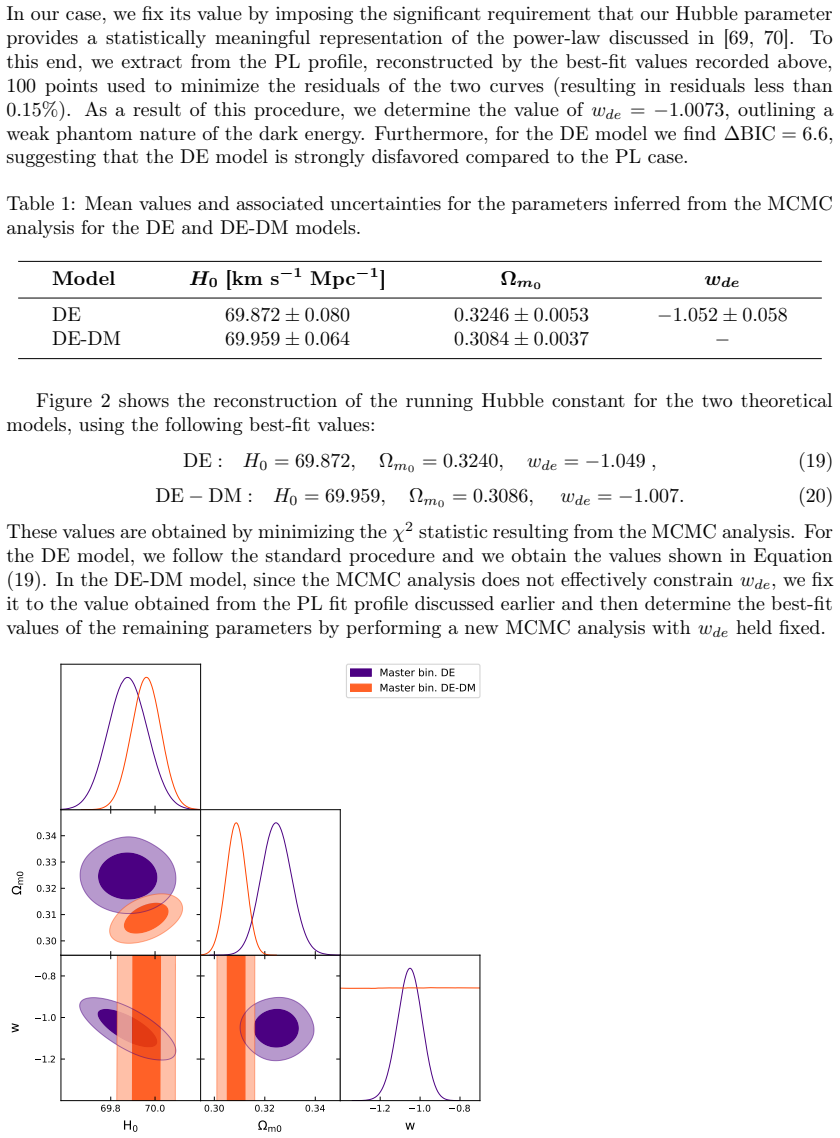
Summary. The paper studies two late-universe models for the effective running Hubble constant H0(z): a pure evolutionary dark-energy model (DE) in which dark energy is created by the gravitational field, and an interacting model (DE-DM) in which dark energy and matter exchange energy through conservation of their combined energy-momentum tensor. Both models are fitted to the 20-bin Master sample of Type Ia supernovae using an MCMC analysis, and the resulting H0(z) reconstructions are compared with a power-law (PL) reference profile. The paper reports that the DE model is strongly disfavored relative to PL (ΔBIC = 6.6), while for the DE-DM model the dark-energy equation-of-state parameter wde is unconstrained; the authors then fix wde = -1.0073 by minimizing residuals against 100 points drawn from the PL best fit and present the resulting reconstruction as reproducing the power-law decay.
Significance. If the central claim were sound, the paper would be relevant to the Hubble tension by suggesting that dark energy-matter interaction can naturally produce the decreasing H0(z) trend seen in binned supernova data. The theoretical setup in Section 2 is clearly written, the analytic solutions for Ωde(z) are useful, and the authors use standard MCMC software and explicitly acknowledge in the introduction that the power-law trend could be due to selection biases. However, the paper's headline claim is not supported by the reported analysis: the DE-DM model is not actually compared with the data in a model-selection sense, and the key parameter wde is calibrated to the very same power-law profile that the model is then said to reproduce. Because the load-bearing comparison is circular and no DE-DM statistic is reported, the significance of the paper's main conclusion cannot be evaluated from the present manuscript.
major comments (4)
- [Abstract and Section 4, Table 1] The claim that the MCMC analysis leads to a 'clear preference of data' for the DE-DM model is not supported by the reported statistics. Table 1 reports no posterior constraint on wde for DE-DM, and the only model-selection quantity in Section 4 is ΔBIC = 6.6 for the DE model, which disfavors that model relative to PL. No ΔBIC, χ², or evidence value is quoted for DE-DM against either PL or ΛCDM. Without such a statistic, the preference asserted in the abstract is a qualitative judgment rather than a result of the comparison procedure.
- [Section 4, paragraph after Table 1; Eq. (20)] The procedure used to fix wde is circular. The paper states that wde is unconstrained (flat posterior), then fixes it to wde = -1.0073 by minimizing residuals against 100 points extracted from the power-law best fit to the same Master bin data, and then shows in Eq. (20) and Figure 2 that the DE-DM curve reproduces that power law. Because the PL curve is used both as the target for setting the free parameter and as the reference for the claimed agreement, the match is constructed rather than tested. A valid test would calibrate wde from external data, use an independent prior, or demonstrate with a posterior predictive check that the agreement is not trivially achievable.
- [Section 1 and Section 3] The physical interpretation depends on the power-law decay of H0(z) being a genuine dynamical signal. The paper itself notes in Section 1 that the behavior 'could also account for selection biases.' The analysis in Section 3 adopts the 20-bin Master sample and the PL fit as the benchmark without quantifying the impact of selection effects, alternative binning, or distance-modulus systematics. Unless the trend is shown to be astrophysical rather than a statistical artifact, the DE-DM model's ability to mimic that trend carries no cosmological meaning.
- [Section 2, Eqs. (5)-(9); Section 4] The conclusions depend on two parameters that are fixed rather than fitted: α = 1 is adopted as 'the simplest case' and Γbar = 0.5 as a 'reference value.' The reported preference of DE-DM could therefore be an artifact of these choices. The analysis should either marginalize over α and Γbar or show that the circular comparison is robust to their variation.
minor comments (5)
- [Abstract] The phrase 'phantom matter equation of state parameter' is inaccurate: wde is the dark-energy equation-of-state parameter, not the matter equation of state, and the body of the paper consistently refers to it as the dark energy parameter.
- [Section 3] The paper states that a preliminary version of the analysis code will be released in a forthcoming work; to make the MCMC results reproducible, the code or a repository should be provided with the submission.
- [Section 4, Table 1] The dash for wde in the DE-DM row should be accompanied by an explicit statement that the parameter is unconstrained by the MCMC, and the table should also list the fixed value wde = -1.0073 used in Eq. (20) with a note explaining its origin.
- [Figure 2] The reconstruction of the DE-DM model is shown without uncertainty bands, so the visual agreement with the PL curve cannot be assessed statistically; the paper should show the propagated uncertainty on the fixed-wde reconstruction.
- [Section 3, BIC definition] The reference given for the Bayesian Information Criterion is a paper on p-values; please cite the original Schwarz criterion (Schwarz 1978) or a standard textbook in addition to the Jeffreys'-scale references.
Circularity Check
The DE-DM model's reproduction of the power-law H0(z) is manufactured by fitting wde to that same power-law curve; the claimed preference for DE-DM is therefore not an independent data-driven result.
-
fitted input called prediction
[Section 4 (Results), paragraph after Table 1 and Eqs. (19)-(20); echoed in Abstract and Section 5 Conclusions.]
"In our case, we fix its value by imposing the significant requirement that our Hubble parameter provides a statistically meaningful representation of the power-law discussed in [69, 70]. To this end, we extract from the PL profile, reconstructed by the best-fit values recorded above, 100 points used to minimize the residuals of the two curves (resulting in residuals less than 0.15%). As a result of this procedure, we determine the value of wde = −1.0073, outlining a weak phantom nature of the dark energy."
In the DE-DM model, wde is the parameter that controls the shape of H0(z) through Eq. (18). The MCMC leaves it unconstrained (flat posterior, Table 1), so the paper fixes it by minimizing residuals against 100 points drawn from the PL best fit of the same binned Master sample. The later conclusion that the model 'can be used to constraint the H0(z) to be a very good representation of the power-law decay observed in [69]' is thus a restatement of the calibration step: the target PL curve is the input used to set the parameter, not an independent prediction. The abstract concedes this ('being left free by data (it has a flat posterior), it is fixed in order to reproduce the decreasing power-law behavior'). The claimed very good representation is forced by construction.
full rationale
The central quantitative result of the paper — that the DE-DM model reproduces the decreasing PL behavior of the running Hubble constant — reduces to a fit: wde is unconstrained by the MCMC and is set by minimizing residuals to the same PL curve that the analysis then claims the model represents. No model-selection statistic is reported for DE-DM (only ΔBIC = 6.6 for DE, which is strongly disfavored relative to PL), so the abstract's 'clear preference of data for the DE-DM interaction model' is not a tested comparison outcome. The PL benchmark itself comes from the authors' own prior works ([69,70], with overlapping authorship), making the calibration anchor self-referential; the introduction even notes the trend 'could also account for selection biases.' However, the decisive circularity is the direct fitting of the free parameter to the target curve, which makes the headline 'representation of the power-law decay' true by construction. This warrants a high circularity score, though the model's H0 and Ωm0 are otherwise fit to external data.
Assumptions & free parameters
free parameters (6)
- H0 =
69.872 (DE), 69.959 (DE-DM) km/s/Mpc
- Omega_m0 =
0.3246 (DE), 0.3084 (DE-DM)
- wde (DE model) =
-1.052 +/- 0.058
- wde (DE-DM model) =
-1.0073 (fixed by matching PL profile, not constrained by SNe data)
- Gamma_bar =
0.5 (chosen by hand)
- alpha =
1 (chosen by hand)
assumptions (6)
- domain assumption The universe is described by a flat, isotropic FLRW metric (Equation 1).
- domain assumption Radiation energy density is neglected.
- ad hoc to paper The dark energy particle creation rate has the form Gamma = Gamma* H rho_de^{-alpha} (Equation 5).
- ad hoc to paper Dark energy and matter interact via conservation of the sum of their energy-momentum tensors (Equation 13).
- ad hoc to paper The reference values Gamma_bar = 0.5 and alpha = 1 are adopted.
- domain assumption The binned Master sample and its power-law fit are valid observational benchmarks.
Cite this review
Pith. "Pith review of Two Dynamical Scenarios for Binned Master Sample Interpretation." pith.science (2026). https://pith.science/paper/P3YSLBYQ
@misc{pith2026250714048,
  author       = {Pith},
  title        = {Pith review of: Two Dynamical Scenarios for Binned Master Sample Interpretation},
  year         = {2026},
  howpublished = {\url{https://pith.science/paper/P3YSLBYQ}},
  note         = {Machine review of arXiv:2507.14048}
}
abstract
We analyze two different scenarios for the late Universe dynamics, resulting into Hubble parameters deviating from the $\Lambda$CDM, mainly for the presence of an additional free parameter, which is the dark energy parameter. The first model consists of a pure evolutionary dark energy paradigm, as result of its creation by the gravitational field of the expanding Universe. The second model also considers an interaction of the evolutionary dark energy with the matter component, postulated via the conservation of the sum of their ideal energy-momentum tensors. These two models are then compared \textit{via} the diagnostic tool of the effective running Hubble constant, with the binned data of the so-called ``Master sample'' for the Type Ia Supernovae. The comparison procedures, based on a standard MCMC analysis, led to a clear preference of data for the dark energy - matter interaction model, which is associated to a phantom matter equation of state parameter (very close to $-1$) when, being left free by data (it has a flat posterior), it is fixed in order to reproduce the decreasing power-law behavior of the effective running Hubble constant, already discussed in literature.
Figures

Forward citations
Cited by 1 Pith paper
-
BAO miscalibration cannot rescue late-time solutions to the Hubble tension
Even after rescaling BAO data to prefer H0≈73 km/s/Mpc, none of six tested late-time dark-energy models can resolve the Hubble tension once unanchored SNeIa and CMB geometry are included.
Reference graph
Works this paper leans on
-
[1]
A flat Universe from high-resolution maps of the cosmic microwave background radiation
P. de Bernardis et al. “A flat Universe from high-resolution maps of the cosmic microwave background radiation”. In: Nature 404.6781 (Apr. 2000), pp. 955–959. doi: 10 . 1038 / 35010035. arXiv: astro-ph/0004404 [astro-ph]
arXiv 2000
-
[2]
Nine-year Wilkinson Microwave Anisotropy Probe (WMAP) Ob- servations: Final Maps and Results
C. L. Bennett et al. “Nine-year Wilkinson Microwave Anisotropy Probe (WMAP) Ob- servations: Final Maps and Results”. In:ApJ S.R. 208.2, 20 (Oct. 2013), p. 20. doi: 10.1088/0067-0049/208/2/20. arXiv: 1212.5225 [astro-ph.CO]
arXiv 2013
-
[3]
A comprehensive measurement of the local value of the Hubble constant with 1 km s−1 Mpc−1 uncertainty from the Hubble Space Telescope and the SH0ES team
Adam G Riess et al. “A comprehensive measurement of the local value of the Hubble constant with 1 km s−1 Mpc−1 uncertainty from the Hubble Space Telescope and the SH0ES team”. In:The Astrophysical journal letters934.1 (2022), p. L7.doi: 10.3847/ 2041-8213/ac5c5b
2022
-
[4]
Planck 2018 results-VI. Cosmological parameters
Nabila Aghanim et al. “Planck 2018 results-VI. Cosmological parameters”. In:Astronomy & Astrophysics641 (2020), A6. 8
2020
-
[5]
The CosmoVerse White Paper: Addressing observational tensions in cosmology with systematics and fundamental physics
Eleonora Di Valentino et al. “The CosmoVerse White Paper: Addressing observational tensions in cosmology with systematics and fundamental physics”. In:Phys. Dark Univ. (2025), pp. 1–416
2025
-
[6]
In the realm of the Hubble tension—a review of solutions
Eleonora Di Valentino et al. “In the realm of the Hubble tension—a review of solutions”. In: Classical and Quantum Gravity38.15 (July 2021), p. 153001.doi: 10.1088/1361- 6382/ac086d
doi:10.1088/1361- 2021
-
[7]
Seven hints that early-time new physics alone is not sufficient to solve the Hubble tension
Sunny Vagnozzi. “Seven hints that early-time new physics alone is not sufficient to solve the Hubble tension”. In:Universe 9.9 (2023), p. 393
2023
-
[8]
Exploring the Hubble tension with a late time Modified Gravity scenario
Luis A. Escamilla et al. “Exploring the Hubble tension with a late time Modified Gravity scenario”.In: Phys. Dark Univ.46(2024),p.101652. doi: 10.1016/j.dark.2024.101652. arXiv: 2408.04354 [astro-ph.CO]
arXiv 2024
Show all 120 references
-
[9]
Kinetic model for dark energy—dark matter interaction: Sce- nario for the hubble tension
Giovanni Montani et al. “Kinetic model for dark energy—dark matter interaction: Sce- nario for the hubble tension”. In:Phys. Dark Univ.48 (2025), p. 101848.doi: 10.1016/ j.dark.2025.101848. arXiv: 2404.15977 [gr-qc]
2025
-
[10]
Slow-rolling scalar dynamics as solution for the Hubble tension
Giovanni Montani, Nakia Carlevaro, and Maria Giovanna Dainotti. “Slow-rolling scalar dynamics as solution for the Hubble tension”. In:Physics of the Dark Universe44 (May 2024), p. 101486.doi: 10.1016/j.dark.2024.101486
2024
-
[11]
Metric f (R) gravity with dynamical dark energy as a scenario for the Hubble tension
Giovanni Montani et al. “Metric f (R) gravity with dynamical dark energy as a scenario for the Hubble tension”. In:Monthly Notices of the Royal Astronomical Society: Letters 527.1 (Oct. 2023), pp. L156–L161.doi: 10.1093/mnrasl/slad159
2023 doi
-
[12]
f(R) gravity in the Jor- dan frame as a paradigm for the Hubble tension
Tiziano Schiavone, Giovanni Montani, and Flavio Bombacigno. “f(R) gravity in the Jor- dan frame as a paradigm for the Hubble tension”. In:Monthly Notices of the Royal Astro- nomical Society: Letters522.1(Mar.2023),pp.L72–L77. doi: 10.1093/mnrasl/slad041
2023 doi
-
[13]
Running Hubble constant from the SNe Ia Pantheon sample?
Tiziano Schiavone et al. “Running Hubble constant from the SNe Ia Pantheon sample?” In: 17th Italian-Korean Symposium on Relativistic Astrophysics. May 2022. arXiv:2205. 07033 [astro-ph.CO]
2022
-
[14]
Introduction to modified gravity and gravita- tional alternative for dark energy
Shin’ichi Nojiri and Sergei D. Odintsov. “Introduction to modified gravity and gravita- tional alternative for dark energy”. In:eConf C0602061 (2006). Ed. by Andrzej Borowiec, p. 06. doi: 10.1142/S0219887807001928
2006 doi
-
[15]
New constraints on interacting dark energy from DESI DR2 BAO observations
Emanuelly Silva et al. “New constraints on interacting dark energy from DESI DR2 BAO observations”. In:Phys. Rev. D111.12, 123511 (June 2025), p. 123511.doi: 10.1103/ qqc6-76z4. arXiv: 2503.23225 [astro-ph.CO]
2025 arXiv
-
[16]
Implications of distance duality violation for theH_0 tension and evolving dark energy
Elsa M Teixeira et al. “Implications of distance duality violation for theH_0 tension and evolving dark energy”. In:arXiv preprint arXiv:2504.10464(2025)
2025 arXiv
-
[17]
Inflation, the Hubble tension, and early dark energy: An alternative overview
William Giarè. “Inflation, the Hubble tension, and early dark energy: An alternative overview”. In:Physical Review D109.12 (2024), p. 123545
2024
-
[18]
Small-amplitude Red Giants Elucidate the Nature of the Tip of the Red Giant Branch as a Standard Candle
Richard I. Anderson, Nolan W. Koblischke, and Laurent Eyer. “Small-amplitude Red Giants Elucidate the Nature of the Tip of the Red Giant Branch as a Standard Candle”. In: ApJ Lett.963.2, L43 (Mar. 2024), p. L43.doi: 10.3847/2041-8213/ad284d. arXiv: 2303.04790 [astro-ph.CO]
2024 arXiv
-
[19]
The Pantheon+ Analysis: The Full Data Set and Light-curve Release
Dan Scolnic et al. “The Pantheon+ Analysis: The Full Data Set and Light-curve Release”. In: The Astrophysical Journal 938.2 (Oct. 2022), p. 113. doi: 10 . 3847 / 1538 - 4357 / ac8b7a
2022
-
[20]
The Complete Light-curve Sample of Spectroscopically Confirmed SNe Ia from Pan-STARRS1 and Cosmological Constraints from the Combined Pantheon Sample
D. M. Scolnic et al. “The Complete Light-curve Sample of Spectroscopically Confirmed SNe Ia from Pan-STARRS1 and Cosmological Constraints from the Combined Pantheon Sample”. In: ApJ 859.2, 101 (June 2018), p. 101.doi: 10.3847/1538- 4357/aab9bb . arXiv: 1710.00845 [astro-ph.CO]. 9
2018 arXiv
-
[21]
The Pantheon+ Analysis: Cosmological Constraints
Dillon Brout et al. “The Pantheon+ Analysis: Cosmological Constraints”. In:ApJ 938.2 (2022), p. 110.doi: 10.3847/1538-4357/ac8e04. arXiv: 2202.04077 [astro-ph.CO]
2022 arXiv
-
[22]
CATS: The Hubble Constant from Standardized TRGB and Type Ia Supernova Measurements
D. Scolnic et al. “CATS: The Hubble Constant from Standardized TRGB and Type Ia Supernova Measurements”. In:Astrophys. J. Lett.954.1 (2023), p. L31.doi: 10.3847/ 2041-8213/ace978. arXiv: 2304.06693 [astro-ph.CO]
2023 arXiv
-
[23]
Cosmological Results from the RAISIN Survey: Using Type Ia Su- pernovae in the Near Infrared as a Novel Path to Measure the Dark Energy Equation of State
D. O. Jones et al. “Cosmological Results from the RAISIN Survey: Using Type Ia Su- pernovae in the Near Infrared as a Novel Path to Measure the Dark Energy Equation of State”. In:Astrophys. J.933.2 (2022), p. 172.doi: 10.3847/1538-4357/ac755b. arXiv: 2201.07801 [astro-ph.CO]
2022 arXiv
-
[24]
Comparing Tip of the Red Giant Branch Distance Scales: An Independent Reduction of the Carnegie-Chicago Hubble Program and the Value of the Hubble Constant
Gagandeep S. Anand et al. “Comparing Tip of the Red Giant Branch Distance Scales: An Independent Reduction of the Carnegie-Chicago Hubble Program and the Value of the Hubble Constant”. In:Astrophys. J.932.1 (2022), p. 15.doi: 10.3847/1538-4357/ ac68df. arXiv: 2108.00007 [astro-ph.CO]
2022 arXiv
-
[26]
Carnegie Supernova Project-I and -II: Measurements ofH0 using Cepheid,TRGB,andSBFDistanceCalibrationtoTypeIaSupernovae
Syed A. Uddin et al. “Carnegie Supernova Project-I and -II: Measurements ofH0 using Cepheid,TRGB,andSBFDistanceCalibrationtoTypeIaSupernovae”.In: arXiv:2308.01875 (Aug. 2023). arXiv:2308.01875 [astro-ph.CO]
2023 arXiv
-
[27]
The Mira Distance to M101 and a 4% Measurement of H0
Caroline D. Huang et al. “The Mira Distance to M101 and a 4% Measurement of H0”. In: Astrophys. J.963.2 (2024), p. 83.doi: 10.3847/1538-4357/ad1ff8. arXiv: 2312.08423 [astro-ph.CO]
2024 arXiv
-
[28]
Reconnaissance with JWST of the J-region Asymptotic Giant Branch in Distance Ladder Galaxies: From Irregular Luminosity Functions to Approximation of the Hubble Constant
Siyang Li et al. “Reconnaissance with JWST of the J-region Asymptotic Giant Branch in Distance Ladder Galaxies: From Irregular Luminosity Functions to Approximation of the Hubble Constant”. In:Astrophys. J. 966.1 (2024), p. 20. doi: 10 . 3847 / 1538 - 4357/ad2f2b. arXiv: 2401....
2024 arXiv
-
[29]
Cosmicflows-4:TheCalibrationofOpticalandInfraredTully–Fisher Relations
EhsanKourkchietal.“Cosmicflows-4:TheCalibrationofOpticalandInfraredTully–Fisher Relations”. In:Astrophys. J.896.1 (2020), p. 3.doi: 10.3847/1538-4357/ab901c. arXiv: 2004.14499 [astro-ph.GA]
2020 arXiv
-
[30]
Using the Baryonic Tully–Fisher Relation to Measure H o
James Schombert, Stacy McGaugh, and Federico Lelli. “Using the Baryonic Tully–Fisher Relation to Measure H o”. In: Astron. J. 160.2 (2020), p. 71. doi: 10 . 3847 / 1538 - 3881/ab9d88. arXiv: 2006.08615 [astro-ph.CO]
2020 arXiv
-
[31]
Leveraging SN Ia spectroscopic similarity to improve the measurement of H0
Yukei S. Murakami et al. “Leveraging SN Ia spectroscopic similarity to improve the measurement of H0”. In:JCAP 11 (2023), p. 046.doi: 10.1088/1475-7516/2023/11/
2023 doi
-
[32]
Small Magellanic Cloud Cepheids Observed with the Hubble Space Telescope Provide a New Anchor for the SH0ES Distance Ladder
Louise Breuval et al. “Small Magellanic Cloud Cepheids Observed with the Hubble Space Telescope Provide a New Anchor for the SH0ES Distance Ladder”. In:arXiv:2404.08038 (Apr. 2024). arXiv:2404.08038 [astro-ph.CO]
2024 arXiv
-
[33]
Measurement of the CMB temperature power spectrum and con- straints on cosmology from the SPT-3G 2018 TT, TE, and EE dataset
L. Balkenhol et al. “Measurement of the CMB temperature power spectrum and con- straints on cosmology from the SPT-3G 2018 TT, TE, and EE dataset”. In:Phys. Rev. D 108.2 (2023), p. 023510. doi: 10.1103/PhysRevD.108.023510 . arXiv: 2212.05642 [astro-ph.CO]
2023 arXiv
-
[34]
The Atacama Cosmology Telescope: DR4 Maps and Cosmological Parameters
Simone Aiola et al. “The Atacama Cosmology Telescope: DR4 Maps and Cosmological Parameters”. In: JCAP 12 (2020), p. 047. doi: 10 . 1088 / 1475 - 7516 / 2020 / 12 / 047. arXiv: 2007.07288 [astro-ph.CO]
2020 arXiv
-
[35]
A proposal to improve the accuracy of cosmolog- ical observables and address the Hubble tension problem
Horst Foidl and Tanja Rindler-Daller. “A proposal to improve the accuracy of cosmolog- ical observables and address the Hubble tension problem”. In:A& A 686, A210 (2024), A210. doi: 10.1051/0004-6361/202348955. 10
2024 doi
-
[36]
DeterminingH0 from distance sum rule combining gamma-ray bursts with observational Hubble data and strong gravitational lensing
Orlando Luongo and Marco Muccino. “DeterminingH0 from distance sum rule combining gamma-ray bursts with observational Hubble data and strong gravitational lensing”. In: arXiv e-prints, arXiv:2412.18493 (Dec. 2024), arXiv:2412.18493.doi: 10.48550/arXiv. 2412.18493. arXiv: 2412....
2024 doi
-
[37]
Deep Learning Based Recalibration of SDSS and DESI BAO Al- leviates Hubble and Clustering Tensions
Rahul Shah et al. “Deep Learning Based Recalibration of SDSS and DESI BAO Al- leviates Hubble and Clustering Tensions”. In: arXiv e-prints, arXiv:2412.14750 (Dec. 2024), arXiv:2412.14750. doi: 10 . 48550 / arXiv . 2412 . 14750. arXiv: 2412 . 14750 [astro-ph.CO]
-
[38]
Tensions between the early and late Universe
Licia Verde, Tommaso Treu, and Adam G. Riess. “Tensions between the early and late Universe”. In: Nature Astronomy 3.10 (Sept. 2019), pp. 891–895.issn: 2397-3366. doi: 10.1038/s41550-019-0902-0. url: http://dx.doi.org/10.1038/s41550-019-0902- 0
2019 doi
-
[39]
The Carnegie-Chicago Hubble Program. VIII. An Inde- pendent Determination of the Hubble Constant Based on the Tip of the Red Giant Branch*
Wendy L. Freedman et al. “The Carnegie-Chicago Hubble Program. VIII. An Inde- pendent Determination of the Hubble Constant Based on the Tip of the Red Giant Branch*”. In:The Astrophysical Journal882.1 (Aug. 2019), p. 34.issn: 1538-4357. doi: 10.3847/1538-4357/ab2f73. url: http...
2019 doi
-
[40]
Calibration of the Tip of the Red Giant Branch (TRGB)
Wendy L. Freedman et al. “Calibration of the Tip of the Red Giant Branch (TRGB)”. In: (Feb. 2020).doi: 10.3847/1538-4357/ab7339. arXiv: 2002.01550 [astro-ph.GA]
2020 arXiv
-
[41]
The Parallax ofω Centauri Mea- sured from Gaia EDR3 and a Direct, Geometric Calibration of the Tip of the Red Gi- ant Branch and the Hubble Constant
John Soltis, Stefano Casertano, and Adam G. Riess. “The Parallax ofω Centauri Mea- sured from Gaia EDR3 and a Direct, Geometric Calibration of the Tip of the Red Gi- ant Branch and the Hubble Constant”. In:Astrophys. J. Lett.908.1 (2021), p. L5.doi: 10.3847/2041-8213/abdbad. a...
2021 arXiv
-
[42]
Analysing the large-scale bulk flow using cosmicflows4: increasing tension with the standard cosmological model
Richard Watkins et al. “Analysing the large-scale bulk flow using cosmicflows4: increasing tension with the standard cosmological model”. In:Monthly Notices of the Royal Astro- nomical Society 524.2 (Sept. 2023), pp. 1885–1892. doi: 10 . 1093 / mnras / stad1984. arXiv: 2302.02...
2023 arXiv
-
[43]
Exploring the evi- dence for a large local void with supernovae Ia data
Vladimir V. Luković, Balakrishna S. Haridasu, and Nicola Vittorio. “Exploring the evi- dence for a large local void with supernovae Ia data”. In:Monthly Notices of the Royal Astronomical Society491.2 (Jan. 2020), pp. 2075–2087.doi: 10.1093/mnras/stz3070. arXiv: 1907.11219 [ast...
2020 arXiv
-
[44]
New constraint of the Hubble constant by proper motions of radio components observed in AGN twin-jets
Wei-Jian Lu and Yi-Ping Qin. “New constraint of the Hubble constant by proper motions of radio components observed in AGN twin-jets”. In:Research in Astronomy and Astro- physics 21.10 (Nov. 2021), p. 261.issn: 1674-4527.doi: 10.1088/1674-4527/21/10/261. url: http://dx.doi.org/...
2021 doi
-
[45]
Unbiased likelihood-free infer- enceoftheHubbleconstantfromlightstandardsirens
Francesca Gerardi, Stephen M. Feeney, and Justin Alsing. “Unbiased likelihood-free infer- enceoftheHubbleconstantfromlightstandardsirens”.In: arXiv e-prints,arXiv:2104.02728 (Apr. 2021), arXiv:2104.02728. arXiv:2104.02728 [astro-ph.CO]
2021 arXiv
-
[46]
arXiv: 2306.00070 [astro-ph.CO]
-
[47]
Rachel Gray, Chris Messenger, and John Veitch.A Pixelated Approach to Galaxy Cat- alogue Incompleteness: Improving the Dark Siren Measurement of the Hubble Constant
-
[48]
arXiv: 2110.11731 [astro-ph.CO]
Simone Mozzon et al.Does non-stationary noise in LIGO and Virgo affect the estimation of H0? 2021. arXiv: 2110.11731 [astro-ph.CO]. 11
2021 arXiv
-
[50]
Forecast of Observing Time Delay of Strongly Lensed Quasars with the Muztagh-Ata 1.93 m Telescope
Shanhao Zhu et al. “Forecast of Observing Time Delay of Strongly Lensed Quasars with the Muztagh-Ata 1.93 m Telescope”. In:Research in Astronomy and Astrophysics23.3, 035001 (Mar. 2023), p. 035001.doi: 10.1088/1674-4527/acaf4e . arXiv: 2203.15680 [astro-ph.CO]
2023 arXiv
-
[51]
A standard siren measurement of the Hubble constant using gravitational wave events from the first three LIGO/Virgo observing runs and the DESI Legacy Survey
Antonella Palmese et al. A standard siren measurement of the Hubble constant using gravitational wave events from the first three LIGO/Virgo observing runs and the DESI Legacy Survey. 2021. arXiv:2111.06445 [astro-ph.CO]
2021 arXiv
-
[52]
A 5 per cent measurement of the Hubble-Lemaıˆtre constant from Type II supernovae
T. de Jaeger et al. “A 5 per cent measurement of the Hubble-Lemaıˆtre constant from Type II supernovae”. In:Monthly Notices of the Royal Astronomical Society514.3 (Aug. 2022),pp.4620–4628. doi: 10.1093/mnras/stac1661.arXiv: 2203.08974 [astro-ph.CO]
2022 arXiv
-
[53]
Assessing the effect of mass-model assumptions on measuring the Hubble constant from the cluster-lensed supernova Refsdal
Yuting Liu and Masamune Oguri. “Assessing the effect of mass-model assumptions on measuring the Hubble constant from the cluster-lensed supernova Refsdal”. In:Phys. Rev. D 111.12(2025),p.123506. doi: 10.1103/v857-ylw5.arXiv: 2402.13476 [astro-ph.CO]
2025 arXiv
-
[54]
The Hubble Constant from Infrared Surface Brightness Fluc- tuation Distances*
John P. Blakeslee et al. “The Hubble Constant from Infrared Surface Brightness Fluc- tuation Distances*”. In:The Astrophysical Journal911.1 (Apr. 2021), p. 65.issn: 1538-
2021
-
[55]
TheMegamaserCosmologyProject.XIII.CombinedHubbleConstant Constraints
D.W.Pesceetal.“TheMegamaserCosmologyProject.XIII.CombinedHubbleConstant Constraints”. In:The Astrophysical Journal Letters891.1 (Feb. 2020), p. L1.issn: 2041-
2020
-
[56]
DESI DR2 Results II: Measurements of Baryon Acoustic Oscil- lations and Cosmological Constraints
M. Abdul-Karim et al. “DESI DR2 Results II: Measurements of Baryon Acoustic Oscil- lations and Cosmological Constraints”. In: (2025). arXiv:2503.14738 [astro-ph.CO] . url: https://arxiv.org/abs/2503.14738
2025 arXiv
-
[57]
Accelerating universes with scaling dark matter
Michel Chevallier and David Polarski. “Accelerating universes with scaling dark matter”. In: International Journal of Modern Physics D10.02 (2001), pp. 213–223
2001
-
[58]
Exploring the expansion history of the universe
Eric V Linder. “Exploring the expansion history of the universe”. In: Physical review letters 90.9 (2003), p. 091301
2003
-
[59]
DESI 2024 VI: cosmological constraints from the measurements of baryon acoustic oscillations
A. G. Adame et al. “DESI 2024 VI: cosmological constraints from the measurements of baryon acoustic oscillations”. In:JCAP 02 (2025), p. 021. doi: 10.1088/1475- 7516/ 2025/02/021. arXiv: 2404.03002 [astro-ph.CO]
2025 arXiv
-
[60]
An overview of what current data can (and cannot yet) say about evolving dark energy
William Giarè et al. “An overview of what current data can (and cannot yet) say about evolving dark energy”. In:Physics of the Dark Universe(2025), p. 101906
2025
-
[61]
Dynamical Dark Energy Beyond Planck? Constraints from multiple CMB probes, DESI BAO and Type-Ia Supernovae
William Giarè. “Dynamical Dark Energy Beyond Planck? Constraints from multiple CMB probes, DESI BAO and Type-Ia Supernovae”. In:arXiv preprint arXiv:2409.17074 (2024)
2024 arXiv
-
[63]
Extended Dark Energy analysis using DESI DR2 BAO measurements
K Lodha et al. “Extended Dark Energy analysis using DESI DR2 BAO measurements”. In: arXiv preprint arXiv:2503.14743(2025)
2025 arXiv
-
[64]
Phenomenology of Λ-CDM Model: A Possibility of Accelerating Uni- verse with Positive Pressure
Saibal Ray et al. “Phenomenology of Λ-CDM Model: A Possibility of Accelerating Uni- verse with Positive Pressure”. In:International Journal of Theoretical Physics50.3 (Mar. 2011), pp. 939–951.doi: 10.1007/s10773-010-0639-0. arXiv: 0711.0686 [gr-qc]. 12
2011 arXiv
-
[65]
Decay of Cosmological Constant as Bose Con- densate Evaporation
Irina Dymnikova and Maxim Khlopov. “Decay of Cosmological Constant as Bose Con- densate Evaporation”. In:Modern Physics Letters A15.38-39 (Jan. 2000), pp. 2305–2314. doi: 10.1142/S0217732300002966. arXiv: astro-ph/0102094 [astro-ph]
-
[66]
Formation of structure in a universe with unstable neutrinos
A. G. Doroshkevich and M. Iu. Khlopov. “Formation of structure in a universe with unstable neutrinos”. In:Mon. Not. RAS 211 (Nov. 1984), pp. 277–282.doi: 10.1093/ mnras/211.2.277
1984
-
[67]
DoesDESI2024Confirm ΛCDM?
EoinÓColgáinetal.“DoesDESI2024Confirm ΛCDM?” In:arXiv preprint arXiv:2404.08633 (2024)
2024 arXiv
-
[68]
On the evolution of the Hubble constant with the SNe Ia pantheon sample and baryon acoustic oscillations: a feasibility study for GRB-cosmology in 2030
Maria Giovanna Dainotti et al. “On the evolution of the Hubble constant with the SNe Ia pantheon sample and baryon acoustic oscillations: a feasibility study for GRB-cosmology in 2030”. In:Galaxies 10.1 (2022), p. 24
2022
-
[69]
M. G. Dainotti et al. A New Master Supernovae Ia sample and the investigation of the H0 tension. 2025. arXiv:2501.11772 [astro-ph.CO]. url: https://arxiv.org/abs/ 2501.11772
2025 arXiv
-
[70]
The effective running Hubble constant in SNe Ia as a marker for the dark energy nature
E. Fazzari et al. “The effective running Hubble constant in SNe Ia as a marker for the dark energy nature”. In: (June 2025). arXiv:2506.04162 [astro-ph.CO]
2025
-
[71]
On the Hubble constant tension in the SNe Ia Pantheon sample
Maria Giovanna Dainotti et al. “On the Hubble constant tension in the SNe Ia Pantheon sample”. In:The Astrophysical Journal912.2 (2021), p. 150
2021
-
[72]
On the statistical assumption on the distance moduli of Supernovae Ia and its impact on the determination of cosmological parameters
M. G. Dainotti et al. “On the statistical assumption on the distance moduli of Supernovae Ia and its impact on the determination of cosmological parameters”. In:JHEAp 41 (2024), pp. 30–41. doi: 10.1016/j.jheap.2024.01.001
2024 doi
-
[73]
Redshift evolution of the underlying type Ia supernova stretch dis- tribution
N. Nicolas et al. “Redshift evolution of the underlying type Ia supernova stretch dis- tribution”. In: Astronomy & Astrophysics 649 (May 2021), A74. issn: 1432-0746. doi: 10.1051/0004- 6361/202038447 . url: http://dx.doi.org/10.1051/0004- 6361/ 202038447
2021 doi
-
[74]
Status Report on the Chicago-Carnegie Hubble Program (CCHP): Measurement of the Hubble Constant Using the Hubble and James Webb Space Telescopes
Wendy L. Freedman et al. “Status Report on the Chicago-Carnegie Hubble Program (CCHP): Measurement of the Hubble Constant Using the Hubble and James Webb Space Telescopes”. In:ApJ 985.2, 203 (June 2025), p. 203.doi: 10.3847/1538-4357/adce78. arXiv: 2408.06153 [astro-ph.CO]
2025 arXiv
-
[75]
Evolution of an effective Hubble constant in f (R) modified gravity
Tiziano Schiavone and Giovanni Montani. “Evolution of an effective Hubble constant in f (R) modified gravity”. In:arXiv preprint arXiv:2408.01410(2024)
2024 arXiv
-
[76]
Can we learn from matter creation to solve theH0 tension problem?
Emilio Elizalde, Martiros Khurshudyan, and Sergei D Odintsov. “Can we learn from matter creation to solve theH0 tension problem?” In:The European Physical Journal C 84.8 (2024), p. 782
2024
-
[77]
Investigating f (R)-Inflation: background evolution and constraints
Elisa Fazzari et al. Investigating f (R)-Inflation: background evolution and constraints
-
[78]
Challenging ΛCDM: 5σ Evidence for a Dynamical Dark Energy Late-TimeTransition
Mateus Scherer et al. “Challenging ΛCDM: 5σ Evidence for a Dynamical Dark Energy Late-TimeTransition”.In: arXiv e-prints,arXiv:2504.20664(Apr.2025),arXiv:2504.20664. doi: 10.48550/arXiv.2504.20664. arXiv: 2504.20664 [astro-ph.CO]
-
[79]
The gamma-ray bursts fundamental plane correlation as a cos- mological tool
M. G. Dainotti et al. “The gamma-ray bursts fundamental plane correlation as a cos- mological tool”. In: Mon. Not. Roy. Astron. Soc. 518.2 (2023), pp. 2201–2240. doi: 10.1093/mnras/stac2752. arXiv: 2209.08675 [astro-ph.HE]
2023 arXiv
-
[80]
Influence of particle creation on flat and negative curved FLRW universes
Giovanni Montani. “Influence of particle creation on flat and negative curved FLRW universes”. In:Classical and Quantum Gravity18.1 (2001), p. 193
2001
-
[81]
A new binning method to choose a standard set of Quasars
Maria Giovanna Dainotti et al. “A new binning method to choose a standard set of Quasars”. In:Physics of the Dark Universe44 (2024), p. 101428. 13
2024
-
[82]
The evidence for a spatially flat Universe
George Efstathiou and Steven Gratton. “The evidence for a spatially flat Universe”. In: Monthly Notices of the Royal Astronomical Society: Letters496.1 (2020), pp. L91–L95
2020
-
[83]
Weinberg
S. Weinberg. Gravitation and Cosmology: Principles and Applications of the General Theory of Relativity. Wiley, 1972.isbn: 9780471925675
1972
-
[84]
On the thermodynamics of matter creation in cosmology
MO Calvao, JAS Lima, and I Waga. “On the thermodynamics of matter creation in cosmology”. In:Physics Letters A162.3 (1992), pp. 223–226
1992
-
[85]
Coupled quintessence
Luca Amendola. “Coupled quintessence”. In: Phys. Rev. D 62.4, 043511 (Aug. 2000), p. 043511. doi: 10.1103/PhysRevD.62.043511. arXiv: astro-ph/9908023 [astro-ph]
2000 arXiv
-
[86]
Cosmological evolution with interaction between dark energy and dark matter
Yuri L. Bolotin et al. “Cosmological evolution with interaction between dark energy and dark matter”. In: International Journal of Modern Physics D 24.03 (Feb. 2015), p. 1530007. issn: 1793-6594. doi: 10.1142/s0218271815300074. url: http://dx.doi. org/10.1142/S0218271815300074
2015 doi
-
[87]
Dark matter and dark energy interactions: theoretical challenges, cos- mological implications and observational signatures
B Wang et al. “Dark matter and dark energy interactions: theoretical challenges, cos- mological implications and observational signatures”. In:Reports on Progress in Physics 79.9 (Aug. 2016), p. 096901.issn: 1361-6633. doi: 10.1088/0034-4885/79/9/096901 . url: http://dx.doi.or...
2016 doi
-
[88]
Transition of the dark energy equation of state in an interacting holographic dark energy model
Bin Wang, Yungui Gong, and Elcio Abdalla. “Transition of the dark energy equation of state in an interacting holographic dark energy model”. In:Physics Letters B 624.3–4 (Sept. 2005), pp. 141–146.issn: 0370-2693. doi: 10.1016/j.physletb.2005.08.008 . url: http://dx.doi.org/10....
2005 doi
-
[89]
Phantom behavior via cosmological creation of par- ticles
Rafael C Nunes and Diego Pavón. “Phantom behavior via cosmological creation of par- ticles”. In:Physical Review D91.6 (2015), p. 063526
2015
-
[90]
Acosmographicanalysis ofholographic darken- ergymodels
Supriya Panand Subenoy Chakraborty. “Acosmographicanalysis ofholographic darken- ergymodels”.In: International Journal of Modern Physics D23.11(Oct.2014),p.1450092. issn: 1793-6594. doi: 10.1142/s0218271814500928 . url: http://dx.doi.org/10. 1142/S0218271814500928
2014 doi
-
[91]
Cosmologies with energy exchange
John D. Barrow and T. Clifton. “Cosmologies with energy exchange”. In:Physical Review D 73.10 (May 2006).issn: 1550-2368. doi: 10.1103/physrevd.73.103520. url: http: //dx.doi.org/10.1103/PhysRevD.73.103520
2006 doi
-
[92]
Consequences of dark matter-dark energy interaction on cosmological parameters derived from SNIa data
Luca Amendola, Gabriela Camargo Campos, and Rogerio Rosenfeld. “Consequences of dark matter-dark energy interaction on cosmological parameters derived from SNIa data”. In: Phys. Rev. D 75 (2007), p. 083506. doi: 10 . 1103 / PhysRevD . 75 . 083506. arXiv: astro-ph/0610806
2007 arXiv
-
[93]
Effects of the interaction between dark energy and dark matter on cosmological parameters
Jian-Hua He and Bin Wang. “Effects of the interaction between dark energy and dark matter on cosmological parameters”. In:Journal of Cosmology and Astroparticle Physics 2008.06 (June 2008), p. 010.issn: 1475-7516. doi: 10.1088/1475-7516/2008/06/010 . url: http://dx.doi.org/10....
2008 doi
-
[94]
Superacceleration as the signature of a dark sector interaction
Subinoy Das, Pier Stefano Corasaniti, and Justin Khoury. “Superacceleration as the signature of a dark sector interaction”. In:Physical Review D 73.8 (Apr. 2006). issn: 1550-2368. doi: 10.1103/physrevd.73.083509 . url: http://dx.doi.org/10.1103/ PhysRevD.73.083509
2006 doi
-
[97]
Observational constraints on an interacting dark energy model
Jussi Väliviita, Roy Maartens, and Elisabetta Majerotto. “Observational constraints on an interacting dark energy model”. In:Monthly Notices of the Royal Astronomical Society 402.4 (Mar. 2010), pp. 2355–2368.issn: 1365-2966. doi: 10.1111/j.1365-2966.2009. 16115.x. url: http://...
2010
-
[98]
Linear and nonlinear interactions in the dark sector
Luis P. Chimento. “Linear and nonlinear interactions in the dark sector”. In:Physical Review D 81.4 (Feb. 2010).issn: 1550-2368. doi: 10.1103/physrevd.81.043525. url: http://dx.doi.org/10.1103/PhysRevD.81.043525
2010 doi
-
[99]
Large-scale instability in inter- acting dark energy and dark matter fluids
Jussi Väliviita, Elisabetta Majerotto, and Roy Maartens. “Large-scale instability in inter- acting dark energy and dark matter fluids”. In:Journal of Cosmology and Astroparticle Physics 2008.07 (July 2008), p. 020.issn: 1475-7516. doi: 10.1088/1475-7516/2008/ 07/020. url: http...
2008 doi
-
[100]
Interacting dark sector with transversal inter- action
Luis P. Chimento and Martín G. Richarte. “Interacting dark sector with transversal inter- action”. In:AIP Conference Proceedings. Vol. 1647. AIP Publishing LLC, 2015, pp. 44–
2015
-
[102]
Testing coupled dark energy with large scale structure observation
Weiqiang Yang and Lixin Xu. “Testing coupled dark energy with large scale structure observation”. In:Journal of Cosmology and Astroparticle Physics2014.08 (Aug. 2014), p. 034. doi: 10.1088/1475-7516/2014/08/034 . url: https://dx.doi.org/10.1088/ 1475-7516/2014/08/034
2014 doi
-
[103]
New constraints on inter- acting dark energy from cosmic chronometers
Rafael C. Nunes, Supriya Pan, and Emmanuel N. Saridakis. “New constraints on inter- acting dark energy from cosmic chronometers”. In:Physical Review D94.2 (July 2016). issn: 2470-0029. doi: 10.1103/physrevd.94.023508 . url: http://dx.doi.org/10. 1103/PhysRevD.94.023508
2016 doi
-
[104]
Testing the interaction between dark energy and dark matter via the latest observations
Jian-Hua He, Bin Wang, and Elcio Abdalla. “Testing the interaction between dark energy and dark matter via the latest observations”. In:Physical Review D83.6 (Mar. 2011). issn: 1550-2368. doi: 10.1103/physrevd.83.063515 . url: http://dx.doi.org/10. 1103/PhysRevD.83.063515
2011 doi
-
[105]
Dynamics of nonlinear interacting dark energy models
Andronikos Paliathanasis, Supriya Pan, and Weiqiang Yang. “Dynamics of nonlinear interacting dark energy models”. In:International Journal of Modern Physics D28.12 (Sept. 2019), p. 1950161. issn: 1793-6594. doi: 10 . 1142 / s021827181950161x. url: http://dx.doi.org/10.1142/S02...
2019 doi
-
[106]
url: http://dx.doi.org/10.1063/1.4913335
doi: 10.1063/1.4913335. url: http://dx.doi.org/10.1063/1.4913335
-
[108]
Observational con- straints and predictions of the interacting dark sector with field-fluid mapping
Joseph P. Johnson, Archana Sangwan, and S. Shankaranarayanan. “Observational con- straints and predictions of the interacting dark sector with field-fluid mapping”. In:Jour- nal of Cosmology and Astroparticle Physics2022.01 (Jan. 2022), p. 024.issn: 1475-7516. doi: 10.1088/147...
2022 doi
-
[109]
Remedy of some cosmological tensions via effective phantom-like be- havior of interacting vacuum energy
Suresh Kumar. “Remedy of some cosmological tensions via effective phantom-like be- havior of interacting vacuum energy”. In:Physics of the Dark Universe33 (Sept. 2021), p. 100862. issn: 2212-6864. doi: 10.1016/j.dark.2021.100862. url: http://dx.doi. org/10.1016/j.dark.2021.100862
2021
-
[110]
Quantum field theory of inter- acting dark matter and dark energy: Dark monodromies
Guido D’Amico, Teresa Hamill, and Nemanja Kaloper. “Quantum field theory of inter- acting dark matter and dark energy: Dark monodromies”. In:Physical Review D94.10 (Nov. 2016). issn: 2470-0029. doi: 10.1103/physrevd.94.103526 . url: http://dx. doi.org/10.1103/PhysRevD.94.103526
2016 doi
-
[111]
Cosmological constraints on parametrized interacting dark en- ergy
R. von Marttens et al. “Cosmological constraints on parametrized interacting dark en- ergy”. In:Physics of the Dark Universe23 (Jan. 2019), p. 100248.issn: 2212-6864. doi: 10.1016/j.dark.2018.10.007. url: http://dx.doi.org/10.1016/j.dark.2018.10. 007
2019 doi
-
[112]
Testing interacting dark matter and dark energy model with cosmo- logical data
Gong Cheng et al. “Testing interacting dark matter and dark energy model with cosmo- logical data”. In:Phys. Rev. D102 (4 Aug. 2020), p. 043517.doi: 10.1103/PhysRevD. 102.043517. url: https://link.aps.org/doi/10.1103/PhysRevD.102.043517
2020 doi
-
[113]
Improved cosmological constraints from a joint analysis of the SDSS- II and SNLS supernova samples
Marc Betoule et al. “Improved cosmological constraints from a joint analysis of the SDSS- II and SNLS supernova samples”. In:Astronomy & Astrophysics568 (2014), A22
2014
-
[114]
Cobaya: Code for Bayesian Analysis of hierarchical physical models
Jesus Torrado and Antony Lewis. “Cobaya: Code for Bayesian Analysis of hierarchical physical models”. In: Journal of Cosmology and Astroparticle Physics2021.05 (2021), p. 057
2021
-
[115]
Inference from iterative simulation using multiple sequences
Andrew Gelman and Donald B Rubin. “Inference from iterative simulation using multiple sequences”. In:Statistical science7.4 (1992), pp. 457–472
1992
-
[116]
Tale of stable interacting dark energy, observational signatures, and the H0 tension
Weiqiang Yang et al. “Tale of stable interacting dark energy, observational signatures, and the H0 tension”. In:Journal of Cosmology and Astroparticle Physics2018.09 (Sept. 2018), pp. 019–019. issn: 1475-7516. doi: 10 . 1088 / 1475 - 7516 / 2018 / 09 / 019. url: http://dx.doi....
2018 doi
-
[117]
A Practical Solution to the Pervasive Problems of p Values
Eric-Jan Wagenmakers. “A Practical Solution to the Pervasive Problems of p Values”. In: Psychonomic bulletin & review14 (Nov. 2007), pp. 779–804.doi: 10.3758/BF03194105
2007 doi
-
[118]
The Dark Energy Survey: Cosmology Results with 1500 New High- redshift Type Ia Supernovae Using the Full 5 yr Data Set
TMC Abbott et al. “The Dark Energy Survey: Cosmology Results with 1500 New High- redshift Type Ia Supernovae Using the Full 5 yr Data Set”. In:The Astrophysical Journal Letters 973.1 (2024), p. L14
2024
-
[119]
Bayes factors
Robert E Kass and Adrian E Raftery. “Bayes factors”. In:Journal of the american sta- tistical association90.430 (1995), pp. 773–795
1995
-
[120]
The Theory of Probability
Harold Jeffreys. The Theory of Probability. Oxford Classic Texts in the Physical Sciences,
-
[122]
GetDist: a Python package for analysing Monte Carlo samples
Antony Lewis. “GetDist: a Python package for analysing Monte Carlo samples”. In:arXiv preprint arXiv:1910.13970 (2019)
2019 arXiv
-
[124]
Bayes in the sky: Bayesian inference and model selection in cosmology
Roberto Trotta. “Bayes in the sky: Bayesian inference and model selection in cosmology”. In: Contemporary Physics49.2 (2008), pp. 71–104
2008
-
[1939]
isbn: 978-0-19-850368-2, 978-0-19-853193-7. 16
-
[2021]
arXiv: 2111.04629 [astro-ph.CO]
-
[2025]
url: https://arxiv.org/abs/2507.13890
arXiv: 2507.13890 [astro-ph.CO]. url: https://arxiv.org/abs/2507.13890
-
[4357]
url: http://dx.doi.org/10.3847/1538- 4357/abe86a
doi: 10.3847/1538- 4357/abe86a . url: http://dx.doi.org/10.3847/1538- 4357/abe86a
-
[8213]
url: http://dx.doi.org/10.3847/2041- 8213/ab75f0
doi: 10.3847/2041- 8213/ab75f0 . url: http://dx.doi.org/10.3847/2041- 8213/ab75f0
Reviewed August 6, 2026 · model on record in the stance chip above.
Discussion (0). Sign in to comment.