REVIEW 4 major objections 6 minor 33 references
DPMT: Dual Process Multi-scale Theory of Mind Framework for Real-time Human-AI Collaboration
T0 review · 4 major / 6 minor · reviewed 2026-08-06 · deepseek-v4-flash
Pith's one-line read The paper claims that a dual-process theory-of-mind framework, which pairs a fast small-LLM decision system with a slow multi-scale reasoning module that infers a human partner's domain knowledge, cognitive style, and intentions, improves…
desk verdict The three-tier ToM hierarchy is a real organizational idea, but the 'significantly enhances' claim is not backed by the statistics as written. read the letter →
The pith
A machine-rendered reading of the paper's core claim, the machinery that carries it, and where it could break.
The reading
What carries the argument
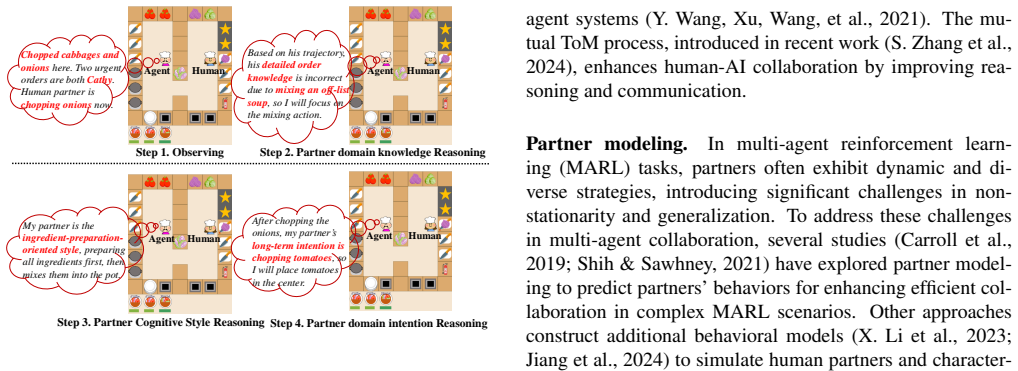
The key machinery is the multi-scale ToM module, a three-stage LLM-based slow system: ToM_knowledge reasons about the partner's ingredient, order, and tool knowledge; ToM_style classifies the partner's cognitive style along dimensions such as field-dependent versus field-independent and stable versus random strategies; ToM_intention predicts the partner's short-term atomic actions and long-term macro-actions. Each stage is driven by a hand-authored corpus of mental characteristics and by the previous stage's prediction, and the resulting mental-state estimates kt, yt, and nt are injected into the fast system's prompt to shape action selection.
What would settle it
Have a human partner deliberately switch between style categories every few actions, or use behaviors not in the corpus, and compare DPMT to HLAgent on all three maps. If DPMT no longer scores higher, the claim that multi-scale ToM generalizes to unseen partners is refuted; if it still wins, the taxonomy assumption is not the source of the benefit.
Extended reading notes
Core claim
The central claim is that the hierarchical ordering of three mental characteristics—domain knowledge, cognitive style, and domain intention—is what makes partner modeling effective for real-time human-AI collaboration. The slow system's three ToM stages each consume a different cue built from the language state and the partner's trajectory, and their outputs are passed to the fast system as text. The fast system then computes token probabilities over a predefined macro-action set and selects the action with the highest probability. The paper attributes the score improvements and the sharp ablation drops to this insertion of multi-scale ToM reasoning into the decision loop.
Load-bearing premise
The load-bearing premise is that the hand-authored taxonomy of partner knowledge, cognitive styles, and intentions covers the behaviors of real human partners, so that any partner behavior outside those categories is invisible to the slow system and the claimed adaptation cannot happen.
Editorial extensions
If this is right
- DPMT should outperform an LLM agent that plans directly from environment state when interacting with partners whose behavior varies, because its intention predictions reduce redundant and blocking actions.
- On maps with narrow passages or high congestion, the style-reasoning stage contributes the most; on maps with dense orders, the intention stage is the most load-bearing.
- The fast system can run on a smaller, cheaper LLM without losing the collaboration benefit, as long as the slow system supplies accurate mental-state predictions.
- Removing the multi-scale ToM module drops average scores to 44, 23, and 9, so the reasoning module rather than the base LLM alone drives the reported improvement.
- The framework improves subjective judgments of game ability, collaboration fluidity, and perceived theory-of-mind ability compared with the HLAgent baseline.
Reading between the lines
- A testable extension the paper does not report is a latency-staleness experiment: refresh the slow system's reasoning only every N macro-actions and measure how much scores degrade as N grows, which would quantify how real-time the slow system must be.
- A stronger generalization test would replace the hand-authored style corpus with a learned clustering of human trajectories; if the intention stage still helps, then the ToM mechanism rather than the specific taxonomy is the active ingredient.
- The same three-stage mental-characteristic prompt could transfer to other real-time collaboration domains, such as shared warehouse robots or surgical teams, but the current corpora are Overcooked-specific, so transfer would require building new corpora for each domain.
Editorial analysis
A structured set of objections, weighed in public.
Referee Report
Summary. The paper proposes DPMT, a dual-process framework for real-time human-AI collaboration in Overcooked. A fast small-LLM system selects macro-actions, while a slow LLM-based theory-of-mind module reasons about a human partner's domain knowledge, cognitive style, and domain intentions using hand-authored corpora. The authors report experiments with fixed-strategy confederates and with 30 diverse human participants, plus ablations, and claim that DPMT significantly improves collaboration scores and subjective ratings over HLAgent and over a version without the multi-scale ToM module.
Significance. If the empirical claims were properly supported, the paper would make a useful contribution: it applies dual-process theory in a concrete way to LLM agents, separates fast action selection from slower partner modeling, and evaluates with real human partners in a recognized benchmark, which is relatively rare in the LLM-agent literature. The reported effect sizes on Bottleneck are large, and the ablation pattern is qualitatively sensible. However, the manuscript currently does not provide the statistical evidence needed for the 'significantly enhances' claim, and the dependence on undocumented hand-authored corpora makes the mechanism hard to evaluate. The significance is therefore conditional on a substantial revision of the experimental reporting.
major comments (4)
- [Human Experiment 1, Table 1] The abstract's claim that DPMT 'significantly enhances' collaboration is not supported by the statistics reported in Table 1. The table gives means and standard deviations for five runs per map but no inferential tests, no information about whether the runs are paired or independent, and no statement about how many distinct human partners produced them. Recomputing Welch t-tests from the reported summary statistics gives p≈0.17 for Ring (121±13.56 vs 99±18.81), p≈0.03 for Bottleneck (101±13.56 vs 60±20.74), and p≈0.26 for Quick (104±16.73 vs 87±16.00); after adjusting for three comparisons, none is clearly significant. The authors should either add appropriate inferential statistics with a pre-specified multiple-comparison procedure and enough runs for power, or soften the language from 'significantly' to a descriptive claim.
- [Human Experiment 2, Figure 8 and Table 2] The claim that DPMT adapts to diverse unseen human partners rests on Experiment 2, but the objective-score evidence appears only as a bar chart in Figure 8 with no numeric means, standard deviations, sample sizes per condition, or statistical tests, and Table 2 reports only 5-point Likert averages with no tests. Given the within-subject design with 30 participants, paired tests or mixed models should be reported for both objective scores and questionnaire responses; without them the reader cannot tell whether the visible differences are larger than participant noise.
- [Slow System (ToMknowledge, ToMstyle, ToMintention)] The core mechanism relies on hand-authored 'customized' corpora and a three-category taxonomy (domain knowledge, cognitive style, domain intention; field-dependent/independent; ingredient-preparation-oriented stable/random), but the manuscript gives no details on how these corpora were constructed, how categories were chosen, or how they were validated. Because the authors define the taxonomy and the corpora that are then used to evaluate the method, there is a circularity risk: the apparent adaptation may reflect that the test partners' behaviors were selected to fit the taxonomy. To make the central claim convincing, the authors should release the corpora and prompts, describe their construction and coverage, and provide at least one validation of the taxonomy, such as inter-rater agreement on style labels or a robustness check across taxonomy variants.
- [Experiments, Baselines] No comparison is made with a prior ToM-based LLM agent, such as the mutual-ToM method of S. Zhang et al. (2024), or with a communication-enabled LLM agent, even though the introduction positions the work against these approaches. The w/o MsToM ablation shows that the slow system contributes within DPMT, but it does not show that the specific multi-scale mental-characteristic decomposition is better than a simpler single-stage ToM prompt or a prior ToM method. Adding such a baseline would make the contribution claim in the abstract more specific and would strengthen the paper's novelty argument.
minor comments (6)
- [Figure 1] The caption contains the typo 'disicion-making' and should read 'decision-making'.
- [Figure 3] The figure caption includes an untranslated Chinese sentence ('心智模型建模智能体的心智特性—参考公共物品博弈任务中的心理变量'); all text in the paper should be in English.
- [Human Experiment 2, Experiment Setup] The text says each participant collaborated with 'the DPMT and three baseline agents (A-D)', but four labels A-D are listed; the mapping from labels to specific agents should be stated explicitly.
- [Figure 8] The bar chart lacks axis labels, error bars, and a statement of the score range; adding these would make the objective results interpretable.
- [Human Experiments, General] The paper does not state whether the human experiments were approved by an ethics board or describe participant recruitment and exclusion criteria; such a statement is expected for studies with 30 human participants.
- [Reproducibility] There is no code, prompt, or corpus availability statement. Given that the method's behavior is determined largely by the custom prompts and corpora, releasing these artifacts or describing them in an appendix is important for reproducibility.
Circularity Check
No significant circularity: DPMT is evaluated against external Overcooked rewards and human ratings, and the cited prior work is not load-bearing.
full rationale
The paper's central claim is empirical: DPMT improves human-AI collaboration scores in Overcooked and receives higher subjective human ratings. There are no equations, fitted parameters, or first-principles predictions that reduce to the method's own inputs. The slow system's ToM stages use hand-authored corpora (domain knowledge, partner style, intention cases), but these are part of the method being tested, not outputs derived from the evaluation data. The main results compare DPMT against HLAgent and ablated versions on an external game reward, and the human experiment uses independent participants with Likert-scale judgments. The only self-citation (X. Li et al., 2023, by the present first and last authors) appears in related-work discussion of partner modeling and does not support any uniqueness claim or centrality. No ablation result is presented as a prediction derived from the framework's definitions; it is an empirical comparison. Therefore no step in the claimed derivation chain is circular by construction.
Assumptions & free parameters
assumptions (5)
- domain assumption Dual process theory, with a fast intuitive system and a slow deliberative system, is an appropriate decomposition for real-time agent decision-making.
- ad hoc to paper The three-level mental-characteristic hierarchy (domain knowledge, cognitive style, domain intention) is a sufficient and correct model of human partner behavior in Overcooked.
- domain assumption LLMs (GPT-4o, Qwen-72B) can accurately infer partner knowledge, style, and intentions from a textualized environment state and trajectory.
- domain assumption Token-probability ranking of macro-action strings is a valid action-selection policy for the fast system.
- domain assumption The 30-participant within-subject study and 5 repeated fixed-strategy runs are representative enough to support generalization claims.
invented entities (1)
-
Overcooked-specific partner style taxonomy (field-dependent/independent; ingredient-preparation-oriented stable/random)
Cite this review
Pith. "Pith review of DPMT: Dual Process Multi-scale Theory of Mind Framework for Real-time Human-AI Collaboration." pith.science (2026). https://pith.science/paper/KIIR4L2P
@misc{pith2026250714088,
  author       = {Pith},
  title        = {Pith review of: DPMT: Dual Process Multi-scale Theory of Mind Framework for Real-time Human-AI Collaboration},
  year         = {2026},
  howpublished = {\url{https://pith.science/paper/KIIR4L2P}},
  note         = {Machine review of arXiv:2507.14088}
}
read the original abstract
Real-time human-artificial intelligence (AI) collaboration is crucial yet challenging, especially when AI agents must adapt to diverse and unseen human behaviors in dynamic scenarios. Existing large language model (LLM) agents often fail to accurately model the complex human mental characteristics such as domain intentions, especially in the absence of direct communication. To address this limitation, we propose a novel dual process multi-scale theory of mind (DPMT) framework, drawing inspiration from cognitive science dual process theory. Our DPMT framework incorporates a multi-scale theory of mind (ToM) module to facilitate robust human partner modeling through mental characteristic reasoning. Experimental results demonstrate that DPMT significantly enhances human-AI collaboration, and ablation studies further validate the contributions of our multi-scale ToM in the slow system.
Figures


Figures from the paper (5 more)


Reference graph
Works this paper leans on
-
[1]
write newline
" write newline " cite write " FUNCTION editor.postfix editor num.names #1 > "( )" "( )" if FUNCTION editor.trans.postfix editor num.names #1 > "( )" "( )" if FUNCTION trans.postfix translator num.names #1 > "( )" "( )" if FUNCTION authors.editors.reflist.apa5 'field := 'dot := field num.names 'numnames := numnames 'format.num.names := format.num.names na...
-
[2]
achiam2023gpt APACrefauthors Achiam, J. , Adler, S. , Agarwal, S. , Ahmad, L. , Akkaya, I. , Aleman, F L. others APACrefauthors \ 2023 . Gpt-4 technical report Gpt-4 technical report . arXiv preprint arXiv:2303.08774
arXiv 2023
-
[3]
astington1995theory APACrefauthors Astington, J W. \ Jenkins, J M. APACrefauthors \ 1995 . Theory of mind development and social understanding Theory of mind development and social understanding . Cognition & Emotion 9 2-3 151--165
work page 1995
-
[4]
bostan2009player APACrefauthors Bostan, B. APACrefauthors \ 2009 . Player motivations: A psychological perspective Player motivations: A psychological perspective . Computers in Entertainment (CIE) 7 2 1--26
work page 2009
-
[5]
brohan2023can APACrefauthors Brohan, A. , Chebotar, Y. , Finn, C. , Hausman, K. , Herzog, A. , Ho, D. others APACrefauthors \ 2023 . Do as i can, not as i say: Grounding language in robotic affordances Do as i can, not as i say: Grounding language in robotic affordances . Conference on robot learning Conference on robot learning \ ( \ 287--318)
work page 2023
-
[6]
carroll2019utility APACrefauthors Carroll, M. , Shah, R. , Ho, M K. , Griffiths, T. , Seshia, S. , Abbeel, P. \ Dragan, A. APACrefauthors \ 2019 . On the utility of learning about humans for human-ai coordination On the utility of learning about humans for human-ai coordination . Advances in neural information processing systems 32
work page 2019
-
[7]
chen2021evaluating APACrefauthors Chen, M. , Tworek, J. , Jun, H. , Yuan, Q. , Pinto, H P d O. , Kaplan, J. others APACrefauthors \ 2021 . Evaluating large language models trained on code Evaluating large language models trained on code . arXiv preprint arXiv:2107.03374
arXiv 2021
-
[8]
deng2024mind2web APACrefauthors Deng, X. , Gu, Y. , Zheng, B. , Chen, S. , Stevens, S. , Wang, B. Su, Y. APACrefauthors \ 2024 . Mind2web: Towards a generalist agent for the web Mind2web: Towards a generalist agent for the web . Advances in Neural Information Processing Systems 36
work page 2024
Show all 33 references
-
[9]
, Gong, R
gao2020joint APACrefauthors Gao, X. , Gong, R. , Zhao, Y. , Wang, S. , Shu, T. \ Zhu, S C. APACrefauthors \ 2020 . Joint mind modeling for explanation generation in complex human-robot collaborative tasks Joint mind modeling for explanation generation in complex human-robot co...
2020
-
[10]
APACrefauthors \ 2016
ghosttown2016overcooked APACrefauthors Ghost Town Games . APACrefauthors \ 2016 . Overcooked. Overcooked
2016
-
[11]
APACrefauthors \ 2019
hauser2019social APACrefauthors Hauser, O P. APACrefauthors \ 2019 . Social dilemmas among unequals Social dilemmas among unequals . Nature 572 7770 524--527
2019
-
[12]
, Yao, W
he2024webvoyager APACrefauthors He, H. , Yao, W. , Ma, K. , Yu, W. , Dai, Y. , Zhang, H. Yu, D. APACrefauthors \ 2024 . WebVoyager: Building an End-to-End Web Agent with Large Multimodal Models Webvoyager: Building an end-to-end web agent with large multimodal models . arXiv p...
2024 arXiv
-
[13]
APACrefauthors \ 2019
hoffman2019evaluating APACrefauthors Hoffman, G. APACrefauthors \ 2019 . Evaluating fluency in human--robot collaboration Evaluating fluency in human--robot collaboration . IEEE Transactions on Human-Machine Systems 49 3 209--218
2019
-
[14]
, Liu, Q
jiang2024learning APACrefauthors Jiang, Y. , Liu, Q. , Ma, X. , Li, C. , Yang, Y. , Yang, J. Zhao, Q. APACrefauthors \ 2024 . Learning Diverse Risk Preferences in Population-Based Self-Play Learning diverse risk preferences in population-based self-play . Proceedings of the AA...
2024
-
[15]
, Allal, L B
li2023starcoder APACrefauthors Li, R. , Allal, L B. , Zi, Y. , Muennighoff, N. , Kocetkov, D. , Mou, C. others APACrefauthors \ 2023 . Starcoder: may the source be with you! Starcoder: may the source be with you! arXiv preprint arXiv:2305.06161
2023 arXiv
-
[16]
li17mixture APACrefauthors Li, X. , Ni, Z. , Ruan, J. , Meng, L. , Shi, J. , Zhang, T. \ Xu, B. APACrefauthors \ 2023 . Mixture of personality improved Spiking actor network for efficient multi-agent cooperation Mixture of personality improved spiking actor network for efficie...
2023
-
[17]
liu2023llm APACrefauthors Liu, J. , Yu, C. , Gao, J. , Xie, Y. , Liao, Q. , Wu, Y. \ Wang, Y. APACrefauthors \ 2023 . Llm-powered hierarchical language agent for real-time human-ai coordination Llm-powered hierarchical language agent for real-time human-ai coordination . arXiv...
2023 arXiv
-
[18]
, Mowry, R
lizardo2016dual APACrefauthors Lizardo, O. , Mowry, R. , Sepulvado, B. , Stoltz, D S. , Taylor, M A. , Van Ness, J. \ Wood, M. APACrefauthors \ 2016 . What are dual process models? Implications for cultural analysis in sociology What are dual process models? implications for c...
2016
-
[19]
, Shu, T
puigwatch APACrefauthors Puig, X. , Shu, T. , Li, S. , Wang, Z. , Liao, Y H. , Tenenbaum, J B. Torralba, A. APACrefauthors \ 2020 . Watch-And-Help: A Challenge for Social Perception and Human-AI Collaboration Watch-and-help: A challenge for social perception and human-ai colla...
2020
-
[20]
, Perbet, F
rabinowitz2018machine APACrefauthors Rabinowitz, N. , Perbet, F. , Song, F. , Zhang, C. , Eslami, S A. \ Botvinick, M. APACrefauthors \ 2018 . Machine theory of mind Machine theory of mind . International conference on machine learning International conference on machine learn...
2018
-
[21]
APACrefauthors \ 2008
santos2008social APACrefauthors Santos, F C. APACrefauthors \ 2008 . Social diversity promotes the emergence of cooperation in public goods games Social diversity promotes the emergence of cooperation in public goods games . Nature 454 7201 213--216
2008
-
[22]
\ Sawhney, A
shih2021critical APACrefauthors Shih, A. \ Sawhney, A. APACrefauthors \ 2021 . On the Critical Role of Conventions in Adaptive Human-AI Collaboration On the critical role of conventions in adaptive human-ai collaboration . International Conference on Representation Learning. I...
2021
-
[23]
, Zhang, W
tantrue APACrefauthors Tan, W. , Zhang, W. , Liu, S. , Zheng, L. , Wang, X. \ An, B. APACrefauthors \ 2024 . True Knowledge Comes from Practice: Aligning Large Language Models with Embodied Environments via Reinforcement Learning True knowledge comes from practice: Aligning la...
2024
-
[24]
APACrefauthors \ 2009
vaisey2009motivation APACrefauthors Vaisey, S. APACrefauthors \ 2009 . Motivation and justification: A dual-process model of culture in action Motivation and justification: A dual-process model of culture in action . American journal of sociology 114 6 1675--1715
2009
-
[25]
, Xie, Y
wang2023voyager APACrefauthors Wang, G. , Xie, Y. , Jiang, Y. , Mandlekar, A. , Xiao, C. , Zhu, Y. Anandkumar, A. APACrefauthors \ 2023 . Voyager: An open-ended embodied agent with large language models Voyager: An open-ended embodied agent with large language models . arXiv p...
2023 arXiv
-
[26]
wang2024mobile APACrefauthors Wang, J. , Xu, H. , Ye, J. , Yan, M. , Shen, W. , Zhang, J. Sang, J. APACrefauthors \ 2024 . Mobile-agent: Autonomous multi-modal mobile device agent with visual perception Mobile-agent: Autonomous multi-modal mobile device agent with visual perce...
2024 arXiv
-
[27]
wang2021tom2c APACrefauthors Wang, Y. , Xu, J. , Wang, Y. \ . APACrefauthors \ 2021 . ToM2C: Target-oriented Multi-agent Communication and Cooperation with Theory of Mind Tom2c: Target-oriented multi-agent communication and cooperation with theory of mind . International Confe...
2021
-
[28]
, Min, S Y
wu2024spring APACrefauthors Wu, Y. , Min, S Y. , Prabhumoye, S. , Bisk, Y. , Salakhutdinov, R R. , Azaria, A. Li, Y. APACrefauthors \ 2024 . Spring: Studying papers and reasoning to play games Spring: Studying papers and reasoning to play games . Advances in Neural Information...
2024
-
[29]
, Yang, K
zhang2024proagent APACrefauthors Zhang, C. , Yang, K. , Hu, S. , Wang, Z. , Li, G. , Sun, Y. others APACrefauthors \ 2024 . ProAgent: building proactive cooperative agents with large language models Proagent: building proactive cooperative agents with large language models . P...
2024
-
[30]
, Yang, Z
zhang2023appagent APACrefauthors Zhang, C. , Yang, Z. , Liu, J. , Han, Y. , Chen, X. , Huang, Z. Yu, G. APACrefauthors \ 2023 . Appagent: Multimodal agents as smartphone users Appagent: Multimodal agents as smartphone users . arXiv preprint arXiv:2312.13771
2023 arXiv
-
[31]
zhang2023building APACrefauthors Zhang, H. , Du, W. , Shan, J. , Zhou, Q. , Du, Y. , Tenenbaum, J B. Gan, C. APACrefauthors \ 2023 . Building cooperative embodied agents modularly with large language models Building cooperative embodied agents modularly with large language mod...
2023 arXiv
-
[32]
, Wang, X
zhang2024mutual APACrefauthors Zhang, S. , Wang, X. , Zhang, W. , Chen, Y. , Gao, L. , Wang, D. Wen, Y. APACrefauthors \ 2024 . Mutual theory of mind in human-ai collaboration: An empirical study with llm-driven ai agents in a real-time shared workspace task Mutual theory of m...
2024 arXiv
-
[33]
\ Smillie, L D
zhao2015role APACrefauthors Zhao, K. \ Smillie, L D. APACrefauthors \ 2015 . The role of interpersonal traits in social decision making: Exploring sources of behavioral heterogeneity in economic games The role of interpersonal traits in social decision making: Exploring source...
2015
Reviewed August 6, 2026 · model on record in the stance chip above.
Discussion (0). Sign in to comment.