REVIEW 4 major objections 5 minor 57 references
Extreme Value Theory-based Distributed Interference Prediction for 6G Industrial Sub-networks
T0 review · 4 major / 5 minor · reviewed 2026-08-06 · deepseek-v4-flash
Pith's one-line read A hybrid extreme-value-theory and conformal predictor gives interference predictions with statistical coverage guarantees, letting 6G industrial sub-networks meet block error rate targets beyond the 95th percentile.
desk verdict Serious engineering with a promising pipeline, but the statistical coverage guarantee is not proven: Eq. (22) is not conformal calibration. read the letter →
The pith
A machine-rendered reading of the paper's core claim, the machinery that carries it, and where it could break.
The reading
What carries the argument
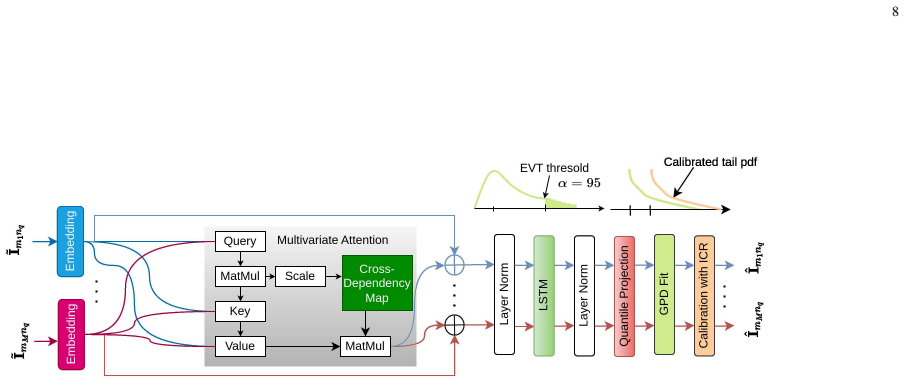
The load-bearing object is the calibrated tail pdf $G^c(\cdot)$ defined in Eq. (22): the generalized Pareto tail estimate from Eq. (20) is shifted by the conformal conformity score $z_{1-\beta}(R, D_{\mathrm{cal}})$ computed from calibration residuals, yielding a prediction interval that inherits the conformal validity property under exchangeability. The iQPTransformer, an inverted transformer whose tokens are per-SA-pair temporal patches augmented with LSTM and quantile projection trained by pinball loss, supplies the dynamic threshold that separates the EVT tail from the body of the interference distribution. To make conformal calibration applicable, the paper restructures the non-stationary interference series into instances using a stationary interval $S_w$ determined by local region of stationarity, separating correlated samples so that calibration and test instances can be treated as exchangeable.
What would settle it
Take a trained model with its calibration set, then evaluate empirical coverage on a test segment recorded under a different traffic intensity, mobility path, or channel condition than the calibration data. If the fraction of test points with $y^* \leq \hat{y}$ falls below $1-\beta$ by a statistically significant margin, the exchangeability assumption is violated and the claimed coverage guarantee collapses. A simpler check is to run a permutation or stationarity test on the restructured calibration and test instances; rejection of exchangeability would falsify the premise on which Property 1 rests.
Extended reading notes
Core claim
The central claim is that the interference tail distribution can be predicted with a finite-sample statistical guarantee by combining three pieces: an inverted quantile patch transformer (iQPTransformer) that forecasts a dynamic $1-\alpha$ quantile threshold from multi-SA-pair interference histories, a generalized Pareto distribution fit to exceedances above that threshold, and inductive conformal regression that calibrates the resulting tail pdf. The calibrated tail pdf $G^c$ is formed by shifting the EVT tail estimate by a conformity score $z_{1-\beta}$ computed from a calibration set, so the $1-\varsigma$ quantile of $G^c$ inherits the conformal coverage property $\mathbb{P}[y^* \leq \hat{y}] \geq 1-\beta$. The paper argues that this is the first framework to give such coverage guarantees for predicted interference tail statistics in sub-network or HRLLC settings, and that it translates directly into risk-aware resource allocation.
Load-bearing premise
The load-bearing premise is that interference observations, once restructured into stationary intervals, become exchangeable with future test data; if future interference is not exchangeable with the calibration set, the stated $1-\beta$ coverage guarantee is not guaranteed to hold.
Editorial extensions
If this is right
- Under the 3GPP InF-DL channel model with two mobility models, both centralized and split iQPTransformer variants achieve block error rates beyond the 95th percentile for targets in the $10^{-5}$ to $10^{-7}$ range.
- The calibrated tail pdf gives average coverage probabilities above 0.997 with normalized coverage widths around 2.6-2.7 dB, outperforming moving-average and Wiener predictors.
- The split-iQPTransformer preserves near-centralized performance, with at most 0.036 degradation in average coverage probability, while distributing computation between SA pairs and the SN controller.
- Scaling from 4 to 16 SA pairs keeps average coverage above 0.997 for the calibrated variants, indicating that the inverted token design retains spatial dependencies as deployments grow.
- The framework allows selective tuning of the quantile threshold $1-\alpha$, the calibration level $1-\beta$, and the EVT quantile $1-\varsigma$, so reliability can be traded against resource usage, roughly 10-20% extra channel usage in the Bernoulli traffic case.
Reading between the lines
- The coverage guarantee is marginal over the exchangeable calibration-test distribution, not a per-time-step conditional guarantee; under abrupt regime changes such as a new traffic intensity or mobility path, the $1-\beta$ bound should be re-verified or the calibration window updated.
- The same calibrated-tail construction could be applied to other network risk metrics, such as outage probability or queue tail latency, whenever a quantile threshold can be predicted and exceedances are heavy-tailed.
- A direct testable extension is to compare against conformal methods designed for dependent time series on the same 3GPP interference traces; if those achieve similar coverage with narrower widths, the stationary-interval restructuring may be conservative.
- Two stated caveats sit outside the central claim: the footnote in Section VI leaves joint optimization of dynamic constraints for future work, and the conclusion defers validation to a real-time setup.
Editorial analysis
A structured set of objections, weighed in public.
Referee Report
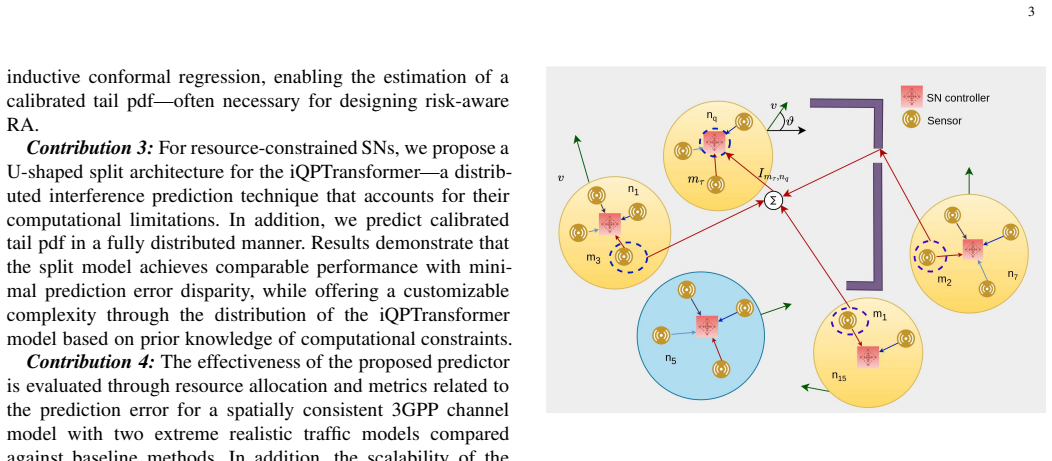
Summary. This manuscript proposes a hybrid interference prediction framework for 6G industrial sub-networks: an "inverted quantile patch transformer" with LSTM predicts a high quantile threshold; exceedances above the threshold are modeled with a generalized Pareto distribution (GPD); inductive conformal regression is used to "calibrate" the tail CDF; and the 1-ς quantile of the calibrated tail is fed into finite-blocklength resource allocation. A U-shaped split version distributes the model between SA pairs and the SN controller. The experiments, conducted under two mobility models and two traffic models with a spatially consistent 3GPP channel model, report coverage probabilities around 0.998 and BLER targets achieved beyond the 95th percentile, with modest degradation for the split variant.
Significance. The system-level contribution is potentially useful: the paper addresses an important problem, evaluates on realistic 3GPP-based scenarios, and identifies real limitations of Gaussian or fixed-width prediction approaches. The extensive simulation campaign and the split-learning architecture for resource-constrained sub-networks are noteworthy strengths. However, the central theoretical claim—statistical coverage guarantees for predicted tail quantiles—is not established by the manuscript as written. The construction in Eq. (22) is not a valid calibrated distribution, the exchangeability assumption is asserted rather than proven, and the reported numerical "coverage probability" metric does not measure the conformal coverage stated in Property 1. These are load-bearing issues for the claimed novelty.
major comments (4)
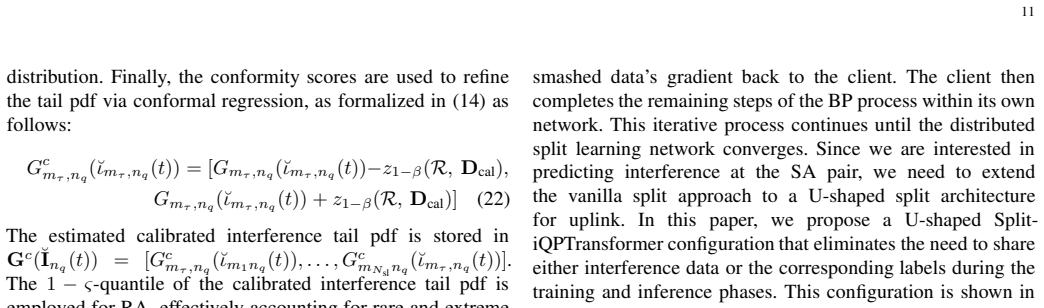
- [Section V-B, Eq. (22)] The calibrated tail object G^c = [G − z, G + z] cannot serve as a "calibrated tail pdf." Here G is a GPD CDF (a probability), while z_{1−β}(R, D_cal) is a residual conformity score with units of interference power; subtracting the score from the CDF does not produce a function confined to [0,1], nor a monotone CDF, nor a distribution whose inverse has any stated coverage property. Property 1, Eq. (13), is a coverage guarantee for a prediction region for the response y(t+1), not for the inverse of a shifted CDF at level 1−ς. The manuscript never connects Eq. (13) to Eq. (22) or to the quantile used in Eq. (5). Therefore the abstract's claim of "statistical coverage guarantees" is not derived from the conformal result that the paper invokes.
- [Section IV-A, Assumption 1 and Eqs. (6)-(7)] Exchangeability of calibration and test instances is asserted rather than established. The LRS stationary interval Sw only enforces a threshold on Pearson correlation between consecutive interference values; it does not imply that sliding-window instances constructed from a non-stationary, mobility-driven process are exchangeable. Moreover, the calibration and test sets are temporal splits, so future test instances are not automatically exchangeable with past calibration instances under the described mobility and traffic dynamics. Since Property 1 explicitly conditions on exchangeability, the claimed finite-sample 1−β guarantee is conditional on an assumption that is neither proven nor empirically checked.
- [Section VII-B, Eqs. (29)-(30)] The numerical validation does not measure the conformal coverage stated in the paper. Eq. (29) defines coverage as P(actual interference ≤ predicted interference), i.e., the fraction of one-sided pointwise exceedances, and Eq. (30) defines "coverage width" as mean absolute prediction error. These are not the conformal interval coverage P(y ∈ [μ−z, μ+z]) from Eq. (14). Consequently, the coverage probabilities reported in Tables II–IV (e.g., 0.998) cannot be used to validate the claimed 1−β conformal guarantee, even if Eq. (22) were corrected.
- [Section V-B, Eq. (20) and Algorithm 2] The GPD is fitted to exceedances over a threshold predicted by the iQPTransformer, and the conformity scores in Algorithm 1 are computed from residuals of the same model on the calibration set. The resulting "calibrated tail pdf" is therefore a shifted fitted tail, not an independent conformal object; the statement in Section IV-B that Eq. (14) yields fixed-width intervals does not bridge this gap, because a fixed-width interval for a point prediction is not a confidence band or coverage guarantee for the tail CDF. If conformalized quantile regression is intended, it should be applied directly to the quantile of interest and the guarantee tied to that object.
minor comments (5)
- [Section II-B] The notation "Poss(0, λ)" should be "Poisson(λ)" (or "Pois(λ)"); the parameter 0 appears to be extraneous.
- [Section II-C] The sentence "the estimated interference power values for for all Mnq SA pairs" contains a duplicated "for."
- [Eq. (9)] The last three rows of the test label vector all read \tilde I_{m1,nq}(Sw+j); they should presumably be indexed by m2, ..., mM to match the structure of Eq. (8).
- [Section VII-C / Table I] Table I lists |M| as {4, 8, 12, 16}, whereas the push-pull experiment in Section VII-D uses M = 6 SA pairs; please reconcile or clarify the configuration.
- [Algorithm 2, line 20] The instruction "Fit GPD G(ψ) from (20)" is ambiguous because G is defined as the GPD CDF in Eq. (20), not the sample of exceedances; please distinguish the exceedance sample from the fitted CDF.
Circularity Check
No significant circularity: the prediction pipeline is a composition of externally established methods, and no claimed prediction is defined by the quantity it is supposed to derive.
full rationale
The paper's derivation chain is not circular in the sense prohibited here. The iQPTransformer produces a quantile-regression threshold from historical interference windows; the GPD tail parameters are fitted by maximum likelihood to training exceedances; and the conformal score is the 1-β quantile of calibration residuals. These are three distinct fitted components, none of which is defined in terms of the final predicted interference or the claimed 1-β coverage. The coverage claim is imported from the standard finite-sample conformal prediction literature, not from a self-citation, and the heavy-tailed interference premise is supported by an external experimental citation in addition to the authors' prior work. Self-citations to [7], [17], [18], and [22] provide modeling context, hyperparameter heuristics, and prior EVT framing, but they are not the load-bearing justification for the central result: the conformal validity property is attributed to the external literature [41]-[44], and the empirical evaluation is conducted against independent baselines on a 3GPP channel model. The most serious concern is a correctness gap rather than a circularity: Eq. (22) produces an interval [G-z, G+z] and calls it a calibrated tail pdf, yet an interval of CDF values is not itself a CDF, and the paper does not explicitly prove that the 1-ς quantile of that interval inherits the 1-β coverage guarantee. That is an invalid or incomplete derivation, not a reduction of the output to the input by construction. Accordingly, no specific circular step can be exhibited, and the appropriate circularity score is 0, with the validity gap noted separately as a correctness risk.
Assumptions & free parameters
free parameters (6)
- Quantile level 1-α =
0.95
- Conformal confidence 1-β =
0.95
- EVT operating quantile 1-ς =
0.5
- GPD shape parameter ξ =
not reported
- GPD scale parameter σ =
not reported
- Stationary interval correlation threshold φc =
not specified
assumptions (5)
- domain assumption Interference data are exchangeable within restructured stationary intervals (Assumption 1)
- domain assumption Interference exceedances above threshold follow a Generalized Pareto Distribution (Pickands-Balkema-de Haan)
- standard math Finite-blocklength capacity formula from Polyanskiy et al. [34]
- domain assumption 3GPP InF-DL channel model with spatial consistency
- standard math Conformal prediction validity under exchangeability (Property 1)
Cite this review
Pith. "Pith review of Extreme Value Theory-based Distributed Interference Prediction for 6G Industrial Sub-networks." pith.science (2026). https://pith.science/paper/TPEKACLB
@misc{pith2026250714155,
  author       = {Pith},
  title        = {Pith review of: Extreme Value Theory-based Distributed Interference Prediction for 6G Industrial Sub-networks},
  year         = {2026},
  howpublished = {\url{https://pith.science/paper/TPEKACLB}},
  note         = {Machine review of arXiv:2507.14155}
}
read the original abstract
Interference prediction that accounts for extreme and rare events remains a key challenge for ultra-densely deployed sub-networks (SNs) requiring hyper-reliable low-latency communication (HRLLC), particularly under dynamic mobility, rapidly varying channel statistics, and sporadic traffic. This paper proposes a novel calibrated interference tail prediction framework, a hybrid statistical and machine learning (ML) approach that integrates an inverted quantile patch transformer (iQPTransformer) within extreme value theory (EVT). It captures interference dynamics and tail behavior while quantifying uncertainty to provide statistical coverage guarantees. Its effectiveness is demonstrated by leveraging the estimated interference tail distribution to design predictive, risk-aware resource allocation. In resource-constrained SN scenarios, we introduce the split-iQPTransformer, enabling collaborative training by distributing neural network components between sensor-actuator (SA) pairs and the SN controller, while maintaining minimal performance disparity compared to the centralized iQPTransformer. The framework effectively handles deep fading, random traffic, and time-division duplexing (TDD) misalignments and is resilient to rare and extreme interference events. Extensive evaluations are performed under two mobility models and two realistic SN traffic patterns, using a spatially consistent 3GPP channel model across all scenarios. Experimental results show consistent achievement of block error rate (BLER) targets beyond the 95th percentile in the hyper-reliable regime, significantly outperforming baseline approaches.
Figures

Figures from the paper (7 more)



Reference graph
Works this paper leans on
-
[1]
A Secure and Resilient 6G Architecture Vision of the German Flagship Project 6G-ANNA,
M. Hoffmann, G. Kunzmann, T. Dudda, R. Irmer, A. Jukan, G. Macher, A. Ahmad, F. R. Beenen, A. Bröring, F. Fellhauer et al. , “A Secure and Resilient 6G Architecture Vision of the German Flagship Project 6G-ANNA,” IEEE Access , vol. 11, pp. 102 643–102 660, 2023
work page 2023
-
[2]
Framework and overall objectives of the future d evelopment of IMT for 2030 and beyond,
ITU-R, “Framework and overall objectives of the future d evelopment of IMT for 2030 and beyond,” International Telecommunication Union (ITU) Recommendation (ITU-R) , 2023
work page 2023
-
[3]
Multi-Agent Reinforcement Learning for Dynamic R esource Management in 6G in-X Subnetworks,
X. Du, T. Wang, Q. Feng, C. Y e, T. Tao, L. Wang, Y . Shi, and M. Chen, “Multi-Agent Reinforcement Learning for Dynamic R esource Management in 6G in-X Subnetworks,” IEEE Transactions on Wireless Communications, vol. 22, no. 3, pp. 1900–1914, 2023
work page 1900
-
[4]
Extreme Communication in 6G: Vision and Challenges for ‘in -X’ Subnetworks,
G. Berardinelli, P . Baracca, R. O. Adeogun, S. R. Khosrav irad, F. Schaich, K. Upadhya, D. Li, T. Tao, H. Viswanathan, and P . Mogensen, “Extreme Communication in 6G: Vision and Challenges for ‘in -X’ Subnetworks,” IEEE Open Journal of the Communications Society , vol. 2, pp. 2516–2535, 2021
work page 2021
-
[5]
Towards 6G in-X subnetworks with sub-mill isecond communication cycles and extreme reliability,
R. Adeogun, G. Berardinelli, P . E. Mogensen, I. Rodrigue z, and M. Razzaghpour, “Towards 6G in-X subnetworks with sub-mill isecond communication cycles and extreme reliability,” IEEE Access , vol. 8, pp. 110 172–110 188, 2020
work page 2020
-
[6]
Interference prediction in wireless networks: Stochastic geometry meet s recursive filtering,
J. F. Schmidt, U. Schilcher, M. K. Atiq, and C. Bettstette r, “Interference prediction in wireless networks: Stochastic geometry meet s recursive filtering,” IEEE Transactions on V ehicular Technology , vol. 70, no. 3, pp. 2783–2793, 2021
work page 2021
-
[7]
Probabilisti c Interference Prediction for Dynamic 6G In-X Sub-Networks,
P . Gautam, C. Bockelmann, and A. Dekorsy, “Probabilisti c Interference Prediction for Dynamic 6G In-X Sub-Networks,” IEEE Open Journal of the Communications Society , vol. 6, pp. 2454–2473, 2025
work page 2025
-
[8]
Ex- perimental evidence for heavy tailed interference in the Io T,
L. Clavier, T. Pedersen, I. Larrad, M. Lauridsen, and M. E gan, “Ex- perimental evidence for heavy tailed interference in the Io T,” IEEE Communications Letters , vol. 25, no. 3, pp. 692–695, 2020
work page 2020
Show all 57 references
-
[9]
A Nonlinear Autoregressive Neural Network for Interference Prediction and Resource Allocation in URLLC Scenarios,
C. Padilla, R. Hashemi, N. H. Mahmood, and M. Latva-Aho, “ A Nonlinear Autoregressive Neural Network for Interference Prediction and Resource Allocation in URLLC Scenarios,” in 2021 International Conference on Information and Communication Technology Co nver- gence (ICTC) , 20...
2021
-
[10]
Predictive resource allocation for URLLC us ing em- pirical mode decomposition,
C. Jayawardhana, T. Sivalingam, N. H. Mahmood, N. Rajat heva, and M. Latva-Aho, “Predictive resource allocation for URLLC us ing em- pirical mode decomposition,” in 2023 Joint European Conference on Networks and Communications & 6G Summit (EuCNC/6G Summit) , 2023, pp. 174–179
2023
-
[11]
Decomposition Based Interference Management Framework for Local 6G Netwo rks,
S. Gunarathne, T. Sivalingam, N. H. Mahmood et al. , “Decomposition Based Interference Management Framework for Local 6G Netwo rks,” in 2023 IEEE Globecom W orkshops . IEEE, 2023, pp. 1633–1638
2023
-
[12]
Joint Model and Data-Driven Two-Stage Uplink Interference Predi ction in URLLC Scenarios,
L. Wei, Z. Liu, C. Zhang, L. Zhang, Y . Wang, and Y . Huang, “ Joint Model and Data-Driven Two-Stage Uplink Interference Predi ction in URLLC Scenarios,” in 2024 IEEE Wireless Communications and Net- working Conference (WCNC) . IEEE, 2024, pp. 1–6
2024
-
[13]
A Predictive Interference Management Algorithm for URLLC in Beyond 5G Networks,
N. H. Mahmood, O. A. López, H. Alves, and M. Latva-Aho, “A Predictive Interference Management Algorithm for URLLC in Beyond 5G Networks,” IEEE Communications Letters , vol. 25, no. 3, pp. 995– 999, 2021
2021
-
[14]
Interference prediction for low-complexity link adaptat ion in beyond 5G ultra-reliable low-latency communications,
A. Brighente, J. Mohammadi, P . Baracca, S. Mandelli, an d S. Tomasin, “Interference prediction for low-complexity link adaptat ion in beyond 5G ultra-reliable low-latency communications,” IEEE Transactions on Wireless Communications, vol. 21, no. 10, pp. 8403–8415, 2022
2022
-
[15]
Mathematical Modelling and Prediction of Interference Power in In-robot Subnetworks,
L. Menholt and L. V . Friis, “Mathematical Modelling and Prediction of Interference Power in In-robot Subnetworks,” Master’s t hesis, Math- ematical Engineering-Aalborg University, 2022
2022
-
[16]
Deep learning for probabilistic interference predictions in mmwave netw orks,
M. F. Marzban, W. Nam, T. Luo, A. Kannan, and T. Y oo, “Deep learning for probabilistic interference predictions in mmwave netw orks,” in 2023 IEEE International Conference on Communications W orkshop s (ICC W orkshops). IEEE, 2023, pp. 42–47
2023
-
[17]
Cooperative Interference Estimation Using LSTM-Based Federated Learn ing for In- X Subnetworks,
P . Gautam, M. V akilifard, C. Bockelmann, and A. Dekorsy, “Cooperative Interference Estimation Using LSTM-Based Federated Learn ing for In- X Subnetworks,” in GLOBECOM 2023-2023 IEEE Global Communica- tions Conference, 2023, pp. 1338–1344
2023
-
[18]
Interferenc e Prediction in Unconnected In-X Mobile 6G Subnetworks Using a Data-Driv en Approach,
P . Gautam, C. Bockelmann, and A. Dekorsy, “Interferenc e Prediction in Unconnected In-X Mobile 6G Subnetworks Using a Data-Driv en Approach,” in 2024 IEEE International Conference on Communications W orkshops (ICC W orkshops), 2024, pp. 2046–2052. 18
2024
-
[19]
Ultrareliable and low-latency wireless communication: Tail, risk, and scale,
M. Bennis, M. Debbah, and H. V . Poor, “Ultrareliable and low-latency wireless communication: Tail, risk, and scale,” Proceedings of the IEEE , vol. 106, no. 10, pp. 1834–1853, 2018
2018
-
[20]
Prediction of Rare Channel Conditions using B ayesian Statistics and Extreme V alue Theory,
T. Kallehauge, A. E. Kalør, P . Ramírez-Espinosa, C. Bis cio, and P . Popovski, “Prediction of Rare Channel Conditions using B ayesian Statistics and Extreme V alue Theory,” IEEE Transactions on Communi- cations, pp. 1–1, 2025
2025
-
[21]
Ultra -High Re- liability by Predictive Interference Management Using Ext reme V alue Theory,
F. Salehi, A. Mahmood, S. Coleri, and M. Gidlund, “Ultra -High Re- liability by Predictive Interference Management Using Ext reme V alue Theory,” arXiv preprint arXiv:2501.11704 , 2025
2025 arXiv
-
[22]
Extreme V alu e Theory- based Predictive Interference Management for 6G Subnetwor ks with Transformer,
P . Gautam, C. Bockelmann, and A. Dekorsy, “Extreme V alu e Theory- based Predictive Interference Management for 6G Subnetwor ks with Transformer,” in ICC 2025 - IEEE International Conference on Commu- nications. IEEE, 2025
2025
-
[23]
A 5G Traffic Model for Industrial Use Cases,
5G-ACIA, “A 5G Traffic Model for Industrial Use Cases,” 5 G-ACIA, Germany, White Paper, November 2019, [Online]. Available: https://5g- acia.org/media/2021/04/WP_5G_5G_Traffic_Model_for_Industrial_Use _Cases_22.10.19.pdf
2019
-
[24]
Advanc ed frequency resource allocation for industrial wireless control in 6G s ubnetworks,
D. Li, S. R. Khosravirad, T. Tao, and P . Baracca, “Advanc ed frequency resource allocation for industrial wireless control in 6G s ubnetworks,” in 2023 IEEE Wireless Communications and Networking Conferen ce (WCNC), 2023, pp. 1–6
2023
-
[25]
Enabling URLLC in 5G NR IIoT networ ks: A full-stack end-to-end analysis,
G. Cuozzo, S. Cavallero, F. Pase, M. Giordani, J. Eichin ger, C. Buratti, R. V erdone, and M. Zorzi, “Enabling URLLC in 5G NR IIoT networ ks: A full-stack end-to-end analysis,” in 2022 Joint European Conference on Networks and Communications & 6G Summit (EuCNC/6G Summit ). IEE...
2022
-
[26]
Distribut ed Scheduling in Multiple Access With Bursty Arrivals Under a Maximum Dela y Constraint,
S. Kapoor, S. Sreekumar, and S. R. B. Pillai, “Distribut ed Scheduling in Multiple Access With Bursty Arrivals Under a Maximum Dela y Constraint,” IEEE Transactions on Information Theory , vol. 64, no. 2, pp. 1297–1316, 2018
2018
-
[27]
Service requirements for the 5G system,
3GPP , “Service requirements for the 5G system,” 3rd Generation Part- nership Project (3GPP), Technical Specification (TS) 22.26 1, 2019
2019
-
[28]
Coexistence of Pull and Push Communication in Wireless Access for IoT Devices,
S. Cavallero, F. Saggese, J. Shiraishi, S. R. Pandey, C. Buratti, and P . Popovski, “Coexistence of Pull and Push Communication in Wireless Access for IoT Devices,” in 2024 IEEE 25th International W orkshop on Signal Processing Advances in Wireless Communications ( SPAWC), 202...
2024
-
[29]
Study on communication for automation in vertic al domains (cav),
3GPP , “Study on communication for automation in vertic al domains (cav),” Technical Report, 2018
2018
-
[30]
Novel sum-of-s inusoids simulation models for Rayleigh and Rician fading channels,
C. Xiao, Y . R. Zheng, and N. C. Beaulieu, “Novel sum-of-s inusoids simulation models for Rayleigh and Rician fading channels, ” IEEE Transactions on Wireless Communications , vol. 5, no. 12, pp. 3667– 3679, 2006
2006
-
[31]
5G: Study on channel model for frequencies from 0 .5 to 100 GHz (3GPP TR 38.901 version 16.1.0 release 16),
3GPP , “5G: Study on channel model for frequencies from 0 .5 to 100 GHz (3GPP TR 38.901 version 16.1.0 release 16),” 2020
2020
-
[32]
Effects of correlated sh adowing modeling on performance evaluation of wireless sensor netw orks,
S. Lu, J. May, and R. J. Haines, “Effects of correlated sh adowing modeling on performance evaluation of wireless sensor netw orks,” in 2015 IEEE 82nd V ehicular Technology Conference (VTC2015-F all), 2015, pp. 1–5
2015
-
[33]
Inter- ference data collection with beam information for ml-based interference prediction,
M. F. A. Marzban, W. Nam, T. Luo, T. Y oo, and A. C. Kannan, “ Inter- ference data collection with beam information for ml-based interference prediction,” Mar. 14 2024, US Patent App. 17/932,191
2024
-
[34]
Channel coding rate in the finite blocklength regime,
Y . Polyanskiy, H. V . Poor, and S. V erdú, “Channel coding rate in the finite blocklength regime,” IEEE Transactions on Information Theory , vol. 56, no. 5, pp. 2307–2359, 2010
2010
-
[35]
Improving QoS by predictive channel quality feedback for LTE,
X. Xu, M. Ni, and R. Mathar, “Improving QoS by predictive channel quality feedback for LTE,” in 2013 21st International Conference on Software, Telecommunications and Computer Networks-(S oftCOM 2013), 2013, pp. 1–5
2013
-
[36]
Correlat ion matrix distance, a meaningful measure for evaluation of non-stati onary MIMO channels,
M. Herdin, N. Czink, H. Ozcelik, and E. Bonek, “Correlat ion matrix distance, a meaningful measure for evaluation of non-stati onary MIMO channels,” in 2005 IEEE 61st V ehicular Technology Conference , vol. 1. IEEE, 2005, pp. 136–140
2005
-
[37]
E mpirical channel stationarity in urban environments,
A. Gehring, M. Steinbauer, I. Gaspard, and M. Grigat, “E mpirical channel stationarity in urban environments,” in Proceedings of the European Personal Mobile Communications Conference , 2001
2001
-
[38]
Distances and Riemannian metrics for s pectral density functions,
T. T. Georgiou, “Distances and Riemannian metrics for s pectral density functions,” IEEE Transactions on Signal Processing , vol. 55, no. 8, pp. 3995–4003, 2007
2007
-
[39]
Prob abilistic individual load forecasting using pinball loss guided LSTM ,
Y . Wang, D. Gan, M. Sun, N. Zhang, Z. Lu, and C. Kang, “Prob abilistic individual load forecasting using pinball loss guided LSTM ,” Applied Energy, vol. 235, pp. 10–20, 2019
2019
-
[40]
Conformalized quantile regression,
Y . Romano, E. Patterson, and E. Candes, “Conformalized quantile regression,” Advances in neural information processing systems , vol. 32, 2019
2019
-
[41]
V ovk, A
V . V ovk, A. Gammerman, and G. Shafer, Algorithmic learning in a random world . Springer, 2005, vol. 29
2005
-
[42]
Conformal prediction for time series,
C. Xu and Y . Xie, “Conformal prediction for time series, ” IEEE Transactions on Pattern Analysis and Machine Intelligence , 2023
2023
-
[43]
Conf ormal time- series forecasting,
K. Stankeviciute, A. M Alaa, and M. van der Schaar, “Conf ormal time- series forecasting,” Advances in neural information processing systems , vol. 34, pp. 6216–6228, 2021
2021
-
[44]
A Tutorial on Conformal Predicti on
G. Shafer and V . V ovk, “A Tutorial on Conformal Predicti on.” Journal of Machine Learning Research , vol. 9, no. 3, 2008
2008
-
[45]
Conformal prediction interval est imation and applications to day-ahead and intraday power markets,
C. Kath and F. Ziel, “Conformal prediction interval est imation and applications to day-ahead and intraday power markets,” International Journal of F orecasting, vol. 37, no. 2, pp. 777–799, 2021
2021
-
[46]
Inductive confidence machines for regression,
H. Papadopoulos, K. Proedrou, V . V ovk, and A. Gammerman , “Inductive confidence machines for regression,” in Machine Learning: ECML 2002: 13th European Conference on Machine Learning Helsinki, Fin land, August 19–23, 2002 Proceedings 13 . Springer, 2002, pp. 345–356
2002
-
[47]
Ensemble Co nformalized Quantile Regression for Probabilistic Time Series Forecas ting,
V . Jensen, F. M. Bianchi, and S. N. Anfinsen, “Ensemble Co nformalized Quantile Regression for Probabilistic Time Series Forecas ting,” IEEE Transactions on Neural Networks and Learning Systems , vol. 35, no. 7, pp. 9014–9025, 2024
2024
-
[48]
iTransformer: Inverted Transformers Are Effective for Ti me Series Forecasting,
Y . Liu, T. Hu, H. Zhang, H. Wu, S. Wang, L. Ma, and M. Long, “iTransformer: Inverted Transformers Are Effective for Ti me Series Forecasting,” arXiv preprint arXiv:2310.06625 , 2023
2023 arXiv
-
[49]
A T ime Series is Worth 64 Words: Long-term Forecasting with Transf ormers,
Y . Nie, N. H. Nguyen, P . Sinthong, and J. Kalagnanam, “A T ime Series is Worth 64 Words: Long-term Forecasting with Transf ormers,” in International Conference on Learning Representations , 2023
2023
-
[50]
Attention is All you Need,
A. V aswani, N. Shazeer, N. Parmar, J. Uszkoreit, L. Jone s, A. N. Gomez, L. u. Kaiser, and I. Polosukhin, “Attention is All you Need,” in Advances in Neural Information Processing Systems , vol. 30. Curran Associates, Inc., 2017
2017
-
[51]
R eversible instance normalization for accurate time-series forecast ing against distri- bution shift,
T. Kim, J. Kim, Y . Tae, C. Park, J.-H. Choi, and J. Choo, “R eversible instance normalization for accurate time-series forecast ing against distri- bution shift,” in International Conference on Learning Representations , 2021
2021
-
[52]
N. K. Manaswi, RNN and LSTM . Berkeley, CA: Apress, 2018
2018
-
[53]
Long short-term mem ory based recurrent neural network architectures for large vocabula ry speech recognition,
H. Sak, A. Senior, and F. Beaufays, “Long short-term mem ory based recurrent neural network architectures for large vocabula ry speech recognition,” arXiv preprint arXiv:1402.1128 , 2014
2014 arXiv
-
[54]
Haan and A
L. Haan and A. Ferreira, Extreme value theory: an introduction . Springer, 2006, vol. 3
2006
-
[55]
Efficient parallel split learning over resource-constrai ned wireless edge networks,
Z. Lin, G. Zhu, Y . Deng, X. Chen, Y . Gao, K. Huang, and Y . Fa ng, “Efficient parallel split learning over resource-constrai ned wireless edge networks,” IEEE Transactions on Mobile Computing , vol. 23, no. 10, pp. 9224–9239, 2024
2024
-
[56]
A survey on activation functions and their re lation with xavier and he normal initialization,
L. Datta, “A survey on activation functions and their re lation with xavier and he normal initialization,” arXiv preprint arXiv:2004.06632 , 2020
2004 arXiv
-
[57]
S. M. Kay, Fundamentals of statistical signal processing: estimatio n theory. Prentice-Hall, Inc., 1993
1993
Reviewed August 6, 2026 · model on record in the stance chip above.
Discussion (0). Continue with ORCID to comment.