REVIEW 3 major objections 5 minor 27 references
FAMST: Fast Approximate Minimum Spanning Tree Construction for Large-Scale and High-Dimensional Data
T0 review · 3 major / 5 minor · reviewed 2026-08-06 · deepseek-v4-flash
Pith's one-line read The paper claims FAMST constructs approximate minimum spanning trees in near-linear time with mean relative error 0.44 percent, making exact-scale MST analysis feasible on large high-dimensional datasets.
desk verdict Solid practical approximate-MST paper with strong experiments, but its central O(dn log n) claim rests on an unstated and unverified bound on the number of components. read the letter →
The pith
A machine-rendered reading of the paper's core claim, the machinery that carries it, and where it could break.
The reading
What carries the argument
The load-bearing mechanism is the iterative inter-component edge refinement loop: for every edge $(u,v)$ joining components $C_i$ and $C_j$, it searches the neighbors of $u$ inside $C_i$ and the neighbors of $v$ inside $C_j$, and whenever a neighboring vertex yields a shorter crossing distance it slides the edge endpoint to that vertex. Repeating this until no edge changes turns cheap random bridges between components into shorter, more MST-like bridges, which is what keeps the approximation error low. The sparse ANN graph provides the local neighborhoods, and the randomized component-pair sampling in Algorithm 3 provides the initial bridges; together they avoid all-pairs distance computation.
What would settle it
Build a dataset whose $k$-nearest-neighbor graph breaks into many components, for instance $n$ points arranged into $t \approx n^{3/4}$ well-separated clusters, run FAMST with fixed $k$ and $\lambda$, and measure the wall-clock time spent by the inter-component sampling step. If that time grows like $t^2\lambda$ rather than staying within a near-linear envelope, the simplified $O(dn\log n)$ statement fails on that input.
Extended reading notes
Core claim
On the paper's own terms, the discovery is that a three-phase pipeline can produce near-exact MSTs from a sparse neighborhood graph. Starting from a directed $k$-nearest-neighbor graph, FAMST symmetrizes it, finds its connected components, and for each pair of components randomly samples $\lambda^2$ candidate edges and keeps the $\lambda$ shortest. It then repeatedly examines, for each inter-component edge, the neighbors of both endpoints within their own components and replaces the edge with a shorter crossing edge when such a neighbor exists, until no replacement occurs. The resulting connected sparse graph is handed to Kruskal's algorithm, yielding an approximate MST whose total weight in the reported experiments is typically within 0.44 percent mean relative error, with median error 0.07 percent. The claimed complexity is near-linear in the number of points and dimensions, a qualitative improvement over the $O(n^2)$ cost of exact complete-graph methods.
Load-bearing premise
The claimed $O(dn\log n)$ bound holds only if the number of disconnected components $t$ stays small enough that the $O(t^2\lambda)$ work in the inter-component sampling stays within the near-linear budget, and if the approximate-nearest-neighbor construction finishes in its typical rather than worst-case time.
Editorial extensions
If this is right
- MST-based clustering, outlier detection, and manifold learning become usable on datasets with millions of points and thousands of dimensions, where complete-graph methods previously ran out of time or memory.
- Because the sparse graph has $O(kn)$ edges rather than $O(n^2)$, memory use grows linearly with $n$ and $d$, so MST analysis can run on ordinary workstations.
- Several reported near-zero errors (0.049 percent on MNIST, 0.045 percent on Shuttle) suggest the approximation is often indistinguishable from the exact MST in downstream analyses.
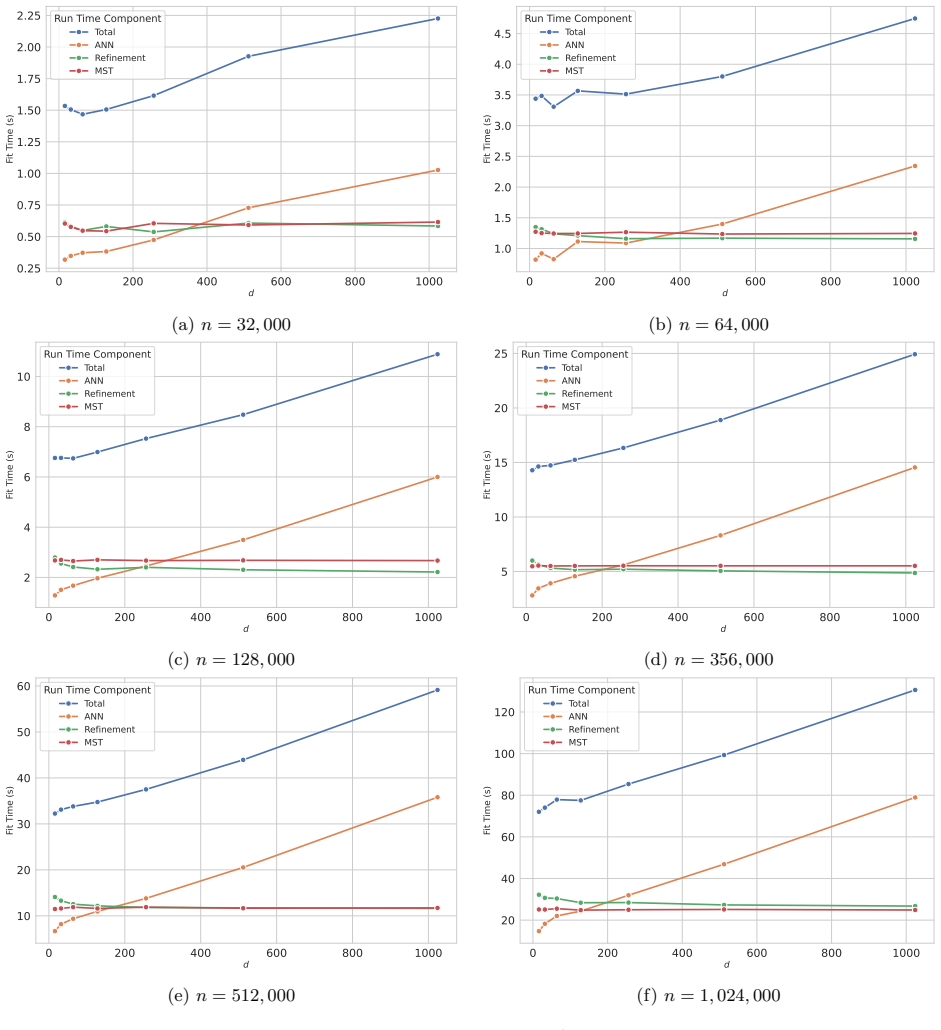
- The experiments support concrete hyperparameter guidance: keep $\lambda \leq k$, choose $k$ around 10 for a balance of accuracy and speed, and expect ANN construction rather than refinement to dominate the runtime.
Reading between the lines
- Because ANN construction dominates measured runtime and FAMST treats that phase as a replaceable module, swapping in faster GPU-accelerated nearest-neighbor search would likely yield an almost proportional end-to-end speedup.
- The refinement loop is generic: any initial sparse graph with disconnected components could be fed through the same endpoint-neighborhood shortening before MST extraction, so the technique may serve as a post-processor for other approximate graph-forest methods.
- A natural next step would be to prove a bound on the number of refinement iterations $r$; the near-linear complexity claim currently treats $r$ and the component count $t$ as small constants observed in practice.
Signed reviews
Editorial analysis
A structured set of objections, weighed in public.
Referee Report
Summary. The paper proposes FAMST, a three-phase approximate MST algorithm: construct a k-ANN graph via PyNNDescent, identify connected components, add λ random edges per component pair, iteratively refine inter-component edges through neighbor-of-neighbor exploration, and finally run Kruskal's algorithm. It claims O(dn log n) time and O(dn + kn) space, and reports experiments on 14 datasets with mean relative error 0.44% and speedups up to roughly 1000× against the exact EMST implementation in mlpack.
Significance. If the complexity claim held, this would be a practically valuable contribution for high-dimensional MST construction, combining an off-the-shelf ANN builder with a lightweight refinement heuristic and validating against an independent exact MST implementation. The empirical evaluation is reasonably careful: it uses mlpack EMST as ground truth, averages over 10 runs, and includes phase-by-phase scaling experiments. However, the complexity analysis undercounts the inter-component edge set by a factor of t, and the headline O(dn log n) is conditional both on the typical-case (not worst-case) behavior of NN-Descent and on unstated assumptions about the number of disconnected components. Until these issues are resolved, the central theoretical claim is not established. No code or reproducibility artifact is provided.
major comments (3)
- [Section 4.1, Algorithm 3] The analysis undercounts the inter-component edge set by a factor of t. Algorithm 3 loops over all O(t²) component pairs and inserts the λ best of λ² sampled edges per pair, so |E| = Θ(t²λ), not Θ(tλ). Consequently, the refinement step processes Θ(t²λ) edges (its cost is O(r t² λ k), not O(r t λ k)), and Kruskal's input has Θ(kn + t²λ) edges (so the final term is O((kn + t²λ) log(kn + t²λ))). With these corrections, the overall time is O(k² d n log n) + O(t² λ² log λ) + O(r t² λ k) + O((kn + t²λ) log(kn + t²λ)), and the simplified O(dn log n) claim requires t = O(√n) for constant k, λ, and r. The paper only states that t ≪ n empirically; that is insufficient (e.g., t = n^{3/4} still satisfies t ≪ n but makes the t²λ term superlinear). Since no theorem or experiment establishes t = O(√n), the central near-linear complexity claim is not proven.
- [Section 4.1, ANN graph construction] The asserted O(dn log n) complexity rests on the 'typical' runtime of NN-Descent/PyNNDescent from [24], which the paper itself notes has no strict worst-case guarantee. The abstract and conclusion present O(dn log n) as an achieved complexity; the authors should either provide a worst-case bound for the chosen ANN construction method or explicitly label the headline complexity as expected/heuristic, stating the additional assumptions on k, t, and r under which it holds.
- [Section 4.2, Space complexity] The space accounting for inter-component edges is inconsistent with the algorithm: Section 4.2 states a total of O(tλ²) inter-component edges, but Algorithm 3 stores λ edges per component pair, i.e., Θ(t²λ) edges. This should be corrected to Θ(t²λ); the term is negligible only under the same t = O(√n) condition needed for the time analysis. As written, both the time and space summaries in the abstract rely on an unstated condition on t.
minor comments (5)
- [Algorithm 3, line 7] The line 'for λ2 times' should read 'for λ² times'; the superscript appears to have been lost in typesetting.
- [Section 1, last paragraph] The roadmap says 'Section 1 reviews related work,' but related work is presented in Section 2; the cross-reference is off by one.
- [Table 1, Birch1 row] The entry in the n column for Birch1 appears malformed ('10 5'); please clarify the intended sample size.
- [Figures 5 and 6, captions] The captions report \bar{t} as the average number of components; please add a note that these averages are over the same 10 random runs used for the error and time metrics, since the random initialization affects both t and the final results.
- [Section 6, hyperparameter guidelines] The recommendation 'keep λ ≤ k' is supported only by the displayed datasets; adding a sentence about the range of n and d for which this guideline is intended would improve its practical utility.
Circularity Check
No significant circularity: evaluation uses an independent exact MST baseline, and the sole self-citation is background rather than load-bearing.
full rationale
The paper's central empirical claims are not circular. The approximation error is measured against the exact MST computed by mlpack's EMST implementation, an external and independent baseline; the reported 0.44% mean relative error is therefore not constructed from FAMST's own parameters or constants. Hyperparameter selection (k and lambda) is an empirical tuning step, not a fitted input that is later renamed a prediction. The only self-citation is reference [16], used to support a background claim that WSPD-based methods become unattractive in high dimensions; this claim is not load-bearing for FAMST's derivation or its experimental validation. The theoretical complexity O(dn log n) is inherited from PyNNDescent's typical-case runtime, cited to an external source [24], and the paper explicitly acknowledges that NN-Descent lacks a strict worst-case guarantee; this is an assumption about an external component, not a circular reduction. One noteworthy weakness is that Section 4.1 undercounts the inter-component edge set as O(t lambda) when Algorithm 3 adds lambda edges for each of the O(t^2) component pairs, making the correct count O(t^2 lambda); the simplified O(dn log n) therefore relies on the empirical assertion t << n. This is a correctness/rigor concern, not a circularity, because the complexity claim is conditional on observed t values rather than being true by construction. Overall, no step in the paper reduces its predictions to its own inputs, so circularity is minimal.
Assumptions & free parameters
free parameters (2)
- k (neighborhood size) =
10 in default experiments
- lambda (inter-component random edges) =
5 in default experiments
assumptions (3)
- domain assumption PyNNDescent/NN-Descent runtime is O(k^2 d n log n) in typical practice
- domain assumption The number of disconnected components t in the ANN graph satisfies t << n
- domain assumption A kNN/ANN graph contains enough MST edges for local refinement to reach near-optimal trees
Cite this review
Pith. "Pith review of FAMST: Fast Approximate Minimum Spanning Tree Construction for Large-Scale and High-Dimensional Data." pith.science (2026). https://pith.science/paper/CPZWJQ7C
@misc{pith2026250714261,
  author       = {Pith},
  title        = {Pith review of: FAMST: Fast Approximate Minimum Spanning Tree Construction for Large-Scale and High-Dimensional Data},
  year         = {2026},
  howpublished = {\url{https://pith.science/paper/CPZWJQ7C}},
  note         = {Machine review of arXiv:2507.14261}
}
abstract
We present Fast Approximate Minimum Spanning Tree (FAMST), a novel algorithm that addresses the computational challenges of constructing Minimum Spanning Trees (MSTs) for large-scale and high-dimensional datasets. FAMST utilizes a three-phase approach: Approximate Nearest Neighbor (ANN) graph construction, ANN inter-component connection, and iterative edge refinement. For a dataset of $n$ points in a $d$-dimensional space, FAMST achieves $\mathcal{O}(dn \log n)$ time complexity and $\mathcal{O}(dn + kn)$ space complexity when $k$ nearest neighbors are considered, which is a significant improvement over the $\mathcal{O}(n^2)$ time and space complexity of traditional methods. Experiments across diverse datasets demonstrate that FAMST achieves remarkably low approximation errors while providing speedups of up to 1000$\times$ compared to exact MST algorithms. We analyze how the key hyperparameters, $k$ (neighborhood size) and $\lambda$ (inter-component edges), affect performance, providing practical guidelines for hyperparameter selection. FAMST enables MST-based analysis on datasets with millions of points and thousands of dimensions, extending the applicability of MST techniques to problem scales previously considered infeasible.
Figures


Figures from the paper (3 more)


Reference graph
Works this paper leans on
-
[16]
Fast and memory-efficient approximate minimum spanning tree generation for large datasets,
M. K. Almansoori, A. Meszaros, and M. Telek, “Fast and memory-efficient approximate minimum spanning tree generation for large datasets,” Arabian Journal for Science and Engineering , vol. 50, no. 2, pp. 1233–1246, 2025
work page 2025
-
[24]
K-Nearest Neighbor Approximation Via the Friend-of-a-Friend Principle
J. D. Baron and R. Darling, “K-nearest neighbor approximation via the friend-of-a-friend principle,” arXiv preprint arXiv:1908.07645 , 2019
work page Pith review arXiv 1908
-
[1]
A comprehensive survey of clustering algorithms,
D. Xu and Y. Tian, “A comprehensive survey of clustering algorithms,” Annals of data science , vol. 2, no. 2, pp. 165–193, 2015
work page 2015
-
[2]
A survey on large datasets minimum spanning trees,
C. Mohapatra and B. B. Ray, “A survey on large datasets minimum spanning trees,” in International Symposium on Artificial Intelligence , pp. 26–35, Springer, 2022
work page 2022
-
[3]
Fast euclidean minimum spanning tree: algorithm, analysis, and applications,
W. B. March, P. Ram, and A. G. Gray, “Fast euclidean minimum spanning tree: algorithm, analysis, and applications,” in Proceedings of the 16th ACM SIGKDD international conference on Knowledge discovery and data mining , pp. 603–612, 2010
work page 2010
-
[4]
Approximate Tree Completion and Learning-Augmented Algorithms for Metric Minimum Spanning Trees
N. Veldt, T. Stanley, B. W. Priest, T. Steil, K. Iwabuchi, T. Jayram, and G. Sanders, “Approximate tree completion and learning-augmented algorithms for metric minimum spanning trees,”arXiv preprint arXiv:2502.12993, 2025
work page Pith review arXiv 2025
-
[5]
New algorithms for efficient high-dimensional nonpara- metric classification.,
T. Liu, A. W. Moore, A. Gray, and C. Cardie, “New algorithms for efficient high-dimensional nonpara- metric classification.,” Journal of machine learning research , vol. 7, no. 6, 2006
work page 2006
-
[6]
Nearest-neighbor search on a time budget via max-margin trees,
P. Ram, D. Lee, and A. G. Gray, “Nearest-neighbor search on a time budget via max-margin trees,” in Proceedings of the 2012 SIAM International Conference on Data Mining , pp. 1011–1022, SIAM, 2012
work page 2012
Show all 27 references
-
[7]
Revisiting kd-tree for nearest neighbor search,
P. Ram and K. Sinha, “Revisiting kd-tree for nearest neighbor search,” in Proceedings of the 25th acm sigkdd international conference on knowledge discovery & data mining , pp. 1378–1388, 2019
2019
-
[8]
Insights into efficient k-nearest neighbor clas- sification with convolutional neural codes,
A.-J. Gallego, J. Calvo-Zaragoza, and J. R. Rico-Juan, “Insights into efficient k-nearest neighbor clas- sification with convolutional neural codes,” IEEE Access, vol. 8, pp. 99312–99326, 2020. 18
2020
-
[9]
A divide-and-conquer approach for minimum spanning tree- based clustering,
X. Wang, X. Wang, and D. M. Wilkes, “A divide-and-conquer approach for minimum spanning tree- based clustering,” IEEE Transactions on Knowledge and Data Engineering , vol. 21, no. 7, pp. 945–958, 2009
2009
-
[10]
A fast minimum spanning tree algorithm based on k-means,
C. Zhong, M. Malinen, D. Miao, and P. Fr¨ anti, “A fast minimum spanning tree algorithm based on k-means,” Information Sciences, vol. 295, pp. 1–17, 2015
2015
-
[11]
Fast approximate minimum spanning tree based clustering algorithm,
R. Jothi, S. K. Mohanty, and A. Ojha, “Fast approximate minimum spanning tree based clustering algorithm,” Neurocomputing, vol. 272, pp. 542–557, 2018
2018
-
[12]
kMiST: A kd-tree based fast minimum spanning tree algorithm,
P. Ghosh and G. Mishra, “kMiST: A kd-tree based fast minimum spanning tree algorithm,” in 2024 15th International Conference on Computing Communication and Networking Technologies (ICCCNT) , pp. 1–7, IEEE, 2024
2024
-
[13]
Fast parallel algorithms for euclidean minimum spanning tree and hierarchical spatial clustering,
Y. Wang, S. Yu, Y. Gu, and J. Shun, “Fast parallel algorithms for euclidean minimum spanning tree and hierarchical spatial clustering,” in Proceedings of the 2021 international conference on management of data , pp. 1982–1995, 2021
2021
-
[14]
A decomposition of multidimensional point sets with applications to k-nearest-neighbors and n-body potential fields,
P. B. Callahan and S. R. Kosaraju, “A decomposition of multidimensional point sets with applications to k-nearest-neighbors and n-body potential fields,” Journal of the ACM (JACM), vol. 42, no. 1, pp. 67–90, 1995
1995
-
[15]
I/o-efficient well-separated pair decom- position and applications,
S. Govindarajan, T. Lukovszki, A. Maheshwari, and N. Zeh, “I/o-efficient well-separated pair decom- position and applications,” Algorithmica, vol. 45, pp. 585–614, 2006
2006
-
[17]
Approximate nearest neighbor algorithm based on navigable small world graphs,
Y. Malkov, A. Ponomarenko, A. Logvinov, and V. Krylov, “Approximate nearest neighbor algorithm based on navigable small world graphs,” Information Systems , vol. 45, pp. 61–68, 2014
2014
-
[18]
Efficient and robust approximate nearest neighbor search using hier- archical navigable small world graphs,
Y. A. Malkov and D. A. Yashunin, “Efficient and robust approximate nearest neighbor search using hier- archical navigable small world graphs,” IEEE transactions on pattern analysis and machine intelligence , vol. 42, no. 4, pp. 824–836, 2018
2018
-
[19]
Fishdbc: Flexible, incremental, scalable, hierarchical density-based clustering for arbi- trary data and distance,
M. Dell’Amico, “Fishdbc: Flexible, incremental, scalable, hierarchical density-based clustering for arbi- trary data and distance,” arXiv preprint arXiv:1910.07283 , 2019
1910 arXiv
-
[20]
Efficient k-nearest neighbor graph construction for generic similarity measures,
W. Dong, C. Moses, and K. Li, “Efficient k-nearest neighbor graph construction for generic similarity measures,” in Proceedings of the 20th international conference on World wide web , pp. 577–586, 2011
2011
-
[21]
Pynndescent: A python nearest neighbor descent for approximate nearest neighbors,
J. H. Leland McInnes, “Pynndescent: A python nearest neighbor descent for approximate nearest neighbors,” 2018
2018
-
[22]
Fast k-nn graph construction by gpu based nn-descent,
H. Wang, W.-L. Zhao, X. Zeng, and J. Yang, “Fast k-nn graph construction by gpu based nn-descent,” in Proceedings of the 30th ACM International Conference on Information & Knowledge Management , pp. 1929–1938, 2021
1929
-
[23]
Mistree: a python package for constructing and analysing minimum spanning trees,
K. Naidoo, “Mistree: a python package for constructing and analysing minimum spanning trees,” Journal of Open Source Software , vol. 4, no. 42, p. 1721, 2019
2019
-
[25]
Deep learning face attributes in the wild,
Z. Liu, P. Luo, X. Wang, and X. Tang, “Deep learning face attributes in the wild,” in Proceedings of the IEEE international conference on computer vision , pp. 3730–3738, 2015
2015
-
[26]
Constructing a high-dimensional k nn-graph using a z-order curve,
S. Sieranoja and P. Fr¨ anti, “Constructing a high-dimensional k nn-graph using a z-order curve,”Journal of Experimental Algorithmics (JEA) , vol. 23, pp. 1–21, 2018. 19
2018
-
[27]
Song: Approximate nearest neighbor search on gpu,
W. Zhao, S. Tan, and P. Li, “Song: Approximate nearest neighbor search on gpu,” in 2020 IEEE 36th International Conference on Data Engineering (ICDE) , pp. 1033–1044, IEEE, 2020. 20
2020
Reviewed August 6, 2026 · model on record in the stance chip above.
Discussion (0). Continue with ORCID to comment.