Pith. sign in

REVIEW 3 major objections 4 minor 63 references

The Rise of Particle Physics

T0 review · 3 major / 4 minor · reviewed 2026-08-06 · deepseek-v4-flash

Pith's one-line read This volume argues that the November 1974 discovery of the narrow 3.1 GeV J/psi was the pivotal event that converted the Standard Model from speculation into consensus.

desk verdict A valuable first-person historical record of the Standard Model's construction, but its central claim about the J/psi as 'final proof' is retrospective interpretation, not established fact. read the letter →

arxiv 2507.14275 v1 pith:72MXMPHU submitted 2025-07-18 hep-ph

classification hep-ph MSC 81V0581V1581T1301A60 PACS 01.65.+g12.15.-y12.38.-t14.40.Pq
keywords J/psidiscoveryNovemberRevolutionStandardModelcharmoniumGIMmechanismasymptoticfreedomelectroweaktheoryhistoryofparticlephysics
verification ladder T0 review T1 audit T2 compute T3 formal

The pith

A machine-rendered reading of the paper's core claim, the machinery that carries it, and where it could break.

The reading

This volume collects first-person accounts of the fifty years since the November 1974 discovery of a narrow 3.1 GeV particle, the J/psi. The editors and contributors argue that this single experimental result was the pivotal event that turned the Standard Model of particle physics from a speculative set of gauge theories into the accepted framework for microscopic physics. Before the discovery, theoretical tools such as the GIM mechanism, asymptotic freedom, and renormalizable electroweak theory existed but were widely ignored; after it, the charm interpretation of the new particle made the whole structure credible. The volume's central claim is that the community's shift was a phase transition, symbolized by the move from many models to one theory.

What carries the argument

The central object is the J/psi meson, a narrow resonance at 3.1 GeV seen independently in hadronic collisions and in electron-positron annihilation. The mechanism that carries the argument is the charmonium interpretation: a bound state of a charmed quark and antiquark ($c\bar{c}$) lying below the threshold for decay into charmed meson pairs, so that it decays through three gluons rather than one, giving a width suppressed by powers of $\alpha_s$ and by the OZI rule. This single object ties together the earlier puzzle of the hadron-to-muon ratio $R$, the GIM prediction of charm, asymptotic freedom, and the anomaly-cancellation condition that made the electroweak theory consistent.

What would settle it

A dated document, such as a lab notebook, proposal approval record, or contemporaneous seminar note, showing that the J/psi was not treated as decisive at the time, or that the community had already accepted the Standard Model before November 1974, would settle the question.

Watch

Extended reading notes

Core claim

The central claim is that the J/psi was not just another resonance. Its extremely narrow width, corresponding to a lifetime roughly ten thousand times longer than typical hadrons, implied a new kind of matter: a bound state of a new quark flavor, later named charmonium. That identification retrospectively confirmed the GIM mechanism's prediction of charm, the anomaly arguments that required complete generations of quarks and leptons, and the running of the strong coupling that makes three-gluon decay slow. The volume contends that this convergence of theory and a single dramatic experimental discovery is why the J/psi, rather than any one theoretical paper, convinced the majority of the community that a radical change of paradigm had occurred.

Load-bearing premise

The volume's narrative rests on the reliability of the participants' first-person recollections and self-reported historical roles, with no archival cross-checking to verify the accounts.

Editorial extensions

If this is right

  • If the volume is right, the Standard Model's acceptance had a definite historical trigger: the November 1974 discovery, not any single theory paper.
  • The recollections imply that theoretical predictions for charm and for narrow vector mesons existed before the discovery but were ignored until experiment forced the issue.
  • It would follow that subsequent milestones, including the tau lepton, the W and Z bosons, the top quark, and the Higgs boson, were confirmations of a fixed framework rather than surprises.
  • The accounts suggest that the current absence of new physics at colliders may reflect a similar situation, where theory already contains ideas that await a decisive experimental signal.

Reading between the lines

Editorial extensions of the paper, not claims the author makes directly.

  • The volume's method, first-person recollection without archival cross-checking, means its strongest claim should be treated as a historical hypothesis that dated documents could test.
  • The citation plot for the 1967 lepton model suggests a quantitative signature of the November Revolution: a sharp inflection in citations to electroweak theory papers around 1974 and 1975.
  • The charmonium diagnostic, narrow width as the signature of a new quark bound state, is still applied to the X, Y, and Z multiquark states discussed in the volume.
  • If the J/psi had lain above the charmed-meson threshold, its width would have been hadronic and the revolution might have been delayed, underscoring how contingent the discovery was.
Share X Bluesky LinkedIn Reddit HN

Editorial analysis

A structured set of objections, weighed in public.

Desk editor's note, referee report, and a circularity audit.

Referee Report

3 major / 4 minor

Summary. This is the inaugural issue of Highlights in High-Energy Physics, containing the proceedings of the conference 'The Rise of Particle Physics' held in Rome in September 2024 on the 50th anniversary of the J/ψ discovery. The fourteen contributions are retrospective accounts by leading physicists—Ting, Georgi, Iliopoulos, Maiani, De Rújula, Di Lella, and others—covering the discovery of the J/ψ at BNL and SLAC, the GIM mechanism and the advent of charm, the development of gauge theories and QCD, the W and Z discoveries at the CERN p̄p collider, subsequent precision physics, and the current status of the field. The editorial preface and Iliopoulos's contribution frame the 1974 discovery as the 'final proof' that converted the community to the Standard Model; other chapters offer a more gradualist account. The volume is presented as a record of the conference talks and includes reproductions of historical documents and data figures.

Significance. The volume's value lies in its collection of first-person retrospective accounts from central protagonists, several of which cross-corroborate key episodes: the J/ψ discovery is independently described by Ting, Maiani, De Rújula, and Iliopoulos, and the GIM/charm story by Maiani and Iliopoulos. It also reproduces original documents (the E598 proposal page in Ting's chapter; data figures from the 1974 PRL papers) and candid assessments of the theoretical confusion of 1974 (Georgi's discussion of the 'nutty' PRL theory papers). If treated as a primary-source archive, the volume is a useful contribution. However, as a historical-causal argument about how and when the community was convinced, the volume's evidence is limited: it relies on retrospective memory, provides no contemporaneous measurement of consensus, and its own chapters contain competing attributions of the decisive step. The volume's archival and evidentiary value is therefore higher than its analytical-historical value.

major comments (3)
  1. [Iliopoulos, Abstract and §5] The abstract asserts that the J/ψ discovery 'was the final proof which convinced the large majority of our community that we were witnessing a radical change of paradigm', and §5 introduces an 'order parameter' for this conversion that is asserted rather than measured. This is a causal claim about community consensus, and the volume does not provide contemporaneous evidence for it (no citation data, surveys, or documented reactions from 1974–1976 are offered). Moreover, other chapters in the same volume assign the pivotal role elsewhere: Georgi (§2) calls 't Hooft's renormalizability proof 'the real birth of the Standard Model', De Rújula (§4) documents that acceptance was slow and resisted through 1976, and Maiani (§5) notes that the decisive evidence for naked charm came only in 1976. Iliopoulos himself disclaims impartiality. The claim should be reframed as a personal retrospective interpretation, or supported by actual evidence of consensus change; as written, it overstates what the volume demonstrates.
  2. [Preface and Editorial] The preface states that the J/ψ discovery 'triggered the November Revolution and solidified the Standard Model', and the editorial repeats that the discovery 'shaped a major milestone in establishing the Standard Model'. Yet the body of the volume presents a more gradual and contested process: De Rújula's chapter is explicitly about the period 'when the Standard Model was ignored', and he reports that as late as 1976 most physicists at a major conference were not convinced; Georgi dates the transformation to the early 1970s. The front matter should be revised to present the November Revolution as one pivotal episode among several, rather than as the single conclusive turning point, to avoid contradicting the volume's own chapters.
  3. [General (all historical chapters)] The volume's historical narrative relies entirely on the participants' retrospective testimony, with no archival cross-checking or footnote apparatus indicating where the written record conflicts. For example, Ting's account of the BNL experiment (§3) and Maiani's reconstruction of the GIM discussions (§3) are unverified by primary documents, and the chapters do not attempt to resolve known discrepancies (such as the relative priority of the Appelquist-Politzer and De Rújula-Glashow pre-discovery charmonium arguments, discussed in both Georgi's and De Rújula's chapters). Given that the volume makes a causal historical claim, the editors should add a prominent methodological note stating that the contributions are personal recollections and that disagreements in the historical record are not adjudicated.
minor comments (4)
  1. [Georgi, Keywords] The keyword 'Standard Mode' should read 'Standard Model'.
  2. [De Rújula, §4] Raw LaTeX/XML fragments (e.g., a <latexit> block and base64-encoded equations) appear in the text and must be rendered as mathematical notation.
  3. [General (citation style)] The citation style is inconsistent across chapters; several references are informal (e.g., De Rújula's 'It is unnecessary to give a GIM reference') and some reference lists are incomplete; the editors should impose a uniform style.
  4. [Ting, §5] The statement 'We have published over 300 papers in Physics Letters' is ambiguous—it should specify whether this includes Physical Review Letters or only Physics Letters B.

Circularity Check

0 steps flagged · score 2.0 of 10

Historical retrospective with self-citations but no circular derivation; the central J/ψ claim rests on testimony, not on a self-referential argument.

full rationale

This document is a conference-proceedings collection of first-person historical recollections, not a paper whose conclusions are derived from equations or fitted parameters. The nearest thing to a central claim is Iliopoulos's abstract assertion that the J/ψ discovery was 'the final proof which convinced the large majority of our community' of a paradigm change. That is a historical and sociological judgment supported by the authors' retrospective testimony and narrative, not a conclusion forced by a derivation whose inputs already contain it. The many self-citations (Ting citing the E598 experiment, Maiani citing GIM, De Rujula citing his charmonium and QCD papers, Di Lella citing UA1/UA2) are the normal texture of personal retrospectives; in each case the cited work is an independent, externally published result, cross-confirmed by other experiments (SLAC, ADONE, later LEP). No fitted parameter is renamed as a prediction, no uniqueness theorem is imported from the authors' prior work, and no ansatz is smuggled in via self-citation. Iliopoulos's 'order parameter' in §5 is asserted rhetorically rather than measured, but it is not used as an input to derive the volume's thesis, so it does not create circularity. Concerns about the reliability of memory-based testimony and the absence of archival consensus evidence are legitimate evidence-quality criticisms, but they are not circularity under the definitions used here. The score of 2 reflects the presence of numerous self-citations that are normal and not load-bearing for any derivational claim.

Assumptions & free parameters 0 free parameters · 2 assumptions · 0 invented entities

The volume introduces no new free parameters, derivations, or postulated entities. Its claims rest on the reliability of personal recollections and on the correctness of previously published results, treated as given.

assumptions (2)
  • domain assumption First-person recollections of the 1970s events are accurate.
    The historical narrative is built on the authors' memories and anecdotes, with no archival cross-verification presented in the volume.
  • domain assumption Previously published results cited in the articles are correctly summarized.
    Several chapters, especially Ting's AMS section, restate quantitative results from the authors' own earlier papers without re-derivation; the reader must trust those sources.

how reviews work

0 comments
Cite this review

Pith. "Pith review of The Rise of Particle Physics." pith.science (2026). https://pith.science/paper/72MXMPHU

@misc{pith2026250714275,
  author       = {Pith},
  title        = {Pith review of: The Rise of Particle Physics},
  year         = {2026},
  howpublished = {\url{https://pith.science/paper/72MXMPHU}},
  note         = {Machine review of arXiv:2507.14275}
}
abstract

Discovery of the J Particle at Brookhaven National Laboratory and the Physics of Electrons and Positrons; The Standard Model Yesterday, Today and Tomorrow; The Rise of Gauge Theories: From Many Models to One Theory; From Charm to CP Violation; When the Standard Model Was Ignored; The Discovery of the W and Z Bosons at the CERN Proton-Antiproton Collider; A Personal History of CERN Particle Colliders (1972-2022); The Age of Gravitational Wave Astronomy; Precision Physics in the Era of (HL)LHC; Recent Developments in Flavor Physics, the Unitary Triangle Fit, Anomalies and All That; About BSM Physics, with Emphasis on Flavour; The Discovery of the Antiproton between Rome and Berkeley; Raoul Gatto and Bruno Touschek: the Rise of $e+e^-$ Physics; From ADONE's Multi-Hadron Production to the J/$\Psi$ Discovery; From Bjorken Scaling to Scaling Violations

Figures

Figures reproduced from arXiv: 2507.14275 by the authors.

Figure 1
Figure 1. Results of the Harvard experiment showing that the electron has a radius of ∼ 10−13 –10−14 cm. Copyright: © 2025 by the authors. This is an open access article under the terms and conditions of the Creative Commons Attribution (CC BY) license (https://creativecommons.org/licenses/by/4.0/). Publisher’s Note: Scilight stays neutral with regard to jurisdictional claims in published maps and institutional affiliations … view at source ↗
Figure 2
Figure 2. (a) Experimental layout of my experiment for electron size measurement at DESY; (b) Photo of the experiment for electron size measurement. In 1966, after 8 months, our group completed the experiment at DESY and discovered that electron indeed has no measurable size Re <10−14cm [3] ( [PITH_FULL_IMAGE:figures/full_fig_p006_2.png] view at source ↗
Figure 3
Figure 3. Results of our experiment showing that electron does not have measurable size up to 10−14 cm. 2. Studies on Photons and Heavy Photons The QED experiment set the foundation for further studies in particle physics, showing the importance of precision measurements in particle physics. When we tuned the spectrometer magnets so that the pair mass acceptance is centered near 750 MeV, we observed a large increase in the e … view at source ↗
Figures from the paper (146 more)
Figure 4
Figure 4. Figure 4: Deviation from QED due to heavy photon (ρ , ω and ϕ) production. The heavy photons ρ, ω and ϕ are resonance states of π +π − (ρ), π +π −π 0 (ω), and K+K− or π +π −π 0 (ϕ) with a rather short lifetime of typically between 10−24 and 10−23 s. They are unique in that they …
Figure 5
Figure 5. Figure 5: Feynman diagrams of ρ − ω coherent interference. https://doi.org/10.53941/hihep.2025.100003 3 of 23 [PITH_FULL_IMAGE:figures/full_fig_p007_5.png]
Figure 6
Figure 6. Figure 6: Observation of ρ − ω coherent interference in the e +e − final state [PITH_FULL_IMAGE:figures/full_fig_p008_6.png]
Figure 7
Figure 7. Figure 7: Feynman diagrams of forbidden ω → π +π − decays due to isospin I violation [PITH_FULL_IMAGE:figures/full_fig_p008_7.png]
Figure 8
Figure 8. Figure 8: First observation of forbidden ω → π +π − decays. https://doi.org/10.53941/hihep.2025.100003 4 of 23 [PITH_FULL_IMAGE:figures/full_fig_p008_8.png]
Figure 9
Figure 9. Figure 9: (a) invariant mass of e +e − pairs showing the ϕ meson peak; (b) first validation of Weinberg’s first sum rule using our data on Γ(ρ → e +e −), Γ(ω → e +e −) and Γ(ϕ → e +e −). 3. Discovery of the J Particle—The Brookhaven Experiment (1972–1974) From previous experimen…
Figure 10
Figure 10. Figure 10: Page 4 of proposal E598 submitted to Brookhaven National Laboratory early in 1972 and approved in May of the same year. From our experience at DESY, we felt the best way to build an electron-pair spectrometer that could handle high intensities with high background rej…
Figure 11
Figure 11. Figure 11: Concept of the AGS Experiment E598. The extracted beam of 1012 protons/s interact with a 10% target. The multiplicity is 10, resulting in 1012 particles/s from the target volume. The ratio e +e −/π+π − is less than 1/108 , so a percent accuracy measurement requires 1/…
Figure 12
Figure 12. Figure 12: Layout of the AGS Experiment E598, which is an upgraded precision version of the DESY experiment. The main features of the spectrometer are the following: (1) Shielding. Shielding the detector and the control room from 1012 particles per second generated in the experi…
Figure 13
Figure 13. Figure 13: Shielding arrangement with roof open. https://doi.org/10.53941/hihep.2025.100003 6 of 23 [PITH_FULL_IMAGE:figures/full_fig_p010_13.png]
Figure 14
Figure 14. Figure 14: Nine separate targets to reduce the background. (3) The magnet system. The magnetic field is measured with 3−D Hall probe in 105 points. The bending power of the dipole magnets M0, M1 and M2 are such that none of the counters sees the target directly ( [PITH_FULL_IMA…
Figure 15
Figure 15. Figure 15: The magnets bend charged particles to an angle such that the detectors are not exposed to photons or neutrons from the target. https://doi.org/10.53941/hihep.2025.100003 7 of 23 [PITH_FULL_IMAGE:figures/full_fig_p011_15.png]
Figure 16
Figure 16. Figure 16: Detector calibration with a pure electron beam by placing a specially designed magnet M0 close to the target followed by a special Cherenkov counter, CA, to detect positrons from π 0 → γe+e − ensuring the electron entering the spectrometer. (4) The position detectors.…
Figure 17
Figure 17. Figure 17: Precision position detectors, which were designed by the late Professor UJ Becker. The chamber, shown on the right, is on display in Smithsonian Institution in Washington, DC after completion of the experiment. (5) The π − e separation was achieved by four extremely s…
Figure 18
Figure 18. Figure 18: The π − e separation was achieved by four extremely sensitive Cherenkov Counters Co, Ce [PITH_FULL_IMAGE:figures/full_fig_p013_18.png]
Figure 19
Figure 19. Figure 19: J. J. Aubert, Professor of Physics, University of Marseille, Director-General, IN2P3, France. In the early summer of 1974 we took some data in the high-mass region of 4–5 GeV. However, analysis of the data showed very few electron-positron pairs. By the end of August …
Figure 20
Figure 20. Figure 20: (a) First observation of the J particle peak in August 1974. (b) Stability of the peak position against the change of magnetic field strength. Second, we realized that there were earlier Brookhaven measurements [18] of direct production of muons and pions in nucleon-n…
Figure 21
Figure 21. Figure 21: Aluminum foil arrangement in front of magnet M0 in our new experiment to determine the e/π ratio. The converter was used to determine the electron background yield. On 6 November I paid a visit to G. Trigg, Editor of Physical Review Letters, to find out if the rules f…
Figure 22
Figure 22. Figure 22: Members of the J-Particle Group [PITH_FULL_IMAGE:figures/full_fig_p015_22.png]
Figure 23
Figure 23. Figure 23: The “November Revolution” – papers on a narrow hadronic resonance with a mass of 3.1 GeV published in the December 1974 issue of Physical Review Letters. https://doi.org/10.53941/hihep.2025.100003 11 of 23 [PITH_FULL_IMAGE:figures/full_fig_p015_23.png]
Figure 24
Figure 24. Figure 24: (left) Article about discovery of a new form of matter in New York Times [22]; (right) Myself and Professor B.Richter in Stockholm two years later [PITH_FULL_IMAGE:figures/full_fig_p016_24.png]
Figure 25
Figure 25. Figure 25: The transitions spectrum of the J particle is similar to positronium. This implies the existence of a new kind of matter made out of a new kind of quark-antiquark [PITH_FULL_IMAGE:figures/full_fig_p016_25.png]
Figure 26
Figure 26. Figure 26: World tau-charm factories and their integral luminosities over time. https://doi.org/10.53941/hihep.2025.100003 12 of 23 [PITH_FULL_IMAGE:figures/full_fig_p016_26.png]
Figure 27
Figure 27. Figure 27: Beijing Electron-Positron Collider, BEPC and the BES detector running for 40 years at BEPC [PITH_FULL_IMAGE:figures/full_fig_p017_27.png]
Figure 28
Figure 28. Figure 28: Hadron spectroscopy with the BES detectors at BEPC [PITH_FULL_IMAGE:figures/full_fig_p017_28.png]
Figure 29
Figure 29. Figure 29: 30 new hadrons were discovered by the BES detectors from charmed meson production and decays [23]. https://doi.org/10.53941/hihep.2025.100003 13 of 23 [PITH_FULL_IMAGE:figures/full_fig_p017_29.png]
Figure 30
Figure 30. Figure 30: (a) Results on forward-backward asymmetry in the reaction e +e − → µ +µ − showing the contribution of the Z 0 boson. (b) Article in the August 1982 issue of Physics Today devoted to the observation of electroweak interference [26]. Most importantly, the experiment ana…
Figure 31
Figure 31. Figure 31: (a) Angular distribution of three-jet events showing bremsstrahlung emission of gluons. (b) Article in February 1980 issue of Physics Today showing the MARK–J results to the discovery of gluons [32]. 5. L3 Experiment at CERN (1982–2003) We spent 20 years, 1982–2003, b…
Figure 32
Figure 32. Figure 32: L3 detector at LEP. The L3 detector conceptually differs from a standard e +e − collider detector by its emphasis on high resolution measurements of leptons, photons and jets. This is implemented in the experimental setup by an accurate tracking system, a high-resolut…
Figure 33
Figure 33. Figure 33: L3 experimental results: (a) dependence of the strong coupling constant, αs, on center-of-mass energy √ s; (b) dependence of the electromagnetic fine structure constant, α, on momentum transfer Q 2 [PITH_FULL_IMAGE:figures/full_fig_p020_33.png]
Figure 34
Figure 34. Figure 34: L3 experimental results: model independent determination of the number of light neutrino species using the reaction e + e − → ννγ¯ . https://doi.org/10.53941/hihep.2025.100003 16 of 23 [PITH_FULL_IMAGE:figures/full_fig_p020_34.png]
Figure 35
Figure 35. Figure 35: Layout of the AMS experiment showing the countries which participated in the construction of individual detectors. As a magnetic spectrometer, AMS is unique in its exploration of a new and exciting frontier in physics research. Following a 16-year period of constructi…
Figure 36
Figure 36. Figure 36: AMS on the International Space Station. Studies of light cosmic ray antimatter species, such as positrons, antiprotons, and antideuterons, are crucial for the understanding of new phenomena in the cosmos, since the yield of these particles from traditional cosmic ray …
Figure 37
Figure 37. Figure 37: The positron flux is the sum of low energy part from cosmic ray collisions plus a high-energy term from pulsars or dark matter with a cutoff energy. The empirical formula (shown on top), which includes both cosmic ray collisions and new source term with an exponential…
Figure 38
Figure 38. Figure 38: (a) Comparison of the AMS data with predictions of a dark matter model with MDM = 1.5 TeV. (b) The projection of AMS measurements to 2030 shows that we will not only improve the accuracy of current measurements but also provide a data point above the dark matter mass,…
Figure 39
Figure 39. Figure 39: The electron spectrum with the fit results showing that the charge symmetric measured positron source term (from [PITH_FULL_IMAGE:figures/full_fig_p023_39.png]
Figure 40
Figure 40. Figure 40: The antiproton spectrum (blue data points, right axis) and the positron spectrum (yellow data points, left axis) show identical behavior above 60 GeV [PITH_FULL_IMAGE:figures/full_fig_p024_40.png]
Figure 41
Figure 41. Figure 41: Class of light nuclei: 2 ≤ Z ≤ 8 He-C-O primaries compared with Li-Be-B secondaries [PITH_FULL_IMAGE:figures/full_fig_p024_41.png]
Figure 42
Figure 42. Figure 42: Class of heavier nuclei: 9 ≤ Z ≤ 14 Ne-Mg-Si primaries compared with F secondaries. https://doi.org/10.53941/hihep.2025.100003 20 of 23 [PITH_FULL_IMAGE:figures/full_fig_p024_42.png]
Figure 43
Figure 43. Figure 43: The fluxes of all cosmic nuclei from Z = 1 to Z = 16. In each plot the contributions of the primary and secondary components are indicated by the yellow and green shading, respectively. One of the main physics research topics in the last half a century is the search f…
Figure 1
Figure 1. Figure 1: Plot of the citations/year of Steven Weinberg paper “Model of Leptons” [PITH_FULL_IMAGE:figures/full_fig_p030_1.png]
Figure 2
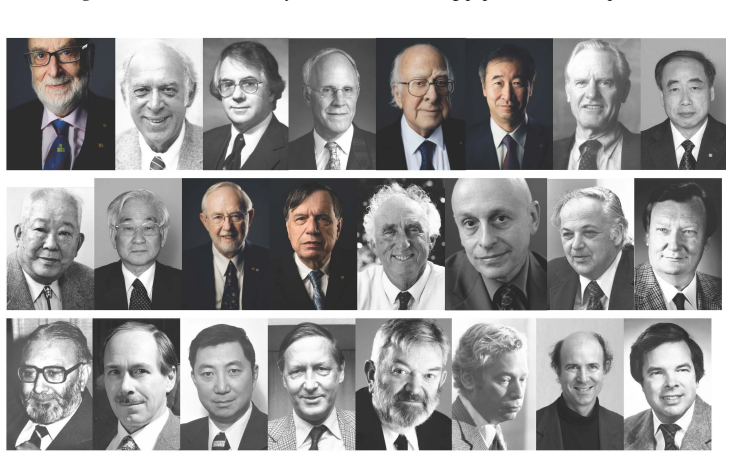
Figure 2. Figure 2: Nobel Prize winners that contributed significantly to the Standard Model. I now want to talk briefly about some of the components of this revolution. You have already heard about an important one from Sam. And you will hear more about some of the rest in subsequent tal…
Figure 3
Figure 3. Figure 3: The fundamental paper of Gerard ’t Hooft. The next piece to fall into place was dimensional transmutation. I am referring, of course, to the classic paper by Coleman and Erick Weinberg, “Radiative Corrections as the Origin of Spontaneous Symmetry Breaking” [9] This was…
Figure 4
Figure 4. Figure 4: Steven Weinberg paper, 15 April 1972. I call this Weinberg’s second model of leptons [11]. His group was SU(3) cross SU(3) but it is easier to explain with a single SU(3) as shown. This is a real unified theory that has extra interactions with a very large VEV that bre…
Figure 5
Figure 5. Figure 5: Pati-Salam: lepton number as a 4th colour. The next really important piece was confinement, [PITH_FULL_IMAGE:figures/full_fig_p032_5.png]
Figure 6
Figure 6. Figure 6: Quarks confinement. What was really new and revolutionary was the idea that leaving the color gauge symmetry unbroken might kill two birds with one stone by confining both quarks and massless gluons so that no massless particles appear as physical states, but fractiona…
Figure 7
Figure 7. Figure 7: The puzzle of R, the ratio of hadrons to muons in e +e − collisions. The week before the ψ was discovered at SPEAR, Burt Richter was at Harvard as a Loeb lecturer, giving talks on his theory that the reason for the apparently steadily rising R was that the electron was…
Figure 8
Figure 8. Figure 8: Stable Particle Table in 1974 Particle Data Group. The corresponding table for D0 today runs to over 10 pages. The particle physics world had really changed! Meanwhile, from 1974 to 1978, the development of the details of the Standard Model continued at a rapid pace. W…
Figure 9
Figure 9. Figure 9: Betting that any interesting new physics result is wrong! I used Inspire to count the number of papers that mention the Standard Model as a function of time, [PITH_FULL_IMAGE:figures/full_fig_p036_9.png]
Figure 10
Figure 10. Figure 10: Number of papers mentioning the Standard Model as a function of time. The Swampland conjectures [26], as I understand them which is not very well, are a set of constraints on https://doi.org/10.53941/hihep.2025.100004 9 of 11 [PITH_FULL_IMAGE:figures/full_fig_p036_10.png]
Figure 11
Figure 11. Figure 11: H. Georgi escapes from hadron dynamics (Original drawing by Michael Peskin). Now that is a “swamp”! Let me close by briefly discussing one puzzle that I think has been solved by my grand-student Matt Schwartz and his students [27]. They find that the universe will las…
Figure 1
Figure 1. Figure 1: A compilation of all early measurements of the ratio R, as presented in the 1974 London International Conference on High Energy Physics by Burton Richter. I remind you that the QCD prediction was that R should approach the value R = 2 (the sum of the electric charges s…
Figure 2
Figure 2. Figure 2: The discovery of the J/Ψ meson in Nov. 1974 independently by SPEAR (left) and AGS (right). Both exhibit peaks in the oppositely charged dielectron mass spectrum consistent with the J/Ψ mass at 3.1 GeV. This result was also confirmed by the Frascati group. I was in Pari…
Figure 3
Figure 3. Figure 3: The value of R for energies between 3 and 5 GeV. As expected, there are broader resonances with masses ≥ 4 GeV which are those lying above the DD¯ threshold. Lo and behold, the particles with naked charm were found among the decay products of these resonances. It was i…
Figure 4
Figure 4. Figure 4: The ratio R from low energies, up to and above the Z mass. The green curve is the parton model prediction and the red one includes QCD corrections. Remarkable agreement. https://doi.org/10.53941/hihep.2025.100005 6 of 7 [PITH_FULL_IMAGE:figures/full_fig_p044_4.png]
Figure 1
Figure 1. Figure 1: Decays and mixing in the Ko system resulting from higher order weak corrections. Attempts were made during 1968-69 to make the amplitude more convergent: • Introducing more than one Intermediate Vector Boson(Gell-Mann, Low, Kroll, Ruderman) [18]: far too many were need…
Figure 2
Figure 2. Figure 2: GIM mechanism for K0 → µ +µ −. With two quark generations, Cabibbo weak mixing dC = (cos θ d + sin θ s) is replaced by a unitary 2 × 2 matrix U U = cos θ sin θ − sin θ cos θ  (2) Charged currents in four-flavor space (u, c, d, s) are given by the matrices C and C † : …
Figure 3
Figure 3. Figure 3: GIM mechanism for K0 − K¯ 0 mixing [PITH_FULL_IMAGE:figures/full_fig_p051_3.png]
Figure 4
Figure 4. Figure 4: Penguin diagram yielding an imaginary contribution to the decay amplitude. After several controversial results, a non vanishing value of ϵ ′/ϵ was established in 2001 by the NA48 (CERN) and KTeV (FermiLab) Collaborations, with the observation of the double ratio Equati…
Figure 5
Figure 5. Figure 5: Examples of lattice QCD determination of the CKM parameter Vub, Vcb. 9. The Special Role of Massive Quarks in QCD • QCD is asymptotically free. Quarks carry color, associated to SU(3)col and flavour, associated to S(3)f lavour, and are confined inside color singlet had…
Figure 6
Figure 6. Figure 6: Predicted and observed charmonia, S1, 2 and P1, 2 states in (black). In red the first discovered unanticipated charmonia. Figure from Ref. [47] [PITH_FULL_IMAGE:figures/full_fig_p053_6.png]
Figure 7
Figure 7. Figure 7: Quark diagram for B + → K+ + X, with X = (ccq¯ q¯ ′ ). Figure from [53]. The challenge, after X, Y and Z particle discovery, is to reconcile their structure with what we know about the binding of the classical mesons (qq¯) and baryons (qqq) by QCD interactions. There i…
Figure 8
Figure 8. Figure 8: The new wave of multiquark states discovered by LHCb and BES III, 2016-2021. All can be described as multiquark states bound by QCD forces, J/Ψ − ϕ and J/ΨK states fit into SU(3) flavour nonets with X(3872), ZC (3900) and Zc(4020). Much remains to be done, to produce m…
Figure 1
Figure 1. Figure 1: Data on the proton’s magnetic form factor (normalized to a specific dipole approximation) and a QCD fit [6]. QCD αs(Mz) = 0.1181 ± 0.0013 pp –> jets e.w. precision fits (NNLO) 0.1 0.2 0.3 αs (Q2 ) 1 10 100 Q [GeV] Heavy Quarkonia (NLO) e+ e – jets & shapes (res. NNLO) …
Figure 2
Figure 2. Figure 2: The colored lines are αs(Q2 ) with uncertainty estimates [6]. The rest are later results. 2.2. The November Revolution A revolution took place in 1974, see [PITH_FULL_IMAGE:figures/full_fig_p058_2.png]
Figure 3
Figure 3. Figure 3: The data on the discovery of the J and the Ψ [PITH_FULL_IMAGE:figures/full_fig_p059_3.png]
Figure 4
Figure 4. Figure 4: Masses and lifetimes of the particles known in 1974. https://doi.org/10.53941/hihep.2025.100007 3 of 9 [PITH_FULL_IMAGE:figures/full_fig_p059_4.png]
Figure 5
Figure 5. Figure 5: Charmonium spectroscopy. The data providers (right) did not refer to theory. The SLAC data on the ratio R are shown in [PITH_FULL_IMAGE:figures/full_fig_p060_5.png]
Figure 6
Figure 6. Figure 6: The well-know ratio R, measured at SLAC. Σc Σ∗ c Ξ ! c Ξ∗ c Ωc Ω∗ c Λc Ξc 1 2 3 2 1 2 3 2 1 2 3 2 1 2 1 2 P. Perez-Rubio, S. Collins and G. S. Bali, Phys. Rev. D92 034504 (2015) !? !? DGG: Common Uncertainty: ± 50 MeV Singly charmed baryons Lattice postdictions [PITH_…
Figure 7
Figure 7. Figure 7: Masses of the singly charmed positive parity baryons compared to the data, the predictions in [17] and a collection lattice results. https://doi.org/10.53941/hihep.2025.100007 5 of 9 [PITH_FULL_IMAGE:figures/full_fig_p061_7.png]
Figure 8
Figure 8. Figure 8: Three colors, four quarks and their pins in Cyrillic. K ⇡ K3⇡ [PITH_FULL_IMAGE:figures/full_fig_p062_8.png]
Figure 9
Figure 9. Figure 9: Invariant mass distributions of recoils against Kπ and Kππ and the peculiarities of D ∗ → D decays. https://doi.org/10.53941/hihep.2025.100007 6 of 9 [PITH_FULL_IMAGE:figures/full_fig_p062_9.png]
Figure 10
Figure 10. Figure 10: Origin of the “fakes” in the invariant mass of the ensembles of particles recoiling against K−π +. Based on the above considerations we [21] could make a description (not meant to be a fit) of the observed recoiling mass spectra, with only one tuned parameter (b in ex…
Figure 11
Figure 11. Figure 11: Recoil mass spectra in D ∗D production [21]. 5. The Higgs boson Most scientists, often justifiably, feel under-cited. We all contribute to this. There are a lot of possible citations that I skipped. Citations are peculiar. One example which I shall not cite: perhaps t…
Figure 12
Figure 12. Figure 12 [PITH_FULL_IMAGE:figures/full_fig_p064_12.png]
Figure 1
Figure 1. Figure 1: The Gargamelle body installed inside the magnetic coils. The first hint for the existence of NC interactions was obtained in 1971 by the observation of an event consisting of a single electron only during a run with a ν¯µ beam [3]. In this event, shown in [PITH_FULL_I…
Figure 2
Figure 2. Figure 2: A single-electron event observed in Gargamelle during a ν¯µ run in 1971. The background from neutron interactions in events with final states consisting of hadrons only was studied by using CC νµ (ν¯µ) interactions occurring near the chamber entrance, with the outgoing…
Figure 3
Figure 3. Figure 3: Event distributions and NC/CC ratios vs. distance from chamber centre [4] [PITH_FULL_IMAGE:figures/full_fig_p068_3.png]
Figure 4
Figure 4. Figure 4: A neutrino interaction with three final-state hadrons and no muon. https://doi.org/10.53941/hihep.2025.100008 3 of 18 [PITH_FULL_IMAGE:figures/full_fig_p068_4.png]
Figure 5
Figure 5. Figure 5: Cooling of a single particle (dotted line) horizontal oscillation. Following the success of the so-called Initial Cooling Experiment (ICE) [7], which provided the experimental demonstration that stochastic cooling could indeed achieve the required increase of p¯ phase-…
Figure 6
Figure 6. Figure 6: View of the Antiproton Accumulator during construction [PITH_FULL_IMAGE:figures/full_fig_p070_6.png]
Figure 7
Figure 7. Figure 7: Schematic sequence illustrating antiproton cooling and accumulation in the AA [1]. Consecutive PS cycles achieved beam injection into the SPS, when AA accumulated a sufficiently dense p¯ stack. Firstly, three proton bunches (six after 1986), each containing ∼ 1011 prot…
Figure 8
Figure 8. Figure 8: Layout of the three machines initially involved in the operation of the CERN pp¯ collider: the PS, the AA, the SPS and the interconnecting transfer lines. In 1987, to increase the luminosity of the machine, the source of antiprotons was upgraded. A second ring, the Ant…
Figure 9
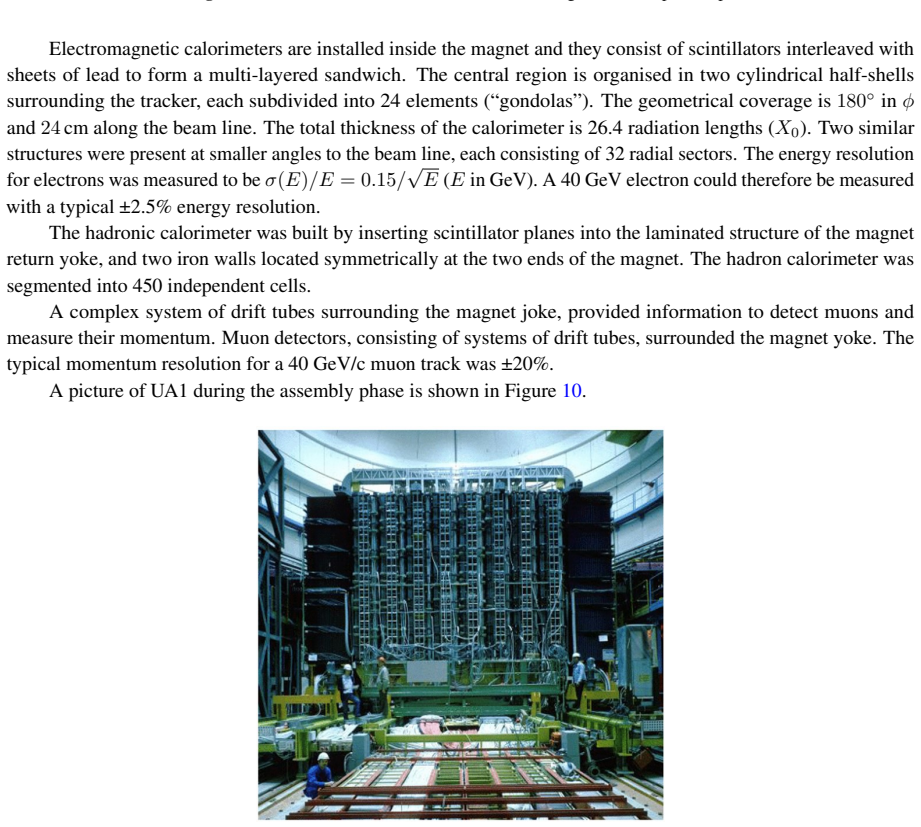
Figure 9. Figure 9: View of the UA1 detector with the two magnet halves opened up. Electromagnetic calorimeters are installed inside the magnet and they consist of scintillators interleaved with sheets of lead to form a multi-layered sandwich. The central region is organised in two cylind…
Figure 10
Figure 10. Figure 10: The UA1 detector during assembly. 4.2. The UA2 Experiment UA2 was not designed as a general-purpose detector, but rather optimized for the detection of electrons from W and Z decays. The emphasis was on highly granular calorimetry with spherical projective geometry, w…
Figure 11
Figure 11. Figure 11: shows the layout of the UA2 detector for the collider runs between 1981 and 1985. The central region contained a “vertex detector”, which consisted of various types of cylindrical tracking chambers. A “preshower” counter, located just behind the last chamber and consi…
Figure 12
Figure 12. Figure 12: The UA2 detector in its 1981–1985 configuration. 4.3. Discovery of the W Boson The dominant decay mode of the W boson is to quark-antiquark pairs, i.e. hadronic jets. Unfortunately, this decay mode, that accounts for about 70% of the branching fraction, is overwhelmed…
Figure 13
Figure 13. Figure 13: shows the |⃗p miss T | distribution, as measured by UA1 from the 1982 data[9]. There is a component decreasing approximately as |⃗p miss T | 2 , due to the effect of calorimeter resolution in events without significant ⃗p miss T , followed by a flat component due to e…
Figure 14
Figure 14. Figure 14: UA1 scatter plot of all the events from the 1982 data which contain a high − pT electron and large ⃗p miss T . The abscissa is the electron pT and the ordinate is the ⃗p miss T component antiparallel to the electron ⃗pT [PITH_FULL_IMAGE:figures/full_fig_p075_14.png]
Figure 15
Figure 15. Figure 15: Display of a UA1 W → eνe event. The arrow points to the electron track. The results from the UA2 search for W → eνe events[10] were presented at a CERN seminar on the day after the UA1 presentation. Six events containing an electron with pT > 15 GeV/c were identified …
Figure 16
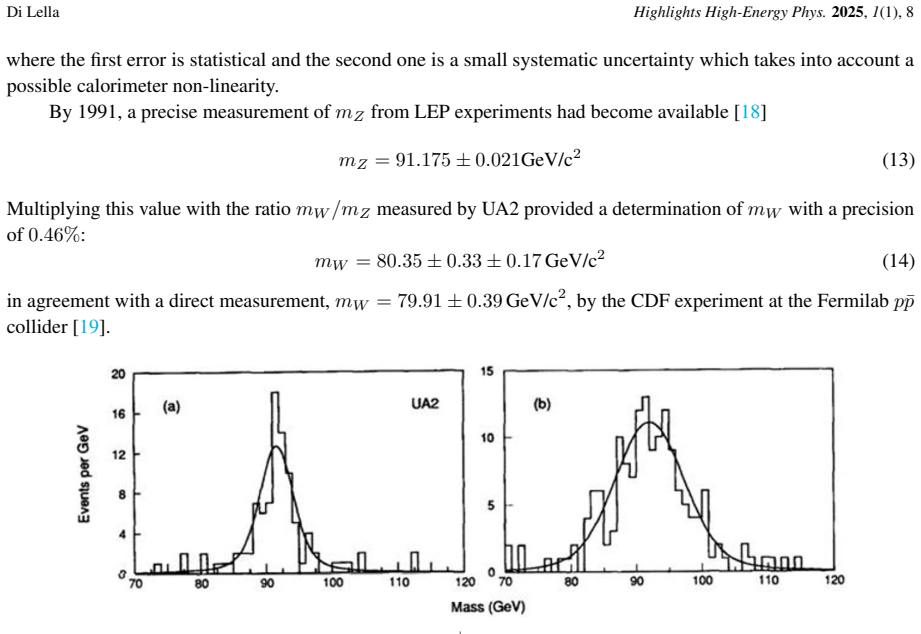
Figure 16. Figure 16: b displays the electron pT distribution for the events with |⃗p miss T | larger than 80% of the electron pT (four events). These events have the properties expected from W → eνe decay. A fit to the distribution of these events using mW as a free parameter gives mW = 8…
Figure 17
Figure 17. Figure 17: illustrates the search for the decay Z → e +e − in UA1[11]. The first step of the analysis requires the presence of two calorimeter clusters consistent with electrons and having a transverse energy ET > 25 GeV. Among the data recorded during the 1982–1983 collider run…
Figure 18
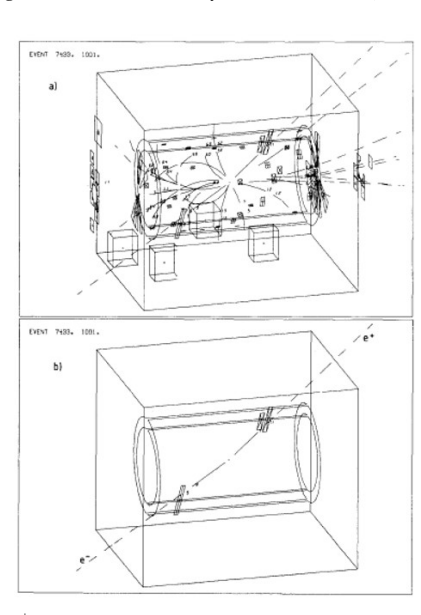
Figure 18. Figure 18: One of the Z → e +e − events in UA1: (a) display of all reconstructed tracks and calorimeter hit cells; (b) only tracks with pT > 2 GeV/c and calorimeter cells with ET > 2 GeV are shown. https://doi.org/10.53941/hihep.2025.100008 11 of 18 [PITH_FULL_IMAGE:figures/ful…
Figure 19
Figure 19. Figure 19: shows the mass distribution of all lepton pairs found by UA1 from the analysis of the 1982–1983 data. The mean of these values is mZ = 95.2 ± 2.5 ± 3.0 GeV/c2 (2) The first uncertainty arises from statistical, while the second originates from the systematic uncertaint…
Figure 20
Figure 20. Figure 20: Search for the decay Z → e +e − in UA2 (see text). The shaded area represents the three events with isolated electron tracks pointing to both energy clusters in the calorimeter. https://doi.org/10.53941/hihep.2025.100008 12 of 18 [PITH_FULL_IMAGE:figures/full_fig_p07…
Figure 21
Figure 21. Figure 21: shows the energy deposited in the UA2 calorimeter by a W → eν and by a Z → e +e − event. These distributions exemplify the distinctive topologies of such events, characterized by a substantial deposition of energy within a limited number of calorimeter cells, with min…
Figure 22
Figure 22. Figure 22: Transverse mass distribution for all 1982–1985 UA1 W → eν events. https://doi.org/10.53941/hihep.2025.100008 13 of 18 [PITH_FULL_IMAGE:figures/full_fig_p078_22.png]
Figure 23
Figure 23. Figure 23: shows the invariant mass distribution of all e +e − pairs recorded by UA1 during the same period. The W and Z mass values obtained from fits to the distributions of Figures 22 and 23 were mW = 82.7 ± 1.0 ± 2.7 GeV/c2 (5) mZ = 93.1 ± 1.0 ± 3.1 GeV/c2 (6) respectively, …
Figure 24
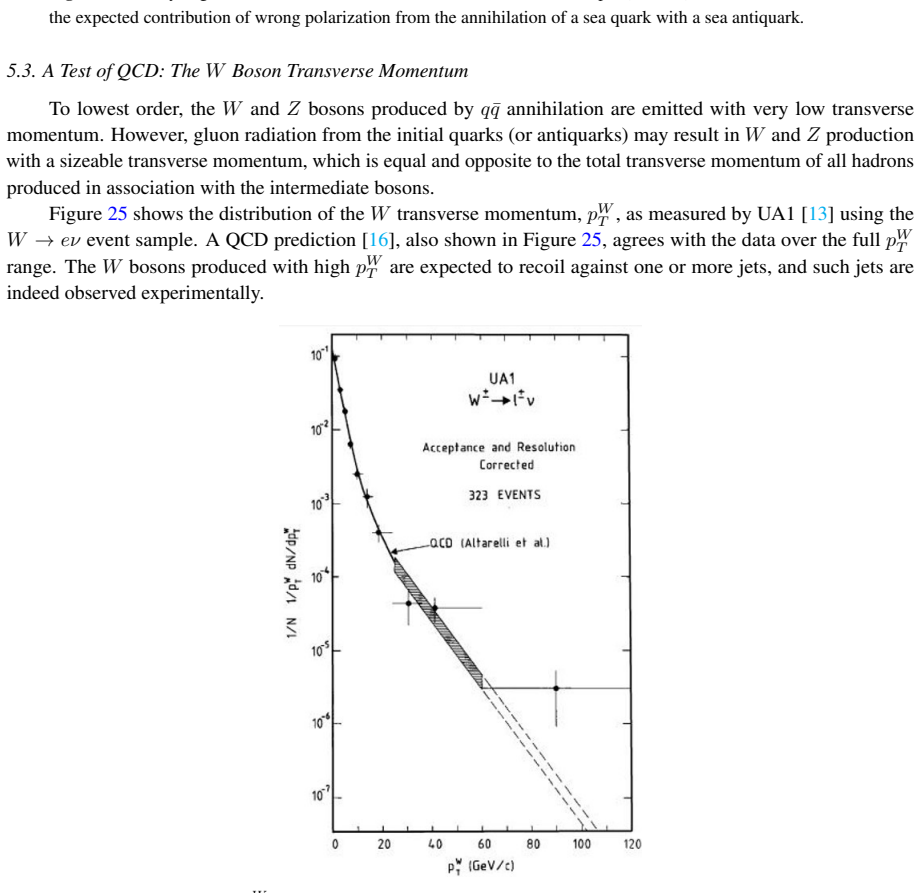
Figure 24. Figure 24: Decay angular distribution for the final UA1 W → eν event sample (see text). The shaded band shows the expected contribution of wrong polarization from the annihilation of a sea quark with a sea antiquark. 5.3. A Test of QCD: The W Boson Transverse Momentum To lowest …
Figure 25
Figure 25. Figure 25: shows the distribution of the W transverse momentum, pW T , as measured by UA1 [13] using the W → eν event sample. A QCD prediction [16], also shown in [PITH_FULL_IMAGE:figures/full_fig_p080_25.png]
Figure 26
Figure 26. Figure 26: The UA2 detector layout for the 1987–1988 collider run. From 1988 to 1990, UA2 collected large samples of W → eν and Z → e +e − events [PITH_FULL_IMAGE:figures/full_fig_p081_26.png]
Figure 27
Figure 27. Figure 27: shows the transverse mass distribution for 2065 W → eν decays with the electron measured in the UA2 central calorimeter [17]. A best fit to this distribution using mW as a free parameter gives mW = 80.84 ± 0.22GeV/c2 (statistical error only) [PITH_FULL_IMAGE:figures/…
Figure 28
Figure 28. Figure 28: Invariant mass distributions for two Z → e +e − event samples, as measured by UA2 (see text). The curves are best fits to the data using mZ as a free parameter. The precise determination of mW was used to obtain bounds on the top quark mass, for which early direct sea…
Figure 29
Figure 29. Figure 29: mW versus mtop (curves on the left) and the determination of mW obtained by combining the precise UA2 measurement of mW /mZ with an early precise measurement of mZ at LEP (the open point with error bar on the right). The curves are the Standard Model predictions for f…
Figure 1
Figure 1. Figure 1: ISR Control Room [PITH_FULL_IMAGE:figures/full_fig_p085_1.png]
Figure 2
Figure 2. Figure 2: Physics Interaction points 1 (left) and 8 (right). 2.1. Lack of Diagnostics in ISR Due to Coasting Beam High-precision beam diagnostics are crucial for particle colliders, enabling measurement of particle count, beam size, and position. Beams are grouped into highly ch…
Figure 3
Figure 3. Figure 3: Longitudinal Schottky scans. Schottky scans revolutionized ISR operation by providing the only quantitative beam diagnostics during long stable-beam fills, sometimes lasting up to five days. While the sodium curtain offered visual but non-quantitative cross-section vie…
Figure 4
Figure 4. Figure 4: First observation of stochastic cooling [PITH_FULL_IMAGE:figures/full_fig_p088_4.png]
Figure 5
Figure 5. Figure 5: Fast momentum cooling in ICE. 2.6. The Legacy of the ISR Although not known for discoveries, the ISR was a pioneering project as the first proton-(anti)proton collider, answering key questions and inspiring future collider designs. It also served as an excellent traini…
Figure 6
Figure 6. Figure 6: (a) Layout of the LEP ring, the 4 experiments and the LEP injectors. (b) Photo of water input to LEP tunnel. 4.3. 1988 LEP Octant Test The first major task was the controversial octant test—passing a positron beam through the first eighth of the accelerator. Despite sk…
Figure 7
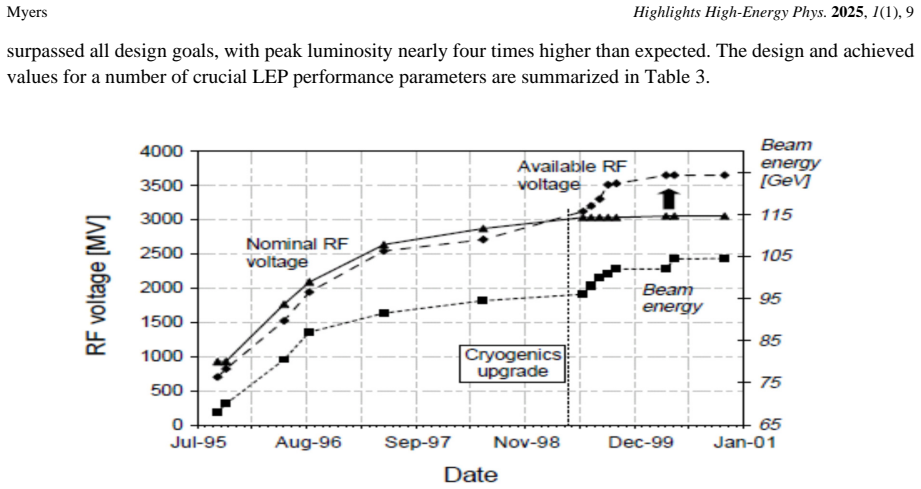
Figure 7. Figure 7: RF voltage per turn over the years [PITH_FULL_IMAGE:figures/full_fig_p093_7.png]
Figure 8
Figure 8. Figure 8: LEP daily integrated luminosity from 1993 to 2000. Insertion: 2000, The Last Year of LEP2 Operation: On the verge of a great discovery? LEP’s days were never fated to dwindle. Early on, CERN had a plan to install the Large Hadron Collider in the same tunnel, in a bid t…
Figure 9
Figure 9. Figure 9: Last beam dump in LEP. 4.7. Moving Focus and Personnel to the LHC The closure of LEP allowed massive redeployment of skilled and experienced CERN staff from LEP2 to the LHC design. With the new focus from the closure of LEP, the design of the LHC gathered real momentum…
Figure 10
Figure 10. Figure 10: Plots show the daily progress in performance of the LHC in 2010 and 2011, reaching a maximum of 44 in 2010 and 6000 in 2011 [PITH_FULL_IMAGE:figures/full_fig_p097_10.png]
Figure 11
Figure 11. Figure 11: (a) Prediction of Integrated Luminosity for 2012. (b) Plot of predicted integrated luminosity in blue and measured in red. Operation of the LHC restarted in April 2012 and I was carefully watching the performance every day. Initially the preformance was lagging my pre…
Figure 12
Figure 12. Figure 12: LHC performance in 2012 (predicted and achieved) and over 2010 to 2012. Conflicts of Interest The author declares no conflict of interest. References 1. Unser, K. A Toroidal DC Beam Transformer with High Resolution. IEEE Trans. Nucl. Sci. 1981, 28, 2344–2346. 2. Ciapa…
Figure 1
Figure 1. Figure 1: Left : Estimated gravitational-wave strain signal from GW150914 in LIGO Hanford and illustration of the system dynamics. Right: Time-frequency representation of the LIGO Livingston data at the time of the GW150914 event [1]. A key feature of the chirp is that the chara…
Figure 2
Figure 2. Figure 2: The gravitational-wave spectrum, highlighting detection techniques and various sources of interest. Figure courtesy of NASA/J. I. Thorpe. https://doi.org/10.53941/hihep.2025.100010 2 of 8 [PITH_FULL_IMAGE:figures/full_fig_p102_2.png]
Figure 3
Figure 3. Figure 3: Simplified optical layout of the Advanced Virgo interferometer. Each of the long cavities in the arms is formed by an input mirror (IM) and an end mirror (EM). The recycling cavities are formed by the power-recycling mirror (PRM) or the signal-recycling mirror (SRM) an…
Figure 4
Figure 4. Figure 4: The sample of binary systems observed in the LIGO-Virgo O1, O2 and O3 observing runs and used to characterize the population of sources, shown in the component mass space. Figure courtesy of LIGO-Virgo-KAGRA Collaboration/IGFAE/Thomas Dent. Inferring the mass distribut…
Figure 1
Figure 1. Figure 1: Evolution of experimental performance vs. time for the CMS experiment, quantified quoting the ratio of the efficiency or of the inverse of the uncertainty over the corresponding 2012 value, for various inputs to physics analyses. Plot extracted from Ref. [3] . The LHC …
Figure 2
Figure 2. Figure 2: Evolution of b-jet tagging efficiency for CMS (left) and ATLAS (right), from the Run-1 algorithms to the DL architectures. 3. Physics Highlights from LHC Run 1 and Run 2 The precision in Higgs boson coupling measurements has seen remarkable progress in Run 2, with curr…
Figure 3
Figure 3. Figure 3: (Top-left): CMS measurements of the Higgs couplings to bosons and fermions as a quadratic and linear function of the mass, respectively. (Top-right): extraction of the universal fermion and boson coupling modifiers from a combined fit to the CMS coupling measurements. …
Figure 1
Figure 1. Figure 1: together with its three related angles [PITH_FULL_IMAGE:figures/full_fig_p120_1.png]
Figure 2
Figure 2. Figure 2: State-of-the-art UT analysis in the SM implementing all the most relevant constraints in the (ρ, ¯ η¯) plane. Contour regions are shown at the 95% probability. Further details on the fit are reported in [PITH_FULL_IMAGE:figures/full_fig_p122_2.png]
Figure 3
Figure 3. Figure 3: Determinations of the SM UT using partial information from the constraints available. In [PITH_FULL_IMAGE:figures/full_fig_p122_3.png]
Figure 5
Figure 5. Figure 5 [PITH_FULL_IMAGE:figures/full_fig_p125_5.png]
Figure 6
Figure 6. Figure 6: Constraints from the NP UT analysis on the set of dimension-six operators that generalizes the effective Hamiltonian for |∆F| = 2 transitions beyond the SM. Filled histograms correspond to bounds on local operators affecting the short-distant physics of neutral meson o…
Figure 1
Figure 1. Figure 1: The SM unambiguously defined in the context of field theory. Each fermion field occurs in 3 replicas. Not surprisingly however, as it happens for all great theories of nature, the SM leaves open a number of important questions, both of observational and of structural n…
Figure 2
Figure 2. Figure 2: Questions raised by the SM, of observational (green) or structural (yellow) origin. The significance of these questions cannot be overstated. Unsurprisingly, they have long been, and continue to be, the driving force behind numerous ideas and inquiries in BSM physics—t…
Figure 3
Figure 3. Figure 3: The SM Lagrangian with its two sectors defined: the “gauge” and the “Higgs” one. Both sectors are each an unavoidable pillar of the SM. Nevertheless, jointly with the fact that the Higgs sector is where the Fermi scale originates, these considerations represent, in my …
Figure 4
Figure 4. Figure 4: Constraints on the scale Λ weighting the d = 6 operators that mediate ∆F = 2 transitions, taken from Ref. [8], for a generic EFT (empty) or by including in each operator an ad hoc CKM factor (coloured). To try to address this question, let us consider what we know of t…
Figure 5
Figure 5. Figure 5: Representation of the Yukawa couplings with the colour intensity reflecting the typical size of the corresponding matrix elements, assuming [U u,d L ]i̸=j ≲ [VCKM]i̸=j (left) and also [U u,d R ]i̸=j ≲ [U u,d L ]i̸=j (right). The dotted lines indicate the emergence of a…
Figure 6
Figure 6. Figure 6: Overall representation of the model. On the left and on the right are shown the different gauge (SU(3) × SU(2)) and global symmetries (Universal U(1)B × U(1)L), which appear as (almost) unbroken at a given energy. In the centre are the masses of the new particles: neut…
Figure 1
Figure 1. Figure 1: 8th Solvay Conference on Elementary Particles, 1948. Wikimedia. After receiving his Doctorate from the University of Glasgow in November 1949, Bruno Touschek became Nuffield Lecturer, giving a contribution on weak interactions to Max Born’s Atomic Physics book, and col…
Figure 2
Figure 2. Figure 2: From left: Marcello Conversi in the 1960’s, Edoardo Amaldi with Bruno Touschek soon after his arrival in Rome, and young Raoul Gatto, family photos. 3. New Challenges for Theoretical Physics In the early 1950s, when Touschek and Gatto began their new scientific life in…
Figure 3
Figure 3. Figure 3: Bruno Touschek in Padua: at left in April 1954 at the Conference on Unstable Heavy Particles and High-Energy Events in Cosmic Rays in [23], and, at right, in September 1957 with T. D. Lee, W. Pauli and R. Marshak (at right) at the Padua-Venice Conference on Mesons and …
Figure 4
Figure 4. Figure 4: Cover and two pages from AdA’s Storage Ring Notebook, started by Bruno Touschek on 18 February 1960. © Touschek Family, and Touschek Papers, Sapienza University of Rome, Archives of the Physics Department, all rights reserved. 5.1. Moving to Orsay One of the reasons be…
Figure 5
Figure 5. Figure 5: Exterior of the ADONE building in 1966, © INFN-LNF, all rights reserved [PITH_FULL_IMAGE:figures/full_fig_p153_5.png]
Figure 6
Figure 6. Figure 6: May 1966 letter by Touschek to Lucio Mezzetti, Frascati Laboratories director, Sapienza University of Rome, Archives of the Physics Department, all rights reserved. In the fall of 1968, two beams, of electrons and positrons, circulated in ADONE. The long road Italian p…
Figure 7
Figure 7. Figure 7: Raoul Gatto, receiving blessings from Pope John Paul II, INFN-LNF images. 7. Conclusions We have presented a short overview of how Raul Gatto and Bruno Touschek together contributed to the rise of electron positron physics in the 1960s. Although they never wrote a pape…
Figure 1
Figure 1. Figure 1: ADONE experimental results, from ref. [27] . Of course only two of them, both from Harvard, had the right interpretation: by T. Applequist and H.D. Politzer [38], who related the reason for the very narrow width of the J/Ψ to the asymptotic freedom of QCD just discover…
Figure 2
Figure 2. Figure 2 [PITH_FULL_IMAGE:figures/full_fig_p161_2.png]
Figure 3
Figure 3. Figure 3: The ratio R = σhad(s)/σµµ(s) as a function of √ s, from Particle Data Group. The problem of the radiative corrections to the J/Ψ line-shape, because of the very narrow width involved, showed the crucial role played by the theoretical ideas of the early times on the inf…
Figure 4
Figure 4. Figure 4: Experimental results for J/Ψ production in e +e − annihilation. The data are from SPEAR and ADONE (see text). The full lines refer to the theoretical analysis including radiative corrections of Ref. [43,44]. The above treatment of the radiative corrections for the J/Ψ …
Figure 1
Figure 1. Figure 1: The prediction of Parisi and Petronzio [43] compared with the experimental data of SLAC [56] for the plot of d ln F (x,q2) d ln(q 2) for the proton versus x. Curve I is their prediction for the logarithmic derivative of the proton structure function compared with exper…

Discussion (0). Sign in to comment.

Reference graph

Works this paper leans on

63 extracted references · 62 canonical work pages

  1. [1]

    A meeting with Enrico Fermi

    Dyson, F. A meeting with Enrico Fermi. Nature 2004, 427, 297–297

  2. [2]

    Nobel lecture: The discovery of asymptotic freedom and the emergence of QCD

    Gross, D.J. Nobel lecture: The discovery of asymptotic freedom and the emergence of QCD. Rev. Mod. Phys. 2005, 77, 837–849

  3. [3]

    Streater, R.F.; Wightman, A.S.PCT, Spin and Statistics, and All That; Princeton University Press: Benjamin, W A, USA, 1964

  4. [4]

    On the formulation of quantized field theories—II

    Lehmann, H.; Symanzik, K.; Zimmermann, W. On the formulation of quantized field theories—II. Nuovo Cim. 1957, 6, 319–333

  5. [5]

    Determination of the pion-nucleon scattering amplitude from dispersion relations and unitarity

    Mandelstam, S. Determination of the pion-nucleon scattering amplitude from dispersion relations and unitarity. General theory. Phys. Rev. 1958, 112, 1344

  6. [6]

    The symmetry group of vector and axial vector currents

    Gell-Mann, M. The symmetry group of vector and axial vector currents. Phys. Phys. Fiz. 1964, 1, 63

  7. [7]

    Statistical thermodynamics of strong interactions at high-energies

    Hagedorn, R. Statistical thermodynamics of strong interactions at high-energies. Nuovo Cim. Suppl. 1965, 3, 147–186

  8. [8]

    Exponential hadronic spectrum and quark liberation

    Cabibbo, N.; Parisi, G. Exponential hadronic spectrum and quark liberation. Phys. Lett. B 1975, 59, 67–69

Show all 63 references
  1. [9]

    Unitary symmetry and leptonic decays

    Cabibbo, N. Unitary symmetry and leptonic decays. Phys. Rev. Lett. 1963, 10, 531

  2. [10]

    The axial vector current in beta decay.II Nuovo C

    Gell-Mann, M.; L ´evy, M. The axial vector current in beta decay.II Nuovo C. 1960, 16, 705–726

  3. [11]

    Theory of the Fermi interaction

    Feynman, R.P.; Gell-Mann, M. Theory of the Fermi interaction. Phys. Rev. 1958, 109, 193

  4. [12]

    Nonrenormalization theorem for the strangeness-violating vector currents

    Ademollo, M.; Gatto, R. Nonrenormalization theorem for the strangeness-violating vector currents. Phys. Rev. Lett. 1964, 13, 264

  5. [13]

    Spin and unitary spin independence of strong interactions.Phys

    G ¨ursey, F.; Radicati, L.A. Spin and unitary spin independence of strong interactions.Phys. Rev. Lett. 1964, 13, 173

  6. [14]

    Approximate Symmetry and the Algebra of Current Components; California Institute of Technology: Pasadena, CA, USA, 1965

    Dashen, R.F.; Gell-Mann, M. Approximate Symmetry and the Algebra of Current Components; California Institute of Technology: Pasadena, CA, USA, 1965

  7. [15]

    A dispersion theory of symmetry breaking

    Fubini, S.; Furlan, G.; Rossetti, C. A dispersion theory of symmetry breaking. Il Nuovo C. A 1965, 40, 1171–1193

  8. [16]

    Applications of the chiral U (6) ⊗ U (6) algebra of current densities

    Bjorken, J.D. Applications of the chiral U (6) ⊗ U (6) algebra of current densities. Phys. Rev. 1966, 148, 1467

  9. [17]

    Current algebra at small distances

    Bjorken, J.D. Current algebra at small distances. Conf. Proc. C 1967, 670717, 55–81

  10. [18]

    Crucial test of a theory of currents

    Callan, C.G., Jr.; Gross, D.J. Crucial test of a theory of currents. Phys. Rev. Lett. 1968, 21, 311

  11. [19]

    Current commutators and electron scattering at high momentum transfer

    Cornwall, J.M.; Norton, R.E. Current commutators and electron scattering at high momentum transfer. Phys. Rev. 1969, 177, 2584

  12. [20]

    Asymptotic sum rules at infinite momentum

    Bjorken, J.D. Asymptotic sum rules at infinite momentum. Phys. Rev. 1969, 179, 1547

  13. [21]

    Very high-energy collisions of hadrons

    Feynman, R.P. Very high-energy collisions of hadrons. Phys. Rev. Lett. 1969, 23, 1415

  14. [22]

    Inelastic Electron-Proton and γ-Proton Scattering and the Structure of the Nucleon Phys

    Bjorken, J.D.; Paschos, E.A. Inelastic Electron-Proton and γ-Proton Scattering and the Structure of the Nucleon Phys. Rev. 1969, 185, 1975

  15. [23]

    Observed behavior of highly inelastic electron-proton scattering

    Breidenbach, M.; Friedman, J.I.; Kendall, H.W.; et al. Observed behavior of highly inelastic electron-proton scattering. Phys. Rev. Lett. 1969, 23, 935

  16. [24]

    Planck’s Legacy to Statistical Mechanics

    Parisi, G. Planck’s Legacy to Statistical Mechanics. arXiv 2001, arXiv:cond-mat/0101293

  17. [25]

    Relativistic Quantum Mechanics; American Institute of Physics: College Park, MA, USA, 1965

    Bjorken, J.D.; Drell, S.D. Relativistic Quantum Mechanics; American Institute of Physics: College Park, MA, USA, 1965

  18. [26]

    Asymptotic estimates in quantum electrodynamics

    Itzykson, C.; Parisi, G.; Zuber, J.B. Asymptotic estimates in quantum electrodynamics. Phys. Rev. D 1977, 16, 996

  19. [27]

    Can we make sense out of Quantum Chromodynamics? In The Whys of Subnuclear Physics; Springer: Berlin, Germany, 1979; pp

    Hooft, G. Can we make sense out of Quantum Chromodynamics? In The Whys of Subnuclear Physics; Springer: Berlin, Germany, 1979; pp. 943–982

  20. [28]

    Model Hamiltonians for local quantum field theory

    Wilson, K.G. Model Hamiltonians for local quantum field theory. Phys. Rev. 1965, 140, B445

  21. [29]

    On products of quantum field operators at short distances

    Wilson, K.G. On products of quantum field operators at short distances. In Cornell Report; Cornell University: Ithaca, NY , USA, 1964

  22. [30]

    Derivation of renormalized relativistic perturbation theory from finite local field equations

    Brandt, R.A. Derivation of renormalized relativistic perturbation theory from finite local field equations. Ann. Phys. 1967, 44, 221–265

  23. [31]

    Non-Lagrangian models of current algebra

    Wilson, K.G. Non-Lagrangian models of current algebra. Phys. Rev. 1969, 179, 1499

  24. [32]

    Broken scale invariance in scalar field theory

    Callan, C.G., Jr. Broken scale invariance in scalar field theory. Phys. Rev. D 1970, 2, 1541

  25. [33]

    Small distance behaviour in field theory and power counting

    Symanzik, K. Small distance behaviour in field theory and power counting. Commun. Math. Phys. 1970, 18, 227–246

  26. [34]

    Small-distance-behaviour analysis and Wilson expansions

    Symanzik, K. Small-distance-behaviour analysis and Wilson expansions. Commun. Math. Phys. 1971, 23, 49–86

  27. [35]

    Operator product expansions near the light cone

    Brandt, R.A.; Preparata, G. Operator product expansions near the light cone. Nucl. Phys. B 1971, 27, 541–567

  28. [36]

    Light-cone behavior of perturbation theory

    Christ, N.; Hasslacher, B.; Mueller, A.H. Light-cone behavior of perturbation theory. Phys. Rev. D 1972, 6, 3543

  29. [37]

    Canonical scaling and conformal invariance

    Ferrara, S.; Grillo, A.F.; Parisi, G.; et al. Canonical scaling and conformal invariance. Phys. Lett. B 1972, 38, 333–334

  30. [38]

    Serious Difficulties with Canonical Dimensions; Comitato Nazionale per l’Energia Nucleare: Frascati, Italy, 1972

    Parisi, G. Serious Difficulties with Canonical Dimensions; Comitato Nazionale per l’Energia Nucleare: Frascati, Italy, 1972

  31. [40]

    How to measure the dimension of the parton field

    Parisi, G. How to measure the dimension of the parton field. Nucl. Phys. B 1973, 59, 641–646

  32. [41]

    A field theory with computable large-momenta behaviour

    Symanzik, K. A field theory with computable large-momenta behaviour. Lett. Nuovo Cim. 1973, 6, 77–80

  33. [42]

    Deep inelastic scattering in a field theory with computable large-momenta behaviour.Lett

    Parisi, G. Deep inelastic scattering in a field theory with computable large-momenta behaviour.Lett. Nuovo Cim.1973, 7, 84–88

  34. [43]

    Covariant expansion of the conformal four-point function.Nucl

    Ferrara, S.; Grillo, A.F.; Parisi, G.; et al. Covariant expansion of the conformal four-point function.Nucl. Phys. B1972, 49, 77–98

  35. [44]

    Experimental limits on the values of anomalous dimensions

    Parisi, G. Experimental limits on the values of anomalous dimensions. Phys. Lett. B 1973, 43, 207–208

  36. [45]

    A similarity hypothesis in the strong interactions

    Polyakov, A. A similarity hypothesis in the strong interactions. 1. Multiple hadron production in e+ e− annihilation. Sov. Phys. JETP 1971, 32, 296

  37. [46]

    Parton models and asymptotic freedom

    Kogut, J.; Susskind, L. Parton models and asymptotic freedom. Phys. Rev. D 1974, 9, 3391–3399

  38. [47]

    Green’s functions in theories with non-abelian gauge group

    Khriplovich, I.B. Green’s functions in theories with non-abelian gauge group. Sov. J. Nucl. Phys. 1969, 10, 409

  39. [48]

    Ultraviolet behavior of non-abelian gauge theories

    Gross, D.J.; Wilczek, F. Ultraviolet behavior of non-abelian gauge theories. Phys. Rev. Lett. 1973, 30, 1343

  40. [49]

    Reliable perturbative results for strong interactions? Phys

    Politzer, H.D. Reliable perturbative results for strong interactions? Phys. Rev. Lett. 1973, 30, 1346

  41. [50]

    In a Flight of Starlings: The Wonders of Complex Systems; Penguin: London, UK, 2023

    Parisi, G. In a Flight of Starlings: The Wonders of Complex Systems; Penguin: London, UK, 2023

  42. [51]

    Advantages of the color octet gluon picture

    Fritzsch, H.; Gell-Mann, M.; Leutwyler, H. Advantages of the color octet gluon picture. Phys. Lett. B 1973, 47, 365–368

  43. [52]

    Electroproduction scaling in an asymptotically free theory of strong interactions

    Georgi, H.; Politzer, H.D. Electroproduction scaling in an asymptotically free theory of strong interactions. Phys. Rev. D 1974, 9, 416

  44. [53]

    Asymptotically free gauge theories

    Gross, D.J.; Wilczek, F. Asymptotically free gauge theories. II. Phys. Rev. D 1974, 9, 980

  45. [54]

    Detailed predictions for the pn structure functions in theories with computable large momenta behaviour.Phys

    Parisi, G. Detailed predictions for the pn structure functions in theories with computable large momenta behaviour.Phys. Lett. B 1974, 50, 367–368

  46. [55]

    On the breaking of Bjorken scaling

    Parisi, G.; Petronzio, R. On the breaking of Bjorken scaling. Phys. Lett. B 1976, 62, 331–334

  47. [56]

    Tests of scaling of the proton electromagnetic structure functions

    Riordan, E.M.; Bodek, A.; Breidenbach, M.; et al. Tests of scaling of the proton electromagnetic structure functions. Phys. Lett. B 1974, 52, 249–252

  48. [57]

    The ρ Bremsstrahlung; CERN Report TH: Geneva, Switzerland, 1872

    Cabibbo, N.; Rocca, M. The ρ Bremsstrahlung; CERN Report TH: Geneva, Switzerland, 1872

  49. [58]

    An Introduction to Scaling Violations

    Parisi, G. An Introduction to Scaling Violations. In Proceedings of the 11th Rencontres de Moriond, Flaine, France, 28 February–12 March 1976

  50. [59]

    Field Theory, Disorder and Simulations; World Scientific: Singapore, 1992

    Parisi, G. Field Theory, Disorder and Simulations; World Scientific: Singapore, 1992

  51. [60]

    Asymptotic Freedom in Parton Language: the Birth of Perturbative QCD

    Forte, S. Asymptotic Freedom in Parton Language: the Birth of Perturbative QCD. arXiv 2025, arXiv:2501.13158

  52. [61]

    Leptoproduction and Drell-Yan processes beyond the leading approximation in chromodynamics

    Altarelli, G.; Ellis, R.K.; Martinelli, G. Leptoproduction and Drell-Yan processes beyond the leading approximation in chromodynamics. Nucl. Phys. B 1978, 143, 521–545

  53. [62]

    Transverse momentum of jets in electroproduction from quantum chromodynamics

    Altarelli, G.; Martinelli, G. Transverse momentum of jets in electroproduction from quantum chromodynamics. Phys. Lett. B 1978, 76, 89–94

  54. [63]

    Transverse momentum in drell-yan processes

    Altarelli, G.; Parisi, G.; Petronzio, R. Transverse momentum in drell-yan processes. Phys. Lett. B 1978, 76, 351–355

  55. [64]

    Processes involving fragmentation functions beyond the leading order in QCD

    Altarelli, G.; Ellis, R.K.; Martinelli, G.; et al. Processes involving fragmentation functions beyond the leading order in QCD. Nucl. Phys. B 1979, 160, 301–329. https://doi.org/10.53941/hihep.2025.100017 12 of 12

Pith tools

Reviewed August 6, 2026 · model on record in the stance chip above.